A plastic pipe system design checklist has one job: to prove, before the drawings leave your desk, that every decision in the system was actually made. The go/no-go rule is blunt. An item passes only when the answer is written in the drawing set or the specification. If it lives in your head, in a supplier PDF you have not attached, or in the last project you did, it is a no-go until the drawing changes.
Thirty questions, six sections, each answerable in under a minute. This is a verification pass, not a design tutorial: every row gives the criterion, the failure it catches, and the document or published guide that settles it. Where a threshold belongs to a supplier rather than to a standard, the row names the document to request instead of printing somebody else’s number. Three rows do exactly that.
Key Takeaways
- A row passes only when the answer is written down. Assumed is a no-go.
- EN ISO 15874 and EN ISO 21003 stop at the building envelope: buried gravity work runs to EN 1610:2015, external supply to EN 805:2025.
- Design pressure equals the MDP of EN 806-1, and series S follows from class plus that pressure, never from PN alone.
- Series S 5, S 6,3 and S 8 are valid only for PP-RCT, so S 5 drawn in standard PP-R fails on the standard.
- Support spans are read at pipe-wall temperature: one published table falls from 85 cm at 0 °C to 50 cm at 70 °C on 20 mm pipe.
- The site test is EN 806-4 at 1,1 times MDP. EN ISO 15874-5 is a type-test regime, not a site test.
Row 18 is easier to score after seeing the mechanism. This independent piping-engineering explainer (PipingStress) shows how a restrained run turns a temperature swing into force at the fixed points.

How to Run This Checklist Before You Issue the Drawings
Run the list against the issued document set, not against your memory of the design. Each row has four fields: the decision, the verdict condition, the no-go trigger that shows the decision was skipped, and the clause or guide that settles it.
A verdict of go means a reviewer can open the drawing or the specification and read the answer there. Anything else is a no-go.
Two rules keep the pass honest. A number without its condition does not count: 10 bar means nothing until the class and the temperature it applies at sit beside it.
And a supplier document referenced but not attached is not an answer, because the next engineer to open the file cannot see it. Score the sheet, then treat every no-go as either a drawing change or a document to request.
Section A: Duty, Class and Material (Items 1 to 6)
Section A fixes what the system has to survive for 50 years and which rulebook applies. ISO 10508 Table 1 gives five classes over a 50-year design period: class 1 runs a 60 °C design temperature and class 2 runs 70 °C. Every class must also suit cold water at up to about 25 °C.
The boundary nobody checks is scope. EN ISO 15874 and EN ISO 21003 both say inside buildings, so the moment a line leaves the envelope the governing document changes. Material declaration belongs here too, because a declared virgin or recycled feedstock changes the evidence a reviewer should expect.
| Design decision | Verdict: go only if | No-go trigger | Where it is settled |
|---|---|---|---|
| 1. Application class | The drawing names one ISO 10508 class, not a bare temperature | Specification says hot water with no class | EN ISO 15874 service classes |
| 2. Cold-water case | The same system is checked against cold water to about 25 °C | Only the hot duty was assessed | ISO 10508:2006, Table 1 cold-water requirement |
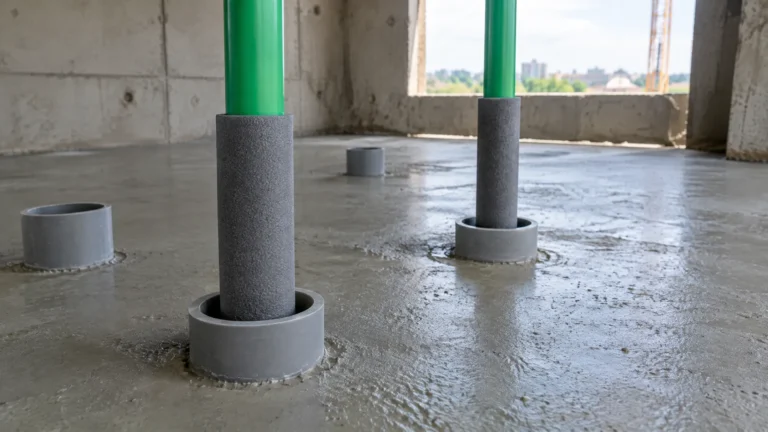
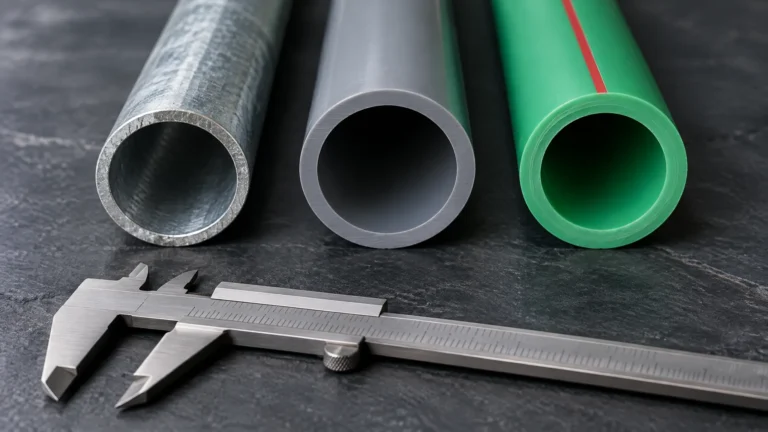
| 3. Material standard | Each material is called up by its own current product standard | One generic line citing plastic pipe to EN standards | EN ISO 15874 (PP), EN ISO 15875-2:2025 (PE-X), EN ISO 21003 (multilayer) |
| 4. Scope boundary | Buried and external runs are specified to their own standard | EN ISO 15874 cited for a buried main | EN 1610:2015 and EN 805:2025 |
| 5. Potable approval | Material approval is named with its scope for the destination market | A certification logo with no scope or reference | Directive (EU) 2020/2184, Article 11 |
| 6. Fifty-year basis | The rating traces to an EN ISO 9080 extrapolation of the material | A 50-year claim traceable only to a brochure | How a 50-year rating is proven |
Section B: Pressure, Pipe Series and Hydraulics (Items 7 to 12)
Wall thickness is a calculation, not a habit. ISO 15874-1 sets the design pressure equal to the maximum design pressure of EN 806-1, and the pipe series S follows from the class and that pressure together, with SDR 11 corresponding to S 5.
The trap sits in a footnote. ISO 15874-2 Table 5 marks series S 8, S 6,3 and S 5 as valid only for PP-RCT, so an S 5 line drawn in standard PP-R is outside the standard whatever the supplier quotes. Hydraulics fails the same way when a 10 bar PN rating is read as a badge rather than as the wall thickness that shrinks the bore.
| Design decision | Verdict: go only if | No-go trigger | Where it is settled |
|---|---|---|---|
| 7. Design pressure | pD is stated on the drawing and equals the MDP of EN 806-1 | PN 20 assumed with no design pressure stated | ISO 15874-1:2013, clause 3.1.2.1 |
| 8. Pipe series | Series S is selected from the class and design pressure together | Wall thickness copied from the previous project | PPR sizes, SDR and PN ratings |
| 9. Series restriction | Any S 5, S 6,3 or S 8 line is specified in PP-RCT | S 5 drawn in standard PP-R | ISO 15874-2, Table 5 footnote a |
| 10. Hydraulic bore | Flow is calculated on the bore left after the wall thickness | Outside diameter used as the flow diameter | PPR flow rate and pressure drop |
| 11. Fitting losses | Fittings and valves enter the model as equivalent length | Only straight pipe was modelled | Fitting equivalent length |
| 12. Recirculation | Return legs are balanced and a velocity limit is stated | A hot-water return with no balancing device | High-rise hot water recirculation |
Section C: Jointing, Transitions and Fittings (Items 13 to 17)
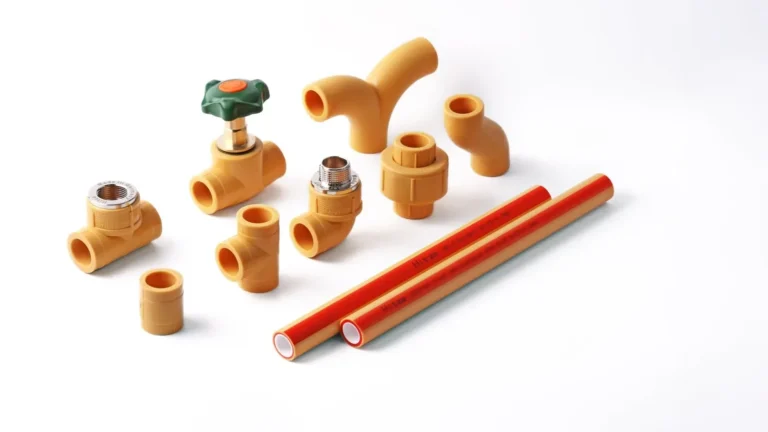
The joint, not the pipe, sets the limit of a fused system. Socket heat fusion produces a homogeneous joint with no elastomeric seal inside it, which is why the fitting pressure rating decides the PN 20 class the system can actually hold.
Fusion time and temperature are supplier property. No project file here holds an approved table for any specific product, so the correct entry on a drawing is a reference to the pipe maker’s document, attached to the specification. Transitions and brand mixing are where warranty exposure enters an otherwise clean design.

| Design decision | Verdict: go only if | No-go trigger | Where it is settled |
|---|---|---|---|
| 13. Jointing method | The method is named per material and matches the fittings supplied | Two jointing methods mixed on one line | Plastic pipe fusion welding methods |
| 14. Fusion parameters | The pipe maker’s time and temperature table is attached | A generic fusion chart taken from a tool catalogue | Supplier data sheet; how to weld PPR pipe |
| 15. Metal transitions | Manufactured transition fittings are used, with the thread standard stated | A threaded adapter improvised on site | Connecting PPR to metal pipe |
| 16. Single system | Pipe and fittings come from one system under one warranty | Fittings substituted from a second brand | Mixing pipe and fitting brands |
| 17. Buried joints | Buried joints follow the standard that governs that section | Indoor test procedure applied to a buried line | EN 1610:2015 for gravity; EN 805:2025 for pressure |
Section D: Expansion, Support and Penetrations (Items 18 to 22)
Movement is the item most often noted and least often drawn. A 10 m run of standard PP-R at 0,15 mm/(m·K) moves 60 mm through a 40 K swing, while a glass-fibre construction at 0,035 mm/(m·K) moves about 14 mm over the same run.
Spans behave the same way. One published PP-R table drops the 20 mm span from 85 cm at 0 °C to 50 cm at 70 °C and adds 20 percent for vertical runs. That is the shape of every credible table, not a substitute for the one your supplier issues; the full span and expansion calculations sit on their own page.
| Pipe construction | Movement at dt 40 K (mm) |
|---|---|
| Standard PP-R | 60 |
| Glass-fibre PP-R | 14 |
| Aluminium-composite PP-R | 12 |
| Design decision | Verdict: go only if | No-go trigger | Where it is settled |
|---|---|---|---|
| 18. Expansion figure | Movement is computed with the coefficient of the pipe specified | Plain PP-R coefficient applied to a fibre pipe | Expansion by pipe construction |
| 19. Compensation | Bending legs, loops or pre-stress are drawn with fixed points marked | Expansion noted in a specification but never drawn | Supplier manual; the fixed-point layout drawing |
| 20. Support spans | Spans come from the supplier table at pipe-wall temperature | One span value used across the whole system | Request the supplier span table by diameter and temperature |
| 21. Bracket loads | Insulation weight, valves and vertical runs are allowed for | Brackets sized for bare horizontal pipe only | Supplier bracket data; the insulation schedule |
| 22. Penetrations | Sleeves, seals and a reaction-to-fire class are specified | Penetration detail left to the installer | EN 13501-1 classification |
Section E: Insulation, Acoustics, UV and Trace Heating (Items 23 to 26)
Section E covers what surrounds the pipe, and it stops short of a number twice. Insulation thickness is set by the project’s national building-energy regulation, which differs by jurisdiction, so row 23 asks for the calculation against that instrument instead of printing millimetres; whether the line needs insulation at all is a separate question from how much.
UV is better evidenced. PPI TR-18 limits the outdoor storage life of non-black polypropylene, notes that 2 % to 3 % carbon black gives good weathering resistance, and requires weathered surface material to be removed before heat fusion. No public clause fixes a maintained surface temperature for trace-heated plastic pipe, so row 26 asks for written approval against the class limit of 80 °C or lower.
| Design decision | Verdict: go only if | No-go trigger | Where it is settled |
|---|---|---|---|
| 23. Insulation thickness | Thickness is calculated against the governing national regulation | Thickness copied from a supplier leaflet | Insulation and heat-loss calculation |
| 24. Acoustics | Bracket and penetration decoupling is specified where pipes cross rooms | Rigid clamps run through a bedroom wall | Acoustic insulation for PPR |
| 25. UV exposure | No non-black polypropylene is left permanently exposed outdoors | An exposed riser with no jacket, paint or enclosure | UV resistance outdoors; PPI TR-18 |
| 26. Trace heating | The pipe maker has approved the maintained temperature in writing | Trace heating added with no written approval | Supplier letter, checked against the class maximum temperature |
Section F: Testing, Marking and Handover (Items 27 to 30)
The last section asks whether the finished system can be proved and whether the delivered pipe can be checked against your drawing. For potable work inside buildings the installation standard is EN 806-4:2010, and the test pressure derives from the maximum design pressure at 1,1 times that value rather than from a round 15 bar figure.
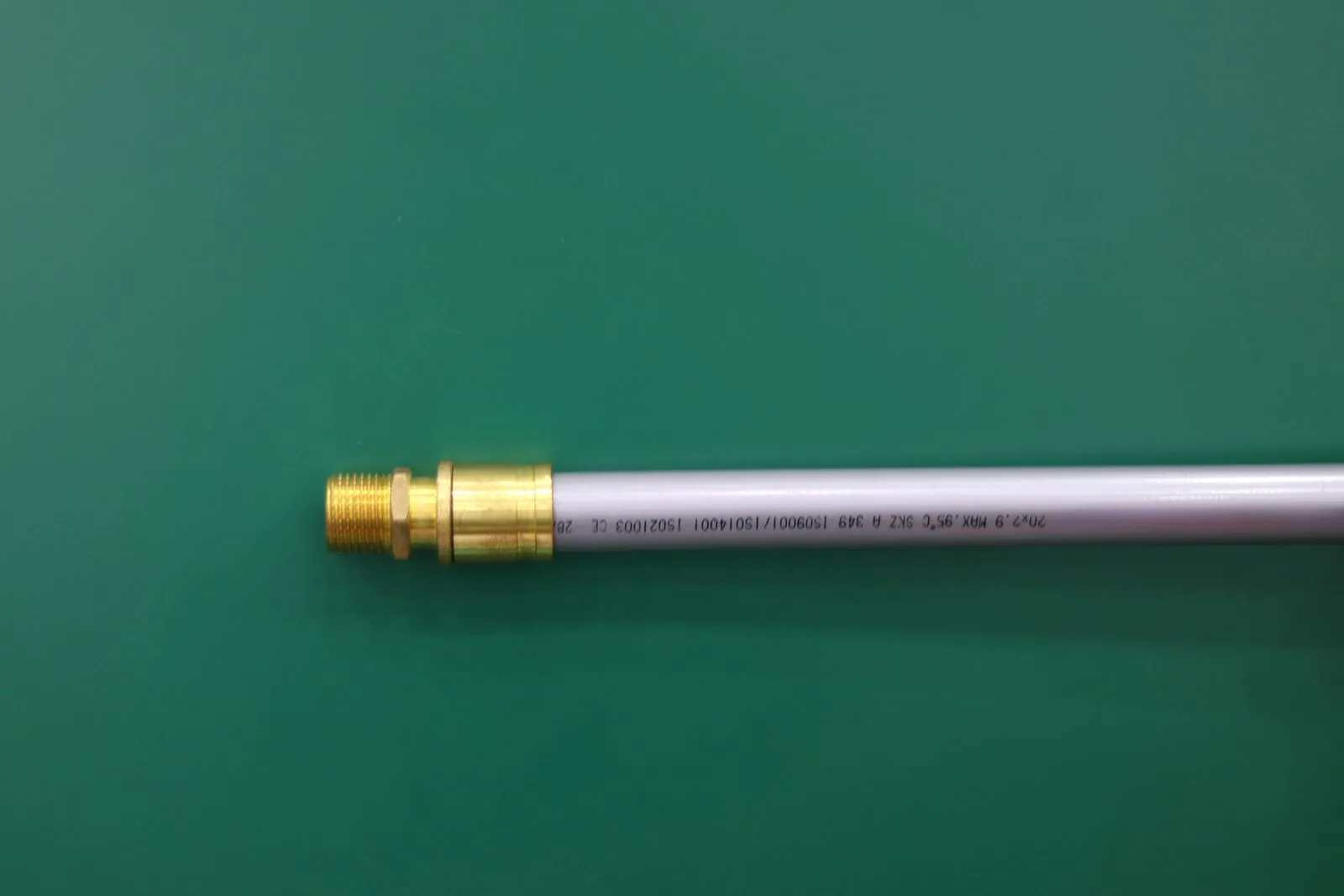
EN ISO 15874-5 is a fitness-for-purpose type-test regime on the system, so a specification citing Part 5 as the site test has named the wrong document. Marking closes the loop: the print line carries the application class and service pressure, which is how a site engineer confirms that a 32 mm delivery is what you specified.
| Design decision | Verdict: go only if | No-go trigger | Where it is settled |
|---|---|---|---|
| 27. Test standard | The test standard is named for each part of the works | EN ISO 15874-5 cited as the site test | EN 806-4 indoors; EN 1610 for drains; EN 805 outside |
| 28. Test pressure | Test pressure is derived from MDP, at 1,1 times MDP under EN 806 | A round figure such as 15 bar with no stated basis | PPR pressure test procedure |
| 29. Print line | The specification states the marking to be delivered on the pipe | No marking requirement anywhere in the specification | Specification and submittal checklist |
| 30. Site acceptance | Storage, handling and rejection criteria are written into the specification | Pipe accepted after months in open sunlight | Storage and handling guidelines |
When an Item Fails: What to Change, and Where We Stop
A no-go falls into one of three classes, and the class decides the fix. The cheapest is a missing decision: rows 1, 7 and 19 are corrected on the drawing in an afternoon.
Next comes the wrong document, which means a redraw of the specification text. Rows 4, 9 and 27 sit here, because each cites a standard that does not cover the case in front of it.
A missing supplier record is the expensive one. Rows 14, 20 and 26 cannot be closed by anybody in the design office, so they route to project piping supply, where the class, pressure and size set are checked against what a supplier can actually evidence.
Judge the supplier by what arrives, not by how fast the quote does. One that can close rows 14, 20 and 26 returns a fusion time and temperature table, a span table by diameter and pipe-wall temperature, and a written position on trace heating.
What we check before a project quote, and where we stop
Hitze publishes its PP-R pipe and fitting range at 10 bar for class 1 and 8 bar for class 2 on the ceramic-core and fibre lines, across OD 20 mm to 110 mm. Resin is verified before extrusion, and outside diameter, wall thickness and ovality are checked against the S-series tables before hydrostatic bench testing at DN15 to DN90. Approved construction parameters for a named project are issued with the quote, not before it.
Conclusion
The trade-off this checklist forces is honest. Thirty answered rows cost about 2 hours, and each one removes a question a reviewer, an installer or a warranty assessor would otherwise ask later at a worse moment.
The rows that cannot be closed from a standard are the ones worth carrying into the supplier conversation, because a span table or a fusion chart is a document somebody signs rather than a value to guess. Score the sheet, list the no-gos, and let the three failure classes decide which ones change the drawing.
Frequently Asked Questions
Does this checklist replace the local authority plan review?
No. A plan review checks the design against the jurisdiction’s adopted code. This list checks that every design decision exists and is traceable to a current standard or a supplier document before the review sees it.
Does it apply to PE-X and multilayer pipe as well as PP-R?
Yes. Rows 3 and 4 route each material to its own standard: EN ISO 15875-2:2025 for PE-X, EN ISO 21003 for multilayer, EN ISO 15874 for PP-R. The verdict conditions themselves are material-independent.
What governs pipe buried outside the building?
Not EN ISO 15874, whose scope stops at installations inside buildings. Buried gravity drains and sewers run to EN 1610:2015 up to 0,5 kPa surcharge, and external pressure supply runs to EN 805:2025.
Is EN ISO 15874-5 the pressure test I should specify?
No. Part 5 covers fitness for purpose of the system as a type-test regime. For potable installations inside buildings the site test is EN 806-4:2010, with test pressure at 1,1 times the maximum design pressure.
Which documents should I request when a row cannot be closed?
Three, in this order: the span table by diameter and pipe-wall temperature, the fusion time and temperature table for the exact product, and the certification scope showing which models each certificate covers.