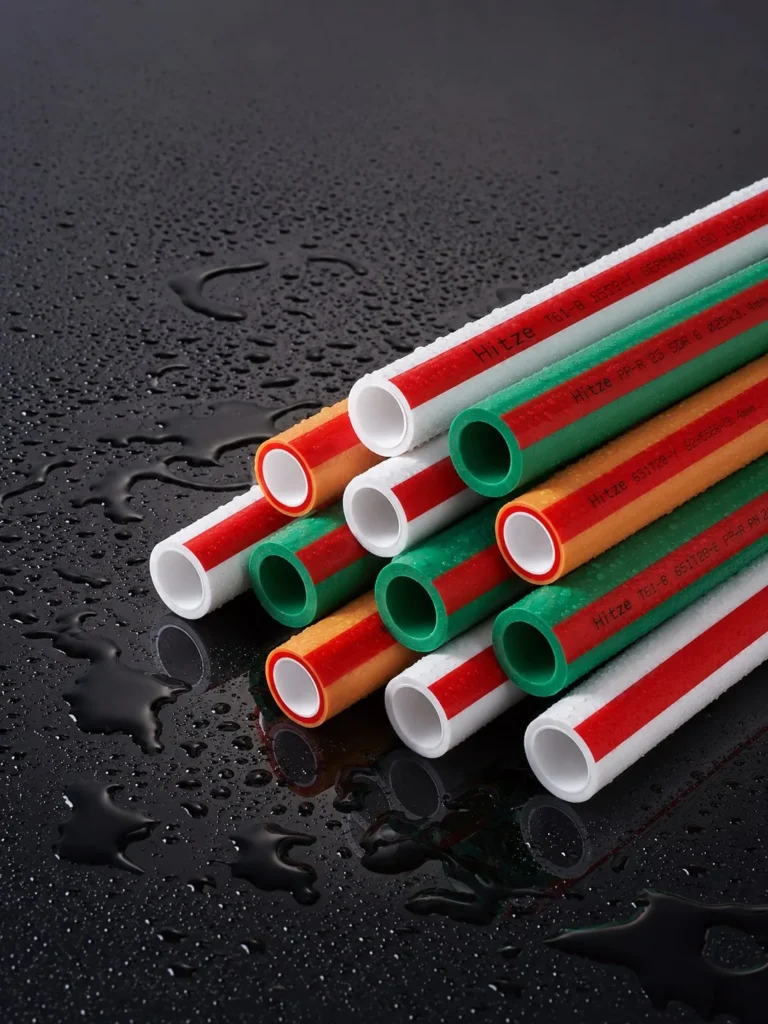
Key Takeaways
- PP-R sizes are outside diameters, standardized in DIN 8077: 20 / 25 / 32 / 40 / 50 / 63 / 75 / 90 / 110 mm. Hitze runs the full span to OD 110 (DN 90).
- SDR is the number that matters — outside diameter divided by wall thickness. SDR 11 is the thin wall, SDR 7.4 the mid wall, SDR 6 the heavy wall. It is pure geometry and cannot be fudged.
- PN is a label, not a law. The same SDR 7.4 pipe is sold as PN16 by one factory and PN20 by another, because PN depends on which design coefficient the maker assumed. Order by SDR and application class, never by PN alone.
- Heat rewrites every rating. A published 50-year table (safety factor 1.5) puts SDR 7.4 at 20.4 bar at 20 °C — and 6.8 bar at 70 °C. Hot risers must be selected on the derated figure.
- Dropping SDR costs bore. At the same OD, an SDR 6 pipe has roughly a third less flow area than SDR 11. Upgrade the pressure class and you often have to upsize the diameter too.
Here is how a PP-R riser gets specified wrong without anyone technically lying: the mechanical spec says “PN20 pipe,” the supplier quotes “PN20,” the pipe arrives printed “PN20” — and three parties are holding three different wall thicknesses in their heads. PN is a marketing convention that shifts between factories. The wall thickness printed against the outside diameter, and the SDR it implies, is the only spec that travels intact from your drawing to the container to the wall chase.
This guide lays out PPR pipe sizes the way a contractor actually needs them: the full DIN 8077 dimension table from 20 to 110 mm across SDR 11, SDR 7.4 and SDR 6, what PN genuinely promises at 20 °C, how hard it derates at 60–70 °C, and a worked eight-storey riser you can copy the logic from.
PP-R sizes are outside diameters — and SDR is the spec that can’t lie
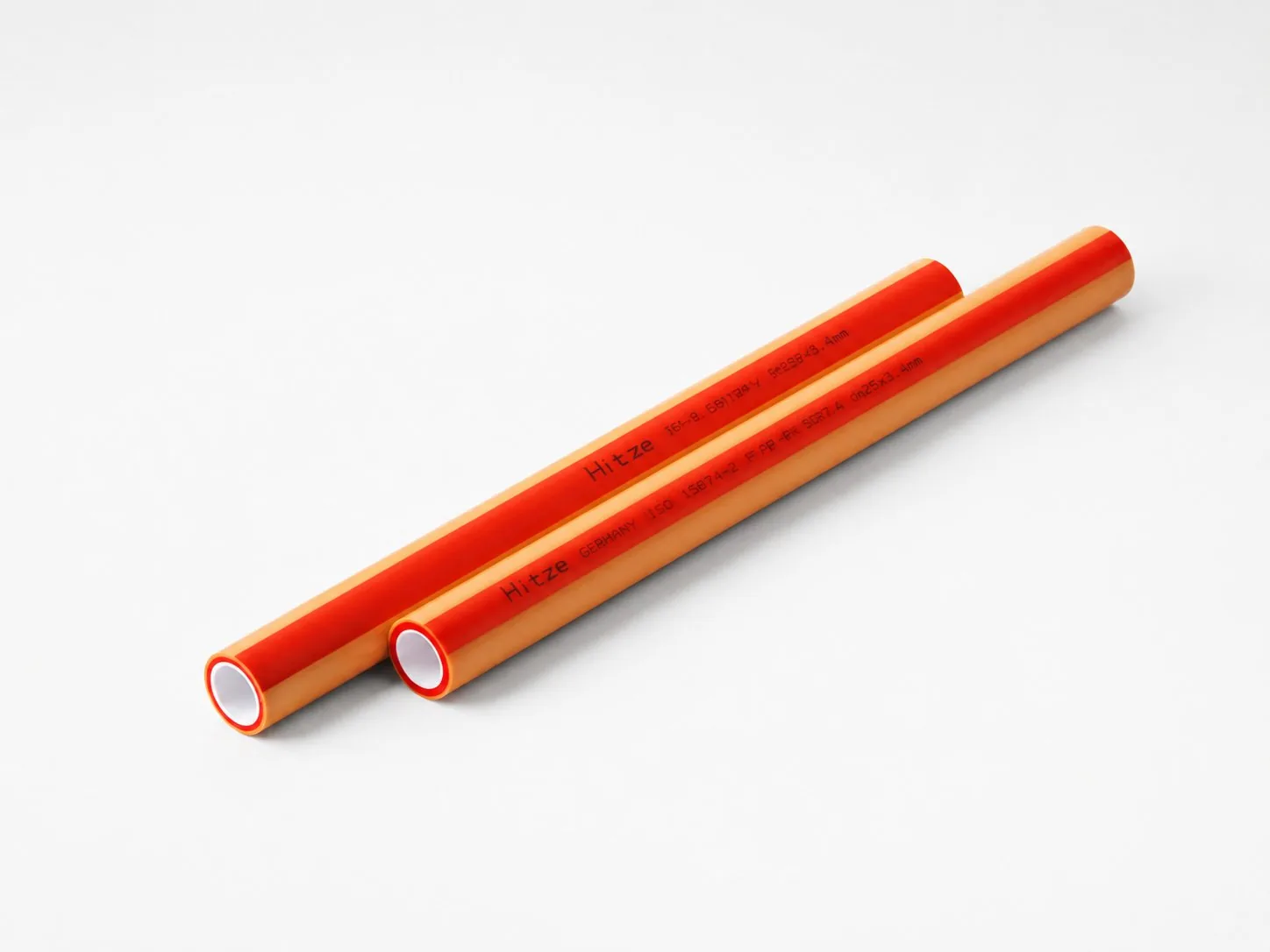
Unlike steel, PP-R is dimensioned on outside diameter, because every joint is made by socket or butt fusion over the pipe’s OD. The metric series comes from DIN 8077, “Polypropylene (PP) pipes — PP-H, PP-B, PP-R, PP-RCT — Dimensions”: 20, 25, 32, 40, 50, 63, 75, 90 and 110 mm are the sizes that cover essentially every riser and branch inside a building. Hitze produces PP-R across this full range up to OD 110 (DN 90), built to DIN 8077/8078 and EN ISO 15874, in three wall constructions — ceramic-core solid wall, fiber-glass composite (PPR-FB-PPR) and aluminium composite (PPR-AL-PPR).
For each OD, DIN 8077 defines several wall-thickness series identified by SDR — Standard Dimension Ratio. The definition is simply SDR = outside diameter ÷ wall thickness; the related pipe series number is S = (SDR − 1) ÷ 2, so SDR 6 is S 2.5, SDR 7.4 is S 3.2 and SDR 11 is S 5. A low SDR means a thick wall and a high pressure capacity; a high SDR means a thin wall and a cheap, high-flow pipe for low-stress duty. When you write “63 × 8.6 SDR 7.4” on a purchase order, there is nothing left to interpret — which is exactly why you should write it that way.
One insider detail worth knowing before the table: pipes intended for fusion welding need a minimum wall of 2.0 mm, and SDR 11 at 20 mm OD comes out at 1.9 mm. That is why you will almost never see 20 mm SDR 11 in a heat-fusion PP-R system — the small sizes ship in SDR 7.4 and SDR 6, and the thin-wall series only becomes practical from 25–32 mm upward.
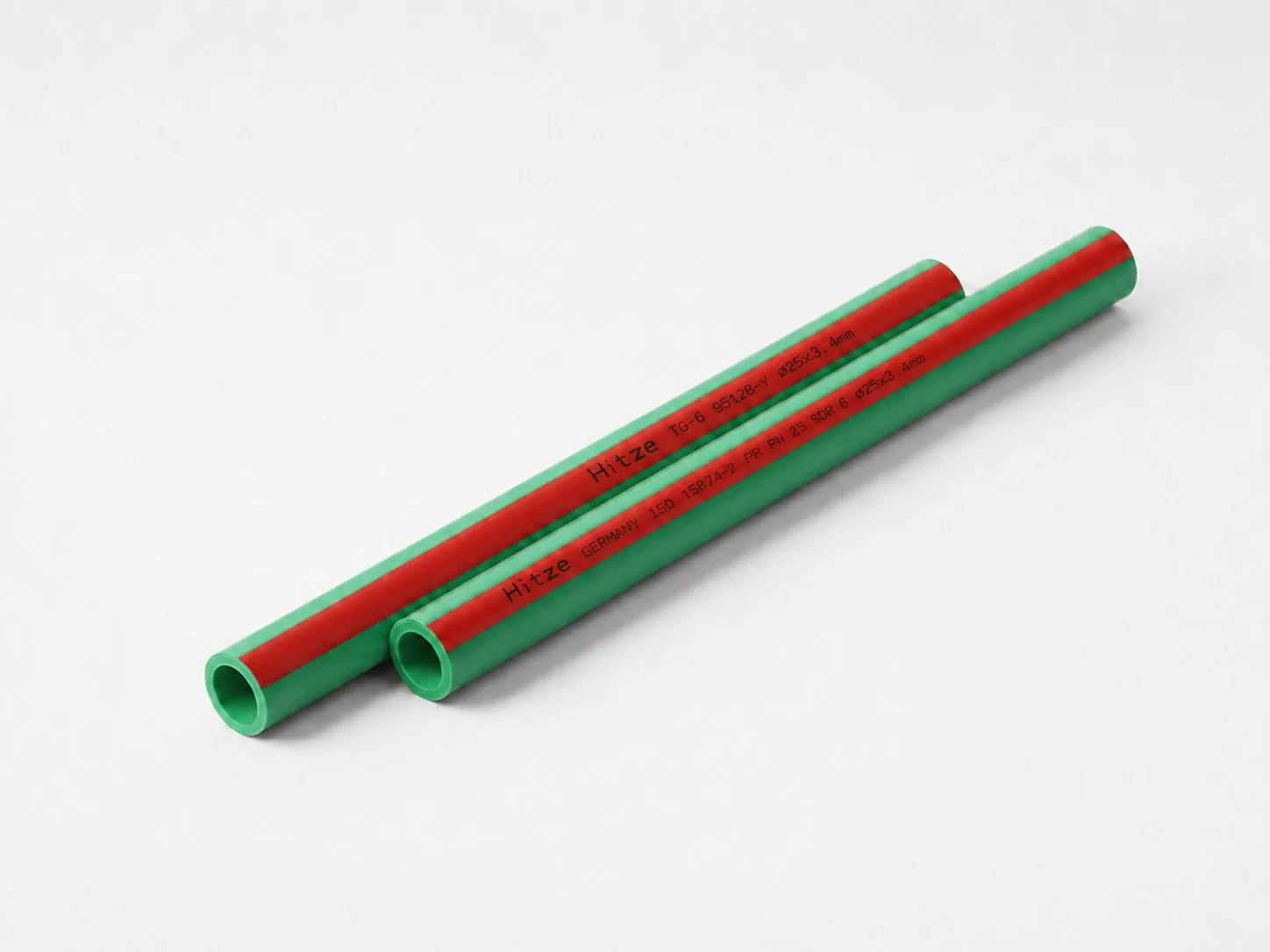
The PPR pipe size chart: 20–110 mm with SDR 11, SDR 7.4 and SDR 6 walls
The table below is the DIN 8077 dimension set for the three wall series a building contractor actually orders. Wall thickness is the minimum (emin); the bore is OD minus twice the wall — the number your flow calculations live and die on.
| OD (mm) | SDR 11 (S 5) wall / bore | SDR 7.4 (S 3.2) wall / bore | SDR 6 (S 2.5) wall / bore |
|---|---|---|---|
| 20 | 1.9 / 16.2 | 2.8 / 14.4 | 3.4 / 13.2 |
| 25 | 2.3 / 20.4 | 3.5 / 18.0 | 4.2 / 16.6 |
| 32 | 2.9 / 26.2 | 4.4 / 23.2 | 5.4 / 21.2 |
| 40 | 3.7 / 32.6 | 5.5 / 29.0 | 6.7 / 26.6 |
| 50 | 4.6 / 40.8 | 6.9 / 36.2 | 8.3 / 33.4 |
| 63 | 5.8 / 51.4 | 8.6 / 45.8 | 10.5 / 42.0 |
| 75 | 6.8 / 61.4 | 10.3 / 54.4 | 12.5 / 50.0 |
| 90 | 8.2 / 73.6 | 12.3 / 65.4 | 15.0 / 60.0 |
| 110 | 10.0 / 90.0 | 15.1 / 79.8 | 18.3 / 73.4 |
Read the 110 mm row across and the real cost of pressure class jumps out. At the same outside diameter, SDR 11 gives you a 90.0 mm bore, SDR 7.4 gives you 79.8 mm, and SDR 6 leaves 73.4 mm. Since flow area scales with bore squared, the SDR 6 pipe carries roughly a third less water than the SDR 11 pipe of the same nominal size — at the same velocity. The pattern holds all the way down: 50 mm SDR 6 has a 33.4 mm bore against 40.8 mm for SDR 11, the same one-third penalty.
The practical consequence: when a project engineer upgrades a line from SDR 11 to SDR 6 “to be safe,” the hydraulics no longer match the original pipe schedule. Velocities rise, friction losses climb steeply, and the recirculation pump that was sized for the fat bore now runs off its curve. If you harden the pressure class, re-run the flow numbers — in most cases the correct move is to step up one OD at the same time.
PN ratings: what they promise — and why two factories print different PN on the same wall
PN nominally means the allowable working pressure in bar for water at 20 °C over a 50-year design life. The physics behind it is one line: allowable pressure = 20 × MRS ÷ (C × (SDR − 1)), where MRS is the material’s minimum required strength in MPa and C is the design (safety) coefficient — the relationship the PE100+ Association documents for pressure pipe generally. Notice what is in that formula: a material value and a chosen coefficient. The geometry (SDR) is fixed by the standard; the coefficient is a factory’s decision.
That is why the market is genuinely inconsistent. One European manufacturer’s catalogue pairs PN20 with SDR 7.4 and PN25 with SDR 6; another supplier lists the identical SDR 7.4 wall as a 16-bar (PN16) pipe; and plenty of Middle East spec sheets call the SDR 6 wall “PN20.” None of them are lying — they assumed different coefficients or material strength values. But if your purchase order says only “PN20, 63 mm,” you can legally receive either a 8.6 mm wall or a 10.5 mm wall, and the difference is a full pressure class at 70 °C.
The fix costs nothing: specify OD × wall and SDR, and treat PN as a cross-check. “63 × 10.5 SDR 6” is the same pipe in every catalogue on earth. This is also the first thing to verify on arrival — the print line on the pipe must state the OD, wall, SDR or S-series and standard. A pipe printed with a PN and no wall thickness is telling you something about the factory’s confidence.
Hot water rewrites the table: PN at 20 °C vs the derated truth at 60–95 °C
Every PN figure quietly assumes cold water. PP-R, like all thermoplastics, loses long-term hoop strength as temperature rises, so the allowable pressure at your actual operating temperature is what you design against. A typical manufacturer rating table built on the DIN 8077/8078 regression curves, at safety factor 1.5 and 50-year life, reads like this:
| Water temp | SDR 11 (bar) | SDR 7.4 (bar) | SDR 6 (bar) |
|---|---|---|---|
| 20 °C, 50 yr | 12.8 | 20.4 | 25.8 |
| 40 °C, 50 yr | 9.2 | 14.5 | 18.3 |
| 60 °C, 50 yr | 6.4 | 10.3 | 12.9 |
| 70 °C, 50 yr | 4.3 | 6.8 | 8.5 |
| 95 °C, 5 yr | 2.6 | 4.1 | 5.2 |
Sit with the 70 °C row for a moment. The pipe your supplier called “PN20” — SDR 7.4 — is a 6.8-bar pipe on a 70 °C recirculating hot-water riser if you want the full 50 years. That is not a defect; it is how the material works. The defect is specifying it as if the 20 printed on the wall still applied.
This is exactly the problem EN ISO 15874-2 solves with application classes: Class 1 (60 °C hot water supply), Class 2 (70 °C hot water supply), Class 4 (underfloor heating and low-temperature radiators) and Class 5 (high-temperature radiators up to 90 °C), each combined with a design pressure of 4, 6, 8 or 10 bar. The class system already contains the derating maths — and it produces some results that surprise people. For plain PP-R in Class 2 at 10 bar design pressure, the standard’s calculated series requirement is S ≤ 2.1, which even the heavy SDR 6 wall (S 2.5) does not meet: a 10-bar, 70 °C duty is simply not a solid-wall PP-R job. We unpack the whole class system, including where PP-RCT and composite walls change the answer, in our guide to EN ISO 15874 classes of service for PP-R.
Matching SDR to risers and branches: the working rules
Cold-water mains and risers: SDR 11 is the value play — biggest bore per euro of material — wherever the water stays cold and system pressure sits comfortably under its 12.8-bar/20 °C ceiling, which covers most boosted residential systems. Its limits: not below 25–32 mm (the 2.0 mm minimum weld wall), and not anywhere a cross-connection could ever put 60 °C water in it, because its 60 °C rating collapses to 6.4 bar.
Hot-water risers and recirculation loops: SDR 7.4 is the workhorse — 10.3 bar at 60 °C/50 years clears a typical boosted mid-rise with margin. Push the design temperature to 70 °C, or combine 60 °C with base-of-riser pressures above roughly 8 bar, and SDR 6 (or a fiber-composite wall) is the honest specification. The trade-off is the one-third bore penalty from the size chart — budget for one OD step up on long recirculating loops.
Apartment branches and final connections: 20 and 25 mm in SDR 6 is the default, and not primarily for pressure — the thick wall is what makes small-bore socket fusion forgiving. A 20 × 3.4 wall gives the fusion socket enough material that a half-second of over-heating doesn’t close the bore; try the same sloppiness on a thin wall and you get the classic hidden defect of PP-R work, an internal weld bead throttling one fixture. If you are weighing PP-R branches against press-fit alternatives for the small sizes, our comparison of PEX and multilayer pipe sizing from 16–32 mm runs the same flow logic on the other system family.
One rule that outranks all of the above: keep pipe and fittings from one matched system. Fusion joins the fitting material into the pipe wall; mixing brands means mixing melt behaviours at every socket, and it voids most system warranties. Hitze’s PP-R pipe and fittings range is built as one heat-fusion system across the full 20–110 mm span — same raw material logic in the pipe and the fitting, with brass-insert transitions where the system meets metal.
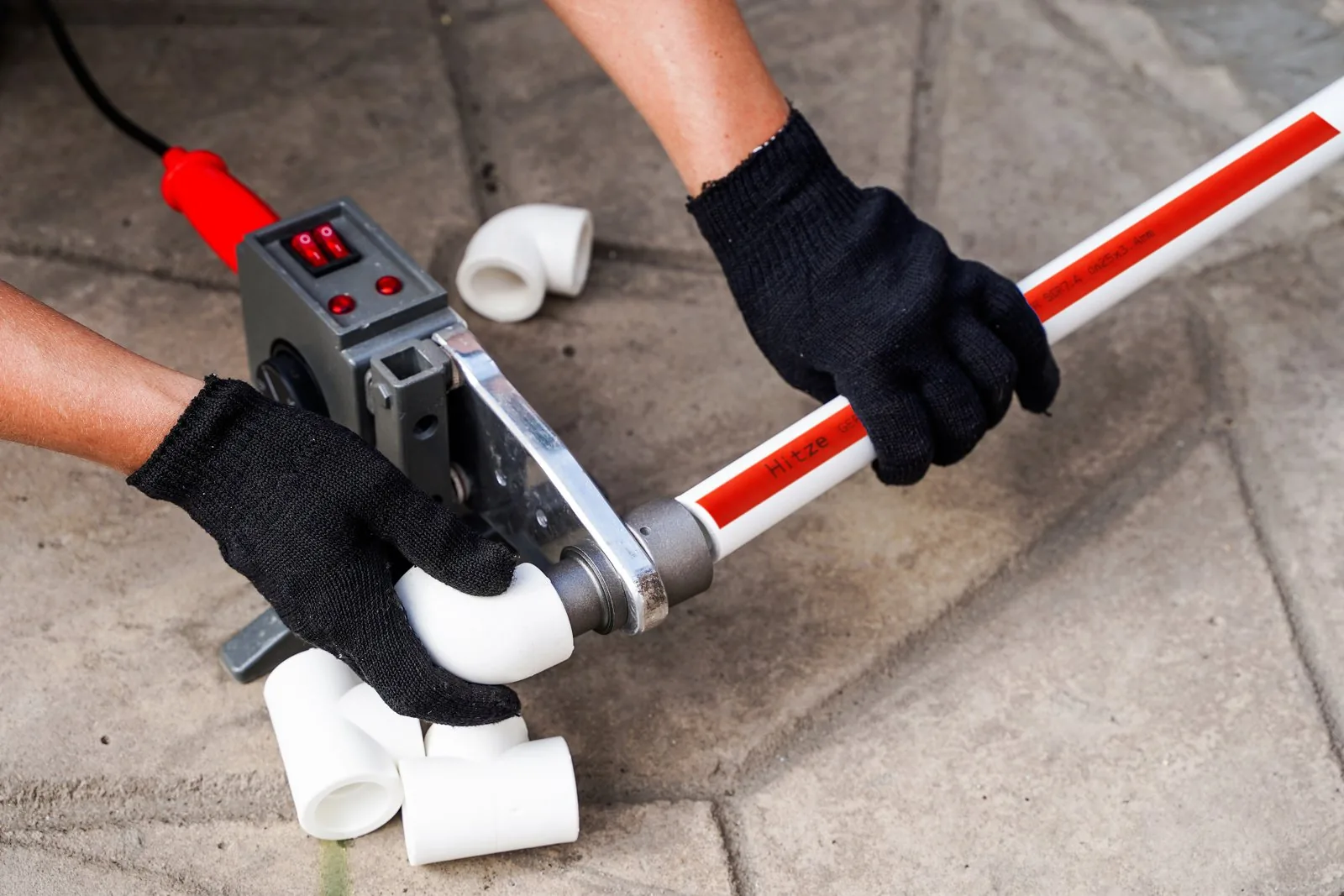
Three wall constructions: ceramic-core, PPR-FB-PPR fiber and PPR-AL-PPR
Size and SDR describe the geometry; the wall construction decides how the pipe behaves once hot water is running through it. Hitze builds PP-R in three constructions. The ceramic-core solid wall is the standard hot/cold workhorse. The fiber-glass composite (PPR-FB-PPR) sandwiches a glass-fiber-reinforced middle layer between PP-R skins. The aluminium composite (PPR-AL-PPR) bonds an aluminium layer into the wall for maximum form stability and an oxygen-tight wall for heating circuits.
The number that separates them in the field is thermal expansion. Plain PP-R expands at about 1.5 × 10⁻⁴ per kelvin — 0.15 mm per metre per degree. On a branch run of a few metres, irrelevant. On a 24-metre riser going from a 20 °C install day to 60 °C service, that is 24 × 40 × 0.15 ≈ 144 mm of growth — pipe visibly snaking out of its clips if nobody engineered the compensation. Fiber-composite construction cuts linear expansion by at least 75% compared with solid-wall polypropylene (a figure the fiber-pipe pioneers publish and our own composite range is engineered around), bringing that same riser’s growth down to roughly 35 mm — manageable with sensible fixed-point placement instead of dedicated expansion loops on every other floor. The aluminium-composite wall behaves closer to metal again and adds the oxygen barrier that closed heating loops need.
The selection habit to build: solid wall for branches, composite for risers and any straight run over about 10 metres of hot service. The material premium on the composite wall is small against the cost of the extra elbows, loops and chase width that solid wall demands on a long hot run. And if your project also weighs hygiene duty — hospitals, hotels, anywhere stagnation risk is on the client’s mind — the copper-lined variant is a fourth path; see our comparison of PP-R vs PPR-CU antibacterial vs multilayer for hot and cold water.
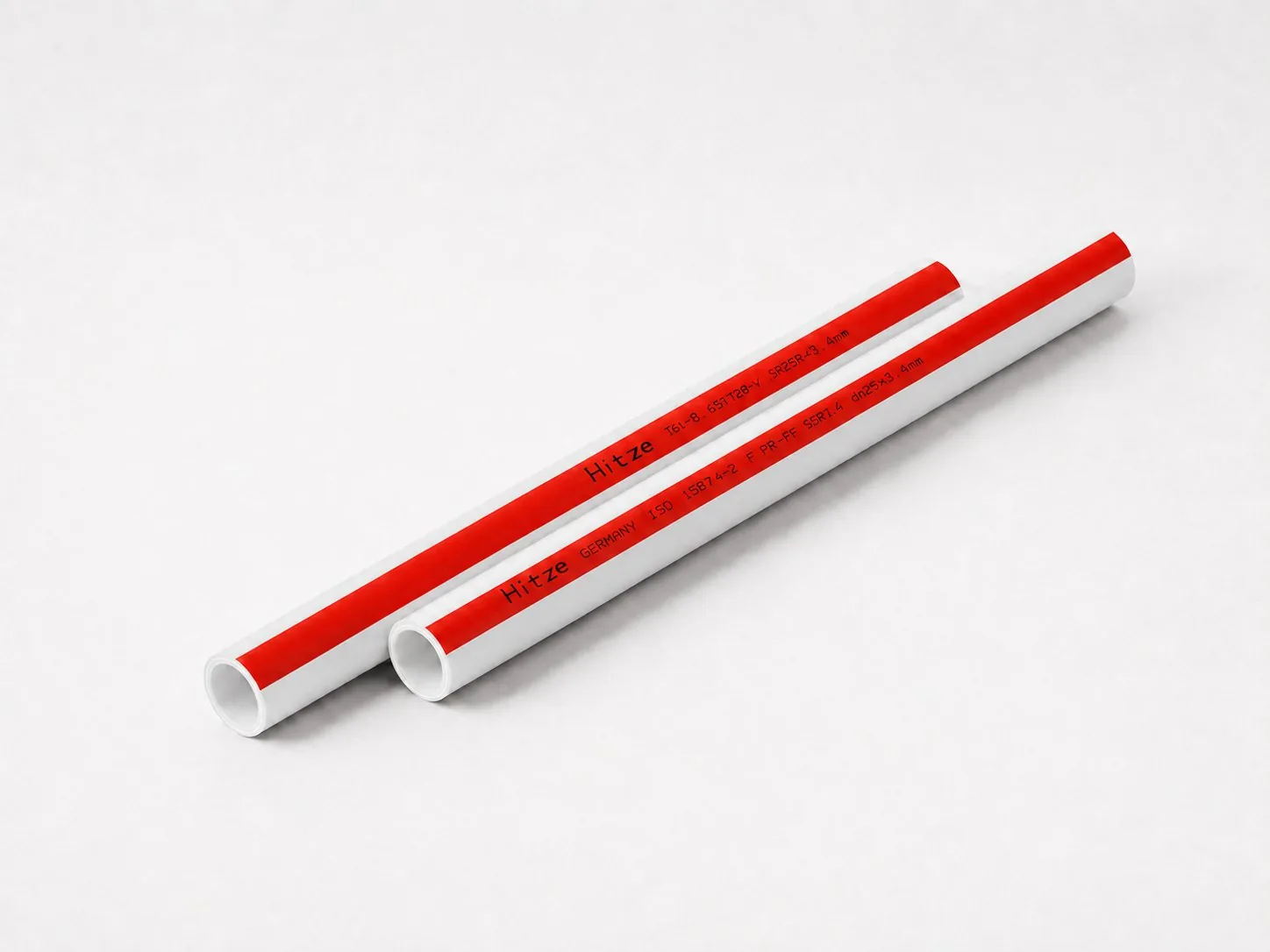
Worked example: an 8-storey hot-water riser, end to end
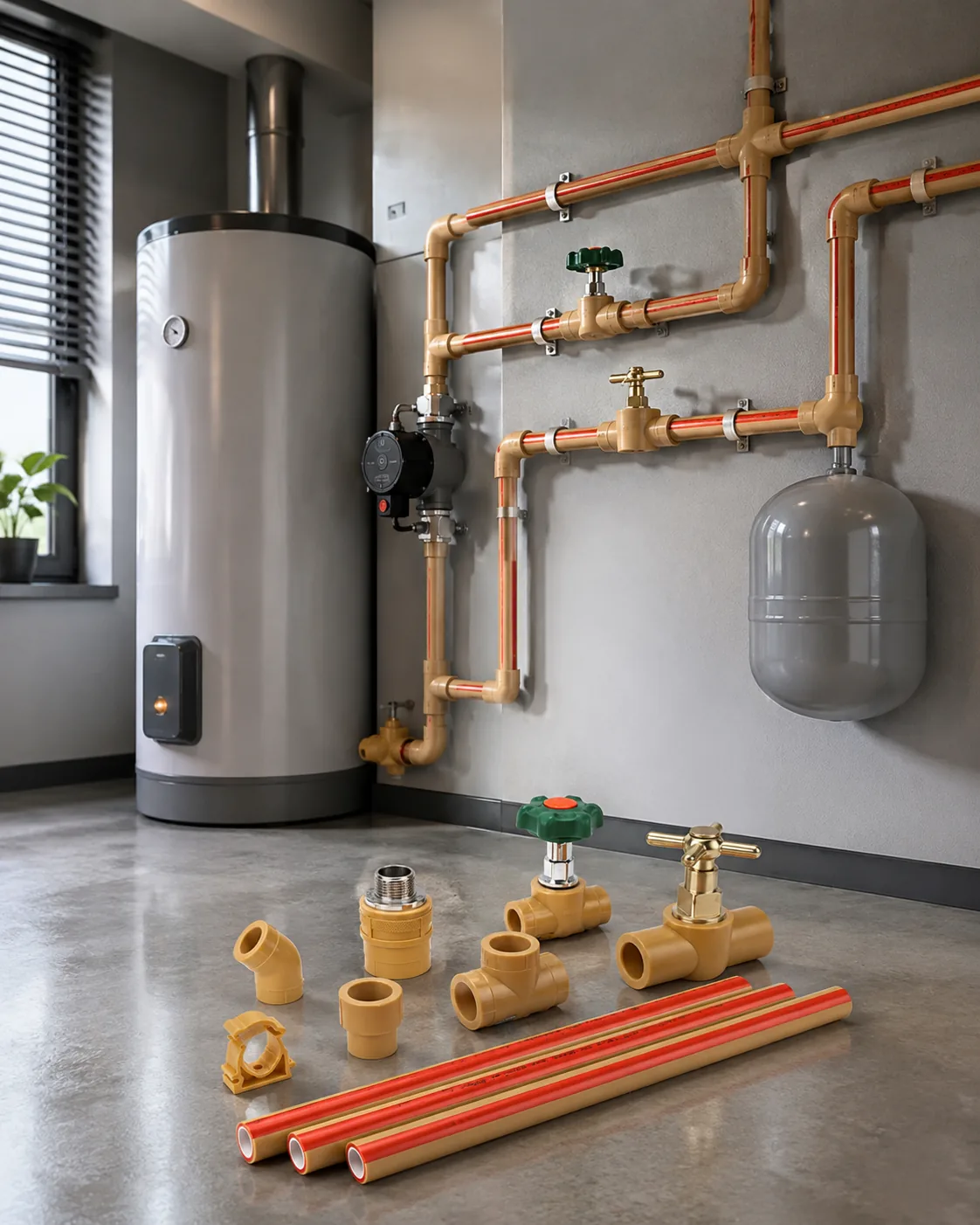
The building: ground plus seven floors, 16 apartments on one hot-water riser, top draw-off 24 m above the booster set, 60 °C stored hot water with continuous recirculation — EN ISO 15874 Class 1 territory. The booster is set to 5.0 bar at the riser base: the 24 m water column absorbs roughly 2.4 bar (about 0.1 bar per metre), leaving ~2.6 bar at the top fixture before friction — comfortable above the 1.5 bar most fixtures want.
Step 1 — pressure class. Operating point: 5.0 bar at 60 °C for 50 years. SDR 11 is rated 6.4 bar there — a 1.4 bar margin that one water-hammer event or a booster recalibration erases. Reject. SDR 7.4 gives 10.3 bar — a 2× margin over the real working pressure. Select SDR 7.4. (If the client’s spec said 70 °C recirculation, SDR 7.4’s 6.8 bar would be the marginal one, and SDR 6 at 8.5 bar — or a composite wall — becomes the defensible choice.)
Step 2 — size for flow. Diversified peak demand for 16 apartments lands around 1.4 L/s. In 50 mm SDR 7.4 the bore is 36.2 mm (area ≈ 1,029 mm²), so velocity = 1.4 ÷ 1.029 ≈ 1.36 m/s — inside the 1.0–1.5 m/s band good European practice typically holds distribution mains to. The next size down, 40 mm (29.0 mm bore), would run at 2.1 m/s: audible, erosive on fittings, and brutal on friction loss. The riser is 50 × 6.9 SDR 7.4. Apartment branches take 0.3 L/s each: 25 mm SDR 6 has a 16.6 mm bore (≈ 216 mm²), giving 1.39 m/s — correct, and thick-walled enough for fast, forgiving fusion work.
Step 3 — expansion. Installed at 20 °C, running at 60 °C: solid-wall PP-R would grow ~144 mm over the 24 m rise. Specify the riser in fiber-composite PPR-FB-PPR — growth drops to roughly 35 mm, absorbed by a fixed point mid-height and guided clips elsewhere. Branches stay solid-wall; their runs are short and every tee to the riser is a natural flex point. The order line that leaves nothing to interpretation: “Riser: PP-R fiber-composite 50 × 6.9 SDR 7.4, EN ISO 15874 Class 1 / 6 bar. Branches: PP-R 25 × 4.2 SDR 6.”
What Hitze checks — and how the pipe is built
Hitze is a German brand of engineered piping systems, founded in 1974, producing on a 120,000 m² base with 1,000+ employees and exporting to 118+ countries. The PP-R line is engineered to DIN 8077/8078 and EN ISO 15874, and the discipline behind a size chart like the one above is dimensional: extrusion lines run gravimetric dosing and continuous OD/wall gauging so that a “63 × 8.6” stays 63 × 8.6 along the whole 4-metre stick, not just at the cut end the inspector measures.
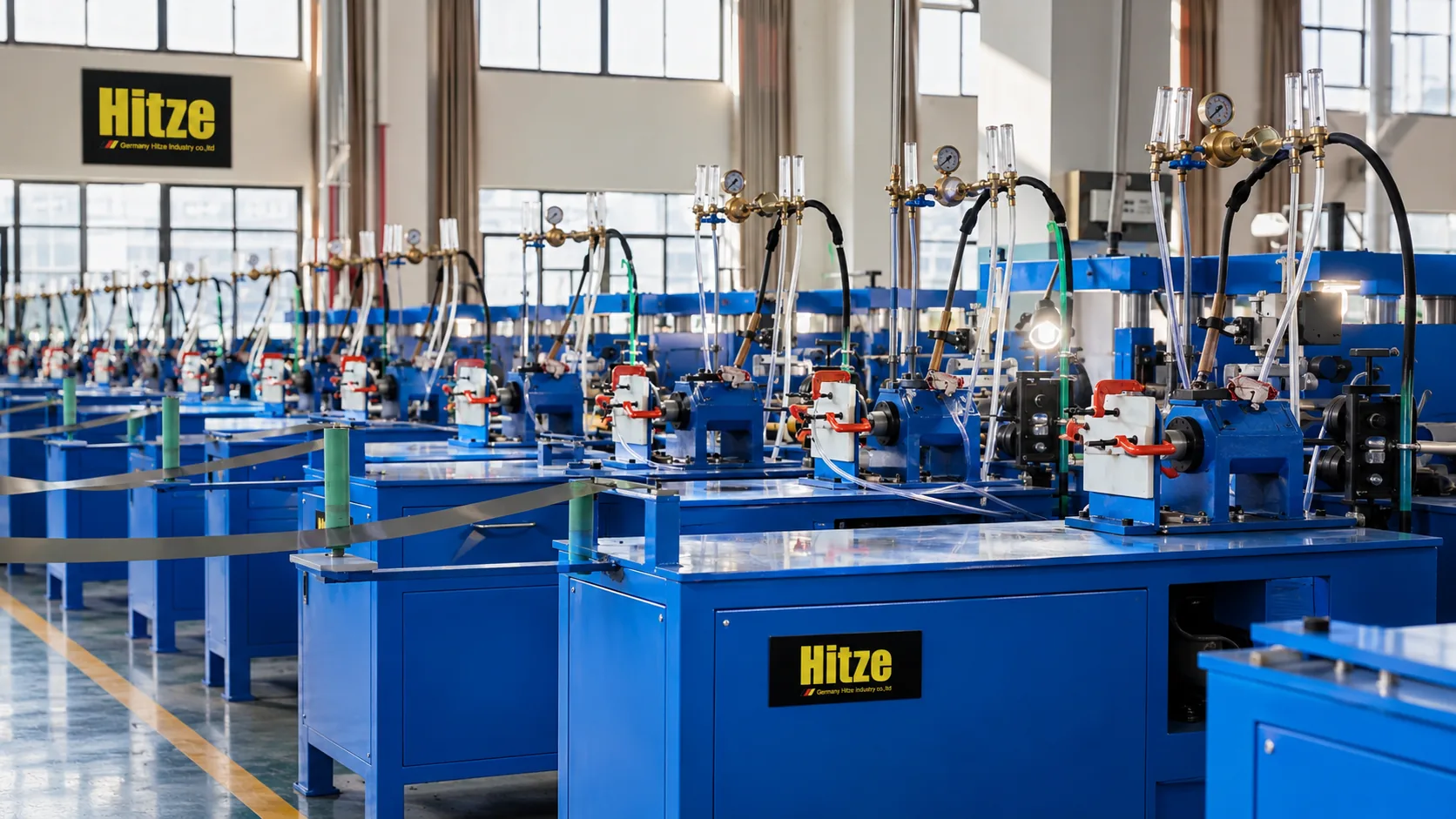
Every production batch feeds the hydrostatic test benches — racks of pressure stations that hold pipe and fused fittings at elevated stress and temperature to verify the wall against the DIN 8078 / EN ISO 15874 requirements the ratings in this guide are built on. Third-party verification sits on top: SKZ (Süddeutsches Kunststoff-Zentrum, Germany) certificates for PP-R pressure pipes and PP-R fittings, DVGW type examination for PP-R drinking-water pipe, WRAS material approval in the UK, a BS 6920 potable-water test report from NSF International Laboratories covering hot (≤65 °C) and cold contact, and ISO 45001-certified management of the plant itself. Certificate numbers are available on request against your market’s requirements.
Who this range is for: distributors, importers and mechanical contractors who buy PP-R by the pallet or container and need the full 20–110 mm span — all three wall constructions, matched fittings included — from one certified source. It is not a retail single-coil channel.
Start sample-first: Hitze works with no MOQ, so you can fusion-test pipe and fittings on your own benches before committing a container. The matched pipe-and-fitting system carries a 50-year warranty. Explore the range and request samples at Hitze PP-R pipe & fittings.
FAQ: PPR pipe sizes, SDR and PN
What sizes does PPR pipe come in?
The DIN 8077 series for building services runs 20, 25, 32, 40, 50, 63, 75, 90 and 110 mm outside diameter; the standard extends further for industrial work. Hitze produces PP-R across the full 20–110 mm (DN 90) range in SDR 11, SDR 7.4 and SDR 6 walls.
What is the difference between SDR and PN?
SDR is geometry: outside diameter divided by wall thickness, fixed by DIN 8077. PN is a derived pressure label — allowable bar at 20 °C for 50 years — that depends on the material strength and safety coefficient a factory assumes, which is why the same SDR 7.4 wall is sold as PN16 by some suppliers and PN20 by others. Specify SDR; verify PN.
Is PN20 PPR pipe suitable for 70 °C hot water?
Only at modest pressures. On 50-year regression tables at safety factor 1.5, an SDR 7.4 (“PN20”) wall is good for about 6.8 bar at 70 °C. For a low-rise system under ~5 bar that works; for higher pressures or higher temperatures, move to SDR 6 or a fiber-composite wall and check the EN ISO 15874 class calculation.
Which SDR should I use for risers and which for branches?
Cold risers: SDR 11 (32 mm and up). Hot risers and recirculation: SDR 7.4 as the default, SDR 6 for 70 °C duty or high base pressures, in fiber-composite construction on long runs to control expansion. Branches at 20–25 mm: SDR 6, mainly because the thick wall makes small-bore fusion reliable.
Is Hitze PP-R made in Germany?
Hitze is a German brand — trademark registered at the DPMA in Munich — engineered in Germany and built to German DIN standards, with production on a 120,000 m² base serving 118+ countries. The German credentials that matter for PP-R are test-based: SKZ certificates and DVGW type examination, verifiable with the issuing bodies.


