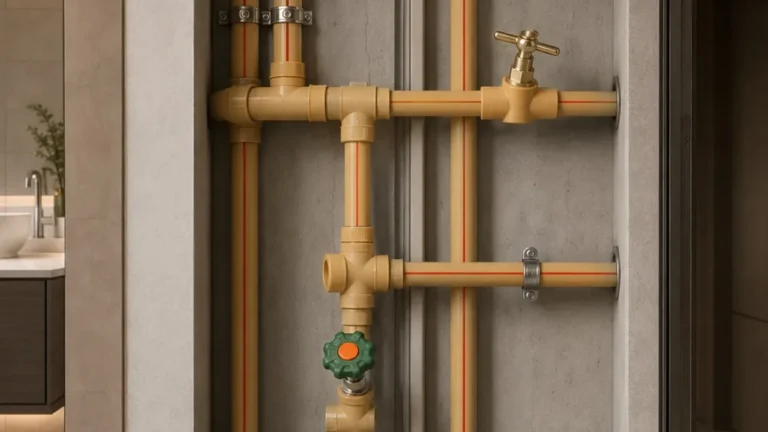
Published resistance data puts a 90° PP-R fusion elbow at dn40 at the equivalent of 2.89 m of dn40 pipe, and the larger dn50 elbow at 1.00 m. The smaller fitting costs almost three times the metres of the bigger one. The published coefficient steps from 1.9 down to 0.5 between those two sizes, and the equivalent length follows it.
So a PP-R fitting has no fixed equivalent length, and any chart offering one has hidden its conditions. Build it in three moves. Take ζ for your fitting and size from the fitting maker’s own table. Compute the friction factor λ of the pipe at your design flow and temperature. Convert: Leq = ζ × di / λ. Pipe sizing belongs to our PP-R flow rate and pressure drop guide.
Key Takeaways
- Fitting makers publish ζ, not metres. Leq = ζ × di / λ, so the allowance depends on the pipe as much as on the fitting.
- PP-R is smooth (k = 0.007 mm against 0.05 mm for commercial steel), so the same fitting converts to a longer equivalent length in PP-R.
- The published PP-R elbow ζ steps down between dn40 and dn50, so the metric allowance is not monotonic: 2.89 m at dn40, 1.00 m at dn50.
- A generic L/D of 37 understates the dn32 and dn40 elbow by 2.7×, overstates dn50 and dn63 by 34% and 27%, then understates dn75 and dn110 again. The error changes sign twice, not once.
- On a worked dn32 branch the fittings are worth 20.7 m against 14.0 m of real pipe, and the generic chart under-predicts the drop by 15 kPa.
- Velocity, temperature and pipe series move the same dn32 elbow allowance by 39%, 22% and 49%. Publish the design case or the number means nothing.
Why There Is No Single Equivalent Length for a PP-R Fitting
An equivalent length is the run of same-size pipe that would cost the same pressure as the fitting. Katmar Software’s reference puts the consequence plainly: a fitting’s material barely affects its pressure drop, but the equivalent length “would depend strongly on the roughness of that pipe”.
PP-R is smooth: published roughness for fusiolen PP-R is k = 0.007 mm against roughly 0.05 mm for commercial steel. A smoother pipe loses less per metre, so it takes more metres to lose what a fitting loses. The same elbow converts to a longer equivalent length in PP-R than in steel, the reverse of what a borrowed steel chart implies.
The Published PP-R Coefficients, and Whose Fittings They Describe
Fitting makers publish ζ, not metres. The values below are the ones aquatherm prints for its own PP-R fittings, beside the local-loss formula Z = ζ × ρ × v² / 2. The table’s source line credits DIN 1988 Part 3, and DIN 1988-3:1988-12 was replaced by DIN 1988-300:2012-05: current manufacturer figures carrying a withdrawn standard reference.
| Nominal size (mm OD) | Socket ζ (dimensionless) | Elbow 90° ζ (dimensionless) | Elbow 45° ζ (dimensionless) | Reducer ζ (dimensionless) |
|---|---|---|---|---|
| dn20 | 0.5 | 1.3 | 2.0 | 1.9 |
| dn25 | 0.5 | 1.2 | 1.9 | 1.9 |
| dn32 | 0.7 | 2.0 | 1.9 | 1.9 |
| dn40 | 0.9 | 1.9 | 0.5 | 0.2 |
| dn50 | 0.2 | 0.5 | 0.4 | 0.2 |
| dn63 | 0.2 | 0.5 | 0.4 | 0.2 |
| dn75 to dn110 | 0.2 | 0.7 | 0.4 | 0.2 |
Two rows repay a second reading. Socket and 90° elbow step down between dn40 and dn50; the reducer steps earlier, 1.9 at dn32 to 0.2 at dn40. At dn20 and dn25 the 45° elbow carries a higher coefficient than the 90° elbow — 2.0 against 1.3 at dn20, 1.9 against 1.2 at dn25 — and the order reverses by dn32, where the 90° elbow is 2.0 against 1.9. Reported as measured behaviour. A reducing tee is the tee value plus the reducer value.
Converting Those Coefficients Into Metres of PP-R
Take dn32 in series S3.2. ISO 15874-2:2013 sets a 4.4 mm minimum wall, so the bore is 23.2 mm. At 2.0 m/s with water at 50 °C the Reynolds number is 83,800, and Colebrook-White at k = 0.007 mm returns λ = 0.0200. The elbow’s ζ of 2.0 converts to 2.0 × 0.0232 / 0.0200 = 2.32 m, an L/D of 100.
| Nominal size (mm OD) | Bore, S3.2 (mm) | Elbow 90° ζ (dimensionless) | PP-R allowance (m) | Generic chart (m) |
|---|---|---|---|---|
| dn20 | 14.4 | 1.3 | 0.84 | 0.53 |
| dn25 | 18.0 | 1.2 | 1.02 | 0.67 |
| dn32 | 23.2 | 2.0 | 2.32 | 0.86 |
| dn40 | 29.0 | 1.9 | 2.89 | 1.07 |
| dn50 | 36.2 | 0.5 | 1.00 | 1.34 |
| dn63 | 45.8 | 0.5 | 1.33 | 1.69 |
| dn75 | 54.4 | 0.7 | 2.29 | 2.01 |
| dn110 | 79.8 | 0.7 | 3.62 | 2.95 |
Read the allowance column downward, not the ζ column across. It climbs to 2.89 m at dn40, collapses to 1.00 m at dn50, then climbs again to 3.62 m at dn110. Size does not rank fittings by what they cost the pressure budget, and the worst offender on a domestic riser is usually a dn40 elbow nobody looked at twice.
What the Generic Chart Costs You
The charts ranking on page one were built for threaded steel. Neutrium publishes L/D = 30 for a threaded 90° elbow and 60 for a tee through the branch; Katmar’s smooth-plastic column raises it to 37. Set 37 against the figures above and it understates dn32 and dn40 by a factor of 2.7, overstates dn50 by 34% and dn63 by 27%, then understates dn75 and dn110 again: the sign changes twice, not once.
Two gaps matter more. Neither set carries a row for a heat-fusion socket, and a fused system has one at every joint, so the generic chart prices them at zero. The method also states its own accuracy: errors up to 30% in turbulent and 50% in laminar flow, before any PP-R-specific error.
Four Conditions That Invalidate the Number You Just Copied
Every figure above was computed at one declared design case: series S3.2, water at 50 °C, 2.0 m/s, k = 0.007 mm. Below is how far the allowance moves when each changes, all on one dn32 90° elbow, so ζ is fixed and only the pipe varies.
| Condition | Range checked (min to max) | dn32 elbow (m) | Verdict |
|---|---|---|---|
| Pipe series at the same dn | S5 to S2 (bore 26.2 to 19.0 mm) | 2.69 to 1.81 | Re-run. A 49% swing, and the drawing shows only “dn32”. |
| Design velocity | 0.5 to 3.0 metres per second | 1.77 to 2.46 | Re-run. A 39% swing across the usable band. |
| Water temperature | 10 to 70 degrees Celsius | 1.98 to 2.42 | Carry it. A 22% swing; size the hot leg and accept it cold. |
| Pipe roughness assumed | 0.007 mm PP-R against 0.05 mm steel | 2.32 against 1.80 | Re-run. Never import an allowance computed on steel. |
Two conditions sit outside that table because they are not continuous. A tee has six published coefficient rows depending on the water’s path, running 0.4 to 3.2 at dn32 alone, so “a tee” without a flow direction is not a number. The reducer treatment holds only above Reynolds 4,000, on the upstream diameter: a plastic reducer acts as a sudden contraction, not the rounded steel fitting most tables assume.
A Worked Branch: 14 Metres of Pipe, 16 Fittings
A dn32 S3.2 branch carrying 2,283 L/h at 50 °C runs at 1.5 m/s, inside the 2.0 m/s ceiling EN 806-3 sets for header, rising and floor service pipes. Fourteen metres of pipe, six elbows, eight fusion sockets, one tee on the run, one ball valve. Counting them is the job of our PP-R fitting takeoff guide.
| Item | Count (pcs) | ζ each (dimensionless) | Equivalent length (m) |
|---|---|---|---|
| Straight pipe | n/a | n/a | 14.00 |
| Elbow 90° | 6 | 2.0 | 13.24 |
| Fusion socket | 8 | 0.7 | 6.18 |
| Tee, flow on the run | 1 | 0.9 | 0.99 |
| Ball valve | 1 | 0.3 | 0.33 |
| Total equivalent length | 16 | 18.8 summed | 34.74 |
The fittings are worth 20.7 m against 14.0 m of actual pipe, a 148% uplift. At 1,008 Pa/m the 34.7 m total gives 35.0 kPa, where straight pipe alone predicts 14.1 kPa. The same branch on the generic chart lands at 20.0 kPa. That 15 kPa gap is most of a storey of static head, and it is why a system commissions short at the top outlet while every calculation on the drawing looks correct.
What We Check on the Bore, and What to Ask Your Supplier For
EN 806-3:2006 stops at what it calls standard-installations, and clause 5.2 sends the designer to a nationally approved detailed method, DIN 1988-300:2012-05 in Germany, once the job exceeds that. Clause 5.3 rules hot water return pipes out of it, which is why a recirculation loop must be summed fitting by fitting.
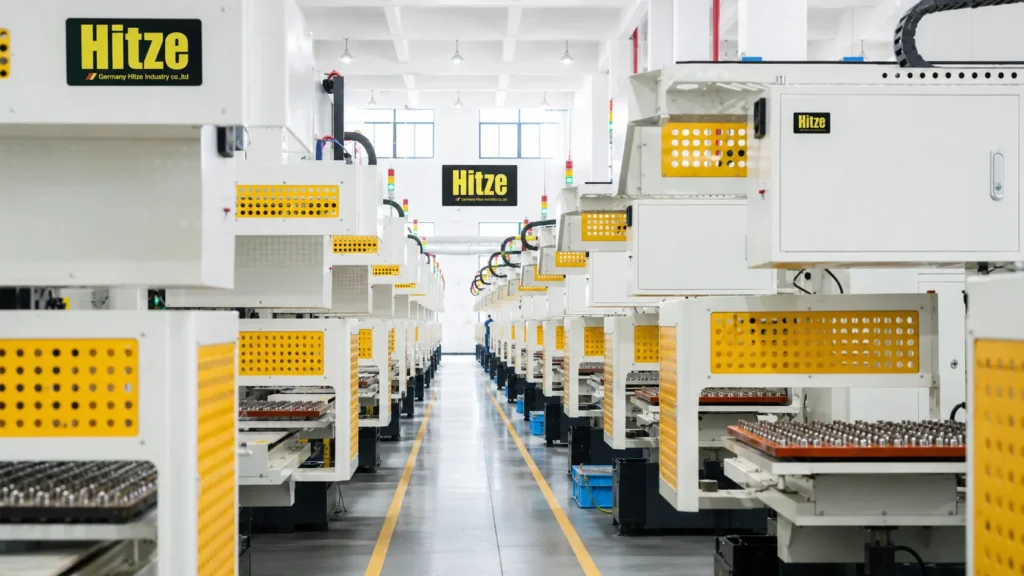
The bore behind the socket is a manufacturing variable, not a drawing number. The Hitze PP-R pipe and fitting range runs OD 20 to 110 mm, bores 13.2 to 73.4 mm, mapping onto ISO 15874-2:2013 series S2.5; OD, wall at several points and ovality are checked against the S-series tables before output is released. Hitze publishes no per-fitting coefficient table and this page has not invented one. Ask whoever quotes you for the wall and SDR matrix, the ζ table for the fittings offered, and the flow direction behind each tee value.
Sizing the Allowance, in Order
Five checks turn a borrowed chart into a defensible allowance, in this order, because each changes the input to the next.
- Fix the series before the size. dn32 in S5 and dn32 in S2 differ by 7.2 mm of bore and 49% of allowance.
- Get ζ from the maker of the fittings you are buying, not from a steel chart and not from this page.
- Compute λ at your own design flow and temperature, then convert with Leq = ζ × di / λ.
- Name the flow path on every tee and the direction on every reducer, and confirm Reynolds is above 4,000.
- Count the fusion sockets. Eight of them were worth 6.2 m on the worked branch, and no generic chart lists them.
Write the design case beside the total on the calculation sheet. An allowance without its conditions is the one number on a schedule nobody can check.
Frequently Asked Questions
What is the equivalent length of a 90° PPR elbow?
There is no single value. At series S3.2, water at 50 °C and 2.0 m/s, published PP-R coefficients convert to 0.84 m at dn20, 2.32 m at dn32, 2.89 m at dn40 and 1.00 m at dn50. The dn40 elbow costs nearly three times the dn50 elbow because the coefficient steps from 1.9 to 0.5 between those sizes.
Can I use a steel pipe equivalent length chart for PPR?
Not without recomputing it. A generic L/D of 37 understates a PP-R dn32 or dn40 elbow by a factor of 2.7, overstates dn50 by 34% and dn63 by 27%, then understates dn75 and dn110 again. The error changes sign twice across the range, not once. Neither generic set carries a row for a heat-fusion socket, and a fused system has one at every joint.
How do I convert a zeta value into an equivalent length?
Use Leq = ζ × di / λ, where di is the real bore and λ the Darcy friction factor of that pipe at your design flow. For dn32 S3.2 at 50 °C and 2.0 m/s the bore is 23.2 mm and λ is 0.0200, so ζ = 2.0 gives 2.32 m. Use the same λ as the straight pipe.
Do PPR fitting equivalent lengths change with water temperature?
Yes, through the friction factor. The same dn32 elbow converts to 1.98 m at 10 °C and 2.42 m at 70 °C, a 22% swing, because hotter water raises the Reynolds number and lowers λ. Design velocity moves the same fitting by 39% and pipe series by 49%.
Does EN 806-3 tell me the equivalent length of fittings?
No. EN 806-3:2006 offers a simplified method for what it defines as standard-installations, and clause 5.2 leaves the designer free to use a nationally approved detailed method instead. In Germany that is DIN 1988-300:2012-05. Clause 5.3 also excludes hot water return pipes, so a circulation loop must be summed fitting by fitting.