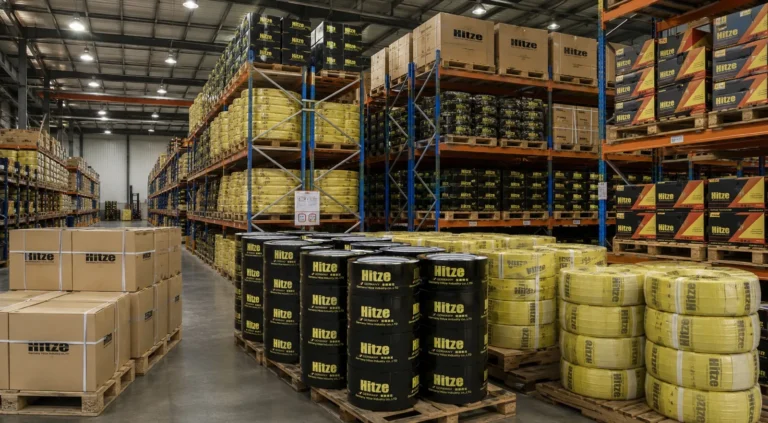
Plastic pipe storage guidelines are written one material at a time, which is the problem for mixed stock. A distribution yard runs three clocks at once. PVC-U to ASTM D1784 may sit in the open for at least one year; non-black polypropylene carries a published limit of a total of three months; black PE with 2 percent carbon black has no practical limit. Apply the loosest rule to everything and a pallet of PP-R quietly passes its allowance.
For mixed stock the rule set is short. Bring in or cover non-black polypropylene inside three months of arrival. Cover PVC before 12 months, ventilated rather than sealed. Past three months, hold socketed lengths to a 1.5 m free height on 75 mm bearers at 1.5 m centres.
Discard any length whose gouges take more than 10% of the wall. Every figure below names its issuing body and clause; none is a Hitze figure: no Hitze-approved storage window or stack height exists.
Key Takeaways
- Non-black polypropylene: a total of three months in the open (PPI TR-18, clause 5.0). The allowance is cumulative, so it does not reset when a stack moves indoors.
- PVC-U: at least one year (PPI TR-18, clause 6.0); AS/NZS 2032 requires cover beyond 12 months; the manufacturers’ association argues at least 2 years is defensible.
- Jurisdiction first: PPI TR-18, PPI HG-1 and the Uni-Bell guide are US industry references; AS/NZS 2032, PIPA and Vinidex are Australian and New Zealand references. TN006 applies that recommendation “unless specified by the contract, regulation or similar, that AS/NZS2032 applies”. So check which document your contract or receiving standard names.
- Cover has to breathe. Black plastic sheet is named as the wrong cover because it raises the temperature inside the stack.
- Heavy-wall pipe stacks lower, not higher: PPI HG-1 Table 2 drops a 12 in DR 17 row from 5 rows to 4.
- Goods-in threshold: gouges deeper than 10% of wall thickness are discarded, and a sharp notch is rejected at any depth.
The Plastics Pipe Institute, which issues TR-18 and HG-1, filmed the yard-storage sequence below.

The Storage Clock Belongs to the Polymer, Not to the Pallet
The tightest clock belongs to polypropylene. PPI TR-18 (2019) states at clause 5.0 that the outdoor storage life of non-black polypropylene “should be limited to a total of three months unless the pipe is covered or otherwise protected from sunlight”. Read “a total of” literally: the allowance is cumulative sun exposure, not a countdown that restarts when a stack moves under a roof for the winter. Clause 5.0 puts the carbon-black concentration that changes this at two to three percent, which a grey or green PP-R bundle does not carry.
PVC is where the published sources disagree, and a stockholder needs that before writing a procedure. Clause 6.0 of the same report says standard PVC grades under ASTM D 1784 hold enough titanium dioxide “to be stored outdoors for at least one year”.
AS/NZS 2032:2006, the Australian and New Zealand PVC installation standard, is stricter: beyond 12 months of exposed outdoor storage, pipes and fittings “shall be covered and stored in a manner that allows ventilation and prevents heat entrapment”. PIPA TN006, from the Australian industry association, recommends at least 2 years, citing trials in which 2 years of weathering left tensile strength, modulus and yield stress unchanged. Only surface gloss moved, and only in the first 12 months.
TN006 applies that recommendation “unless specified by the contract, regulation or similar, that AS/NZS2032 applies”. So check which document your contract or receiving standard names.
Polyethylene is the easy end. TR-18 clause 4.0 puts non-black PE stabilised with hindered amine light stabilisers at “3 years or more” of typical outdoor storage, and black PE at the ASTM D3350 minimum of 2 percent well-dispersed carbon black at more than 50 years of outdoor service. The full four-material TR-18 comparison is set out in the outdoor UV article. Below, the table carries only the figures that disagree with it.

The importer-specific trap is in the fittings. TN006 records that large-diameter parallel-socketed PVC fittings brought in from elsewhere may hold less than 1.5 phr of titanium dioxide, and must carry the marking “Protection required for use outdoors in direct sunlight”.
| Material as stocked | Published open-air limit | Source and clause | What the limit is measured against |
|---|---|---|---|
| PP-R in UV-protective bags | 6 months, one maker | aquatherm handling and storage instruction | Open air, European conditions only |
| PVC-U, cover trigger | 12 months, then cover | AS/NZS 2032:2006, quoted in PIPA TN006 | Total period of exposed outdoor storage |
| PVC-U, association view | At least 2 years | PIPA TN006 (2010), recommendation a | Not less than 1.5 phr titanium dioxide |
Covering a Stack: Ventilated, Pale, and Never Black Plastic
Two independent sources ask for the same thing and most yards do the opposite. AS/NZS 2032 requires stock held beyond 12 months to be covered “in a manner that allows ventilation and prevents heat entrapment”. Vinidex publishes the practical version: beyond one year in direct sunlight, cover with a material such as hessian, placed so that it does not restrict the circulation of air.
Coverings such as black plastic “must not be used as these can greatly increase the temperatures within the stack”, and that roll is the cheapest thing on the shelf.
The temperatures are not marginal. The same Vinidex guidance records that in hot weather, especially with black pipe, the surface may reach 70 °C when ambient reaches 40 °C, so a sealed tarpaulin over a dark stack is a heat trap.
PIPA POP005, Issue 7.0 keeps stored pipe away from engine exhausts, boilers, naked flames and hot water or steam lines, and out of contact with oils, petrol and solvents; Vinidex adds reflective metal fences.
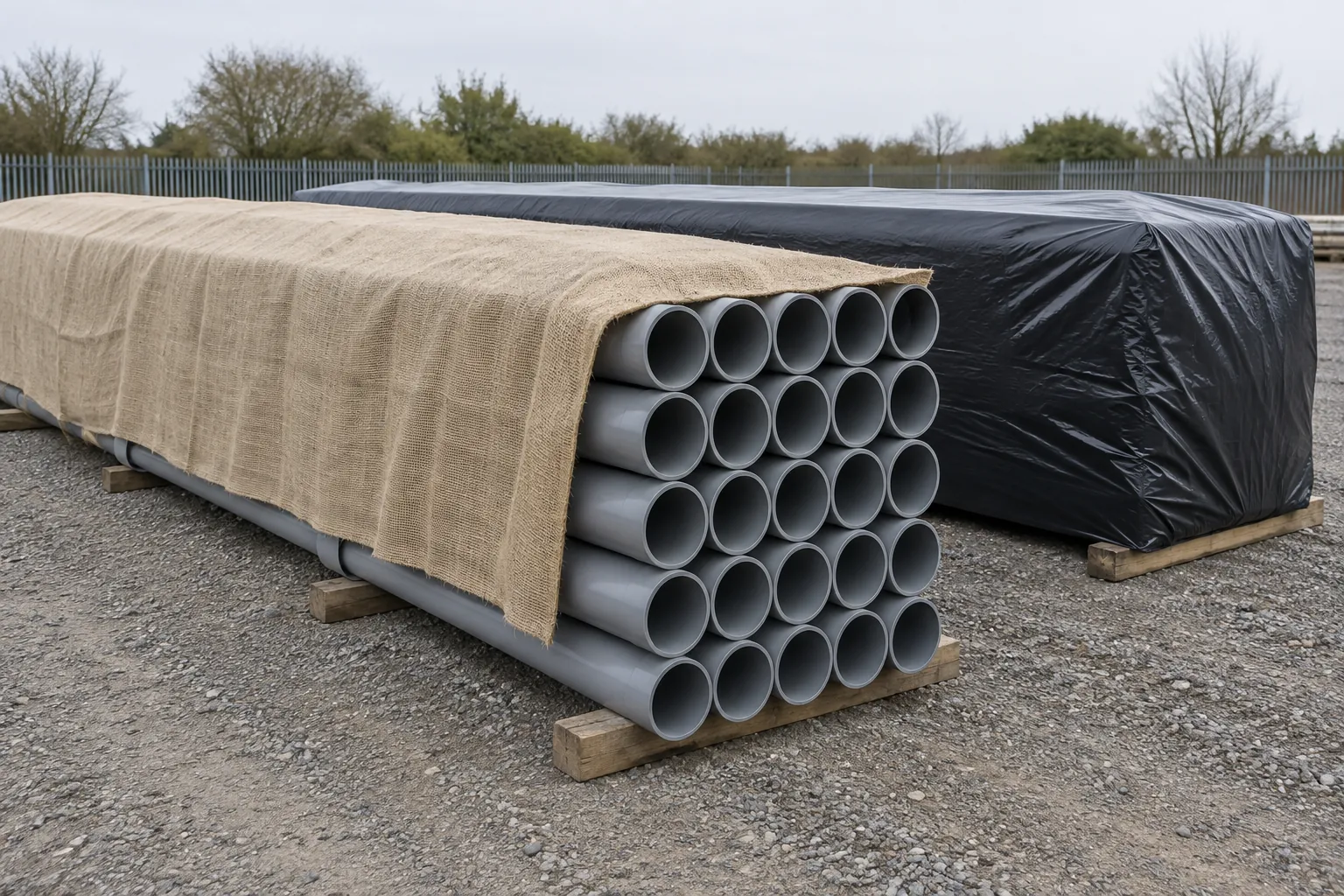
Stack Height and Bearers: What Each Body Actually Publishes
Stacking guidance arrives in three incompatible formats: rows, metres and feet. PPI HG-1 (2018 edition) counts rows in its Table 2, and its dimension ratio column is the counter-intuitive half: a 12 in pipe above DR 17 may go five rows high, the same size at DR 17 and below only four.
Thicker wall means heavier pipe, and the load lands on the bottom row. Clause 6.2 builds the pile pyramidal and freestanding, each layer one pipe shorter than the one below, bottom layer braced, thickest pipe on the floor, one size and pressure rating per pile.
The metric guidance converts the same decision into heights and bearers. Vinidex puts horizontal supports of about 75 mm width at no more than 1.5 m centres under the pipes, with vertical side supports every 3 m along a rectangular stack, and caps the free height at 1.5 m beyond three months.
Its PE figures run the same way: timber spacers of 75 mm minimum width at 1.5 m centres, long-term PE100 stacks to 2.5 m up to SDR 21 or 2 m above it. The Uni-Bell PVC Pipe Association installation guide sets one blunt ceiling: never stack more than eight feet in height.
None of these sources publishes a stacking table for PP-R, and Hitze has no approved figure of its own, so work to the metric PVC and PE limits as a ceiling. Socketed lengths go in with the sockets at alternate ends and protruding, so the socket is never the bearing surface.
Coils lie flat on a continuous surface such as pallets, only to a height at which the bottom convolutions are not distorted, or stand near-vertical and restrained. Check the SDR and PN rating of each pile before deciding its height.
| Material and source | Maximum stack as published | Support and restraint | Best for |
|---|---|---|---|
| HDPE, PPI HG-1 Table 2, above DR 17 | 4 in: 15 rows; 8 in: 8; 12 in: 5; 24 in: 3 | Spacing strips between rows above 2 in | Loose straight lengths on the floor |
| HDPE, same table, DR 17 and below | 4 in: 12 rows; 8 in: 6; 12 in: 4; 24 in: 2 | Pyramidal, bottom layer braced | Heavy-wall pipe, which stacks lower |
| PE, Vinidex storage guidance | PE100: 2.5 m up to SDR 21, 2 m above | 75 mm timber spacers at 1.5 m centres | Racked long-term PE stock |
| PVC, Vinidex storage guidance | 1.5 m free height beyond three months | 75 mm supports at 1.5 m centres, side restraint every 3 m | Socketed lengths, sockets alternating |
| PVC pressure pipe, Uni-Bell guide | Eight feet, about 2.4 m | Level ground, clear of heat sources | Unit packages kept banded |
| PP-R | No published table located | Stored flat and fully supported | Work to the PVC and PE metric limits |
| Nominal pipe size (in) | Above DR 17 (thinner wall) | DR 17 and below (thicker wall) |
|---|---|---|
| 4 | 15 | 12 |
| 6 | 10 | 8 |
| 8 | 8 | 6 |
| 12 | 5 | 4 |
| 20 | 3 | 3 |
| 24 | 3 | 2 |
| 30 | 2 | 2 |
| 36 | 2 | 1 |
| 48 | 1 | 1 |
Two Temperature Limits, and Only One of Them Is About Storage
Storage temperature and handling temperature are different limits, and collapsing them into one number is the commonest error here. On storage, aquatherm’s published PP-R instruction is permissive: the pipes can be stored at all temperatures, provided they are flat and fully supported.
On handling, the same document draws a line at +5 °C, below which heavy falling objects, hammering or a thrown fitting can start hairline cracks that later develop into bigger cracks. POP005 puts it differently for polyethylene: below 0 °C, impact resistance slowly reduces.
That 0 °C is not an arbitrary round number. It is where the PP product standard tests impact. ISO 15874-2:2013/Amd 2:2022 added subclause 7.2 for exactly that: a Charpy result of 10% or less for DN 25 mm and under, a total impact rate of 10% or less for DN 32 mm and above, both at 0 °C.
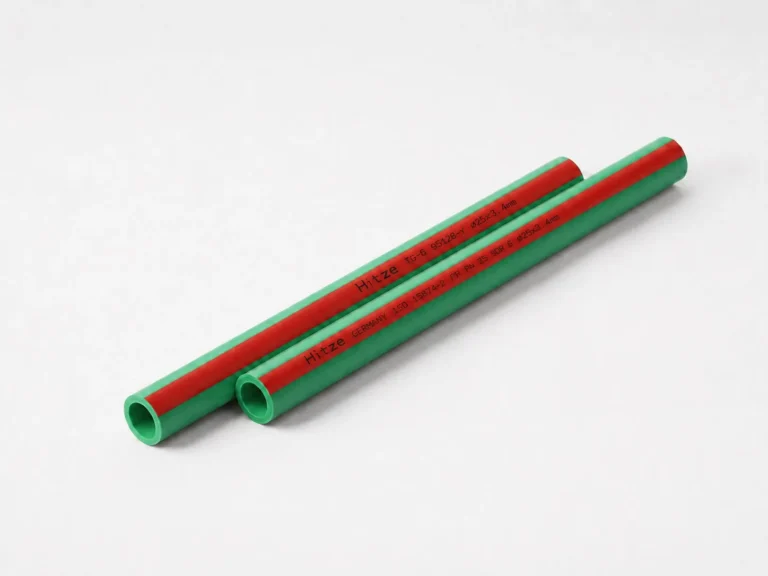
Hitze PP-R is made to DIN 8077, DIN 8078 and EN ISO 15874, so that is the reference point. At the warm end, POP005 caps electrofusion fitting storage at 50 °C, which rules out the roof space.
PVC is the gap. No storage-temperature ceiling for PVC is published in any of the sources cited here. What is published is a heat rule: AS/NZS 2032 asks for cover that “prevents heat entrapment”. PIPA TN006 has one temperature caveat, and it is about service, not storage. Pipes and fittings “exposed to high service temperatures must also be adequately protected against thermal degradation by the use of appropriate thermal stabilisers”.
Goods-In: The Measurement That Decides Accept, Buff or Discard
Two independent bodies publish the same threshold, rare enough to build on. PPI HG-1 clause 6.0 requires inspection for scratches, gouges, discoloration and other defects before pipe goes into storage, and keeps damaged or questionable material out of storage altogether.
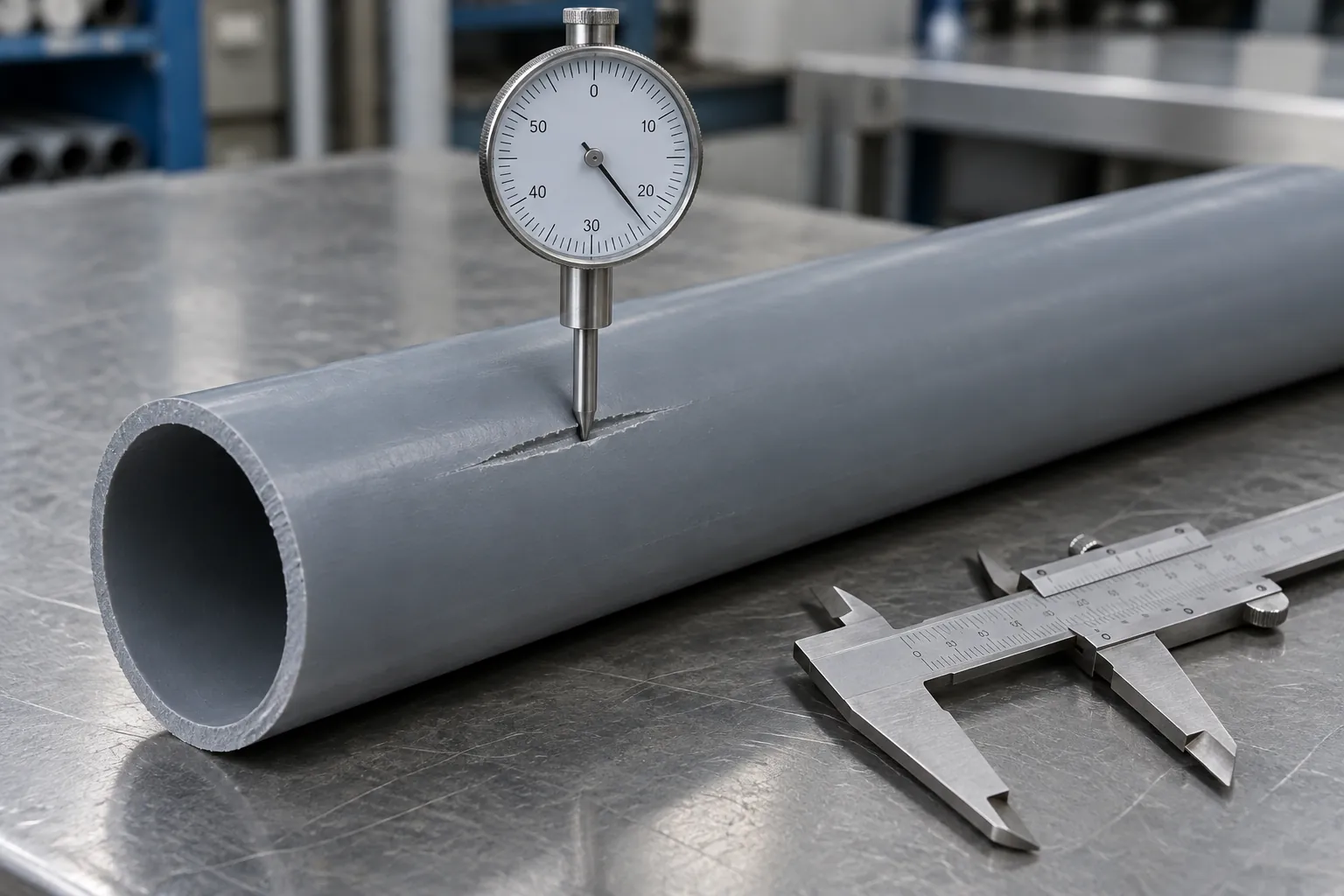
Its threshold is numeric: cuts and gouges reducing the wall thickness by more than 10% “may impair long-term service life and should be discarded”. Vinidex arrives at the same figure from the other side: up to 10% may be tolerated, but sharp notches should be rejected, or buffed out to remove the sharp edges.
The rest of goods-in is reading and recording. HG-1 clause 3.3 lists what to read off the product itself: diameter, dimension ratio, resin type, pressure rating, cell classification, maker’s name and any required markings, checked against the packing list.
Uni-Bell’s receiving section is blunt about the paperwork: damaged or missing items should be documented on the bill of lading, set aside, and the shipper notified. Record the date as well as the count, because POP005 measures electrofusion fitting shelf life, more than 10 years with proper storage, from the manufactured date.
| Finding on the length | How to measure it | Published threshold | Verdict |
|---|---|---|---|
| Smooth scratch or shallow gouge | Depth gauge against the nominal wall | Up to 10% of wall thickness | Accept into stock |
| Deep gouge or cut | Depth gauge against the nominal wall | More than 10% of wall thickness | Discard the length |
| Sharp notch, any depth | Visual, then a fingernail across it | No depth allowance given | Reject, or buff the edges smooth |
| Chalky or faded surface | Wipe the outside diameter clean | No numeric limit published | Accept, remove the skin before fusing |
| Print line unreadable | Read diameter, SDR and pressure rating | Markings must be legible | Quarantine until identified |
| Crushed or visibly oval bundle | Caliper two diameters at 90° | Ovality against the S-series table | Quarantine for re-measurement |
Rotation, Re-Inspection and What We Check Before the Next Order
Elapsed storage time changes the rules, which makes a receipt date a technical record rather than an accounting one. Two figures above move at the three-month mark: the PPI allowance for non-black polypropylene is a total of three months of sun, and the Vinidex free height for PVC drops to 1.5 m once storage runs “longer than 3 months”.
A warehouse that cannot say which bundle landed in March can apply neither.
TR-18 clause 8.0 says the first effect of weathering is usually a slight discoloration of the pigment, a chalky surface or whitening, before any reduction in tensile strength and ductility.
Chalking is a trigger for inspection, not a reason to scrap, with one hard consequence: clause 8.0 also states that surface degradation “must be removed in order to allow the plastic compound to be heat fused or solvent bonded”. Socket heat fusion of PP-R acts on the pipe outside diameter, the surface that weathered. Do not turn any of this into a service-life estimate: ISO 16871 restricts itself to components “subject to yard storage prior to installation”.
What We Check Before a Pipe Leaves the Plant
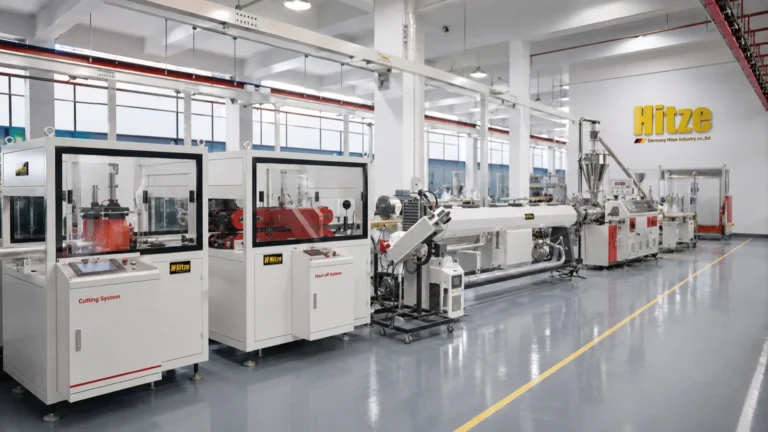
Hitze’s in-house sequence verifies resin before extrusion, then measures outside diameter, wall thickness at multiple points and ovality against the S-series tables across OD 20 mm to 110 mm, DN15 to DN90, before hydrostatic testing. That is the dimensional record a distributor re-checks a stored bundle against, so ask for the per-size wall and ovality data rather than a diameter list.
The importer and distributor programme is where stocking depth gets set. The quality control page covers how the checks are run, and the pressure rating guide covers what wall class means for stack weight.
Conclusion
Work it in this order. Sort the yard by polymer, not by order number, and put non-black polypropylene on the three-month list. Cover PVC before 12 months with something that breathes, never black sheet.
Hold socketed long-term stacks to 1.5 m on 75 mm bearers at 1.5 m centres, heaviest at the bottom. Apply the 10% wall rule at goods-in and write the date on the bundle. Re-measure ovality and remove any chalked skin before a stored length reaches a fusion machine.
Have three things ready for the next order: the per-size wall and ovality data for the sizes you hold, the marking format on the bundle label, and the replenishment frequency your yard can cover.
Frequently Asked Questions
Can PVC pipe be stored outside?
Yes. PPI TR-18 clause 6.0 puts standard PVC grades under ASTM D 1784 at “at least one year” outdoors. AS/NZS 2032:2006 requires cover beyond 12 months, ventilated and without heat entrapment; PIPA TN006 argues at least 2 years is defensible at 1.5 phr titanium dioxide.
What is the best way to store PVC pipes in a warehouse?
In unit packages on level ground, sockets at alternate ends and protruding, on 75 mm supports at no more than 1.5 m centres with side restraint every 3 m. Beyond three months hold the free height to 1.5 m, and never stack more than eight feet.
How long can PP-R pipe sit outdoors before it needs cover?
PPI TR-18 clause 5.0 limits non-black polypropylene to a total of three months unless it is covered or otherwise protected from sunlight. One PP-R maker publishes 6 months in UV-protective bags under European conditions, and advises against open storage in intense-UV countries.
Does a cold warehouse damage plastic pipe?
Storage itself is accepted at all temperatures if the pipe is flat and fully supported. Handling is the risk: below +5 °C an impact can start hairline cracks in PP-R, and ISO 15874-2:2013/Amd 2:2022 tests impact resistance at 0 °C.
What temperature can PVC hold up to?
No storage-temperature ceiling for PVC is published in any of the sources cited here. What is published is a heat rule: AS/NZS 2032:2006 requires cover that allows ventilation and “prevents heat entrapment”, and Vinidex keeps stored PVC away from heaters, boilers, steam lines, engine exhausts and reflective metal fences. PIPA TN006 has one temperature caveat, and it is about service, not storage. Pipes and fittings “exposed to high service temperatures must also be adequately protected against thermal degradation by the use of appropriate thermal stabilisers”.
How deep a scratch is too deep on a delivered pipe?
More than 10% of the wall thickness: PPI HG-1 clause 6.0 says such cuts and gouges should be discarded, and Vinidex tolerates up to 10%. A sharp notch is rejected at any depth, or the area is buffed out to remove the sharp edges.