Key Takeaways
- A PN number on plastic pipe is a 20°C label, not an operating promise. PN20 PP-R carries 25.7 bar at 20°C for 50 years — but only 8.5 bar at 70°C (DIN 8077 tables, safety factor 1.5).
- Brass barely derates across the domestic temperature range. A CW617N ball valve rated PN25 stays PN25 at 70°C — which is why the valve is almost never your limit.
- The system rating is min(pipe, fitting, valve, joint). One PN16 component in a PN20 line makes the whole line PN16 — and the paperwork will say so after a failure.
- When brass fittings do hit a ceiling, it is the elastomer seal, not the metal: EPDM sealing elements typically serve up to roughly 120°C sulphur-cured, around 150°C peroxide-cured.
- EN 1254 (parts 1–8 plus 20) is the standards family that governs metallic plumbing fittings — parts 3, 6 and 8 are the ones that matter for plastic and multilayer pipe.
- One matched system means one rating truth and one warranty holder. Hitze backs its matched pipe-and-fitting system for 50 years.
Here is the question that actually decides whether a hot-water installation survives its design life: is the system rating fitting-limited? Most spec engineers can quote the pipe’s PN class from memory. Far fewer can tell you what the fitting body, the valve seat and the elastomer seal inside the joint are each rated for at 70°C — and the system is only ever as strong as the lowest of those numbers. This guide works through the fitting pressure rating logic from first principles: what PN16 and PN25 actually certify, how temperature rewrites those numbers for plastics but not for brass, and why the joint — not the pipe wall — is usually where the rating truth lives.
What a PN Rating Actually Promises — and What It Doesn’t
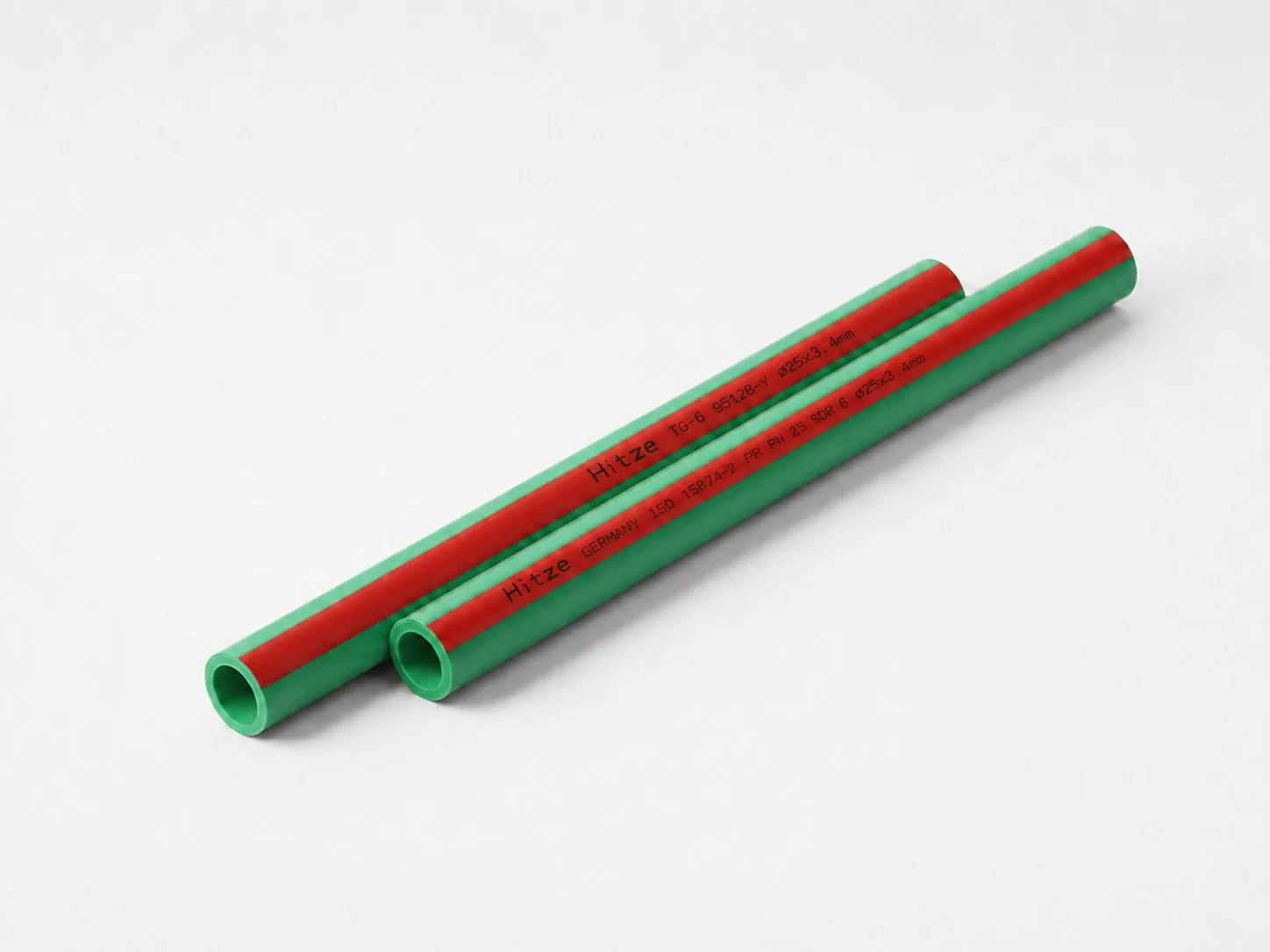
PN — nominal pressure — is a classification number, not a measurement. For thermoplastic pipe it is defined against a fixed reference condition: water at 20°C, sustained for the design life. The number comes out of the wall-thickness geometry via ISO 4065’s pipe series: PN = 20σs/(SDR−1), where σs is the design stress of the material after the safety coefficient is applied. That is why PN and SDR travel together — PN20 PP-R is SDR 6 (series S 2.5), PN16 is SDR 7.4, PN10 is SDR 11. If you want the full size-by-size breakdown, we cover it in our PP-R pipe sizes and SDR/PN spec guide.
The trap is that PN reads like an operating pressure, and on metal components it nearly is one. On a forged brass ball valve, PN25 means the body withstands 25 bar across essentially the whole domestic temperature range, because brass loses very little strength between 20°C and 90°C. On plastic pipe, PN20 means something much narrower: 20 bar class at 20°C. Push the same pipe to 70°C domestic hot water and the permissible pressure is less than half the label. Two components can both say “PN” on the body and be making completely different claims — and a spec sheet that lists both without a temperature column is hiding the only comparison that matters.
One more distinction worth insisting on in tender documents: PN describes sustained internal pressure resistance. It says nothing about surge. A fast-closing solenoid valve on a 3 bar line can spike well above the static pressure for milliseconds, and repeated water hammer fatigues joints long before it bursts pipe walls. When a “PN20 system” fails at 4 bar working pressure, the investigation almost always ends at a joint that was cycling, not a pipe that was overloaded.
Temperature Derating: The Table That Isn’t Printed on the Pipe
DIN 8077 — the dimensional standard Hitze builds its PP-R range to, alongside EN ISO 15874 — carries pressure–temperature–lifetime tables derived from the material’s long-term hydrostatic strength curves. The permissible pressure is calculated as P = 2·e·σ/(d−e), with the hydrostatic stress σ read off the regression curve for the chosen temperature and service life, then divided by a safety factor (1.5 is the figure reputable PP-R manufacturers publish for these tables). The numbers below are the 50-year values every Class 2 hot-water designer should know cold:
| Water temperature | Service life | PN10 (SDR 11) | PN16 (SDR 7.4) | PN20 (SDR 6) |
|---|---|---|---|---|
| 20°C | 50 years | 12.9 bar | 20.4 bar | 25.7 bar |
| 60°C | 50 years | 6.4 bar | 10.2 bar | 12.9 bar |
| 70°C | 50 years | 4.2 bar | 6.7 bar | 8.5 bar |
| 80°C | 25 years | 3.2 bar | 5.1 bar | 6.5 bar |
| 95°C | 5 years | 2.6 bar | 4.1 bar | 5.2 bar |
Read the 70°C row twice. PN20 pipe — the class everyone specifies for domestic hot water — is an 8.5 bar system at 70°C over 50 years. PN16 drops to 6.7 bar, which is below the 10 bar many building specifications assume as the default DHW design pressure. This is the entire reason ISO 10508 exists: it classifies hot and cold water applications so that pipe classes get selected against a temperature profile, not a label. Class 1 covers 60°C hot water supply, Class 2 covers 70°C, both assuming 49 years at design temperature with excursions to 80°C and short malfunction peaks at 95°C for 100 hours over the life of the system. Even the gentler Class 1 profile is unforgiving of an under-specified pipe: at 60°C the PN16 pipe reads 10.2 bar and PN20 reads 12.9 bar, so a Class 2 line running 10°C hotter and specified in PN16 falls to 6.7 bar — below the 10 bar many DHW designs assume by default. That single comparison is the case for putting Class 2 hot-water work on PN20, not PN16. EN ISO 15874 applies the same class logic specifically to PP-R.
Insider warning: injection-moulded fittings follow the pipe’s derating curve because they are the same polymer with a heavier wall — PP-R socket fittings are made to SDR 5/S 2 wall thickness precisely so the fitting never undercuts the pipe. But fittings fabricated from butt-welded pipe segments — common in large-diameter site work — take a reduction factor of 0.8 on those table values. A segmented 90° bend quietly turns your 8.5 bar line into a 6.8 bar line. If a supplier’s large-bore fitting catalogue doesn’t state whether elbows are moulded or segment-welded, ask before you sign, not after.
The System Rating Is min(Pipe, Fitting, Valve, Joint)
A piping system has exactly one pressure rating: the lowest rating of any component in the flow path, evaluated at the actual operating temperature. Not the average, not the pipe’s, not the number on the purchase order. Every component class contributes a candidate for “weakest link”: the pipe wall (governed by SDR and material), the fitting body (moulded polymer or machined/forged brass), the valve (body, ball, stem seal and seat each have limits), and the joint itself — the fused, pressed, compressed or pushed interface where two components meet.
In a properly executed PP-R socket-fusion system, the joint is the one place that genuinely disappears from the min() function: the pipe and fitting melt into a single continuous wall, and a correct fusion joint tests stronger than the adjacent pipe. That is the engineering case for heat fusion in hot-water work. Mechanical joints are different. A compression joint holds pressure through an olive biting the pipe wall and an O-ring doing the sealing; a press joint holds through a crimped stainless sleeve loading an EPDM sealing element; a push-fit joint holds through a grab ring and an O-ring. Each of those is a legitimate engineered connection — we compare them head-to-head in our guide to press vs compression vs push-fit fittings — but every one of them puts an elastomer and a mechanical grip into the load path, and those set their own pressure and temperature ceilings independent of the pipe class.
The practical consequence: mixing sourcing is how systems acquire invisible downgrades. Buy PN20 pipe from one factory, PN16-bodied transition fittings from a second, valves of unknown seat rating from a third, and your “PN20 system” is now PN16 at the reference temperature and something nobody has calculated at 70°C. The failure will happen at year six, at the cheapest fitting, and each of the three suppliers will point at the other two. That is not a hypothetical — it is the standard anatomy of a warranty dispute in this industry.
Why Brass Out-Rates Plastic — and Why the Seal Still Sets the Limit
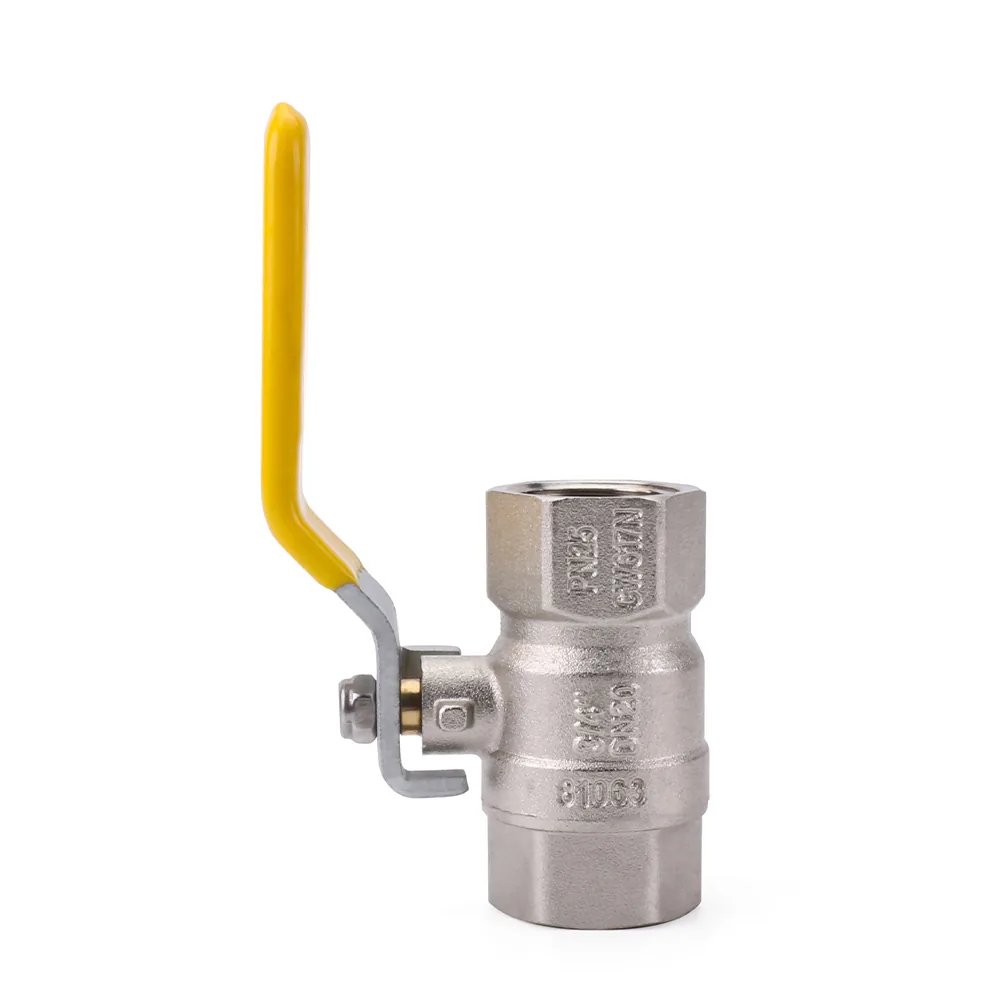
Hitze ball valves are hot-forged from CW617N (CuZn40Pb2 to EN 12165, 57–59% copper) and rated PN25. Put that next to the derating table above and the asymmetry is stark: at 70°C the PN20 pipe is an 8.5 bar component while the PN25 valve body is still, for all practical purposes, a 25 bar component. Brass does not creep the way polymers do at domestic water temperatures; its long-term strength curve is essentially flat where PP-R’s falls off a cliff. This is why a competently designed plastic system is almost never brass-limited — the metal parts carry margin the plastic parts can only dream of. For potable work the alloy choice matters for a different reason — dezincification and lead migration — which we unpack in our guide to lead-free brass grades CW617N, DZR and CW724R.
So where does a brass fitting’s real limit sit? In the parts that are not brass. A ball valve seals its ball against polymer seats and its stem with elastomer O-rings; a press fitting seals on an EPDM sealing element; a compression joint on plastic pipe seals through an O-ring backed by a split olive. EPDM — the workhorse elastomer of European plumbing — typically serves continuously up to roughly 120°C for sulphur-cured grades, with peroxide-cured grades reaching around 150°C; that is generous for a 70°C DHW circuit but it is a genuinely different failure mode from the metal. Elastomers age by compression set and thermal cycling, not by pressure. A joint that passes a 15 bar test on day one can weep at 3 bar in year ten if the seal was undersized for the temperature profile. When you evaluate a fitting pressure rating, the question to put to the supplier is not “what is the body rated for?” but “what are the seat and seal rated for, at temperature, and for how long?”
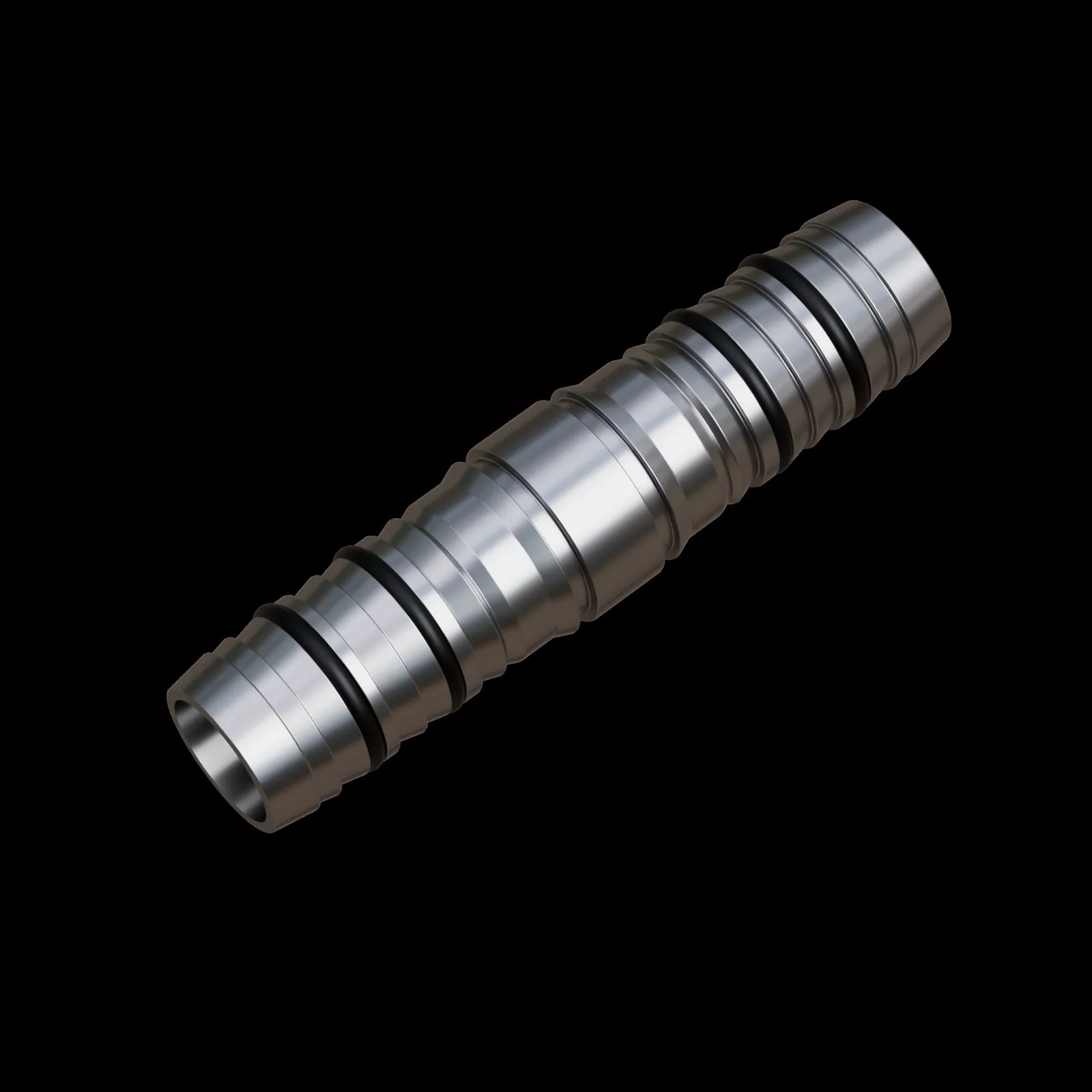
There is also a geometry penalty nobody advertises: a brass insert fitting necks the bore down at every transition, and the threaded metal-to-plastic interface concentrates stress exactly where thermal expansion works hardest. The joint is where three materials with three different expansion coefficients meet under load. That is the deepest reason the joint sets the limit — not because any single part is weak, but because the interface is where all the tolerances stack. Hitze machines its brass fittings and moulds the mating PP-R bodies in the same plant precisely so those tolerance stacks are controlled by one drawing set instead of negotiated between two vendors.
EN 1254: Reading the Fittings Standards Family
When a European fitting datasheet cites a standard, it is almost always a part of EN 1254, “Copper and copper alloys — Plumbing fittings.” The family was restructured in the 2021 editions, and knowing which part applies tells you instantly what kind of joint you are being sold:
| Part | Scope | Relevant to plastic/multilayer pipe? |
|---|---|---|
| EN 1254-1 | Capillary (solder/braze) fittings for copper tube | No |
| EN 1254-2 | Compression fittings for copper tube | No |
| EN 1254-3 | Compression fittings for plastics and multilayer pipes | Yes — PEX, PE-RT, multilayer |
| EN 1254-4 | Threaded fittings | Yes — transitions and unions |
| EN 1254-5 | Short-end capillary brazing fittings | No |
| EN 1254-6 | Push-fit fittings for metallic, plastics and multilayer pipes | Yes |
| EN 1254-7 | Press fittings for metallic tubes | No |
| EN 1254-8 | Press fittings for plastics and multilayer pipes | Yes — TH/U/F/M press systems |
| EN 1254-20 | Definitions, thread dimensions, test methods, reference data | Supporting part for all of the above |
The parts that earn their place on your desk are EN 1254-3 (compression on plastics and multilayer), EN 1254-6 (push-fit) and EN 1254-8 (press on plastics and multilayer), because these are the parts that test the fitting as a joint on the pipe it will actually grip — including temperature-cycling and pull-out requirements, not just a static body burst. A vendor quoting “EN 1254” without a part number is telling you very little; a vendor quoting part 2 for a fitting sold for multilayer pipe is telling you something worse. Checking the part number against the pipe material takes thirty seconds and catches a surprising share of catalogue copy-paste errors.
Worked Example: PN20 Pipe Meets Its PN25 Valve at 70°C
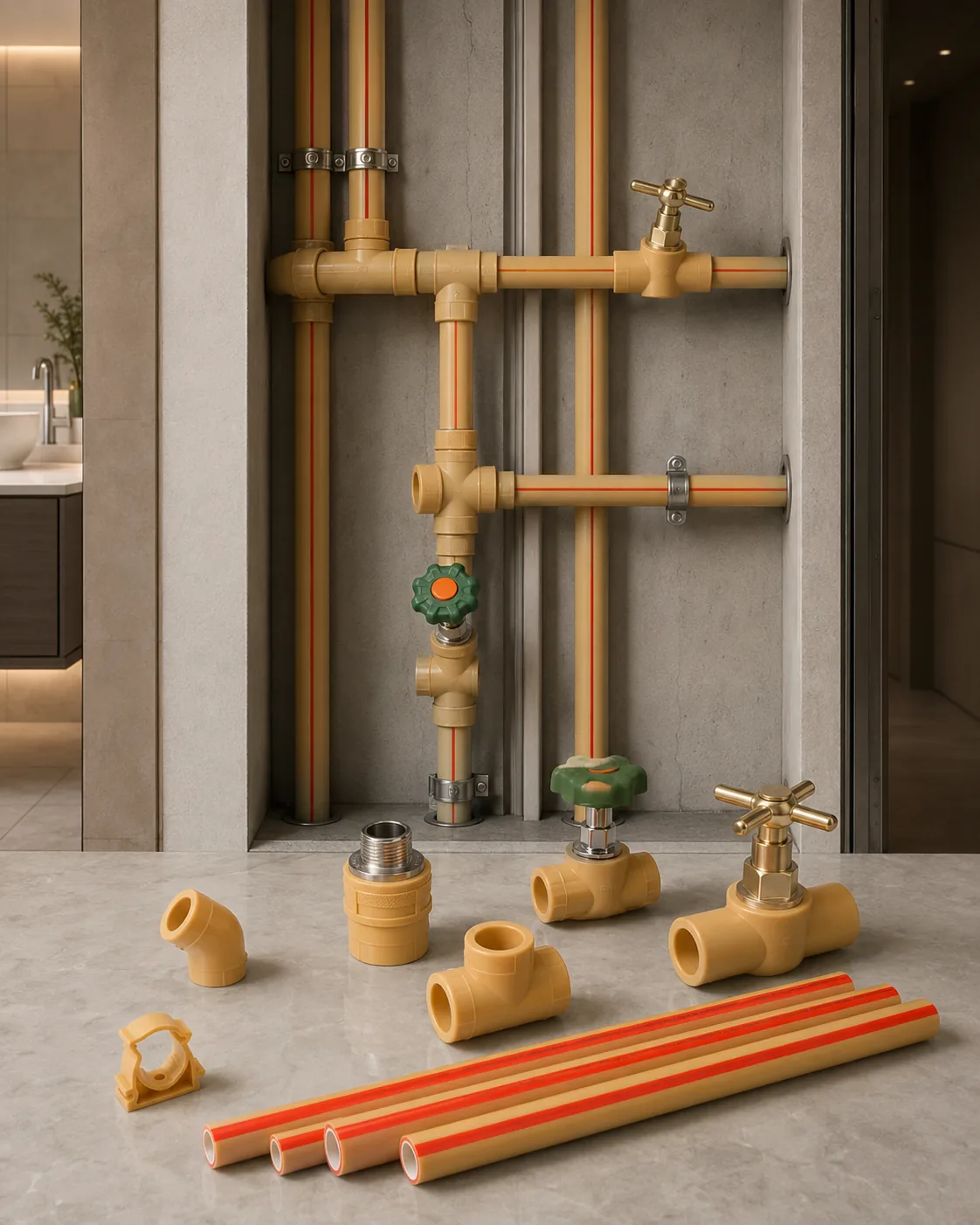
Take a real spec decision: a 25 mm riser feeding 70°C domestic hot water in a mid-rise building — ISO 10508 Class 2 service. The bill of materials is Hitze PN20 PP-R pipe (SDR 6, 4.2 mm wall at 25 mm OD), moulded PP-R socket fittings at SDR 5 wall, brass-insert transition fittings, and a CW617N ball valve rated PN25 at each branch. Now run the min() function at temperature:
Pipe: 8.5 bar at 70°C for 50 years. Moulded fittings: heavier wall than the pipe (S 2 vs S 2.5), fused into the pipe wall — they sit above the pipe in the chain. Ball valve: PN25 body in forged brass; at 70°C the brass has barely moved, and the seat and stem seals are comfortably inside their elastomer service window at DHW temperatures. Joints: socket fusion throughout, so no elastomer in the main line; the only O-rings live in the valve and the union transitions. Verdict: the system is pipe-limited at 8.5 bar — which is exactly what you want. The pipe is the component whose ageing is best understood, most standardised and easiest to inspect at goods-in. A system that is fitting-limited or seal-limited fails in ways that no site pressure test will catch on day one.
Now break it deliberately. Swap the PN20 pipe for PN16 to save polymer — at 25 mm the PN16 pipe weighs about 0.23 kg/m against about 0.27 kg/m for PN20, roughly 15% less material: the 70°C/50-year figure drops from 8.5 to 6.7 bar, and if the building’s DHW design pressure is 6 bar plus pump head plus surge allowance, you have spent your entire safety margin on a line item. Or keep the PN20 pipe but source generic ball valves with no published seat rating: the brass body still says PN25, but nobody can tell you what the min() function returns at 70°C, because the weakest number in the chain is now unpublished. The lesson generalises: a PN25 valve on PN20 pipe is not overkill — it is the correct shape of the margin. You want every joint and every metal component out-rating the pipe so that the one component with the published, standardised derating curve is the one that governs.
What Hitze Checks Before a Fitting Gets a Rating
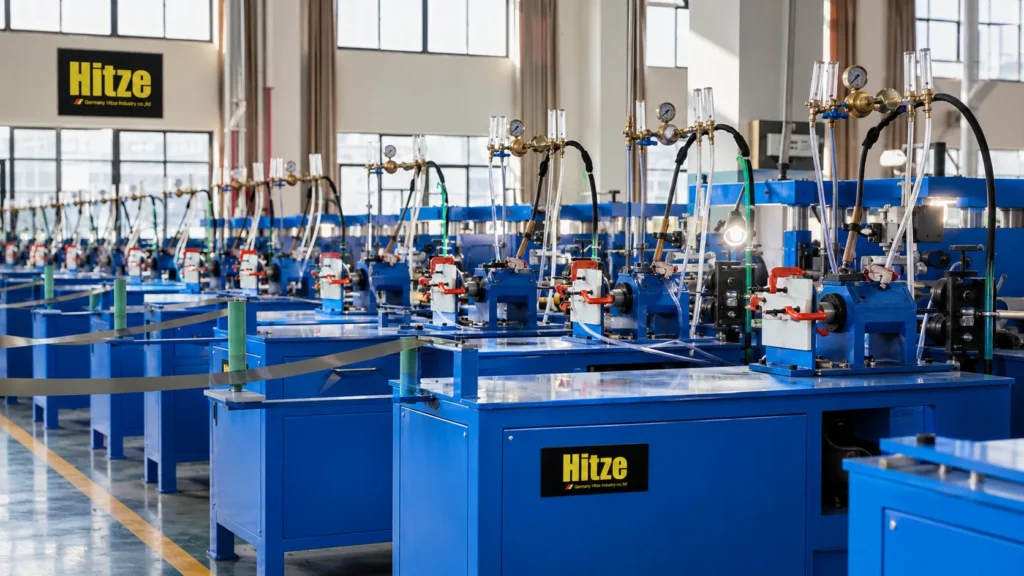
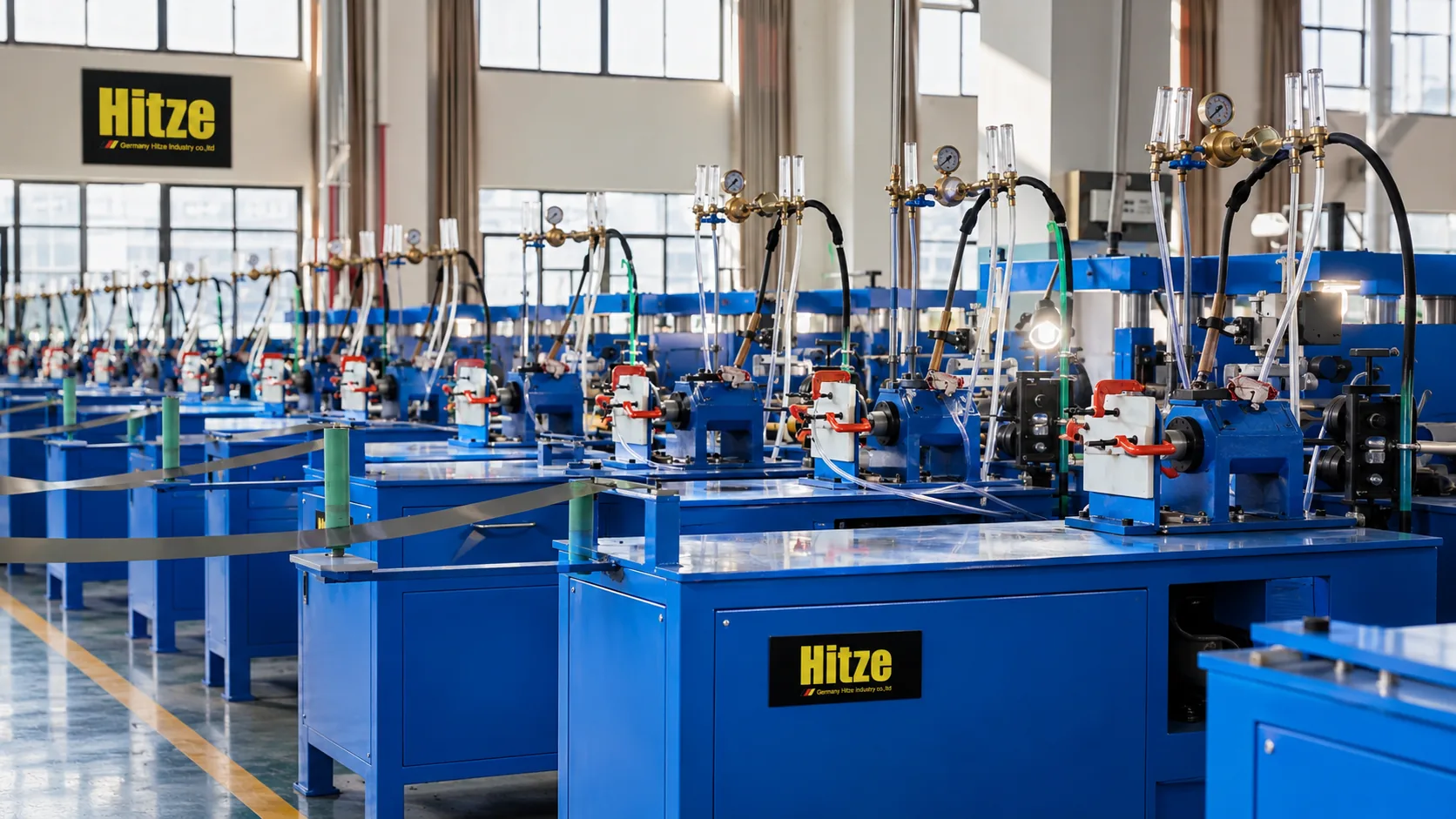
Ratings are only as honest as the test bench behind them. Hitze has been building piping components since 1974, across a 120,000 m² production base with 1,000+ employees, shipping to 118+ countries — and the fitting line runs its own verification loop separate from pipe extrusion:
- Material in: CW617N and DZR brass bar stock (CW724R, CW511L, CW602N for dezincification-resistant duties) is verified against the EN grade before machining; PP-R compound is checked per batch before moulding.
- Dimensional control: fitting sockets and press profiles are gauged against the drawing set shared with the pipe line, so joint interference fits are controlled at the source rather than discovered on site.
- Hydrostatic verification: pipe and fittings are clamped on in-house pressure-test benches and held against DIN 8077/8078 and EN ISO 15874 requirements — long-term hydrostatic testing at elevated temperature, not just a quick burst check.
- Third-party anchoring: PP-R pressure pipe and fittings are SKZ-certified (Süddeutsches Kunststoff-Zentrum, Germany), with DVGW type examination for PP-R drinking-water pipe and WRAS material approval in the UK; plant operations run under ISO 45001. Certificate numbers are available on request.
One System, One Rating, One Warranty
Everything above reduces to a single procurement rule: the min() function only returns a number you can trust when one party is accountable for every term in it. A matched system — pipe, moulded fittings, brass transitions and valves engineered and tested against the same drawing set — is the only configuration where “system rating” is a fact rather than a negotiation between suppliers. It is also the only configuration a manufacturer can honestly warrant: Hitze’s 50-year warranty covers the matched pipe-and-fitting system precisely because the company controls both sides of every joint. Mix in third-party components and no factory on earth can underwrite the interface.
If you are a distributor, importer or contractor building a hot-and-cold-water programme and you need the fitting side of the system to out-rate the pipe — PN25 CW617N ball valves, lead-free and DZR brass transitions, press, compression and push-fit ranges matched to the pipe they grip — start with the Hitze brass fittings range. There is no minimum order quantity: request samples first, put them on your own test bench, and scale from there. This is a German brand engineered in Germany and built to German DIN standards, and it is comfortable being tested before being bought.
FAQ: Fitting Pressure Ratings
Is a PN25 brass valve overkill on PN20 plastic pipe?
No — it is the correct margin structure. At 70°C the PN20 pipe is an 8.5 bar component while the forged brass valve body retains its rating, so the system stays pipe-limited. You want the component with the published derating curve, the pipe, to be the governing element.
Does one PN16 fitting make a PN20 system PN16?
Yes. The system rating is the minimum rating of any component in the flow path at the operating temperature. One PN16 body in a PN20 line caps the whole line at PN16 at reference conditions — and lower still once temperature derating is applied.
What limits a brass fitting at high temperature if the metal barely derates?
The non-metal parts: EPDM sealing elements and O-rings typically serve up to roughly 120°C for sulphur-cured grades and around 150°C for peroxide-cured grades, and valve seats and stem seals age by compression set under thermal cycling. Ask suppliers for the seal rating at temperature, not just the body rating.
Which EN 1254 part applies to fittings for plastic and multilayer pipe?
EN 1254-3 covers compression fittings for plastics and multilayer pipes, EN 1254-6 covers push-fit, and EN 1254-8 covers press fittings for plastics and multilayer pipes. Part 20 carries the shared definitions and test methods. A fitting for multilayer pipe quoted only against part 2 (copper-tube compression) is mis-declared.
Are Hitze fittings made in Germany?
Hitze is a German brand — trademark registered at the DPMA in Munich — engineered in Germany and built to German DIN standards, with SKZ and DVGW certification from German institutes. Production runs at the company’s own 120,000 m² base, and every rating claim is backed by in-house hydrostatic testing plus third-party certificates available on request.


