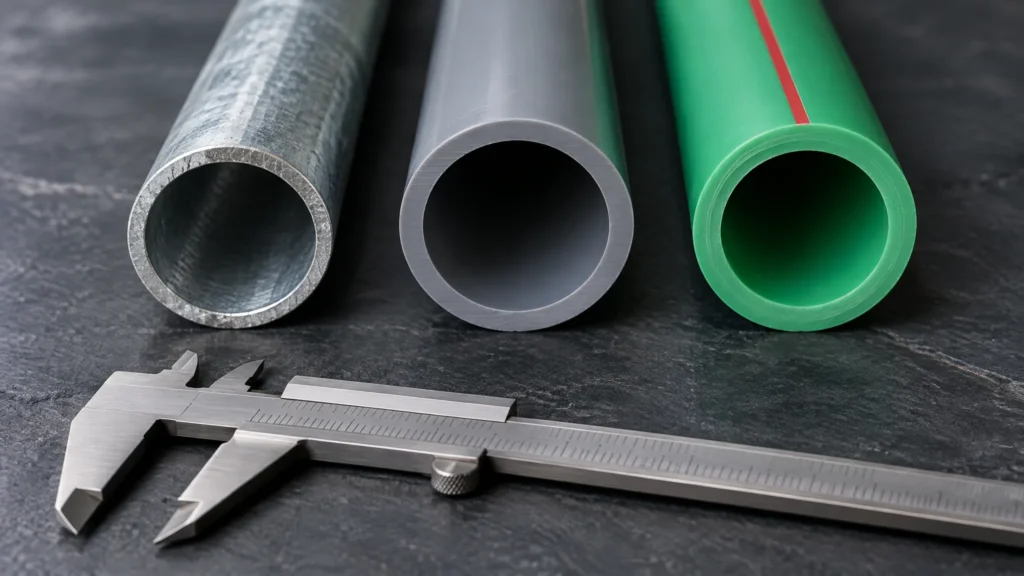
A pipe wall thickness table only works inside its own system. A schedule number fixes one wall for each nominal pipe size: ASME B36.10-2022 for steel, B36.19M-2018 for stainless, ASTM D1785-26 for PVC. An SDR or S series, used by ISO 15874-2 for PP-R, fixes the ratio of outside diameter to wall instead, so the wall grows with the pipe. PN is a pressure class and sets no dimension. No factor turns Sch 40 into an SDR.
To read a mixed spec, convert every line to outside diameter × minimum wall in millimetres: 1/2 in Sch 40 steel is 21.34 × 2.77 mm nominal and may measure 2.42 mm, while 20 mm PP-R SDR 11 is 20 × 1.9 mm minimum.
Key takeaways
- Schedule fixes a wall per size; SDR fixes a ratio. OD ÷ Sch 40 wall runs from 7.7 at NPS 1/2 to 19.0 at NPS 4.
- Steel walls are nominal. ASTM A53 allows up to 12.5% under the table value at any point.
- Plastic walls are minimums. ISO 4065 sets the nominal wall equal to the minimum, and ISO 15874-2 tolerances only go up.
- DN is a name, not a diameter. Steel DN15 is 21.34 mm OD; PP-R DN/OD 20 is 20 mm.
- A PN-only line names no wall. Ask for the S series or SDR.
On this page
The short explainer below, from irrigation supplier Sprinkler Warehouse, walks through the SCH, Class and SDR markings printed on PVC pipe and poly tubing. Watch it for how each label reads, then use the tables on this page for the numbers.

Schedule and SDR fix the wall in opposite ways
A schedule is a wall series indexed to size. For each NPS the outside diameter stays fixed and a higher schedule adds wall inward, so the bore shrinks: at NPS 2 the bore is 52.51 mm in Sch 40 and 49.25 mm in Sch 80. Up to NPS 10, Sch 40 and STD are the same wall. An SDR works the other way: it is the nominal outside diameter divided by the nominal wall. Hold SDR 11 and a 20 mm PP-R pipe gets a 1.9 mm wall, while a 110 mm pipe gets 10.0 mm, per ISO 15874-2:2013 Table 5. The two systems also disagree on what the printed wall means.
| Label on the spec | Governing standard (edition) | What the label fixes | Printed wall is | Verdict for the order |
|---|---|---|---|---|
| Sch 40 / Sch 80 steel | ASME B36.10-2022; pipe often to ASTM A53 | Wall per NPS; OD fixed by NPS | Nominal; A53 allows 12.5% under | Convert to OD × minimum wall |
| Sch 10S / 40S stainless | ASME B36.19M-2018 | Wall per NPS | Nominal | Name the material specification too |
| Sch 40 / Sch 80 PVC | ASTM D1785-26 | Wall per NPS at steel ODs | Minimum wall | Compare directly in mm |
| SDR or S series, PP-R | ISO 15874-2:2013 | OD ÷ wall ratio | Minimum wall, plus-only tolerance | Order as OD × S series |
| SDR, metric PVC-U | ISO 1452-2:2009 | OD ÷ wall ratio | Minimum wall | Confirm the OD is metric |
| PN 10 / 16 / 20 | Product standard plus service conditions | Pressure class only | No wall stated | Never compare walls by PN |
Source: ASME B36.10-2022 and B36.19M-2018 scopes; ASTM A53/A53M clause 10.3; ASTM D1785-26 scope; ISO 4065:2018 definitions; ISO 15874-2:2013 Tables 5 and 9; ISO 1452-2:2009.
The pipe wall thickness table, side by side
Put the Sch 40 walls in millimetres and divide each outside diameter by its wall. The result is the SDR the pipe would carry if it were plastic, and it changes at every size.
| NPS (DN) | OD (mm) | Sch 40 wall (mm) | Sch 80 wall (mm) | OD ÷ Sch 40 wall (mm per mm) |
|---|---|---|---|---|
| 1/2 (DN15) | 21.34 | 2.77 | 3.73 | 7.7 |
| 3/4 (DN20) | 26.67 | 2.87 | 3.91 | 9.3 |
| 1 (DN25) | 33.40 | 3.38 | 4.55 | 9.9 |
| 2 (DN50) | 60.33 | 3.91 | 5.54 | 15.4 |
| 4 (DN100) | 114.30 | 6.02 | 8.56 | 19.0 |
Source: ASME B36.10 Table 2-1 values as published in NPS reference tables (Wikipedia, Engineering Toolbox); ratio column calculated. ASTM D1785 PVC uses the same ODs and walls as minimums.
Sch 40 behaves like a thick SDR 7.7 pipe at 1/2 in and a thin SDR 19 pipe at 4 in. PP-R SDR 11 holds its ratio near 11 across the range: 20 × 1.9, 63 × 5.8 and 110 × 10.0 mm. A plastic line written as “Sch 40 equivalent” has one answer per size, and the answer that fits 1/2 in is wrong by 2 in.
| Outside diameter (mm) | Steel Sch 40 | Steel Sch 80 | PP-R SDR 11 |
|---|---|---|---|
| 21.34 | 7.7 | 5.7 | — |
| 26.67 | 9.3 | 6.8 | — |
| 33.4 | 9.9 | 7.3 | — |
| 60.33 | 15.4 | 10.9 | — |
| 114.3 | 19.0 | 13.4 | — |
| 20 | — | — | 10.5 |
| 25 | — | — | 10.9 |
| 32 | — | — | 11.0 |
| 63 | — | — | 10.9 |
| 110 | — | — | 11.0 |
Nominal wall or minimum wall: the same 0.109 in means two things
ASTM D1785 PVC Sch 40 and ASME B36.10 steel Sch 40 both print 0.109 in at 1/2 in. On the PVC data sheet that figure is the minimum wall. On steel it is the nominal wall, and ASTM A53/A53M clause 10.3 lets the wall at any point sit up to 12.5% under it. Conforming steel can therefore measure 2.42 mm where the table says 2.77 mm; at NPS 2 the floor is 3.42 mm against 3.91 mm.
ISO plastics run the other way. ISO 4065:2018 defines the nominal wall as identical to the minimum permissible wall at any point, and ISO 15874-2 tolerances are plus-only. A 20 mm SDR 11 PP-R pipe may measure 1.9 to 2.2 mm, a 63 mm one 5.8 to 6.5 mm, and never less than the table.
A third steel family adds its own numbers. Tube to EN 10255:2004+A1:2007, the successor to BS 1387, gives DN15 a 2.6 mm wall in the medium series and 3.2 mm in the heavy series, both at 21.3 mm OD. “DN15 steel” on a drawing can mean 2.6, 2.77 or 3.2 mm before any tolerance.
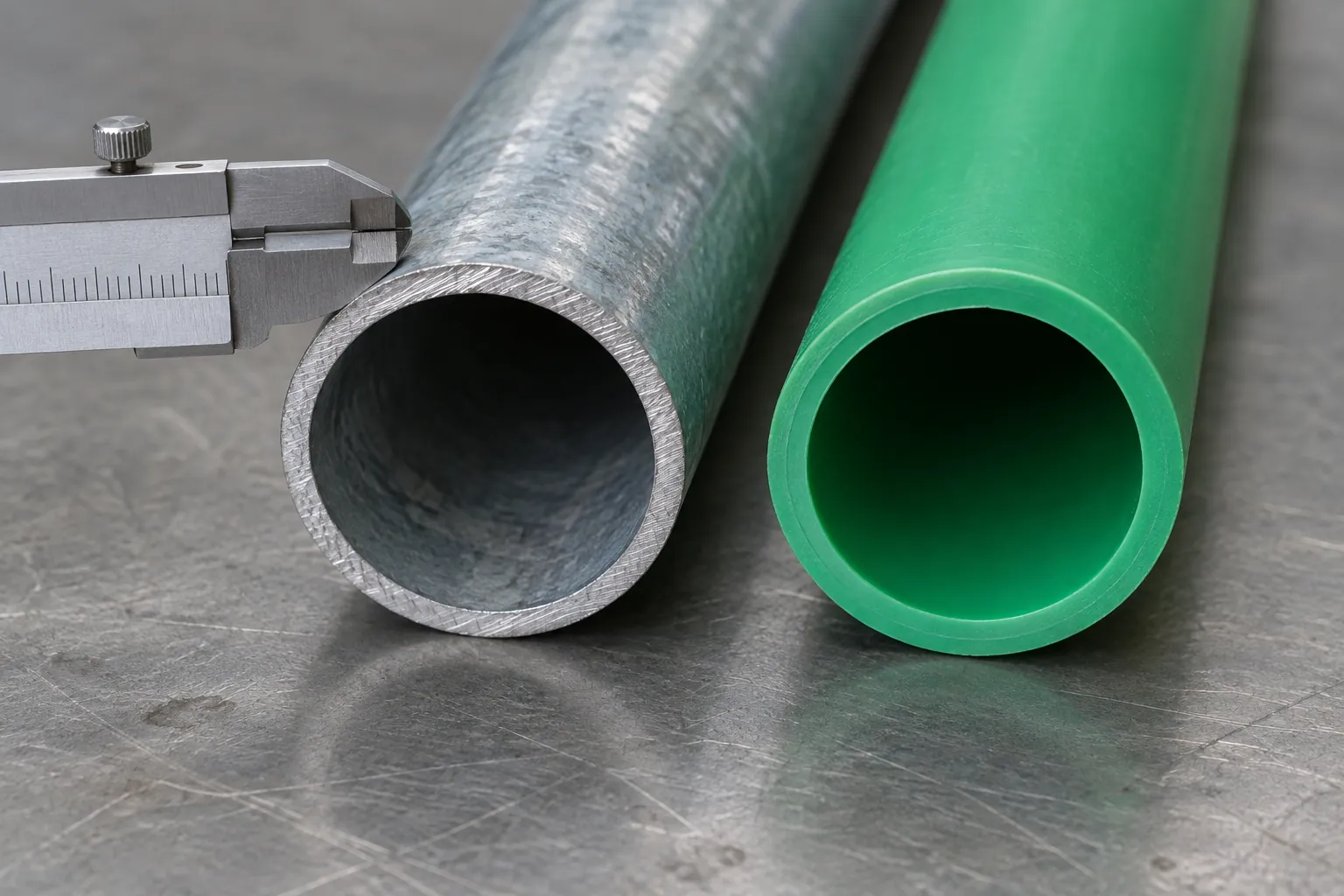
DN, NPS and OD: three names, three diameters
DN is a name. Under ISO 6708 it maps one-to-one onto inch sizes, so steel DN15 is NPS 1/2 with a 21.34 mm outside diameter. ISO 15874-2 designates PP-R as DN/OD, and DN/OD 20 is a 20 mm pipe. Trade habit then calls that pipe “1/2 inch”, which is how a 21.34 mm steel line and a 20 mm plastic line land on the same schedule row. The PP-R size conversion chart covers those labels.
PVC is the sharpest trap because it exists in both systems. A 4 in ASTM D1785 pipe is 114.3 mm OD; the nearest ISO 1452-2 PVC-U size is 110 mm. The 4.3 mm gap means an inch pipe will not enter a metric solvent-cement socket, so the spec needs a transition fitting. Check which OD series every PVC line uses before comparing walls, and see connecting PVC to PP-R for the plastic-to-plastic joint.
Where PN fits: a pressure class, not a wall
Pressure labels answer a different question. Schedule pressure ratings fall as size rises: ASTM rates PVC Sch 40 at 600 psi at 1/2 in and 220 psi at 4 in, both at 73 °F. In PP-R, ISO 15874-2 clause 6.2.2 picks the S series from the application class and the design pressure, so one pressure can need different walls at different service temperatures. Compare walls in millimetres and pressures under stated conditions, never one through the other. The pressure rating explainer covers the arithmetic, and the PP-R SDR and PN tables cover the PP-R series.
Reading a mixed-standard spec, line by line
Run each line of the spec through the same five questions:
- Which system is it? A schedule number means ASME or ASTM inch sizes; SDR, S or a metric OD means an ISO series.
- What is the outside diameter? Take it from that system’s table, never from the DN.
- What is the wall basis? Steel schedule walls are nominal, so take 87.5% for A53 pipe. PVC schedule and ISO plastic walls are already minimums.
- Write the line as OD × minimum wall in millimetres.
- Does the line give only a PN? Stop and ask for the S series or SDR.
| Spec line as written | OD × minimum wall (mm) | Basis | Ask the supplier for |
|---|---|---|---|
| DN50 Sch 40 carbon steel | 60.33 × 3.42 | 3.91 nominal less 12.5% (A53) | Pipe specification and mill certificate |
| 2 in Sch 80 PVC | 60.33 × 5.54 | ASTM D1785 minimum wall | D1785 print line on the pipe |
| 63 mm PP-R SDR 11 | 63 × 5.8 (up to 6.5) | ISO 15874-2 minimum, +0.7 tolerance | S 5 on the print line |
| 63 mm PP-R PN 20 | Not convertible | PN names no wall | S series and application class |
Source: Calculated from ASME B36.10 Table 2-1 walls, ASTM A53/A53M clause 10.3, ASTM D1785 minimum walls and ISO 15874-2:2013 Tables 5 and 9.
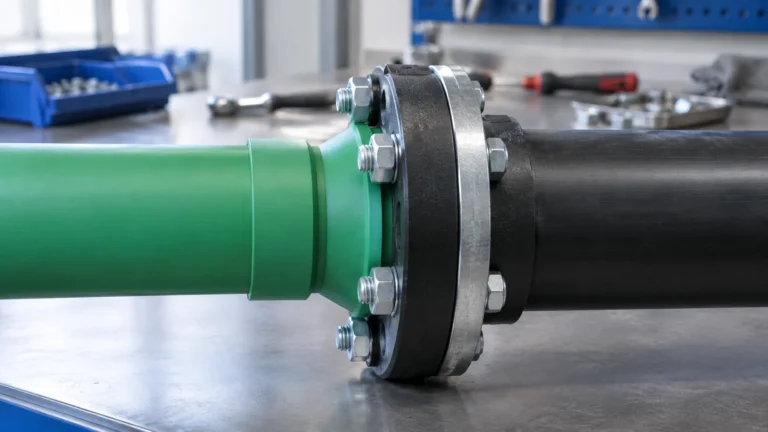
Where a steel riser meets a PP-R branch, the joint is a threaded transition, covered in connecting PP-R to metal pipe. Convert both sides before you approve the transition part, because the steel thread size follows the NPS while the PP-R socket follows the metric OD.
What we check, and where we stop
On PP-R, Hitze checks outside diameter, wall thickness at several points around the section and ovality against the S-series tables before pipe ships, as the quality control page sets out. That is the check a converted line makes possible: a wall measured below the ISO 15874-2 minimum at any point fails, whatever the label says. Where we stop: a per-size wall table is not yet published on this site, so ask for the measured values against the line you converted rather than assume them.

Lead time and what to write on the order
Put the converted figure on the order: outside diameter, S series or SDR, and the standard, for example “63 × 5.8 mm, S 5, ISO 15874-2”. That is a line goods-in can measure. Lead time depends on whether each OD and S-series pair is a stocked series or a special run, and on order length; no figure is printed here because none is confirmed per order, so ask for it per SKU with the quote. Hitze supplies PP-R from 20 to 110 mm OD with no MOQ. Request the current TDS with the quote and check it against ISO 15874-2 Table 5 before approval.
Conclusion
The expensive error on a mixed spec is a quiet one: a “Sch 40 equivalent” plastic line that fits at 1/2 in and fails at 2 in, or a steel wall 12.5% under its table value that is still in specification. Convert every line to OD × minimum wall in millimetres, and hold any PN-only line until it names a series. Check the first delivery against those converted figures, not against the label.
Frequently asked questions
Is Schedule 40 the same as SDR 11?
No. OD divided by the Sch 40 wall runs from 7.7 at NPS 1/2 to 19.0 at NPS 4, so Sch 40 matches no single SDR. Compare walls in millimetres, size by size.
Is the wall in a pipe schedule table a minimum?
For steel to ASME B36.10 it is a nominal wall, and ASTM A53 allows the wall to be up to 12.5% under it at any point. ASTM D1785 PVC and ISO plastic tables give minimum walls.
What wall thickness is 20 mm PP-R pipe?
Under ISO 15874-2:2013 Table 5: 1.9 mm at S 5 (SDR 11), 2.8 mm at S 3.2 (SDR 7.4) and 3.4 mm at S 2.5 (SDR 6). All are minimum walls with a plus-only tolerance.
Why does 4 inch PVC pipe not fit 110 mm fittings?
ASTM D1785 4 inch PVC is 114.3 mm OD, while ISO 1452-2 PVC-U uses a 110 mm OD. The 4.3 mm difference needs a transition fitting.