The call comes from the flat above. A hot-water branch ticks when the boiler fires, a riser hisses at night, and the tenant wants to know what the builder will do. In Germany the answer is already written down: DIN 4109-1:2018-01, Table 9, lets a water installation put no more than LAF,max,n 30 dB into someone else’s living or sleeping room, 35 dB into a teaching or working room.
Lagging fixes half of that, the airborne half radiating off the pipe wall. The rest travels through the clamp into the slab, where no thickness of insulation reaches it. The job is three moves: keep the fitting noise low, decouple every fixing, and fit the lagging at the thickness the energy code already demands. Our insulation decision guide covers whether PP-R needs lagging at all.
Key Takeaways
- DIN 4109-1:2018-01 Table 9 caps building-services noise in a neighbour’s living or sleeping room at LAF,max,n 30 dB, and 35 dB in a teaching or working room. That is a room level, not a pipe property.
- The same standard specifies no pipe clamp, no bracket and no decoupling detail. It sets the result and leaves the method to whoever fixes the pipe.
- German law already sets the lagging thickness by inner diameter: 20 mm up to 22 mm bore, 30 mm to 35 mm bore, then a thickness equal to the bore, at λ 0.035 W/(m·K).
- Real elastomeric tube runs at 0.0383 W/(m·K) at 40 °C mean, so a dn32 PP-R line needs 35 mm of it to match the 30 mm the table states.
- The law halves that thickness at penetrations, crossings, joints and manifolds. On dn32 the halved section conducts 1.57 times the heat per metre of the run either side.
- A 6 m PP-R branch warmed 40 K moves 36 mm. Fibre-reinforced wall construction cuts that to 8.4–12 mm, and the clamp has to let whatever remains slide.
Under three minutes on a ticking heating pipe, and where that noise is actually released.

What Actually Makes a PP-R Heating Pipe Audible
Two paths carry the noise. Airborne noise starts at the valve or the outlet fitting and radiates off the pipe wall. Structure-borne noise leaves through the clamp, enters the slab or the stud, and re-radiates in a room two floors from the fitting that made it.
German practice puts numbers on the first path before the pipe is chosen. DIN 4109-1:2018-01, clause 11 and Table 11, sorts drinking-water fittings by installation noise level to DIN EN ISO 3822, tested at 0.3 and 0.5 MPa: group I outlet fittings at 20 dB or less, group II through-flow fittings, pressure reducers and shower heads at 30 dB or less. Specify a group II tap under a 30 dB room limit and the fitting has spent the whole allowance alone.
Velocity is where designers go wrong. DIN 1988-300 holds the house connection line to 2 m/s and allows up to 5 m/s in consumption pipework, depending on continuous draw-offs and valve resistances. Both are sizing limits, not acoustic thresholds: size at 4 m/s because a standard permits it, call the result quiet, and you have bought a complaint. Flow rate and pressure drop in PP-R carries the sizing side.
| Protected room type, DIN 4109-1:2018-01 Table 9 | Room limit (dB) | Group II fitting (dB) | Group I fitting (dB) |
|---|---|---|---|
| Living / sleeping room | 30 | 30 | 20 |
| Teaching / working room | 35 | 30 | 20 |
The Clamp Decides Whether the Lagging Does Anything
Read DIN 4109-1:2018-01 end to end and you will not find a pipe clamp in it. The standard names the level allowed in the receiving room and specifies no fixing, no bracket spacing, no elastic interlayer, no sleeve detail. The structure-borne path is left to the installer, which is why two buildings with identical drawings measure differently.
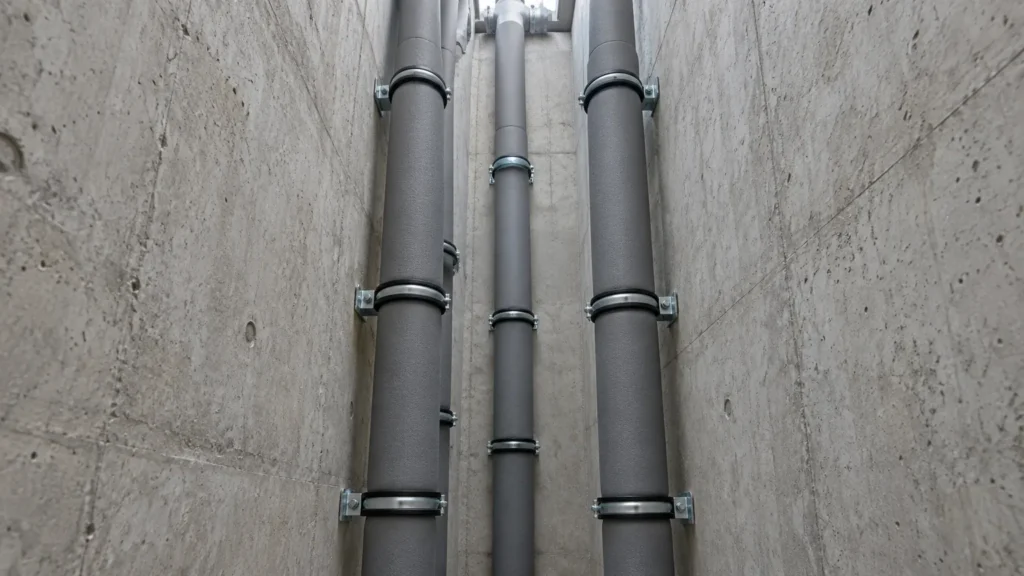
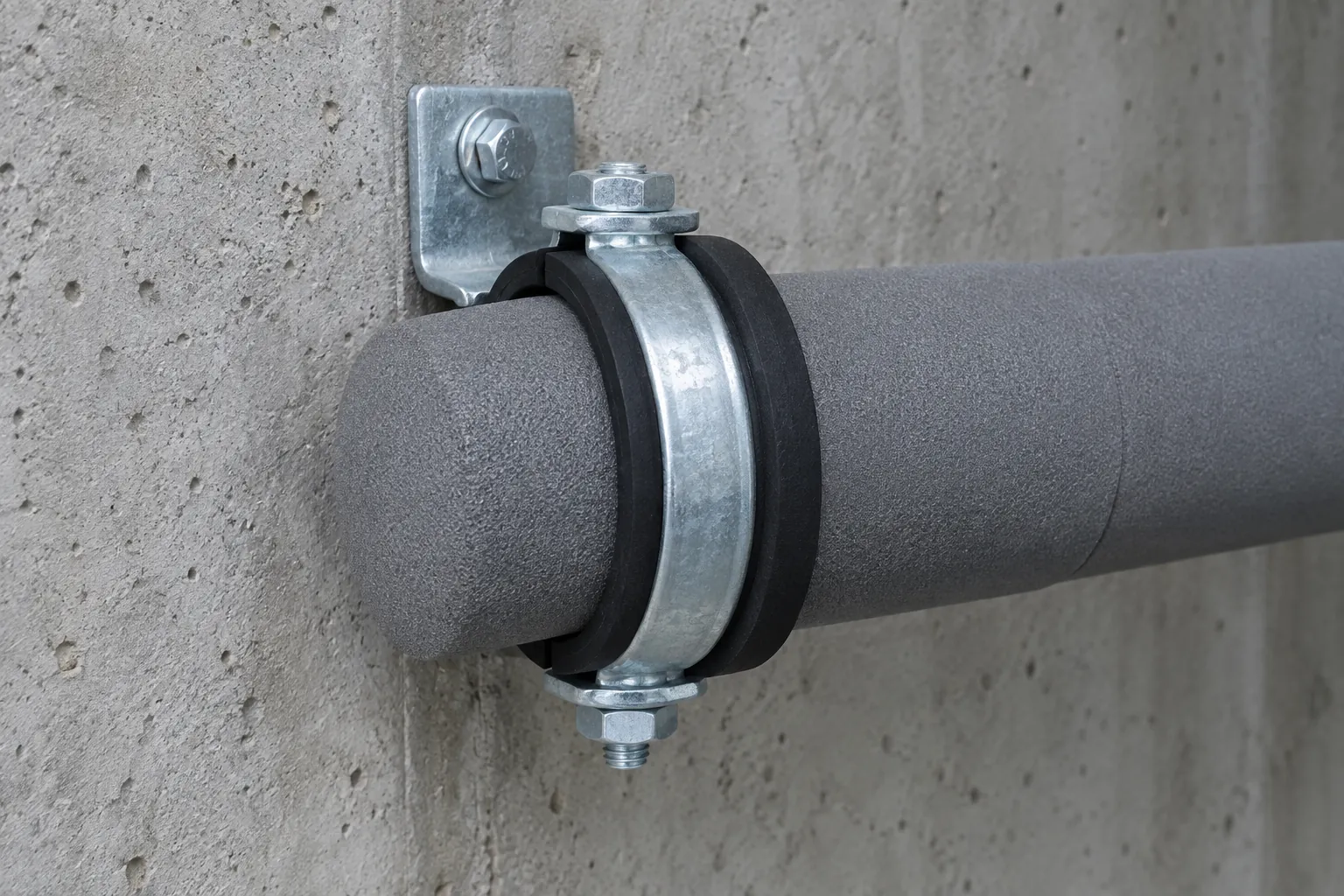
German practice fills the gap the same way each time: a system clamp whose elastomer profile separates pipe from bracket, and an elastic layer wherever the installation touches the building fabric. Cents per fixing. Getting it wrong costs a chased wall.
The clamp matters twice over on PP-R. Standard PP-R expands 0.15 mm per metre per kelvin, so a 6 m branch warmed 40 K grows 36 mm; fibre-reinforced construction cuts that to 8.4–12 mm. Clamp the movement rigidly and the pipe releases it in steps, and those steps are the tick a tenant hears when the boiler fires. Guide clamps let it slide, anchors decide where it goes: see the support spacing and expansion guide and the wall-construction comparison.
How Thick the Lagging Has to Be Before Acoustics Even Asks
On a German project the thickness is settled law. Anlage 8 of the federal buildings energy act bands heat-distribution and hot-water pipes by inner diameter, with every figure referred to an insulation conductivity of 0.035 W/(m·K) at 40 °C mean. The bands run 20 mm up to a 22 mm bore, 30 mm from 22 to 35 mm, a thickness equal to the bore from 35 to 100 mm, and 100 mm above that.
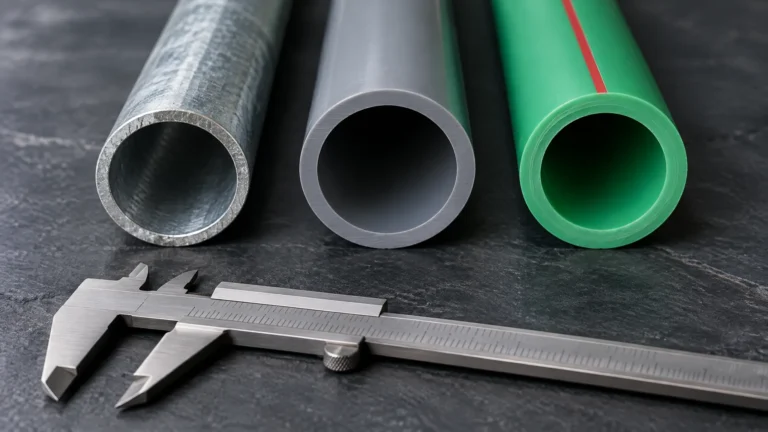
Two things follow. The law counts the bore, and a plastic pipe carries a thick wall, so a PP-R line often sits one band below the metal line it replaced. And 0.035 W/(m·K) is a reference, not a product: AF/Armaflex declares 0.0383 W/(m·K) at that same 40 °C mean, stone wool 0.037 at 50 °C. Nummer 3 requires the conversion, so the buyable thickness sits in the last two columns, not in the statute.
| PP-R size (mm OD) | Bore, series S3.2 (mm) | Statutory minimum at λ 0.035 (mm) | Elastomeric at λ 0.0383 (mm) | Stone wool at λ 0.037 (mm) |
|---|---|---|---|---|
| dn20 | 14.4 | 20 | 23.3 | 21.9 |
| dn25 | 18.0 | 20 | 23.0 | 21.8 |
| dn32 | 23.2 | 30 | 34.8 | 32.9 |
| dn40 | 29.0 | 30 | 34.5 | 32.7 |
| dn50 | 36.2 | 36 | 41.3 | 39.2 |
| dn63 | 45.8 | 46 | 52.8 | 50.1 |
Acoustic lagging is rarely a second layer over this one. It is the same layer bought in a product that also does an acoustic job, so a wrap chosen on its sound data and fitted at 13 mm fails an energy inspection on a dn32 line needing 35 mm. Size from the table first, then ask the acoustic question. The heat-loss calculation guide works the same geometry thermally.
Where the Thermal Bridges Hide on an Insulated PP-R Run
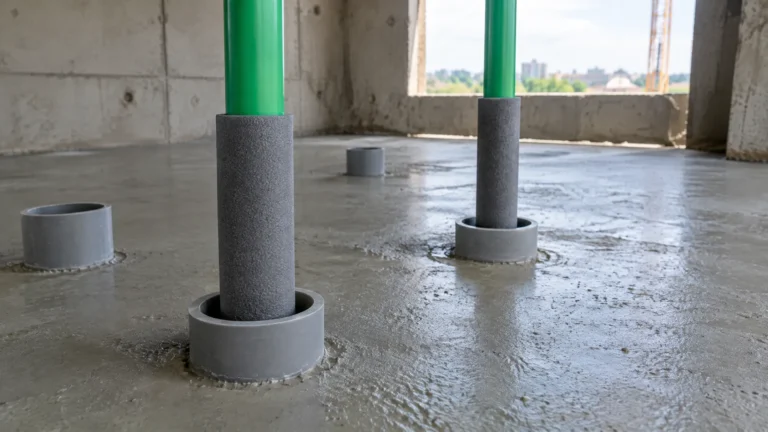
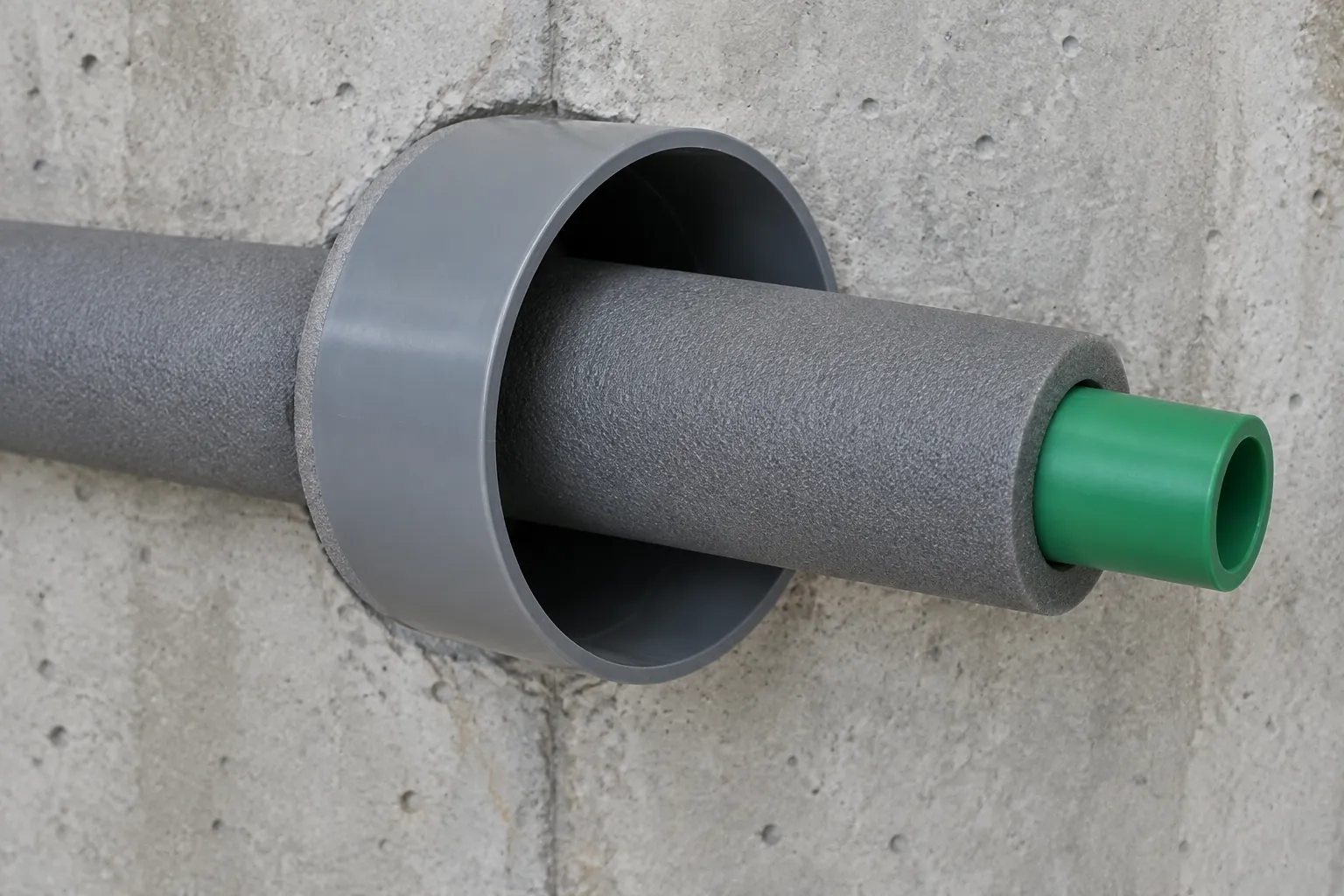
The same annex gives the thickness back. Anlage 8 Nummer 1 a ee halves the required layer in wall and ceiling penetrations, where pipes cross, at joints and at central manifolds. A pipe inside a floor build-up needs 6 mm; a pipe bordering outside air needs double.
That list names every place a fitter is tempted to stop insulating anyway, and it is a concession to space rather than an invitation. On dn32 the full 34.8 mm elastomeric layer has a linear resistance of 4.80 m·K/W against 3.06 m·K/W halved to 17.4 mm, so the shortened section conducts 1.57 times the heat per metre of the run either side, on lagging conduction alone. Stop the lagging dead at the sleeve and the multiplier becomes a wet patch.
One clause favours a plastic pipe. Anlage 8 Nummer 4 allows a reduced thickness where an equivalent limitation of heat emission is ensured, and it names the insulating effect of the pipe walls as something to count. PP-R sits at 0.23 to 0.24 W/(m·K) on published material data, a resistance worth counting where a copper wall has none. Two details keep the bridge closed: a clamp with a load-bearing insulation insert, so the lagging runs through the fixing, and a sleeve wide enough to pass the insulation through the wall unbroken.
What We Check, and What to Put in the Specification
A specification that says “insulate to reduce noise” gets priced as tape. The version that survives a site meeting names the location, the measures, and the call to make when the space runs out.
| Where on the run | Lagging, dn32 (mm) | Fixing detail | Verdict if space is short |
|---|---|---|---|
| Open riser in a shaft | 34.8 | Guide clamps with elastomer profile; anchor set deliberately | Space exists in a shaft. Fit full thickness. |
| Wall or slab penetration | 17.4 (halved allowance) | Sleeve sized for unbroken lagging; no mortar contact | Enlarge the sleeve before thinning the layer. |
| Branch above a ceiling | 34.8 | Clamp with load-bearing insert; hanger isolated from soffit | Reroute rather than clamp bare pipe to the slab. |
| Inside a floor build-up | 6 (statutory minimum) | Pipe fully sleeved or wrapped; no direct screed contact | Screed contact is the failure. Keep the wrap continuous. |
| Manifold or valve group | 17.4 (halved allowance) | Cabinet lined; fittings specified to group I where fitted | Specify the fitting group before adding lining. |
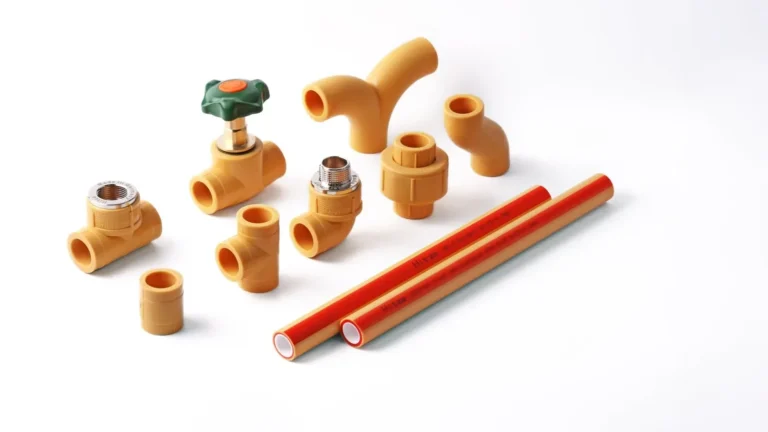
What a pipe maker can evidence is narrower than a brochure implies. Hitze builds PP-R from OD 20 to 110 mm in four wall constructions. In the plant, resin is verified before extrusion, diameter, wall thickness and ovality are checked against the S-series tables, and fused assemblies are hydrostatically tested to the DIN and EN ISO thresholds. SKZ testing covers the pressure pipe and fittings, a DVGW type examination the drinking-water pipe, and certificate references are available on request. The PP-R pipe and fittings range lists the sizes.

The part most suppliers skip: no acoustic test data exists for this pipe, no installation noise level to DIN EN ISO 3822, no sound-reduction figure for a clamped assembly, no measured comparison against copper. Ask any supplier for one of the three and you learn fast whether a quiet-pipe claim has a document behind it. Where the number is genuinely needed it comes from a measurement to ISO 16032:2024 or a prediction to EN 12354-5:2023, both consultant work rather than catalogue work.
Fitting It in Order
Work it in this sequence and the acoustic question stops being a retrofit:
- Write the room limit into the document first. Without a target level nothing below it is checkable.
- Specify the fitting group. A group II tap alone can spend a 30 dB allowance.
- Size the lagging from the bore, then convert it for the λ of the product you buy.
- Detail every clamp, sleeve and penetration on the drawing. The standard will not do it for you.
- Leave the pipe room to move: 36 mm on a 6 m standard PP-R branch at 40 K.
Then ask for the wall-and-SDR matrix and certification scope in writing, before thicknesses reach the drawing.
Frequently Asked Questions
Does insulating a PPR pipe stop the noise?
It stops part of it. Lagging works on the airborne path, the sound radiating off the pipe wall, and does nothing for noise travelling through the clamp into the slab. DIN 4109-1:2018-01 sets the room limit at LAF,max,n 30 dB in a neighbour’s living or sleeping room but specifies no fixing detail, so the structure-borne half is decided by the clamp you choose.
How thick should insulation on a PPR heating pipe be?
In Germany the thickness is statutory and banded on the bore: 20 mm up to a 22 mm inner diameter, 30 mm from 22 to 35 mm, then a thickness equal to the bore, all referred to λ 0.035 W/(m·K). Converted for elastomeric tube at 0.0383 W/(m·K), a dn32 PP-R line needs 34.8 mm and a dn50 line 41.3 mm.
Is PPR quieter than copper pipe?
No published measurement in our hands answers that, and Hitze holds no acoustic test data for its own pipe. The mechanisms differ, and a plastic wall at 0.23 to 0.24 W/(m·K) behaves unlike metal thermally, but a dB comparison needs a test to DIN EN ISO 3822 or a room measurement to ISO 16032:2024. Ask for the document, not the claim.
Can I thin the insulation where the pipe passes through a wall?
German law allows half the normal thickness in wall and ceiling penetrations, at pipe crossings, at joints and at central manifolds. It costs something: on dn32 the halved layer conducts 1.57 times the heat per metre against the full layer, on lagging conduction alone. Enlarging the sleeve is the better move where the opening can still be changed.