Technical Authority · Engineering
The Engineering Inside Every Hitze Pipe
German-engineered from the core out — 5-layer multilayer construction, controlled PEX crosslinking, and a true EVOH oxygen barrier built to DIN 4726. This is the technology wholesalers, contractors and spec engineers ask us to prove. So we show it.
Hitze designs heating and potable-water piping to German standards. On this page we open up the construction — how a 5-layer PEX-AL-PEX pipe is built, what separates PEX-a from PEX-b and PEX-c, why an oxygen barrier decides whether a boiler survives a decade of hydronic service, and the temperature-pressure numbers you can drop straight into a spec. No marketing — just the engineering, with the standards cited.
Trade & bulk supply only — technical data ships to verified trade accounts.
 EN ISO 21003 · DIN 4726
Where It’s Built
Inside the Pipe Line — From Extrusion to Cross-Section
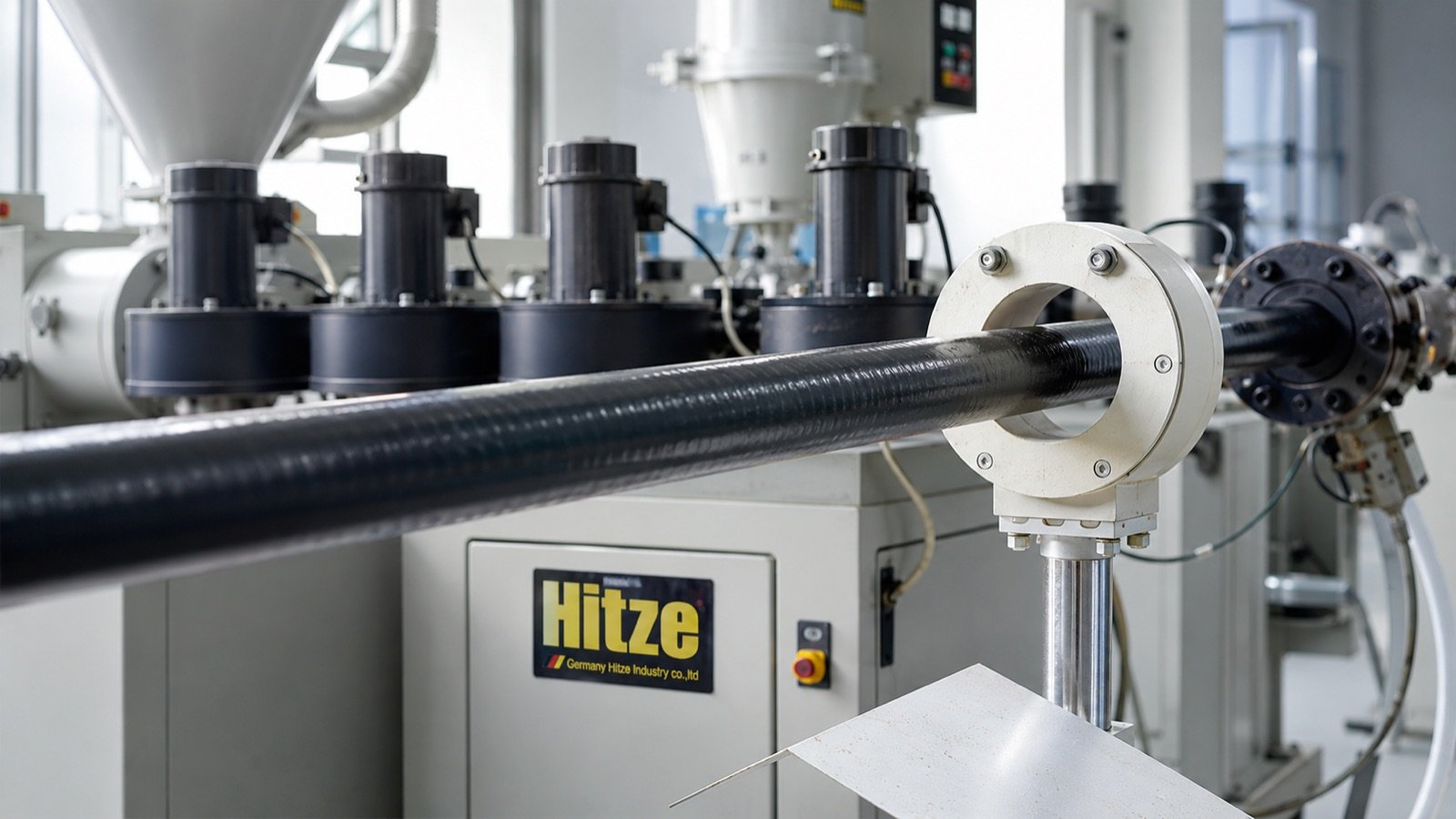
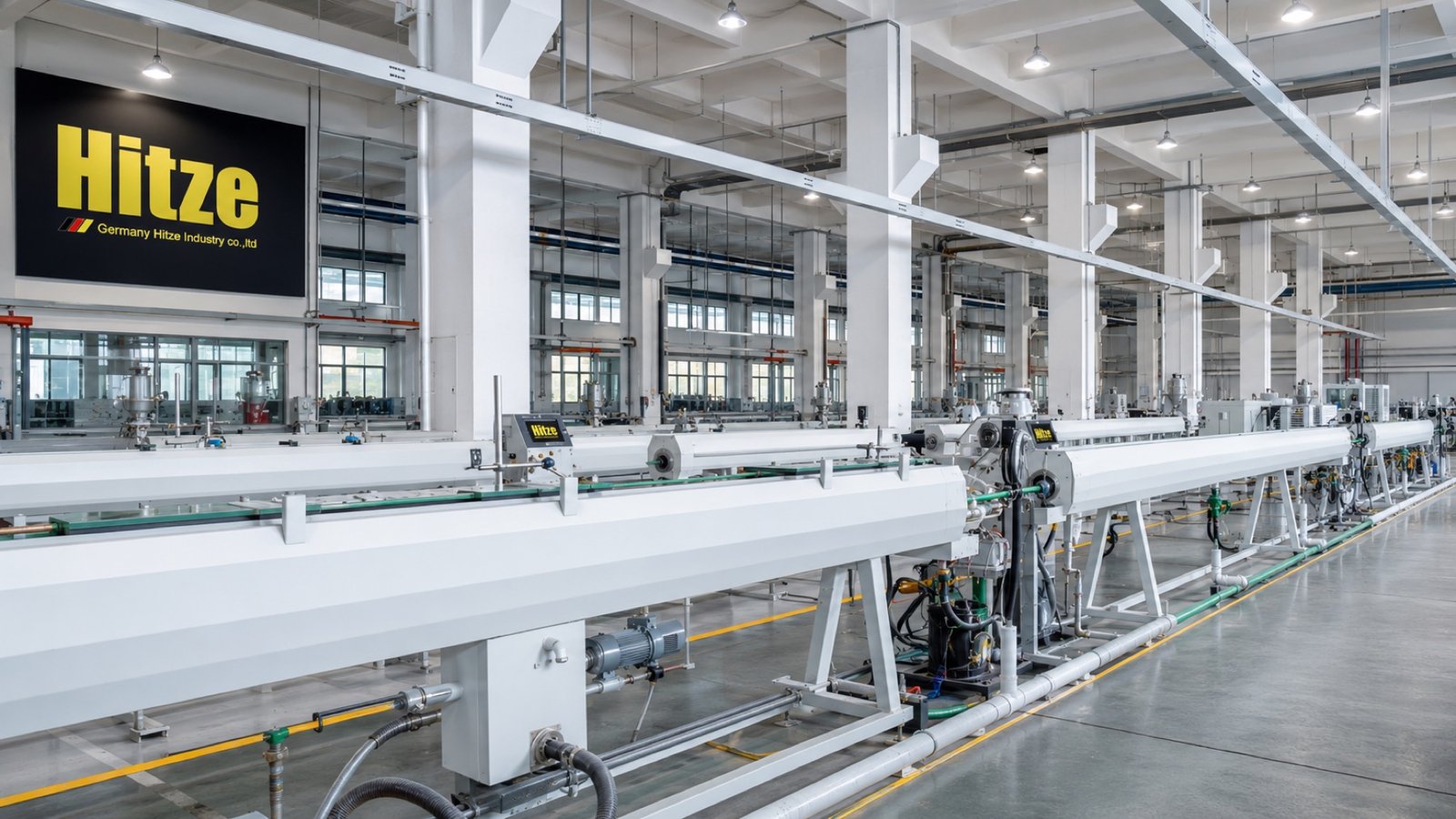
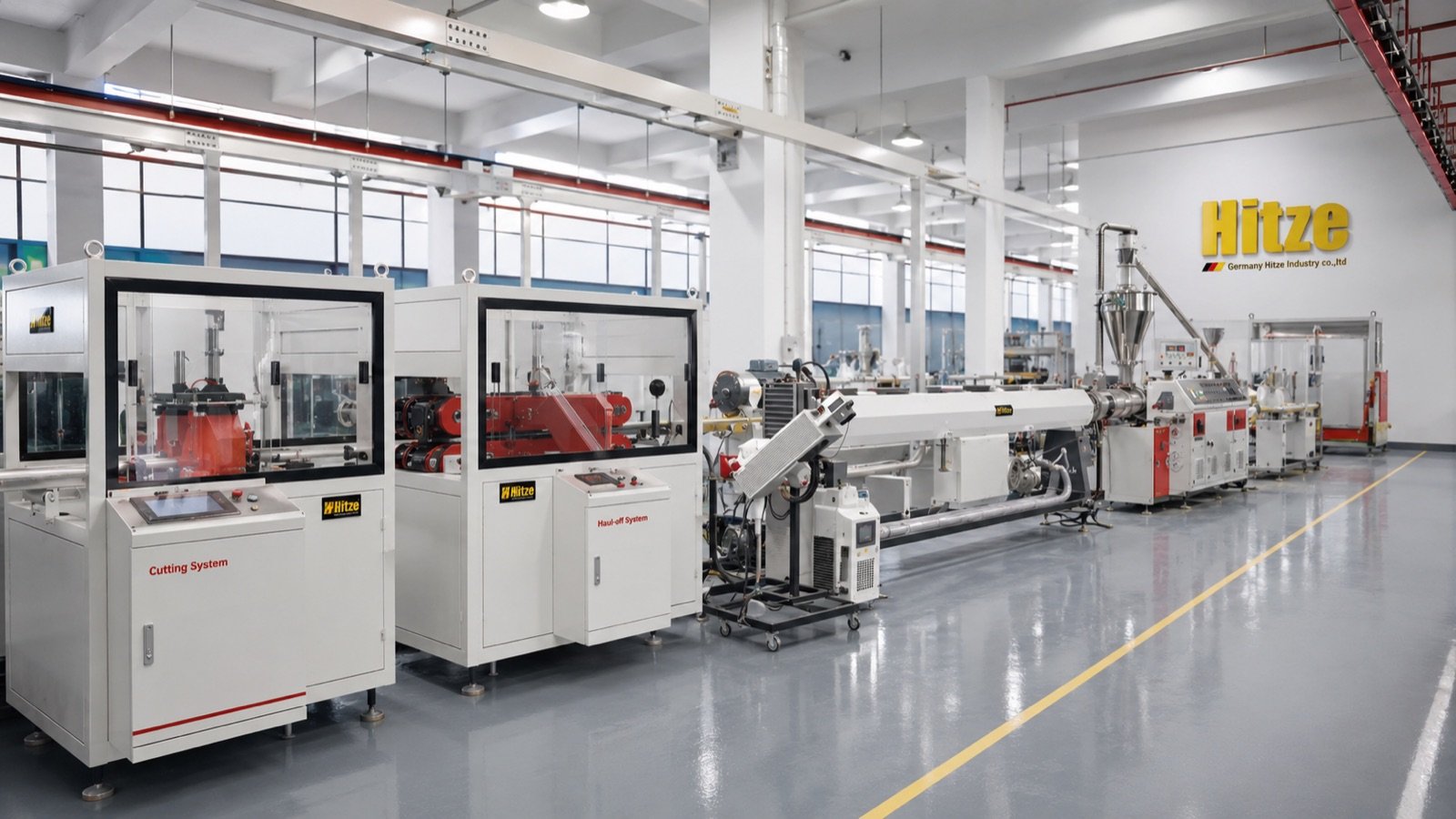
The engineering on this page starts on a real extrusion line. Below: our production floor, plus captioned frames of the construction details we cut open to prove it. (Cross-section and layer photography is being finalized; captioned frames show the exact shots.)
Construction
Multilayer Pipe vs PEX: The 5-Layer Construction Explained
A Hitze multilayer composite pipe (PEX-AL-PEX or PERT-AL-PERT) is not a plastic tube — it’s five bonded layers working as one.
| Layer | Material | Function |
|---|---|---|
| 1 (inner) | PEX-b / PE-RT | Smooth potable-safe flow surface, high-temperature resistance |
| 2 | Adhesive tie layer | Molecular bond to the aluminium core |
| 3 (core) | Butt-/overlap-welded aluminium | 100% oxygen-tight barrier, shape retention, low thermal expansion |
| 4 | Adhesive tie layer | Molecular bond to the outer wall |
| 5 (outer) | PEX-b / PE-RT | Mechanical & abrasion protection |
Why it matters vs plain PEX: the aluminium core makes the pipe hold its bend (no coil memory, easier layout), cuts thermal expansion to roughly 1/7 of plain plastic, and gives a 100% oxygen barrier by construction — not just a coating. That’s why multilayer is specified for both radiant floor heating and potable risers where plain PEX would spring back or over-expand.
- Common sizes: 16 / 20 / 25 / 32 mm
- Aluminium core makes oxygen diffusion through the wall effectively zero
- Compliant with EN ISO 21003 (multilayer) and ASTM F1281 / F1282 (PEX-AL-PEX)
- Per-SKU wall and aluminium-layer values: available on request in the TDS
Process Depth
PEX Crosslinking Methods: PEX-a, PEX-b and PEX-c
“PEX” describes the result — crosslinked polyethylene — not how it’s made. The crosslinking method changes flexibility, crosslink degree and install behavior. Hitze supplies all three, matched to the application.
| Type | Method | Crosslink degree | Key trait | Best for |
|---|---|---|---|---|
| PEX-a | Peroxide (Engel), crosslinked in the melt | ≥70–85% | Highest flexibility, thermal shape-memory (heat repairs kinks), tightest coil radius | Radiant floor heating, tight retrofits |
| PEX-b | Silane / moisture-cure | ≥65–70% | Stiffer, lower cost, strong track record | Potable plumbing, general distribution |
| PEX-c | Electron-beam irradiation | ≥60–70% | No chemical catalysts, clean process | Value lines, straight runs |
Why PEX-a for heating: its uniform, high crosslink degree gives the flexibility and thermal memory installers want — a kinked run can be heat-repaired instead of cut out, and the pipe coils to a small radius for dense underfloor loops. All Hitze PEX is manufactured to ASTM F876 / F877 (US) and EN ISO 15875 (EU).
Not sure which PEX grade fits your line? Start Custom Spec →
Oxygen Barrier · DIN 4726
EVOH Oxygen Barrier & DIN 4726 Compliance
In a sealed hydronic heating loop, dissolved oxygen is the enemy. Oxygen that diffuses through the pipe wall corrodes steel boilers, pumps and brass/steel manifolds from the inside — the failure homeowners never see coming. The fix is an oxygen barrier.
- On PE-RT and PEX heating pipe, Hitze co-extrudes an EVOH (ethylene-vinyl-alcohol) barrier layer that blocks oxygen diffusion.
- On multilayer PEX-AL-PEX, the aluminium core is itself a 100% oxygen barrier — no diffusion is physically possible through metal.
- Both are engineered to the DIN 4726 oxygen-diffusion limit for hydronic underfloor systems: ≤ 0.10 g/m³·day at 40 °C.
Standard cited: DIN 4726 defines the maximum permissible oxygen permeation for plastic pipes in warm-water heating. Meeting it is what lets an MEP consultant spec Hitze pipe into a closed-loop system with confidence.
Spec’ing a closed-loop system? Request Technical Data → Underfloor Heating Pipe →
Validation
Pressure-Cycle & Dimensional Tolerance Testing
Engineering only counts if it holds up. Piping intended for heating and potable service is validated against standard test regimes.
Hydrostatic / Long-Term Pressure
Sustained internal pressure at elevated temperature to confirm the design-stress rating, per EN ISO 15875-2 / ASTM F876.
Thermal & Pressure Cycling
Repeated hot/cold and pressure cycles simulating years of hydronic operation — checking for delamination in multilayer and joint integrity.
Dimensional Tolerance
Outer diameter, wall thickness and ovality held to tight tolerance so press and push-fit fittings seat and seal reliably (jaw-profile compatible TH/U/F/M).
Oxygen-Permeation
Barrier verified to the DIN 4726 diffusion limit for warm-water heating pipe.
Hitze’s measured test results and lot certificates are available on request. Tolerance control is what ties the pipe to the connection method — hold the OD and wall tight, and press and push-fit fittings seal on the first go.
Ask for the test protocol summary → Matched Press Fittings →
The Manufacturer Behind It
Engineered in Germany, Made at Scale
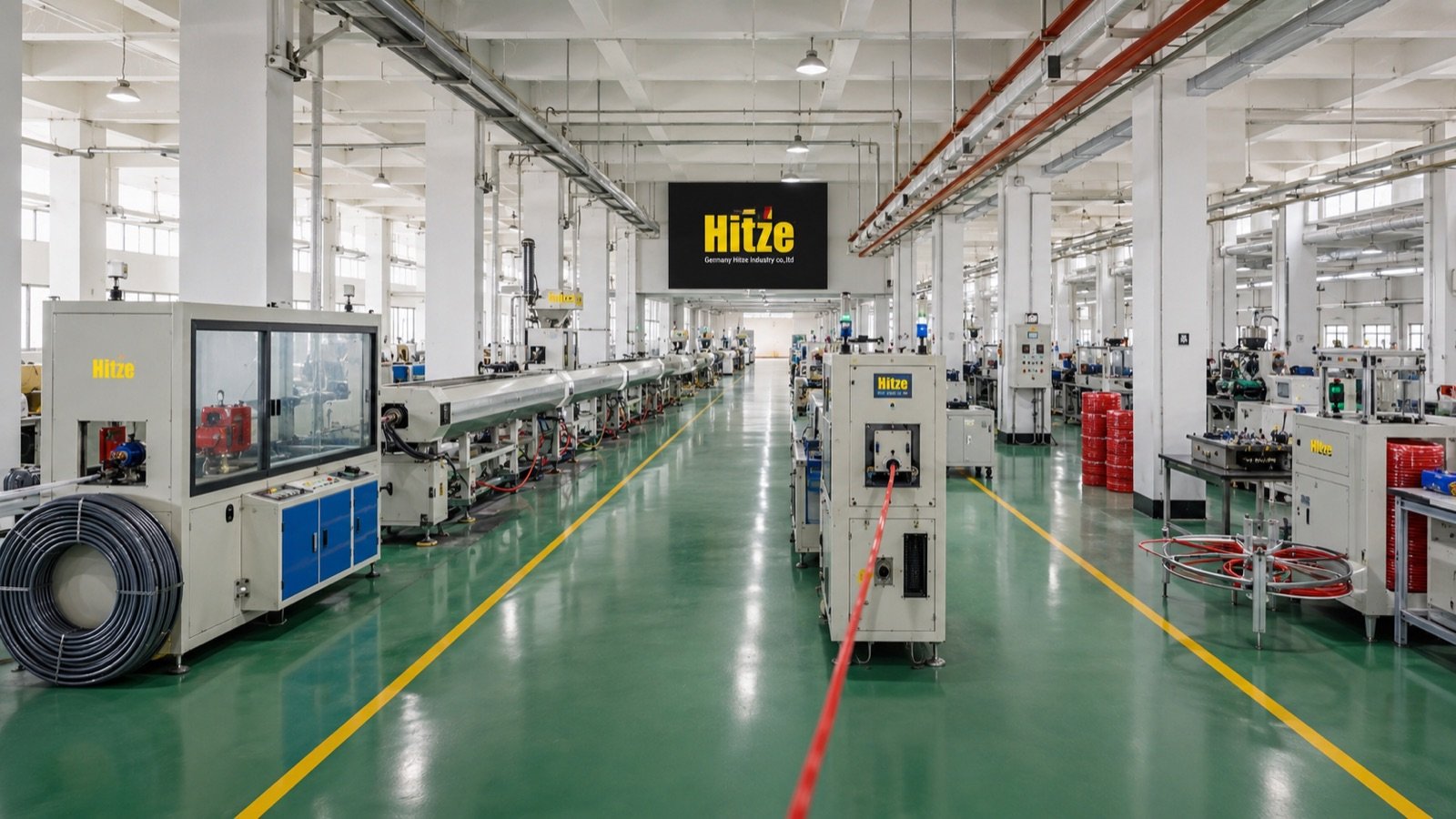
The specs above aren’t a datasheet in isolation — they’re what an established plant produces day in, day out. Hitze is a German brand with a manufacturing base built to hold these tolerances at volume.
Founded in 1974, Hitze runs a 120,000 m² production base with 1,000+ employees, exporting to 118+ countries. Pipe is designed to German DIN / EN ISO standards and validated to the test regimes on this page — the same discipline that lets a private-label buyer put their own brand on the wall and stand behind it.
See It · Cut It · Spec It
Request a Technical Sample Card
Reading about a 5-layer wall is one thing — cutting one open is another. The Hitze Technical Sample Card puts the engineering in your hands: cross-sectioned multilayer pipe with visible aluminium core, a PEX-a coil segment, a press fitting, and the EVOH barrier layer, all labelled with the standards they meet. For wholesalers, private-label buyers and spec engineers who evaluate before they commit.
Hitze supplies trade only — wholesalers, contractors, importers and private-label brands. Not a homeowner retail store. Sample cards ship to verified trade accounts.
Every element on the card is labelled with the standard it meets, so a technical buyer can verify construction, wall thickness and barrier layer before committing to a brand or a spec.
Get the Complete Technical Data Pack
TDS by product family · 5-layer construction diagrams · PEX crosslinking guide · EVOH / DIN 4726 oxygen-barrier note · temp-pressure & SDR tables. Email required.
Request Technical Data (TDS + White Paper) → Start Custom Spec →
Apply the Engineering
See the Pipe Families These Specs Apply To
This is the technical hub. When you’re ready to select and order, the specs above map directly to these ranges — and every standard cited here is verifiable in the Cert Pack.
FAQ
Pipe Technology FAQ
Does the oxygen barrier meet DIN 4726?
What temperature and pressure can it handle?
Why does Hitze recommend PEX-a for heating?
How do I know it’s a true 5-layer pipe, not a thin-wall lookalike?
Which standards can I write into a specification?
Get Started
Request the TDS & the Cert Pack
Tell us your pipe types, sizes, target market and application — we reply with the full technical data sheet, per-SKU ratings, and the certification documents for your region.