Key Takeaways
- Transit damage is a contract variable, not fate. If your purchase agreement is silent on damage allowances and claim procedure, every crushed coil becomes an argument instead of a line item.
- Coil packaging does three separate jobs — abrasion protection (film), bore cleanliness (end caps) and shape retention (strapping). A spec that names only “shrink wrap” leaves two of the three uncovered.
- PEX carries a UV-resistance category under the ASTM F876 designation code — commonly one, three or six months of rated sun exposure, tested per ASTM F2657. Weeks in a port yard count against that clock, and UV damage is invisible when it happens.
- Under ISPM 15, export pallets must be heat-treated to 56°C core temperature for at least 30 minutes and carry the IPPC mark. One unstamped pallet can hold your entire container at the border.
- Under the Hague-Visby Rules, apparent damage must be noted at delivery and concealed damage notified in writing within three days. Your receiving crew’s first hour with the container decides whether a claim exists at all.
How much transit damage is acceptable? The contract answers, not the industry
Every wholesaler who imports pipe eventually asks the same question: what damage rate is “normal”? Here is the uncomfortable answer from someone who has sat on both sides of the claim email — there is no industry-standard percentage, and any supplier who quotes you one is quoting their own tolerance, not yours. The acceptable damage rate on your shipments is exactly what your purchase contract says it is. If the contract is silent, the practical answer defaults to “whatever you failed to document within the notice window,” which usually means you absorb it.
The legal skeleton underneath ocean claims is worth thirty seconds of your attention because it drives everything your warehouse team should do on arrival day. Under Article III of the Hague-Visby Rules, loss or damage that is apparent must be noted in writing at or before the time the goods are removed into your custody. Damage that is not apparent — a kinked inner coil turn hidden under film, chipped fitting threads inside an intact carton — must be notified in writing within three days of delivery. Miss those windows and the law presumes the goods were delivered as described on the bill of lading. Suit must be brought within one year. Three days is not much time to open several hundred cartons, which is why your packaging spec and your receiving procedure are really one document.
One boundary before we go further: this article is about damage prevention and the packaging spec itself. The economics of how many coils and cartons fit in a container — and when to trade protection for cube — is a separate decision we cover in our guide to container loading for pipe coils and cartons. Read them together: the cheapest cube plan and the safest packaging plan are almost never the same plan, and the right answer for a wholesaler is usually one notch toward protection, because a damaged coil doesn’t just cost its replacement value — it costs the picking error, the customer credit and the argument.
Coil packaging: shrink film, woven bags and end caps do three different jobs
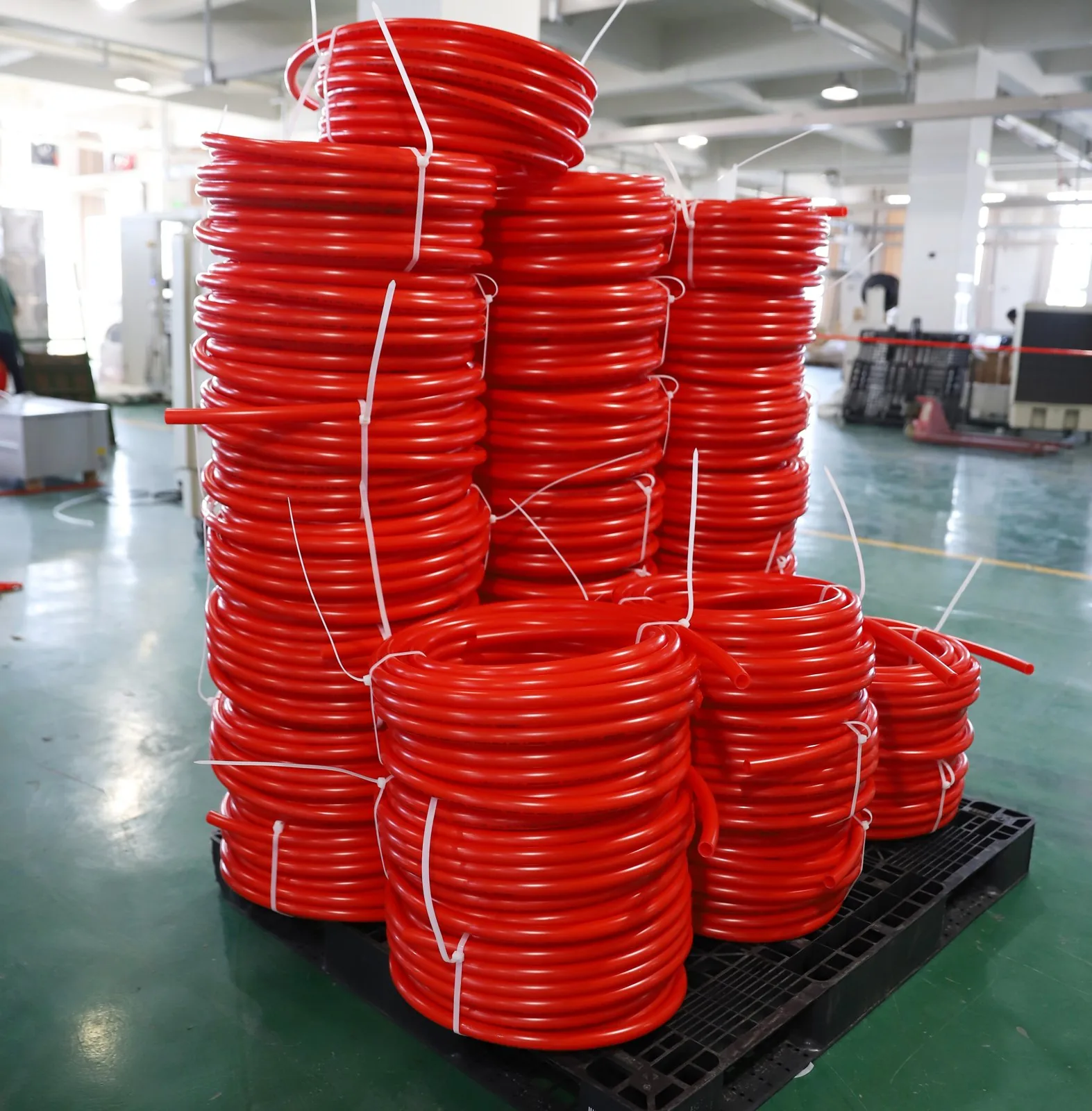
A pipe coil in transit faces three distinct threats, and each layer of packaging answers exactly one of them. Get the spec wrong and you can have a coil that arrives looking perfect and is still unsellable. First, abrasion and dirt on the outer surface — the job of the wrap. Second, contamination inside the bore — the job of end caps or taped ends. Third, shape retention — the job of strapping. A coil that sheds its straps in handling relaxes into a tangle; re-coiling small-bore PEX or multilayer pipe by hand almost always introduces kinks, and a kinked section of PEX-AL-PEX is scrap because the aluminium core creases permanently. When you write “shrink wrapped” into a PO and nothing else, you have specified one job out of three.
On the wrap itself there is a real trade-off between shrink film and woven polypropylene bags. Film is the better moisture and dust shield and it is honest — crush damage shows through it, so your receiving team can flag a suspect coil without unwrapping it. Its weakness is that it tears on fork tines and rough dunnage, and once torn it stops doing anything. Woven PP bags are far tougher against abrasion in floor-loaded containers where coils rub against each other for weeks, but they hide damage: a bagged coil can conceal a flattened arc until the installer finds it. Our recommendation: film for palletised, unitised coils that will be machine-handled; woven bags for loose floor-loaded coils where surfaces grind together — and if you take bags, extend your receiving inspection to sample-unbag a portion of every batch rather than trusting the outside view.
End caps sound like a cosmetic detail until you remember what the pipe is for. An open coil end sitting through two port yards collects diesel-laden dust deep into the bore. For a fusion or press-connected system that matters directly: contamination at the joint face is one of the classic causes of weak socket-fusion welds in PP-R and compromised sealing on O-ring press joints. Spec caps or taped ends per coil, not per pallet — a hooded pallet protects the outer coils and leaves every inner bore open to whatever circulates under the hood. And an insider warning for your receiving crew: coil damage hides on the inner turns. The outer wraps take visible scuffs; the kink from a drop on edge is two or three turns in. Any coil that arrives with broken strapping should be opened and walked through turn by turn, not shelved.
Straight lengths: strap points, end protection and the bottom-layer problem
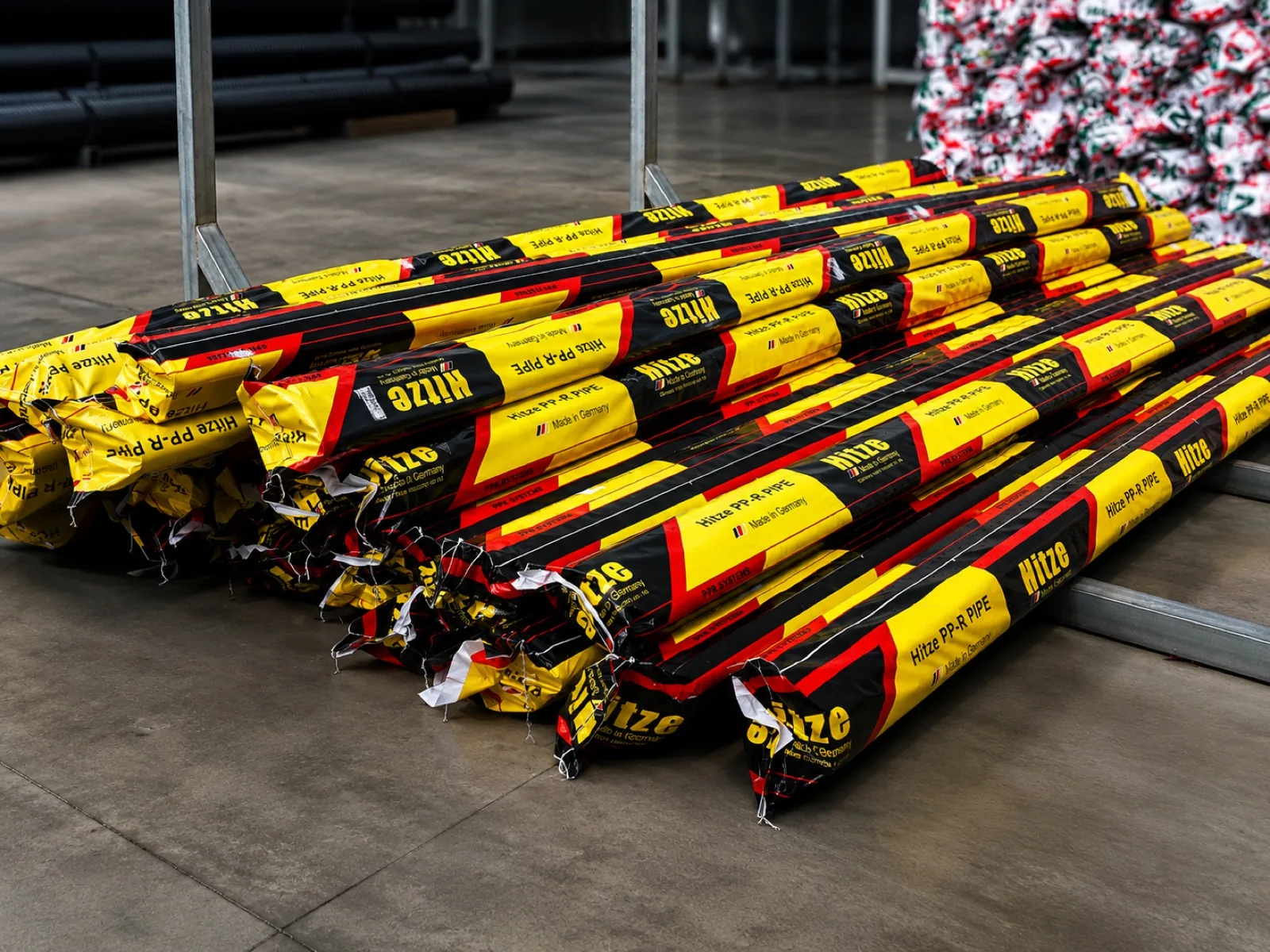
Rigid pipe — PP-R and larger HDPE — ships in straight lengths, typically 4 m for plumbing sizes, and bundles fail in predictable places. The first is the strap point itself. A steel or PET strap tensioned directly onto the outer pipes of a bundle bites into the wall and leaves a notch or a flat. On a pressure pipe a notch is not cosmetic — it is a stress riser in a wall that is engineered to hold PN16 or PN20 service for decades, and the correct disposition is reject, not discount. The fix costs almost nothing: spec edge protectors or spacer battens under every strap, and spec the strap count — bundles need straps near both ends plus intermediate points so the free overhang cannot whip and fan out during crane or fork handling.
The second failure zone is the bundle ends. During devanning, straight lengths get pushed, pulled and rammed end-first; unprotected pipe ends arrive splayed, split or packed with debris, and a split end steals usable length from every pipe in the bundle — 100 mm cut off 4 m lengths across a container is a real inventory loss that never appears in any damage photo. Spec shrink hoods or end boards over bundle ends and, for socket-ended PP-R, individual end protection on the socket side. The third zone is the bottom layer of floor-loaded lengths: fork tines and container floor bolts scar whatever sits lowest. Dunnage bearers under the first layer are a one-dollar answer to a recurring claim. If your supplier resists any of this on cube grounds, that is the protection-versus-density negotiation again — the arithmetic for that trade sits in the 40HQ loading guide, but the short version is that end boards and bearers cost you almost no cube, so a supplier refusing them is saving pennies, not space.
Fittings cartons and pallets: wall grade, weight caps and ISPM 15
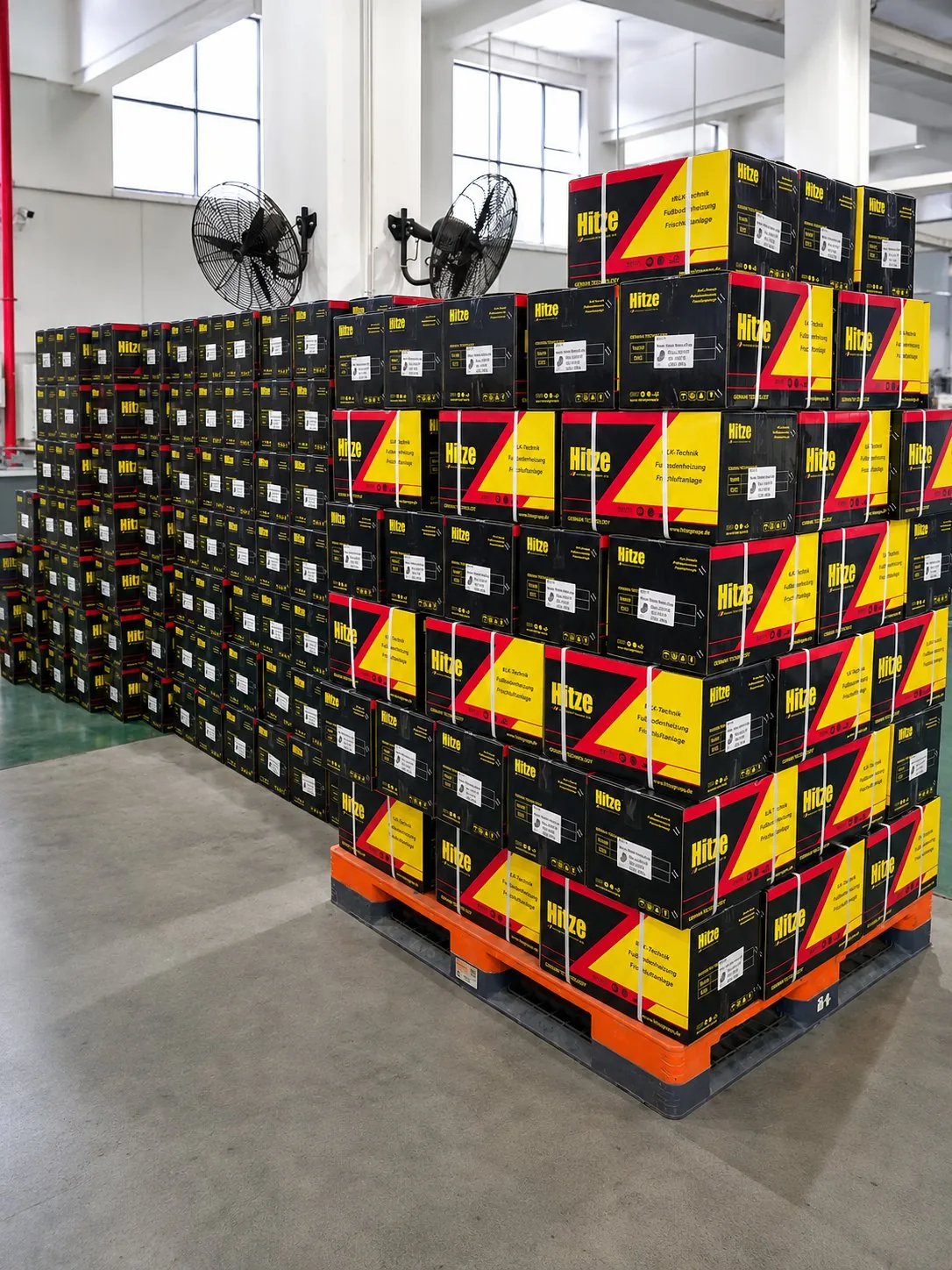
Fittings are the opposite packaging problem from pipe: enormously heavy for their volume. A carton of brass fittings concentrates weight the way a carton of pipe never does, and the failure mode is the carton letting go — a burst seam drops a hundred press fittings onto concrete, and every one of them now has potentially chipped threads or a deformed stainless sleeve that will fail at the crimp. Two qualitative rules cover most of the risk. First, spec double-wall (5-ply) corrugated for brass and press-fitting cartons; single-wall board that is perfectly adequate for plastic fittings fatigues at the hand-holds and corners under brass weight, especially after humidity cycles at sea soften the board. Second, cap the per-carton weight at what one person can lift repeatedly without dropping — heroic 40 kg cartons look efficient on the packing list and generate drops at every single touch point from packing bench to your shelf. Inside the carton, fittings should be inner-bagged in fixed counts: it protects pre-fitted O-rings from grit, and it turns your receiving count from “weigh and hope” into arithmetic.
The pallet under those cartons is a regulatory object, not just a wooden square. Under ISPM 15, solid-wood packaging thicker than 6 mm crossing borders must be made of debarked wood and treated — heat treatment to 56°C core temperature for at least 30 minutes is the common route — and must carry the IPPC compliance mark with country code, producer number and treatment code. A container arriving with unmarked or wrongly marked pallets can be held, fumigated at your expense, re-exported or destroyed. The insider move is to verify the stamp in the pre-shipment loading photos, not at your quay: ask for a clear photo of the IPPC mark on pallets from each batch as part of the shipping document set. It costs your supplier one minute and removes the single dumbest way to lose two weeks at the border.
For the unit load as a whole — pallet pattern, stretch wrap, corner boards, strapping — there is an objective benchmark you can reference instead of arguing adjectives. The International Safe Transit Association publishes test procedures for packaged products, and ISTA 3E specifically simulates the shocks, compression and random vibration a unitized pallet load of same-product cartons experiences in truckload distribution. You do not need to demand certified lab reports for every SKU; asking a supplier whether their standard pallet pattern has ever been drop- and vibration-validated, and against what, tells you very quickly whether their packaging spec is engineered or inherited. Column-stack cartons aligned corner over corner preserve far more compression strength than interlocked brick patterns — if the loading photos show pretty interlocked stacks of heavy brass cartons, that is decoration purchased with your crush margin.
| Packaging element | Job it does | Typical failure if missing | What to write in the spec |
|---|---|---|---|
| Shrink film (coils) | Moisture, dust, partial UV shield | Surface abrasion, dirt bonded to pipe wall | Film on palletised coils; opaque film for PEX |
| Woven PP bag (coils) | Abrasion armour in floor-loaded containers | Coil-on-coil scuffing through torn film | Bags for loose-loaded coils + sample unbagging at receipt |
| End caps / taped ends | Bore cleanliness for fusion and press joints | Contaminated joint faces, weak welds | Caps per coil / per bundle end, not per pallet |
| Strapping (coils & bundles) | Shape retention | Tangled coils, kinks; fanned bundles | Strap count per coil/bundle + edge protectors under straps |
| Double-wall (5-ply) cartons | Carrying dense brass fittings intact | Burst seams, dropped fittings, chipped threads | Wall grade by content weight + per-carton weight cap |
| ISPM 15 pallets | Border compliance for wood packaging | Container held, fumigated or refused | IPPC mark photographed in loading photo set |
| Durable labels | Traceability that survives the voyage | Unidentifiable stock, broken batch trace | Laminated/PE labels: size, standard, batch, date |
UV and moisture in port storage: the damage nobody photographs
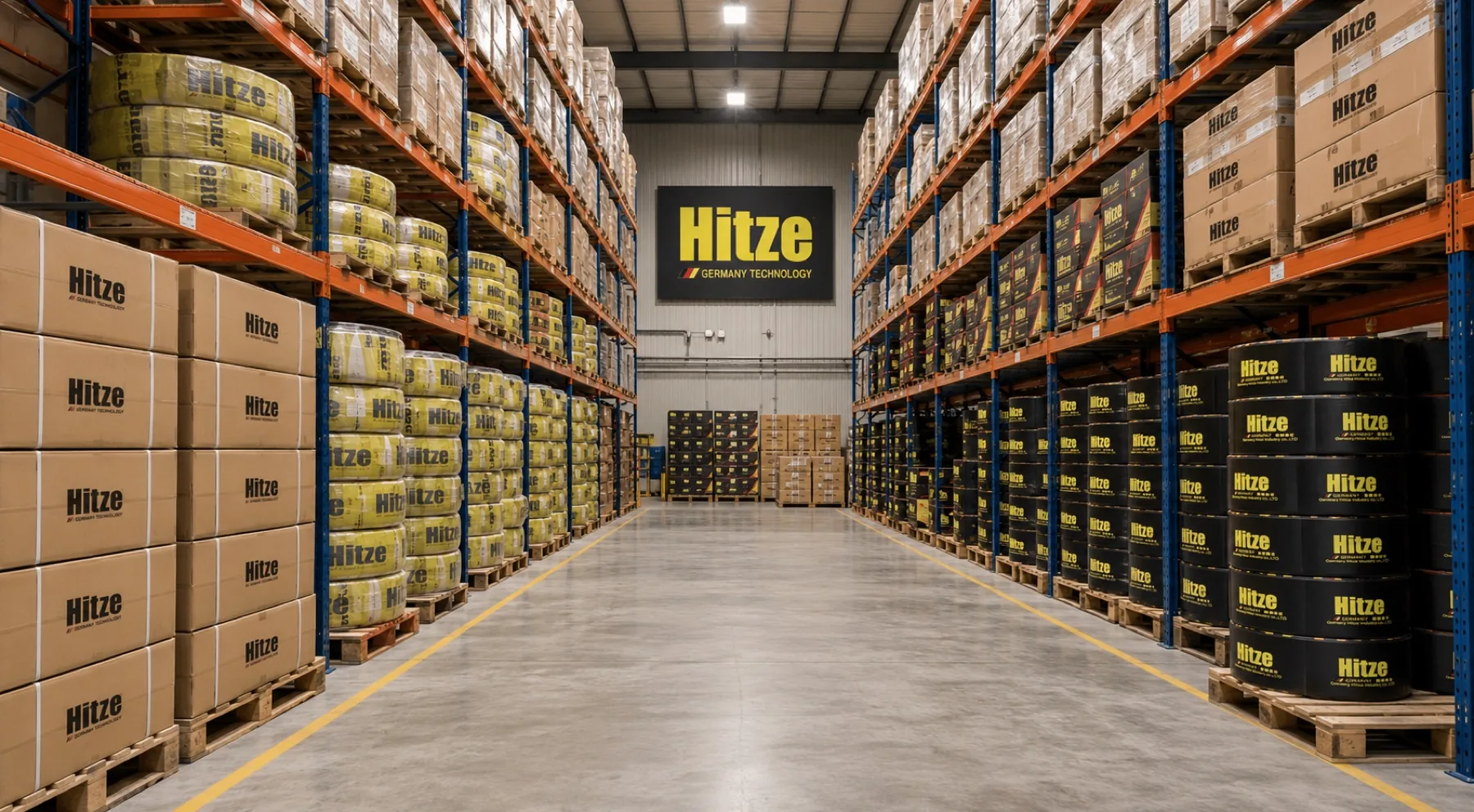
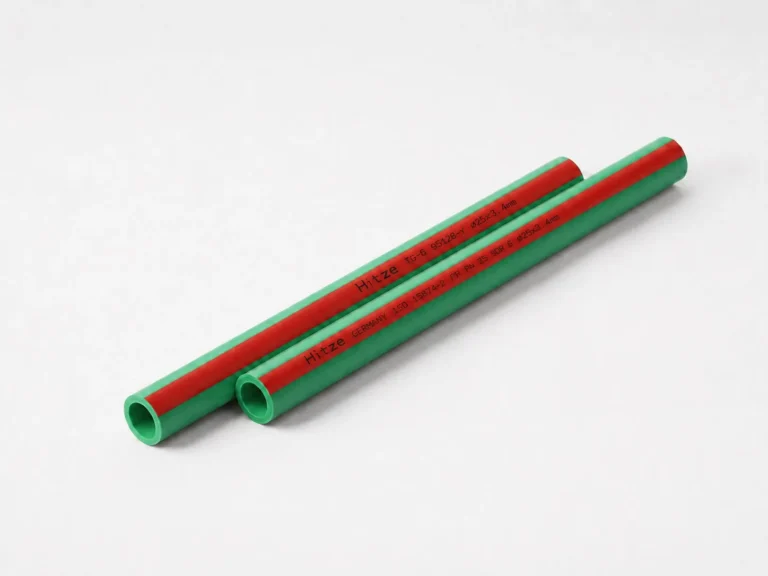
Every damage type discussed so far leaves evidence. UV degradation of PEX does not — and that makes it the most dangerous item on this page for a wholesaler, because you can receive, shelve and resell pipe that has already lost service life without a single visible symptom. The Plastics Pipe Institute is blunt about the mechanism: sunlight depletes the stabilisers engineered into the tubing, the damage is not visible to the naked eye, and PEX is not intended to be stored outdoors. Under the ASTM F876 material designation code, PEX carries a UV-resistance category established by natural-exposure testing per ASTM F2657 — categories correspond to roughly one month, three months or six months of rated sunlight exposure, with category 0 meaning not tested or rated at all. As the NAHB notes, the test benchmark is the harsh sun near Phoenix, so a month of rated exposure may stretch to two or three in milder climates — but the clock only runs one direction.
Now do the transit math from the wholesaler’s chair. That UV budget is supposed to be spent on the job site, between rough-in and drywall. Instead, part of it can be silently consumed before you ever own the pipe: a week staged in an origin yard, a transshipment dwell, days uncovered at the destination terminal, then whatever happens in your own yard if coil pallets overflow the racking. None of those days appear on any document you receive. The defence is packaging plus procedure: spec opaque packaging for all PEX — carbon-black or heavily pigmented film, or boxed coils — so yard time doesn’t touch the budget at all; ask your supplier what UV category their PEX is produced to and where it appears in the print line; and put one line in your warehouse SOP that PEX pallets are never staged outdoors, even “just for the weekend.” Translucent film on a UV-category-1 coil is a spec failure you will never be able to claim for, because there will never be anything to photograph.
Moisture works on the packaging rather than the pipe, and its favourite victim is corrugated board: cartons that cross the ocean through humidity cycles lose a meaningful share of their stacking strength, which is exactly when a marginal single-wall carton at the bottom of a tall stack gives up. The second victim is the label. A thermal-printed paper label that fades or peels mid-voyage doesn’t damage the product — it damages your ability to prove what the product is. Batch number, size, standard designation and production date are what tie a physical coil back to its test certificates and Declaration of Performance; when the label dies, that chain dies. Spec laminated or polyethylene labels carrying size, standard, batch and date, plus the same data printed on the pipe line marking itself, so the identity survives even if the packaging doesn’t.
What Hitze checks before packaging leaves the floor
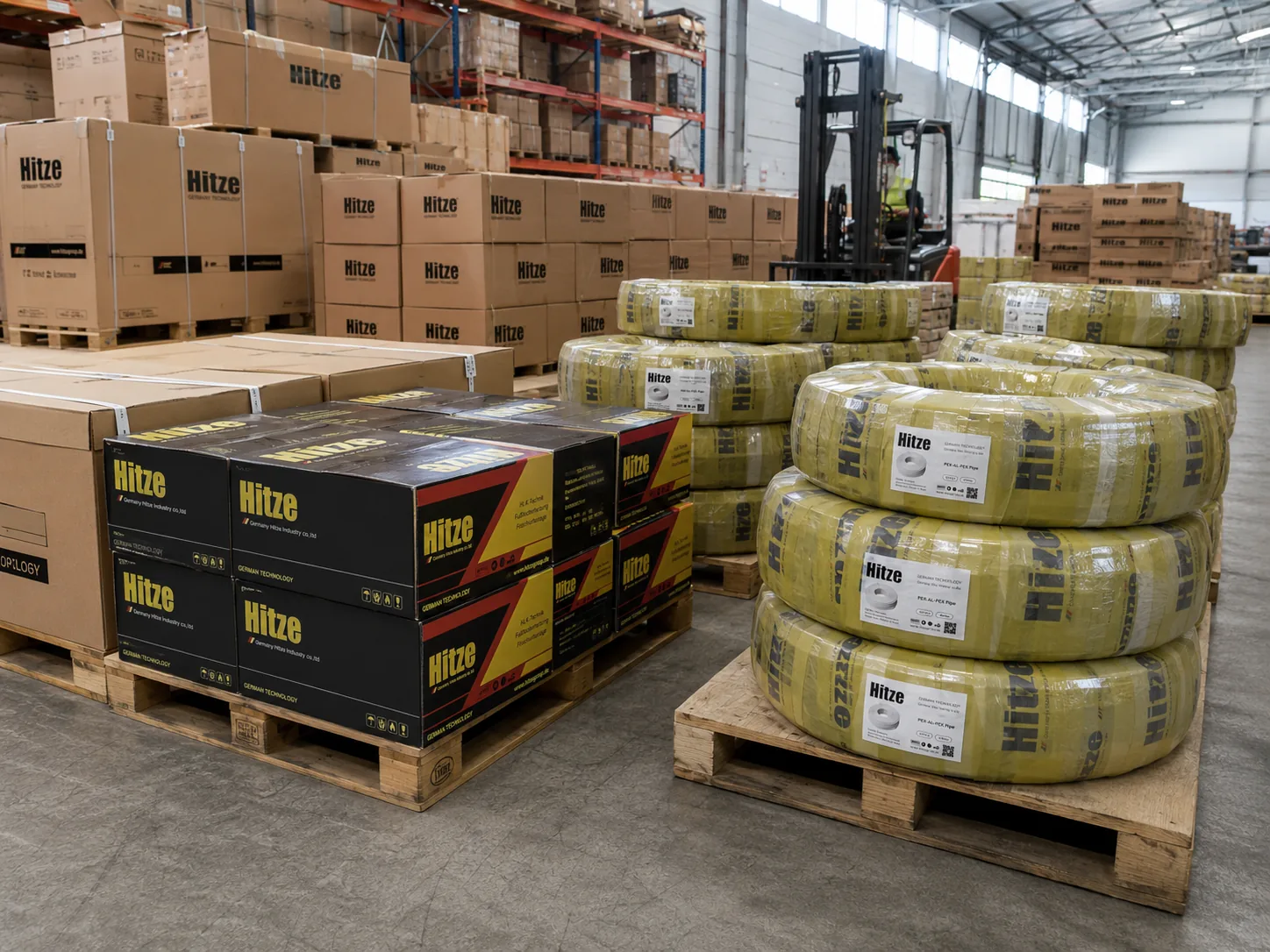
The packaging gate on the Hitze floor
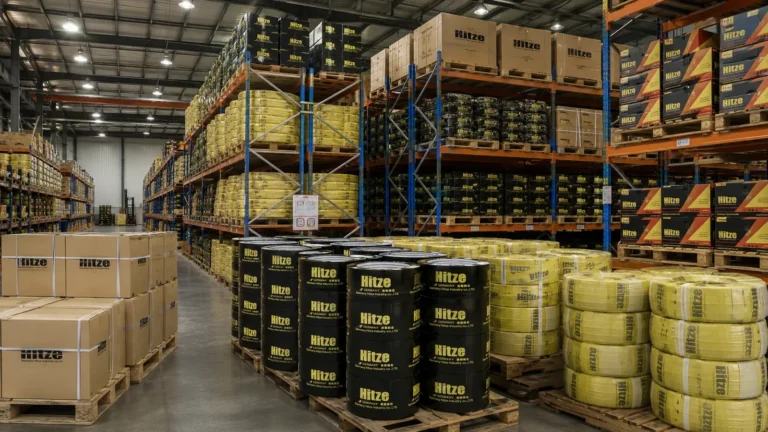
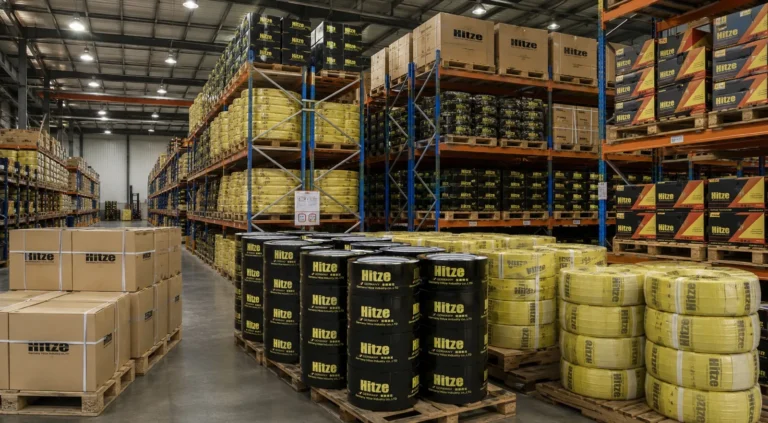
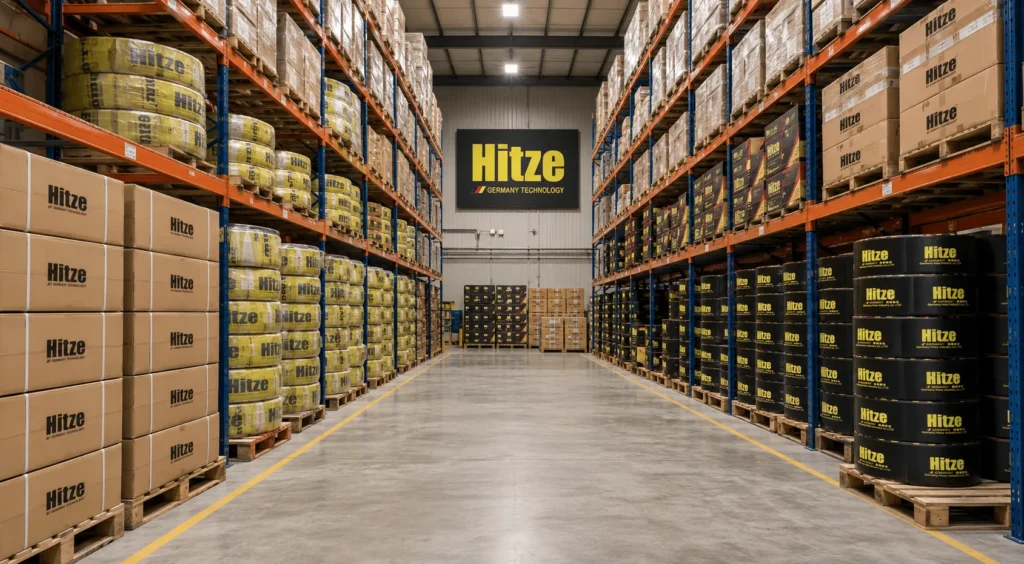
Hitze has been building piping systems since 1974, ships from a 120,000 m² production base to 118+ countries, and packs to the receiving conditions of each market rather than to a single house default. Before a wholesale order is released for loading, the packing team works through a fixed sequence:
- Product before packaging: pipe and fittings pass the in-house pressure-test benches before anything is wrapped — packaging is for protecting verified product, not hiding unverified product.
- Coils: strapped to hold shape, ends capped or taped, then shrink-wrapped; private-label buyers can specify their own print on coil wrap and cartons under the ODM program.
- Cartons: wall grade matched to contents — heavier board for brass and press fittings than for plastic — with inner bags in fixed counts and box-end markings for size, type and batch.
- Pallets and unit loads: compliant export pallets, column stacking, strapping and stretch wrap, staged in labelled racking bays until loading.
- Evidence pack: loading photos — including pallet markings and the packed container before sealing — travel with the shipping documents, so your claim file starts on our floor, not yours.
Packaging details beyond this — carton dimensions, per-market label formats, special crating — vary by market and order and are available on request.
This matters more for a wholesaler than it first appears, because packaging quality is a proxy for everything you cannot audit from a distance. A factory that engineers its pallet pattern usually engineers its extrusion tolerances too. Across the wholesale plumbing and heating pipe program, the same logic applies from the first sample carton to the hundredth container: the packaging spec is agreed in writing before the first bulk order, so “how it arrives” is a contractual property of the product, not a surprise.
Negotiating damage into the contract — without inventing a magic percentage
So back to the opening question: what number do you write into the contract? Resist the urge to anchor on a universal damage percentage, because the honest inputs — packaging spec, load type, route, port dwell, number of touches — differ so much between buyers that a borrowed number is meaningless. What a well-drafted supply agreement fixes instead is mechanism, in four clauses. One: the packaging spec itself, by reference — strap counts, end protection, wall grades, opaque film for PEX, ISPM 15 pallets — so that a deviation is itself a breach, independent of whether damage resulted this time. Two: the evidence protocol — supplier provides loading photos and container condition photos pre-sealing; you provide devanning photos and a tally within an agreed window that respects the three-day Hague-Visby reality. Three: the remedy — for pipe, replacement units in the next scheduled shipment are usually worth more than a credit note, because your real loss is stock availability, not cash. Four: the threshold that triggers a packaging-spec review rather than just a claim, so a bad lane gets fixed instead of endlessly compensated.
Whatever allowance you do agree, put its cost where you can see it. Damage that is replaced free in the next container still costs you handling, quarantine space and stockouts, and that belongs in your per-unit economics alongside freight and duty — the framework in our landed-cost breakdown for imported pipe has a natural line for it. And feed the data forward: a receiving report that tallies damage by packaging type and position in the container is the single most persuasive document you can bring to the next packaging negotiation, far stronger than adjectives. Buyers running scheduled replenishment fold this into their standing order reviews — the cadence for that is covered in our guide to building a reorder program with your pipe supplier.
A worked arrival: one 40HQ, from seal to shelf
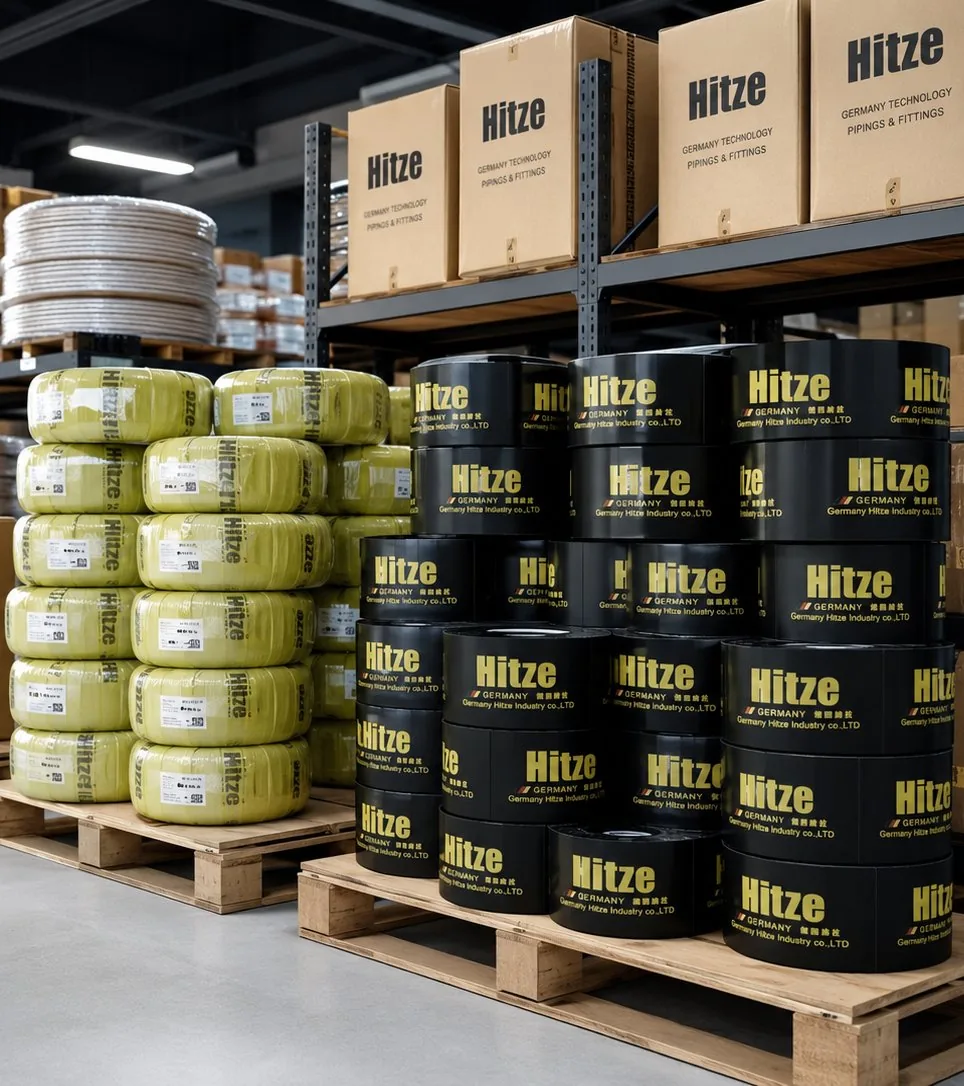
Put it all together on arrival day. A distributor outside Rotterdam takes delivery of a mixed 40HQ: palletised, film-wrapped 16 and 20 mm PEX coils at the door end; floor-loaded 4 m PP-R lengths in strapped bundles behind them; double-wall fittings cartons on pallets deep in the box. Before the doors open, the receiving lead photographs the seal and checks its number against the bill of lading — a mismatched or broken seal changes the whole legal character of what follows, and it is the one check that cannot be redone later. Doors open: two photos of the untouched stow from the threshold. These thirty seconds of photography are the foundation of every claim the company will ever file on this container.
Devanning runs in stow order with a live tally sheet. The PEX pallets come off clean except one with torn film and a visibly flattened arc on two coils — that goes on the tally in writing before the trucker leaves, photographed with the pallet label legible in frame, and the pair of suspect coils goes to a quarantine shelf, not into pick stock. The PP-R bundles show one with a snapped strap and fanned ends; the crew checks the outer pipes for strap notches, finds two, and those lengths are pulled — notched pressure pipe is rejected, never discounted into the trade. The fittings cartons look intact, which is precisely why a sample of them is opened today rather than at first pick: concealed damage found on day five is legally a different animal from damage found on day two. By close of business the tally, photos and packing list sit in one claim file, and written notice of the flagged items is with the forwarder — inside the window whether the damage counts as apparent or concealed.
Compress that into the checklist your receiving wall should carry:
- Photograph seal + number against the B/L before cutting; photograph the untouched stow from the doors.
- Devan against the packing list with a live tally; note every exception in writing before the carrier leaves.
- Check the IPPC mark on a sample of pallets; photograph one per batch.
- Coils: film intact? straps intact? end caps present? Open any coil with broken strapping and inspect the inner turns.
- Straight lengths: sight down bundles for fanned ends; check outer pipes under every strap point for notches or flats.
- Cartons: sample-open heavy fittings cartons on arrival day; verify inner-bag counts and O-ring condition.
- Labels: legible batch, size and standard on every pallet; flag any stock whose identity cannot be tied to its certificates.
- Anything suspect goes to quarantine, not pick stock; written notice to carrier/forwarder within the three-day concealed-damage window.
- Log damage by packaging type and stow position; feed the log into the next PO’s packaging clause.
Who needs a tighter pipe packaging spec — and who doesn’t
Best for: importers taking floor-loaded or mixed containers on long routes with transshipment, buyers in markets with slow port clearance where cargo sits in the yard, and any wholesaler whose stock passes through three or more handling touches before the counter. For these operations, every clause above earns its space. Not for: a buyer pulling palletised truckload stock two hours from a bonded domestic warehouse with two touches end to end — there, over-specifying packaging buys protection you already have and pays for it in cube and material.
If you are in the first group and want packaging agreed as a written spec rather than discovered at the quay, that is how the Hitze wholesale pipe program is built to work: start sample-first with no minimum order quantity, pressure-test the product and the packaging on a small trial shipment, agree the spec and the evidence protocol in writing, and scale from there — with the matched pipe-and-fitting system carrying Hitze’s 50-year system warranty once it is in the wall.
Frequently asked questions
How much transit damage is normal for imported pipe?
There is no industry-standard percentage, and treating any quoted figure as one is a mistake. Acceptable damage is whatever your contract defines, backed by a documented packaging spec and an evidence protocol. Well-run lanes with correct packaging see damage as a rare exception; recurring damage is a packaging-spec problem to fix, not a rate to tolerate.
Can PEX that sat in a sunny port yard still be sold?
It depends on its UV category and the exposure time — and that is the problem, because yard exposure is rarely documented and UV damage is invisible. PEX carries a rated UV-resistance category (commonly one, three or six months per the ASTM F876 designation code). If exposure history is unknown and the packaging was translucent or torn, quarantine the stock and consult the manufacturer. The better fix is upstream: opaque packaging on every PEX coil.
Shrink film or woven bags for pipe coils — which is better?
Neither is universally better. Film seals against moisture and dust and shows damage honestly, but tears easily; woven PP bags are tougher in floor-loaded containers but conceal crush damage. Use film on palletised unit loads, bags on loose-loaded coils — and sample-unbag at receiving whenever bags are used.
What is the ISPM 15 stamp and why should a pipe buyer care?
ISPM 15 is the international standard for wood packaging in trade: pallets must be made of debarked wood, treated (heat treatment to 56°C core for at least 30 minutes is typical) and marked with the IPPC stamp. Non-compliant pallets can get a container held, fumigated, re-exported or destroyed at the buyer’s cost. Ask for a photo of the mark in the pre-shipment document pack.
Does Hitze support private-label packaging for wholesale orders?
Yes. Coil wrap, cartons and labels can carry the buyer’s brand under the ODM/private-label program, with the packaging spec agreed in writing before bulk production. There is no minimum order quantity — programs start with samples or a small trial shipment, and specific packaging formats vary by market and order.