Key Takeaways
- For a distributor, lead-time consistency beats headline speed. A supplier who is reliably four weeks out lets you plan tighter than one who averages three weeks but swings to seven — variability, not the average, is what forces you to over-buy inventory.
- Your reorder point is arithmetic, not intuition: Reorder Point = demand during lead time + safety stock. Every extra week of lead-time swing pushes your safety stock up, and that buffer is cash sitting on a pallet.
- The three things that actually break reorder consistency are dimensional drift between batches, silent spec/print changes, and cert lapses — not the shipping schedule. A pipe that arrives on time but 0.2 mm off tolerance is still a stockout for a press-fit job.
- Share a rolling forecast and commit to a blanket volume and a real factory will hold capacity and often shorten quoted lead time; buying spot every time is what makes lead times jump.
- Hitze runs no MOQ, so you can reorder to actual sell-through — smaller, more frequent top-ups sized to real depletion rather than a forced minimum. That is less dead stock and less cash parked on a pallet between containers.
- A 50-year system warranty on the matched pipe-and-fitting set is the long-horizon signal a reorder relationship is built on — a supplier warranting the system for decades has to hold the product consistent, batch to batch, to stand behind it.
- Hitze publishes lead-time terms on request per market and order — this guide is about how to structure the program so those numbers stay stable, whatever they are for your line.
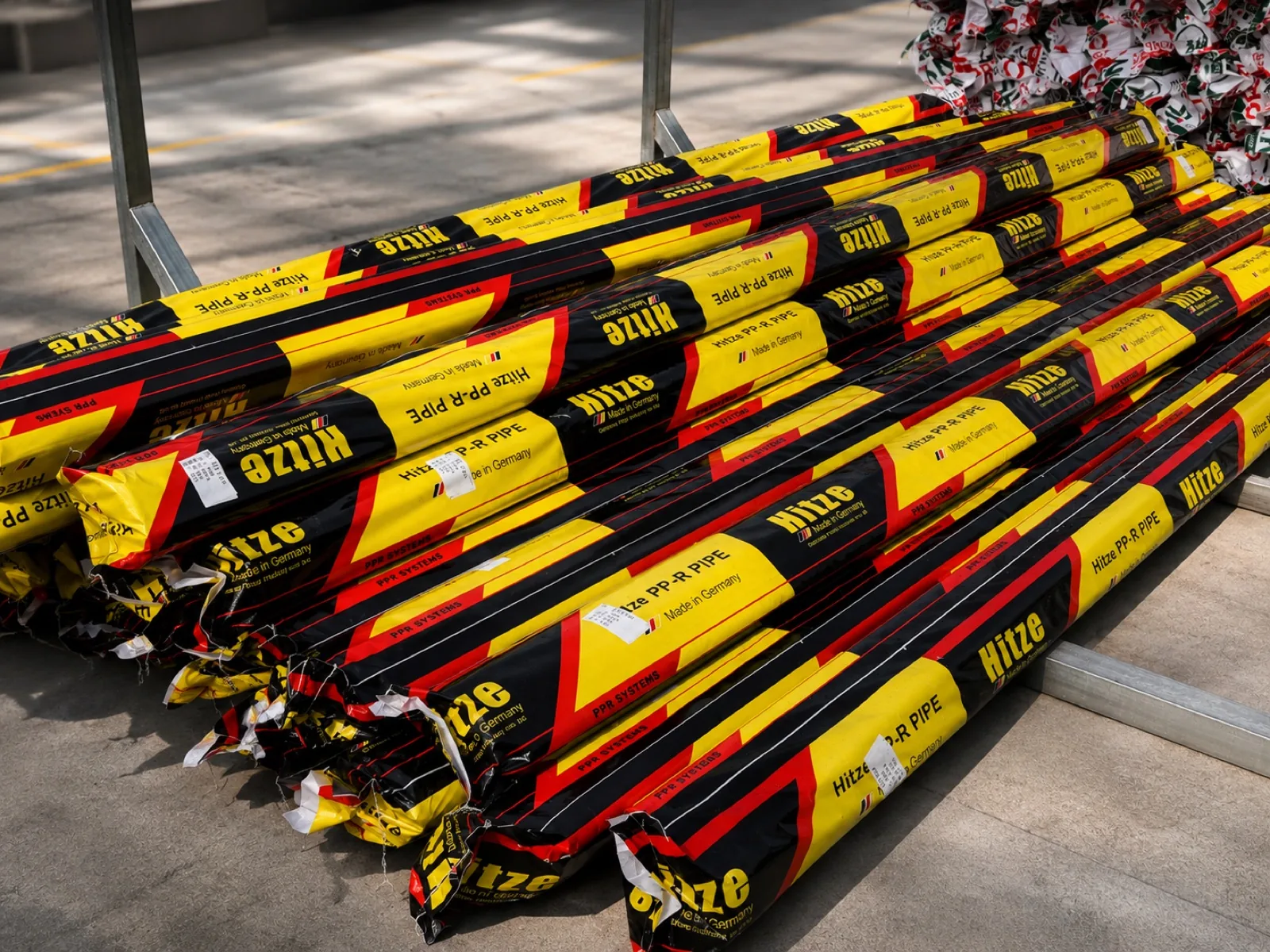
Most distributors who get burned on a pipe supplier don’t get burned on the first order. The first order is a sample-backed, hand-held affair: everyone is paying attention, the factory ships its best coils, and the container arrives more or less on schedule. The pain shows up on reorder three, reorder six, reorder eleven — when the person who negotiated the deal has moved on, the factory has quietly changed a raw-material lot, and a container lands two weeks late with pipe that presses slightly differently than the batch your contractor customers already have in the wall. That is the failure mode a reorder program exists to prevent. This is a decision-stage guide for wholesalers and importer-distributors who have already chosen a pipe brand and now need the boring, repeatable part to work: consistent product, predictable pipe supplier lead time, and no surprises between batch one and batch twenty.
We’ll build it the way a real program gets built — reorder math first, then the specific consistency failures that show up in plastic pipe, then how to structure the supplier relationship so lead times stop moving, and finally what Hitze checks on a repeat order so the twentieth carton matches the first. Where a number is genuinely proprietary — our exact lead-time days, our MOQ, freight — we say “on request,” because inventing one would be worse than useless to you.
Why lead-time consistency is worth more than lead-time speed
Ask a distributor what they want from a supplier and most say “fast.” Ask a distributor’s inventory planner and they’ll correct you: what they want is predictable. The reorder point that keeps your shelves full without drowning you in cash is a formula, and lead time enters it twice. The standard replenishment model is Reorder Point = demand during lead time + safety stock, where demand during lead time is simply your average daily sales multiplied by the lead time in days. Safety stock — the buffer that protects you when a container is late or a job order spikes — is driven not by the average lead time but by its variability. One common formulation makes it explicit: safety stock equals your worst case minus your average case, (max daily demand × max lead time) − (average daily demand × average lead time). Read that formula and the lesson jumps out: the gap between a supplier’s best week and worst week is exactly what you pay for in dead inventory.
Here is the trade-off in plain numbers. Say you sell an average of 400 coils of 16 mm heating pipe a month and your supplier quotes “about 30 days.” Supplier A actually delivers in 28–32 days, every time. Supplier B averages 26 days — faster on paper — but ranges from 18 to 45. To hit a 95% service level (the industry-standard buffer, which corresponds to a Z-score of about 1.65 in the statistical safety-stock model), Supplier B’s swing forces you to carry weeks of extra coils you didn’t need with Supplier A. The “faster” supplier is more expensive to stock, because the buffer that absorbs their inconsistency is real money on a real pallet. This is why seasoned wholesalers say plainly that unreliable lead times erode margin harder than a modestly higher unit price from a reliable partner — the buffer, the expediting, and the occasional air-freight rescue cost more than the few points you saved.
There’s a second lever most distributors leave on the table: the size of the reorder itself. A minimum order quantity forces you to buy in one lump whether or not your shelves need that lump — so a slow-moving size sits as dead stock while your cash is locked in it. Hitze runs no MOQ, which changes the arithmetic of the whole program. Instead of ordering up to a floor, you reorder to actual sell-through: smaller, more frequent top-ups sized to real depletion of each SKU. The practical effect is that you hold the reorder point steady but shrink the reorder quantity to what the data says you’ll sell before the next container — 16 mm heating pipe topped up every few weeks against its real run-rate, a slow 32 mm size ordered in a modest quantity instead of a mandated pallet. That’s tighter cash-flow, less dead stock, and a reorder cadence set by your demand curve rather than the factory’s minimum. Position it plainly: no MOQ is not a “small buyer” perk — for an established distributor it’s the difference between a warehouse tuned to sell-through and one carrying a minimum’s worth of the wrong sizes.
Insider warning: the most dangerous quote is a suspiciously short one. A factory that beats the market on lead time is often quoting free-capacity time — the number they can hit when their line is empty. The day a bigger buyer books that line, your “18-day” pipe becomes a 45-day pipe, and you find out when your own customer is already waiting. Ask for the typical and the peak-season lead time separately. A supplier that will only give you one number is hiding the variance.
The three consistency failures that actually hurt distributors
Late containers get all the attention because they’re visible. But in plastic-pipe distribution, the reorder failures that generate real callbacks and returns are usually not about the schedule at all — they’re about the product changing between batches while the label stays the same. Three specific ones recur.
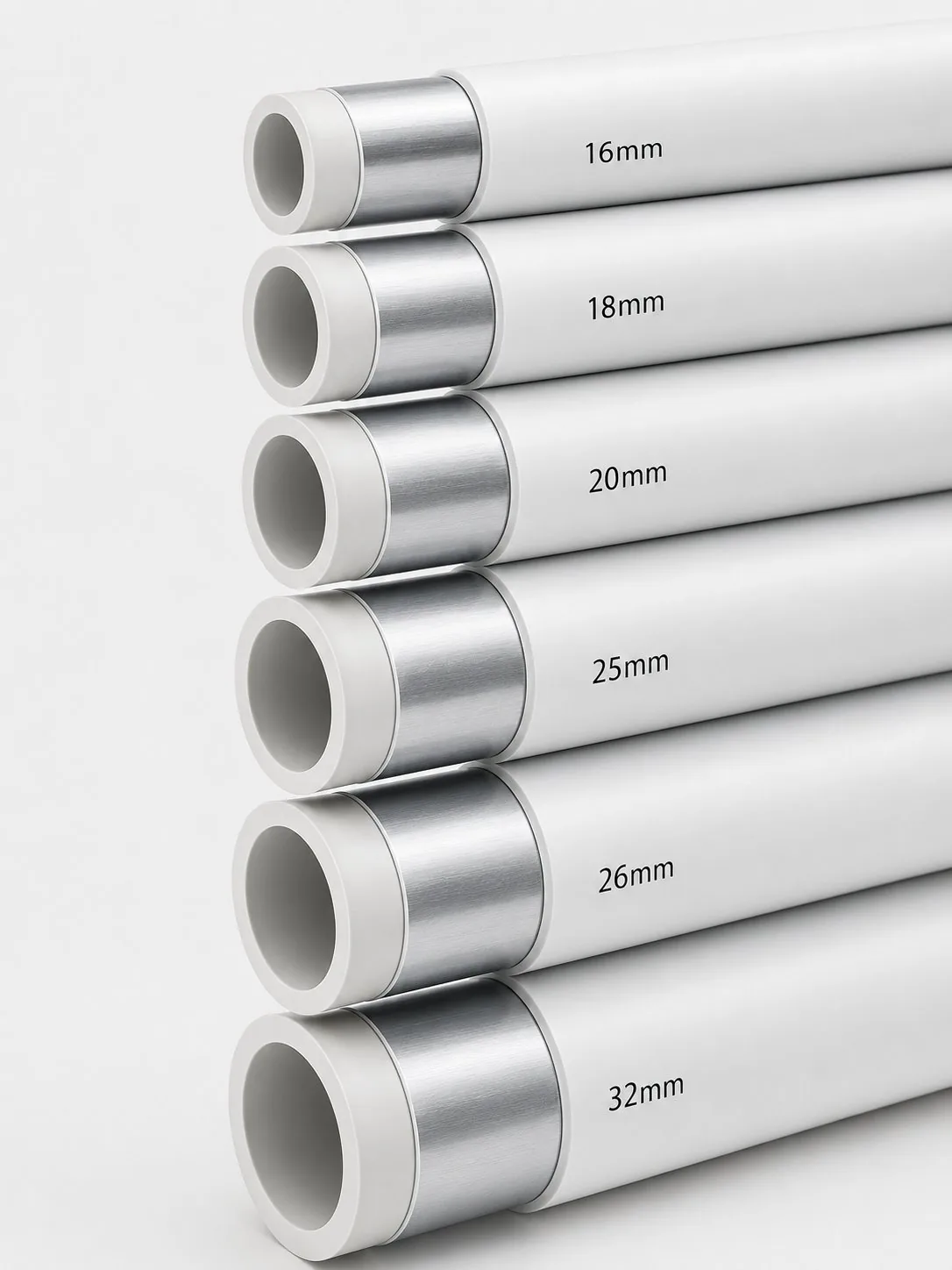
1. Dimensional drift. Pipe outer diameter and wall thickness are held to a tolerance band. Two batches can both pass and still differ enough to change how a press fitting or a compression olive seats — and your contractor customers have already calibrated their press jaws to the first batch. When the second batch runs to the far edge of tolerance, you get intermittent joint failures that get blamed on the fitting, then on you. This is why the meaningful question to a supplier isn’t “is it in spec,” it’s “how tight is your batch-to-batch process control, and can you run our reorders against the same setpoints.” A factory that extrudes to the middle of the band and holds it there is worth more to a distributor than one that merely stays inside the lines.
2. Silent spec and print changes. The label says PEX-AL-PEX; the new lot has a thinner aluminium layer, or a different print marking, or a colour that doesn’t match the coils already in your customers’ vans. None of it is fraud — the factory sourced a cheaper input or updated its print plate — but on a reorder program, a change you didn’t approve is a defect. The fix is contractual: the reorder spec is frozen at first-article approval, and any change to material construction, marking, or colour requires written notice and a re-approved sample before it ships. Distributors who skip this clause discover the change when a customer photographs two “identical” coils that don’t look identical.
3. Certification lapses. This is the quiet killer for importer-distributors. A cert can expire, a scope can change, or a factory can let a listing lapse between your orders — and a container of pipe that would have cleared last year now sits at the border or, worse, becomes unsellable into a jurisdiction that requires the mark. If you resell into the US, a lapsed cUPC or NSF listing is a resale blocker; into the UK and EU, WRAS and DVGW status is what your own trade customers check. The reorder program has to include a live check that the certifications on this shipment are current, not just that they existed when you first qualified the supplier. We treat cert currency as part of every order file, and you should demand the same.
Structuring the relationship so lead times stop moving
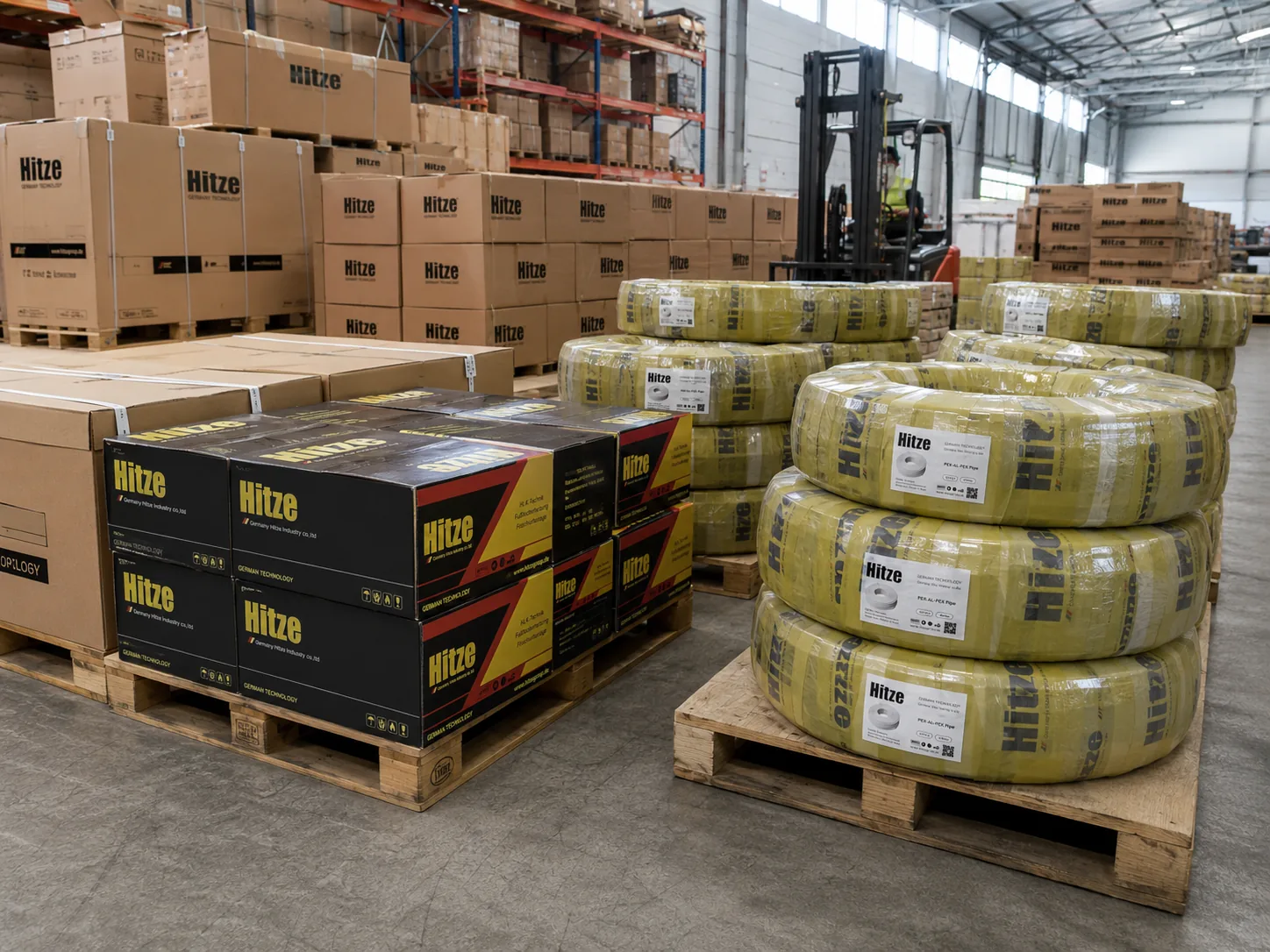
Lead-time variability is not fate — it’s a symptom of buying spot. Every time you place an unforecast order, the factory slots you into whatever gap it has, and your lead time is whatever that gap allows. The single highest-leverage move a distributor can make is to give the factory forward visibility, because a factory that can see your demand can hold line capacity for it. Sharing a multi-month rolling forecast — even a non-binding one — lets the supplier plan production around you rather than around the last buyer who happened to call, and this alone can compress quoted lead times. Pair it with a blanket or framework order that commits an annual volume while releasing it in smaller monthly or quarterly pulls, and you convert “we’ll see what we can fit” into “your capacity is reserved.”
That structure also fixes the raw-material problem behind dimensional drift and price swings. When a factory knows your annual pull, it can buy resin and aluminium against a plan instead of scrambling per order — which stabilizes both the physical product and the lead time, because material availability is one of the biggest hidden drivers of a slipped ship date. The distributor who forecasts is not doing the factory a favour; they are buying themselves a shorter, tighter, more predictable lead time and a more consistent coil. Mid-body, this is exactly the operating model our pipe importer & distributor program is built around — forecast-linked capacity, frozen reorder specs, and a documented consistency check on every batch rather than a promise on the first.
A trade-term footnote that saves reorder headaches
Reorder consistency isn’t only about the pipe — it’s about who owns the risk at each handoff, and that lives in your Incoterm. The Incoterms 2020 rules published by the International Chamber of Commerce define 11 three-letter terms and split them into two families: seven for any mode of transport (EXW, FCA, CPT, CIP, DAP, DPU, DDP) and four reserved for sea and inland-waterway transport (FAS, FOB, CFR, CIF). A detail that trips up pipe distributors specifically: FOB and CIF were written for bulk, non-containerised sea cargo, whereas coiled and palletised pipe moving in a container is better matched to the FCA/CPT/CIP family, where risk transfers when the goods are handed to the carrier rather than at the ship’s rail. Locking one agreed Incoterm across every reorder — rather than renegotiating per shipment — removes one more variable from an already moving target. (Our deeper breakdown of trade terms and landed cost lives with the wholesale supply resources.)
What Hitze checks on a repeat order — the consistency file
Hitze is a German brand of engineered piping systems, founded in 1974, producing across a 120,000 m² base with 1,000+ employees and exporting to 118+ countries. Scale matters for a reorder program only because it means the line that ran your first order is still there for your twentieth. The other half of the signal is the commitment behind the product: Hitze backs the matched pipe-and-fitting system with a 50-year warranty. For a reorder relationship that’s not a marketing line — a warranty measured in decades only makes commercial sense if the factory holds the product consistent batch to batch, because inconsistency is precisely what would generate the field failures a long warranty exposes. The warranty and the consistency discipline are the same promise viewed from two ends. Here is how a repeat order is actually handled so the second container matches the first:
- Frozen first-article reference. When your program is set up, the approved sample — dimensions, wall build, print marking, colour, packaging — becomes the reference the reorder is measured against. Reorders are checked back to your approved article, not just to the DIN/EN band, so “in spec” also means “same as last time.”
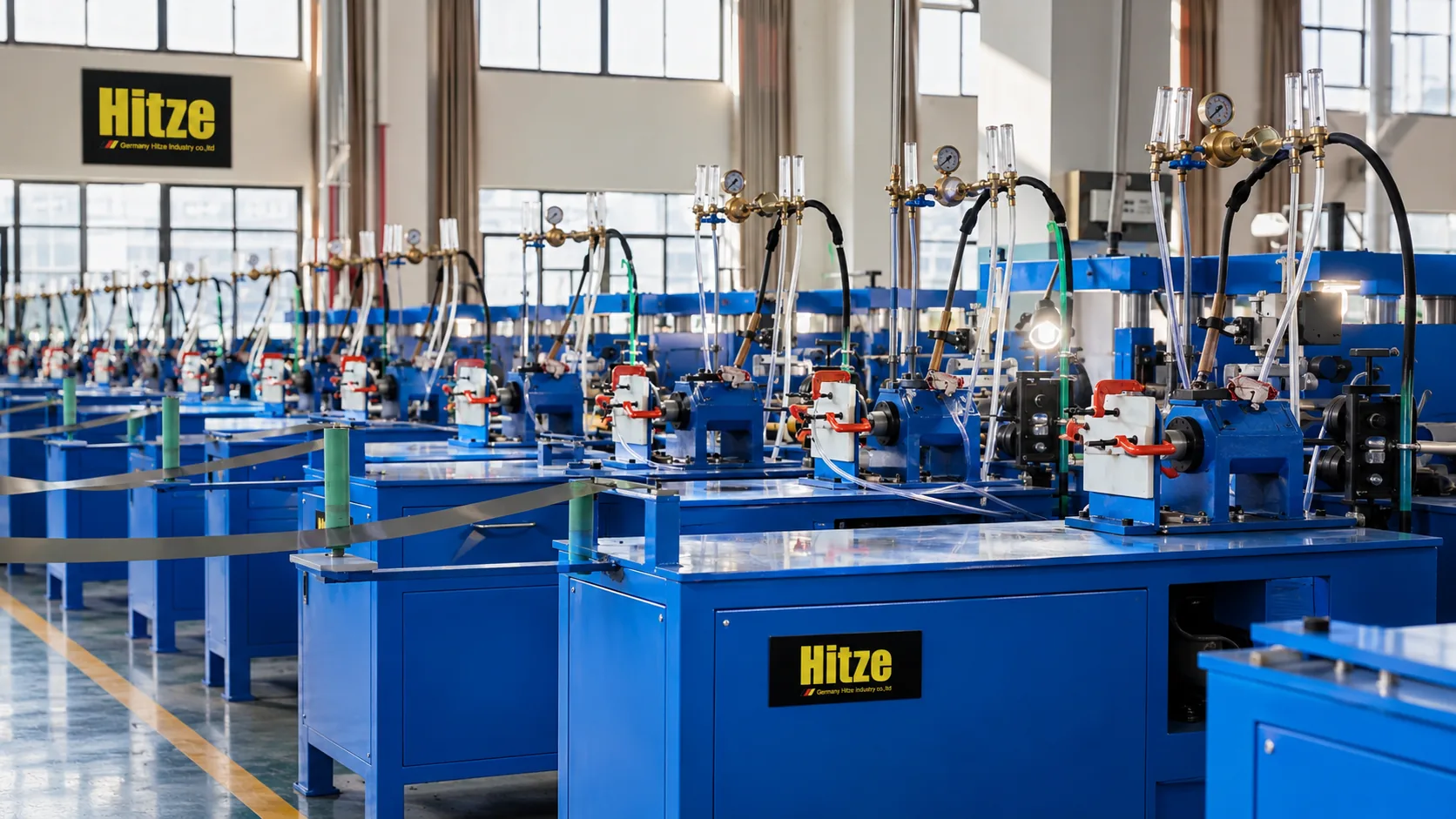
Batch verification on the plant’s pressure-test benches — logged to the order file, not assumed. - Hydrostatic and dimensional verification each batch. Pipe and fittings run against the standards Hitze builds to — DIN 8077/8078 and EN ISO 15874 for PP-R, DIN 4726 oxygen barrier for heating pipe, ASTM F876/F877 where PEX is cited — on the plant’s pressure-test benches, with results logged to the order file rather than assumed.
- Cert-currency check per shipment. The relevant scheme approvals — SKZ and DVGW (Germany), WRAS (UK), the NSF potable-water test report, ISO 45001, plus cUPC/UPC, NSF-14 and NSF/ANSI 61 where applicable — are confirmed current for the market you’re shipping into. Certificate numbers exist on the physical certificates and are provided on request; we don’t publish them loose because the number that matters is the one tied to your shipment.
- Consistent print and packaging. On a private-label or own-brand line, the print plate and carton artwork are held from batch to batch, so coils from different reorders look identical on your customer’s shelf. Any change is notified and re-approved before it ships.
- Right-sized reorders, no forced minimum. There is no MOQ, so each reorder is sized to your actual sell-through rather than up to a floor — you top up the sizes that are moving and hold back on the ones that aren’t, instead of committing cash to a mandated pallet. Freight and lead-time windows are agreed for your program and quoted on request — they vary by market, product line and order size — but once agreed they’re the baseline every reorder runs against, so the number stops moving.
- A warranty that underwrites the relationship. The matched pipe-and-fitting system carries a 50-year warranty. On a multi-batch program that’s the consistency guarantee made contractual: it commits the factory to a product that keeps performing across every reorder, not just the qualifying one.
An end-to-end reorder scenario
Picture a mid-size heating-and-plumbing wholesaler in the EU stocking a private-label multilayer and PP-R range. In month one they place a qualified first order against approved samples — dimensions verified, WRAS and DVGW status confirmed for their market, print plate signed off. So far, nothing unusual; most suppliers can nail the first order. The program is what happens next.
In month two the wholesaler shares a rolling 12-month forecast: roughly 400 coils of 16 mm and 250 of 20 mm a month, spiking 40% in the autumn heating-season build. Against that forecast the factory reserves line capacity and buys resin to plan, so the quoted reorder lead time settles into a tight window instead of drifting. The wholesaler sets their reorder point off that window — demand during lead time plus a modest safety buffer sized to the window’s small variance, not to a worst-case guess. Because the lead time is now consistent, the buffer is small, and the cash it ties up is small.
Come autumn, demand spikes exactly as forecast — and because the capacity was reserved, the peak-season lead time barely moves. Reorder six lands with pipe that presses identically to reorder one, cartons that match on the shelf, and a cert pack current for the destination. No callback, no border hold, no scramble to re-approve a “slightly different” coil. That is the whole point of a reorder program: the drama all happens in the setup, and the reorders are boring. Boring is the goal.
Best-for / not-for: is a structured reorder program right for you?
| Buyer profile | Forecast-linked reorder program | Better served by spot buying |
|---|---|---|
| Regional wholesaler with steady monthly pull | Strong fit — forecast reserves capacity, lead time tightens, buffer shrinks | — |
| Importer-distributor reselling into regulated markets | Strong fit — cert-currency check per shipment protects resale | — |
| Private-label brand needing shelf-consistent coils | Strong fit — frozen print/spec, batch-to-batch match | — |
| One-off project buyer, single container | Overkill — no repeat cadence to stabilise | Better — buy to the project spec once |
| Trader with unpredictable, opportunistic demand | Weak fit — no forecast to reserve against | Better — flexibility over consistency |
The dividing line is cadence. If you reorder the same range on a rhythm, a program pays for itself in lower buffers and fewer callbacks. If your demand is genuinely one-off or opportunistic, spot buying keeps you flexible — a program’s discipline is wasted on you.
Where a program can’t help — and the honest limits
A reorder program stabilises what’s inside the factory’s control: capacity, material planning, spec discipline, cert currency, batch-to-batch consistency. It does not repeal geography or force majeure. Ocean transit, port congestion, and customs timing sit outside any supplier’s four walls, which is why a serious program separates the production lead time (what the factory controls and commits to) from total lead time (production plus transit plus clearance). Judge a supplier on the first; plan your reorder point on the second, with the buffer sized to whichever leg is more variable — for most trans-ocean pipe distributors, that’s the transit, not the factory. Any supplier who quotes you a single door-to-door number and treats it as guaranteed is either inexperienced or optimistic, and both are expensive.
Build a reorder program that stays boring — batch twenty like batch one
This is for wholesalers and importer-distributors who reorder a range on a rhythm and are tired of chasing consistency and lead times per shipment. If your demand is genuinely one-off, spot buying serves you better and we’ll tell you so. If it isn’t, a forecast-linked program with frozen reorder specs and a per-batch consistency check is the point of working with a real factory rather than a trader. There’s no MOQ, so you can start at trial scale and reorder to real sell-through, and the matched system carries a 50-year warranty. Lead-time windows and terms are quoted for your market and line on request.
Talk through a reorder program →
Prefer to start from the product side? See the multilayer PEX-AL-PEX and PP-R pipe & fittings ranges, or review the certifications & market compliance that travel with every reorder.
Frequently asked questions
What is a typical pipe supplier lead time, and why won’t a factory just quote one number?
Because there isn’t one honest single number. Production lead time depends on your product line, order size, and whether the factory has forward visibility of your demand; ocean transit and customs clearance add a separate, more variable leg on top. A credible supplier will give you a production window and a peak-season window separately, and will tighten both once you share a forecast. At Hitze, lead-time windows are quoted per market and order on request — the aim of a reorder program is to make whatever that window is stable, not to pretend it’s a fixed constant.
How do I set a reorder point so I don’t stock out between containers?
Use the standard model: reorder point = demand during lead time + safety stock, where demand during lead time is your average daily sales multiplied by the total lead time in days. Size the safety stock to the variability of that lead time — the more your delivery window swings, the bigger the buffer you need to hit your target service level (a 95% level corresponds to a Z-score of about 1.65). The practical takeaway: a supplier with a tight, consistent lead time lets you run a smaller buffer, which is cash you keep instead of park on a pallet.
Is there a minimum order quantity on reorders, or can I order to my actual sell-through?
Hitze runs no MOQ, so reorders can be right-sized to real depletion rather than forced up to a minimum. In practice that lets you top up the sizes that are actually moving in smaller, more frequent pulls and hold back on the slow ones, instead of committing cash to a mandated pallet of stock you don’t need yet. For a distributor that means less dead inventory and tighter cash-flow between containers, with the reorder cadence set by your demand curve. Lead-time windows and freight still vary by market, product line and order size and are quoted on request.
How do I make sure reorders match the first batch dimensionally?
Freeze a first-article reference at program setup — dimensions, wall build, print, colour, packaging — and require that every reorder be checked back to that approved article, not merely to the standard’s tolerance band. Two batches can both pass a DIN or EN check and still differ enough to change how a press or compression fitting seats. Insist that any change to material construction, marking or colour is notified in writing and re-sampled before it ships. Hitze runs reorders against the frozen first article and logs dimensional and hydrostatic checks per batch to the order file.
Is the pipe made in Germany?
Hitze is a German brand of engineered piping systems, engineered in Germany and built to German DIN standards, and it is DVGW-certified and SKZ-tested. For a reorder program that spans markets, what matters alongside the brand’s engineering is that the product is certified to the schemes your destination requires — SKZ and DVGW for Germany, WRAS for the UK, NSF for potable-water contact, plus cUPC/UPC and NSF/ANSI 61 where applicable — and that those certifications are confirmed current on each shipment.
How can I get a shorter, more reliable lead time without paying for expedited freight every time?
Give the factory forward visibility. Sharing a multi-month rolling forecast — even non-binding — lets the supplier reserve line capacity and buy raw material to plan, which can compress quoted lead time and, more importantly, stabilises it. Layer a blanket or framework order that commits an annual volume while releasing it in smaller monthly pulls, and you convert “we’ll fit you in” into “your capacity is held.” Spot buying every time is precisely what makes lead times jump.
Which Incoterm should I use for containerised pipe reorders?
For coiled and palletised pipe moving in a container, the FCA/CPT/CIP family under Incoterms 2020 generally fits better than FOB or CIF, which the ICC intends for bulk, non-containerised sea cargo — the difference is where risk transfers relative to the carrier. The bigger point for consistency is to agree one Incoterm and hold it across every reorder rather than renegotiating per shipment; each renegotiation is another variable that can move your landed cost and your risk exposure. Confirm the term with your freight forwarder against the ICC rules for your route.