Key Takeaways
- Resin is typically the largest single cost input in a plastic pipe — which is why a polymer rally can hit your reorder price harder than freight ever does.
- Three public reference tools dominate contract talks: ICIS weekly price assessments, S&P Global (Platts) Polymerscan, and the Plastics News resin pricing tables. For USD contracts, the US BLS producer price index for plastics pipe (429.477 in January 2026, June 1993 = 100) is a free, neutral fourth option.
- A workable indexation clause has three parts: a named index, a trigger band (typically ±5%), and a review cadence based on period averages — never spot prints.
- Surcharges are faster but stickier; full repricing is slower but cleaner. Fixed-price windows exist, and the premium you pay for them is the supplier’s hedging cost plus a risk margin.
- The single most revealing question you can ask a supplier: “When the index falls below the band, does my price come down automatically?” Silence tells you everything.
You confirmed a container of PP-R at one price in March. The reorder quote in June is 8% higher, and the only explanation on the email is “raw material increase.” You cannot verify it, you cannot pass it through to your contractor accounts mid-season, and you cannot tell whether it will come back down when resin does. That is the wholesaler’s version of the resin problem — not the volatility itself, but the fact that it reaches you late, one-directional, and unexplained.
The fix is not predicting polymer markets. It is writing the reorder contract so that resin moves flow through it on rules you agreed in advance — a named resin price index, a band that filters out noise, and a mechanism that works in both directions. This guide covers how those clauses are actually built, when a surcharge beats a reprice, what a fixed-price window really costs, and the questions that separate a supplier with a pricing policy from one improvising against you.
Why a Resin Swing Hits Your Reorder Price So Hard
Start with the cost structure. For commodity pressure pipe — PP-R, PEX, PE-RT, HDPE — resin is typically the largest single cost input, usually bigger than energy, labour, and packaging combined. Treat any precise percentage a supplier quotes you with suspicion (it varies by product, wall thickness, and how much machinery cost they load in), but the direction is not in dispute: when polypropylene or polyethylene moves 15%, a meaningful slice of that lands in the ex-works price of every metre of pipe extruded afterward.
The long-run drift is documented. The US Bureau of Labor Statistics producer price index for plastics pipe and pipe fitting manufacturing stood at 429.477 in January 2026 against a June 1993 base of 100 — more than a fourfold rise over the life of the series, with the sub-index for plastics water pipe at 327.400 (base June 1987 = 100, an older base than the parent series, so the two figures are not directly comparable). Those numbers hide the part that hurts distributors: the path is not smooth. It moves in steps, and each step arrives as a surprise reorder quote if your contract has no mechanism for it.
Here is the asymmetry to watch. When resin rises, suppliers reprice within one or two order cycles — they have to, or they ship at a loss. When resin falls, the old price tends to survive quietly until a buyer pushes. Entering 2026, S&P Global analysts were flagging oversupply keeping downward pressure on propylene, the monomer behind every PP-R pipe you stock. A falling feedstock market is exactly when an indexed contract earns its keep — because without one, the decrease is a negotiation you have to win, while the increase was a notification you had to accept.

The Resin Price Index Options Buyers Actually Use
An indexation clause is only as good as the index behind it, and “the price of plastic” is not an index. You need a published, third-party series that both sides can read, covering the right polymer family in the right region and currency. In practice, pipe buyers work from four sources.
ICIS publishes weekly price assessments for polypropylene and polyethylene across Europe, Asia-Pacific, the US, and other regions, built from transactions and bids/offers captured through the week, plus 18-month rolling price forecasts updated monthly. S&P Global (Platts) Polymerscan carries over 200 global term and spot polymer assessments — HDPE, LDPE, LLDPE, PP, PVC — under a methodology aligned with IOSCO principles, which matters if your contract may ever be disputed. Plastics News maintains North American resin pricing tables in US cents per pound for prime, unfilled, natural resin FOB supplier, generated from interviews with buyers and suppliers — the accessible option for US-market distributors who will not pay for a subscription service. One caveat worth quoting in the contract discussion: Plastics News itself discourages using its tables as a stand-alone index for structuring price contracts unless they are paired with another published index, because an interview-based table is a directional read rather than a settled assessment. Treat it as a cross-check, not the sole reference series you write into a clause. And for USD contracts there is a free, government-published alternative: the BLS producer price index for plastics pipe and pipe fitting manufacturing, which tracks finished-pipe producer prices rather than resin itself — slower, but immune to the “which resin grade” argument entirely.
| Reference | What it tracks | Cadence | Best for |
|---|---|---|---|
| ICIS price assessments | PP / PE by region, transaction-based | Weekly (forecasts monthly) | EU and Asia-sourced contracts |
| Platts Polymerscan | 200+ global term & spot polymer assessments | Daily / weekly | Larger buyers; dispute-resilient methodology |
| Plastics News tables | North America prime resin, US cts/lb FOB supplier | Regularly updated | US distributors without a data budget |
| BLS PPI (PCU326122326122) | US producer prices for finished plastic pipe | Monthly | Free, neutral benchmark for USD contracts |
| CME resin futures | Cash-settled PP / PE contracts against published indices | Exchange-traded | Processors and traders hedging directly, not SME distributors |
| ECB reference rates | Euro FX rates for 29 currencies, since the lev was dropped on Bulgaria’s euro entry (not a resin index) | Daily, ~16:00 CET | Naming the currency-conversion fixing inside the clause |
One insider warning on index selection: match the polymer family, not just the polymer. PP-R pipe is made from polypropylene random copolymer, and a homopolymer assessment can diverge from copolymer pricing when the propylene chain tightens unevenly. If the exact grade is not published, name the closest assessment in the contract and state explicitly that it serves as the agreed proxy — the goal is a number neither side can argue about later, not chemical perfection.
Anatomy of an Indexation Clause: Index, Band, Cadence, Symmetry
A functioning clause has four moving parts, and weakness in any one of them is where buyers get hurt. First, the named index — publication, series, region, currency, all spelled out. “Prevailing raw material market conditions” is not an index; it is a blank cheque. Second, the trigger band: a corridor, typically ±5% around the baseline index value, inside which nothing happens. The band is what stops weekly resin noise from generating monthly price letters. Set it too narrow (±2%) and you have created an administration machine; too wide (±10%) and the clause never fires and you are back to ad-hoc repricing.
Third, the review cadence and averaging rule. Quarterly review against the average of the index over the preceding quarter is the standard that works for pipe, because it matches typical reorder rhythm and smooths spot spikes. Never let a contract reference a single-date spot print — a one-week squeeze in the resin market should not set your price for three months. Fourth, and least negotiated, the pass-through coefficient: the agreed fraction of the index move that flows into the pipe price, reflecting that resin is only part of cost. A supplier who wants 100% of a resin increase passed through is telling you resin is 100% of their cost, which is false; a coefficient in the region of half is a common and defensible compromise, provided both sides accept it is an estimate rather than an audited figure.
Then comes the question that reveals whether you are negotiating with a partner or a counterparty: bilateral symmetry. Does the same clause, the same band, the same coefficient apply when the index falls? Insist that the downward adjustment is automatic — triggered by the same review, not by your request. In our experience the suppliers who resist symmetry are the same ones whose “raw material increase” emails never arrive with a source attached. If you are also negotiating how you pay, not just what, the same symmetry logic applies to deposits and balances — see our guide to payment terms with overseas pipe suppliers, because an indexed price with a 100% upfront T/T still leaves all the timing risk on you.
Surcharge vs. Reprice: Two Mechanisms, Two Failure Modes
When the index breaches the band, the adjustment can arrive two ways. A raw-material surcharge is a separate line item added to the invoice — “polymer surcharge: +4.2%” — leaving the base price untouched. A reprice folds the adjustment into a new unit price. They sound equivalent. They are not.
The surcharge’s virtue is transparency and reversibility: because it is visibly separate, it is politically easy for the supplier to remove when the index falls back inside the band, and easy for you to pass through to your own trade accounts as an explained, temporary line. Its failure mode is permanence — surcharges introduced in a spike have a way of still being on the invoice two years later, quietly renamed. If you accept surcharges, write an expiry: each surcharge lapses automatically at the next quarterly review unless the index still sits outside the band. The reprice’s virtue is cleanliness — one price, no invoice clutter, no stacking of three historical surcharges nobody remembers the basis for. Its failure mode is the ratchet: each reprice becomes the new “base,” and the next negotiation starts from the top of the last spike. If you accept repricing, anchor every adjustment to the original baseline index value in the contract, not to the previous price.
| Raw-material surcharge | Full reprice | |
|---|---|---|
| Visibility | Separate invoice line; easy to explain downstream | Folded into unit price; invisible after one cycle |
| Reversibility | High — politically easy to remove | Low — each new price becomes the anchor |
| Failure mode | Permanence — spike surcharges that never lapse | Ratchet — negotiations restart from the last peak |
| Buyer safeguard | Automatic expiry at each quarterly review | Every adjustment anchored to the original baseline index |
Our recommendation for distributors reordering on a rhythm: surcharge with automatic expiry for moves you believe are temporary, contractual reprice against the original baseline at annual renewal. And whichever mechanism you run, keep it visible in your own resale math — a surcharge you absorb silently is margin you donated. The arithmetic of where each dollar of adjustment lands sits inside the bigger per-unit picture we walk through in the landed cost of imported pipe: a 5% ex-works move is not a 5% landed move, because freight, duty, and inland legs do not scale with resin.
Fixed-Price Windows: What the Premium Actually Buys
The alternative to indexation is a cost lock: a fixed price for a defined window — 90 days, 6 months, occasionally a year — regardless of what resin does. Buyers love the idea until they see the number, because a rational supplier prices the lock the way an insurer prices a policy: expected resin cost over the window, plus the cost of whatever cover they take (forward resin purchases, extra inventory), plus a margin for the risk they cannot lay off. That stack is the premium, and it is real even when it is invisible — a supplier who offers you a 12-month fixed price with no premium either has resin contracted forward already, or is planning to recover the difference somewhere you are not looking: wall thickness, resin grade, or your next order’s lead time.
When is the premium worth paying? When your sell-side is fixed too. If you have quoted a developer project or a utility tender at firm prices for delivery across two or three quarters, a matching fixed-price window on the buy side converts an open resin position into a closed one, and the premium is simply the cost of sleeping. When your sell-side reprices freely — normal trade counter business — paying a lock premium means buying insurance against a risk you can largely pass through, which is rarely rational beyond a 90-day horizon. The hybrid that works for most wholesalers: fix the next confirmed order at booking (a per-order lock costs far less than a calendar lock), and run the standing reorder program on a banded index. How to structure that standing program — quantities, cadence, and buffer — is its own discipline, covered in building a reorder program for distributors.

Hedging Reality for SMEs — and the Currency Layer Underneath
Can a distributor hedge resin directly? In theory, yes: CME Group lists cash-settled resin futures for polypropylene and polyethylene grades, settled against published index prices. In practice, almost no small or mid-size pipe wholesaler does, and for defensible reasons — the contracts are built for processors and traders, liquidity is thin next to energy markets, margining ties up cash, and your actual exposure is finished pipe in your currency, not US resin in cents per pound. The honest answer for an SME is that your hedge is the supply contract itself: the band caps how fast pain arrives, the averaging rule smooths it, the symmetry clause guarantees the recovery, and the per-order fixed price at booking removes the risk on everything already sold. That is hedging — done through terms instead of tickers.
The layer buyers forget is currency. European resin assessments print in euros per tonne; North American tables in US cents per pound; your purchase contract may be in USD; your resale in a third currency. If your contract indexes to a EUR-denominated series but you pay in USD, you have imported an FX position into your pricing clause without noticing — the index can “rise” 4% purely because the euro did. Two clean fixes: choose an index denominated in your contract currency, or write the conversion rule into the clause — source, fixing time, and date. For euro legs, the European Central Bank’s reference rates, published each working day at around 16:00 CET, are the standard neutral fixing to name; the ECB itself notes they are published for information purposes, which is exactly what a contract reference needs — a number nobody trades against and nobody can shade. One detail to keep current: the list now covers 29 currencies rather than 30, because the ECB dropped the Bulgarian lev when Bulgaria adopted the euro on 1 January 2026 — a reminder that a contract naming a specific currency’s fixing should be reviewed whenever that country’s monetary status changes. An indexation clause without a named FX fixing is only half written.
What Hitze Checks: How the Resin Question Is Handled at the Factory
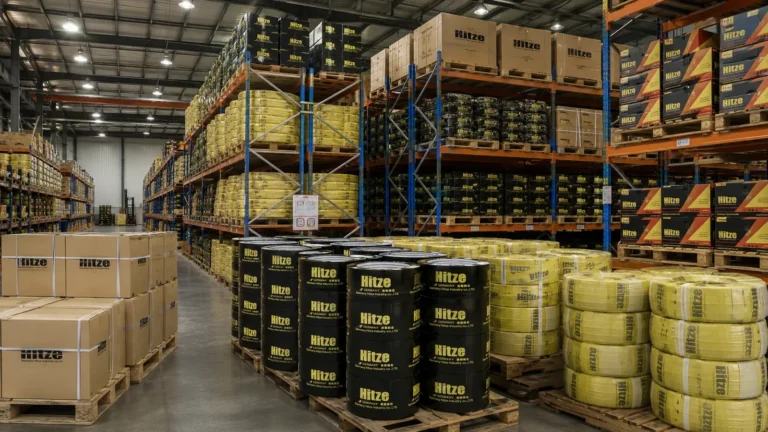
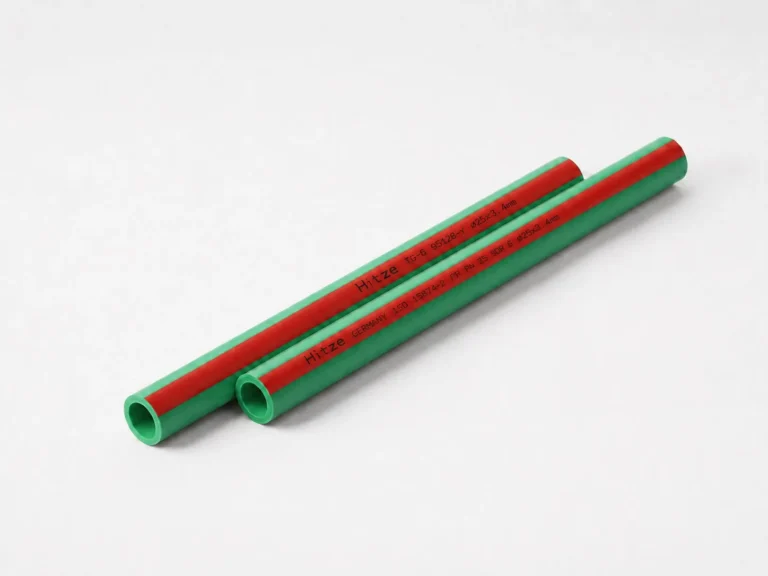
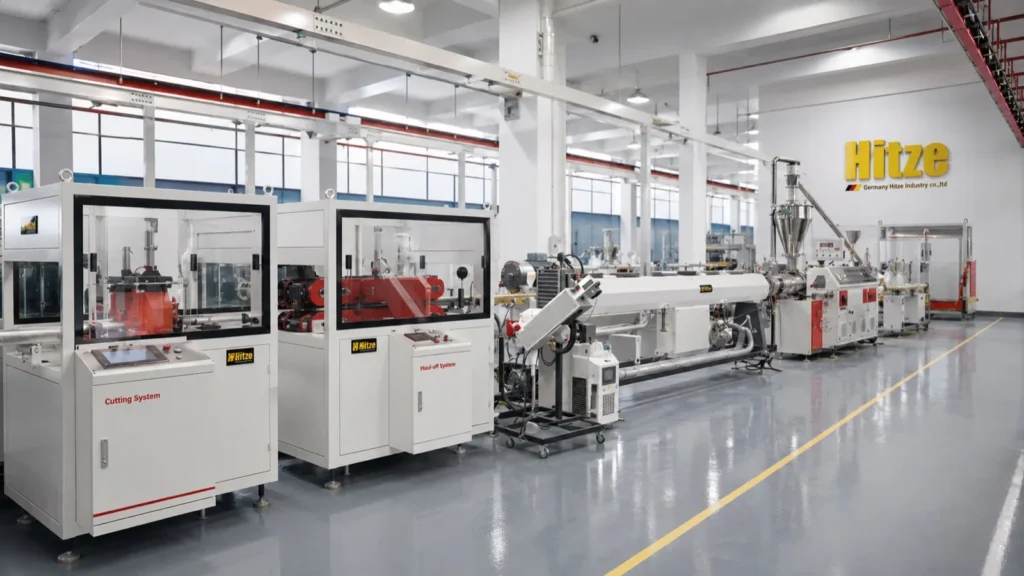
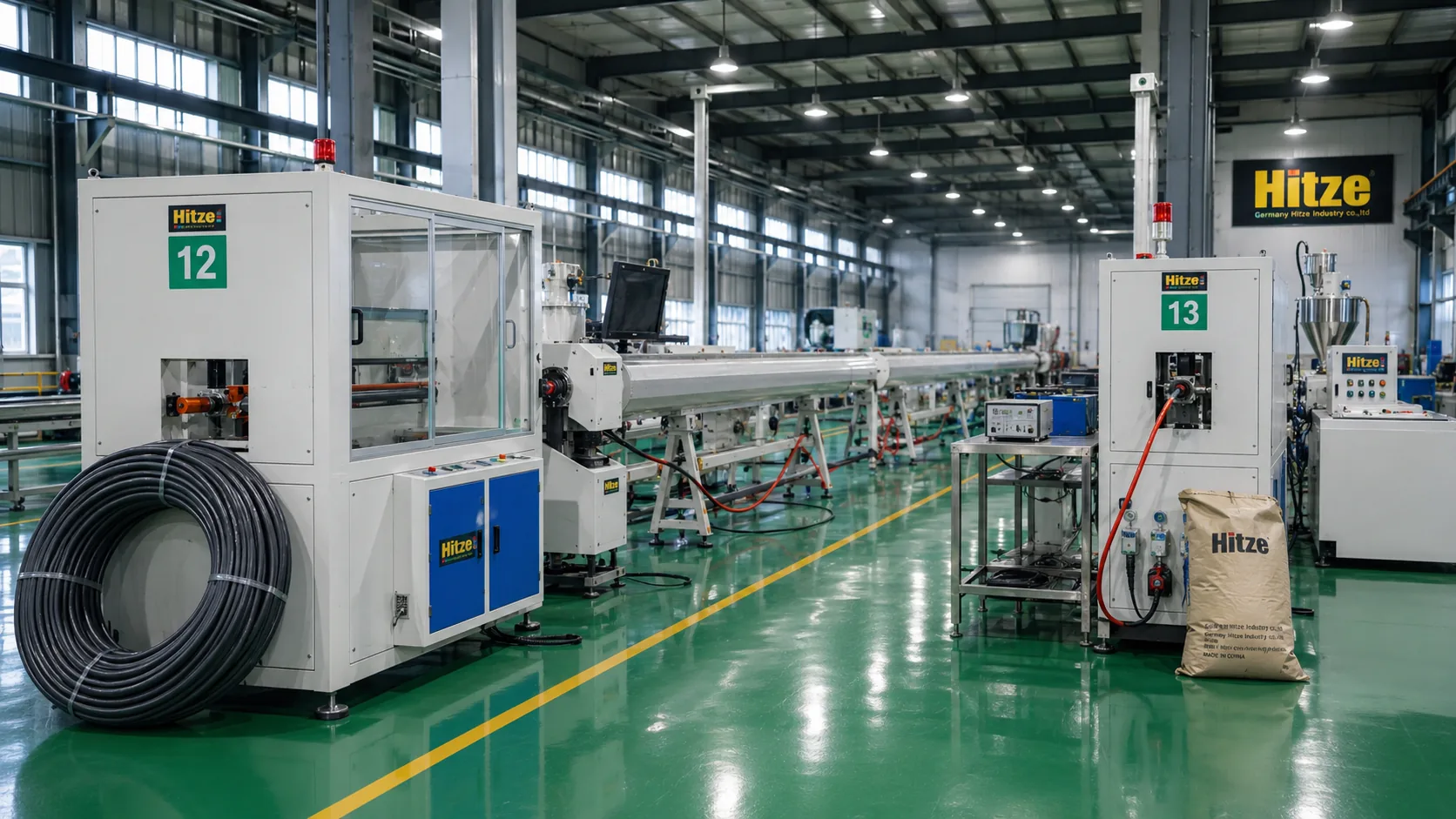
Price mechanics only protect you if the product underneath stays constant — the oldest trick in a resin squeeze is holding the price and cutting the input. Hitze has run polymer piping production since 1974, across a 120,000 m² base with 1,000+ employees supplying 118+ countries, and the process controls exist precisely so that a resin market move never becomes a specification move. Raw material is metered into the extruders through gravimetric dosing systems — the resin blend is weighed into the die feed, not eyeballed — and every production run is checked against the dimensional and pressure requirements of the standards each line is built to: DIN 8077/8078 and EN ISO 15874 for PP-R, DIN 4726 oxygen-barrier requirements for heating pipe, ASTM F876/F877 where PEX is supplied to North American programs. Finished pipe and fittings go across in-house pressure-test benches, and the PP-R and PE-Xb systems carry third-party certificates from SKZ in Germany, with DVGW type examination on PP-R drinking-water pipe.
On pricing itself, Hitze publishes no index formula — commercial terms vary by market and order, and indexation, per-order locks, and review cadence are agreed per program with the buyer. What is fixed is the part that should never float: the specification the pipe is extruded to, and the 50-year warranty on the matched Hitze pipe-and-fitting system, which is only possible when the resin going into the die is controlled regardless of what the resin market is doing that quarter. Distributors setting up a standing program through our wholesale plumbing and heating pipe channel negotiate the price mechanism and the reorder rhythm together — because a banded index clause and a predictable production slot are two halves of the same stability.
Worked Scenario: Indexing a Quarterly PP-R Reorder
All numbers below are illustrative — the mechanics are the point. A UK wholesaler reorders one 40HQ of PP-R pipe and fittings per quarter at an ex-works value of $46,000. The annual supply agreement names a published European polypropylene assessment as the reference index, baseline value 1,200 per tonne at signing, with a ±5% trigger band (no action between 1,140 and 1,260), quarterly review against the preceding quarter’s average, a pass-through coefficient of 0.5, and fully symmetric adjustment. FX is fixed to the ECB reference rate on the last publication day of each quarter.
Q2: resin rallies; the quarterly average prints 1,320 — 10% above baseline, outside the band. Adjustment = 10% × 0.5 = 5%. The Q3 container invoices at $48,300, with the calculation shown on one line referencing the index publication. No negotiation, no surprise email — the wholesaler saw the index moving in April and adjusted resale prices before the cost arrived. Q3: the average falls back to 1,230 — inside the band. Because the clause anchors to the original baseline and resets when the index re-enters the corridor, Q4 invoices at $46,000 again, automatically. Compare the counterfactual most distributors live with: a supplier repricing ad hoc off the spot peak (1,380 in one May week) would have asked +8% or more — and the decrease would have required a fight the buyer usually does not know they have earned. Over a four-container year, the difference between the banded, averaged, symmetric clause and ad-hoc repricing is measured in thousands of dollars, and every one of those dollars was decided at contract time, not in the resin market.
Seven Questions to Put to Your Pipe Supplier
Take these into the next annual review. The answers matter less than whether the supplier can answer at all — a factory with a real pricing mechanism responds in one email; one without will offer you a call. One: which published index or assessment do you reference when you tell me raw material moved — and will you name it in the contract? Two: what trigger band applies before any adjustment, in either direction? Three: is the adjustment calculated on a period average or a spot date? Four: what fraction of the index move passes through — and does the same fraction apply downward? Five: do surcharges expire automatically at the next review, or must I ask? Six: can I fix the price of each confirmed order at booking, and what does a 6-month calendar lock cost over the indexed price? Seven: if the contract currency and the index currency differ, what fixing source and date convert one to the other?
A supplier who answers all seven cleanly is worth a longer agreement — mechanism clarity upstream is what lets you quote confidently downstream. A supplier who answers none of them is not necessarily dishonest; but every resin cycle, you will be renegotiating from zero, in the week the market is least kind to buyers.

Who This Is For
If you are a distributor or wholesaler reordering pipe on a rhythm — and resin-driven quote jumps are eating the margin you planned around — a supplier relationship with a written price mechanism is worth more than a one-off cheap container. Hitze is a German brand of engineered piping systems, supplying trade and wholesale buyers only, with no minimum order quantity: programs start sample-first, so you can verify the product before a single commercial term is negotiated, and the matched pipe-and-fitting system carries a 50-year warranty. If that is the kind of buying relationship you are trying to build, start at our wholesale plumbing and heating pipe page and tell us your reorder rhythm — pricing terms vary by market and order, and the mechanism is agreed with you, not announced to you.
FAQ
What is a resin price index?
A published, third-party series tracking polymer prices — ICIS and S&P Global (Platts) publish subscription assessments for PP and PE by region; Plastics News publishes North American resin tables in US cents per pound; the US BLS producer price index for plastics pipe manufacturing is a free monthly alternative tracking finished-pipe producer prices. Contracts reference these so price adjustments follow a number neither side controls.
What is a typical trigger band in a pipe supply contract?
A corridor of roughly ±5% around the baseline index value is a common working choice: wide enough to absorb weekly noise, narrow enough that a genuine market move triggers adjustment. The exact width matters less than pairing it with period-average calculation and symmetric operation in both directions.
Is a surcharge or a full reprice better for buyers?
A surcharge is more transparent and easier to reverse — provided the contract makes it expire automatically at the next review. A reprice is cleaner but ratchets upward unless each adjustment is anchored to the original baseline index value. Many distributors run surcharges in-year and reprice only at annual renewal.
Can a small distributor hedge resin prices with futures?
Cash-settled resin futures exist on CME Group, but they are built for processors and traders; thin liquidity, margining, and currency mismatch make them impractical for most SME distributors. The realistic hedge is contractual: banded indexation, per-order price fixing at booking, and symmetric downward adjustment.
Does Hitze index its pipe prices to a resin index?
Hitze does not publish a single pricing formula — commercial terms vary by market and order, and indexation, per-order locks, and review cadence are agreed per program with each buyer. What does not vary is the specification: pipe is extruded to the same DIN and EN ISO standards regardless of the resin market, and the matched system carries a 50-year warranty.