A repair quotation can say “press fitting, same size” and still describe the wrong connection. A copper press fitting is not a substitute for a steel-pipe press fitting simply because both carry the same nominal size. First establish the pipe’s dimensional family, material, wall and sealing surface. Then confirm the named fitting system, attachment, sealing element and service. Passing one of those checks does not approve the others.
The comparison below uses the actual Viega North American MegaPress and ProPress manuals as named examples. It concerns steel versus copper system eligibility for mechanical piping selection. It does not establish Hitze compatibility with either system, authorize a fuel-gas installation or provide a universal steel-pipe acceptance specification.
Key Takeaways
- Nominal size alone cannot identify the pipe that a press fitting accepts.
- The named MegaPress manual addresses carbon-steel iron pipe size systems; the named ProPress manual restricts its copper system to specified copper tube.
- Coating and end condition can prevent an otherwise eligible steel pipe from qualifying.
- MegaPress requires its specified attachments; the manual expressly excludes ProPress jaws and rings.
- The named carbon-steel MegaPress system is not suitable for potable-water installations.
- Keep pipe eligibility, tooling and application approval as separate decisions in the purchasing record.
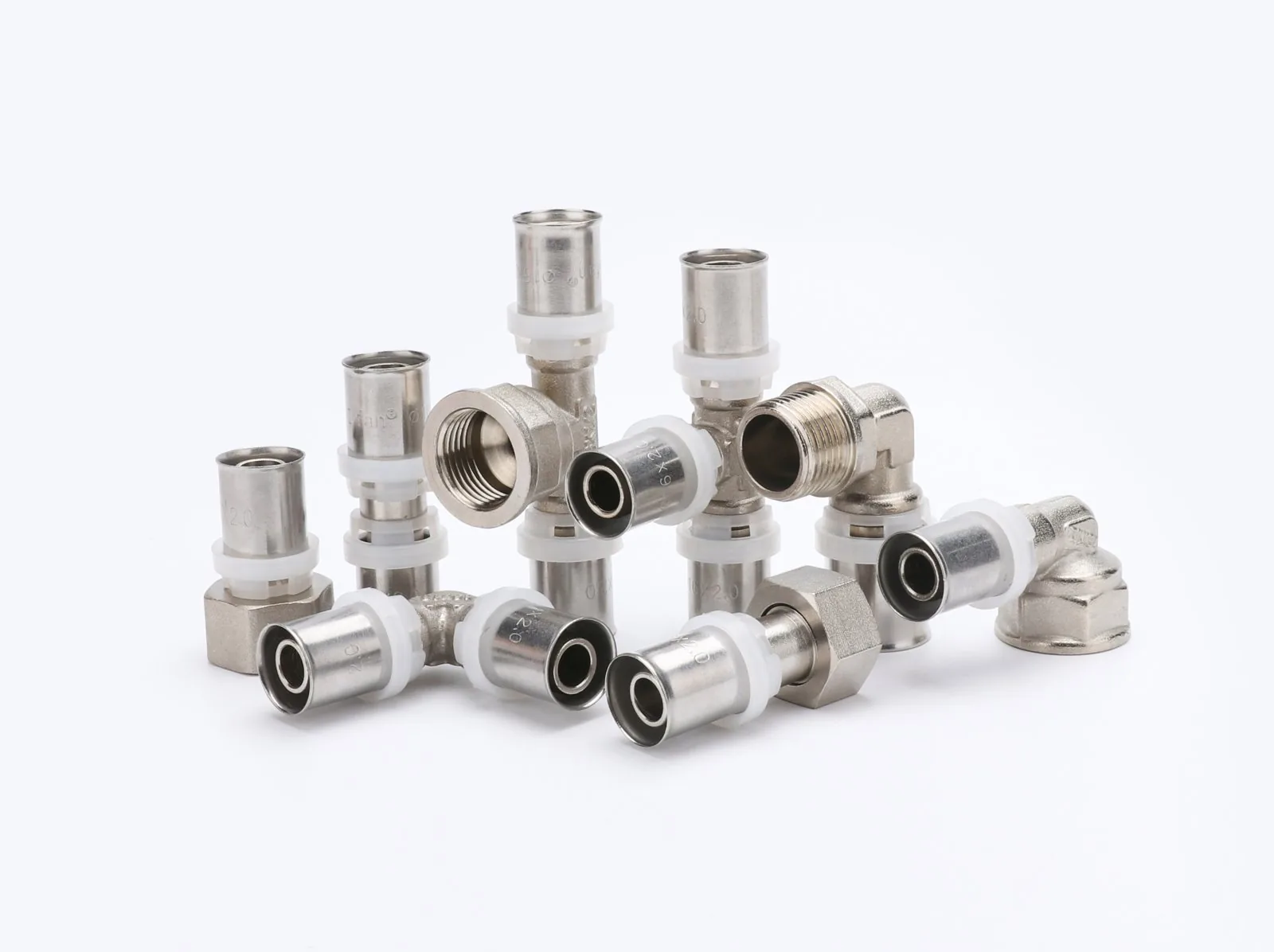
The same nominal size does not identify the same pipe
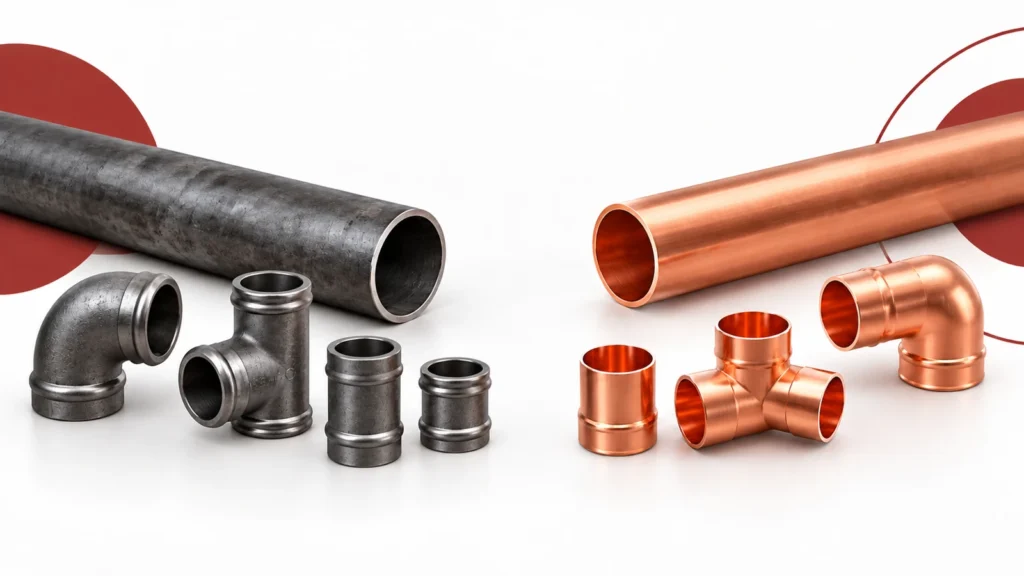
Begin with what the fitting grips and seals against. Viega describes the named MegaPress system as an iron pipe size, or IPS, system for carbon-steel pipe. Its ProPress copper manual describes a copper tube size, or CTS, system. These are different dimensional and material families. A nominal inch label is a designation inside its family, not a promise that the outside surface and wall match another family bearing the same label.
The steel manual’s pipe section lists specified carbon-steel pipe standards and schedules. It also distinguishes the condition of coated pipe: the maximum external diameter in the applicable tables must not be exceeded. The pipe therefore needs more identification than “black steel” or a nominal size from an old invoice. Determine the actual standard, outside diameter, wall or schedule, and condition before selecting a fitting.
The copper manual gives a different eligibility rule. ProPress may only be pressed onto copper tube complying with its stated ASTM B88 or B75 conditions. For B88 it identifies types K, L and M, while temper and size restrictions also apply. Those permissions describe copper tube; they cannot be transferred to a steel pipe because a contractor owns a familiar copper press kit.
| Selection item | MegaPress carbon-steel example | ProPress copper example | Verdict |
|---|---|---|---|
| Dimensional family | IPS steel pipe | CTS copper tube | Do not substitute by nominal label |
| Pipe evidence | Listed steel standard, wall/schedule and diameter | Listed copper standard, type, temper and size | Use the exact system’s pipe conditions |
| External condition | Coating and prepared surface within instructions | Permitted copper surface condition | A material match alone is incomplete |
| Purchasing result | Eligible candidate after pipe checks | Eligible candidate after tube checks | Continue to tooling and service checks |
Sources: Viega MegaPress Systems manual, IM-MP 724992 1125, sections 2.1 and 2.7.2; ProPress Systems manual, IM-PP 724607 1125, section 2.4.4. Standard identifiers describe the manuals’ accepted pipe categories, not a claim that this article has reproduced the full standards.
A clear purchasing question follows: is the proposal a fitting for the identified steel pipe, or merely a fitting with a familiar nominal size? If the only available evidence is the latter, hold the substitution. A drawing or catalogue that identifies the pipe family can resolve that missing input; a successful attempt to push a fitting onto an unknown pipe cannot.
A steel pipe must also qualify at the sealing surface
An eligible pipe standard does not make every point on an existing pipe suitable for a press joint. The sealing region still has to meet the named system’s requirements. Viega’s steel manual gives different preparation instructions for clean bare pipe, galvanized surfaces, shellac or lacquer, rust film and other coatings. This is why a generic instruction to “clean the pipe” is too vague to justify a repair proposal.
For clean bare pipe, the manual’s no-preparation condition depends on a smooth surface without rust or lacquer. Uneven galvanized surfaces need smoothing. Shellac or lacquer must be smoothed, but complete removal is not necessarily required. Rust film must be removed until the surface is smooth. These are distinct branches, not permission to remove any surface feature until the fitting appears to fit.
The manual makes two stronger exclusions. MegaPress fittings are installed on plain-end pipe; pressing directly over threads produces an improper seal. Engraved or stamped pipe must not be used, and the manual expressly says not to remove engraving or stamping with a grinder or another tool. Grinding away the identification defect would not convert that rejected condition into an approved sealing zone.
| Observed condition | Named-manual requirement | Verdict |
|---|---|---|
| Clean, smooth bare pipe without rust or lacquer | No preparation required under that stated condition | Continue other eligibility checks |
| Uneven galvanized surface | Smooth the surface as instructed | Preparation required |
| Shellac or lacquer | Smooth coating; full removal not necessarily required | Do not invent a universal stripping rule |
| Threads in the intended press zone | Plain-end pipe only | Reject that press location |
| Engraving or stamping | Do not use; do not grind away markings | Reject that pipe condition |
Source: MegaPress manual section 3.3 and its accompanying cautions. This excerpt is not a complete preparation procedure.
Coated pipe adds a dimensional question as well as a surface question. A smooth coating is not sufficient if the resulting external diameter exceeds the applicable limit. Conversely, a fitting that slides over the end does not prove the surface can seal reliably. Keep both findings in the inspection record. If coating type or remaining wall condition is unknown, identify that uncertainty before accepting the proposed connection.
For an existing line with localized damage, this analysis helps the contractor explain why a convenient cut location may be unsuitable. The required result is an eligible pipe segment and a permitted joint location, not the shortest possible repair. The engineer or responsible installer must determine the appropriate replacement extent and safe work arrangement; this article does not prescribe cutting into an operating line.

A shared press machine does not share every attachment
Only after pipe eligibility is established should the tool question be asked. A press machine supplies the driving action, while the jaw or ring engages the particular fitting geometry. The ability of a tool body to accept an attachment does not mean every attachment creates the joint specified by the fitting maker.
The named MegaPress instructions are explicit: use MegaPress jaws and rings and do not use ProPress press jaws or rings. They also prohibit mixing actuators and rings from different manufacturers. Those instructions defeat the tempting shortcut of using the copper attachment already in the van because the proposed steel fitting has the same nominal size.
This does not mean every change of pipe material requires buying another drive unit. It means the permitted complete combination must be identified. Record the drive model, jaw or ring reference, actuator where applicable, fitting family and size. Check those references against the current fitting and tool instructions together. A generic profile letter is not enough to replace that record.
The site’s press jaw profile and tool compatibility guide covers the wider attachment-selection task. Here, the narrower conclusion is that the steel pipe first needs an eligible steel system, and that system then needs its own approved attachments. Changing the jaw cannot make a copper fitting into a steel fitting, just as choosing the correct fitting cannot authorize an incompatible jaw.
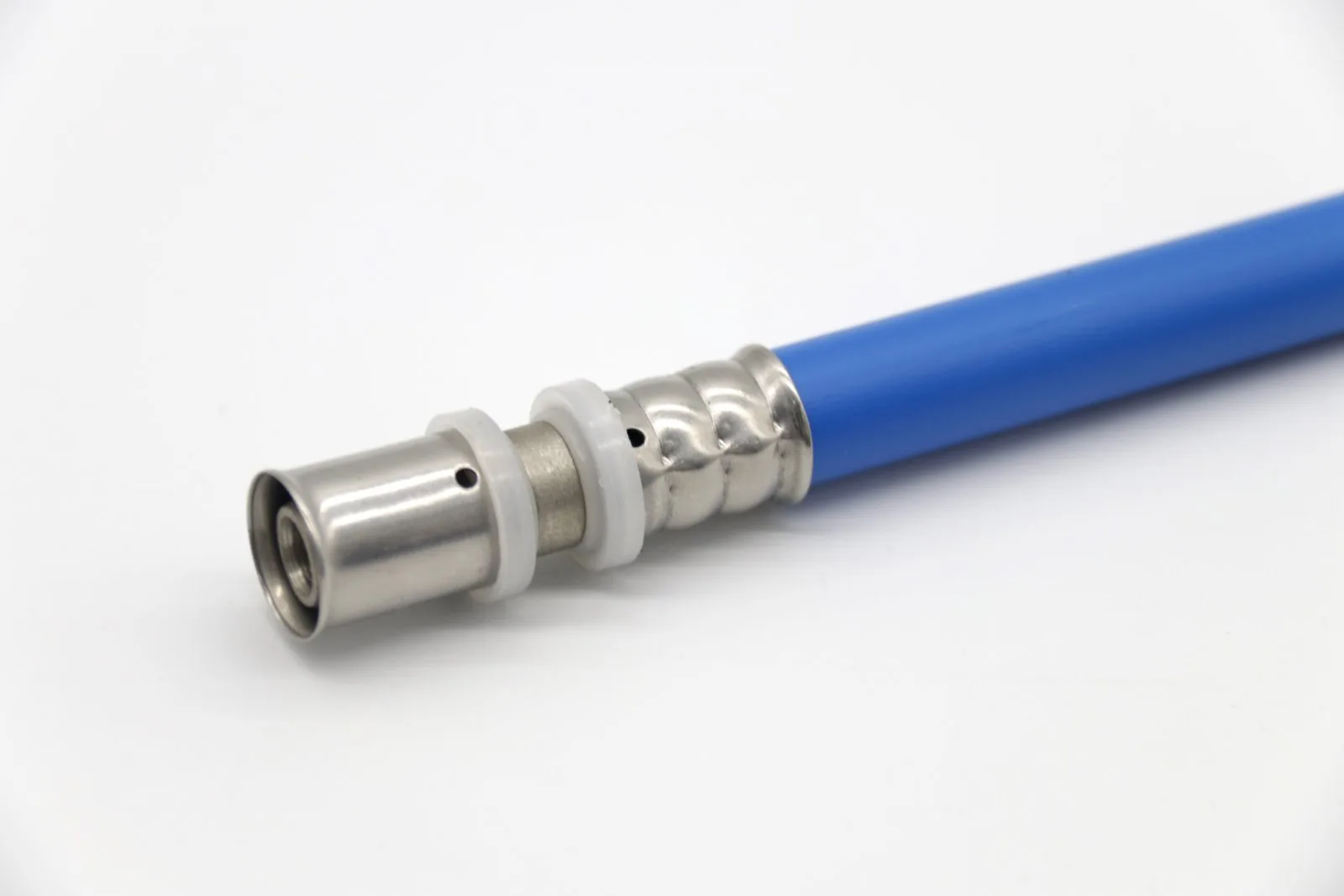
Material eligibility is not service approval
A mechanically plausible connection can still be unsuitable for the fluid or duty. The named carbon-steel MegaPress manual describes industrial, heating and cooling uses and states that the system is not suitable for potable-water installations. A purchasing description that says only “water” therefore leaves a decision-critical distinction unresolved. Cooling water and drinking water cannot be treated as the same application merely because both are water.
The manual also identifies different fitting variants and sealing elements. The presence of a familiar seal material is not a standalone application approval: the fitting family, medium, operating conditions and manufacturer instructions must be considered together. This comparison does not supply a pressure or temperature rating to be applied across all variants, and it does not extend one variant’s permission to another.
Take a conceptual substitution example. A proposed assembly has the correct listed steel pipe and a permitted sealing surface, but the buyer changes its intended use from a mechanical cooling circuit to potable water. The pipe checks do not erase the named system’s potable-water exclusion. That proposal must be rejected for this application even if its physical dimensions and tooling can be matched. A different documented system would have to be evaluated on its own evidence.
Keep that boundary visible in commercial discussions. Hitze’s press fittings category provides a route to discuss project requirements. It does not, by itself, verify that Hitze supplies an equivalent carbon-steel press system, accepts Viega tooling or holds an approval for the proposed service. A specific offered product and its documentation must establish those claims.

Accept or hold a substitution with a complete system record
A useful review record separates the reasons a proposal can proceed from the reasons it must stop. Start with the existing pipe: manufacturer if known, standard, material, measured outside diameter, wall or schedule, and coating. Attach observations of the intended sealing zone and end condition. Then name the exact proposed fitting and its source instructions. This prevents an ambiguous “steel fitting” line from concealing an unverified system.
| Check | Required evidence | Verdict when absent or conflicting |
|---|---|---|
| Pipe eligibility | Applicable pipe standard, dimensions and wall | Hold; nominal label alone is insufficient |
| Sealing zone | Permitted end, surface and coating condition | Reject excluded conditions; resolve preparation requirements |
| Press assembly | Approved drive, attachment and actuator combination | Hold; familiar tool appearance is insufficient |
| Application | Exact variant and duty within its approved scope | Reject an excluded service |
| Supply | Specific offered part and matching documents | Check availability before making a purchase commitment |
The record is useful even when the answer is “not yet.” Missing wall information prevents confirmation that the actual pipe lies within the named system’s acceptance scope. Missing attachment references prevent confirmation of the intended pressing combination. Missing fluid or temperature details prevent application selection. Each missing input has a different consequence and a different route to resolution; collecting a generic certificate bundle does not resolve all three.
Once the information is complete, the responsible reviewer can compare it with the current instructions and approve the exact assembly or reject the mismatch. Installation, inspection and the prescribed test still follow the applicable system instructions and project requirements. Neither a complete quotation nor an apparently successful press is a substitute for that acceptance process.
Decision flow
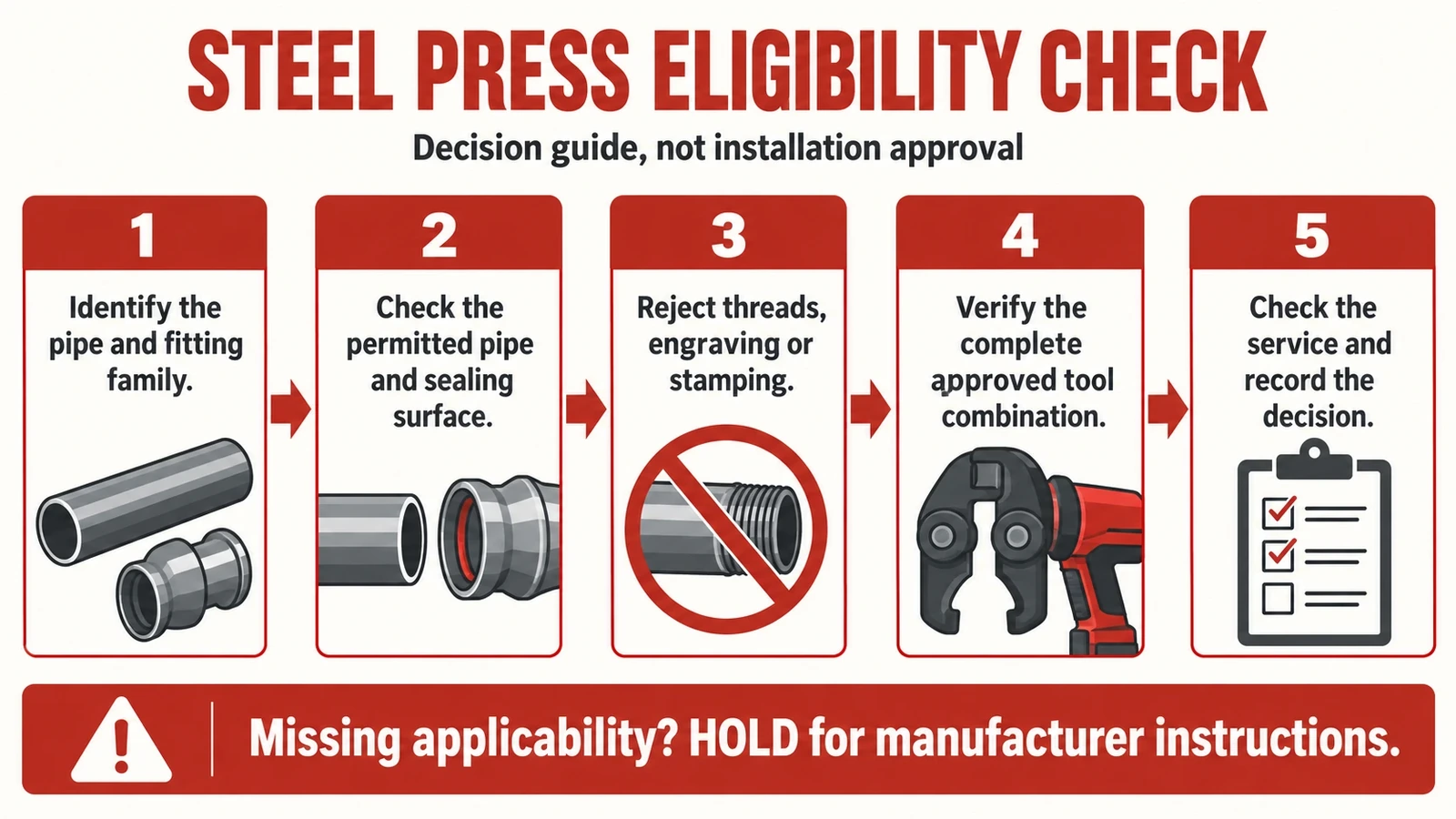
- Identify the pipe and fitting family
- Check the permitted pipe and sealing surface
- Reject threads, engraving or stamping
- Verify the complete approved tool combination
- Check the service and record the decision
Missing applicability? HOLD for manufacturer instructions.
Conclusion
Steel and copper press selection begins with different pipe families. A valid steel candidate must also meet the sealing-surface requirements, use the approved pressing combination and suit its intended service. The practical tradeoff is clear: reusing equipment may be possible where the complete combination is documented, but nominal size and familiar tooling cannot justify an undocumented substitution.
Frequently asked questions
Can a copper ProPress fitting be used on steel pipe?
The named ProPress copper manual permits specified copper tube. It does not authorize steel pipe. Select a documented system for the actual steel pipe instead.
Can ProPress jaws press MegaPress fittings?
The named MegaPress manual expressly prohibits ProPress press jaws and rings. Use the approved MegaPress combination for the fitting and size.
Can I grind stamped pipe smooth before pressing?
The named MegaPress manual says engraved or stamped pipe must not be used and that the markings must not be removed with a grinder or other tool.
Does steel-pipe compatibility establish potable-water suitability?
No. Pipe eligibility and application approval are separate. The named carbon-steel MegaPress system is not suitable for potable-water installations.