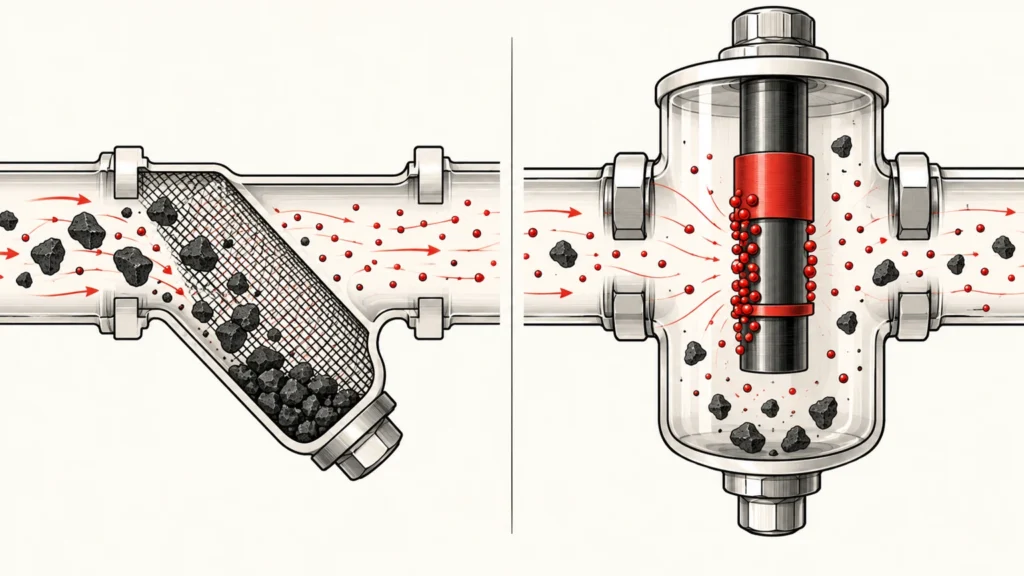
A magnetic dirt separator and a Y-strainer solve different protection tasks: a screen intercepts particles by size, while a magnetic separator targets ferrous contamination and may also use a separate dirt-separation mechanism. For an MEP selection, start with the actual contaminant and the protected equipment’s written requirements. If the equipment specifies a strainer, retain that requirement; a magnet alone is no basis for removing it.
The useful choice is therefore not simply “which device is better?” It is whether the circuit needs screen interception, magnetic capture, nonmagnetic dirt separation, or a documented combination. This comparison provides a mechanism matrix and a completed qualitative case. It does not approve a replacement model or a change to the equipment specification.
This independent plumber’s magnetic-separator video is provided as topic context. The selection decision here rests on the manufacturer evidence below; the video is not equipment approval or site-specific service instruction.
A plumber will show you how to install a magnetic dirt separator #diyplumbing — DIY PLUMBING ANOUAR. Playback not independently verified.
Define the contamination and protection requirement
Write the protection task in two parts. The first describes the material to remove: for example, identified ferrous contamination, nonmagnetic debris, or a mixture that remains uncharacterised. The second records what the protected boiler, circulator or other component requires at its inlet. A description such as “dirty heating water” cannot resolve both questions.
Keep those records independent. Identifying fine ferrous material supports considering magnetic capture; it does not establish that every harmful particle is magnetic. Equally, a specified screen opening describes an interception requirement, not the ability of a magnet to capture smaller ferrous material. The two records can point to complementary mechanisms rather than competing products.
A January 2024 HeatingHelp question asks about replacing a wye strainer before a modulating-condensing boiler. That is a real selection dilemma, but the discussion does not provide the equipment’s full inlet-protection specification. Treat its product suggestions as discussion, not permission to remove a required component.
For the screen-specific approval task, use the existing Y-strainer selection guide, which covers aperture, model-specific loss and cleanout access. Here the additional decision is whether another removal mechanism is needed alongside that screen requirement. Repeating a screen-sizing exercise would leave that question unanswered.

Separate screen interception from magnetic and low-velocity separation
A Y-strainer forces flow through a screen. Particles too large to pass its openings are intercepted; smaller particles may pass. In contrast, Caleffi’s DISCALDIRTMAG technical sheet 01287/23 NA describes a low-velocity zone and an internal element that assists dirt separation and guides particles towards the collection area. Its magnetic function captures ferrous impurities separately from that process.
This distinction prevents two errors. Calling a device “magnetic” does not mean its magnet captures nonmagnetic particles. Calling a separator’s internal element a “screen” does not necessarily mean it supplies the same size-interception function as an inlet strainer. Read the manufacturer’s description of what water passes through and how debris is retained.

| Mechanism | Relevant contamination | What it establishes | What it cannot establish alone |
|---|---|---|---|
| Physical screen interception | Particles retained by the documented opening | A size-based barrier in the flow path | Capture of fine material that passes the screen |
| Magnetic capture | Ferrous contamination responsive to the magnetic field | A mechanism directed at ferrous impurities | Retention of nonmagnetic dirt or compliance with a required screen opening |
| Low-velocity dirt separation with an internal element | Separable dirt within the named device’s documented capability | A distinct separation and collection process | A universal particle cutoff or an automatic substitute for a required strainer |
| Documented combined assembly | Tasks covered by its separate separation, magnetic and screening functions | Multiple mechanisms in one specified arrangement | Approval for every equipment specification or circuit duty |
There is a manufacturer-documented example of that last arrangement. Caleffi’s DIRTMAGPLUS description identifies a dirt separator and cartridge strainer in series: an internal separation element and magnets address one function, and a metal mesh selects particles by size. This proves that combined mechanisms are a real design option. It does not establish a Hitze product specification or approve that assembly for your equipment.
For a proposed combined unit, identify the actual cartridge supplied and the function it must retain throughout operation. The cited manufacturer page describes different cartridge arrangements for initial cleaning and ongoing operation. A commissioning configuration is therefore not sufficient evidence of the permanent screen arrangement. The equipment requirement still governs what may remain installed.

Compare pressure loss and service access by named data
Mechanism fit comes first; hydraulic and maintenance fit follow. Caleffi’s Y-strainer cleaning guidance explains that trapped dirt increases resistance and uses a clean-strainer differential-pressure reference at design flow to assess loading. That supports monitoring the selected screen assembly. It does not supply a universal cleaning alarm for every strainer or a reason to delete the screen.
The DISCALDIRTMAG sheet presents its own head-loss comparison with a Y-strainer. Use that comparison as an example of why construction matters, not a general saving to assign to any magnetic product. A combined unit includes a strainer, so it also needs data for that complete configuration. “Low loss” without the offered model, flow and fitted cartridge leaves the comparison unresolved.
| Check | Evidence to obtain | Decision consequence |
|---|---|---|
| Hydraulic duty | Exact model and screen or cartridge flow-loss data at project flow | Hold a candidate whose loss cannot be checked against the project allowance |
| Loaded-screen condition | Manufacturer guidance and the project’s operating loss/monitoring requirement | Retain a service strategy; do not assess the assembly only when clean |
| Access envelope | Model drawing, magnet-removal space, screen-removal space and drain arrangement | Reject a layout that fits the body but prevents required servicing |
| Installation and service conditions | Named manual for orientation, fluid compatibility, isolation and safe service | Hold when the actual installation cannot meet those instructions |
Access is especially easy to overlook when substituting one body shape for another. A long horizontal run may provide connection space while leaving inadequate clearance for a removable magnet or cartridge. Mark these envelopes on the proposed layout before accepting the device. Compare the service operations in the two manuals rather than assuming that a drain valve makes both assemblies equally accessible.
This is an equipment-selection check, not a drain-down procedure. Any isolation, cooling, depressurisation or debris discharge must follow the selected manufacturer’s instructions and the site’s safe working arrangements. An online description of convenient cleaning is not a general instruction to open hot, pressurised equipment.

Choose the protection path the evidence supports
Use the following table to choose the next design path. It deliberately separates a justified mechanism from a fully approved product. A path can be clear even while the exact model remains on hold for hydraulic or installation evidence. Where the contaminant itself is unknown, a preferred product cannot close that gap.
| Known condition | Supported path | Release condition |
|---|---|---|
| Equipment requires screening; no separate fine-ferrous task established | Retain and assess the specified strainer function | Document compliant screen, loss and service arrangement |
| Fine ferrous target; no screen requirement established | Evaluate magnetic separation | Confirm equipment requirements and named-model capability before approving |
| Fine ferrous target plus mandatory screen | Retain the screen requirement; evaluate a documented combination | Both functions documented; any change approved through the project’s design process |
| Nonmagnetic target | Evaluate appropriate screening or documented nonmagnetic separation | Match the target to actual opening or separation evidence; a magnet alone is insufficient |
| Uncharacterised debris or missing equipment requirement | Unresolved selection | Obtain the missing contamination or equipment record, then repeat the mechanism comparison |
- Record contamination and equipment requirements
- Required screen? YES: retain screen requirement; NO: continue mechanism comparison
- Fine ferrous target? YES: evaluate magnetic separation; NO: evaluate appropriate screening or documented nonmagnetic separation
- Fine ferrous target plus required screen: evaluate a documented combination
- Check named assembly: permanent screen, flow-loss data and service access
- Required evidence complete? YES: send documented assembly for project review; NO: HOLD and obtain missing evidence
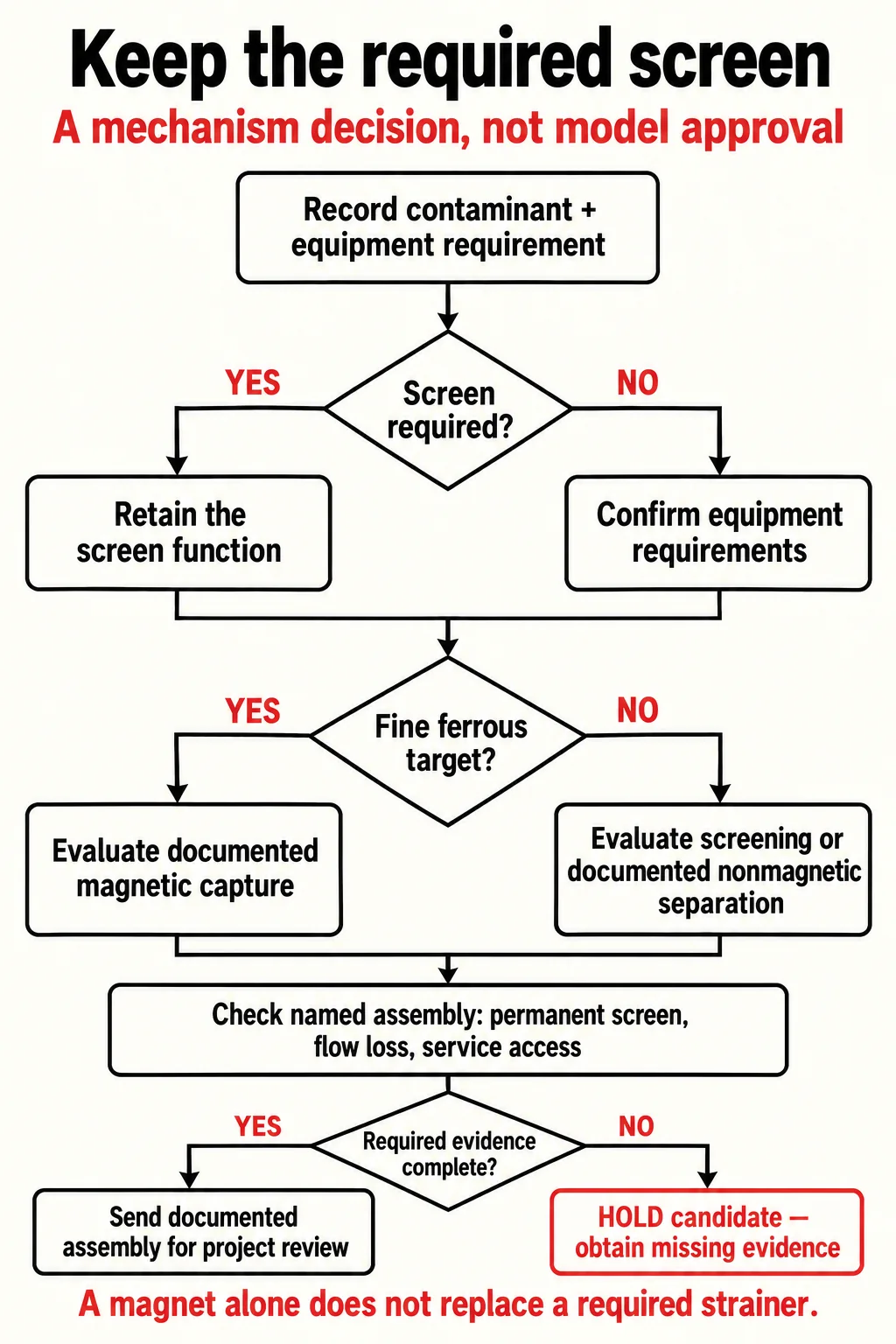
Worked decision: fine ferrous material, but the screen must stay
Illustrative inputs, not a measured installation: an MEP reviewer has a closed hydronic circuit with identified fine ferrous contamination. The protected equipment’s written specification requires an inlet strainer. The reviewer is asked to approve replacing the existing Y-strainer with a magnetic dirt separator. No offered-model flow-loss curve or approved specification change accompanies the request.
The contamination record makes magnetic capture relevant. It does not cancel the screen requirement. The proposed separator-only replacement therefore fails the stated protection brief, even before pressure loss is assessed. Retaining only the existing screen also leaves the additional fine-ferrous removal objective unproven where that material can pass its opening.
Decision: retain the mandatory strainer function and assess a documented combined protection arrangement. The DIRTMAGPLUS example shows the mechanism combination to ask about; it is not the selected product. Request the offered assembly’s permanent screen details, magnetic/separation description, flow-loss data and access drawing. If these satisfy both tasks and the project accepts the arrangement, the candidate can proceed through approval. Without them, hold that candidate rather than approve a swap.
Keep the same mandatory screen requirement, but replace the identified fine ferrous contamination with identified nonmagnetic debris. Magnetic capture now lacks a demonstrated role for that target. Retain the screen and evaluate its opening or a documented nonmagnetic separation mechanism against the debris; do not default to buying a magnet.
The countercheck matters because “more functions” is not itself a selection criterion. A combined product earns consideration when its documented functions answer the actual protection tasks. It still requires a hydraulic and maintenance fit. This avoids both an unsupported substitution and an unnecessary magnetic feature justified only by a product name.
For importers assembling the surrounding piping package, Hitze’s importer and distributor page is the relevant commercial route for piping enquiries. Keep the specialist protection-device approval separate: the examples here do not establish Hitze separator availability. Include the connection/interface requirements in the piping enquiry after the protection arrangement is defined.
Use the selected protection layout to state the adjoining pipe system, connection type, project market and required delivery date. Ask Hitze to confirm the applicable piping scope and quotation timing; have the protection-device vendor resolve the separator or strainer submittal.
Conclusion
Choose by contaminant and required protection function, then assess the named assembly. Screening, magnetic capture and low-velocity dirt separation are different mechanisms; a documented combination may address more than one task. The costly mistake is approving a magnet as evidence that an equipment-required screen can disappear. Keep that requirement until an accepted design change explicitly resolves it.
Frequently asked questions
Can a magnetic dirt separator replace a Y-strainer?
Only when the proposed arrangement meets the protected equipment’s documented requirements and the project approves the change. A magnetic function alone does not satisfy a required screen specification.
Does a magnet remove nonmagnetic dirt?
The magnetic function does not. Some devices also use a separate dirt-separation mechanism or screen; check the named model’s documentation for that capability.
Is a combined separator and strainer always preferable?
No. A combined assembly is relevant when its documented functions match the contamination and equipment requirements. Its hydraulic loss, permanent screen arrangement and service access still need approval.
Can the same cleaning pressure-drop limit be used for every strainer?
No. Use the selected manufacturer’s guidance and the project’s operating requirements. A pressure-drop example for one product is not a universal alarm setting.