Key Takeaways
- ISO 9080 is the method behind every honest 50-year pipe rating. Pipes are pressure-tested to failure at two or more temperatures, with at least 30 failure points per temperature and observations beyond 9,000 hours, then extrapolated by multiple linear regression.
- The published number is not the average — it’s the pessimistic bound. ISO 9080 reports the 97.5% lower prediction limit (σLPL): the strength the material beats with 97.5% statistical confidence at 50 years (438,000 hours) and 20 °C.
- Extrapolation is capped, not open-ended. ISO 9080’s ke factors define exactly how far data may be stretched — roughly 10,000 hours of 95 °C data substantiates about 114 years at 20 °C, which is why a two-year lab program can honestly prove a 50-year figure.
- σLPL → MRS → design stress is a chain of deliberate haircuts. PP-R’s curve gives ≈9.7 MPa at 20 °C/50 years; ISO 12162 rounds it down to MRS 8.0, and a design coefficient of at least 1.25 cuts it again before any pressure rating is printed.
- 50 years at rated conditions — never 100 for PP-R. The rating holds at the temperature/pressure class it was derived for. Hitze’s 50-year warranty on its matched pipe-and-fitting system sits on this engineering, verified by SKZ and DVGW third parties.
Nobody has ever tested a PP-R pipe for 50 years. The material has not existed in its current formulations for that long, and no lab will run a single specimen from now until 2076. So when a datasheet says “50-year service life,” a reasonable specification engineer asks the obvious question: is this number engineering, or is it marketing with a decimal point?
The answer is that it can be either — and the dividing line is ISO 9080. Suppliers who can show an ISO 9080-based classification, third-party test certificates and the design math that connects them have proven the number. Suppliers who print “50 years” (or worse, “100 years”) with nothing underneath are decorating a brochure. This article walks through how the method actually works: the test program, the statistics, the extrapolation limits, and how the result becomes the pressure rating printed on the pipe via ISO 12162, EN ISO 15874 and DIN 8077. By the end you’ll be able to audit any 50-year claim in about twenty minutes.
What ISO 9080 actually is — and the question it answers
ISO 9080 — full title: Plastics piping and ducting systems — Determination of the long-term hydrostatic strength of thermoplastics materials in pipe form by extrapolation — defines the Standard Extrapolation Method (SEM). Its job is to answer one question with statistical honesty: what hoop stress can this material carry, in pipe form, for 50 years at 20 °C — and how sure are we?
Two design choices make the method credible rather than optimistic. First, it works on pipes, not on molded plaques or dogbone tensile bars — the data comes from actual extruded pipe under internal water pressure, per ISO 1167-1 and 1167-2, so processing effects are baked into the result. Second, it does not report the average strength. It reports the 97.5% lower prediction limit (σLPL) — the standard’s own text is explicit that this is “the lower confidence limit of the prediction of the value of the stress that can cause failure in the stated time at a stated temperature.” In plain terms: the regression line says what the material typically does; σLPL says what you can bank on with 97.5% confidence. Ratings are built on the second number.
One insider distinction worth knowing: 50 years is defined as 438,000 hours (50 × 8,760). Every extrapolation limit, every classification and every design-stress table downstream is anchored to that figure at a stated temperature — not to a vague promise that the pipe “lasts 50 years” in whatever service you put it in. The rating is conditional, and the conditions are the whole point.
The test program: roughly two years of pipes failing on purpose
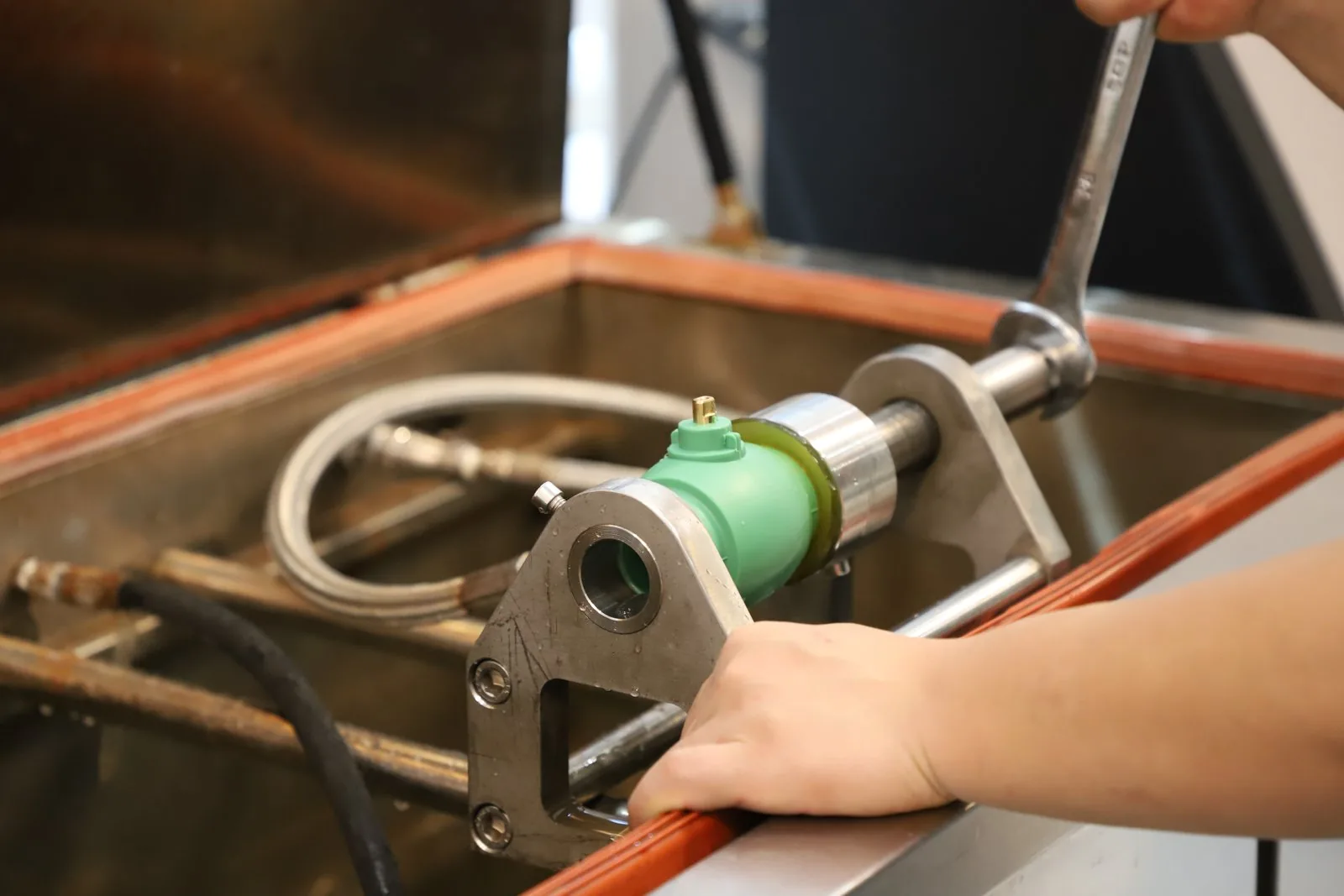
ISO 9080 is prescriptive about the raw data, and the requirements are what make the program expensive — and hard to fake. Test pieces must be straight pipes from the same batch and production run, pressurised with water at constant temperature until the wall ruptures. The standard then demands, for each test temperature, a minimum of 30 failure observations, spread across stress levels so that at least four failures occur beyond 7,000 hours and at least one beyond 9,000 hours. Failures under 10 hours are thrown out entirely — quick bursts tell you nothing about creep rupture — and the standard goes further at low temperatures: at 40 °C or below, failures up to 1,000 hours may also be neglected, provided enough valid observations remain, so the cool-temperature branch is anchored on genuinely long-term data rather than early bursts.
Temperature coverage is equally controlled: testing at two or more temperatures, with adjacent temperatures separated by at least 10 °C and at most 50 °C, and one of them must be 20 °C or 23 °C. For a hot-water material like PP-R the practical program is 20 °C, 60–70 °C and 95 °C — the product standard’s conformity testing expects at least three failure times in each time window (10–100 h, 100–1,000 h, 1,000–8,760 h and beyond 8,760 h) at each of those temperatures. Do the arithmetic on “at least one failure past 9,000 hours” and you see why nobody shortcuts this: 9,000 hours is 375 days of continuous testing on a single specimen, and because you cannot schedule exactly when a pipe will fail, a full material dossier typically consumes 18–24 months of lab time across dozens of pressure stations.
The insider warning here: this program qualifies a material, not a factory’s Tuesday output. The ISO 9080 dossier is usually generated once for a resin grade (often by the polymer producer, witnessed or repeated by institutes such as SKZ). What keeps a specific manufacturer honest is the separate layer of batch testing in the product standards — more on that below. When you audit a supplier, you need evidence of both layers, because a certificate for the resin says nothing about what a poorly run extruder did to it.
The statistics that keep the claim honest: σLTHS, σLPL and the knee
With the failure points collected, ISO 9080 fits a multiple linear regression of log(time) against log(stress) and inverse temperature — all temperatures analysed together in one model. The fitted line at any temperature is σLTHS, the long-term hydrostatic strength: the mean prediction. Around it, the method computes the 97.5% lower prediction limit. The gap between the two is the scatter penalty: a material with consistent, tightly grouped failure times keeps its σLPL close to the mean, while an inconsistent one gets punished with a wider gap. That is exactly the property a buyer should want rewarded.
The second statistical safeguard is knee detection. Polyolefin creep-rupture curves can change slope: an early ductile branch where the wall yields and balloons, and a later, steeper brittle branch where slow crack growth or oxidative degradation takes over. ISO 9080 includes a formal procedure to detect this “knee” and, if found, splits the data into two branches fitted separately — with at least 20 observations required on the second branch. This matters enormously for hot-water materials: at 20 °C the knee sits so far out in time that it never governs, but at 70–95 °C the second branch can cross below the first well inside the 50-year window. A vendor who quotes you the ductile-branch number at 70 °C when the knee governs is overstating strength by roughly 21% — we’ll put exact figures on that in the worked example below.
The North American counterpart, for orientation: ASTM D2837 derives an HDB (hydrostatic design basis) from the stress regression intercept at 100,000 hours at 23 °C, then sorts it into categories. ISO 9080’s approach is more conservative in structure — 438,000 hours instead of 100,000, and a 97.5% lower bound instead of the fitted mean — which is one reason MRS-rated and HDB-rated materials can’t be compared digit-for-digit. If you’re buying for both markets, insist on seeing both dossiers rather than a converted number.
Extrapolation limits: how far the data may legally stretch
Here is the part most marketing copy hopes you never read. ISO 9080 does not allow unlimited extrapolation from short data to long claims. It defines an extrapolation time te = ke × tmax, where tmax is the log-average of the five longest failure times at a test temperature, and ke is a factor set by the temperature difference ΔT between that hot test data and the cooler temperature you want to predict. The physics behind the table is an Arrhenius model with a deliberately conservative activation energy (110 kJ/mol for polyolefins — taken from the degraded branch, i.e., the worst case).
| ΔT = test temp − prediction temp | Extrapolation factor ke (polyolefins) | What ~10,000 h of hot data substantiates |
|---|---|---|
| ≥10 but <15 °C | 2.5 | 25,000 h (≈2.9 years) |
| ≥15 but <20 °C | 4 | 40,000 h (≈4.6 years) |
| ≥20 but <25 °C | 6 | 60,000 h (≈6.8 years) |
| ≥25 but <30 °C | 12 | 120,000 h (≈13.7 years) |
| ≥30 but <35 °C | 18 | 180,000 h (≈20.5 years) |
| ≥35 but <40 °C | 30 | 300,000 h (≈34 years) |
| ≥40 but <50 °C | 50 | 500,000 h (≈57 years) |
| ≥50 °C | 100 | 1,000,000 h (≈114 years) |
Now the 50-year claim stops being mysterious. A PP-R program with solid data at 95 °C, including failures around the 10,000-hour mark, predicts down to 20 °C with ΔT = 75 °C — that’s the ke = 100 row. Ten thousand hours of hot testing legally substantiates one million hours (≈114 years) at 20 °C, comfortably clearing the 438,000 hours a 50-year classification needs. The hot water is doing the time-travel: temperature accelerates the same creep-rupture mechanisms that would take decades to play out at room temperature, and the ke table caps how much credit you may take for it.
The same table is also your weapon against inflated claims. Extrapolation beyond te is simply not permitted — and prediction is only allowed down to 20 °C below the lowest test temperature. So when a PP-R datasheet advertises a 100-year service life at hot-water conditions, ask which test program substantiates 876,000 hours at 70 °C. There isn’t one — at ΔT = 25 °C (95 °C data predicting 70 °C), ke is 12, and you would need over 70,000 hours (8+ years) of continuous 95 °C failures to get there. The long-life conversation that does exist in the industry — such as PE100+ association guidance for PE pressure pipes generally (water and gas) noting that actual service life is expected to be “considerably greater” than the nominal 50-year design basis — is an expectation for operating within the design envelope, not a transferable rating. It is never a PP-R hot-water number. Hitze’s position is deliberate: 50-year design life at rated conditions, full stop.
From σLPL to MRS: why “PP-R 80” means what it says
The regression output is a stress value with decimals; the market needs a class. That translation is ISO 12162, and its key verb is round down. The σLPL at 20 °C and 50 years is rounded down to the next smaller preferred number — the R10 series below 10 MPa, R20 at or above it — and that becomes the MRS: Minimum Required Strength. The classification number on the pipe is 10 × MRS. PP-R’s reference curve delivers approximately 9.7 MPa at 20 °C/50 years; the next R10 step down is 8.0, so the material classifies as MRS 8.0 — printed as PP-R 80. PE100 got its name the same way: σLPL of at least 10.0 MPa, classified as MRS 10, class number 100.
Notice what just happened: nearly 1.7 MPa of demonstrated statistical strength was discarded by the rounding. That’s the second haircut (the first was taking the 97.5% lower bound instead of the mean). The third comes immediately after: nobody designs at MRS. ISO 12162 defines the design stress as σs = MRS / C, where C is a design coefficient with a floor of 1.25 for polyolefins like PP-R and PE — and product standards frequently apply more. Stack the three haircuts and the “aggressive” 50-year claim starts to look like what it actually is: a floor under a floor under a floor.
| Conservatism step | Rule | PP-R at 20 °C / 50 years |
|---|---|---|
| Fitted regression mean (σLTHS) | ISO 9080 multiple linear regression | Above the LPL by the material’s scatter margin |
| Haircut 1: statistical lower bound | 97.5% lower prediction limit (σLPL) | ≈9.7 MPa (reference-curve value) |
| Haircut 2: classification rounding | ISO 12162: round down to R10/R20 series | MRS 8.0 MPa → “PP-R 80” |
| Haircut 3: design coefficient | σs = MRS / C, with C ≥ 1.25 | ≤6.4 MPa usable design stress |
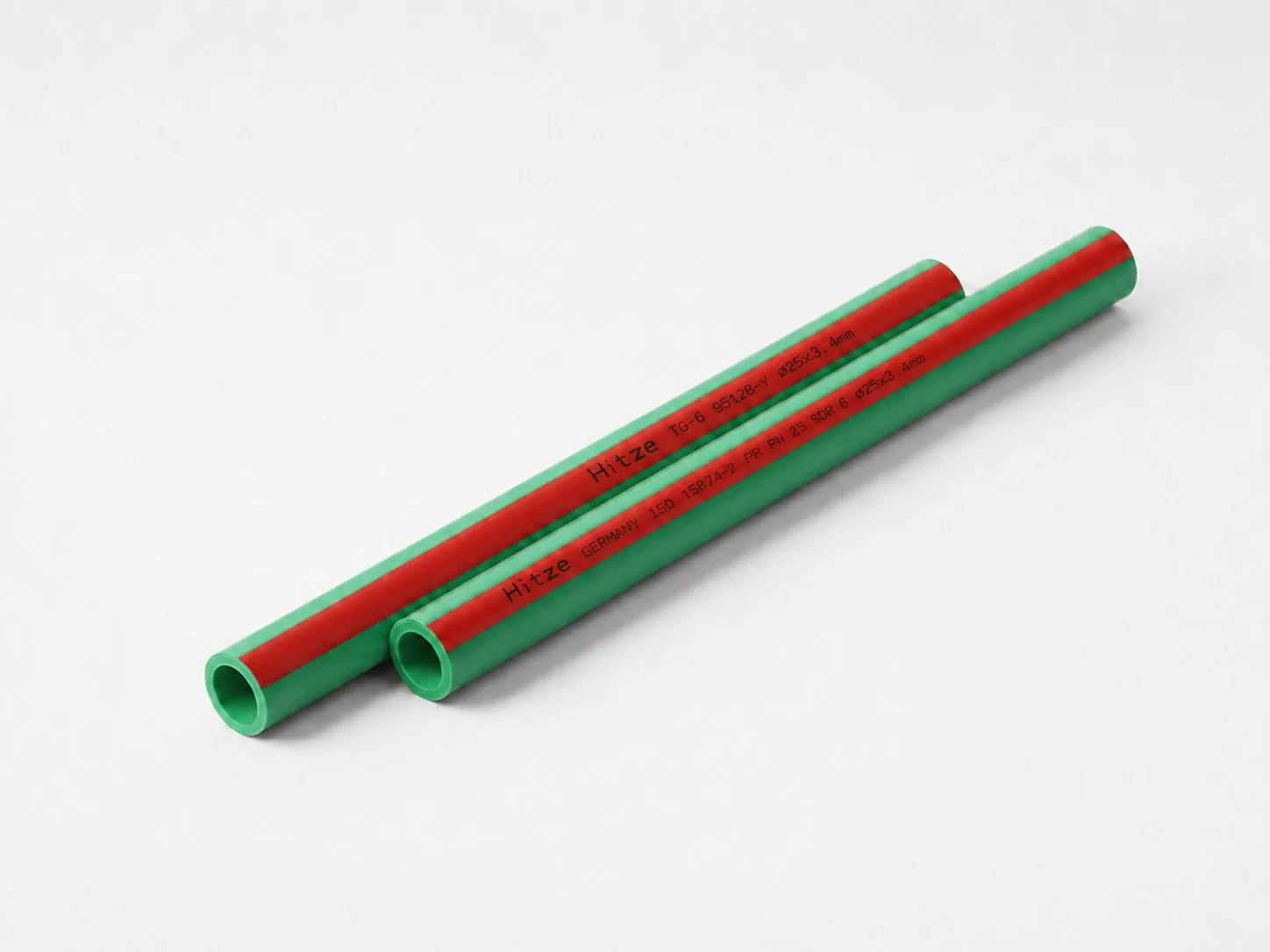
Practical buying consequence: “PP-R 80” on two competing datasheets means both materials cleared the same statistical bar — the brand on the bag doesn’t move the physics. What separates suppliers is everything downstream of the resin: extrusion discipline, batch verification, fitting quality and whether a third party has ever re-checked their output. That’s where your audit time should go, not into comparing adjectives.
From MRS to the pressure rating: EN ISO 15874 and DIN 8077 do the design math
Material classification is step one; a usable pipe rating is step two, and it lives in the product standards. For PP-R hot-and-cold-water systems that is EN ISO 15874, whose Part 2 contains the reference curves — published regression equations for PP-H, PP-B, PP-R and PP-RCT covering 10 °C to 95 °C, first and second branch. A candidate material’s σLPL, evaluated per ISO 9080, must sit on or above those curves at every temperature. This is the mechanism that stops a marginal resin from riding on the class name: the curve, not the label, is the entry ticket. The parallel German route, DIN 8077/8078, publishes the dimensions and the quality/testing requirements for the same materials — DIN 8077 carries the pressure–temperature tables installers actually look up, all derived from the same creep-rupture data.
EN ISO 15874 then adds the layer ISO 9080 deliberately leaves out: service conditions. Real hot-water systems don’t sit at one temperature for 50 years, so the standard defines application classes — composite temperature profiles (design, maximum, malfunction) that sum to a 50-year service life, each paired with a design pressure of 4, 6, 8 or 10 bar. We unpack each class and its temperature profile in our companion guide to EN ISO 15874 classes of service for PP-R. And because heating circuits add a failure mechanism that hydrostatics can’t see — oxygen diffusing through the pipe wall and corroding the steel side of the system — the heating-relevant classes assume oxygen-tight pipe, which is a separate German standard entirely: see our explainer on DIN 4726 oxygen barriers for radiant heating.
Finally, the product standard closes the loop on production reality with batch testing. Every pipe lot must survive fixed hydrostatic test points — short, brutal, and sitting on the material’s reference curve. For PP-R, Table 10 of EN ISO 15874-2 requires:
| Test point (PP-R pipe) | Hoop stress | Temperature | Duration |
|---|---|---|---|
| Short-term integrity | 16.0 MPa | 20 °C | 1 h |
| Elevated temperature | 4.3 MPa | 95 °C | 22 h |
| Extended hot test | 3.8 MPa | 95 °C | 165 h |
| Long-term type test | 3.5 MPa | 95 °C | 1,000 h |
Run PP-R’s published reference equation at 95 °C and 1,000 hours and you get 3.50 MPa — the 1,000-hour batch requirement sits exactly on the material curve. That is the elegance of the whole system: the test your production lot passes this week is a single point on the same regression surface that proved the 50-year figure. A factory that fails Table 10 isn’t failing an arbitrary QC check; it’s falling off the curve the entire rating depends on.
What Hitze checks: how a 50-year system is actually built and verified
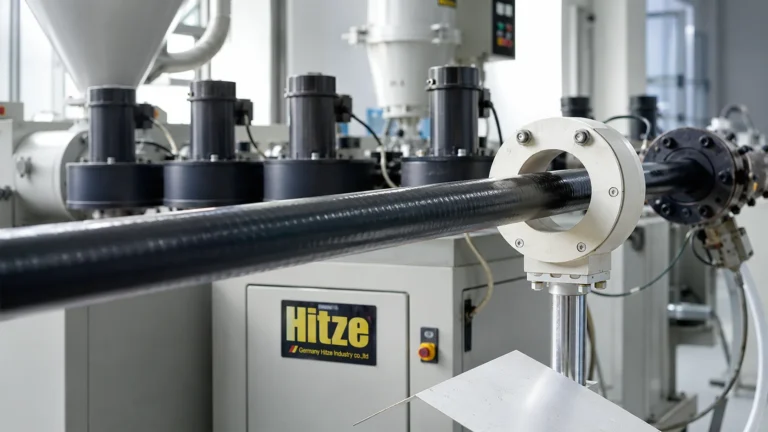
Hitze is a German brand of engineered piping systems — founded in 1974, with a 120,000 m² production base, 1,000+ employees and exports to 118+ countries — and its PP-R program is built to exactly the chain described above. Here is what that means in practice, checkable rather than claimed:
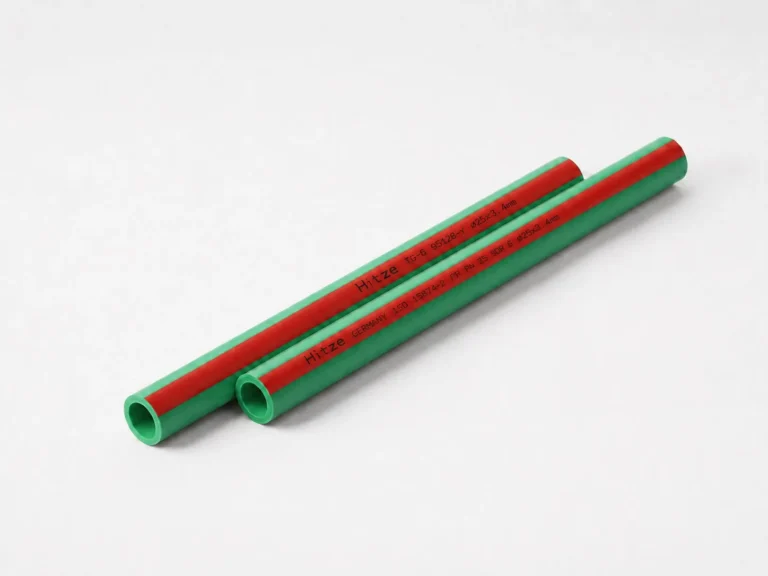
- Built to the design standards, not around them. Hitze PP-R pipe and fittings are produced to DIN 8077/8078 and EN ISO 15874 — the same documents whose reference curves and Table 10 test points this article walks through.
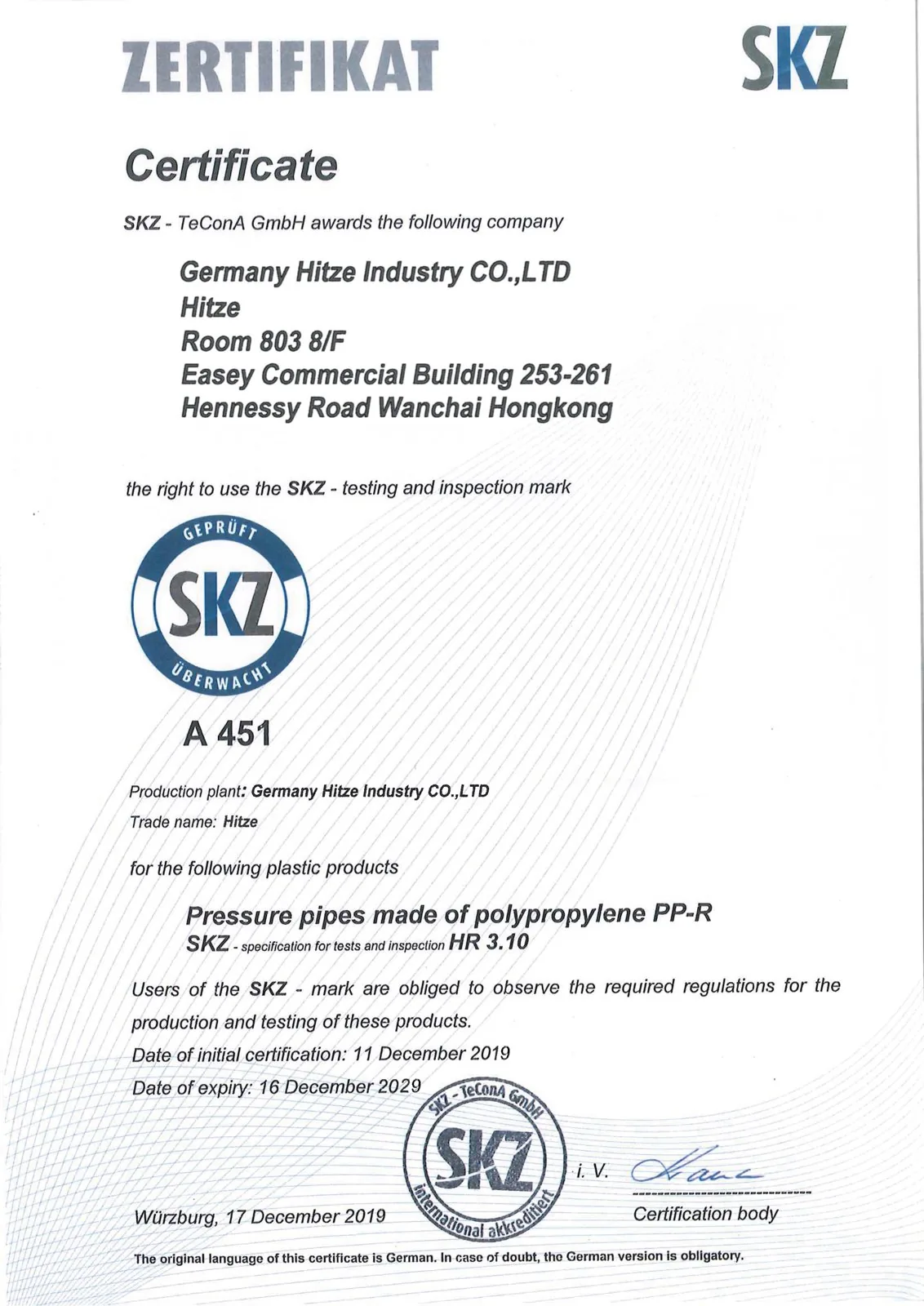
- Third-party verification in Germany. SKZ (Süddeutsches Kunststoff-Zentrum) has issued numbered test certificates for Hitze PP-R pressure pipes, PP-R fittings and PE-Xb heating pipes under its HR 3.10 / HR 3.2 specifications, and DVGW has issued a type examination for Hitze PP-R drinking-water pipe. Certificate numbers are available on request and verifiable with the issuing bodies — the full picture is on our certifications & compliance page.
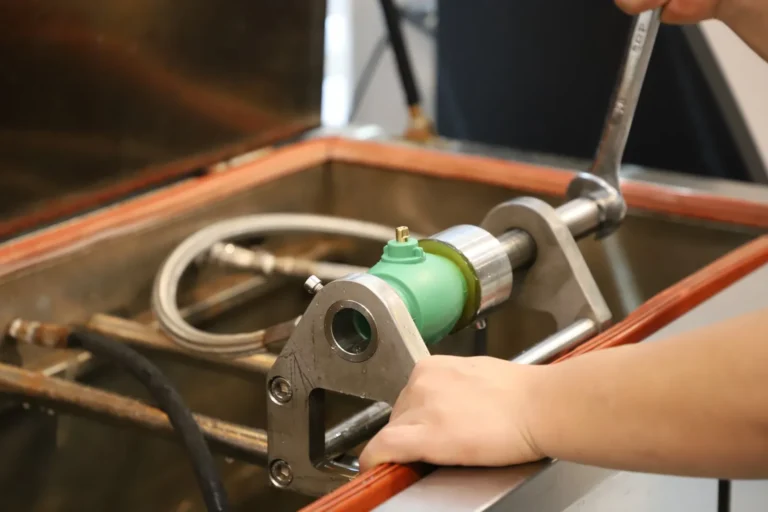
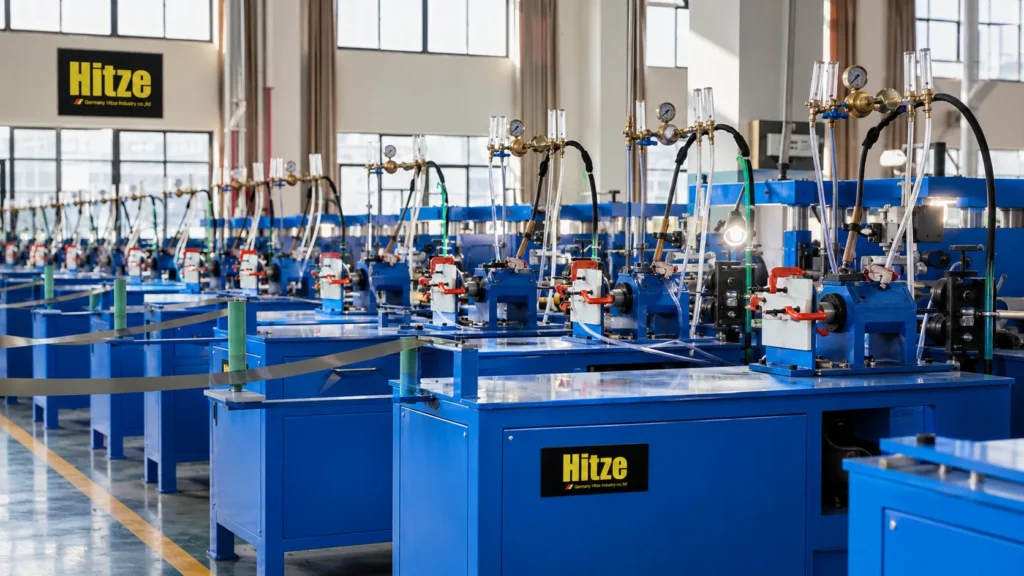
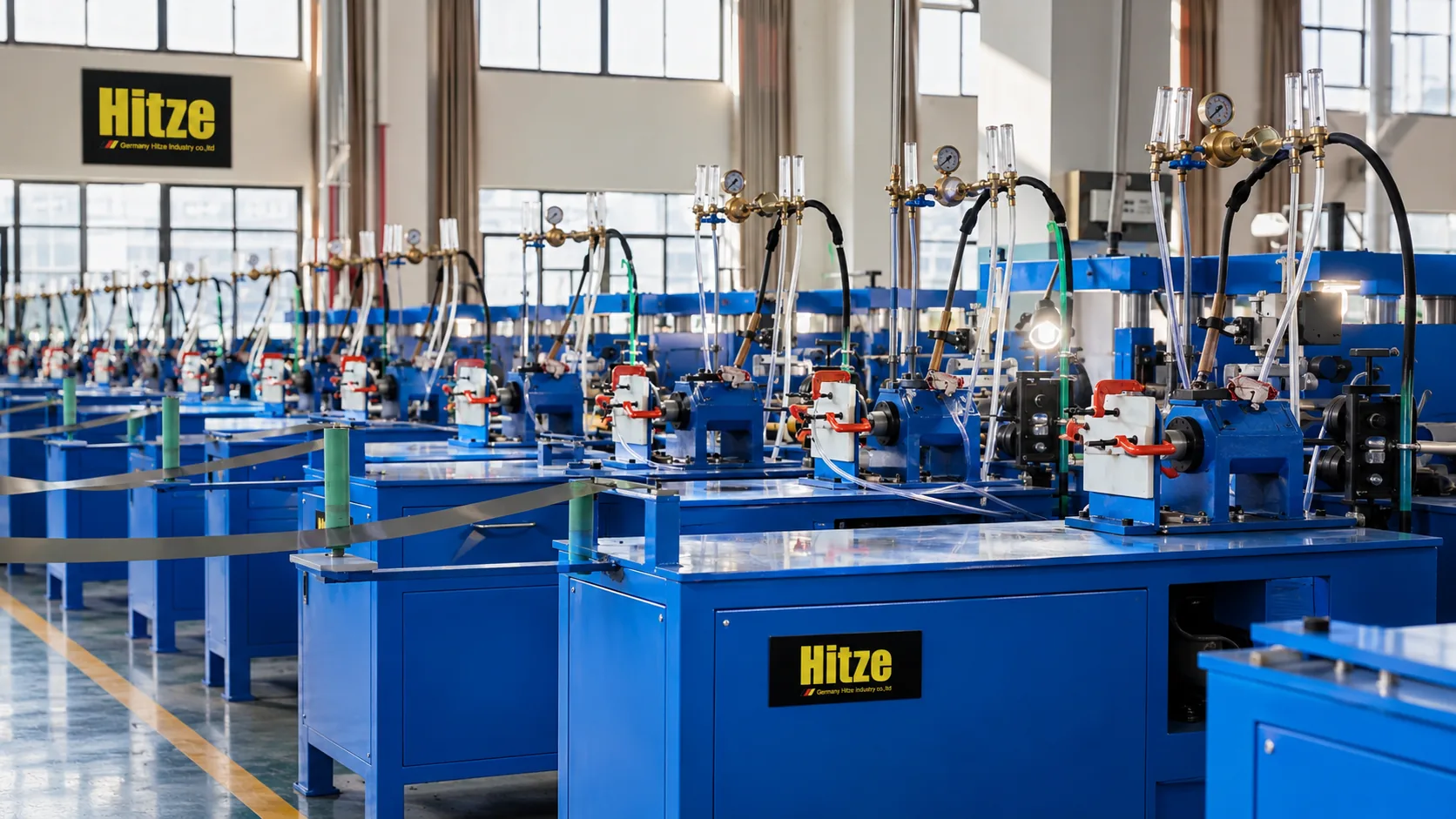
- In-house hydrostatic benches. Production is backed by rows of pressure-test benches that verify pipe and fittings against the standard’s hydrostatic test points — the batch-level layer that keeps this week’s extrusion on the qualified curve.
- A matched system, warranted as a system. The 50-year warranty applies to the matched Hitze pipe-and-fitting system — because a fused joint is only as good as the compatibility of the two melt streams meeting in it. Mixing brands voids the engineering logic, not just the paperwork.
Worked example: auditing a “50-year, PN20” claim end to end
Put yourself in the chair of a mechanical engineer specifying risers for a hotel: 70 °C hot-water recirculation, and a supplier offering PP-R 80 pipe in SDR 6 (“PN20”) with a 50-year claim. Here is the full chain, with real numbers.

Step 1 — material strength at your temperature. EN ISO 15874-2’s PP-R reference equations give two candidate values at 70 °C and 50 years: the ductile first branch at about 4.07 MPa, and the post-knee second branch at about 3.21 MPa. The knee governs — the honest 50-year strength at 70 °C is 3.21 MPa, roughly 21% below the ductile figure. (This is the exact trap flagged earlier: a datasheet quoting ~4 MPa at 70 °C/50 years has quietly ignored the knee.)
Step 2 — apply the design coefficient. With the minimum polyolefin coefficient of 1.25: σs = 3.21 / 1.25 ≈ 2.57 MPa. That is the working stress you may actually design against for continuous 70 °C service over 50 years.
Step 3 — convert stress to pressure for the wall you’re buying. For SDR 6 pipe, p = 2σs / (SDR − 1) = 2 × 2.57 / 5 ≈ 1.03 MPa — call it ≈10.3 bar at 70 °C for 50 years (the binding figure for a given pipe series comes from the DIN 8077 / EN ISO 15874 rating tables, which fold in class profiles and rounding). The lesson lands immediately: “PN20” was never a promise of 20 bar of hot water. It’s a nominal class anchored at 20 °C; at 70 °C continuous, the same pipe honestly carries about half that. A supplier who explains this unprompted is doing engineering. One who lets you believe 20 bar at any temperature is doing sales.
Step 4 — demand the paper. Four documents close the audit: the material’s MRS classification evidence (ISO 9080/ISO 12162), third-party certificates on the manufacturer’s actual output (SKZ, DVGW or equivalent — verified with the issuer, not screenshotted), recent batch hydrostatic results against Table 10, and for EU construction contexts the CE documentation trail — our guide to the Declaration of Performance and CE marking for pipe covers what that file must contain and how to spot a fabricated one. Twenty minutes, four documents, and the 50-year claim is either standing on ISO 9080 or standing on nothing.
Who this is for: distributors, importers and mechanical contractors who specify PP-R, PEX or multilayer systems and need ratings they can defend in front of an engineer — not brochure numbers. If that’s you, start with the documents: Hitze supplies its SKZ and DVGW certificate details, DoP documentation and batch test evidence for review before any commercial discussion. There’s no minimum order quantity — begin with samples, put them on your own test bench, and scale only when the numbers hold. The 50-year warranty on the matched Hitze pipe-and-fitting system is the commercial expression of everything this article just walked through.
FAQ: ISO 9080 and 50-year pipe ratings
Does an ISO 9080-based 50-year rating mean the pipe fails at year 50?
No — it is a statistical floor, not an expiry date: a 97.5% lower prediction limit with a design coefficient of at least 1.25 on top. Actual service life within the design envelope is expected to be longer, but the figure you may claim and design against is 50 years at rated conditions.
What is the difference between ISO 9080 (MRS) and ASTM D2837 (HDB)?
ISO 9080 extrapolates to 50 years (438,000 h) at 20 °C and takes the 97.5% lower prediction limit; ASTM D2837 works from the regression intercept at 100,000 hours at 23 °C and sorts it into HDB categories. Different time bases and different statistics — the numbers are not directly interchangeable, so ask for the dossier that matches your market’s codes.
Can PP-R pipe be rated for 100 years?
No. ISO 9080’s extrapolation limits cannot substantiate 876,000 hours at hot-water temperatures from any realistic test program, and the recognised PP-R product standards rate on a 50-year basis at defined class conditions. Treat a 100-year PP-R hot-water claim as a red flag about everything else on that datasheet.
What documents prove a supplier’s 50-year claim is real?
Four: MRS classification evidence per ISO 9080/ISO 12162; third-party certificates on the manufacturer’s own output (SKZ, DVGW or equivalent), verified with the issuing body; recent batch hydrostatic results against EN ISO 15874-2 Table 10; and, in EU construction contexts, a Declaration of Performance.
Is Hitze pipe made in Germany?
Hitze is a German brand — trademark registered with the DPMA in Munich — engineered in Germany and built to German DIN standards, with SKZ test certificates and a DVGW type examination behind the PP-R program. Certification claims are verifiable with the issuing bodies.