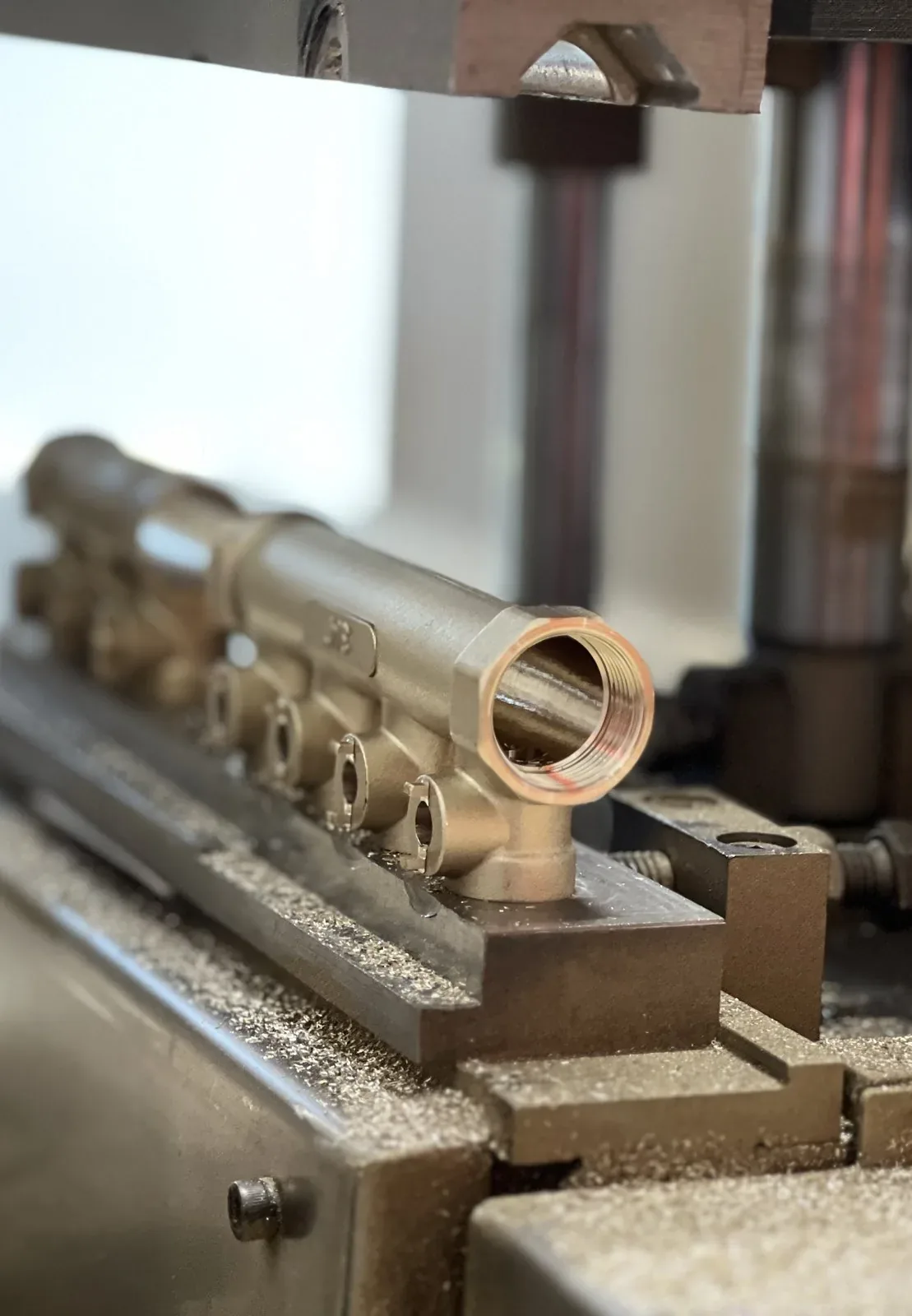
NSF 61-G and NSF 61-9 do not name competing quality grades. G refers to the former Annex G lead-content designation; 4, 8 and 9 refer to product sections of NSF/ANSI 61. Annex G was retired, but its lettering can remain on products. Decode the mark first, then use the exact current listing to establish what the offered model is certified for.
That distinction matters when a pipe importer sees an older mark on one offer and different wording on another. The longer label is not automatically the stronger approval. Nor does a missing G automatically disqualify a product: marking conventions and the standard have changed. This reference separates those meanings without turning a label into a model-specific compliance decision.
Read the whole mark before comparing the letters
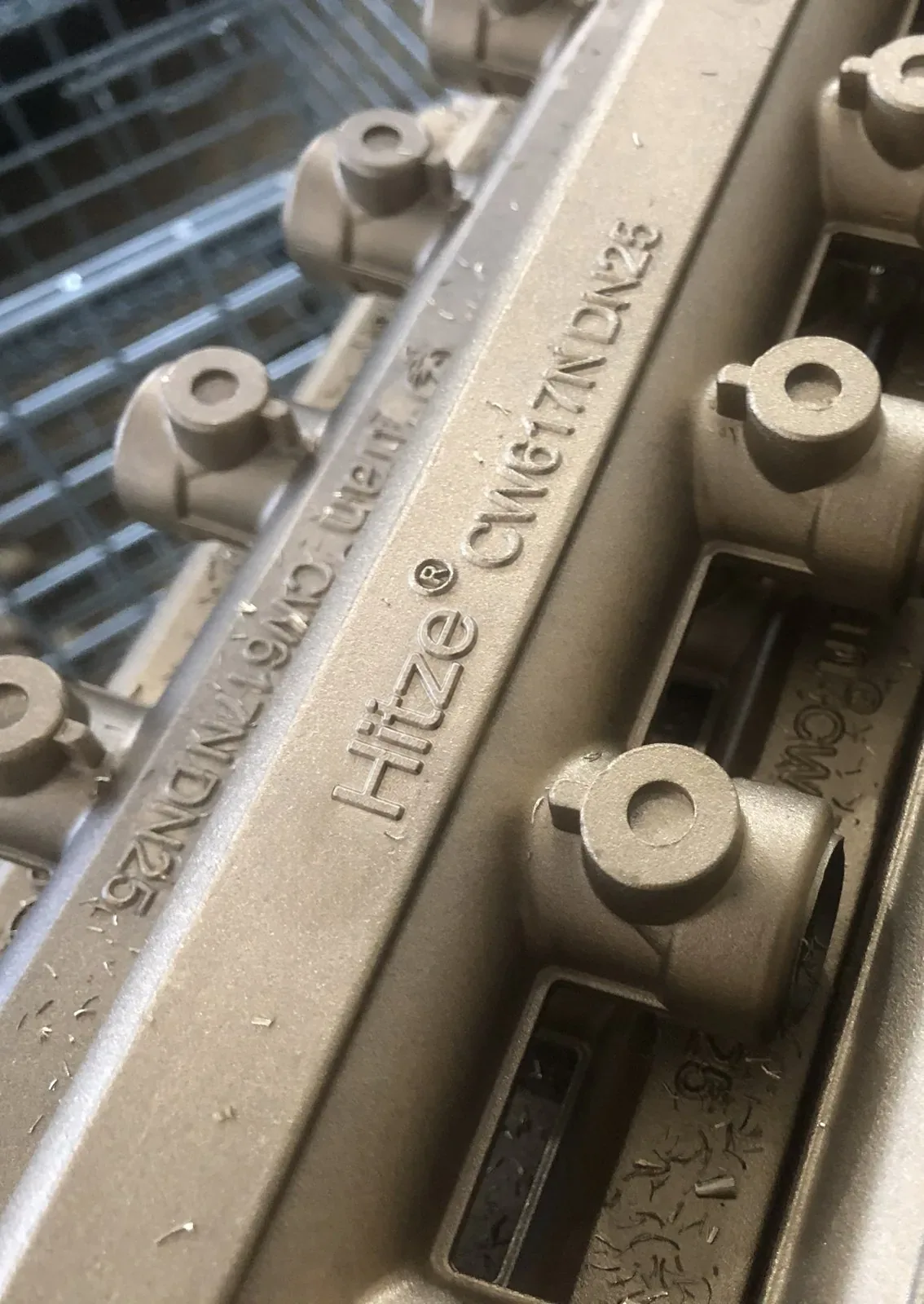
A supplier photograph may show the certification body’s logo, a standard reference and other product markings on the same surface. Copy the identifier text exactly, including slashes, hyphens and any separate 372 reference. Keep the trade designation separate from that transcription. Otherwise a buyer can accidentally treat a catalogue model number as part of the standard, or lose the distinction between a section reference and a lead-content designation.
Use two lines in your notes: “mark as observed” and “meaning of its elements.” The first line is evidence from the offer; the second is interpretation from the decoder. Neither line is the current listing result. This separation makes a correction easy: if a clearer photograph later changes the observed text, update the transcription without silently rewriting the supplier’s certification claim.
Source and scope
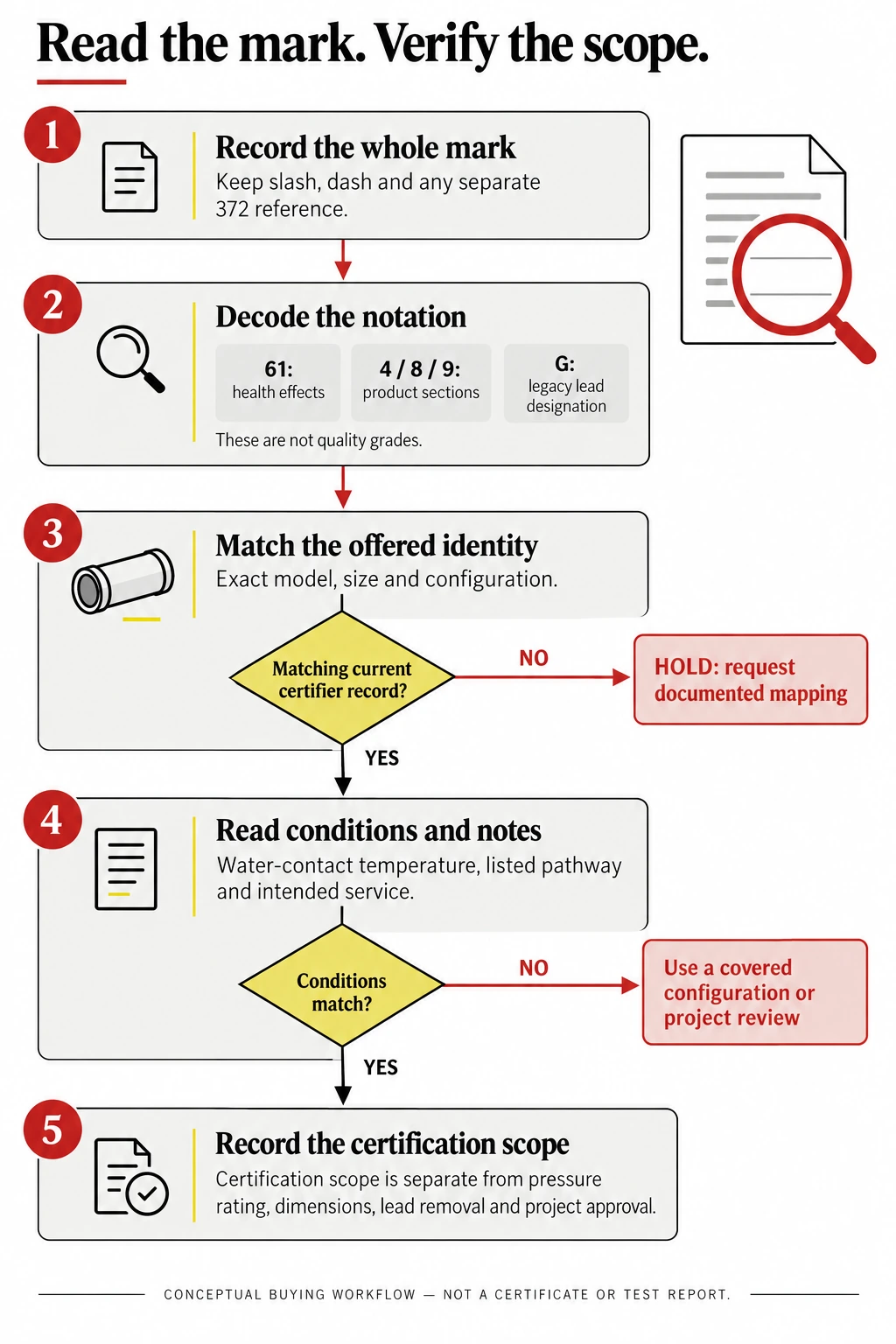
- Record the whole mark.
- Decode 61, the product section and legacy G.
- Match the exact offered model, size and configuration to the current certifier record. If the mapping is missing, hold and request it.
- Compare conditions, notes and service. A mismatch returns to a covered configuration or project review.
- Record certification scope separately from pressure, dimensions, lead removal and project approval.
The EPA guide includes the form NSF-61/9-G. That is a useful check against the assumption that every slash or dash begins a different approval. Read 61 as the standard, 9 as the section reference and G as the legacy designation. Do not invent a new category called “61/9-G certification” with broader scope than the actual record.
Source and scope
G and the section numbers answer different questions
Start with 61: it identifies the drinking-water system components standard addressing health effects. A product-section reference tells you which part of that standard is being discussed. A lead-content designation answers a different question. Combining those elements does not produce a score, a pressure class or a ladder from “basic” to “premium.”
| Reference encountered | What it identifies | What it does not decide |
|---|---|---|
| NSF 61-G / Annex G | Legacy lead-content designation associated with NSF/ANSI 61. | The current status or exact scope of an offered model’s listing. |
| NSF 61-4 / Section 4 | Pipes and related products. | A pressure rating or a universal required printed suffix for every pipe. |
| NSF 61-8 / Section 8 | Mechanical devices. | Approval of every component made from the same metal or polymer. |
| NSF 61-9 / Section 9 | Mechanical plumbing devices. | A higher grade than Section 8, or permission to substitute a different model. |
Source and scope
The section names follow the contents of NSF’s published 2016 edition (PDF pages 7–8); confirm the applicable edition and current model listing for the project. The G explanation and legacy-mark caveat are supported by EPA’s June 2024 certification-marks guide. The table interprets references a buyer may encounter; it does not prescribe the exact mark each manufacturer must print.
Consider a document saying “61/9-G.” The useful reading is a Section 9 reference accompanied by the legacy G designation. It is not a third standard and does not mean “grade 9, improved by G.” Conversely, “61 and 372” names two standards. The notation is different even when the lead-content question overlaps. The existing lead-free brass compliance reference explains that broader compliance pairing.
Source and scope
Sections 4, 8 and 9 follow the product’s function
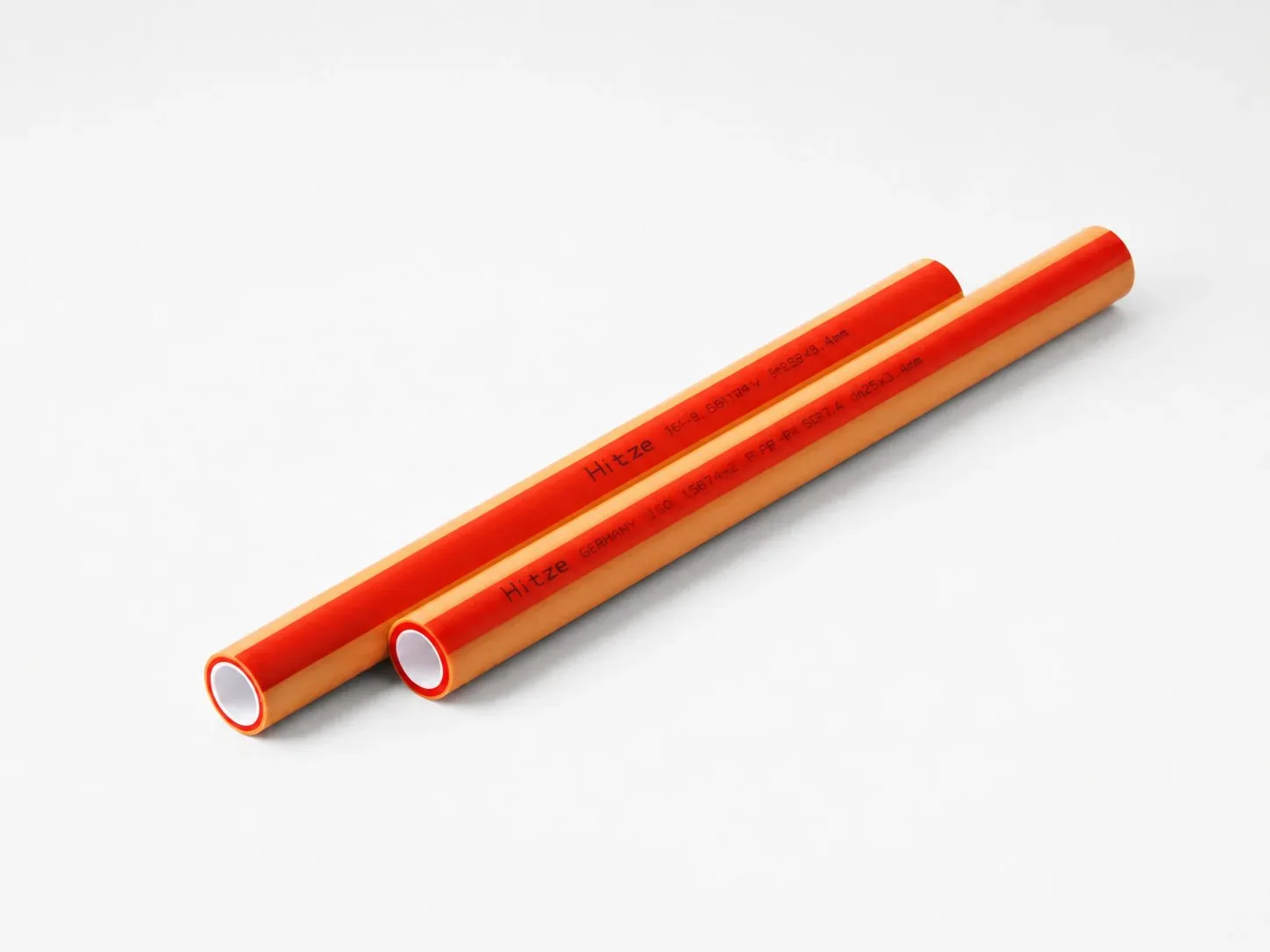
A pipe carrying drinking water fits the broad pipes-and-related-products category. An in-line mechanical device and a mechanical plumbing device at an end use raise different classification questions. That is why “it is brass” or “it contains PP-R” cannot identify the section by itself. The same material can appear in products doing different jobs.
The historical NSF/ANSI 61:2016 text distinguishes mechanical devices used in treatment, transmission and distribution from mechanical plumbing devices such as faucets and endpoint devices. That historical text explains the terminology; it is not used here as the source of current extraction limits or test thresholds. NSF’s current public scope retains the Section 4, 8 and 9 category names.
Section 4: Pipes and related products
Product function points toward a section; material alone does not.
Section 8: Mechanical devices
An in-line distribution device raises the Section 8 question.
Section 9: Mechanical plumbing devices
An endpoint faucet raises the Section 9 question.
Source and scope
For a practical classification example, a pipe description points toward Section 4, while an in-line distribution valve raises the Section 8 question. A faucet description raises the Section 9 question. These are broad scope examples, not instructions to assign an unlisted valve or faucet to a category without its certification record. A manufacturer’s model description, use and listing remain the decisive identity evidence.
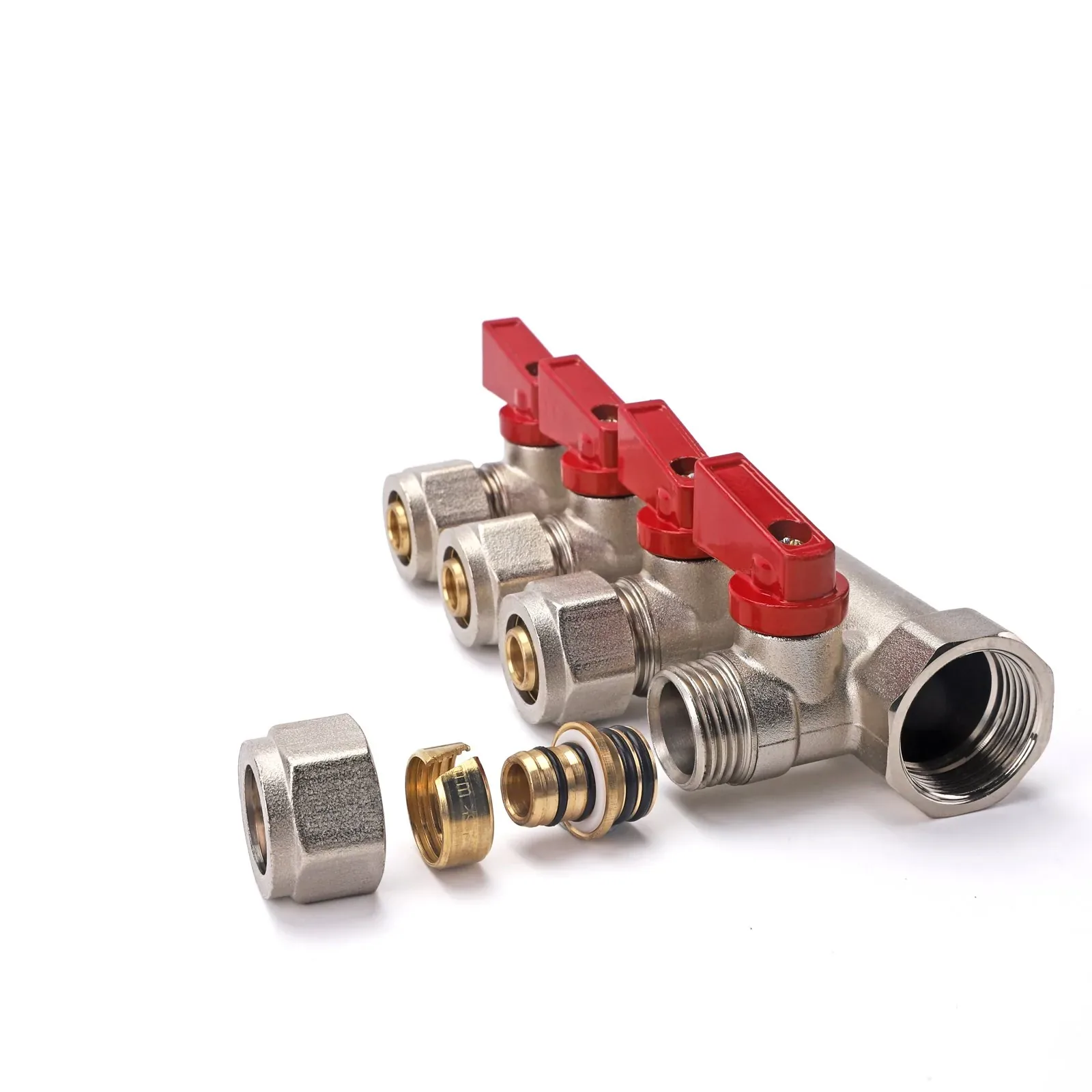
A brass insert inside a fitting makes the shortcut particularly tempting. Its metal does not tell you whether the offered item is certified as a component, as a finished fitting or as part of an assembled device. Approval of one component does not establish that every differently assembled product is covered. Read the listing’s product identity and footnotes before transferring a claim to the item being purchased.
This is visible in NSF’s mechanical plumbing device listings: entries can qualify the evaluated water pathway, size or water-contact temperature. A category heading helps locate the record. The conditions tell you what that record actually covers. For an importer, that makes traceable model evidence more useful than a collection of certification logos. Hitze’s certifications and compliance page is a relevant next page for the documentation context; this decoder asserts no NSF approval for a Hitze model.
Source and scope
Lead content, leaching and lead removal are separate questions
The lead-content question concerns the material composition of the product’s wetted surfaces. The health-effects question concerns substances that may enter water from the evaluated product. A treatment claim concerns removing a substance already in the water. These questions can appear in the same project, but a positive answer to one is not a shortcut to the others.
This explains why a purchasing line that says only “lead free” is difficult to compare. One supplier may be referring to the lead-content designation, while another is presenting a health-effects listing. Ask what claim the document actually supports before asking whether the prices are comparable. Keep the required evidence next to the project requirement instead of putting every certificate into a single yes/no column.
For example, a buyer choosing an endpoint device for drinking water should not turn a component’s material claim into a complete assembly claim. Equally, a buyer assessing a water-treatment unit should not read a materials health-effects standard as a lead-reduction performance result. The decisive question is the scope stated for the item and claim being purchased, not how many marks appear in the brochure.
Source and scope
Why a retired Annex can still appear on a current product
The G was introduced for a real historical reason. NSF’s June 2018 Municipal Water Matters timeline (pages 10–11) places the Annex G introduction in December 2008, the move of its requirements to NSF/ANSI 372 in 2010, and Annex G’s retirement in October 2013. The changed federal lead-free definition took effect in January 2014. NSF also records January 1, 2022 as the implementation deadline for Section 3.6 lead-content verification testing, with the stated statutory exemptions.
Two dates answer different questions. A standard event belongs to its documented revision or implementation history. A guide’s publication or update date tells you when that guidance was issued. Do not infer a normative transition merely because an EPA document carries an update date.
Retiring the annex did not make every existing product carrying G disappear. EPA’s June 2024 guide explicitly explains that the retired Annex G designation may still be found on manufacturers’ products. The mark therefore has an intelligible historical meaning. Its presence alone does not tell you whether that exact model is currently listed, whether an old unit was manufactured before a change, or whether its listed use matches your project.
The countercondition is equally important: a newer product marked only “61” cannot be judged lead-uncontrolled merely because G is absent. EPA advises checking the product information, the certification body’s listing or the body itself to establish lead-free compliance when only the 61 mark is shown. Neither adding nor subtracting a letter replaces that check.
NSF’s own June 2018 Municipal Water Matters newsletter, pages 10–11, provides a downloadable historical companion for the Annex G changes. Its 2022 entry is written as a future implementation deadline because the newsletter predates that event; the later NSF history page supplies the retrospective account. Use the older document for the dated history it records, not as proof of a present model listing.
Read the listing notes, not just the search-result heading
A directory search result is a route to the evidence, not the whole evidence. In the saved NSF mechanical plumbing device directory, records contain conditions relating to product identity, the evaluated water pathway and water-contact temperature. Those details are why a familiar brand name or a matching category heading cannot close the comparison on its own.
| Field | Record | Result / next action |
|---|---|---|
| Observed mark | Exact text and readable offered-unit photo: ____ | Decode notation; keep model text separate. |
| Current identity | Manufacturer, trade designation, size and assembled configuration: ____ | Match the exact certifier record; otherwise hold. |
| Listed use | Water pathway, temperature and record notes: ____ | Select a covered configuration if intended use differs. |
| Distinct claims | Lead-content record ____; health-effects record ____; required lead-reduction evidence ____ | One claim cannot substitute for another. |
| Project fit | Pressure, dimensions and other required approvals: ____ | Review separately for the same identified offer. |
Actual directory-reading example, checked 15 October 2026: the NSF directory lists Elkay’s DSBS130UV under water coolers. Its notes limit the Section9 evaluation to cold/ambient water pathways, exclude evaluation of the sparkling pathway, and state a maximum operating temperature of 74°F /23°C. A request for the sparkling pathway therefore cannot be closed by matching the model name alone. This is a directory-reading example, not a Hitze offer or an endorsement of that product.
What the suffix cannot prove about an offered model
A decoded mark completes a reading task, not an approval task. NSF/ANSI 61’s health-effects scope is not a pressure-temperature declaration, a dimensional standard or proof that a filter removes lead from water. Lead content in a product and contaminant reduction by a treatment unit are different claims. A specification requiring another performance approval still needs that separate evidence.
If the offered model is missing, the unresolved input is the exact trade designation and the applicable listing record—not a more confident interpretation of “G.” Once that input is available, compare the offered size, intended water contact and service conditions with the record and its notes. A mismatch prevents transferring the listing to that offer. A match supplies the evidence needed for the next project review; it does not waive any other approval the project requires.
Use the pipe-certification verification guide to match the offered model to its live listing
Keep the distinction on the comparison sheet: section reference, legacy lead designation, current model listing and project approval are separate fields. If two offers differ only in their printed suffixes, the table above explains the difference. If they differ in certified identity or service conditions, the lettering cannot make them equivalent.