Short pipe length does not establish eligibility for Regulation 31’s conditional small-contact route. For a product used in the public-water supply in England or Wales, the water undertaker must assess the applicable route and actual use. DWI’s worked 2 m, 25 mm, 16-hour communication-pipe example gives C = 92,148 seconds per centimetre and points to Regulation 31(4)(a), far above its small-contact threshold.
The counterintuitive part is the water inside the pipe. Shortening a straight pipe reduces both its wetted surface and its retained water volume. At the same internal bore and contact time, the ratio stays the same. A buyer therefore needs a use-specific contact assessment, rather than a promise that a small quantity of pipe must count as small contact. The calculation explains one route; it does not decide every pipe material or replace the water company’s judgment.
Watch the Pipeline Industries Guild webinar on Regulation 31 for general approval context. Use the article below for the small-surface-area decision and evidence requirements.
Start with who supplies the water and where the product sits
This article addresses the public-water supply task under Regulation 31 in England and Wales. The current England regulation and Wales regulation provide the statutory framework. Their approving authorities differ: the Secretary of State in England and Welsh Ministers in Wales. Confirm the actual supply arrangement and responsible water company before selecting a product route.
That scope matters when a purchase description simply says “drinking-water pipe.” A pipe proposed for a water undertaker’s supply is a different acceptance task from a fitting installed within premises or a product for a private supply. Do not transfer a premises approval claim into a Regulation 31 decision without checking the boundary. Equally, this explanation should not be used as a UK-wide verdict covering Scotland or Northern Ireland.
Start the record with the proposed product’s identity, all materials that touch the water, the location and function, and the normal operating conditions. “Plastic pipe, two metres” leaves out the internal bore, joint construction and maximum time water may remain in contact. Those omissions are directly relevant to the calculation. They are not paperwork to collect after a route has already been selected.
Keep the statutory routes and DWI’s assessment guidance distinct. Regulation 31(4)(a) concerns approval and its conditions; 31(4)(b) depends on satisfaction that the substance or product is unlikely to affect water quality adversely. The contact score below is DWI guidance for assessing small-contact cases. It is not a numerical exemption written into the regulation itself.
A small fitting and a short pipe do not enter the same route automatically
DWI Advice Sheet 8 identifies exemplar products that are normally likely to fit the small-contact approach without a calculation. The qualification is their normal use. The water undertaker still needs to consider the materials’ potential effects on odour, flavour and microbial growth. A familiar component name does not remove that assessment.

For products outside the exemplar list, or used outside the stated normal-use conditions, DWI provides a contact-risk calculation. It connects the wetted surface to the volume of water exposed and the duration of exposure. This is why comparing the visible size of two products is unreliable: a small volume can experience a high surface-to-volume ratio for a long time.
| Starting point | What it establishes | What still needs resolving |
|---|---|---|
| Listed exemplar in normal use | A conditional DWI small-contact category | Actual use and material water-quality assessment |
| Outside exemplar or normal use | A reason to apply the contact calculation | Valid inputs, cumulative contact and material conditions |
| Recognised material grade | A material-specific evidence route may exist | Current product requirements, conditions and applicable approval status |
| Short pipe length only | The proposed installed length | It establishes neither low contact nor an exemption |
Material-specific conditions also prevent a universal “all pipes require 31(4)(a)” answer. Advice Sheet 5, version 8.6, December 2025 describes conditional routes for stainless-steel and copper communication pipes, including meeting Advice Sheet 8 and the stated material and application requirements. It also describes product-application requirements for pipes made from recognised plastic grades. A grade designation is therefore not a blanket product approval.
Use those distinctions to ask the right question. For a plastic communication pipe matching DWI’s worked scenario, the published calculation gives a clear answer. For a copper or stainless proposal, establish the applicable conditions and current evidence rather than carrying that plastic-pipe result across materials. If the proposed grade or route is uncertain, hold acceptance until the uncertainty is resolved.
Calculate contact risk with actual wetted bore and time
DWI defines the individual contact-risk score using the wetted surface area s in square centimetres, water volume v in cubic centimetres and contact time t in seconds. Use the maximum relevant contact time for the assessment, rather than selecting a convenient flowing-water interval that overlooks stagnant conditions.
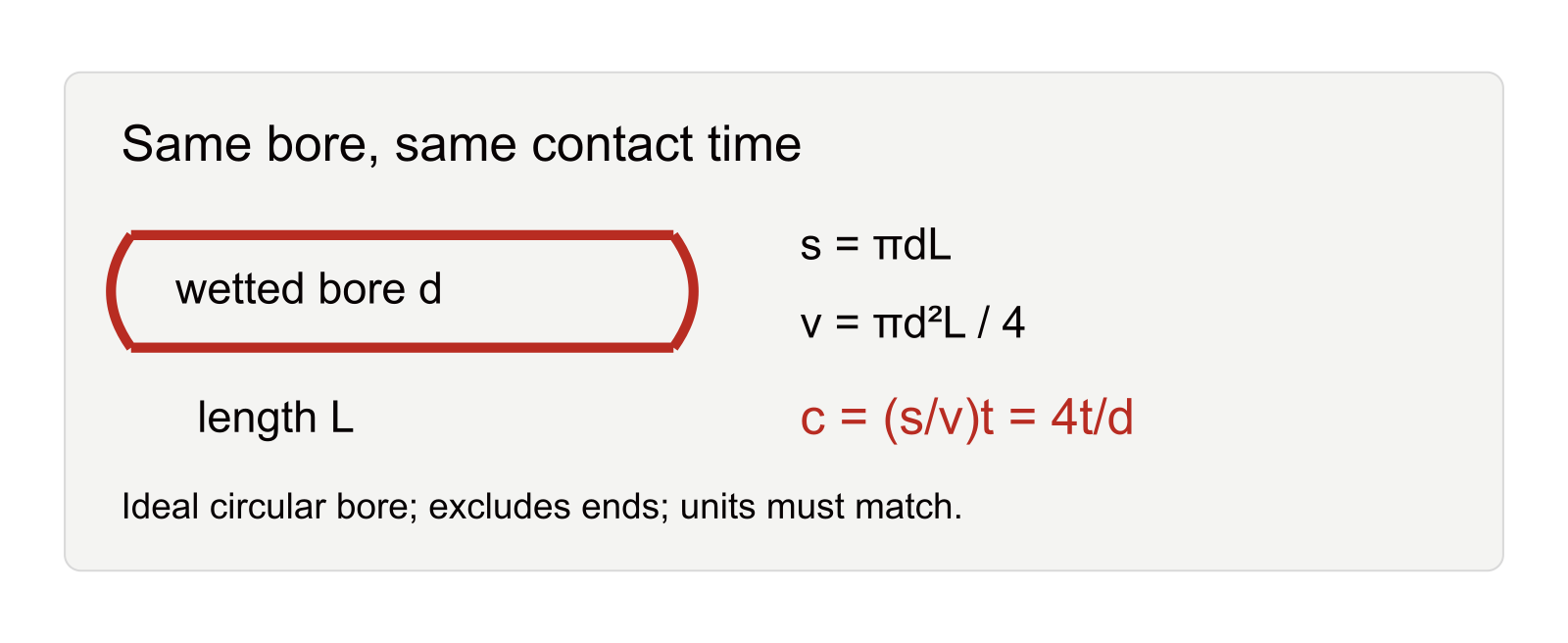
c = s × t ÷ v
The resulting unit is seconds per centimetre. Keep the units consistent before calculating: metres, millimetres and hours cannot be entered directly into a calculation specified in centimetres and seconds. For several relevant products in the calculation branch, DWI uses the cumulative value C = Σci.
| Input or outcome | DWI published value | Meaning for the decision |
|---|---|---|
| Pipe geometry | 2 m length; 25 mm diameter | Use the example’s water-contact geometry, not an outside-diameter substitution |
| Wetted surface s | 1,571 cm² | Surface exposed to water |
| Retained volume v | 982 cm³ | Water exposed within that geometry |
| Contact time t | 16 h = 57,600 s | The example’s exposure duration |
| Published C | 92,148 s/cm | DWI says the 31(4)(a) route should be used |
The table preserves DWI’s printed values and rounded outcome. It is an official worked example, not a Hitze test or a finding for an unspecified supplied pipe. Its result is far beyond the small-contact threshold; the appropriate takeaway is to use a product approved under 31(4)(a) for that scenario, subject to its approval conditions.
Both expressions contain length L, so it cancels. Halving the length at unchanged bore and exposure time halves the surface and the volume together; it does not halve c. That is the mechanism behind the article’s answer.
The assumptions matter. A redesign can change the actual contact time, and that changes the score. A fitting, lining, dead leg or irregular chamber may not have this simple geometry. Additional wetted materials need their own assessment. Use actual internal dimensions: two pipes with the same outside diameter can have different wall thicknesses and therefore different retained volumes. Where these inputs are unknown, there is no defensible numerical pass to issue.
Contact time is often the most consequential missing assumption. Under the same simple geometry, doubling t doubles c; doubling the wetted bore halves c if t remains unchanged. These are algebraic sensitivity relationships, not suggested design changes or predictions about a particular network. A bigger bore can also change actual retention conditions. The useful question is whether the proposed operating arrangement supports the time used, rather than whether a dimension can be adjusted to obtain a desirable number.
Do not mix a pipe’s surface with a different system’s water volume. The quantities must describe the exposure being assessed. Likewise, a flowing service description does not by itself supply the worst-case contact time: the assessment needs to account for the stated use and relevant periods without flow. Document the basis of the input so that the undertaker can challenge or confirm it, instead of receiving an unexplained spreadsheet result.
Check aggregation, threshold and changed conditions
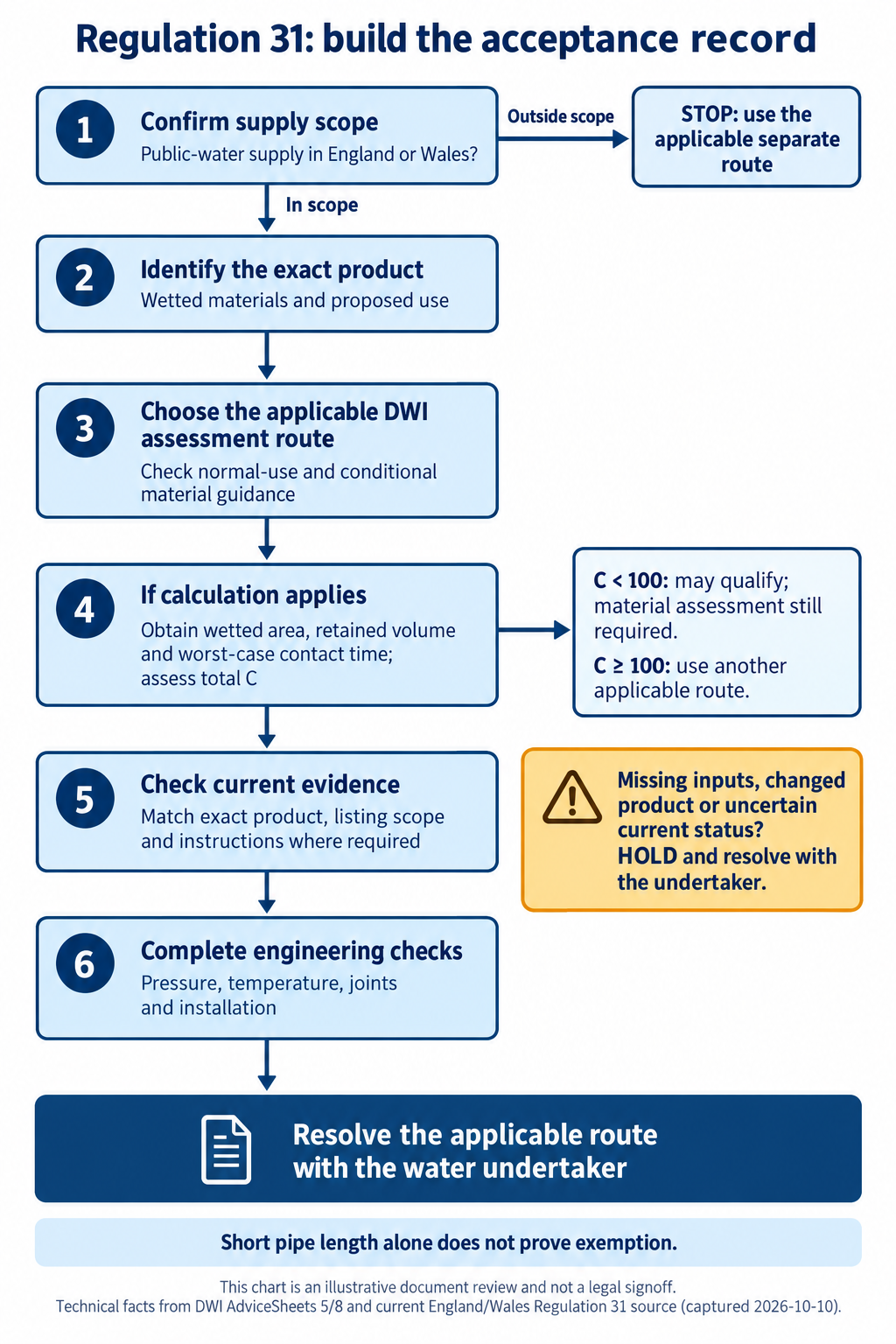
In DWI’s calculation branch, C below 100 may be appropriate for 31(4)(b), subject to the other material conditions. At or above 100, that branch is inappropriate. “Below” excludes equality: a result of exactly 100 is not a borderline pass. A low calculated number still does not establish that the materials will avoid adverse water-quality effects.
One versus two calculated products
DWI’s tank example gives C = 60 for one tank under its stated contact conditions. Two such tanks give cumulative C = 120. Treating each tank separately as below 100 would miss the combined result.
Normal-use exemplars remain conditional
Do not mechanically apply that tank aggregation to every exemplar component. DWI separately discusses normal-use exemplar valves. Establish the correct category and conditions before deciding which calculation applies.
This distinction prevents two opposite errors: overlooking cumulative exposure where calculation is required, and inventing a universal rule that any collection of small components must be added regardless of their category. The starting point is the guidance’s actual branch, not the outcome the project hopes to obtain.
Changed conditions need a fresh look. Longer stagnation increases the calculated exposure if the other inputs stay fixed. A change to wetted bore affects the surface-to-volume ratio. A new lining, jointing material or formulation may change the evidence supporting the product even if the dimensions are identical. A route assessment should therefore name the product and intended conditions clearly enough that later changes are visible.
If bore or contact time is missing, record a hold with those specific missing inputs. Obtain internal wetted geometry, retained volume and the worst-case contact duration. Then apply the appropriate exemplar conditions or calculate c and cumulative C. An unknown duration cannot be repaired by choosing a short installed length.
Take a current, model-specific record to the water undertaker
Approval evidence is a current product record. DWI’s 2025 Wales annual report describes the move to a real-time interactive approved-products list and reports approval revocations associated with unauthorised formulation, material or component changes. Some products returned under changed names or references. An older document can therefore identify a different product from the one proposed today.
| Record field | Fill in / attach | Decision or hold |
|---|---|---|
| Supply and reviewer | Country, supply arrangement, installation location, undertaker and reviewing contact: ____ | Confirm this Regulation31 public-water task applies. |
| Product identity | Manufacturer, exact reference, wetted materials and jointing products: ____ | Unmatched identity or material change remains on hold. |
| Assessment branch | Normal-use exemplar / conditional material route / calculation: ____; supporting guidance: ____ | Do not infer eligibility from short length. |
| Contact assessment | Wetted area ____ cm²; water volume ____ cm³; worst-case contact time ____ s; basis ____ | For calculation, record each c and cumulative C; resolve missing inputs. |
| Current route evidence | Exact current record, approved scope where applicable, instructions and date checked: ____ | Resolve mismatches with the undertaker before acceptance. |
| Separate engineering decision | Pressure, temperature, joints and installation evidence: ____ | Water-contact eligibility does not settle mechanical fitness. |

For a 31(4)(b) proposal, record why the undertaker is satisfied that the product is unlikely to affect water quality adversely, including the relevant material and use conditions. This conditional route does not waive the other applicable duties. A low contact score cannot replace missing identity, material assessment or current evidence. Keep the undertaker’s conclusion, conditions and unresolved items with this same record.
The same report records the requirement for Annex 3 recognised grades to apply for approval by the end of June 2026. For an October 2026 decision, a historical recognised-grade listing is not a sound automatic shortcut. Check the current DWI approved-products resource and resolve the applicable product route with the undertaker. This article does not certify the current status of any individual product.
Work through the record from scope to the separate engineering check. Missing identity, bore, duration or applicable evidence is a hold with a named owner and answer needed; a changed material, formulation or use reopens the assessment.
That final separation is useful when comparing pipe categories. A pressure-class marking or hydrostatic test concerns a different question from effects on drinking-water quality. Conversely, water-contact evidence does not select the correct pressure and temperature rating. A usable procurement record needs both decisions, attached to the same identified product. Hitze’s quality-control information can support the product discussion, while acceptance for this use remains tied to the relevant evidence and water company.
Conclusion
Shortening a pipe can reduce the quantity installed, but it does not by itself establish small contact. In the ideal straight-pipe calculation, length cancels when bore and contact time stay fixed. DWI’s published communication-pipe example therefore gives a useful counterexample to the shortcut.
The tradeoff is between a quick size-based assumption and a route that reflects the actual product and use. Establish the branch, calculate where required, preserve the material conditions, and match current evidence. That produces a decision the water undertaker can assess without pretending that one pipe example answers every material case.
Frequently asked questions
Can a WRAS approval replace this Regulation 31 assessment?
Do not assume it can: first identify whether the proposed product is in the public-water supply task or the premises-fittings task. Apply the appropriate route and obtain the water undertaker’s assessment for the public-water use.
Does a score below 100 guarantee acceptance?
No: below 100 may be appropriate, but material effects and applicable conditions still need assessment. Exactly 100 is outside the below-100 branch.
Do copper and stainless-steel communication pipes always need 31(4)(a)?
No universal conclusion follows from the plastic-pipe example. Advice Sheet 5 describes conditional material routes. Check those conditions and current product requirements with the undertaker before accepting the proposed pipe.
Can outside diameter be used in the straight-pipe formula?
Use the wetted internal bore. Outside diameter alone does not determine the retained water volume. Obtain the internal dimensions or validated wetted area and volume before applying the contact calculation.
Source check: 10 October 2026. The Advice Sheet 8 landing page labels version 5.0, July 2024; its linked HTML retains historical jurisdiction footnotes. This article uses current England and Wales statute pages for legal scope and attributes the contact method and example to the DWI guidance as accessed.