A plastic pipe pressure rating is a conditional number, not a property of the pipe. The PN 20 stamped on a PP-R wall, the SDR 11 on an HDPE coil, the “Schedule 80” on a PVC length and the 400 psi on a CPVC tube are four different rating systems, quoted at three different reference temperatures, under at least three different safety factors. Put them in the same submittal column and you are comparing numbers that were never calculated the same way.
Here is the size of the problem in one line. The identical PP-R wall thickness — SDR 6 — is published as 20.0 bar under DIN 8077:1989, 25.8 bar under EN ISO 15874-2:2013, and 30.9 bar under DIN 8077:2008, purely because each standard applies a different safety factor to the same material. Same pipe, same wall, three legitimate nameplates, a 55% spread. Nothing changed except the divisor.
Key Takeaways
- PN is a pressure in bar at 20 °C. SDR is a geometry ratio. Schedule is a wall series. They are not interchangeable units.
- Every ISO plastic-pipe rating assumes 20 °C and 50 years. PPI states the MRS is only obtained at 20 °C and 50 years.
- ASTM ratings use a different datum — 73 °F (23 °C) — so a psi figure and a bar figure are not directly convertible without derating first.
- PVC loses 78% of its rating between 73 °F and 140 °F: the Spears de-rating factor at 140 °F is 0.22.
- SDR alone does not fix pressure. PE 100 at SDR 11 is PN 16; PE 80 at the same SDR 11 is PN 12,5.
- Design life is a lever too: PP-R SDR 11 at 70 °C is 5.8 bar for 10 years but 4.3 bar for 50 years.
- Ask a supplier for the temperature, the design life and the safety factor behind any pressure number. Without all three it is not a specification.
What a pressure rating actually states
A pressure rating is the answer to a question with three hidden variables baked in: at what temperature, for how long, and with how much margin. Change any one and the number changes, even though the pipe in your hand is identical. The ISO family makes this explicit in its arithmetic. ISO 4427-2 gives the relationship as PN = 20 × σs ÷ (SDR − 1), where the design stress σs is itself the material’s minimum required strength divided by a design coefficient C.
That MRS term is where the conditions hide. The Plastics Pipe Institute’s PEX design manual is blunt about it: the strength line is extrapolated to 480,000 hours — that is 50 years — and the MRS “is only obtained at 20 °C and 50 years.” So a PN number is not a statement about the pipe. It is a statement about the pipe at 20 °C, for half a century, with a specific safety factor already divided out. Move the duty off that datum and the nameplate stops describing your system.
This is why the marking on a wall is a starting point rather than an answer, and why the same physical pipe carries different legitimate ratings in different markets. The scope of ISO 4427-2 states it plainly — the standard applies at “an operating temperature of 20 °C as the reference temperature,” with a maximum operating pressure up to and including 25 bar. Everything above 20 °C is derating territory, and the derating is not a courtesy correction. It is the specification.
The four rating systems on the same axis
Four systems dominate plastic pressure piping, and each encodes something different. PN states a pressure directly in bar. SDR states the ratio of outside diameter to wall thickness — pure geometry, no pressure until you supply a material grade. Schedule is an inherited steel-pipe wall series, so its pressure varies with diameter in a way PN does not. And the CTS copper-tube-size convention used for CPVC ties a fixed SDR to a fixed psi rating per size.
The consequence a specifier feels is that Schedule ratings are diameter-dependent while PN ratings are not. Schedule 80 PVC is published at 850 psi in ½ in, 630 psi in 1 in, 400 psi in 2 in and 320 psi in 4 in — the same schedule, less than half the pressure across four sizes. A PN 16 pipe, by contrast, is 16 bar at every diameter in its range. Anyone reading “Schedule 80 is stronger than PN 16” has compared a size-varying number to a size-invariant one.
| Material | Rating system | Reference temp | Governing standard |
|---|---|---|---|
| PP-R | PN + S-series / SDR, by application class | 20 °C, 50 years | EN ISO 15874, DIN 8077/8078 |
| PE-X | S-series / DR, by application class | 20 °C, 50 years | ISO 15875-2:2025 |
| PE-RT | S-series / SDR, by application class | 20 °C, 50 years | ISO 22391 (Type I / Type II) |
| HDPE (PE 80 / PE 100) | PN derived from MRS and SDR | 20 °C, 50 years | ISO 4427-2 |
| CPVC | psi at fixed SDR, CTS or IPS | 73 °F (23 °C) | ASTM F441 / F442 |
| PVC | psi by Schedule 40 / 80 / 120 and diameter | 73 °F (23 °C) | ASTM D1785-21a |
Why the same SDR gives different pressures
SDR is the most misread marking in the trade because it looks like a specification and behaves like half of one. It fixes geometry only. Feed the same geometry two different resins and the pressure changes, because the MRS term in the equation changes. ISO 4427-2’s Annex B table makes the point with no ambiguity: at SDR 11, PE 100 is PN 16 while PE 80 is PN 12,5. At SDR 17, PE 100 is PN 10 and PE 80 is PN 8. Identical wall ratio, a 25% pressure gap, driven entirely by resin classification.
The practical failure this causes on tenders is a substitution that looks compliant. A buyer specifies PN 16 HDPE, a supplier ships SDR 11 as requested, but in PE 80 rather than PE 100 — and the delivered pipe is a PN 12,5 pipe wearing the right SDR. Nothing on the wall contradicts the purchase order if the order named only the SDR. This is why an SDR and PN rating specification must name the material grade alongside the dimension ratio, every time.
How far each material falls with temperature
Every thermoplastic loses pressure capacity as it warms, but the shape and steepness of the fall differ enough to change material selection. The published figures below come from the standards and technical manuals of each material family — they are not Hitze test results, and they should be read as the reference curves the standards publish rather than as any one manufacturer’s product data.
The steepest cliff belongs to PVC. Spears publishes de-rating factors of 0.75 at 90 °F, 0.40 at 120 °F and 0.22 at 140 °F, against a 1.00 datum at 73 °F, and caps PVC service at 140 °F outright. Their own worked example runs 2 in Schedule 80 from 400 psi down to 160 psi at 120 °F. CPVC survives hotter but still sheds most of its capacity: PPI’s Technical Note TN-62 puts CPVC 4120-05 at 0.50 by 140 °F and 0.25 by 180 °F, so the SDR 11 CPVC tube rated 400 psi at 73 °F is a 100 psi tube at 180 °F.
The hot-water polyolefins fall more gently across the same span. PPI’s PEX table, computed at C = 1.25 on a 50-year basis, takes DR 11 from 15.1 bar at 20 °C to 11.9 bar at 40 °C, 9.5 bar at 60 °C and 8.5 bar at 70 °C — roughly a 44% loss over a 50-degree rise, where PVC has already exceeded its service ceiling. PP-R at SDR 11 and a 1.5 safety factor tracks a similar path, from 12.8 bar at 20 °C to 6.4 bar at 60 °C and 4.3 bar at 70 °C. The material choice is really a choice about where on this curve your duty sits. Our PPR hot water temperature rating guide works through the application classes that formalise those duties.
| Material and wall | At datum | At 60 °C / 140 °F | Published in |
|---|---|---|---|
| PP-R, SDR 11, SF 1.5, 50 yr | 12.8 bar at 20 °C | 6.4 bar | Pestan PP-R catalogue (ISO 15874 basis) |
| PE-X, DR 11, C 1.25, 50 yr | 15.1 bar at 20 °C | 9.5 bar | PPI PEX Design Manual, Table 2 |
| CPVC 4120-05, SDR 11 | 400 psi at 73 °F | 200 psi (factor 0.50) | PPI TN-62, Table 1 |
| PVC Sch 80, 2 in | 400 psi at 73 °F | 88 psi (factor 0.22, at ceiling) | Spears Sch 80 technical data |
The safety factor nobody quotes
The design coefficient is the least visible variable and the one most capable of making an honest supplier look cheap and a careless one look strong. ISO’s recommended minimum for water is C = 1.25, set by ISO 12162 and used throughout ISO 4427-2’s Annex B and PPI’s PEX tables. But PP-R practice in Europe has run at several values over the years, and the published catalogues show what that does to a nameplate.
Take the same SDR 6 PP-R wall through three standards. DIN 8077:1989 applied a safety factor of 2.0 and published 20.0 bar, which is where the familiar PN 20 marking came from. EN ISO 15874-2:2013 at SF 1.5 gives 25.8 bar for the identical wall. DIN 8077:2008 at SF 1.25 gives 30.9 bar. The wall never changed. If one supplier quotes 20 bar and another quotes 30.9 bar for the same geometry, the second is not selling a stronger pipe — it is quoting a thinner margin, and the buyer who does not ask which factor applies will read that as a better product.
This is the single most useful question to put to any pressure claim, and it takes one sentence: which safety factor is this number calculated at? A supplier who cannot answer immediately is quoting from a marketing sheet rather than a technical one.
Design life is part of the number
The fourth hidden variable is time, and it moves the answer more than most specifiers expect. Because the rating derives from a regression line extrapolated across decades, shortening the assumed service life raises the allowable pressure. PP-R at SDR 11 and 70 °C is published at 5.8 bar for a 10-year life and 4.3 bar for a 50-year life — a 26% difference on the same pipe at the same temperature, purely from the number of years assumed.
PPI’s PEX table shows the same mechanism from the other direction. Its rows hold at 50 years up to 70 °C, then step down: 80 °C is quoted at 25 years, 90 °C at 15 years and 95 °C at 10 years. The pipe has not been re-rated for a shorter warranty; the standard is acknowledging that above a certain temperature, 50 years of continuous duty is no longer the honest basis for a number.
One distinction matters commercially here, and it is routinely blurred. A 50-year design-life basis inside a standard’s calculation is not a 50-year product warranty, and a 50-year warranty is not a promise that the pipe was rated on a 50-year regression. Hitze offers a 50-year product warranty as a commercial term; the 50-year figure inside EN ISO 15874 is a calculation assumption. They happen to share a number and mean different things.
What we check before a pressure figure leaves the plant
A pressure rating is only as good as the wall that carries it, which makes the derating table downstream of dimensional control rather than independent of it. GERMANY Hitze INDUSTRY CO., LTD. has been manufacturing since 1974 from a 120,000 m² production base with over 1,000 employees, exporting to more than 118 countries, and the sequence behind any PP-R pressure figure we quote runs in three stages.
- Resin verification before extrusion: the grade going into the hopper is confirmed first, because the MRS term that sets the whole rating is a property of the resin, not the extruder.
- Dimensional control against the S-series tables: outside diameter, wall thickness at multiple points around the circumference, and ovality — a wall that thins on one side has an effective SDR higher than its marking.
- Hydrostatic bench testing: pipes, fittings and fused joint assemblies are pressure-tested in-house against DIN and EN ISO thresholds, with the fused assembly tested rather than the pipe alone.
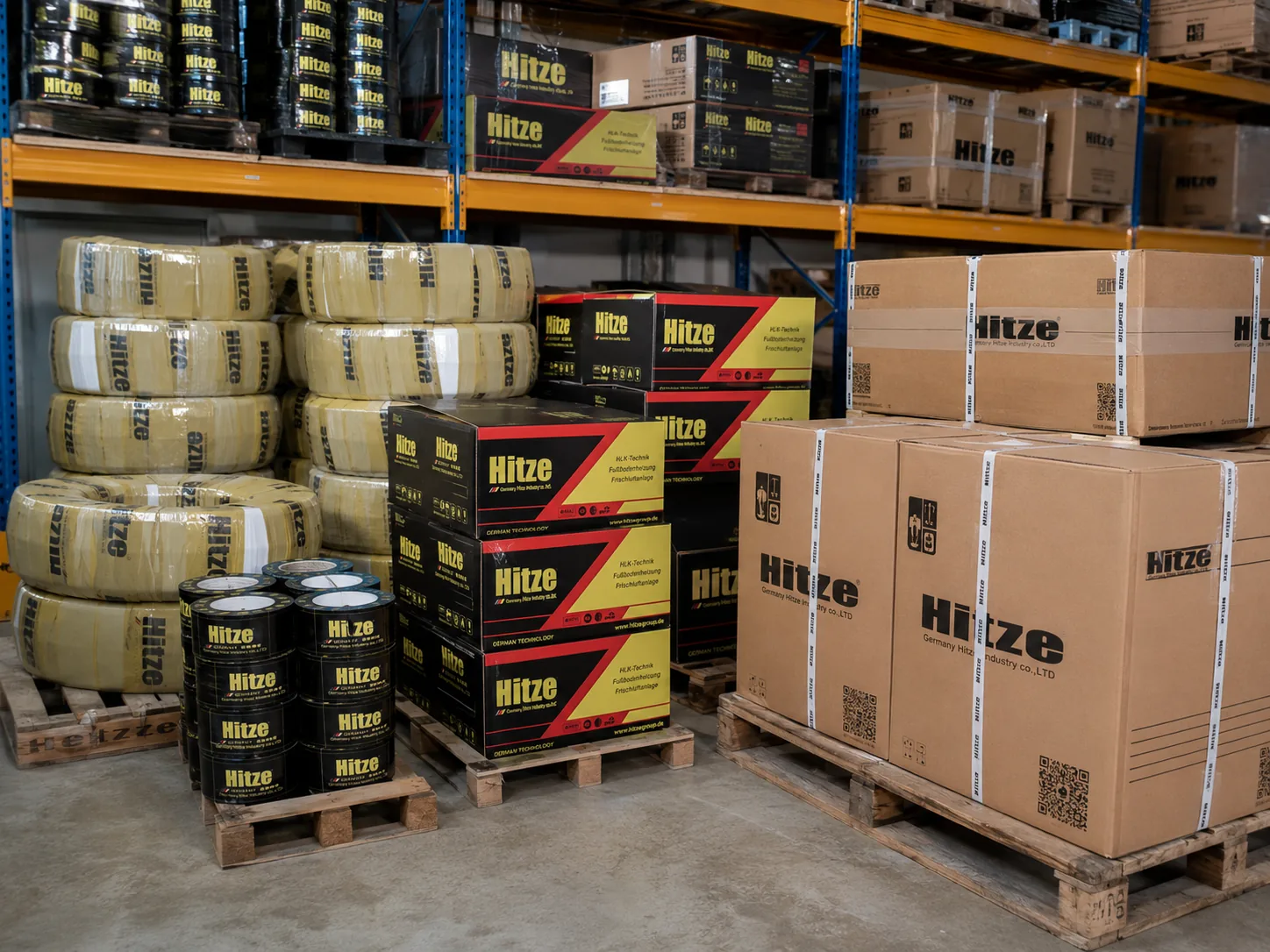
On credentials, our PP-R range carries SKZ testing on pressure pipe and fittings, DVGW type examination for drinking-water pipe, WRAS material approval and an NSF laboratory BS 6920 report for hot and cold potable contact, with ISO 45001 covering plant operations. We name the scope rather than printing certificate numbers in an article, because a number without its current validity window and covered size range is worse than no number — certificate references and their coverage are issued per enquiry against the specific models you are quoting. Our EN ISO 15874 service class guide covers how those classes map to real duties.
How to read a supplier’s pressure claim
Put the four hidden variables into a single request and most ambiguity disappears. For any pressure number on a quotation, ask for the temperature it is quoted at, the design life assumed, the safety factor applied, and the material grade — not just the dimension ratio. Four answers turn a marketing figure into a specification you can compare across suppliers and materials.
A worked example shows what this catches. Suppose a hot-water riser will run at 70 °C continuously and you are handed three offers: PN 20 PP-R, SDR 11 PE-X and Schedule 80 CPVC. On the nameplates, PN 20 looks strongest. Applied to the duty, the picture inverts. PP-R at SDR 6 and SF 1.5 delivers 8.5 bar at 70 °C on a 50-year basis, not 20. PE-X at DR 11 delivers 8.5 bar at the same temperature and basis. CPVC at 160 °F (71 °C) sits at a 0.40 factor, so a 400 psi SDR 11 tube is a 160 psi tube — about 11 bar, but on a 73 °F ASTM datum rather than an ISO 20 °C one. Three offers that looked incomparable become a real comparison only after each has been brought to the same duty.
Two guardrails are worth stating plainly. Pressure ratings for water do not transfer to compressed air or gas, and several PVC technical sheets carry that restriction explicitly. And local codes may impose limits below the standard’s own figure regardless of what the pipe can hold, so confirm the governing requirement with the authority having jurisdiction before a rating goes into a submittal. Where the specification package matters most, our PPR pipe specification checklist sets out the documents to collect.
Conclusion
The number printed on a plastic pipe describes a laboratory condition — 20 °C or 73 °F, a fixed design life, and a safety factor someone chose — rather than the duty your system will impose. Comparing PN against Schedule against psi without first bringing all three to the same temperature, life and margin is how a compliant-looking substitution reaches site.
If you are specifying for hot water, start from the operating temperature and the required service life, then work backwards to the wall you need. You will usually find the decision was made by the duty rather than by the marking.
Frequently asked questions
Is PN 20 the same as 20 bar working pressure?
Only at 20 °C, and only under the safety factor the marking was calculated with. At 70 °C the same wall delivers far less, and PN 20 originally came from a 2.0 safety factor under DIN 8077:1989.
Can I convert a psi rating to a bar rating directly?
Not without correcting the datum first. ASTM ratings are quoted at 73 °F and ISO ratings at 20 °C, so the two figures describe different conditions before any unit conversion is applied.
Does a lower SDR always mean a higher pressure rating?
Within one material, yes — a lower SDR is a thicker wall. Across materials or resin grades it does not hold: PE 100 at SDR 11 is PN 16 while PE 80 at SDR 11 is PN 12,5.
Why do pressure tables list a service life in years?
Because the rating comes from a regression line extrapolated over time. A shorter assumed life yields a higher allowable pressure, which is why the years column belongs beside every figure.
Do these ratings apply to compressed air?
No. Published figures are for water, non-shock service. Several PVC technical sheets restrict air handling explicitly, and gas or multiphase service is governed by separate standards and service factors.
What should I put on a purchase order to avoid a downgrade?
Name the material grade, the dimension ratio, the application class or design temperature, and the standard. An SDR alone lets a lower-grade resin arrive fully compliant with your wording.
Written by the Hitze technical team. GERMANY Hitze INDUSTRY CO., LTD. has manufactured piping systems since 1974 from a 120,000 m² production base, exporting to more than 118 countries, with SKZ, DVGW, WRAS and NSF/BS 6920 credentials across the PP-R range.