Key Takeaways for Stocking Both
- PPSU is an amorphous engineering polymer with a glass transition around 220°C and hydrolytic stability that lets it survive continuous hot potable and heating duty where cheaper plastics creep — but it is UV-sensitive and stress-cracks against the wrong solvents.
- Brass push-fit lives or dies on the alloy. For potable and warm acidic water you want a dezincification-resistant grade (CW602N, CW724R) that passes ISO 6509 at ≤200 µm, not a plain CW617N body that can dezincify and eventually leak.
- Price behaves differently. Brass rides the LME copper index and moves with theft and scrap markets; PPSU rides a resin index. For a wholesaler, that means the two materials hedge each other on your shelf.
- Certification paths diverge: North American potable push-fit is anchored to ASSE 1061 plus NSF/ANSI 61 and 372 lead-free; the same fitting family in Europe/UK leans on WRAS material approval and DZR alloy standards.
- Hitze makes push-fit in both PPSU and brass — so you can split a stocking decision by application instead of by whatever one material a single-material supplier happens to run. Sample-first, no MOQ.
Most suppliers who sell you push-fit fittings only make one material, so their “which is better” answer is never neutral — it is whatever they extrude or machine. Hitze runs both a PPSU injection-moulding line and a brass CNC line, which means the stocking recommendation you get is a trade-off matrix, not a sales pitch for the one thing on the machine. This article is written for the wholesaler deciding how many SKUs of each to carry, and where a wrong call turns into warranty returns two heating seasons later.
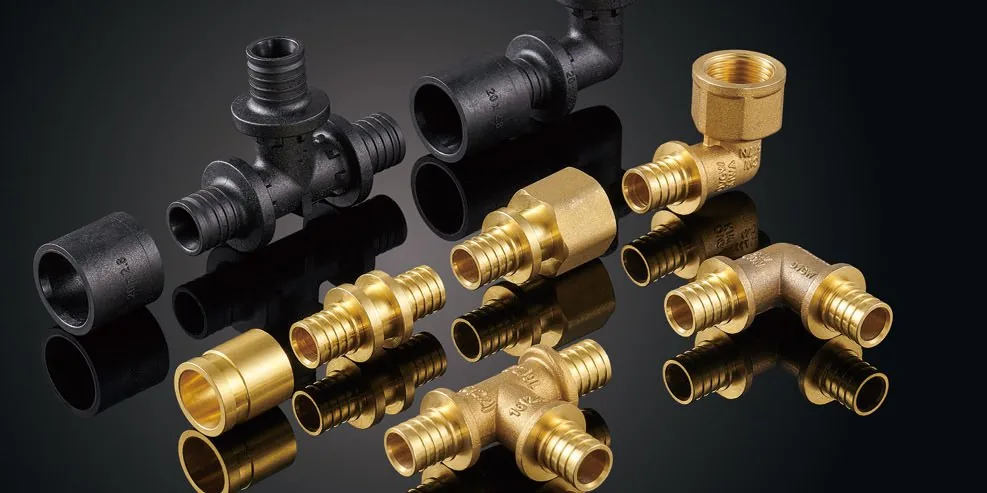
What PPSU Actually Is — And Why It Behaves Differently From “Plastic”
PPSU (polyphenylsulfone) is not the commodity plastic your buyers picture when they hear “plastic fitting.” It is an amorphous high-performance thermoplastic in the sulfone family — the same chemistry BASF sells as Ultrason® P and Solvay/Syensqo as Radel®. The number that matters on a spec sheet is the glass transition temperature: Radel® R-5000 PPSU carries a Tg of roughly 220°C, with transparent grades holding service up to about 204°C. You are never running potable or hydronic water anywhere near that, and that is the point — the material has an enormous thermal headroom over the 70–90°C a domestic hot line or a low-temperature heating circuit actually sees, so it does not soften or creep at working temperature the way a lower-grade polymer does.
The second property that earns PPSU its place in a fitting is hydrolytic stability — its resistance to being chemically attacked by hot water over years. Amorphous sulfones resist hydrolysis where semi-crystalline commodity plastics slowly degrade under repeated hot-water cycling, which is exactly the failure mode a wholesaler dreads: a fitting that passes on day one and weeps on year six. Add high impact strength and toughness, and you get a fitting that survives being dropped on a cold job site and thermal-cycled through winters without going brittle. For a merchant, PPSU is the answer to the customer who says “I don’t trust plastic on hot water” — because this is the plastic engineered for exactly that.
Where it bites back is chemistry. Because PPSU is amorphous, it is sensitive to environmental stress cracking against specific solvent families — ketones, esters and some aromatic/oxygenated solvents. In plumbing terms that means the failure rarely comes from the water; it comes from what an installer smears on the thread. We cover that trap in detail below, because it is the single most common way a perfectly good PPSU fitting gets killed on site.
Brass Push-Fit: The Alloy Is the Whole Decision
With brass, the shape of the fitting is almost irrelevant to reliability — the alloy grade is the reliability. Plain machining brass (CW617N, CuZn40Pb2) is fine for a ball-valve body or a dry mechanical joint, but on potable water, and especially warm or slightly acidic water, it is vulnerable to dezincification: the zinc leaches out of the alloy, leaving a porous copper skeleton that eventually loses pressure integrity and leaks. That is why potable brass push-fit should be a dezincification-resistant (DZR) grade — CW602N (CuZn36Pb2As, arsenic-inhibited) or the lead-free silicon brass CW724R (CuZn21Si3P).
The acceptance test is not marketing — it is ISO 6509. A polished sample sits in 1% copper chloride at 75°C for 24 hours, and a qualifying DZR grade must show a maximum dezincification depth of 200 µm or less. If your supplier cannot tell you which grade the wetted body is and whether it passes ISO 6509, you are buying a lawsuit with a nickel-plated finish. This is the same alloy discipline we walk through in our guide to lead-free brass grades CW617N, DZR and CW724R for potable water — worth reading before you commit a single potable brass SKU to a market with a low-lead rule.
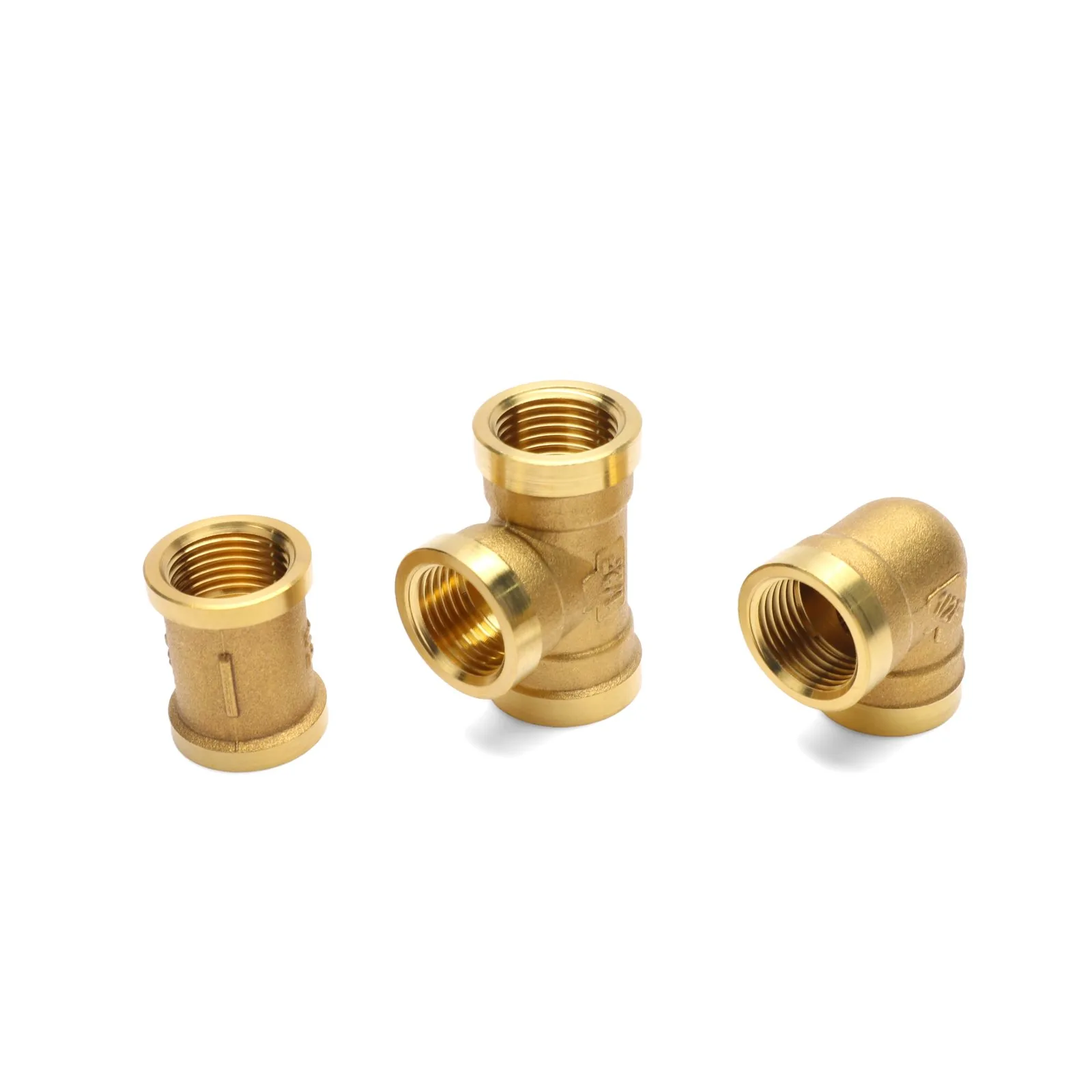
Brass buys you three things PPSU does not. First, a metal-cut thread that transitions cleanly to legacy iron, copper stubs and valve tails — the moment your job hits an existing threaded riser, a metal body is the honest connection. Second, mechanical robustness at the collar under repeated demount cycles. Third, buyer psychology: some markets and some inspectors simply trust metal on a pressurised main. The cost of all three is weight (freight and shelf load), a copper-indexed price that swings, and in some regions a real theft exposure — scrap brass has resale value, PPSU does not.
Head-to-Head: The Trade-Off Table a Stocking Buyer Actually Needs
| Property | PPSU push-fit | Brass push-fit (DZR) |
|---|---|---|
| Base material | Amorphous polyphenylsulfone, Tg ~220°C | CW602N / CW724R dezincification-resistant brass |
| Corrosion / degradation risk | No corrosion; stress-cracks vs. ketones/esters/aggressive glycol packages | Dezincification if wrong grade; must pass ISO 6509 ≤200 µm |
| UV / sunlight | Unstabilised PPSU is UV-sensitive — not for exposed outdoor runs | Unaffected by UV |
| Thread transitions to metal | Needs a brass-insert transition fitting | Native metal thread, cleanest legacy connection |
| Weight / freight / theft | Light; low scrap value; low theft exposure | Heavy; copper scrap value; theft exposure in some markets |
| Price index | Resin-indexed — more stable, decouples from copper | Copper/LME-indexed — swings with the metal market |
| Certification anchor (NA) | ASSE 1061 + NSF/ANSI 61 & 372 lead-free | ASSE 1061 + NSF/ANSI 61 & 372; alloy must clear 0.25% lead weighted average |
| Certification anchor (UK/EU) | WRAS material approval, potable | WRAS + DZR alloy standard |
Read the table as a hedging tool, not a scorecard. The two columns fail in different conditions and price on different indices, which is precisely why a serious wholesaler stocks both instead of betting the shelf on one. If you are still deciding whether push-fit belongs in your range at all versus press or compression, our breakdown of press vs. compression vs. push-fit — when to use each frames that choice before you get to the material question.
The Insider Warnings: Where Each Material Quietly Fails
PPSU and thread sealants / glycol. This is the one your counter staff should be able to recite. PPSU is amorphous, so it is susceptible to environmental stress cracking against polar organic solvents — specifically ketones and esters. Some aggressive pipe-dope carriers, certain solvent cements, and some concentrated antifreeze/glycol inhibitor packages fall in that zone. A stressed PPSU body (a fitting torqued onto a thread, so already under load) exposed to the wrong chemistry can craze and split weeks later, long after the installer has left. The fix is boring and cheap: spec PTFE tape rather than aggressive dopes on any threaded transition, and confirm glycol compatibility for heating loops. Tell your installers this proactively — it is the difference between a return and a repeat order.
PPSU and UV. Unstabilised PPSU has limited resistance to weathering and ultraviolet light — most unfilled grades are not rated for prolonged direct sunlight. On an exposed rooftop run, a plant-room window, or an outdoor manifold that catches afternoon sun, that matters. Route PPSU inside walls, under floors, in cabinets and plant rooms; if a run is genuinely exposed, that is a brass call or a lagged/boxed detail. Do not let a customer put a bare black PPSU tee on a south-facing balcony and then warranty-claim it in three years.
Brass and the low-lead rule. In North America the Safe Drinking Water Act defines “lead free” as a weighted average of no more than 0.25% lead across the wetted surfaces, measured per NSF/ANSI 372. A brass push-fit body that was fine to sell in a heating-only market is not automatically compliant on potable in a low-lead jurisdiction. If you ship into the US or Canada, the wetted brass has to be a genuinely low-lead grade (this is exactly where CW724R silicon brass earns its keep) and the certification has to say so. Buying “brass push-fit” without confirming the lead path is how a container gets rejected at the dock.
Price Stability: Resin Index vs. Copper Index
This is the argument single-material suppliers never make, because they cannot. Brass fitting cost is dominated by copper, which trades on the LME and moves with global metal demand, scrap flows and, at the retail end, theft. When copper spikes, your brass landed cost spikes and your margin gets squeezed on fittings you already quoted. PPSU cost tracks a specialty-resin index that moves on a different clock — it is not immune to petrochemical and energy swings, but it does not follow copper. For a wholesaler carrying both, that is a genuine portfolio hedge: when one input runs hot, the other typically does not, and you can steer quotes and stock toward the calmer material without leaving the category. Stocking both is a procurement decision as much as a technical one.
Certification Paths: Same Fitting, Different Passports
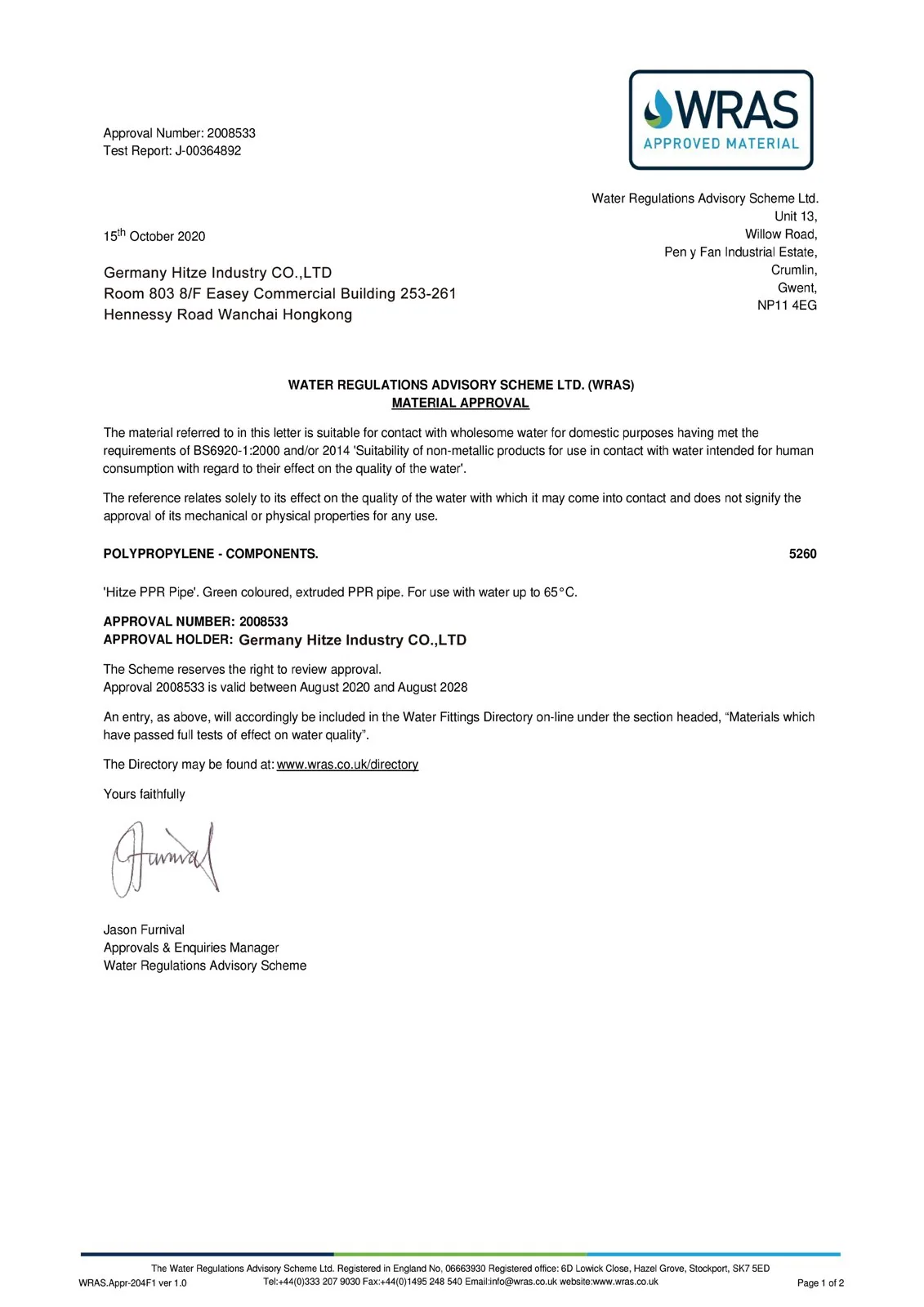
A push-fit fitting does not have one certificate — it has a passport for each market, and PPSU and brass take partly different routes. For North American potable and hydronic use, the anchor standard for push-fit is ASSE 1061, which sets the performance requirements for push-fit connections on PEX, copper, CPVC and PE-RT tube. Lead-free compliance is carried by NSF/ANSI 61 (what can migrate into the water) and NSF/ANSI 372 (how much lead is in the wetted material at all). For the UK and much of Europe, potable suitability leans on WRAS material approval; the brass side additionally has to satisfy the DZR alloy requirement. Hitze holds WRAS material approval for potable water and an independent NSF Laboratories BS 6920 potable-water test report, and the group carries cUPC/UPC (IAPMO) and NSF/ANSI 61 listings with certificate numbers available on request. The discipline for a buyer is simple: match the certificate scope to the destination market before you commit stock, because a fitting certified for one path is not automatically legal on another.
What Hitze Checks / How It’s Built
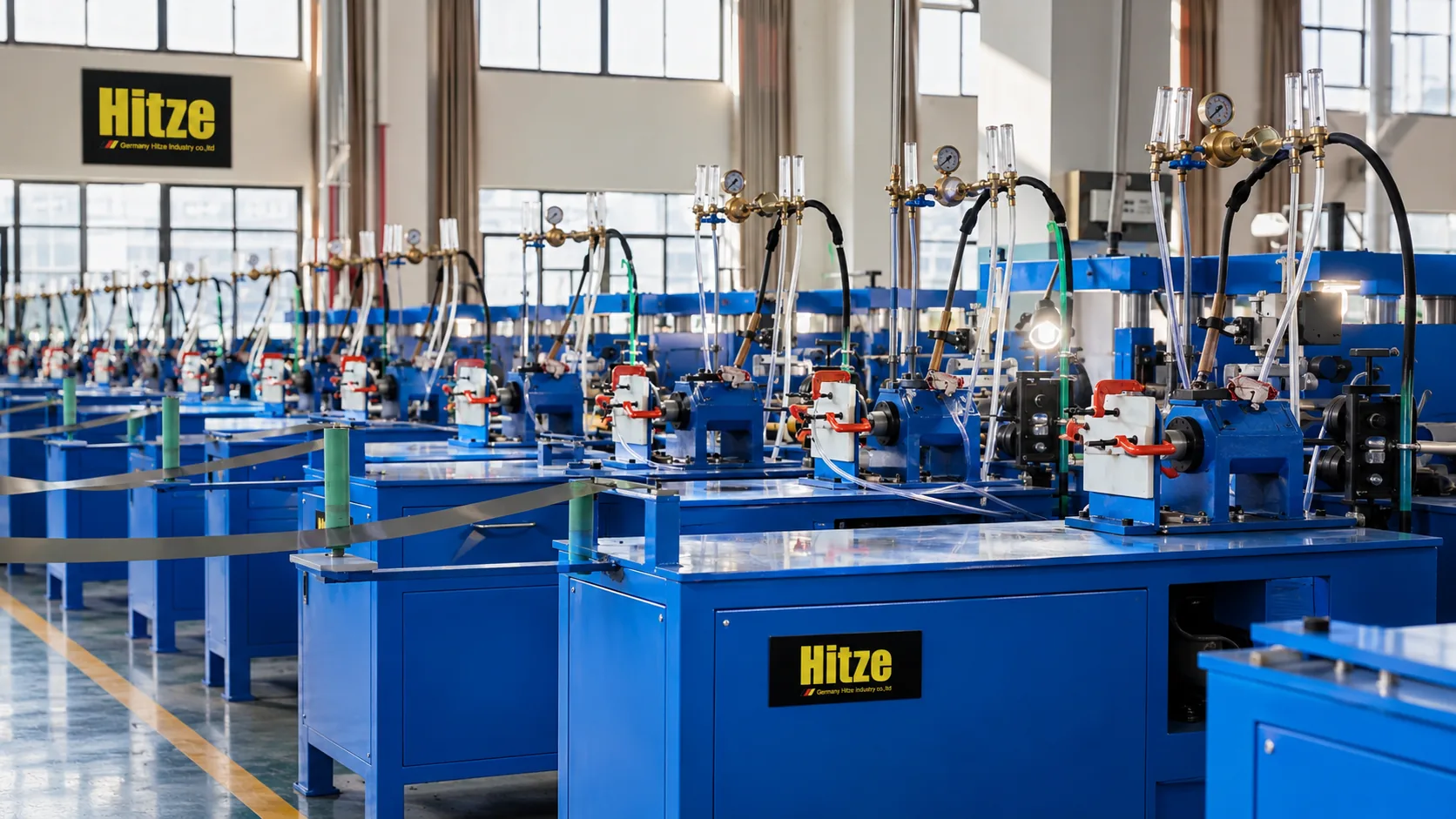
Because we run both material lines under one roof at our 120,000 m² production base — the company has built piping since 1974 and now exports to 118+ countries — the two products go through parallel but different verification. On the PPSU side, fittings are injection-moulded from specified sulfone resin with material-drying hoppers feeding the presses (undried sulfone moulds badly and loses properties), then dimensionally checked at the size markings that print on the body. On the brass side, fittings are CNC-machined from bar stock in a grade selected for the destination — DZR CW602N or low-lead CW724R where potable and low-lead rules apply — and the wetted body is the alloy that clears ISO 6509, not just the visible nickel plating.
Both families finish on the same pressure-test benches — rows of gauged rigs that verify the seated joint holds before anything is packed. The O-ring seal and grab-ring collar are the parts that actually make a push-fit joint; those get inspected on both material bodies, because a perfect PPSU shell or a perfect brass body still leaks if the seal is wrong. As a group Hitze holds SKZ testing on the PP-R and PE-Xb pipe side, DVGW type examination for PP-R drinking-water pipe, WRAS material approval, an NSF Laboratories BS 6920 report, and ISO 45001 occupational health & safety certification — the quality-system backbone behind every line, including fittings.
Recommendation Matrix by Application
| Application | Recommended | Why |
|---|---|---|
| Concealed potable hot & cold, in-wall / under-floor | PPSU | Hydrolytic stability + no corrosion + no UV exposure; lightest to freight |
| Transitions to legacy iron/copper thread & valves | Brass (DZR) | Native metal thread is the honest connection to existing metalwork |
| Exposed / sunlit runs (rooftop, balcony, plant-room window) | Brass | PPSU is UV-sensitive; metal is unaffected |
| Hydronic heating with glycol | Brass, or PPSU with verified glycol compatibility | Some glycol/inhibitor packages stress-crack amorphous PPSU |
| US / Canada low-lead potable | PPSU or CW724R brass | Must clear 0.25% lead weighted average per NSF/ANSI 372 |
| High-turnover renovation / repair stock | Both | Demountable, fast; price hedge across resin and copper indices |
Worked Scenario: A 40-Store Distributor Splitting One SKU into Two
A regional distributor was carrying a single brass push-fit range across 40 branches and taking two kinds of pain: freight cost on heavy metal moving to outlying stores, and a copper-price spike that ate the margin on a quarter’s worth of pre-quoted contract fittings. We split the line by application. Concealed potable and under-floor runs — the bulk of their new-build volume — moved to PPSU in the common 16/20/25/32 mm sizes, cutting shipped weight and decoupling that volume from copper. Brass stayed for the retrofit and transition SKUs where installers hit existing threaded metalwork, and for the exposed-run and glycol jobs where PPSU is the wrong call. The retrofit logic there follows the same time-vs-risk split we lay out in push-fit fittings for retrofit — where they save time, where they don’t. Net result: lighter freight on the high-volume half of the range, a real hedge when copper moved again, and fewer “wrong material for the job” returns because branch staff now had a two-column rule instead of one default.
Who Should Stock Which — and How to Trial It
If you serve new-build and concealed potable/heating work, weight your shelf toward PPSU and keep a disciplined brass range for transitions, exposed runs and glycol. If your customers are mostly retrofit and service plumbers hitting legacy metal all day, brass leads and PPSU covers the clean concealed runs. Either way, carrying both is what lets you answer “which fitting” with the application instead of with whatever you happen to have. Hitze supplies push-fit in both PPSU and brass from the same push-fit fittings program, private-label ready, with the certificate scope matched to your destination market. There is no MOQ — you can start with samples or a small trial order and validate on your own bench before you commit a container — and the 50-year warranty applies on a matched Hitze pipe-and-fitting system. This is for trade and wholesale buyers; certificate numbers and market-specific documentation are available on request.
Ready to split your push-fit shelf by application? Request PPSU and brass samples, tell us your destination markets, and we’ll match the certification scope and alloy grade before you order. Explore Hitze push-fit fittings →
FAQ
Is PPSU push-fit safe for hot potable water? Yes. PPSU is an amorphous sulfone with a glass transition around 220°C and strong hydrolytic stability, so it comfortably handles domestic hot-water temperatures with large thermal headroom. For potable use, confirm the fitting carries the right approval for your market — ASSE 1061 with NSF/ANSI 61 and 372 in North America, or WRAS material approval in the UK/EU.
Why does brass push-fit have to be a DZR grade? Plain brass (CW617N) can dezincify on potable and warm acidic water — zinc leaches out and leaves a porous, weak body that eventually leaks. A dezincification-resistant grade such as CW602N or CW724R passes ISO 6509 with a maximum dezincification depth of 200 µm or less, which is the objective test you should ask any supplier to confirm.
Can I use PPSU fittings with pipe dope or glycol? Be careful. Because PPSU is amorphous, it can stress-crack against ketones, esters and some aggressive dope carriers and glycol inhibitor packages, especially when the fitting is already under thread load. Spec PTFE tape rather than aggressive dopes on threaded transitions, and verify glycol compatibility on heating loops.
Which is cheaper to stock over a year, PPSU or brass? It depends on the copper cycle. Brass cost tracks the copper/LME index and can swing sharply; PPSU tracks a resin index that moves independently. Over a full year the two hedge each other, which is a real argument for carrying both rather than betting on one input.
Can PPSU push-fit be used outdoors in sunlight? Not unstabilised. Most unfilled PPSU grades have limited UV and weathering resistance and are not rated for prolonged direct sunlight. Keep PPSU concealed — in walls, under floors, in cabinets and plant rooms — and use brass for genuinely exposed runs.
Are Hitze push-fit fittings made in Germany? Hitze is a German brand, engineered in Germany and built to German DIN standards, with SKZ, DVGW and WRAS credentials on the relevant product lines. Production runs at the group’s 120,000 m² base; we don’t claim “Made in Germany” on the fittings themselves. Certificate scope and numbers are available on request.


