This guide has been superseded
We have published a fuller, current treatment of the same subject, with expanded service-class tables and the wall-thickness worked examples. Please read EN ISO 15874 for PP-R Pipe: Service Classes Explained instead — the article below is kept for reference only.
Key Takeaways
- EN ISO 15874 is the product standard series for polypropylene piping in hot and cold water installations: Part 1 (general), Part 2 (pipes), Part 3 (fittings), Part 5 (fitness for purpose of the system), plus a Technical Specification, Part 7, on conformity assessment.
- PP-R is dimensioned against four application classes: class 1 (hot water supply at 60 °C), class 2 (hot water supply at 70 °C), class 4 (underfloor heating and low-temperature radiators) and class 5 (high-temperature radiators). Each class is a 50-year temperature-time profile, not a single number.
- A class means nothing on its own. The standard pairs it with a design pressure of 4, 6, 8 or 10 bar — “class 2/10 bar” on the pipe print is the real specification line.
- The class-plus-pressure pair fixes a maximum pipe series Scalc,max. For PP-R at class 2/8 bar that is 2,6 — an SDR 6 wall. At class 5/10 bar it is 1,9, thicker than any standard PP-R series makes.
- On top of its hot class, every system must also carry 20 °C cold water at 10 bar for 50 years, demonstrated by ISO 9080 extrapolation.
If you specify PP-R and your submittal says only “complies with EN ISO 15874”, you have specified almost nothing. The standard covers walls from 1,8 mm to 32,1 mm on the same outside diameters, four different service classes and four design pressures — and a pipe that is perfectly compliant for a cold-water riser will creep-rupture years early on a 70 °C recirculation loop. This guide walks through the classes of service exactly as the standard defines them, shows how the class/pressure pair sets your wall thickness, and flags the two or three cells of the table where engineers most often get burned.
What EN ISO 15874 Covers — and Which Part to Ask For
EN ISO 15874 carries the general title Plastics piping systems for hot and cold water installations — Polypropylene (PP). It was prepared by CEN/TC 155 in collaboration with ISO/TC 138/SC 2 under the Vienna Agreement, which is why the European (EN) and international (ISO) texts are the same document. The current base edition is the second, dated 2013; it added the newer PP-RCT material alongside PP-H, PP-B and PP-R, and the EN edition of Part 1 was amended in 2022 (A1:2022) to add an impact test.
The series splits the work across parts, and a competent supplier should be able to tell you which part answers which question. Part 1 (General) defines the terms, the material requirements and — critically — Table 1, the classification of service conditions. Part 2 (Pipes) carries the reference strength curves for each PP type, the Scalc,max tables and the dimension tables. Part 3 does the same job for fittings. Part 5 (Fitness for purpose of the system) is the one most buyers never read: it tests the assembled joints — pipe plus fitting together — with internal pressure, thermal cycling and, for mechanical joints, bending, pull-out, pressure cycling and vacuum tests. ISO/TS 15874-7 gives guidance for assessing conformity.
One point of housekeeping that saves confusion in submittals: the German DIN standards did not disappear. DIN 8077 (Polypropylene (PP) pipes — Dimensions) and DIN 8078 (General quality requirements and testing) remain live documents covering PP-H, PP-B, PP-R and PP-RCT, and much of the trade still quotes wall series in DIN 8077’s PN shorthand. Hitze builds its PP-R range to DIN 8077/8078 and EN ISO 15874 together — the DIN pair for dimensional and quality discipline, the ISO series for the class-based design logic this article is about.
The Four Application Classes, Exactly As the Standard Defines Them
The classification comes from ISO 10508:2006, the umbrella guidance document for all hot-and-cold-water plastics (PP, PE-X, PB, PVC-C, PE-RT), and is reproduced as Table 1 of EN ISO 15874-1. Each class is built from three temperatures. TD is the design temperature — the water temperature the system is engineered to carry for its working life. Tmax is the highest design temperature occurring for short periods only. Tmal is the malfunction temperature: the worst case when the control limits are exceeded, budgeted at a total of 100 hours across 50 years. Here is the table as the standard states it:
| Class | TD (time) | Tmax (time) | Tmal (time) | Typical field of application |
|---|---|---|---|---|
| 1 | 60 °C (49 years) | 80 °C (1 year) | 95 °C (100 h) | Hot water supply (60 °C) — domestic hot water where the market designs at 60 °C |
| 2 | 70 °C (49 years) | 80 °C (1 year) | 95 °C (100 h) | Hot water supply (70 °C) — hot storage and recirculation at 70 °C |
| 4 | 20 °C (2,5 y) + 40 °C (20 y) + 60 °C (25 y) | 70 °C (2,5 years) | 100 °C (100 h) | Underfloor heating and low-temperature radiators — screed loops, low-temp hydronics |
| 5 | 20 °C (14 y) + 60 °C (25 y) + 80 °C (10 y) | 90 °C (1 year) | 100 °C (100 h) | High-temperature radiators — boiler-fed radiator circuits |
| Source: ISO 10508:2006, Table 1, reproduced in EN ISO 15874-1:2013. Every class additionally includes cold water at 20 °C, 10 bar, for 50 years. Malfunction time totals 100 h over the 50-year period. | ||||
Do the arithmetic on any row and you land on the same figure: class 1 is 49 years at 60 °C plus 1 year at 80 °C plus 100 malfunction hours at 95 °C — a 50-year design period. Class 5 aggregates to 14 + 25 + 10 years across 20/60/80 °C, plus 1 year at 90 °C and the 100-hour malfunction budget. That is the single most misunderstood point about ISO 10508 classes: a class 2 pipe is not “a pipe that survives 70 °C”. It is a pipe whose material, at the specified wall, accumulates less than its allowable creep damage across that entire mixed profile — the derivation aggregates the temperature steps rather than taking the worst case alone, and ISO 10508 lists Miner’s rule (ISO 13760) among its normative references for exactly that cumulative-damage bookkeeping.
Two footnotes in the table matter commercially. First, classes 1 and 2 apply “depending upon international, national or local regulations” — meaning whether your market treats domestic hot water as a 60 °C or a 70 °C service is a regulatory question, not a preference. The UK and Germany typically spec against different assumptions, so an importer serving both should carry the class 2 wall. Second, there is a class 3 (low-temperature underfloor heating, Tmal capped at 65 °C) in ISO 10508 — but the PP product standard does not carry it as a dimensioning case: the Scalc,max tables in EN ISO 15874-2 list classes 1, 2, 4 and 5 only. If a datasheet offers you “class 3 PP-R”, someone is quoting the wrong standard.
And underneath every class sits the cold-water floor: any system satisfying Table 1 must also be suitable for 50 years of 20 °C water at 10 bar, demonstrated using the extrapolation method of ISO 9080. If you want to see how a laboratory turns 10 000 hours of hydrostatic data into a 50-year prediction — and why the 97,5 % lower prediction limit is the number that actually matters — we walk through it in our ISO 9080 explainer.
Class + Design Pressure: How the Pair Sets Your Wall Thickness
EN ISO 15874 never rates a pipe for a class alone. Part 5 states it plainly: the design pressure pD is “4 bar or 6 bar or 8 bar or 10 bar, as applicable”. Each class/pressure combination maps to a maximum calculated pipe series, Scalc,max, where Scalc = (dn − en) / 2en — outside diameter minus wall, over twice the wall. A lower S means a thicker wall. If you think in SDR (dn/en), the conversion is S = (SDR − 1)/2, so SDR 11 is S 5, SDR 7,4 is S 3,2, SDR 6 is S 2,5 and SDR 5 is S 2. Here is the PP-R table from EN ISO 15874-2:2013 (Table 3), values rounded to one decimal:
| pD | Class 1 | Class 2 | Class 4 | Class 5 |
|---|---|---|---|---|
| 4 bar | 6,9 | 5,3 | 6,9 | 4,7 |
| 6 bar | 5,0 | 3,5 | 5,5 | 3,2 |
| 8 bar | 3,8 | 2,6 | 4,1 | 2,4 |
| 10 bar | 3,0 | 2,1 | 3,3 | 1,9 |
Read the table the way an auditor would and three traps jump out. Trap one: class 1 at 10 bar allows Scalc,max 3,0 — which S 3,2 (the “PN 16” wall) just fails. You need S 2,5, the SDR 6 wall the trade calls PN 20. Trap two: class 2 at 10 bar allows only 2,1, so even the S 2,5 wall is out; a 70 °C/10 bar service needs S 2 (SDR 5). A distributor who stocks only “PN 20” pipe cannot legitimately cover class 2/10 bar, whatever the carton says. Trap three, and the one that catches experienced engineers: class 5 at 10 bar allows 1,9 — below S 2, the thickest standard series in the dimension tables. High-temperature radiator service at 10 bar is effectively outside standard PP-R; that cell is where PP-RCT (whose Table 4 value at class 5/10 bar is 2,9) or a different material enters the conversation. Note also the pleasant surprise in the class 4 column: because underfloor heating spends decades at 20–40 °C, class 4/10 bar permits S 3,3 — a thinner, cheaper wall than class 1 at the same pressure.
The PN shorthand deserves one honest paragraph, because it causes real ordering mistakes. PN comes from the DIN 8077 convention and describes cold-water service at 20 °C: S 5/SDR 11 trades as PN 10, S 3,2/SDR 7,4 as PN 16, S 2,5/SDR 6 as PN 20. Manufacturer class pairings published against EN ISO 15874 make the derating explicit: the same S 5 pipe that trades as PN 10 is rated class 1/6 bar and only class 2/4 bar; S 3,2 covers class 1/8 bar and class 2/6 bar; S 2,5 covers class 1/10 bar and class 2/8 bar. Newer designations drop PN entirely — PP-RCT pipe is not designated with PN at all — which is why the class/pressure print line, not the PN number, is what belongs in your specification. This class logic is also exactly how the wall options in the Hitze PP-R pipe and fittings range are organised: the same fusion fitting system, with the pipe series selected against the class and design pressure you actually run, from 20 mm risers up to OD 110/DN 90 mains.
Worked Example: Specifying a Hotel Hot-Water Riser to Class 2
Take a concrete case: a six-storey hotel with a 70 °C domestic hot water system and a continuous recirculation loop, PP-R throughout, 32 mm risers. Six storeys is roughly 18 m of static head — about 1,8 bar — and with pump head, mains pressure and a surge allowance the hydraulic calculation supports a maximum design pressure of 8 bar. Because storage runs at 70 °C for legionella control, class 1 is not defensible; this is class 2 service. The table gives class 2/8 bar → Scalc,max 2,6, so the pipe is S 2,5: a 32 mm pipe at 5,4 mm wall per the standard’s dimension table, leaving a 21,2 mm bore.
Now watch what happens if the engineer, “to be safe”, writes 10 bar instead. Class 2/10 bar allows only 2,1, forcing S 2 — a 32 × 6,5 mm pipe with a 19 mm bore. That is roughly 20 % less flow area than the S 2,5 pipe, so either the recirculation velocity climbs or every riser goes up a size, and the material bill rises with the extra polymer in the wall. Over-declaring design pressure is not conservatism; it is paying twice — once in resin, once in hydraulics. The recommendation is boring but correct: calculate pD honestly, then take the class from the actual stored-water temperature, not from habit.
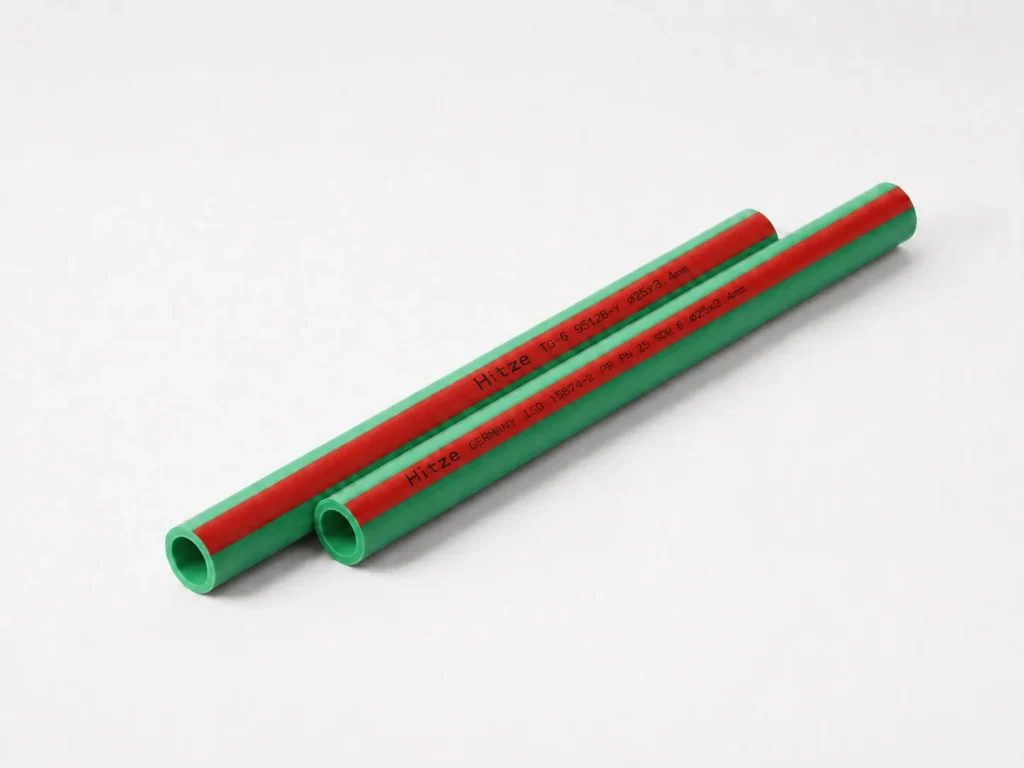
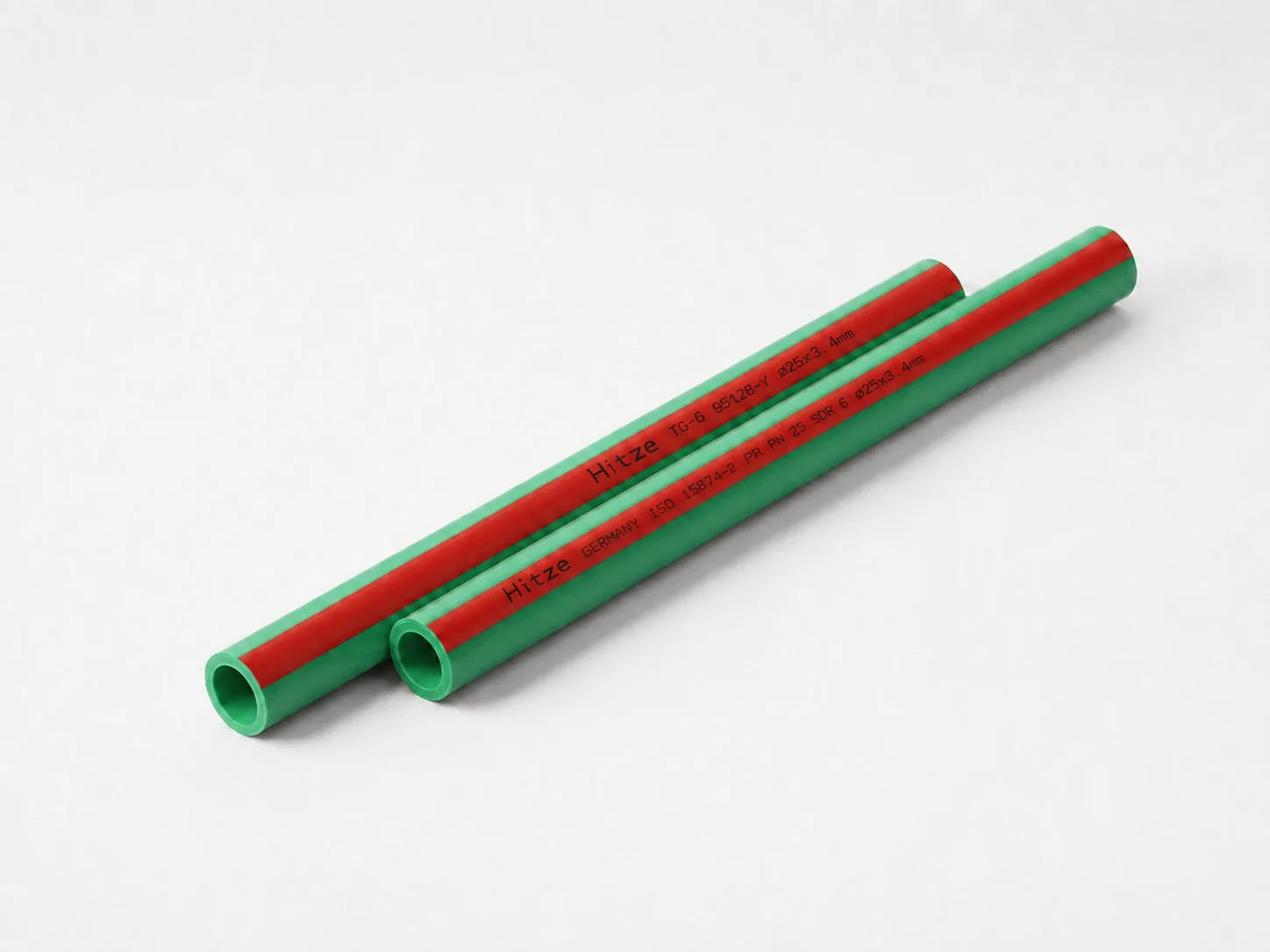
The same project shows why classes must not be mixed casually. The cold-water risers only need the universal 20 °C/10 bar/50-year condition — S 5 pipe at 32 × 2,9 mm, with a generous 26,2 mm bore. The spa’s underfloor heating branch is class 4, where even 10 bar permits S 3,3. Ship all three duties in one undifferentiated “PN 20” order and you have overspent on the cold lines while the number that mattered — the class 2 rating of the hot return — was never checked at all. On site, the check takes ten seconds: the print line on a compliant pipe carries the OD × wall, the S-series and the class/pressure designation, in the format “application class/design pressure”.
How a Class Rating Is Actually Proven
A class marking is only as good as the evidence behind it, and EN ISO 15874 is specific about what that evidence is. At material level, Part 2 requires the pipe compound’s long-term hydrostatic strength to be evaluated per ISO 9080, with internal pressure testing to ISO 1167-1/-2, and the lower prediction limit must sit at or above the standard’s published reference curves for that PP type. Conformance is demonstrated by testing pipe samples at 20 °C, 60–70 °C and 95 °C, with failure points spread across time brackets from 10 h out beyond 8 760 h — a full year under pressure — and at least 97,5 % of all experimental points must lie on or above the reference line. This is why a credible PP-R offer always names its resin pedigree: the four reference-curve equations in Part 2 are material-specific (PP-H, PP-B, PP-R, PP-RCT), and a blended or reprocessed compound has no curve to stand on.
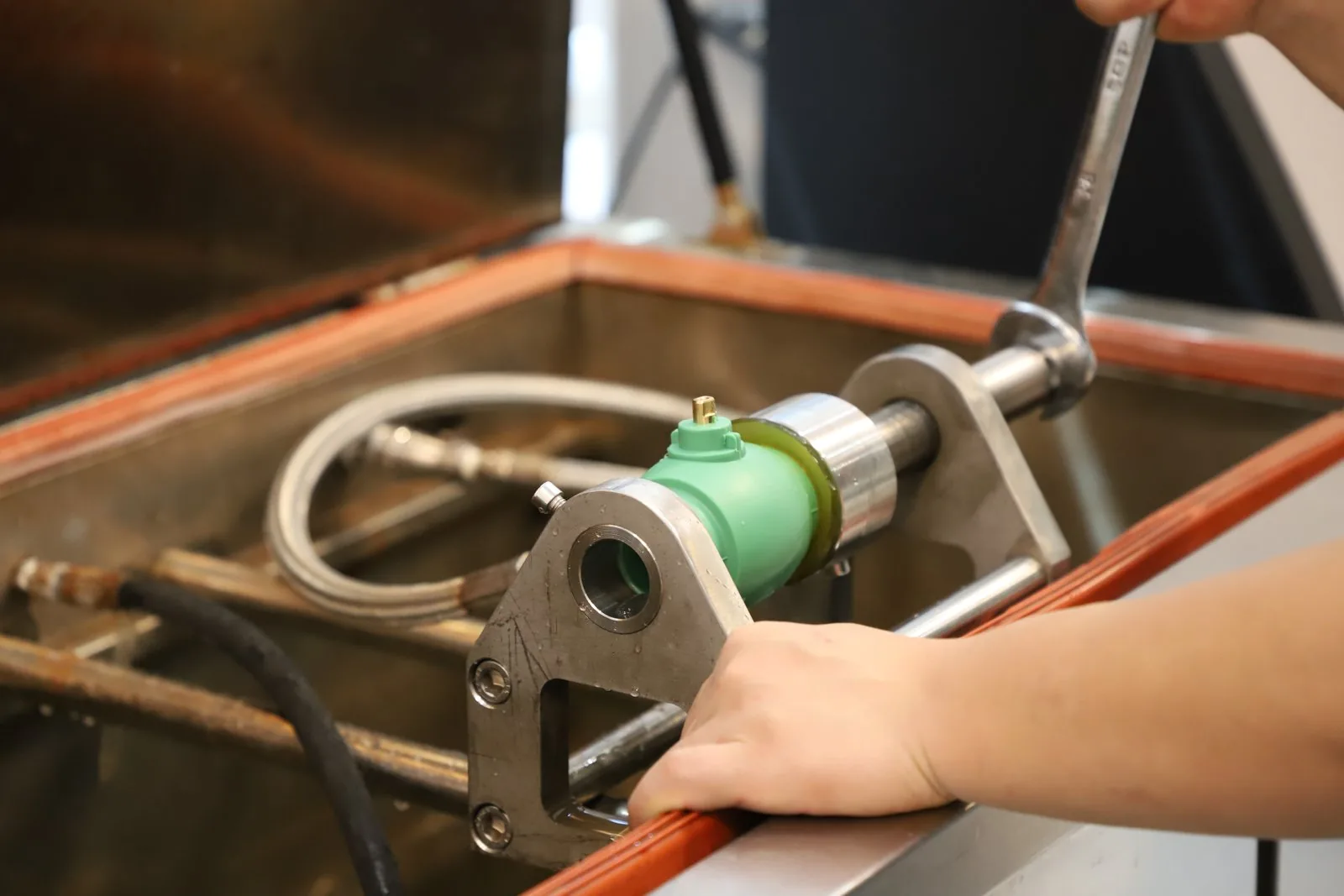
At system level, Part 5 tests the joints you will actually make on site. Socket-fusion and electrofusion joints get internal pressure tests — held for 1 000 h at a test temperature of (Tmax + 10) °C, capped at 95 °C — plus a thermal cycling test to ISO 19893. Mechanical joints face the full battery: bending under pressure (EN 713), pull-out under constant longitudinal force (EN 712), pressure cycling (ISO 19892) and leak-tightness under vacuum (EN 12294). The test pressure itself is derived from the class: pJ = pD × σP/σDP, scaling your declared design pressure up by the ratio of short-term to design stress. In other words, a “class 2/10 bar” claim commits the manufacturer to a specific, harder test regime than “class 1/6 bar” — the designation is a liability statement, not marketing.
One procurement warning: a test report on the pipe alone does not cover the system. Part 5 exists precisely because joints fail in ways straight pipe never does. When you audit a supplier, ask for pipe evidence (Part 2), fitting evidence (Part 3) and joint evidence (Part 5) — and if the paperwork arrives as a CE file, check what the declaration actually declares against, clause by clause; our buyer’s guide to Declarations of Performance and CE marking for pipe covers how to read those documents without being snowed.
What Hitze Checks Before PP-R Ships
Hitze is a German brand of engineered piping systems, founded in 1974, producing across a 120 000 m² base and exporting to 118+ countries. The PP-R line is built to DIN 8077/8078 and EN ISO 15874 in three constructions — ceramic-core, fiber-glass reinforced (PPR-FB-PPR) and aluminium composite (PPR-AL-PPR) — as a matched heat-fusion system of pipe plus fittings, in the common 16/20/25/32 mm sizes and up to OD 110/DN 90.
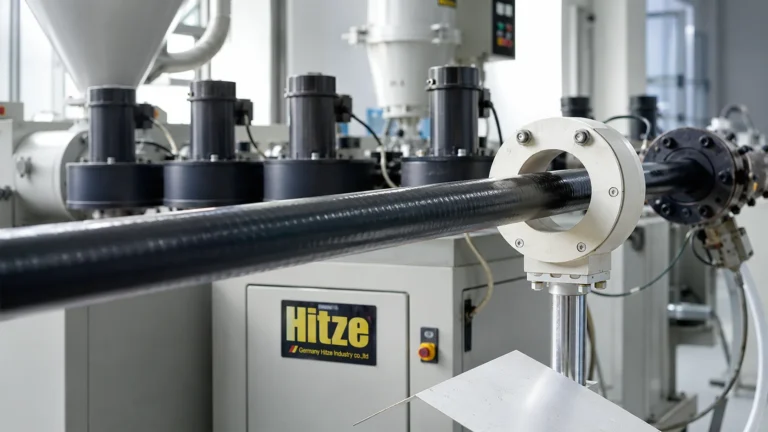
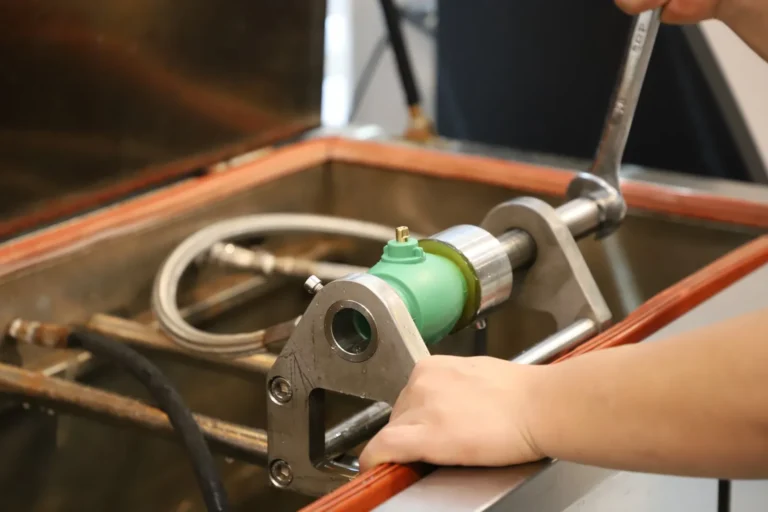
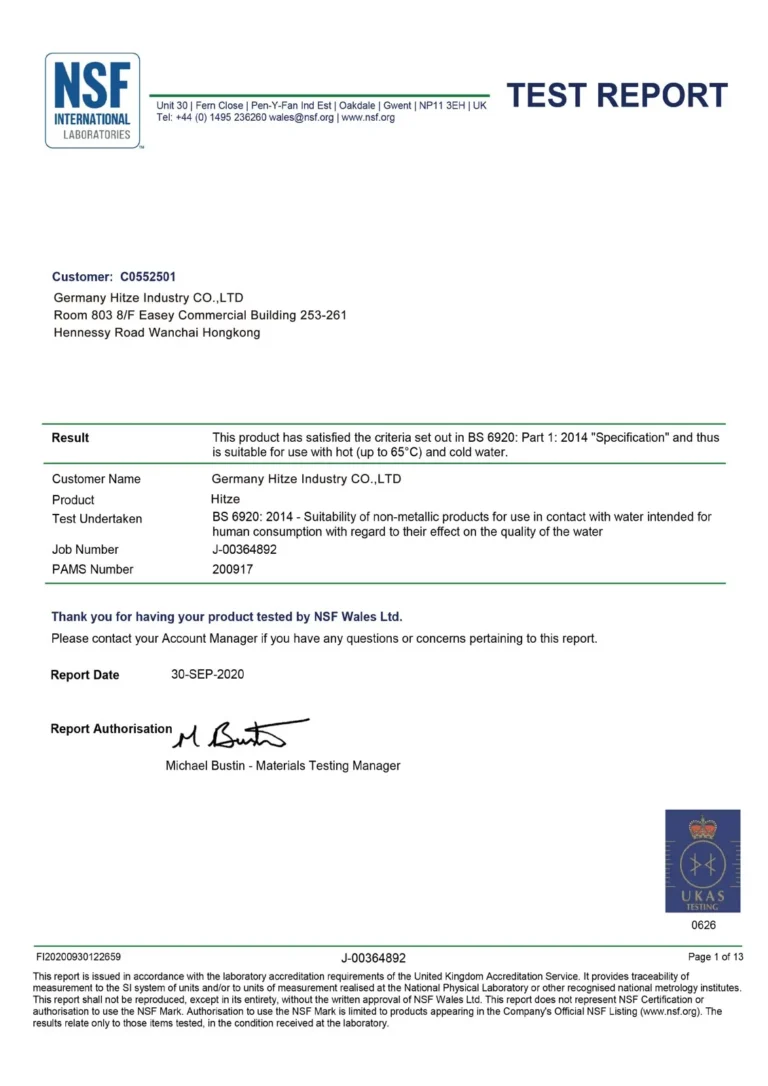
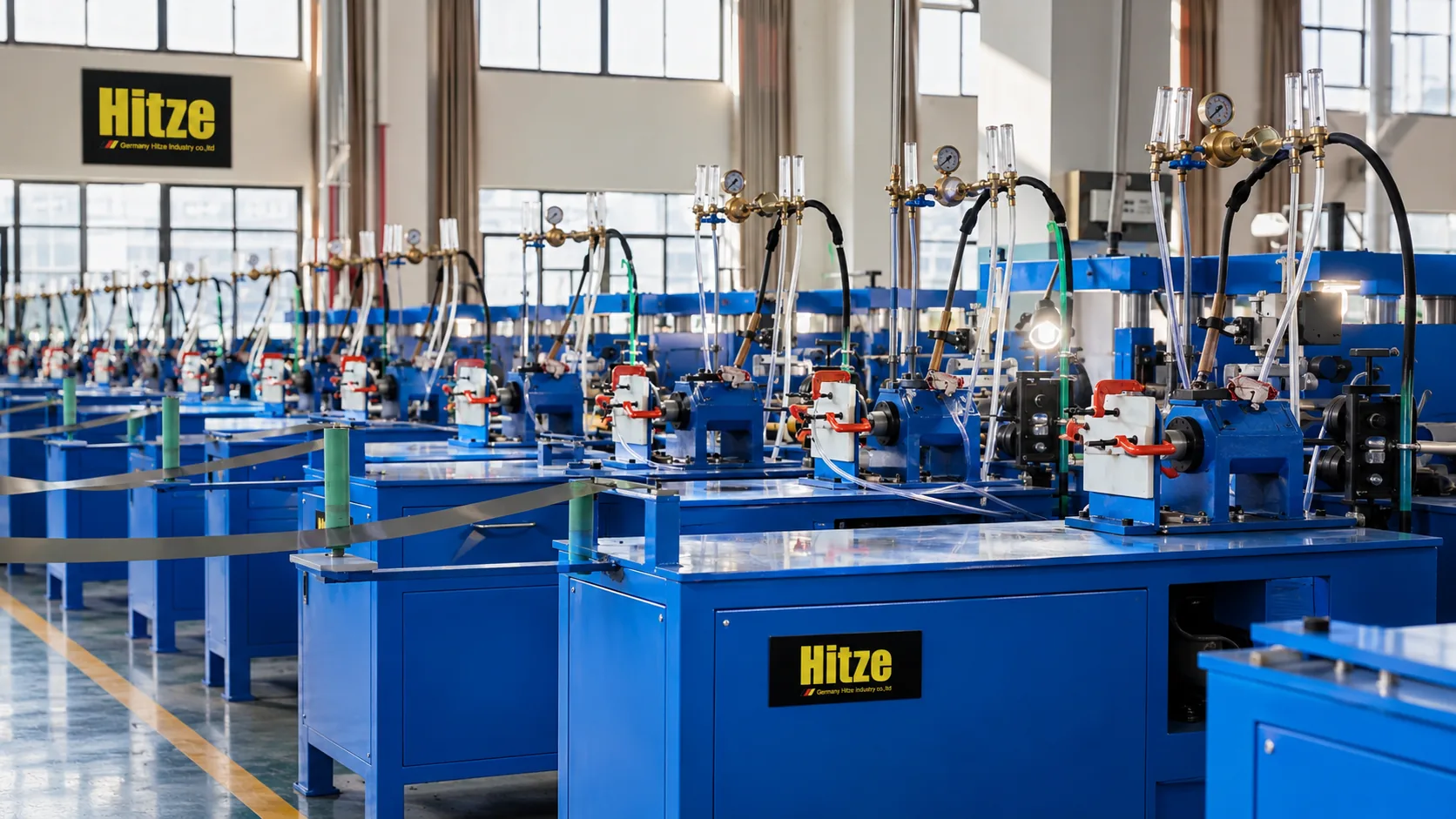
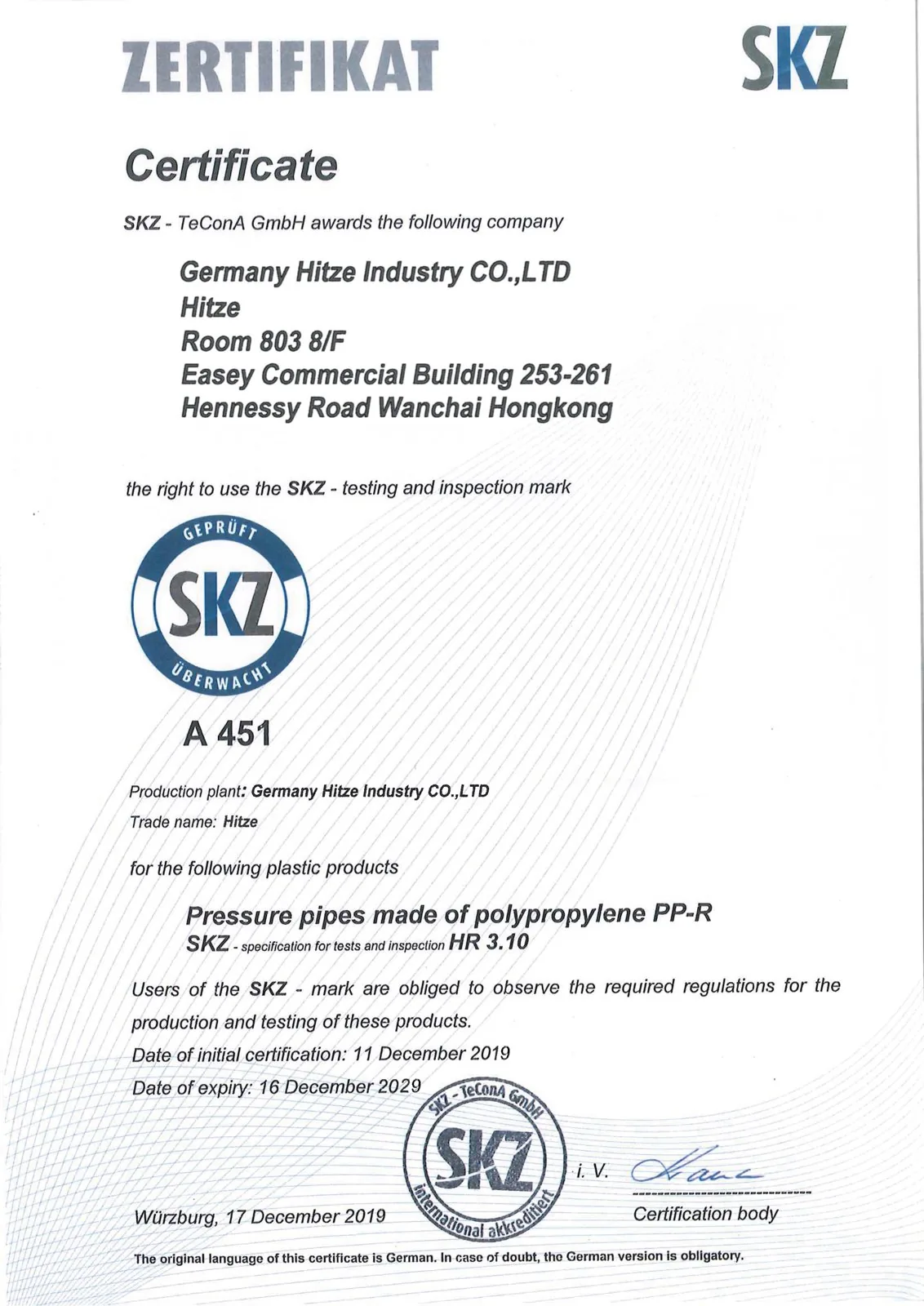
The factory-side discipline follows the standard’s own checklist. Incoming PP-R resin is verified before extrusion, because the class system collapses if the material under the print line is not the material behind the regression curve. Dimensions — outside diameter, wall thickness at multiple points, ovality — are checked against the S-series tables, since a wall that is nominally S 2,5 but runs thin at one point of the circumference no longer meets its Scalc. Pipes and fittings then go to in-house hydrostatic benches for pressure verification against the DIN and EN ISO requirements, and fused joint samples are pressure-tested as assemblies, which is Part 5 thinking applied on the production floor. Third-party evidence sits on top: SKZ in Germany has issued numbered test certificates for Hitze PP-R pressure pipes and PP-R fittings, DVGW has issued a type examination for Hitze PP-R drinking-water pipe, WRAS material approval covers potable contact in the UK, and an NSF laboratory BS 6920 report covers hot (≤65 °C) and cold drinking-water contact. Plant operations run under ISO 45001 occupational health and safety management. Certificate numbers are available on request.
One honest scope note: the class tables in this article are material physics, so they apply to any manufacturer’s PP-R. Where suppliers differ is in whether wall consistency, resin traceability and joint testing actually hold the numbers over 50 years — and in what happens around the standard PP-R envelope. If your project brief also weighs antibacterial linings or multilayer constructions against plain PP-R for hot and cold water, the trade-offs are mapped in our comparison of PP-R vs PPR-CU antibacterial vs multilayer pipe.
Who Should Specify to EN ISO 15874 — and How to Start
If you are a spec engineer, importer or distributor whose projects involve 60–70 °C hot water, hydronic heating or mixed-duty buildings, the class/pressure pair is the one line that should appear on every PP-R purchase order — and this article gives you the exact values to write. If you only ever move 20 °C cold-water pipe, the universal 10 bar/50-year condition covers you and the class columns matter less. For everyone in the first group: Hitze supplies the PP-R pipe and fittings system sample-first with no minimum order quantity, so you can put the print line, the wall gauge and a fused joint in front of your own inspector before committing a container — and the matched pipe-and-fitting system carries a 50-year warranty, which only means something because the class arithmetic above is engineered to the same horizon.
FAQ: EN ISO 15874 Classes of Service
Is EN ISO 15874 the same as ISO 15874?
Technically yes — the text was prepared jointly by CEN/TC 155 and ISO/TC 138/SC 2 under the Vienna Agreement, so the international and European editions are identical in substance. The EN edition of Part 1 additionally carries amendment A1:2022, which added an impact test.
What is the difference between class 1 and class 2?
Ten degrees for 49 years. Class 1 assumes hot water supply at a design temperature of 60 °C; class 2 assumes 70 °C. Both share the same 80 °C/1-year Tmax and 95 °C/100-hour malfunction budget, but the hotter profile cuts allowable wall series hard: at 8 bar, PP-R needs S ≤ 3,8 for class 1 but S ≤ 2,6 for class 2.
Does PN 20 mean the pipe handles 20 bar?
Only for 20 °C cold water under the legacy DIN 8077 convention, and even then PN is a nominal designation. Under the EN ISO 15874 class system the same S 2,5/SDR 6 wall is rated class 1/10 bar or class 2/8 bar. For 70 °C service at 10 bar you need the thicker S 2 wall — no “PN 20” pipe covers it.
Which class applies to underfloor heating?
Class 4, which covers underfloor heating and low-temperature radiators with a mixed profile of 20/40/60 °C over 47,5 years plus 2,5 years at 70 °C. High-temperature radiator circuits are class 5. ISO 10508 also defines a class 3, but the PP product standard does not carry it in its dimensioning tables.
Is Hitze PP-R made in Germany?
Hitze is a German brand — trademark registered at the DPMA in Munich — engineered in Germany and built to German DIN 8077/8078 plus EN ISO 15874, with SKZ test certificates and a DVGW type examination behind the PP-R range. Production runs at the group’s 120,000 m² base, and every batch ships against the same class and pressure verification described in this article.