Key takeaways for importers
- WRAS is a UK-only voluntary scheme that proves compliance with Regulation 4 of the Water Supply (Water Fittings) Regulations 1999 — it is not mandatory and not the only route (KUKreg4 and NSF REG4 are equally accepted).
- DVGW is a German product certification that you can only get after your plastic passes the UBA KTW-BWGL hygiene positive list. WRAS ≠ DVGW; a WRAS approval does not let you sell into Germany.
- KTW-BWGL is a positive-list system for plastics and organics — every additive must be pre-approved by the UBA. It became legally mandatory on 21 March 2021.
- The EU is unifying all of this. The Drinking Water Directive (EU) 2020/2184, Article 11, introduces European positive lists; nationally approved products get a transition window that can run to 31 December 2032.
- Approval is product- and material-specific. A certificate covers the tested pipe, not “everything the factory makes” — verify the certificate matches the exact SKU on your packing list.
The three marks solve three different problems — don’t treat them as interchangeable
If you are importing plumbing pipe into the UK and the EU, the single most expensive mistake is assuming one certificate travels across borders. It does not. WRAS, DVGW and KTW answer three separate questions, issued by three separate authorities, under three separate legal frameworks. A container that clears a UK merchant’s WRAS checklist can still be rejected by a German wholesaler who wants a DVGW number — and neither of those tells a French buyer anything about ACS. Buyers who learn this the hard way usually learn it after the goods have already shipped, when the fix is a re-test that takes months.
Here is the cleanest way to hold the three in your head. KTW-BWGL is the hygiene rulebook — the German Environment Agency (Umweltbundesamt, UBA) defines, on a positive list, exactly which polymers, stabilisers and additives are allowed to touch drinking water. DVGW is the product certificate that says a specific pipe both meets that hygiene rulebook and performs mechanically to the German standard. WRAS is the UK equivalent of the hygiene half — a scheme that tests non-metallic materials against British Standard BS 6920 and, for products, adds mechanical tests, to demonstrate compliance with UK water regulations. So KTW sits underneath DVGW as a prerequisite, while WRAS is a parallel UK-only route with its own standard. Confusing “we have WRAS” with “we can sell in Germany” is the error that stalls the most shipments.
WRAS for the UK: what it actually proves — and what it doesn’t
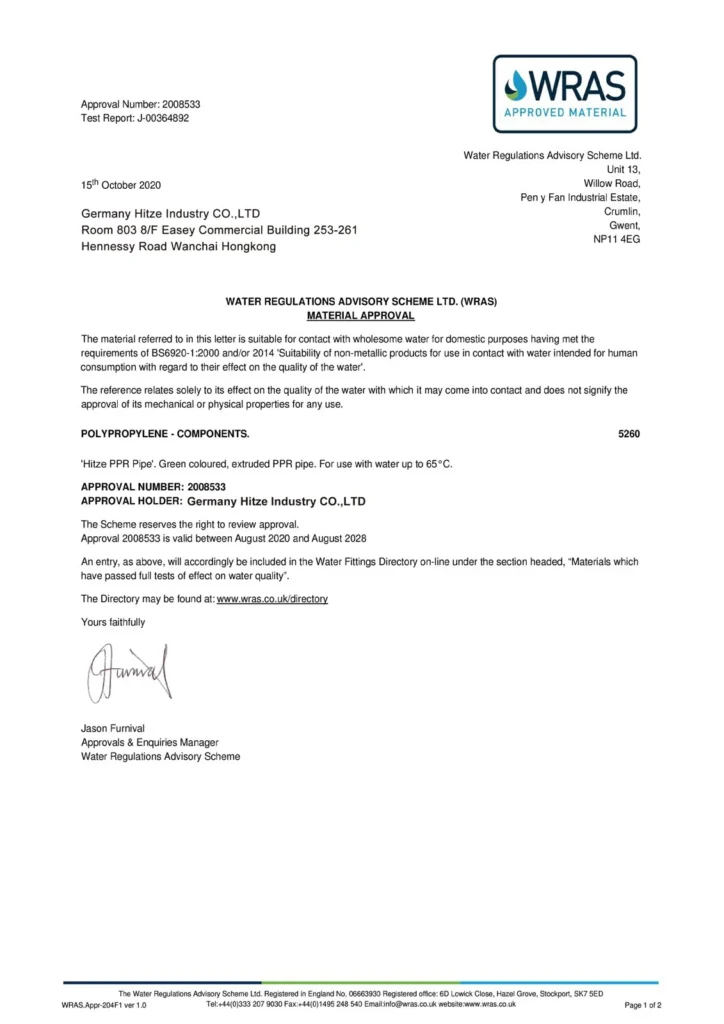
WRAS stands for the Water Regulations Approval Scheme. The critical point most suppliers gloss over: WRAS approval is voluntary. The legal requirement in England, Wales, Scotland and Northern Ireland is that fittings comply with Regulation 4 of the Water Supply (Water Fittings) Regulations 1999 (and the equivalent Scottish Byelaws). Regulation 4 accepts several forms of evidence — an appropriate British or European standard, a specification approved by the regulator, or a recognised third-party approval. WRAS is simply the best-known of those approvals; the KUKreg4 mark (issued by KIWA) and NSF’s REG4 mark are treated as equivalent evidence. So if a supplier tells you “you legally must have WRAS,” they are overstating it — but if your UK merchant customers ask for WRAS on the shelf, that commercial reality is real regardless of the legal nuance.
The testing behind WRAS is where importers get caught. Material approval is based on BS 6920, which checks that a non-metallic material does not spoil the taste or odour of water, does not change its appearance, does not encourage the growth of microorganisms, and does not leach substances or metals above the allowed limits. That is a material test. A product approval layers mechanical testing on top — pressure, leak-tightness, and function. Read your certificate carefully: a material approval on a PP-R compound is not the same as a product approval on the finished fitting, and a merchant’s technical buyer will know the difference.
The second trap is scope. WRAS approval is product- and material-specific, never a blanket approval of a factory’s whole catalogue. A certificate names the exact material or product, its formulation, and often the size range. If your supplier waves a single WRAS certificate and implies it covers thirty SKUs, ask which SKU is on it. The public WRAS directory lets you look up any approval number and see precisely what it covers — use it before you pay, not after the goods land.
DVGW and KTW for Germany: the hygiene gate you can’t skip
Germany runs the strictest potable-water regime in Europe, and it is built as two layers. The bottom layer is KTW-BWGL — the UBA’s “Assessment criteria for plastics and other organic materials in contact with drinking water.” It is a positive list: every polymer, additive, stabiliser and colourant in your pipe must appear on a UBA-approved list, which means the factory needs full formulation transparency from its raw-material suppliers. Crucially, KTW-BWGL applies only to organic materials — plastics, elastomers, seals, lubricants. Metals, ceramics and cement fall under separate UBA criteria. The current KTW-BWGL became legally mandatory on 21 March 2021, replacing the older KTW Guideline, Coating Guideline and Lubricant Guideline.
The top layer is DVGW certification. DVGW (the German Technical and Scientific Association for Gas and Water) — with certificates typically issued through DIN CERTCO — confirms that a specific pipe or fitting both satisfies the KTW-BWGL hygiene requirement and meets the mechanical German standard: DIN 8077/8078 and DIN EN ISO 15874 for PP-R systems, cross-referenced to DVGW worksheets such as W 534 and W 544. In other words, you cannot get DVGW without first clearing KTW-BWGL. That is why a WRAS certificate — which is built on BS 6920, a completely different standard — does nothing for you in Germany. The two systems don’t recognise each other.
Watch the maintenance obligation, because it changes the risk math. A DVGW/DIN CERTCO product certificate is typically valid for five years, but it is not “set and forget” — it comes with recurring surveillance, generally half-yearly verification of both the product and the factory’s production control. That is a feature, not a nuisance: it means a genuine DVGW mark is backed by an audit trail the German importer can lean on. If a supplier shows you a DVGW certificate but can’t produce the surveillance history, treat the mark as suspect.
Side-by-side: which mark unlocks which market
The table below is the one-screen version of everything above. Print it, and check every certificate a supplier sends against the “what it does NOT do” column — that column is where the money leaks.
| Mark | Market | Legal basis | Test standard | What it does NOT do |
|---|---|---|---|---|
| WRAS | United Kingdom | Water Supply (Water Fittings) Regulations 1999, Reg 4 (voluntary route) | BS 6920 (material) + mechanical tests (product) | Not accepted in Germany/EU; not mandatory (KUKreg4 / NSF REG4 equal it) |
| KTW-BWGL | Germany (hygiene layer) | UBA evaluation criteria (mandatory since 21 Mar 2021) | UBA positive list for plastics/organics | Not a full product certificate on its own; covers organics only, not metals |
| DVGW | Germany (product mark) | German water/DVGW rules; requires KTW-BWGL first | DIN 8077/8078, DIN EN ISO 15874, DVGW W 534/W 544 | Not a UK approval; needs ongoing surveillance to stay valid |
| EU DWD positive list | EU-wide (future) | Directive (EU) 2020/2184, Art. 11 | Harmonised European positive lists | Does not apply in Great Britain (post-Brexit); phased in, transition to 2032 |
One nuance the table can’t hold: WRAS and DVGW are not “better or worse” than each other — they are jurisdictional. A pipe engineered to German DIN standards and DVGW-certified is not automatically sellable in the UK, and vice versa. If your sales map covers both the UK and Germany, you need both files, not one. This is exactly the multi-market documentation trap our certifications & market compliance hub is built to walk importers through, certificate by certificate.
The EU is rewriting the map — the 2026–2032 transition you must plan for now
Here is the position-taking part. The fragmented national system — DVGW in Germany, WRAS in the UK, ACS in France, and so on — is being replaced. The revised EU Drinking Water Directive, Directive (EU) 2020/2184 (adopted 16 December 2020), introduces in Article 11 a set of harmonised European positive lists for materials in contact with drinking water. Once those lists are in force, a single EU framework replaces the patchwork of national hygiene approvals across member states.
The timeline matters for anyone planning a two-to-three-year sourcing program. The European positive lists phase in from around the end of 2026 into 2027. Products that hold a valid national approval (such as DVGW or ACS) as of the cut-off can continue to be sold under a transition arrangement that can extend to 31 December 2032, giving already-assessed materials a multi-year runway. Practically, that means a DVGW certificate you secure today is not wasted work — it carries value through the transition — but any new formulation you introduce close to the deadline should be planned against the EU positive list from the start, not the old national one.
And the Brexit asterisk: the EU positive lists do not automatically apply in Great Britain. The UK continues under its own Water Supply (Water Fittings) Regulations 1999 regime — WRAS, KUKreg4, NSF REG4 — decoupled from the EU system. So the harmonisation that simplifies life for a Germany-plus-France importer does not collapse the UK requirement. If Britain is on your map, keep the UK file separate and current no matter what the EU does.
What Hitze checks before a certificate goes on your packing list
Hitze is a German brand of engineered piping systems, founded in 1974, running a 120,000 m² production base with 1,000+ employees and exporting to 118+ countries. On the compliance question specifically, here is how the paperwork is built rather than merely claimed — because for an importer, the process behind the mark is what survives a customs officer or a technical buyer’s audit.
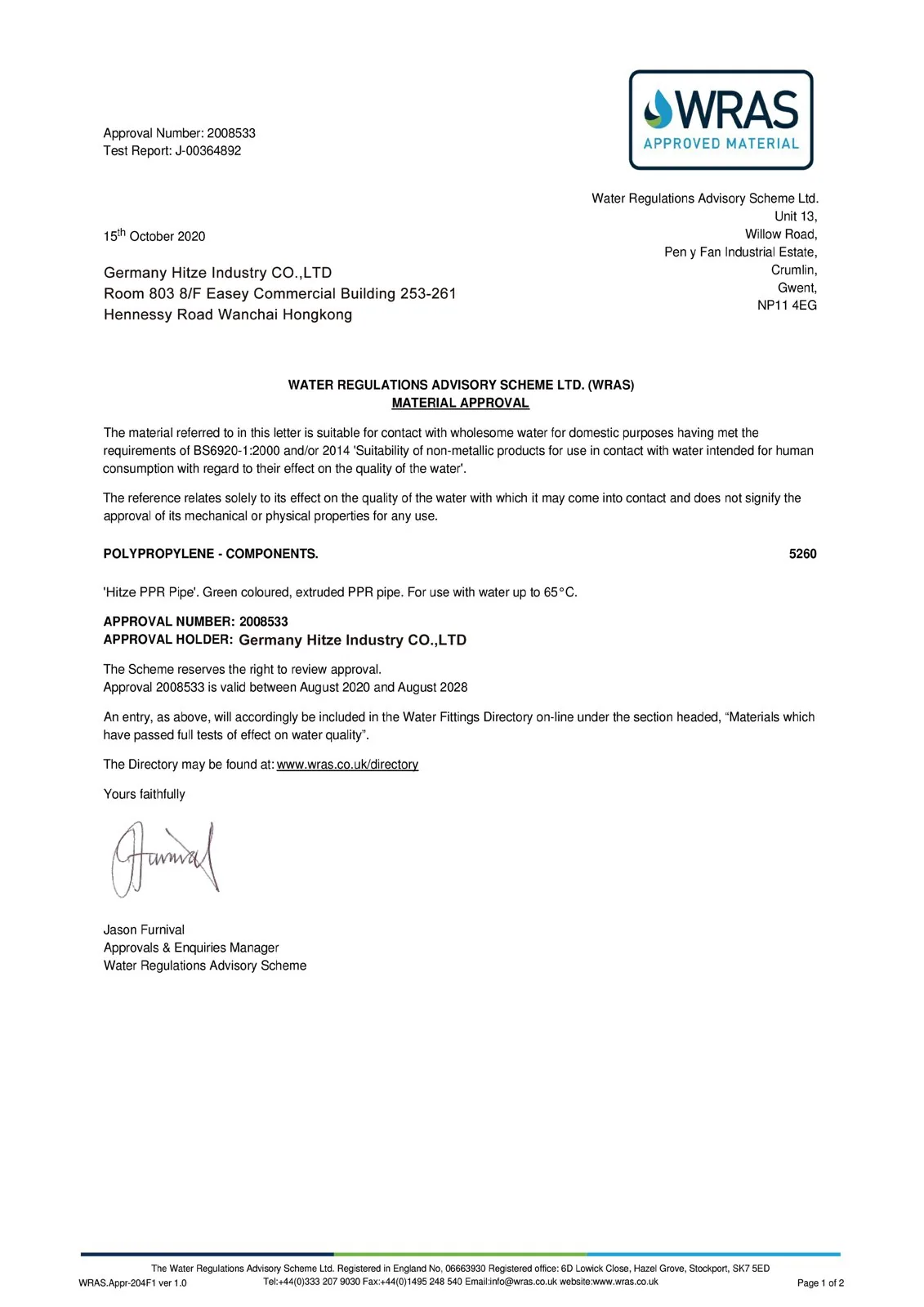
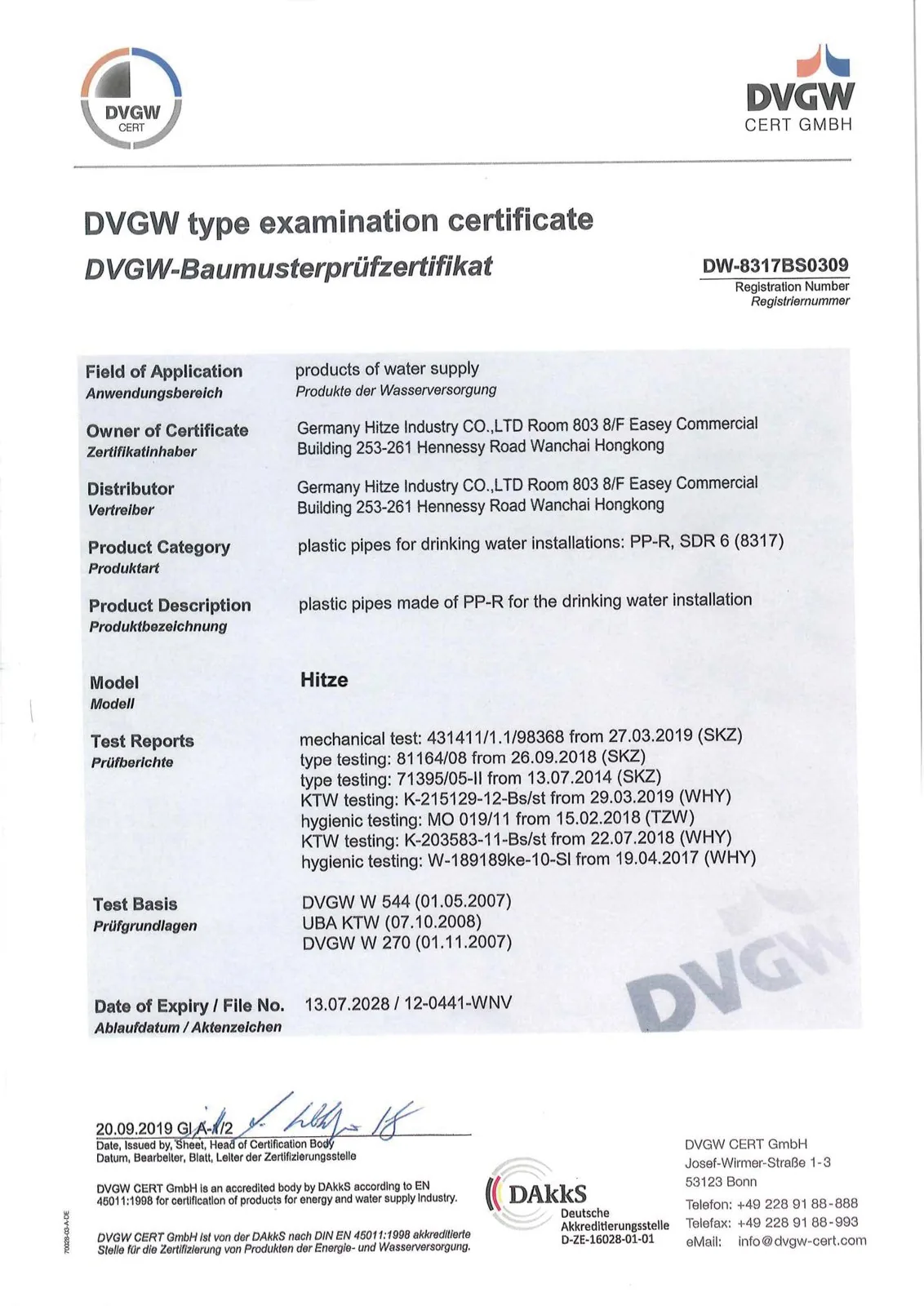
- Hygiene first. Potable grades are engineered to the hygiene layer each market demands — WRAS material approval (BS 6920) for the UK, and DVGW type examination underpinned by the German KTW-BWGL/DIN framework for Germany. Both certificates exist; certificate numbers are provided on request against the specific SKU you’re quoting.
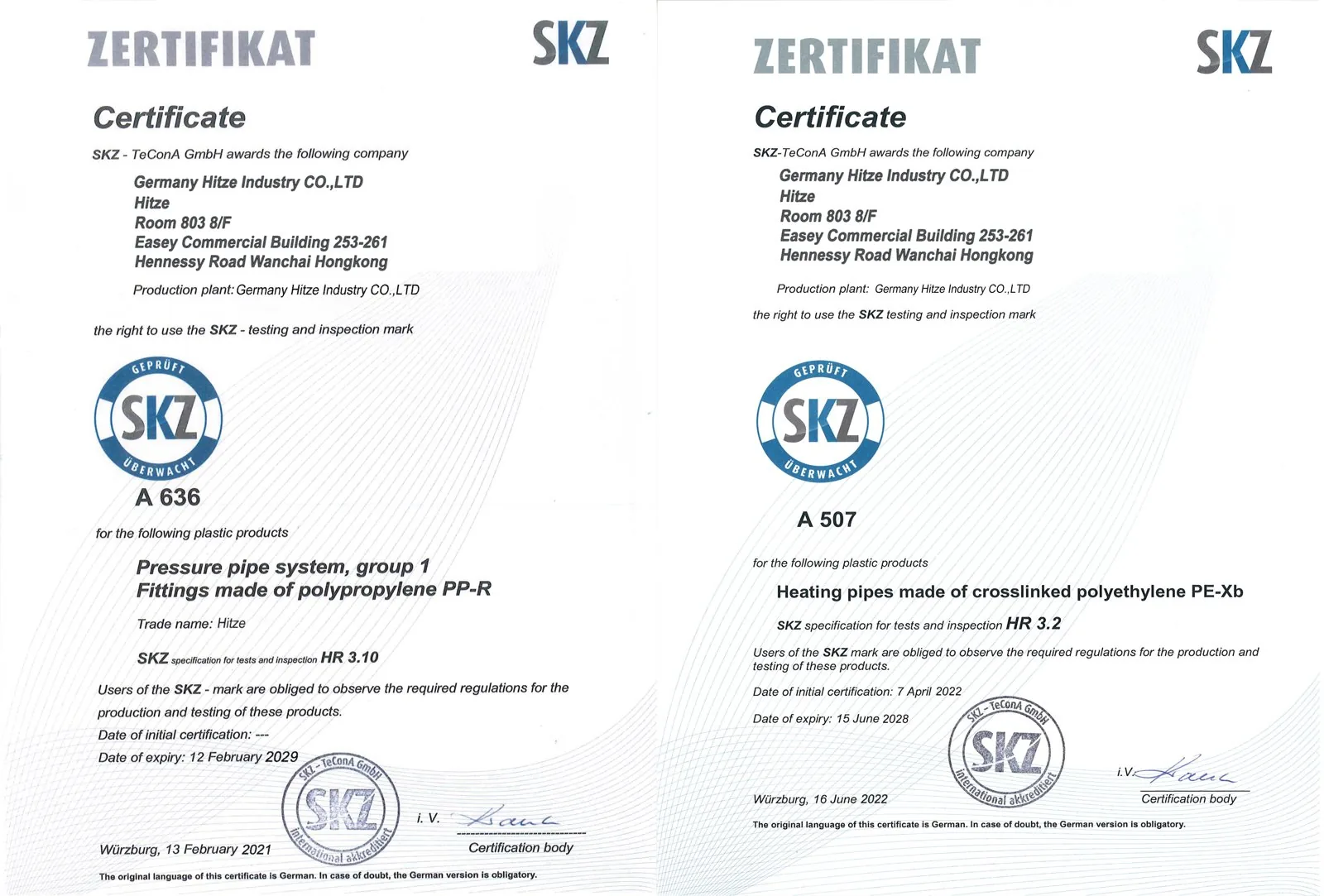
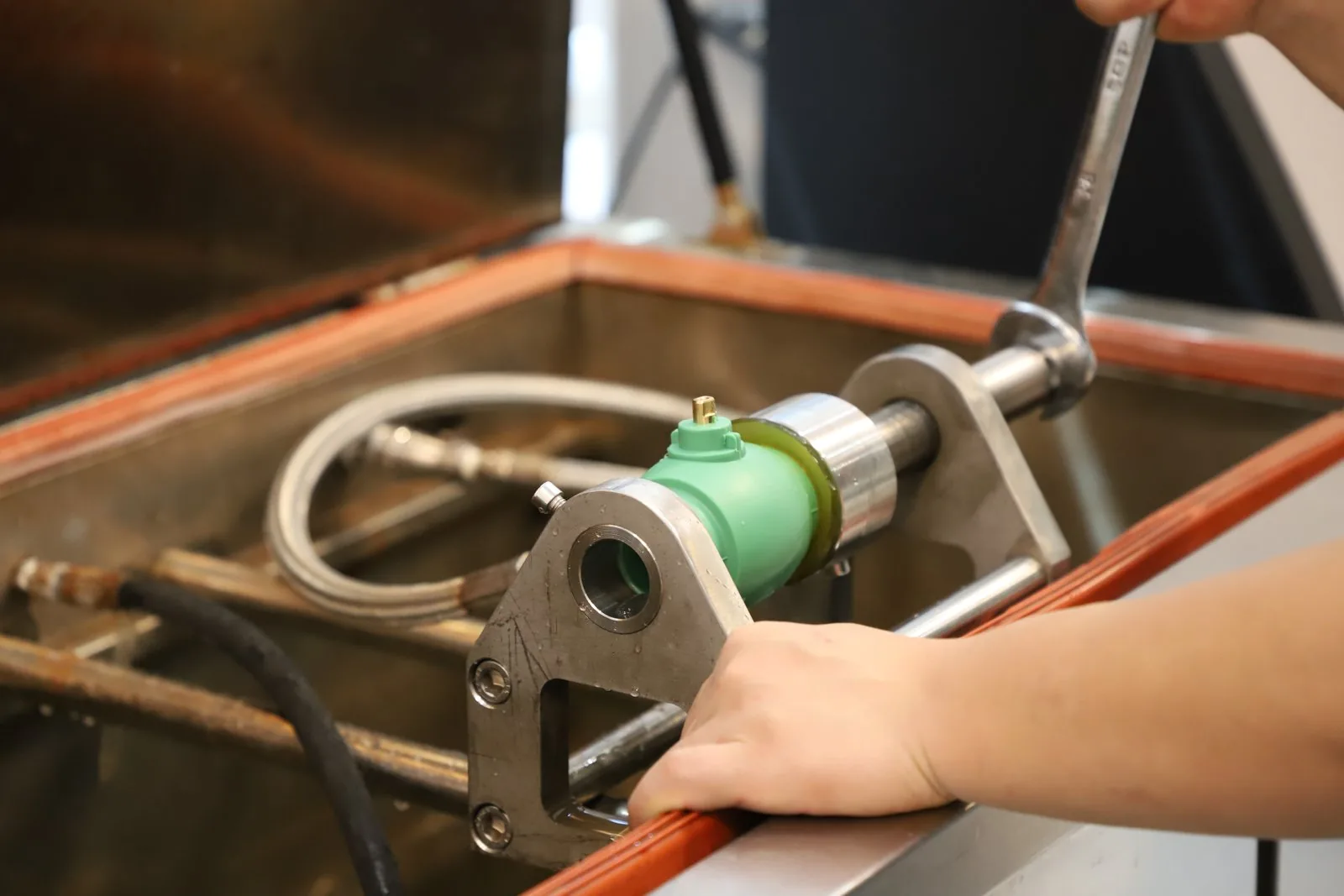
- German testing spine. PP-R pressure pipe and fittings and PE-Xb heating pipe are tested by SKZ (Süddeutsches Kunststoff-Zentrum, Germany), and there is an independent NSF-laboratory BS 6920 potable-water test report covering hot (up to 65°C) and cold contact. That is the evidence base a DVGW or WRAS file rests on.
- Standard-matched build. Pipe is manufactured to DIN 8077/8078 and EN ISO 15874 for PP-R, with DIN 4726 oxygen-barrier construction on heating grades — so the mechanical half of any product approval is not an afterthought bolted onto a hygiene pass.
- SKU-level traceability. Every certificate is matched to the exact material and product it covers, so what lands in your container is what the certificate names — the scope trap described above, closed at source.
A worked example: one importer, two markets, one avoidable delay
Picture a trading company sourcing PP-R hot-and-cold pipe for both a UK builders’ merchant chain and a German plumbing wholesaler. The buyer secures a WRAS material approval, sees it clears the UK merchant’s requirement, and assumes the German account is covered too. The first UK container lands and sells through fine. The German wholesaler’s technical buyer then asks for the DVGW number and the KTW-BWGL declaration — and there is none, because the WRAS file was built on BS 6920, a UK standard the German system does not accept. The German order is frozen while a DVGW type examination is arranged, and a type examination plus its supporting KTW work is a matter of months, not days. The importer eats storage, a missed season, and a shaken relationship with the German account.
The avoidable version: the same importer maps both markets before the first PO, confirms the factory holds both a WRAS approval and a DVGW type examination on the exact SKU, and checks the DVGW surveillance history is current. Same product, same factory — but the certificates were verified against the sales map up front. The difference between the two stories is one hour of certificate-checking against a container’s worth of demurrage. That hour is the entire point of this article.
Best for / not for: is a German-brand, dual-certified pipe the right sourcing call?
This is a strong fit if you are:
- An importer or trading company selling into both the UK and continental Europe, who needs one supplier that can produce WRAS and DVGW files against the same SKUs.
- A distributor whose merchant customers demand a named, verifiable certificate on the shelf and won’t accept “trust us, it’s compliant.”
- A private-label brand that needs certification documentation to hold up under its own name and under third-party audit.
It’s probably not the right fit if you are:
- Selling into a single market with no potable-water contact (e.g. purely industrial or irrigation lines), where hygiene certification is not the gating spec — a simpler PE100 pressure line may suit better.
- Buying a one-off, tiny spot lot where you can’t justify verifying certificate scope — though that is exactly the scenario where uncertified goods get stuck at customs.
Selling potable pipe into the UK and the EU?
If your sales map crosses the Channel, you need a supplier that can hand you the right certificate for each jurisdiction — WRAS for Britain, DVGW backed by KTW-BWGL for Germany — matched to the exact SKU on your order. Hitze is a German brand engineered to German DIN standards, with WRAS and DVGW files available on request. Tell us your target markets and SKUs and we’ll map the certificate pack you actually need. This is aimed at importers, distributors and private-label brands shipping by the pallet or container, not at individual homeowners.
Want to see the underlying products these certificates attach to? Our PP-R pipe & fittings range is the system most commonly specified for DVGW-market projects, while the PEX pipe line covers heating grades built to the DIN 4726 oxygen barrier.
Frequently asked questions
Is WRAS approval a legal requirement to sell plumbing pipe in the UK?
No. The legal requirement is compliance with Regulation 4 of the Water Supply (Water Fittings) Regulations 1999. WRAS is a voluntary scheme and one recognised way to demonstrate that compliance; KIWA’s KUKreg4 and NSF’s REG4 marks are treated as equivalent. That said, many UK merchants ask for WRAS commercially, so in practice it is often what your customers want on the shelf even though the law does not name it.
Does a WRAS approval let me sell the same pipe in Germany?
No. WRAS is built on the UK standard BS 6920, which the German system does not accept for its market. For Germany you need a DVGW certificate, and to obtain that the plastic must first satisfy the UBA’s KTW-BWGL positive list. The two regimes are independent — plan for both files if you sell into both markets.
What is the difference between KTW-BWGL and DVGW?
KTW-BWGL is the UBA’s hygiene rulebook — a positive list of substances permitted in plastics and organic materials that contact drinking water. DVGW is the product certificate that confirms a specific pipe meets that hygiene rule and the mechanical German standard (DIN 8077/8078, DIN EN ISO 15874). KTW is a prerequisite; DVGW is the finished mark that sits on top of it.
Will the EU Drinking Water Directive replace DVGW and WRAS?
For the EU, largely yes over time. Directive (EU) 2020/2184, Article 11, introduces harmonised European positive lists that replace the national hygiene approvals across member states, phasing in from around end-2026 with a transition for existing nationally-approved products that can run to 31 December 2032. The UK, post-Brexit, is not covered by these EU positive lists and keeps its own WRAS/Reg 4 regime.
How do I verify a WRAS or DVGW certificate is genuine and covers my product?
For WRAS, look up the approval number in the public WRAS Approvals directory and confirm it names your exact material or product — approvals are product-specific, not factory-wide. For DVGW, ask for the certificate plus its surveillance history, since a genuine mark carries recurring (typically half-yearly) product and factory-control verification. If a supplier can’t match the certificate to the specific SKU on your packing list, treat it as unverified.
Is Hitze pipe made in Germany?
Hitze is a German brand of piping systems, engineered in Germany and built to German DIN standards, and DVGW-certified for the German market. Founded in 1974, it exports to 118+ countries. For potable-water compliance it holds a WRAS material approval for the UK and a DVGW type examination for Germany, with certificate numbers available on request against your specific SKUs.