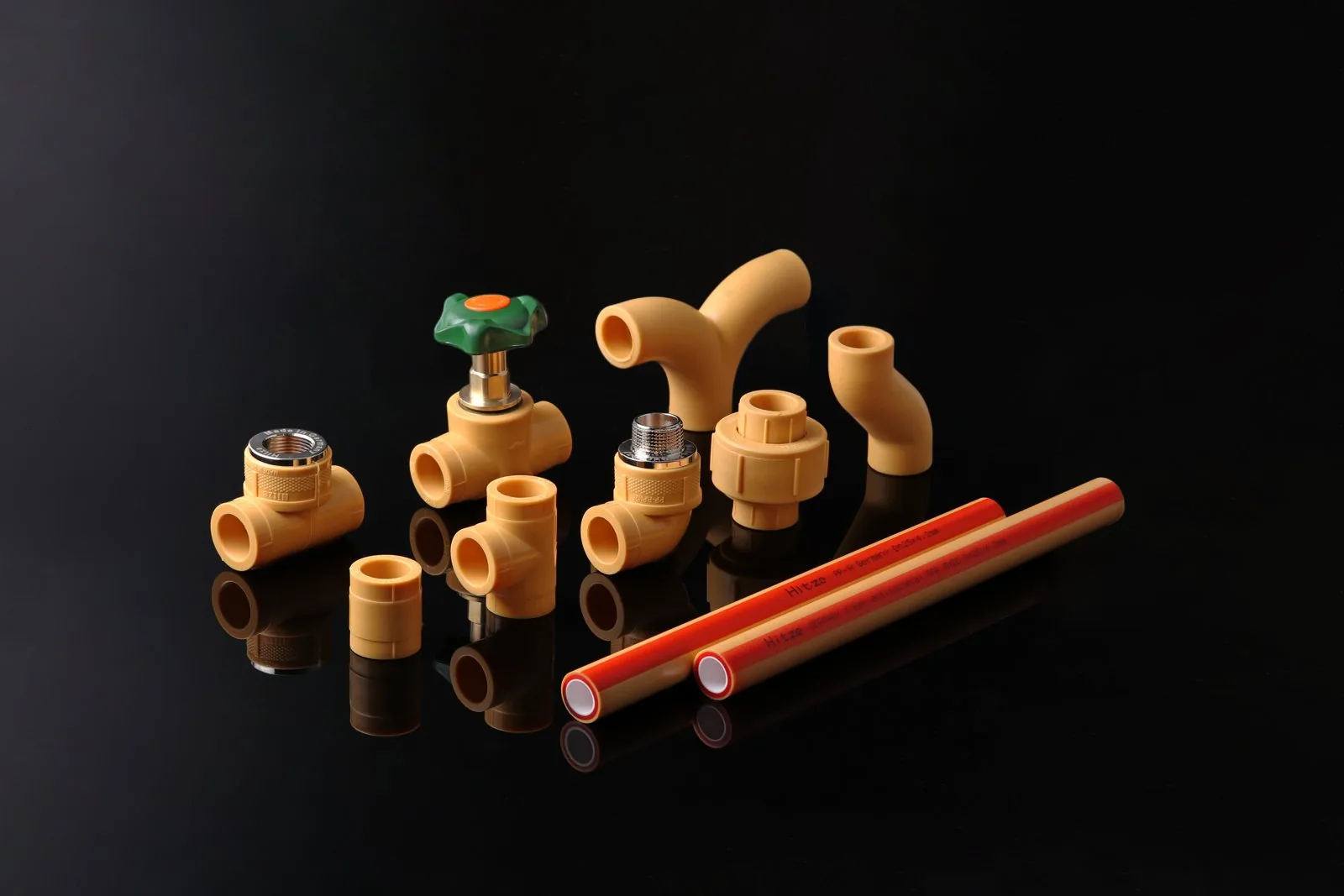
A PP-R range is eight fitting families — socket, elbow, tee, reducer, end cap, union, brass-insert fitting and saddle — and every other catalogue word is a size, an angle or a thread variant of one of them. There is no standard for the names themselves, which is why a quotation lists “reducing tee 50 x 50 x 25” while the drawing calls the same junction “50/25/50”. What is standardised is the geometry: EN ISO 15874 and DIN 16962 fix the dimensions, the marking and the part families. Read the part instead of the label and the catalogue name stops mattering.

Key Takeaways
- Reducing-tee digit order is not standard. EuroAqua codes a 110 mm run with a 90 mm branch as “110/90/110” (branch in the middle); Pestan codes the same class of part as “50 x 50 x 25” (branch last). Always confirm which digit is the branch.
- One part, three names: a “PPR MI SOCKET” at ERA is a “Male Thread Coupler” at EuroAqua and an “ADAPTOR METAL PLASTIC MALE” at Pestan. Match on geometry and thread size, never on the catalogue word.
- Socket depth is a published per-size figure, not a ratio — 16 mm at 20 mm OD, 24 mm at 50 mm, 44 mm at 160 mm in the EuroAqua tables — and it is identical across sockets and tees at the same size.
- ISO 15874-3 requires only six items on a fitting body: maker’s mark, dn, material, production month and year, standard, and application class with working pressure.
Why PPR fitting names do not match across catalogues
EN ISO 15874-3 governs what a fitting must do and how it must be marked; DIN 16962 governs dimensions. Neither publishes a naming dictionary, so every manufacturer writes its own catalogue language. What EuroAqua calls a “Socket” is ERA’s “PPR EQUAL SOCKET”; the four-outlet fitting is a “Four Way Tee/Cross” at one and a “PPR CROSS BEND” at the other. Neither is wrong, which is why a keyword search across two PDFs returns a false negative so often.
The standards do carry a taxonomy, just not where people look for it. DIN 16962 splits the fittings into parts by family, so the part number classifies the geometry: DIN 16962-8 covers sockets and caps, Part 6 socket-weld elbows, Part 7 tees, Part 9 reducers and nipples, Part 13 threaded pipe joints, and Part 4 adaptors and flanges. Cite the part number and the family is unambiguous even when the trade name is not.
The eight fitting families and what each one is called
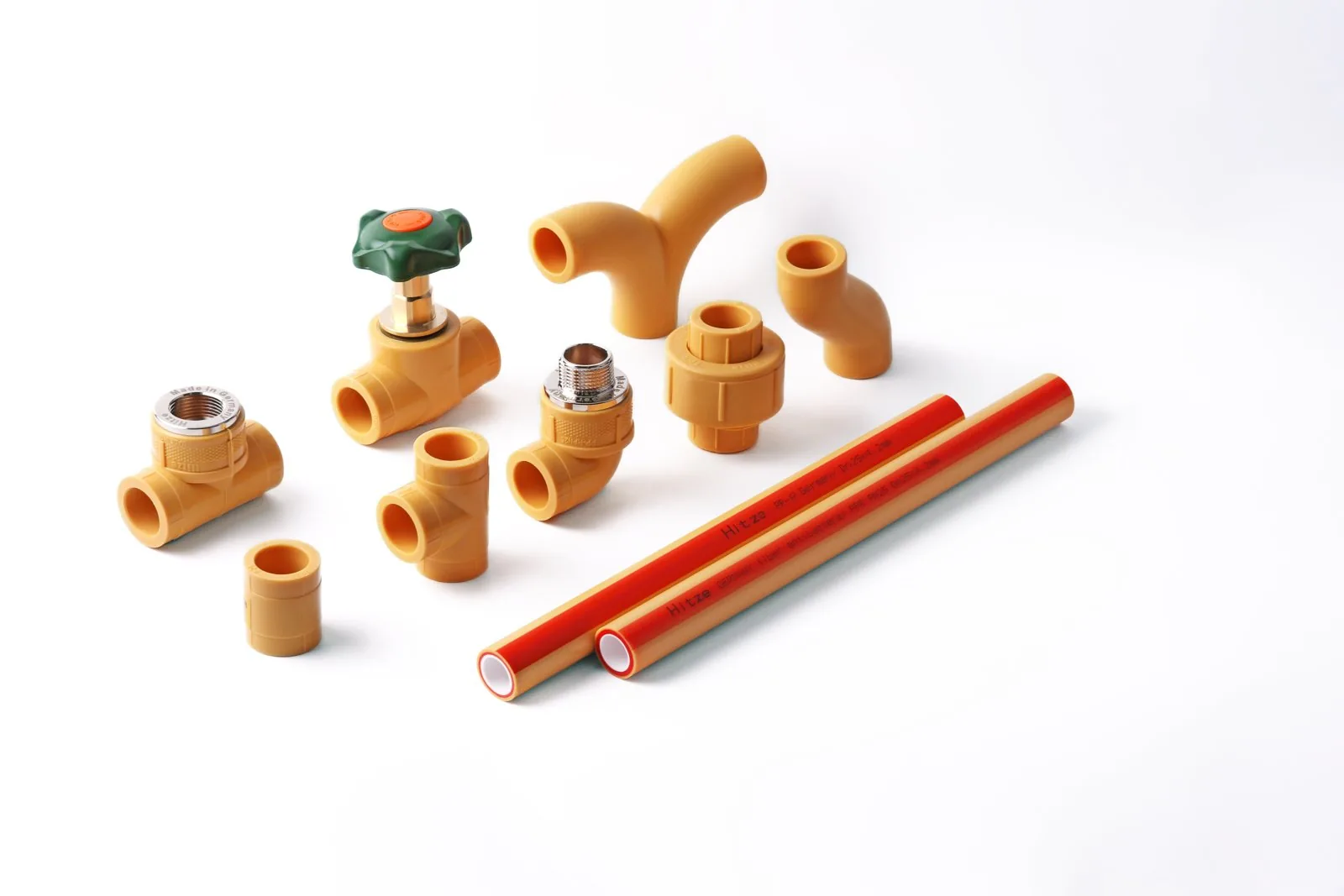
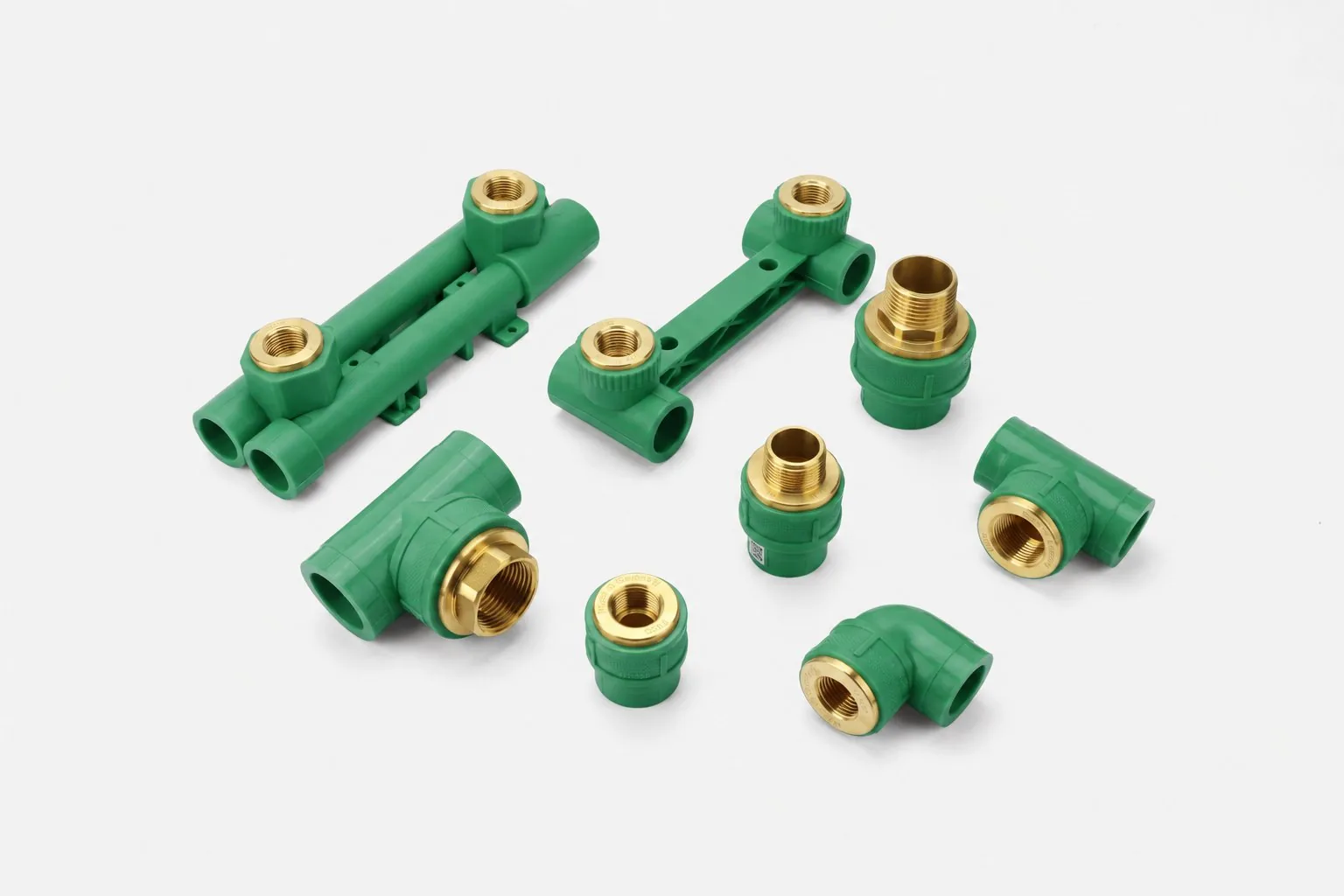
A socket joins two pipes of the same bore in a straight line, an elbow turns it at 90 or 45 degrees, a tee takes a branch off the run, a reducer steps between two bores, and an end cap closes a line. The other three catch people out: brass-insert fittings carry a metal thread so the plastic system can meet a valve or a fixture, saddles clamp onto an existing run to add a branch without cutting it, and the union is a demountable joint.
Because a heat-fused joint melts pipe and fitting into one wall and cannot be undone — socket heat fusion is the only jointing method across our own PP-R range, with no O-ring inside a correctly fused joint — the union is the only planned service point in the line. Under-ordering unions is the most common way a fitting list looks complete and installs badly.
| Family | Also catalogued as | Identify it by | DIN 16962 part |
|---|---|---|---|
| Socket | Coupling, coupler, equal socket | Two equal sockets, straight through | Part 8 |
| Elbow | Bend, knee, 90° / 45° elbow | Two sockets at a fixed angle | Part 6 |
| Tee | Equal tee, reducing tee, reducer tee | Three sockets, one branch off the run | Part 7 |
| Reducer | Reducing socket, reducing bush | Two sockets, unequal bores | Part 9 |
| End cap | Plug, pipe plug, cap | One socket, closed end | Part 8 |
| Union | Plastic union, metal union, double-union valve | A nut in the middle; it unscrews | Part 13 |
| Brass-insert fitting | MI / FI socket, male / female thread coupler, metal-plastic adaptor | Visible brass thread in a plastic body | Part 4 |
| Saddle | Weld saddle, weld-in saddle, saddle transition piece | Curved face that sits on a pipe wall | — |
Two rows need a footnote. DIN 16962-13 covers unions as four coupling types — with gasket (V1), internal thread and gasket (V1I), external thread and gasket (V1A), and O-ring (V2) — so “union” alone does not say whether the seal is a flat gasket or an O-ring, and the two are not interchangeable in service. The em-dash on the saddle row is not an omission: the series publishes no dimensional part for branch saddles, so they follow each manufacturer’s own geometry, and a saddle is the one family where cross-catalogue substitution fails on fit rather than vocabulary.
Reading a size designation without guessing
PP-R fittings are designated by the pipe’s outside diameter in millimetres, never by the bore. A “25 mm” fitting accepts pipe with a 25 mm OD regardless of wall thickness, which is why one fitting size serves several pressure classes and why quoting a bore produces confusion instead of a price. An inch size printed alongside, as Pestan does with “¾” – 25 mm”, is a nominal trade size, not a measurement of the part. Dimension letters vary too — Pestan calls the welding depth L1, EuroAqua calls it SD1 — but every credible catalogue publishes a legend.
Socket depth is the number that settles arguments
Socket depth is the distance the pipe end buries into the fitting, and it is a published per-size figure rather than a proportion of diameter. It is identical across sockets and equal tees at the same size, which makes it a size-identification key: measure the socket depth of an unlabelled fitting and you have narrowed its size to one row.
| Pipe OD (mm) | Socket depth (mm) |
|---|---|
| 20 | 16 |
| 25 | 17 |
| 32 | 19 |
| 40 | 21 |
| 50 | 24 |
| 63 | 28 |
| 75 | 32 |
| 90 | 34 |
| 110 | 37 |
| 125 | 40 |
| 160 | 44 |
Figures are the EuroAqua catalogue’s published values, and socket depth holds broadly across compliant ranges. Note that the last two rows sit outside our own range, which stops at OD 110 mm (DN15–90). The depth also sets the insertion mark and therefore the heated length, which our guide to PPR socket fusion temperature and depth works through; the PPR size, SDR and PN reference carries the wall-thickness tables.
The reducing-tee trap: which digit is the branch
This is the most expensive naming ambiguity in a PP-R range. EuroAqua puts the branch in the middle: code EC130 is “110/90/110 mm”, with D1, the run bore, at 110 mm and S1, the branch bore, at 90 mm. Pestan puts the branch last — code 10002172 is “1½” x 1½” x ¾” – 50 x 50 x 25 mm”, where the reduced branch is always the third figure.
A 50 mm run with a 25 mm branch is therefore 50/25/50 in one convention and 50 x 50 x 25 in the other. Send the second form to a supplier using the first and they read a 50 mm branch reducing to 25 — digits plausible enough that nobody queries it, until the fitter finds the branch will not take a 25 mm pipe.
Brass-insert fittings: male, female, and the thread size
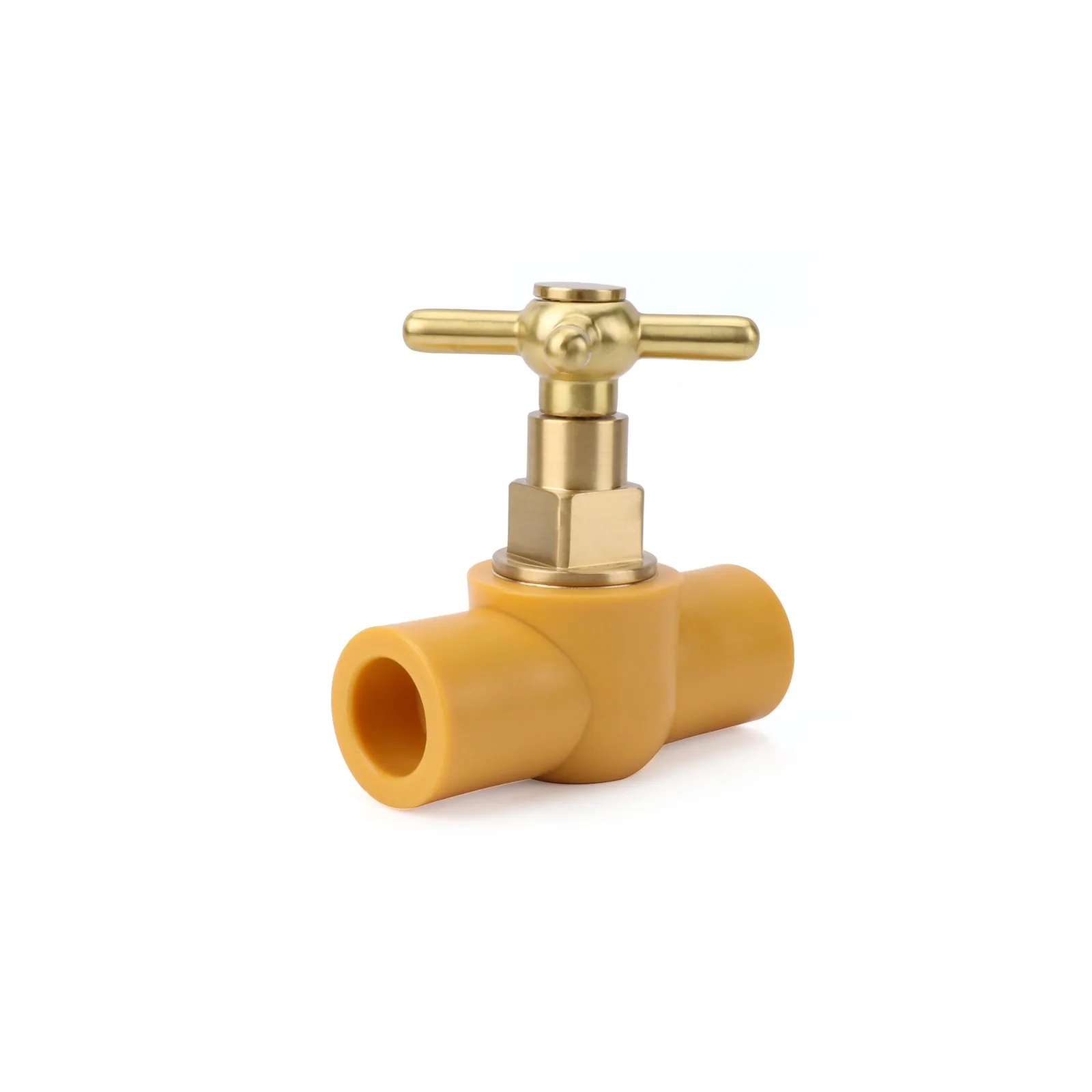
Each catalogue chose a different word for the metal bit — insert, thread, or adaptor — but male and female are reliable, and they describe the metal thread, not the plastic socket. ERA’s MI and FI mean male insert and female insert; read the “I” as “internal” and you order the opposite of what you need.
Thread size is quoted in inches and is independent of the pipe size, which is why these parts carry a two-part designation: EuroAqua’s EB305 is “32×1/2"”, a 32 mm fusion socket with a half-inch thread, and the same body is catalogued with three-quarter-inch and one-inch threads too. A list saying only “32 mm male coupler” will be quoted at whatever thread the supplier stocks deepest — our own brass-insert threaded fittings are published as 1/2" to 2", male and female, so the thread figure is the half of the designation that actually narrows the part.
The brass is the second specification line. EuroAqua states all threaded inserts in its range are brass with a minimum 58% copper content, which governs dezincification resistance; ERA annotates its MI and FI parts “Type of metal – DZR Brass”. Requirements vary by market and water chemistry, so confirm the applicable rule with the local authority before committing a range.
What the markings on the part actually tell you
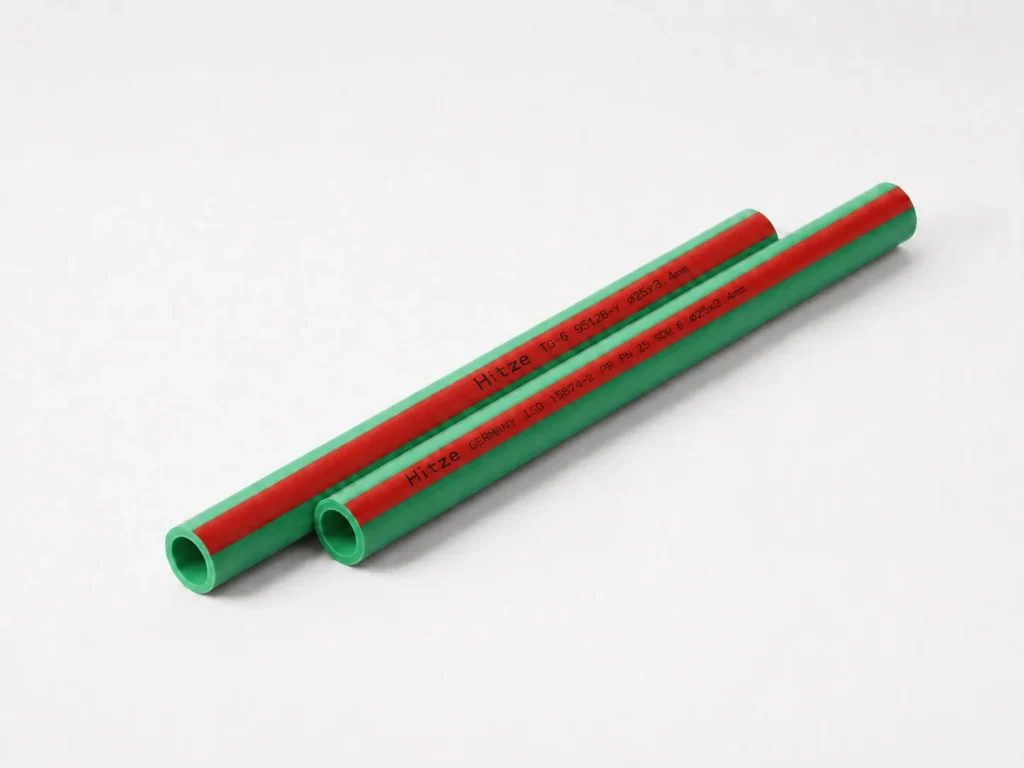
When a catalogue name fails, the part itself is the fallback — the route that works on a fitting sitting loose with no packaging. The minimum marking under ISO 15874-3 is six items: the manufacturer’s mark, the nominal diameter dn, the material, the production month and year, the standard reference, and the application class with working pressure. Anything beyond those may live on the packaging sticker, so a loose fitting may legitimately carry no batch or certificate number. Absence of those is not evidence of a counterfeit. Absence of the six is.
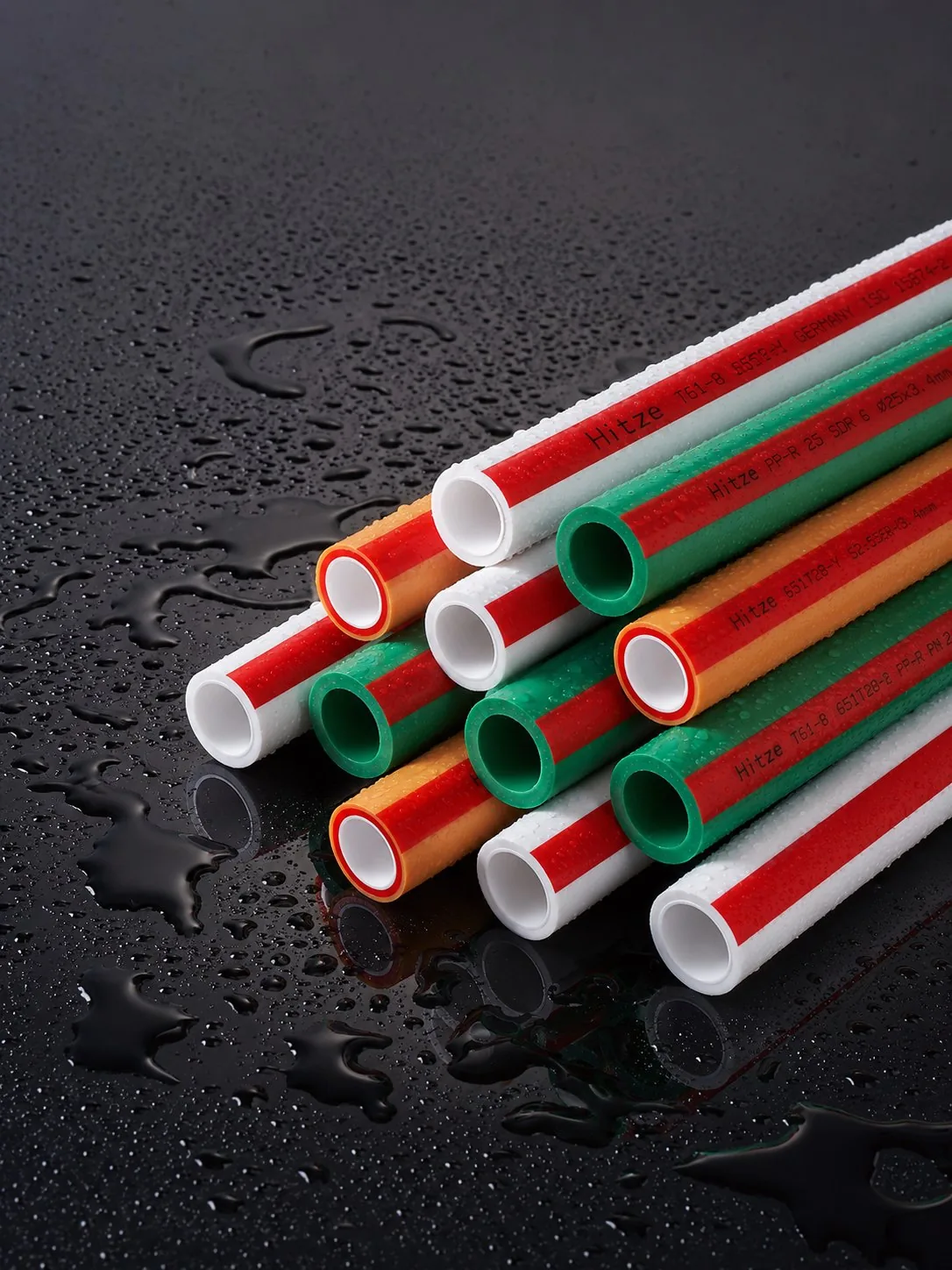
Pipe is marked far more thoroughly. ISO 15874-2:2013 requires marking at least once per metre, legible without magnification, covering the standard number, manufacturer, nominal OD and wall thickness, dimension class, material, application class with operating pressure, and traceability. A length with marking gaps longer than a metre has either been reprinted or is not what the paperwork says.
The application class is the item most often misread. It is not a pressure rating on its own — it pairs with an operating pressure, printed as something like “Class 1/10 bar”, and encodes a service-temperature profile over a design lifetime. The EN ISO 15874 service class explainer works through what each class represents.
Fittings that are not in every catalogue
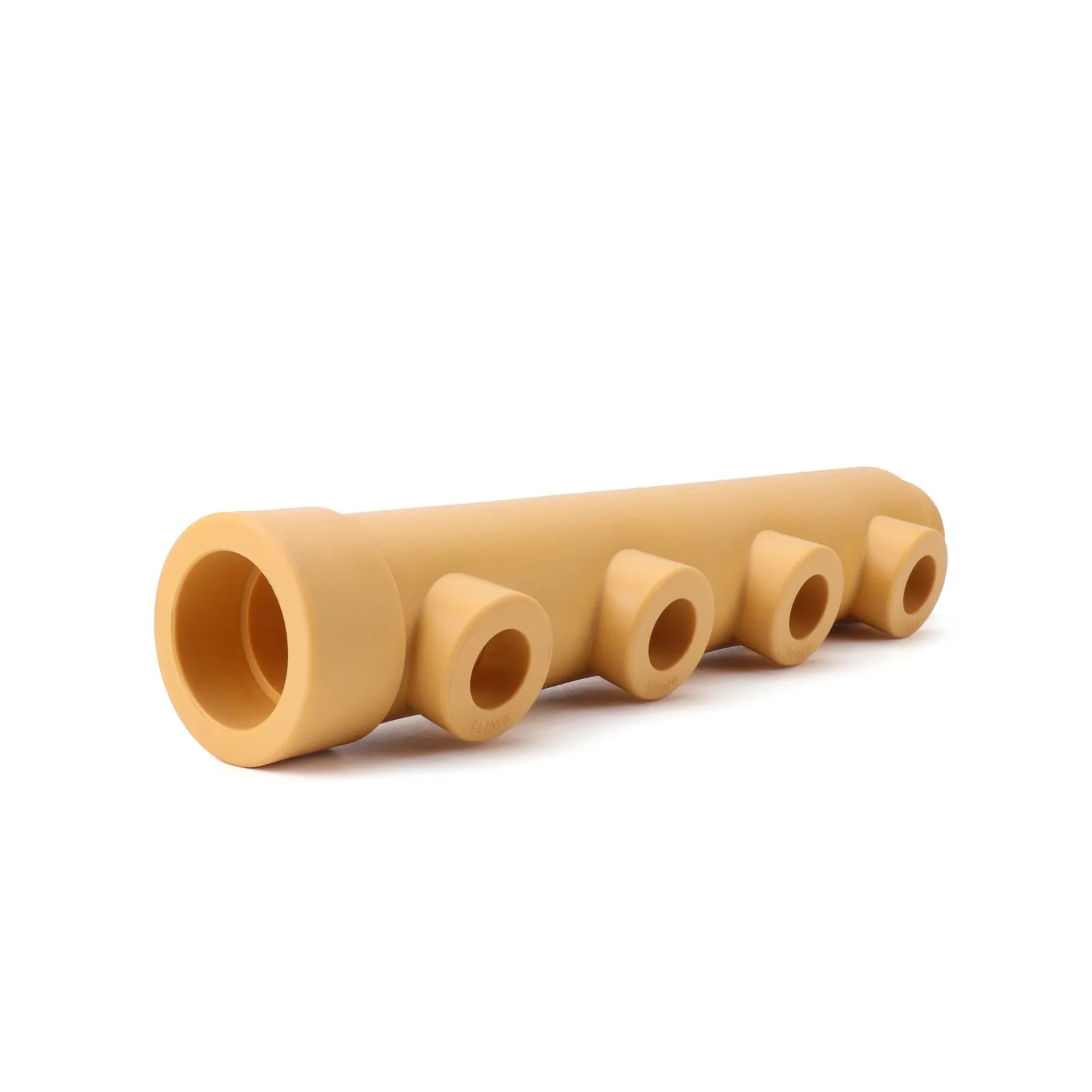
Some fittings exist only in part of a range, and a list that assumes otherwise gets substituted at quotation stage. EuroAqua publishes its “Four Way Tee/Cross” in five sizes only — 20, 25, 32, 40 and 50 mm, codes EF001 to EF005 — while its socket and tee families run to 160 mm. Design a 63 mm crossover into a layout and it becomes two tees and a short nipple.
Saddles hide the sharpest designation trap. On EuroAqua’s weld saddle the leading number is the host pipe, not the saddle’s own dimension: code EB801 is designated “40×1/2"” while its tabulated D1 is 20 mm. Read that first figure as the part size and the whole order line is wrong. Say “saddle for 63 mm pipe, half-inch female thread” and no confusion is possible.
Order codes carry the same warning: a prefix-plus-size scheme is efficient inside one range and useless across two, so never carry a supplier’s code into your own stock system as the primary key. How deep to stock each family is a separate question, worked through in the guide to building a PPR distributor range.
Writing a fitting line so it cannot be misread
Most wrong-part shipments trace to an ambiguous enquiry rather than a careless factory, and the cure is describing geometry instead of trusting a code. State the OD in millimetres. Spell out every reducing tee in words — “50 mm run, 25 mm branch” — beside the supplier’s code. Give both figures on every threaded part: “32 mm body, 1/2" male thread” is unambiguous, “32 mm male coupler” is not. Name the host pipe on saddles, and check flanges as pairs.
An identification sheet is that discipline written down, and it beats a generic downloadable chart because a published list inherits its author’s catalogue dialect. Four columns do it: the family, your own plain-words description, the supplier’s code as a translation column, and the identifying dimension — socket depth for plain parts, thread size for brass-insert parts, host pipe size for saddles. Only the last survives a change of supplier. If you are mapping a range against your own list, the PP-R pipe and fittings range covers OD 20–110 mm (DN15–90).
Our range: where it starts, where we stop
The dimensional tables on this page run out to 125 and 160 mm because that is how far the EuroAqua catalogue goes. Ours does not. The Hitze PP-R range is OD 20–110 mm (DN15–90), and the PPR-CU copper-lined line is narrower still at OD 20–63 mm. That boundary is the most useful thing we can tell a distributor building a fitting list against these tables: specify a 125 mm crossover or a 160 mm socket and it is not a Hitze part, and no amount of code translation will make it one. Inside the range the families are the ones this article has been naming — equal and reducing heat-fusion sockets, 90° and 45° elbows, equal and reducing tees, unions, caps, bridge bends, pipe clips, brass-insert threaded fittings in male and female, ball, gate and stop valves, manifolds and a Y-strainer — plus fusion tools and pressure-test equipment.
Behind the figures sits a documented in-house QC sequence: resin is verified before extrusion, OD, wall thickness at multiple points and ovality are checked against the S-series tables, and pipes, fittings and fused joint assemblies are pressure-tested on in-house hydrostatic benches against DIN and EN ISO thresholds. The standards families documented for the range are DIN 8077/8078 and EN ISO 15874, with SKZ (Germany) testing on PP-R pressure pipe and PP-R fittings; scope varies by product line, so confirm the covered models before quoting into a submittal.
Two commercial facts matter more than any datasheet row when you are trialling a range. There is no MOQ, so a first order can be samples rather than a container, and the published warranty is 50 years on the matched pipe-and-fitting system — matched being the operative word, since it is the system that is warranted, not a fitting bought loose. GERMANY Hitze INDUSTRY CO., LTD has built to German DIN standards since 1974 and supplies 118+ countries under its own label and as ODM.
Conclusion
PP-R fitting names are a manufacturer’s dialect, not a standard, but the geometry underneath is stable: eight families, an OD-based size designation, a socket depth published per size (24 mm at 50 mm OD, whoever moulded the part), and the six items ISO 15874-3 requires on every compliant fitting body. If you are about to send an enquiry, spell out every reducing tee and every threaded part in words alongside the code, and compare dimensional tables rather than product names.
Frequently Asked Questions
Is there an official PPR fittings names list?
No. EN ISO 15874 and DIN 16962 standardise dimensions and marking, not trade names. DIN 16962’s part numbers are the closest thing to an official taxonomy: Part 6 elbows, Part 7 tees, Part 8 sockets and caps, Part 9 reducers.
What is the difference between a socket and a union?
A socket is fused permanently and cannot be undone. A union has a threaded nut so the joint can be broken for service. Unions are the only planned disconnection points in a heat-fused PP-R line.
Do PPR fittings from different manufacturers fit each other?
Usually, because socket dimensions follow the same standards, but verify before mixing. Compare the socket-depth and bore figures in both dimensional tables at the sizes you use, rather than assuming from the OD designation alone.
What does MI and FI mean on a PPR fitting?
Male insert and female insert, describing the brass thread. The “I” is insert, never internal. Other catalogues call the identical parts male and female thread couplers, or metal-plastic adaptors.
Are PPR fitting sizes given in inches or millimetres?
Millimetres of outside diameter. Inch figures printed alongside, such as “¾" – 25 mm”, are nominal trade sizes for reference and do not measure any feature of the part.
Why do some fittings stop at 50 mm in a catalogue?
Low-demand geometries are moulded in fewer sizes. EuroAqua publishes its four-way cross only at 20, 25, 32, 40 and 50 mm, and its flange core starts at 32 mm, while sockets and tees run to 160 mm.


