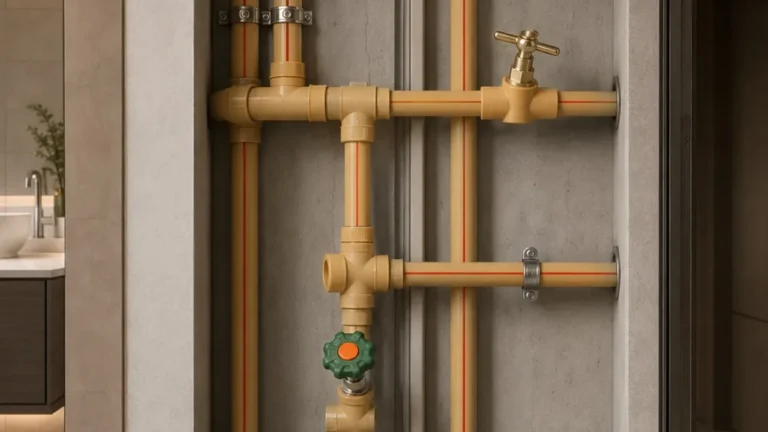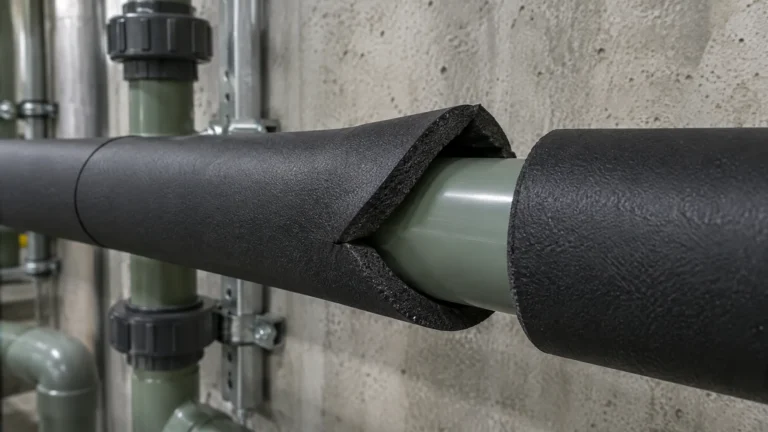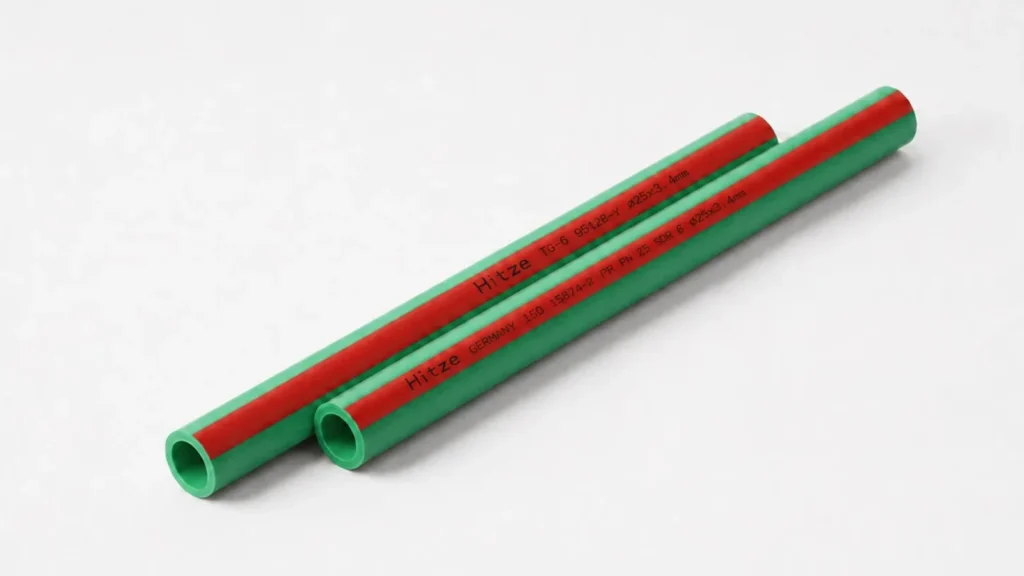
PPR pipe size is normally stated by outside diameter, while SDR describes the relationship between that diameter and the wall thickness. PN is useful as a quick pressure-class label, but it is not enough to select a pipe for hot-water duty. A defensible schedule records OD × wall, SDR or S series, service temperature, design pressure and the applicable standard together.
By the Hitze Technical Content Team · Technical review: 21 July 2026
Key Takeaways
- Read PPR sizes as outside diameters, not as the approximate bore.
- Use SDR = outside diameter ÷ minimum wall thickness; a lower SDR means a thicker wall at the same OD.
- Treat PN as a screening label. Confirm allowable pressure at the project temperature and required service life.
- A thicker wall reduces the internal bore, so a pressure-class change may require a hydraulic recheck.
- Write the purchase line so the received pipe can be checked without interpreting a supplier’s naming convention.
The recurring procurement error is simple: a specification says only “PN20 PPR,” the quotation repeats it and the pipe arrives with a PN20 print line. Yet the engineer, buyer and supplier may not have assumed the same wall series or temperature basis. The solution is not another marketing label. It is a dimensionally complete specification that connects the pipe geometry to the actual duty.
PPR pipe sizes are outside diameters, not bores
In a metric PP-R system, 20 mm, 25 mm and 32 mm refer to the pipe’s outside diameter. That matters because the fitting socket and fusion tooling are sized around the OD. The useful internal opening is smaller and changes with wall series, so a 32 mm pipe does not have a 32 mm waterway.
DN can add confusion. It is a nominal system designation rather than a substitute for an OD × wall dimension. When two schedules use different DN conventions, the outside diameter and minimum wall thickness are the reliable comparison fields. On a tender, keep DN if the project convention requires it, but add the metric OD beside it.
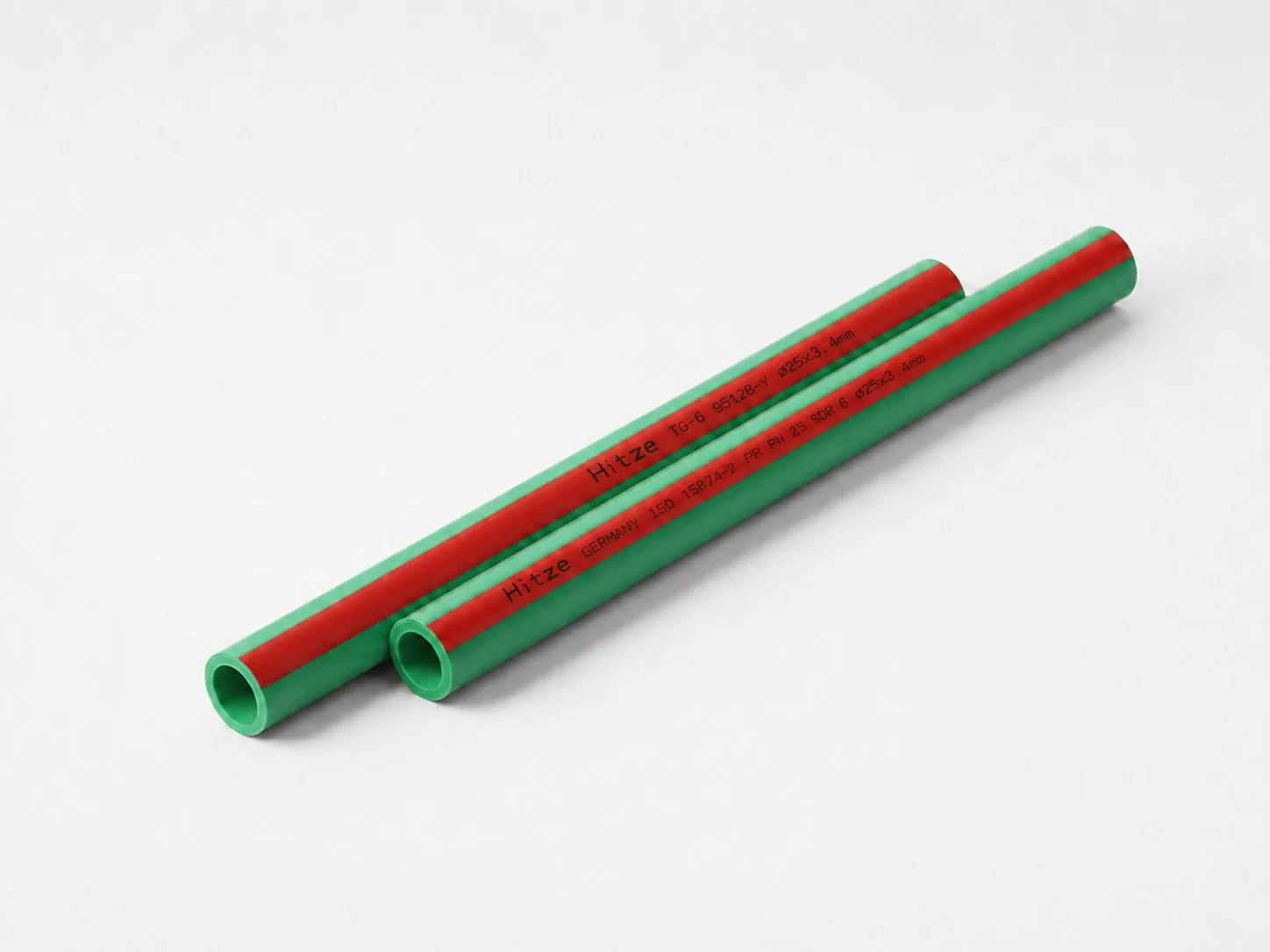
SDR and pipe series: the geometry behind the label
SDR is the standard dimension ratio: nominal outside diameter divided by minimum wall thickness. Pipe series S is related by S = (SDR − 1) ÷ 2. In the common building-services range, SDR 11 corresponds to S 5, SDR 7.4 to S 3.2 and SDR 6 to S 2.5.
At one outside diameter, the lower SDR has the thicker wall. That normally supports higher pressure capability, but it also produces a smaller bore. This is why “upgrading” a schedule from SDR 11 to SDR 6 The same OD and wall also bound how far the pipe can span between clips — see how support spans change with size and temperature.
For example, a 50 mm pipe with a 4.6 mm wall has an approximate 40.8 mm bore. With an 8.3 mm wall, the approximate bore is 33.4 mm. Because cross-sectional area changes with the square of the bore, the difference is operationally significant even though both products are sold as 50 mm pipe.
PPR pipe size chart: where the 20–110 mm dimensions live
The full OD × wall table for SDR 11, SDR 7.4 and SDR 6, with inch trade sizes, DN and thread equivalents, is maintained in one place: the PPR pipe size conversion chart (mm to inches), with an independent cross-check in IFAN’s PPR pipe sizes chart. Both follow the dimensions of DIN 8077:2008-09 and ISO 15874-2:2013+A2:2022; this page stays on the question the chart cannot answer — what a given SDR is worth in bar.
The table below is a practical comparison of common metric dimensions associated with DIN 8077 and the pipe requirements in ISO 15874-2. Values should be confirmed against the selected manufacturer’s current data sheet and the project edition of the governing standard before release for construction. Bore is calculated as OD minus twice the listed wall.
| OD (mm) | SDR 11 wall / bore (mm) | SDR 7.4 wall / bore (mm) | SDR 6 wall / bore (mm) |
|---|---|---|---|
| 20 | 1.9 / 16.2 | 2.8 / 14.4 | 3.4 / 13.2 |
| 25 | 2.3 / 20.4 | 3.5 / 18.0 | 4.2 / 16.6 |
| 32 | 2.9 / 26.2 | 4.4 / 23.2 | 5.4 / 21.2 |
| 40 | 3.7 / 32.6 | 5.5 / 29.0 | 6.7 / 26.6 |
| 50 | 4.6 / 40.8 | 6.9 / 36.2 | 8.3 / 33.4 |
| 63 | 5.8 / 51.4 | 8.6 / 45.8 | 10.5 / 42.0 |
| 75 | 6.8 / 61.4 | 10.3 / 54.4 | 12.5 / 50.0 |
| 90 | 8.2 / 73.6 | 12.3 / 65.4 | 15.0 / 60.0 |
| 110 | 10.0 / 90.0 | 15.1 / 79.8 | 18.3 / 73.4 |
Do not use this as a universal stock list. A supplier may omit a small-size thin-wall option, offer additional series or apply production tolerances defined in its declared standard. Use the table to compare geometry, then place the approved manufacturer’s declared dimensions in the project schedule.
What a PN rating tells you—and what it does not
PN is a nominal pressure designation commonly associated with water service at a reference temperature. It is convenient for catalog browsing, but the printed number does not describe every combination of temperature, time, material grade and design coefficient. Do not assume two products with the same PN are equivalent until their dimensions and declared service conditions are compared.
For procurement, use PN as a consistency check after the load-bearing fields have been fixed. Those fields are: material designation, OD × minimum wall, SDR or S series, application class or stated duty, design pressure, design temperature, service life basis and standard. If a quotation returns only diameter and PN, send it back for completion.

SDR to PN conversion: the formula behind the label
PN = 20 × σs ÷ (SDR − 1), with σs in MPa and PN in bar. It is the thin-wall hoop-stress equation rearranged, and it is the same relationship ISO 4427 uses for PE and ISO 15874-2 uses for PP. σs is the design stress: the pipe material’s long-term hydrostatic strength at the reference condition (20 °C, 50 years) divided by a design coefficient C.
For PP-R at 20 °C and 50 years the regression curve of DIN 8078 / ISO 9080 gives a long-term strength of roughly 9.6–9.7 MPa. DIN 8077:2008-09 applies a safety factor of 1.5 to that curve, which lands at σs ≈ 6.4 MPa (some tables round to 6.3); the ISO route — PP-R classified MRS 8 MPa, C = 1.25 for cold water — gives the same 6.4 MPa. Either way the arithmetic is: SDR 11 → 12.8 bar (PN 12.5), SDR 7.4 → 20 bar (PN 20), SDR 6 → 25.6 bar (PN 25). The DIN 8077 pressure table reads 12.9, 20.4 and 25.7 bar for the same three series, so the two agree to within rounding.
Here is the trap. The labels printed on PP-R pipe under the older DIN 8077 convention are one class lower — PN 10 for SDR 11, PN 16 for SDR 7.4, PN 20 for SDR 6, PN 25 for SDR 5 — because they were set with a more conservative 5 MPa design stress decades ago. So “PN 20” on a European or Turkish print line usually means SDR 6 (S 2.5), while “PN 20” from a supplier using the calculated ISO figure means SDR 7.4 (S 3.2). Same words, one wall series apart. That is why this guide asks you to write OD × wall and SDR/S on the purchase line and treat PN as a check.
| SDR | S series | PN, PP-R at 20 °C (bar) — DIN 8077 label | PN, PE100 at 20 °C (bar) | Typical PP-R duty |
|---|---|---|---|---|
| 5 | S 2 | 32 — labelled PN 25 | 40 | Heating risers, industrial hot lines |
| 6 | S 2.5 | 25 (25.6) — labelled PN 20 | 32 | Hot water and radiator heating (Class 2 / 5) |
| 7.4 | S 3.2 | 20 (20.0) — labelled PN 16 | 25 | Domestic hot water 60–70 °C (Class 1 / 2) |
| 9 | S 4 | 16 (16.0) — no DIN PP-R label | 20 | Hot-water branches in PP-RCT or fibre-composite pipe |
| 11 | S 5 | 12.5 (12.8) — labelled PN 10 | 16 | Cold water, chilled water, compressed air |
| 13.6 | S 6.3 | 10 (10.2) — no DIN PP-R label | 12.5 | Low-pressure cold water, irrigation mains |
| 17 | S 8 | 8 (8.0) — no DIN PP-R label | 10 | Gravity or low-head cold lines; rarely stocked in PP-R |
| Sources: formula and PE100 column per PE100+ Association, “SDR and pressure rating” (MRS 10 ÷ C 1.25 = 8.0 MPa); PP-R column calculated at σs = 6.4 MPa and checked against the DIN 8077:2008-09 20 °C / 50-year table (12.9 / 20.4 / 25.7 / 32.4 bar for SDR 11 / 7.4 / 6 / 5, safety factor 1.5) as reproduced by Vesbo and SPK; S = (SDR − 1) ÷ 2 per ISO 15874-2:2013+A2:2022. PN values are rounded to the standard PN series. Cold water at 20 °C only — see the next section for hot duty. | ||||
Worked example 1 — SDR to PN. A 63 × 5.8 mm PP-R pipe: SDR = 63 ÷ 5.8 = 10.9 → series SDR 11 (S 5). PN = 20 × 6.4 ÷ (11 − 1) = 12.8 bar → PN 12.5. The print line may say “PN 10” (DIN label) — the pipe is the same.
Worked example 2 — wall to PN. A 32 × 5.4 mm pipe: SDR = 32 ÷ 5.4 = 5.9 → SDR 6 (S 2.5). PN = 20 × 6.4 ÷ 5 = 25.6 bar → PN 25. Under the DIN convention this is the pipe sold as “PN 20”; a supplier quoting “PN 20” on the ISO basis would ship SDR 7.4 with a 4.4 mm wall and a 23.2 mm bore instead of 21.2 mm. Check the wall, not the label.
Worked example 3 — PN to SDR. The schedule needs 16 bar at 20 °C. Rearranged: SDR = 1 + 20 × σs ÷ PN. PP-R: 1 + 128 ÷ 16 = 9 → S 4. PE100: 1 + 160 ÷ 16 = 11 → S 5. Same duty, two different walls, because the material strength differs — which is why an SDR without a material designation is not a specification.
All of the above is 20 °C cold-water arithmetic. At 70 °C for 50 years the same SDR 6 PP-R pipe is good for roughly 8–10 bar depending on the table used, and the application-class method in ISO 15874-2 replaces the single σs with a class-specific design stress. Take hot-duty values from the manufacturer’s declared table or the EN ISO 15874 service-class guide, and use the plastic pipe pressure rating explainer when the comparison crosses into PE, PVC or CPVC.
Temperature, time and application class change the answer
Thermoplastic pressure capability decreases as temperature rises. A cold-water PN label must not be carried directly into a continuously recirculating hot-water calculation. The current ISO 15874-2:2013+A2:2022 product standard for PP pipes is used together with the system’s declared application class and design pressure. Parts 1, 3 and 5 cover general requirements, fittings and fitness for purpose respectively.
Application classes use a temperature-time profile rather than one permanent maximum. For example, Class 5 is associated with high-temperature radiator service with an 80 °C design temperature; the profile also includes limited time at higher temperatures, including a 90 °C maximum-temperature period. It should not be shortened to “continuous 90 °C service.”
Ask the supplier for a pressure-temperature or application-class declaration that identifies the exact pipe series and material. Confirm whether it applies to pipe alone or to the complete pipe-and-fitting system. A high pipe rating cannot repair an unverified fitting or a poor fusion joint.
A five-step method for selecting PPR size and wall series
- Define the duty. Record fluid, design and operating temperatures, design pressure, surge allowance, required life, service class and local approval requirements.
- Select a compliant system. Check that pipe, fittings and jointing method are declared together for the intended application. Keep certificate scope separate from marketing claims.
- Choose the wall series from verified data. Use the manufacturer’s current pressure-temperature or application-class table, not the cold PN label alone.
- Size the bore hydraulically. Calculate diversified flow, velocity and pressure loss with the actual internal diameter of the selected wall series. Include fittings, elevation and balancing requirements.
- Check installation behaviour. Address thermal movement, supports, insulation, penetration details, tool sizes, fusion parameters and access for installation and repair.
This order matters. Starting with an attractive bore and then forcing it into an unsuitable pressure class is backward; starting with the heaviest wall and ignoring hydraulic consequences is equally incomplete. The pipe schedule is the intersection of material capability, hydraulics and installation constraints.
Write a purchase line that can be inspected on arrival
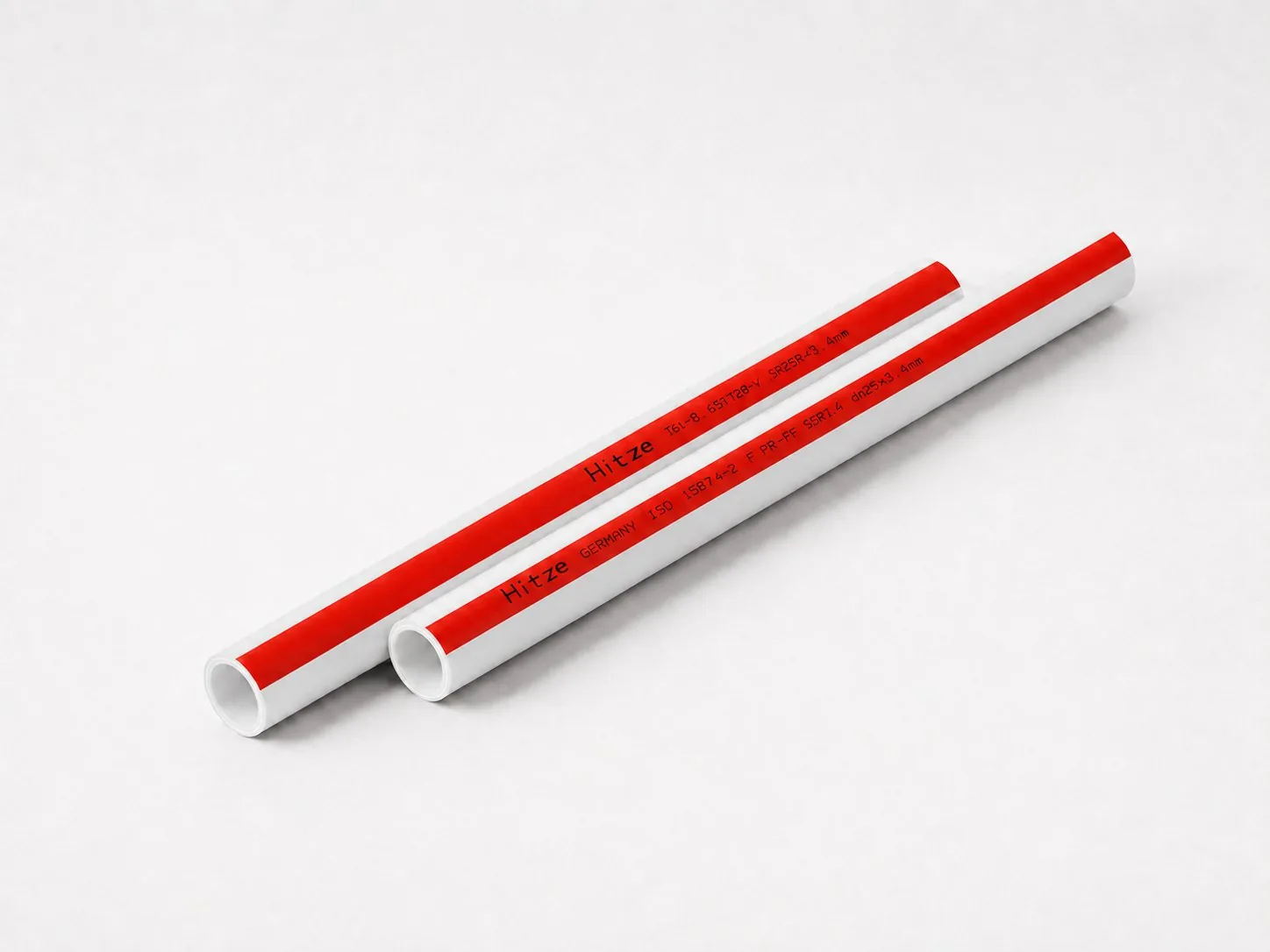
A useful purchase line follows this pattern: PP-R pipe, [OD] × [minimum wall] mm, SDR [value] / S [value], for [application class or stated temperature-pressure duty], manufactured and declared to [standard and edition], compatible with the submitted fitting system, colour/construction [if relevant].
| Purchase-order field | Why it must be explicit |
|---|---|
| Material and construction | Distinguishes pipe constructions. |
| OD × minimum wall; SDR/S | Fixes bore and wall geometry. |
| Temperature, pressure and class | Ties PN to design duty. |
| Standard and approved revision | Ties receipt to approval. |
| Compatible fitting family | Keeps one documented system. |
Add an approved submittal reference and revision. At receiving inspection, compare the pipe print line, packaging label and delivery documents with that reference. Verify OD and wall by the project inspection plan, check that fittings carry compatible identification, and quarantine unexplained substitutions. A PN-only substitution should trigger technical review, even when the new label appears “higher.” Compare the offered family on the PPR pipe and fittings page, then use the project data sheet as the controlling document.
Building a PPR schedule for a tender or distribution range?
Compare the available pipe and fitting families, then send the required OD, wall series, service temperature, design pressure and destination market for a scope-matched response. Hitze supports no-MOQ ordering and a 50-year product warranty; confirm the project-specific warranty scope and commercial terms in the quotation.
Four schedule errors to reject before approval
- PN without temperature: the reviewer cannot verify hot-water capability.
- OD without wall or SDR: the bore and pressure geometry remain unknown.
- Pipe evidence without fitting evidence: the submitted system is incomplete.
- A certificate with no model or size match: the document may be genuine but irrelevant to the offered item.
For a document-by-document review workflow, use the certifications and compliance hub together with the project specification. The goal is not to collect the largest PDF bundle; it is to prove that the offered system matches the specified duty and market.
The joint is part of that system proof. The field risks in mixing pipe and fitting brands explain why a dimensionally correct pipe still needs a compatible fitting and fusion procedure.
Bottom line: specify the geometry and the duty together
Write OD × wall, SDR/S, temperature, design pressure, service class and system standard on the same line. Recalculate the bore whenever the wall series changes, and verify the exact pipe-and-fitting declaration before release. Hitze’s user-confirmed 50-year product warranty is contractual and quotation-specific; it is not the same as a standards-based 50-year engineering design-life calculation.
FAQ: PPR pipe sizes, SDR and PN ratings
Is 25 mm PPR the inside or outside diameter?
It normally identifies a 25 mm outside diameter. The inside diameter depends on the selected wall thickness or SDR, so it must be taken from the approved product data.
Does a lower SDR mean a stronger pipe?
At the same OD and material, a lower SDR means a thicker wall and generally higher pressure capability. Final selection still depends on temperature, time, material and the system declaration.
Can PN20 be used for hot water?
Not from the label alone. Verify the exact pipe series against the manufacturer’s pressure-temperature or application-class table for the project pressure, temperature and service-life basis.
Why can two PPR pipes with the same OD have different flow?
Their walls may have different thicknesses. A thicker wall reduces the bore and flow area, which changes velocity and friction loss at the same flow rate.
What should a PPR purchase order state?
State material, OD × minimum wall, SDR or S series, duty or application class, design pressure, temperature, governing standard and the approved compatible fitting system.
What is PN 20 in PPR pipe?
PN 20 is a nominal pressure class of 20 bar at 20 °C for 50 years. On pipe labelled to the DIN 8077 convention it means SDR 6 (S 2.5); on pipe rated by the ISO calculation at σs 6.4 MPa it means SDR 7.4 (S 3.2). Confirm the wall thickness, and remember the value falls sharply at hot-water temperatures.