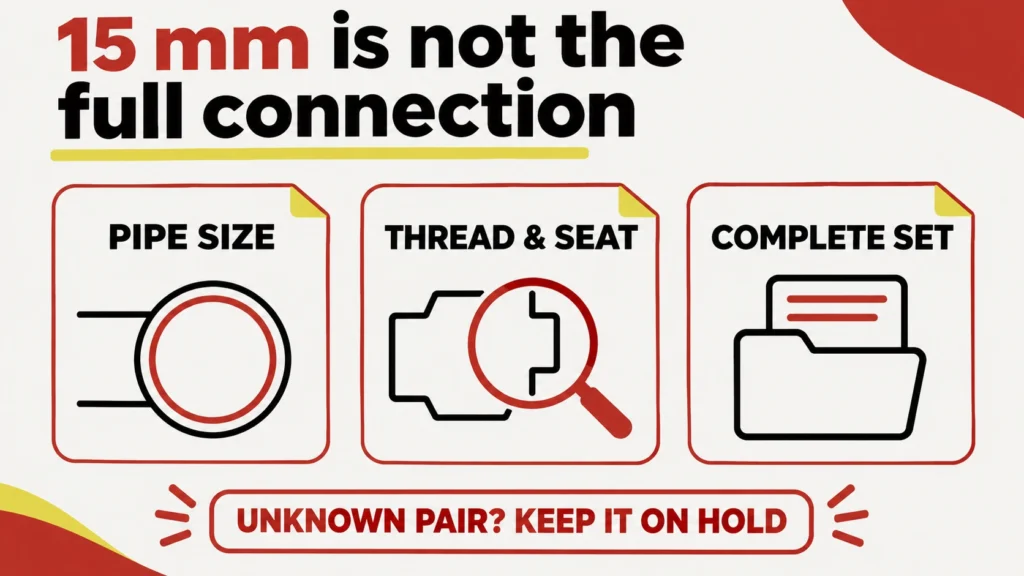
A 15 mm tube outside diameter does not identify the complete compression connection. If the retained nut will not fit a replacement valve, record the original connection set and the replacement interface separately. An unidentified pair stays on HOLD: matching the tube size, or even the thread designation, does not establish that the complete assembly is suitable.
Key Takeaways
- A 15 mm tube dimension does not identify the complete connection.
- The documented HERZ sets have different nut threads despite equal tube diameter.
- Matching a thread does not establish complete assembly suitability.
- Keep unidentified retained and replacement interfaces on HOLD.
- Record missing evidence and ask the responsible manufacturer before confirming a purchase.
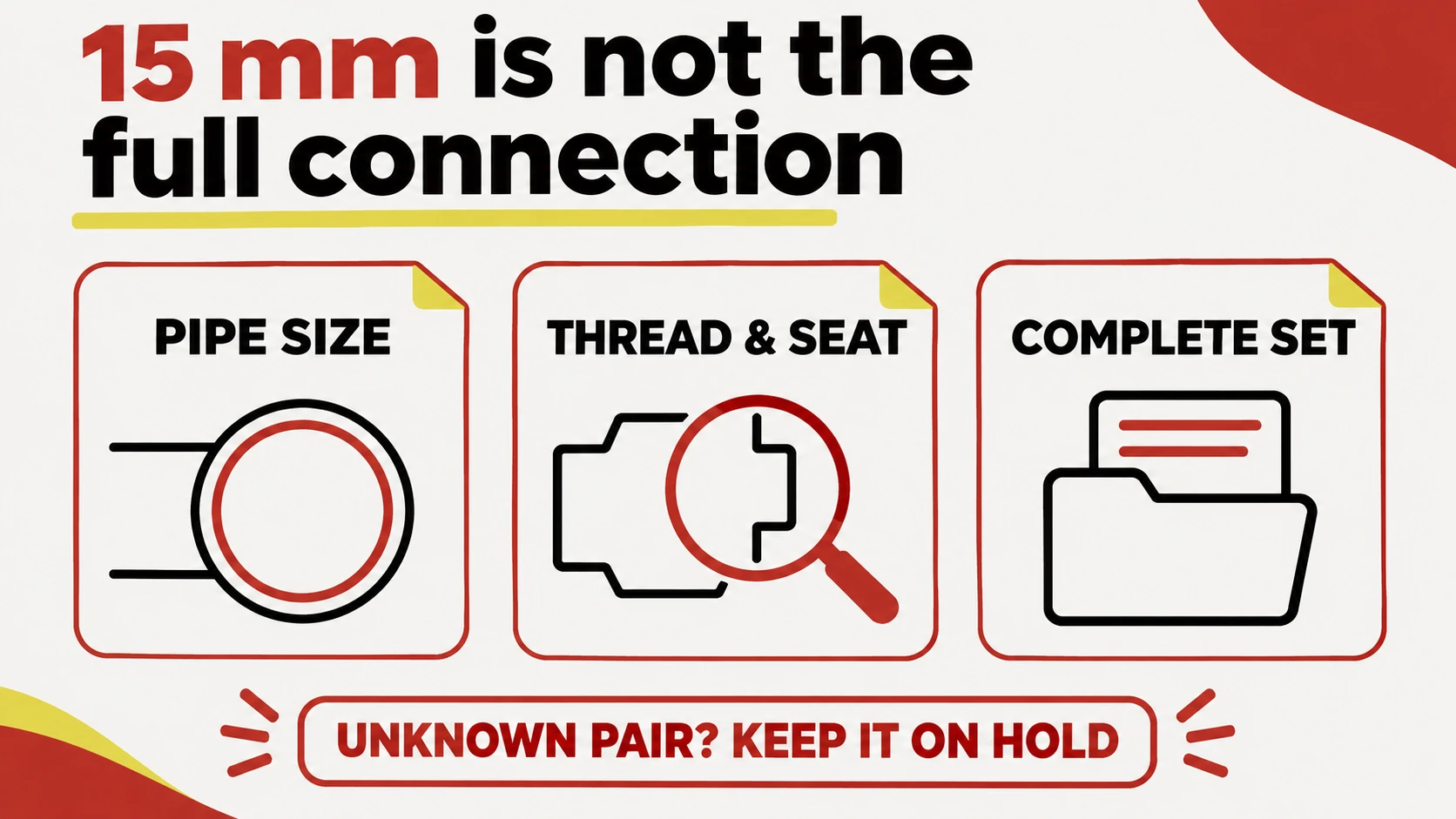
The purchasing mistake is easy to make. The pipe is copper, the replacement listing says 15 mm, and the old nut is still on the pipe. That sounds like enough information to order. A manufacturer’s connection table shows why it can be insufficient: two sets intended for the same tube diameter can use different nut threads.
This guide addresses the enquiry before a replacement is selected. It does not identify a nut from its appearance, prescribe a repair, or authorise the retention of an old olive. Its practical result is a purchase record that separates known dimensions from missing connection identity.
Two documented 15 mm sets, two different threads
HERZ’s compression-fitting datasheet, Issue 0625, provides a concrete example. The order-number table on page 2 gives the following pair. These are HERZ products used to explain a specification distinction; they are not Hitze part numbers or recommended substitutes.
| HERZ order number | Outside pipe diameter | Nut designation in the table | Purchasing conclusion |
|---|---|---|---|
| 1 6274 03 | 15 mm | G3/4, ISO 228-1 | Record the 6274 set identity; do not replace its specification with “15 mm”. |
| 1 6284 04 | 15 mm | M22×1.5 | A different named interface, despite the same tube diameter. |
There is a documentation detail worth keeping with the enquiry. The page 1 heading for the 6284 family lists 10, 12, 14 and 16 mm, omitting 15 mm. Page 2 explicitly lists 1 6284 04 at 15 mm; the official 6284 catalogue page also lists that code at dimension 15 under the M22×1.5 family. The comparison above uses that specific table row with the catalogue corroboration, rather than silently filling in the heading.
The conclusion is limited but useful. “Both are for 15 mm pipe” cannot establish that these two sets are interchangeable. It also cannot tell us whether an unidentified old nut belongs to either family. A mismatch is a reason to resolve identity, not evidence that the pipe or new valve is defective.
The thread is one part of the connection record
A nut designation answers a different question from the tube diameter. The tube dimension describes the pipe being connected; the nut designation describes a threaded interface within a particular connection arrangement. Neither entry alone describes every mating surface.
HERZ’s application description also discusses the olive, the housing’s inner cone and the pipe reaching the internal stop. Those relationships explain why an enquiry needs the complete set and valve interface, rather than a thread label alone. They do not create permission to combine unidentified components.
Keep three questions separate: what pipe is present, what connection set is retained, and what interface the proposed valve requires. A photograph can document markings and context, but an unmarked photograph cannot supply a missing manufacturer’s approval. Likewise, a matching thread designation leaves the specified sealing arrangement and the acceptability of retained components to be confirmed for the actual assembly.
Two completed enquiry records
The records below are illustrative purchasing examples, not customer cases or installation instructions. “HOLD” is a completed purchasing disposition: the line remains unresolved and is not released as a confirmed replacement. It does not mean the assembly has passed a physical assessment.
Record A: known tube size, unidentified retained set
| Original pipe | Copper; reported outside diameter 15 mm; wall thickness and pipe specification not supplied. |
|---|---|
| Retained connection | Nut and olive remain present. Original manufacturer, valve model, connection-set code and thread designation are unknown. |
| Proposed replacement | A seller’s 15 mm valve listing; exact valve code, mating interface and drawing revision not supplied. |
| Available evidence | Reported tube size and photographs only. No original assembly document. |
| Disposition | HOLD — the tube size is known, but the retained-to-replacement connection is unidentified. |
| Required answer | Identify the original set and proposed valve interface, then obtain the responsible manufacturer’s documented position on the complete proposed assembly, including any retained components. |
This record prevents the next enquiry from becoming “send another 15 mm valve”. It names the missing evidence. If the original set cannot be identified, that uncertainty remains explicit; a distributor’s stock description does not close it.
Record B: named sets, invalid same-size equivalence
| Original set in this example | HERZ 1 6274 03, documented in Issue 0625 as 15 mm with G3/4 ISO 228-1 nut. |
|---|---|
| Proposed alternative | HERZ 1 6284 04, proposed solely because its tube dimension is also 15 mm. |
| Document check | The page 2 table specifies M22×1.5 for the proposed alternative; the current 6284 catalogue corroborates its 15 mm entry. |
| Disposition | Reject the assertion that these are the same connection set. Keep the replacement purchase on HOLD. |
| Required answer | Request a documented matched assembly for the actual valve and pipe. Neither row alone selects that assembly or authorises retaining the original olive. |
Here the evidence closes one question: the proposed same-size equivalence is unsupported. It does not close the replacement selection. That distinction stops a useful catalogue comparison from turning into an unsupported repair recommendation.
Document review before a replacement purchase
This is an enquiry-document review, not an installation sequence or compatibility assessment.
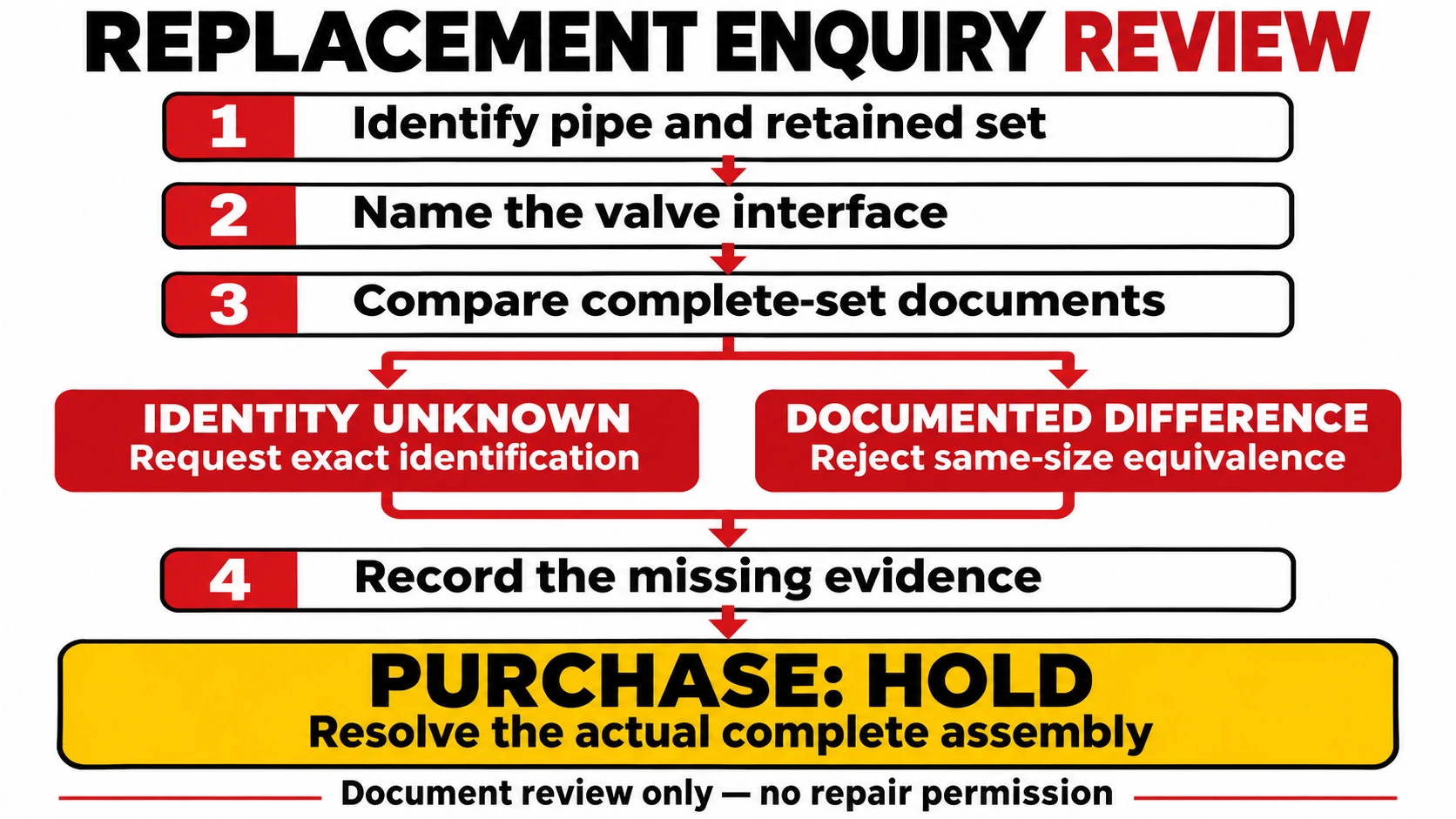
- Identify the pipe and retained connection set.
- Name the proposed valve and mating interface.
- Compare the exact complete-set documentation.
- Record the unresolved evidence and purchase HOLD.
What the supplier enquiry needs to identify
Use separate fields for the original manufacturer and valve model; pipe material, outside diameter and known wall thickness; visible nut markings and documented thread designation; connection-set code; proposed valve code and interface; and the drawing’s issue or revision. Add photographs, the source of each identification and a list of unanswered questions. Write “unknown” where evidence is missing.
The requested reply should identify the exact complete assembly being discussed and address the proposed retained components explicitly. A response that repeats “15 mm connection” has not answered the interface question. An alternative suggestion also needs its own valve and connection-set identities; it should not inherit approval from the rejected proposal.
For the named HERZ examples, use the manufacturer’s product documentation to frame the identification enquiry. For another make, take the record to the responsible manufacturer or supplier. Hitze availability, an exact Hitze replacement SKU and a Hitze compatibility-assessment service have not been established by this comparison.
Manufacturer category context
The Conex Bänninger animation below is a separate manufacturer’s compression-fitting overview. It supplies visual category context only: it does not identify either HERZ set, demonstrate this unidentified copper connection, or authorise retaining an olive. Its assembly instructions do not apply to the unresolved purchase records above.
Manufacturer training source. Manual playback remains unverified.
Conclusion
A replacement order needs more than a familiar tube size. Keep the unknown pair on HOLD, preserve the exact part and drawing references, and obtain an answer about the complete assembly before treating the purchase line as confirmed.
Frequently asked questions
Does 15 mm mean the compression nut has a standard thread?
No. In the documented HERZ example, two sets for 15 mm outside-diameter pipe have different nut designations: G3/4 ISO 228-1 and M22×1.5. The pipe dimension alone cannot identify the nut’s connection family.
If the thread designation matches, is the replacement confirmed?
No. The complete connection set, mating valve interface and specified sealing arrangement still need identification. Any proposal to retain components needs the responsible manufacturer’s documented assessment for that assembly.
Can the old olive be reused with the new valve?
This comparison does not establish that; leave reuse unresolved until the original set, proposed valve and applicable manufacturer’s instructions are identified.