A press-fitting quotation for a retained Schedule 80 carbon-steel steam return needs a pipe-scope decision before a purchase order. Viega’s current MegaPress FKM data sheet lists Schedule 5–40 carbon-steel pipe. Its MegaPress 316 FKM sheet specifies ASTM A312 stainless pipe and its own schedule ranges. Changing the fitting to stainless therefore leaves the original carbon-steel Schedule 80 pipe outside these named configurations.
Split the enquiry into two possible work scopes. One retains the identified pipe and asks the responsible professional for a documented connection method. The other considers an engineered replacement segment with a matching pipe-and-fitting system. The completed review below shows exactly which quotation line fails and which information a revised proposal must supply.
Key Takeaways
- Identify the steam distribution and condensate return as separate quotation lines.
- The two named SD-MP 0726 sheets limit their steam application to less than 15 psig.
- A general operating-pressure figure cannot extend that specific steam application.
- The named carbon-steel FKM sheet stops at Schedule 40, so a retained Schedule 80 return fails its pipe check.
- A stainless fitting requires the pipe identified in its own documentation.
- Agree the retained-pipe or replacement-pipe work scope before comparing fitting prices.
A contractor’s wet-return replacement video
Mikey Pipes’ video concerns a residential condensate wet-return replacement. Its title and provider description identify the topic. Apply the named current data sheets to your own pipe and proposed work scope. Manual playback remains unverified.
Identify the return line before pricing its joint
A low-pressure steam repair can contain several different purchasing decisions. The pipe carrying steam to the load and the line returning condensate may have different materials, wall schedules and service conditions. Calling both “the steam pipe” hides those differences inside one price.
A real practitioner discussion on Heating Help illustrates the problem. The original question concerned press fittings for low-pressure apartment-building steam work. A contributor then described an inaccessible Schedule 80 condensate return where wrench access made a press connection attractive. That discussion establishes a practical question to investigate. Its accounts and preferences supply no manufacturer approval. Read the December 2023 practitioner discussion.
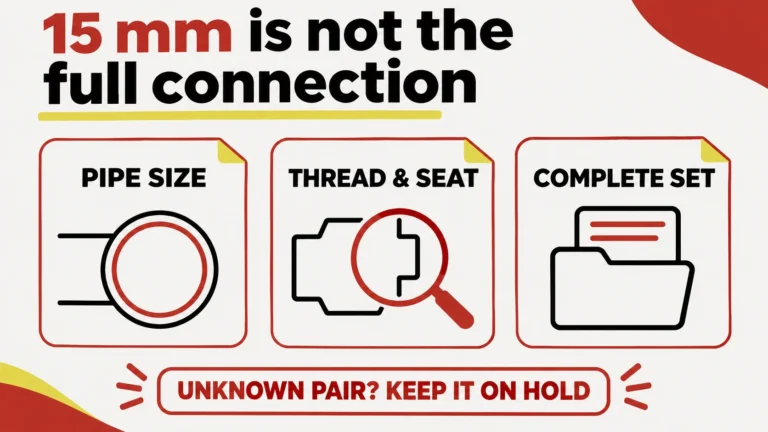
Start the quotation record with the identified line function, material, nominal size, pipe standard and schedule. Preserve uncertainty when the old pipe cannot yet be identified. “Probably Schedule 80” leaves a different procurement problem from a documented Schedule 80 pipe that the proposed system excludes. The first needs identification. The second needs a different proposal.
Access explains why a buyer wants a particular connection method. It cannot change the pipe that method accepts. Keep access constraints in the enquiry so the responsible designer can consider them while resolving the connection and replacement scope. This article provides a purchasing review, with installation and work on the actual system assigned to qualified professionals under the governing instructions.
Compare the two current data sheets
The following comparison uses two actual Viega data sheets bearing the footer code SD-MP 0726, retrieved on 6 November 2026. Each describes its named system. Their pipe requirements remain distinct even where the sealing-element designation and published steam limit coincide.
| Review field | MegaPress FKM | MegaPress 316 FKM |
|---|---|---|
| Pipe material and standard | Carbon steel under ASTM A53, A106, A135 or A795 | IPS stainless steel under ASTM A312 |
| Listed pipe schedules | Schedule 5–40 | ½–2 inch fittings with Schedule 5–40, and 2½–4 inch fittings with Schedule 10–40 |
| Named steam application | Less than 15 psig | Less than 15 psig |
| Retained carbon-steel Schedule 80 pipe | Outside this listed schedule range | Outside this listed pipe material and schedule configuration |
Read the original MegaPress FKM data sheet and MegaPress 316 FKM data sheet for the full operating parameters, tool references and conditions. This selected comparison supports the pipe-scope decision below.
Both sheets also contain a general maximum operating-pressure figure of 200 psi. A quotation that extracts that figure while omitting the specific steam entry changes the meaning of the document. In the named sheets, the steam application remains less than 15 psig. Exactly 15 psig falls outside that printed less-than condition. Any application-specific acceptance must address the complete configuration and duty.
Viega’s April 2021 steam article discusses corrosion in condensate returns and expresses a preference for stainless in that context. That is useful background for reviewing a replacement proposal. The current stainless data sheet still requires its specified stainless pipe. A preference for a fitting material cannot establish permission to press that fitting onto the retained carbon-steel pipe. Read Viega’s steam application discussion.
Complete a two-line repair review
Consider an illustrative enquiry stating 12 psig steam duty. Line A identifies a Schedule 40 carbon-steel distribution pipe under one of the standards listed in the carbon-steel FKM sheet. Line B identifies a retained Schedule 80 carbon-steel condensate return. The supplier offers the same named carbon-steel FKM family for both lines and points to its 200 psi headline figure.
These are hypothetical project inputs, not a Hitze installation or a measured system. They let the buyer complete two specific document comparisons without inventing a field result.
| Quotation line | What the named evidence resolves | Recorded purchasing result |
|---|---|---|
| A — identified Schedule 40 carbon-steel distribution | The stated 12 psig is below the printed steam boundary, and the identified pipe category falls within the selected sheet | These two checks pass. Complete the remaining duty, temperature, exact part, tooling and project acceptance before release |
| B — retained Schedule 80 carbon-steel return | The selected carbon-steel sheet lists Schedule 5–40 | Reject this fitting-only configuration. Request a separately defined repair scope |
| B revised — stainless fitting, same retained pipe | The selected stainless system requires ASTM A312 stainless pipe and its stated schedules | Reject the fitting-only substitution. Changing the fitting leaves the retained-pipe mismatch unresolved |
Line A is deliberately a partial result. It passes the two comparisons actually performed, while the remaining conditions retain their own evidence requirements. Line B has a concrete mismatch, so collecting another favourable pressure figure would not resolve it. The revised stainless line changes one item but preserves the object causing the mismatch.
This distinction changes how the buyer requests the next quotation. Line A needs completion of its application record. Line B needs a decision about retaining or replacing pipe. Sending the same vague request for a “better press fitting” to both suppliers would keep that difference hidden.
Change the pipe scope deliberately
For the retained-pipe route, keep the identified Schedule 80 carbon-steel pipe in the scope and ask the responsible professional to specify a documented connection arrangement for that actual pipe and duty. The buyer should receive an intelligible repair description with the required access and work extent. This review selects no alternative joint or installation method on the professional’s behalf.
For the replacement-pipe route, identify the proposed replacement material, standard, size, schedule and segment boundaries together. The proposal must also address how the replacement interfaces with the remaining system. A line saying only “upgrade to stainless” cannot be priced or reviewed reliably because it leaves the replacement extent and connection configuration undefined.
Change one assumption in the worked example. Suppose the revised proposal now identifies a two-inch ASTM A312 Schedule 40 stainless replacement segment with the named MegaPress 316 FKM system. That described pipe falls within the corresponding pipe category in the selected sheet. The earlier retained-pipe mismatch is resolved for that segment.
The result remains bounded. The responsible reviewer must establish suitability for the actual return duty, temperature and fluid conditions, corrosion considerations, transitions and project requirements. The pipe-category comparison alone predicts no service life and grants no operating permission. What changed is that the supplier has finally offered a defined replacement configuration that can undergo those remaining checks.
Two completed enquiry outcomes
The retained-pipe example can leave the buyer with this completed disposition and request. “The proposed MegaPress FKM fitting-only return line is rejected against the named Schedule 5–40 pipe scope. Our stated existing return is two-inch Schedule 80 carbon steel, with project duty stated as 12 psig and actual temperature and return-fluid information still required. Please define a documented repair arrangement retaining that pipe, including the connection configuration, access requirements and required professional acceptance. Keep this return line separate from distribution line A.”
The replacement example produces a different request. “The revised return proposal identifies a two-inch ASTM A312 Schedule 40 stainless replacement segment with MegaPress 316 FKM. Its stated pipe category matches the named data sheet. Please identify the replacement boundaries, the interfaces to retained pipe and the evidence addressing the actual condensate-return duty, fluid and temperature. Quote the defined replacement configuration with its required documentation and actual lead time. Purchasing release remains conditional on the remaining application and project acceptance.”
These completed records are illustrative enquiry wording. They authorize neither physical work nor payment. Each preserves the known pipe identity, the finding already reached and the evidence still needed. The supplier can respond to a specific scope instead of interpreting “steam fitting” for the buyer.
Compare prices only after those scopes can be read side by side. A fitting-only line and an engineered replacement segment contain different deliverables. Identify the included pipe, transitions, documents and work responsibilities before treating a lower part price as a lower repair cost. No labour saving, repair price or delivery promise has been assumed in these examples.
Prepare the revised enquiry

Use the following five steps to turn the failed fitting-only line into a reviewable enquiry. Keep the completed line-by-line disposition with the revised offer so the next reader can see why the scope changed.
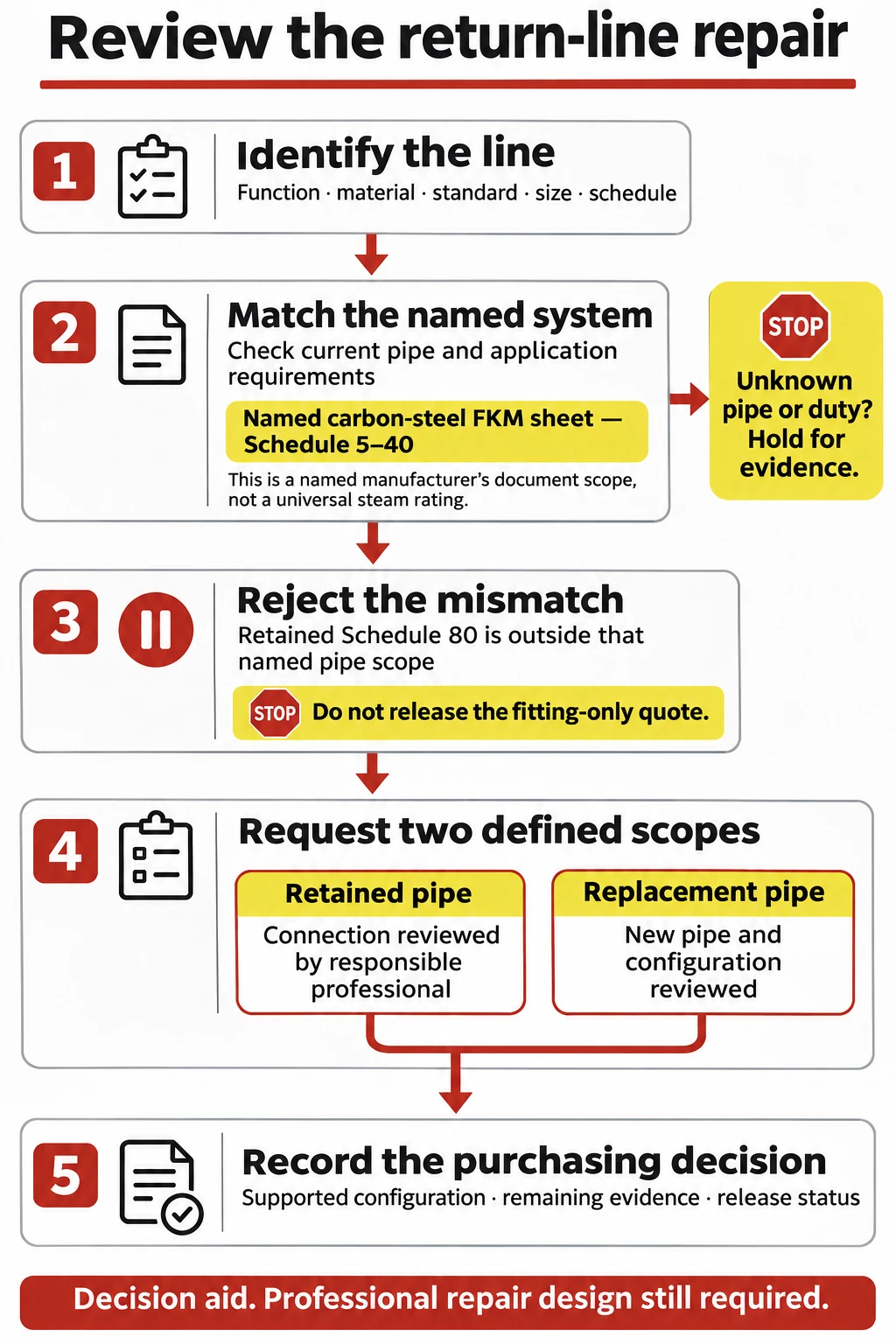
Scroll the full-size image. Complete steps remain in the article text.
- Identify each line’s function, material, standard, size and schedule.
- Compare the exact offered system with its current pipe and application requirements.
- Reject the named fitting-only proposal where the retained Schedule 80 pipe falls outside its scope.
- Request separately defined retained-pipe and replacement-pipe proposals from the responsible professional.
- Record the supported configuration, remaining evidence and purchasing decision before release.
A useful enquiry attachment has two clearly separated sections. The first records the observed or documented existing pipe and access constraints. The second identifies what the proposed work retains and what it replaces. Include the named product documents, actual service conditions, intended quantity and the documentation still required for acceptance.
Ask for availability and lead time against that defined scope. Quantity, special transitions, the approved configuration and required documents can affect an offer. Keep the supplier’s actual terms with the quotation instead of assuming that a fitting-only price includes a redesigned repair or replacement segment.
Hitze’s published press-fitting range concerns PEX and multilayer water-system fittings. A steam enquiry requires an exact offered product and its own supporting documents. Send the identified pipe, duty and defined work scope to check documented product availability. The external Viega examples establish no equivalent Hitze steam product or compatibility claim.
Conclusion
Keep the retained Schedule 80 return visible in the purchasing record. Under the two named current data sheets, neither the carbon-steel FKM offer nor a fitting-only stainless substitution resolves that pipe configuration. Prepare a specific retained-pipe or replacement-pipe enquiry, then complete the application and project review for the actual proposal received. That gives the buyer a concrete next decision and a quotation scope worth comparing.
Frequently asked questions
Does a 200 psi headline rating approve steam service at that pressure?
The two named sheets list their steam application separately as less than 15 psig. Use that specific application condition with the rest of the system requirements.
Can a stainless press fitting solve the Schedule 80 return problem by itself?
The named MegaPress 316 FKM configuration requires its specified stainless pipe. Replacing only the fitting leaves the retained carbon-steel pipe mismatch unresolved.
What belongs in the revised quotation?
Identify what pipe remains, what pipe changes, the exact offered configuration, service conditions and supporting documents. Keep the remaining acceptance requirements and actual commercial terms explicit.