A temporary compressor can change the oil exposure of an existing press-fit air line. Before accepting the changeover, identify the installed system and seal, obtain evidence for the replacement air supply, and compare the applicable manufacturer’s chart. Unknown oil carryover remains an unresolved application condition; a successful leak check does not settle chemical compatibility.
The numbers are system-specific. AusPress’s February 2025 technical note separates air below and above 1.0 mg/m³ of oil. Viega’s September 2026 application chart separates its compressed-air entries at 25 mg/m³. Those boundaries belong to different documents and assemblies. Choosing whichever number appears more permissive would discard the evidence needed for the decision.
What changed when the replacement compressor arrived?
The review starts with the service change, rather than a new fitting purchase. A hired unit may replace an unavailable compressor while the original distribution line stays in place. The useful question is whether the evidence supporting that line still covers the air now being supplied.
AusPress TN.35, Compressed Air & Press-Fit explicitly discusses a temporary or different compressor type, particularly where uptime matters. It advises checking both the system’s base material and its ring seal, and relates compressed-air suitability to the supply air’s oil content. This is a documented reason to reopen the application check; it is not a claim that every compressor replacement damages seals.
Record what changed: compressor identity, lubricant where relevant, the supplied air-quality evidence and the treatment arrangement described in that evidence. Keep the old record alongside the replacement details. “The pipe has worked for years” describes its history under the earlier service; it does not identify the replacement supply’s oil exposure.
Likewise, a compressor label does not complete the record. For this review, the evidence must address the air supplied to the existing line and be usable against its governing application document. If a supplier provides a broad air-quality statement without the oil information the chart needs, ask for the missing scope instead of assigning the statement a concentration.

Read the oil limit in the correct system chart
An elastomer family is only part of an application decision. The chart must apply to the installed product line, seal and service conditions. A useful comparison therefore preserves the document version and notes alongside the oil entry.
| Document | What it actually distinguishes | How to use it |
|---|---|---|
| AusPress TN.35, February 2025 | Dry air <1.0 mg/m³; lubricated air >1.0 mg/m³. Its table lists EPDM with a caution for the lubricated row. | Use for the listed AusPress stainless, copper and CuNiFe press-fit systems and relevant scope. Read the EPDM footnote on oil type and concentration. |
| Viega AP-PP-MP-PF 0926 | Compressed-air rows for oil concentration ≤25 mg/m³ and >25 mg/m³, with different product-line/seal columns. | Read the exact column and applicable notes for the identified Viega assembly. A number copied without its column is incomplete. |
AusPress’s footnote warns that EPDM suitability in a lubricated system can depend on the oil type and concentration, and that some oils may cause premature deterioration. Its table is not permission to ignore lubricant identity whenever a concentration has been supplied. Nor do the two strict inequalities allocate a result exactly equal to 1.0 mg/m³: that boundary needs clarification rather than an invented “less than or equal” sign.
The Viega application chart is a separate example. Its ≤25 row includes the equality boundary, but that does not answer a question about an AusPress assembly. The chart also says that systems must use the manufacturer’s recommended sealing element, and that listed operating ranges can be overruled by the sealing-element limits in its notes.
These differences are useful because they expose a common review error: combining a seal name from one source with an oil limit from another. The documents do not need a universal reconciled cutoff. The reviewer needs the document that governs the installed assembly. Where that assembly cannot be identified, neither example establishes permission to continue the changed service.
Unknown oil carryover means an unresolved condition
The following record is a hypothetical documentation example, not a measured plant result or an approved changeover. No oil concentration, field test or manufacturer response has been invented.
| Review field | Entry in this example | Decision consequence |
|---|---|---|
| Change | A temporary replacement compressor is proposed for the existing press-fit line. | Reopen the service comparison. |
| Assembly evidence | The installation record identifies an AusPress system with EPDM seals; the reviewer has TN.35, February 2025. | Use that system’s scope and notes, not Viega’s oil boundary. |
| Replacement air evidence | Oil concentration at the line supply is not documented; lubricant details are also outstanding. | Neither a numerical row comparison nor the oil-dependent EPDM assessment is complete. |
| Recorded result | HOLD — obtain the missing oil evidence and the manufacturer’s application decision for the identified assembly and proposed service. | No compatibility acceptance or replacement seal order follows from this record. |
This HOLD is specific enough to resolve. The person coordinating the temporary compressor can request the missing supply evidence; the application question can then go to the identified system manufacturer. Writing only “check EPDM” would leave the next reviewer unsure whether the missing item is the compound, lubricant, concentration or complete assembly.
If new evidence arrives, amend the record rather than treating any response as approval. Check that it addresses this replacement supply and the governing system. For AusPress, a documented value exactly at 1.0 mg/m³ would still leave the table’s equality question open. For a named Viega assembly, a value within its ≤25 entry would settle that numerical comparison only; the correct product/seal column, operating conditions and notes still need to match.
A completed comparison is therefore narrower than a universal release. An acceptable record identifies which conditions were supported and who resolved any condition outside the published scope. It does not turn a generic air specification into approval for every fitting on the network.
Record the changeover decision before ordering a different seal
The decision record should survive the return of the temporary compressor. Keep the evidence with the installation information so a later supply change can be assessed against a known configuration, rather than an assumption about whichever ring was last fitted.
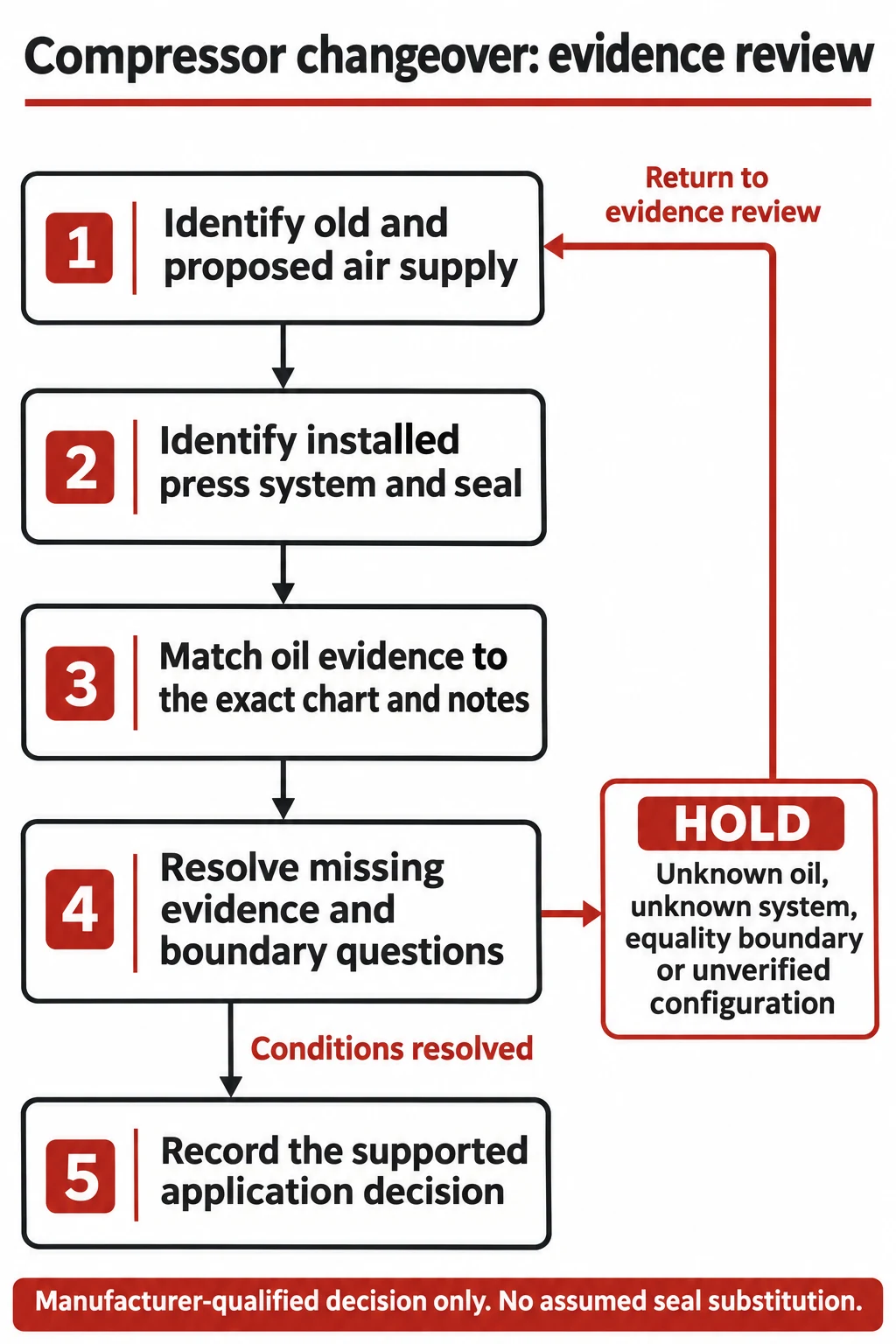
- Identify the change: record the old and proposed air source and the service information that differs.
- Identify the assembly: name the installed press system, pipe/fitting references and seal specification.
- Match the evidence: compare the supplied oil information with the exact versioned chart, operating conditions and notes.
- Keep unresolved items explicit: record unknown oil content, an unallocated boundary or an unverified configuration as HOLD.
- Record the application decision: retain the manufacturer’s answer where needed and the supported configuration; do not infer permission for a seal substitution.
Changing from EPDM to FKM is a separate configuration question, not a shortcut around missing evidence. Viega’s chart refers to proper procedures for replacing factory-installed EPDM with its specified FKM or HNBR elements in applications requiring them. That instruction concerns those Viega systems. It does not authorize a physically similar ring in another manufacturer’s fitting.
For an enquiry, send the installation identity, replacement compressor and lubricant information, available oil evidence, project operating conditions, country and the application document being used. State the unresolved condition in the request. Ask Hitze about availability and application evidence; a suitable offer and its documented scope require confirmation before purchase. No Hitze compressed-air assembly or FKM retrofit approval is established by the external examples in this article.
Keep material approval separate from a leak test
A leak check and a chemical-service review answer different questions. A check showing no leakage at that time does not supply missing oil-concentration data or establish that the installed seal remains suitable for the changed medium. The distinction matters especially when a changeover is temporary: a short intended duration does not create an application approval.
Follow the governing manufacturer’s procedures and applicable project requirements for installation and testing. This article does not provide a pneumatic test recipe, a pressure setting or permission to operate an unresolved configuration. Existing unpressed-joint detection guidance addresses a different installation check; it cannot close the oil-compatibility question.
Conclusion
Conclusion: before accepting the changed supply, preserve the old/new compressor evidence, identify the exact installed assembly and make the scoped chart comparison. If an input remains unknown, name it and assign the application question to the appropriate manufacturer. The useful result is a documented decision with clear limits, not a more confident guess about EPDM or FKM.
Frequently asked questions
Does an oil-free compressor label prove EPDM suitability?
No: the label does not establish the complete installed assembly’s application approval. Match the supplied air evidence, seal and operating conditions to its manufacturer’s requirements.
Can I replace EPDM with FKM before changing compressors?
Only when the fitting manufacturer authorizes that configuration and the applicable procedure. Physical fit or a generic material comparison is insufficient.
Does passing a leak test resolve unknown oil carryover?
No: a leak test does not provide the missing oil evidence or establish continuing chemical compatibility. Keep the application decision unresolved until the relevant conditions are supported.