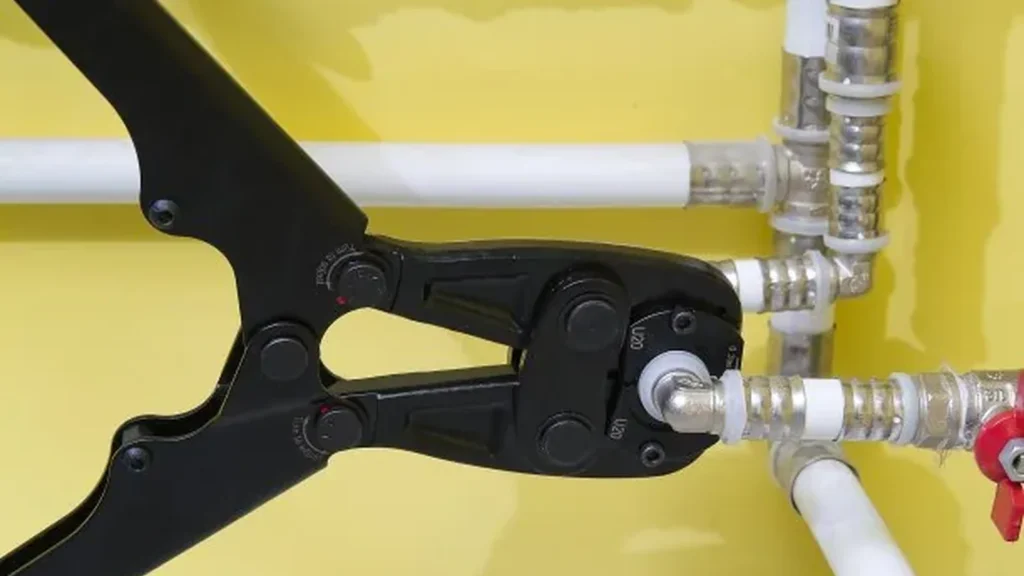
An unpressed press fitting does not necessarily announce itself with an obvious leak. A dry connection, or a system apparently holding pressure, is insufficient evidence that every joint was pressed. Named systems with a documented leak-before-press feature are designed to expose missed presses during their specified initial checks. That feature has conditions; it is not a universal property of anything sold as a press fitting.
The useful distinction is between no leakage observed and the required installation checks completed. If you are looking at a suspect installed joint, have the responsible installer identify and assess it under the exact system instructions. Do not pull, twist or try a second squeeze to see what happens.
IFAN group installation context. This video does not verify an unpressed-joint detection feature or the acceptance of any Hitze model. Watch on YouTube.
What a dry joint tells you—and what it leaves unanswered
“It is not leaking” describes an observation at a particular time and condition. “It was correctly pressed” describes a completed assembly operation. The first statement does not logically establish the second. A pressure reading also describes the system under the conditions used for that observation; it does not identify which installation steps were performed at each connection.
This matters when someone asks whether an apparently sealed joint can be left alone. Waiting for a leak is not a way to verify its assembly. Equally, seeing water near a fitting does not tell you by itself whether the cause is an unpressed connection, another installation fault or a nearby component. The symptom needs identification, not a universal repair answer.
A useful counterexample is a fully seated pipe in a viewing window with no pressing evidence. Seating may have been checked correctly, but the next operation remains a separate question. Conversely, a sleeve with a press impression does not reconstruct the pipe’s earlier position. Our insertion-depth marks and viewing-window guide explains that earlier check without treating it as proof of a completed joint.
What a documented leak-before-press feature changes
Viega’s explanation of Smart Connect says its named fittings expose unpressed connections within a specified initial-test range. The purpose is to make a missed pressing operation detectable rather than let an apparently tight connection reassure the installer.
In that published example, Viega gives initial hydrostatic testing at 15–85 psi and initial pneumatic testing at ½–45 psi, with a walk-through to find unpressed connections. These are attributed Viega instructions, not pressure settings for Hitze multilayer fittings or instructions to test an unidentified installation. The qualification is essential: the detection claim has an operating envelope. Using another pressure, another medium or another fitting system is not the same documented check. Increasing test pressure is therefore not a substitute for identifying the specified procedure. This article supplies no general pneumatic testing recipe; pressurized gas testing presents stored-energy hazards.
Viega also separates the initial identification check from final testing to local requirements. That distinction is the practical benefit of the feature: it helps find an omitted operation before the installation advances. It does not promise that every other possible defect has been excluded.
Do not translate that named example into “all press fittings must leak before pressing.” The exact product documentation must establish both the presence of a detection feature and how it is used. A catalogue photograph, familiar sleeve shape or the word “press” cannot establish either.

Three checks that cannot replace each other
| Observation | Question it addresses | What remains separate |
|---|---|---|
| Specified insertion mark or window | Was the pipe seated as the instructions require? | Completed pressing and subsequent testing |
| System-specific press indicator or completion evidence | What evidence exists of the pressing operation? | Earlier insertion and the complete installation requirements |
| Specified initial leak check | Was leakage detected under that check’s conditions? | Other assembly checks and final required testing |
The table is a way to interpret evidence, not a substitute acceptance procedure. Start by naming the observation accurately. A pipe-position window is not automatically a press indicator. A tool impression is not automatically proof that the correct tool combination was used. A successful initial check is not automatically the final test record.
Keeping those statements separate avoids two expensive errors: accepting a connection on evidence that answers a different question, and replacing sound components because an unfamiliar indicator was interpreted incorrectly. Where the disputed point is tooling, the press-tool and jaw compatibility guide addresses that separate selection task.
How to interpret a suspected missed press
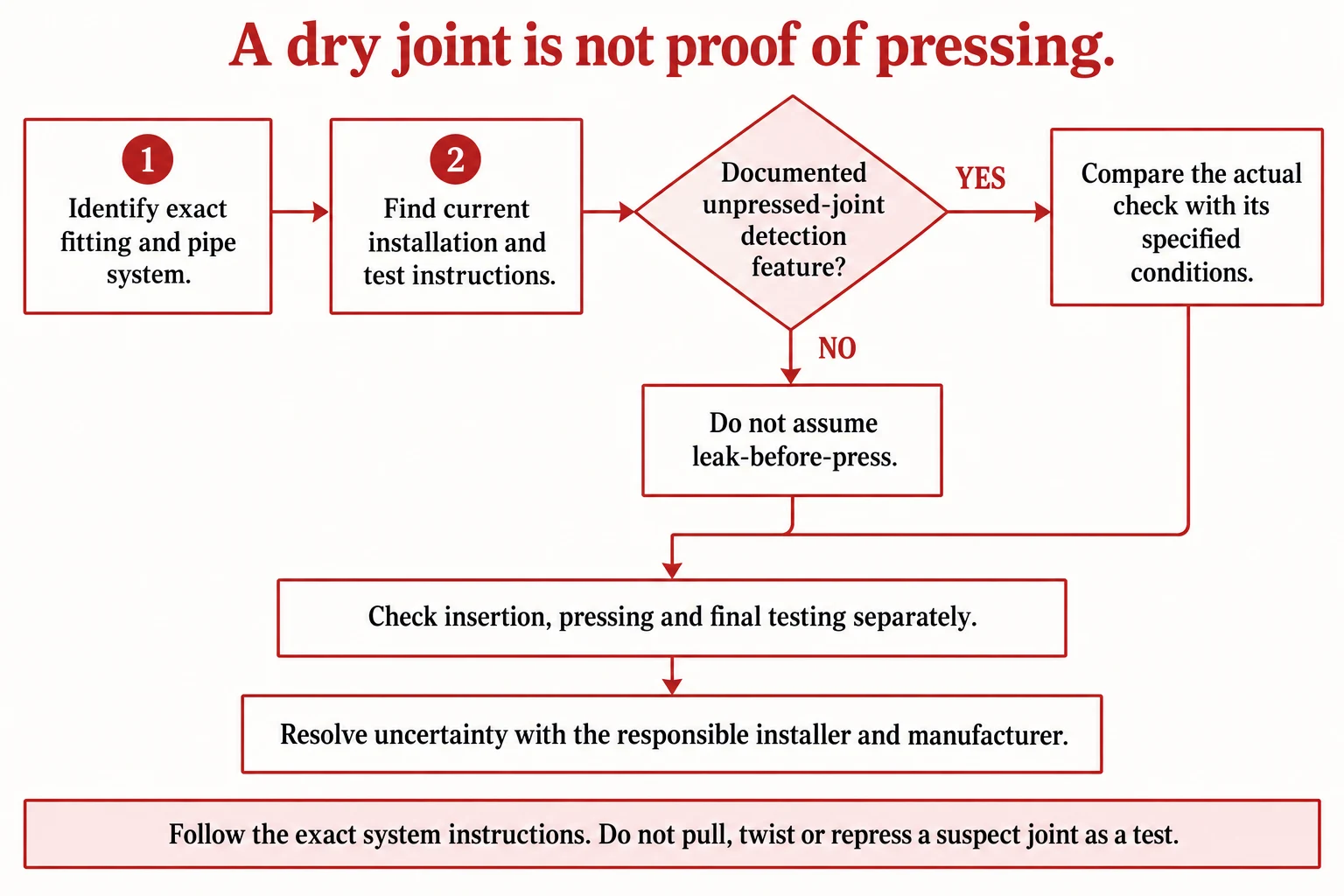
- Identify the exact connection. Establish the fitting brand, series, size and pipe system. Use its current installation and test instructions.
- Check whether unpressed-joint detection is documented. If it is, establish the specified conditions. If it is not, do not assume a generic leak-before-press function.
- Compare the actual check with the documented one. An observation outside its conditions cannot inherit its detection claim. The responsible installer must follow the approved project procedure.
- Keep the other checks in view. No observed leak does not supply missing evidence of insertion or pressing, and the initial check does not replace final testing.
- Resolve the identified uncertainty. Ask the responsible installer and system manufacturer for the exact inspection or remedy. There is no universal permission here to repress, rotate or accept a suspect installed fitting.
For example, suppose an installer identifies a named detection feature, but the only information available is “the water was turned on and nothing dripped.” The usable result is not that the feature failed, or that the fitting passed. The observation has not established that the specified check took place. Compare the actual procedure with the instructions before drawing either conclusion.
Change the condition: the specified initial check was completed successfully, and insertion and press-completion checks were also completed. That is a stronger, appropriately separated set of evidence. Final testing and project acceptance still follow their own requirements. The conclusion changes because the evidence changed, not because the joint looked dry for longer.
Choose the detection feature with the fitting system
For trade buyers, the benefit to seek is a defined way to reveal a missed operation during installation. Specify the exact feature and system rather than asking merely for a fitting that “passes a pressure test.” Confirm which series and sizes it covers, the installation instructions and how the detection check fits into the project procedure.
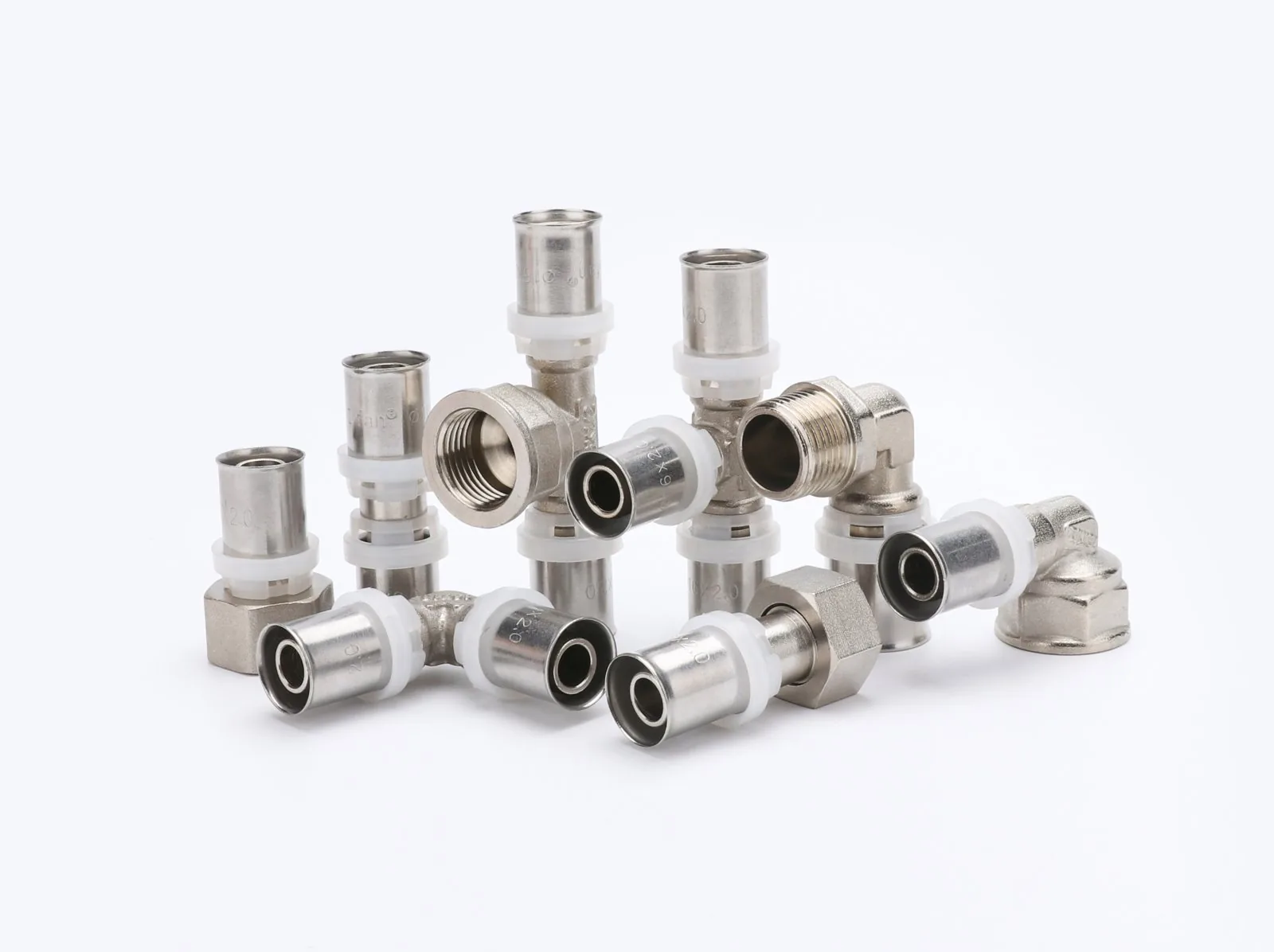
The Hitze press-fitting range is a relevant starting point for a PEX or multilayer fitting enquiry. This article does not establish that any Hitze model has Smart Connect or another leak-before-press feature. Those named external examples are technical explanations, not Hitze performance claims.
Ask whether your required fitting configuration and detection feature are available. Include the pipe marking and dimensions, project country, intended medium and the requested feature. Availability and supporting instructions need confirmation for the proposed model.


Conclusion
Absence of leakage is an observation, not proof that pressing occurred. A documented unpressed-joint detection feature makes that omission easier to expose under defined conditions. Identify the actual system, distinguish seating from pressing and testing, and assess each result against the question it can answer.
FAQ
Does every unpressed fitting leak immediately?
No universal claim is justified. A named detection feature works under its specified conditions; identify the actual series and instructions rather than relying on appearance.
Can a pressure test replace an insertion check?
No. They address different questions. Follow the exact system’s required assembly checks and test procedure.
Should I press a suspect joint again?
Do not use a second squeeze as a diagnostic. The responsible installer must establish the exact system’s inspection and remediation instructions.
Justin · Editorial research. Based on the cited manufacturer explanation and the linked installation-check guide. This article is not a site inspection or confirmation of a Hitze detection feature.