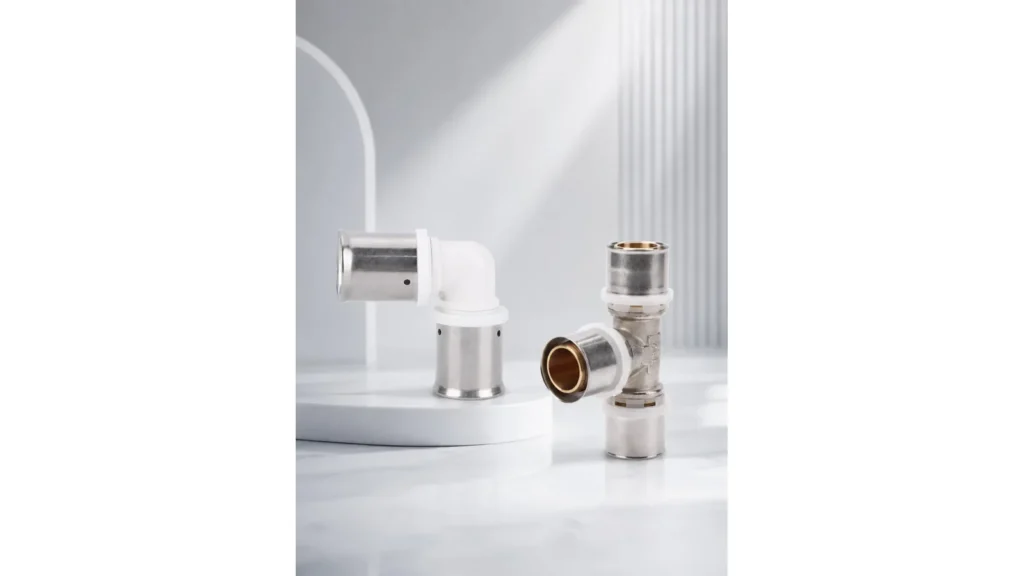
A pressed fitting that turns is not automatically a failed joint, and rotation is not permission to adjust every press system the same way. Identify the exact fitting family first. Viega’s instructions distinguish ProPress copper or stainless, MegaPress and PureFlow PEX. For an unidentified assembly, stop adjustment until its own instructions establish what is allowed.
An elbow points slightly away from the planned route. The temptation is to twist it into line and add another press “for insurance.” That combines two decisions: whether the connection may be moved, and whether the particular system permits or requires another press. Make those decisions separately before applying a tool.
Key Takeaways
- Identify the system and material before interpreting rotational movement.
- For the named ProPress example, rotation beyond five degrees calls for re-pressing under its instructions.
- The rule does not transfer to PEX press or other brands.
- For the cited ½–2-inch ProPress example, follow the stated jaw-flat alignment.
- Plan adjustment on an isolated, depressurized system; test the connections afterwards.
Read the system name before the movement
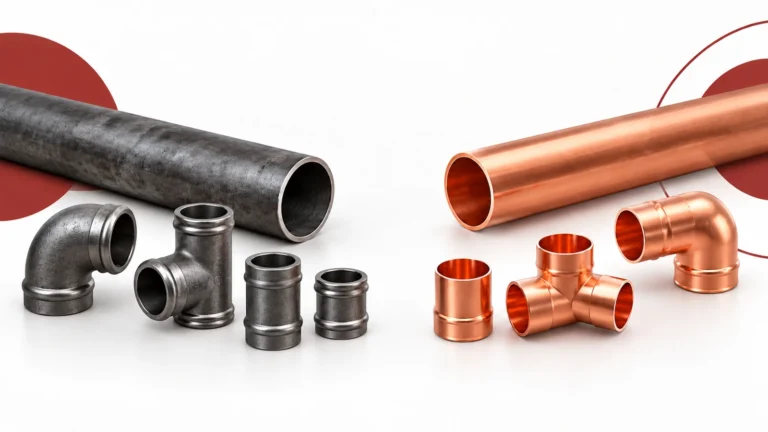
“Press fitting” describes a joining approach, not a single internal construction. Copper tube systems, steel pipe systems and PEX systems can use different gripping and sealing arrangements. A useful diagnosis starts with the marked product and installation record, rather than the amount of effort needed to turn an elbow.
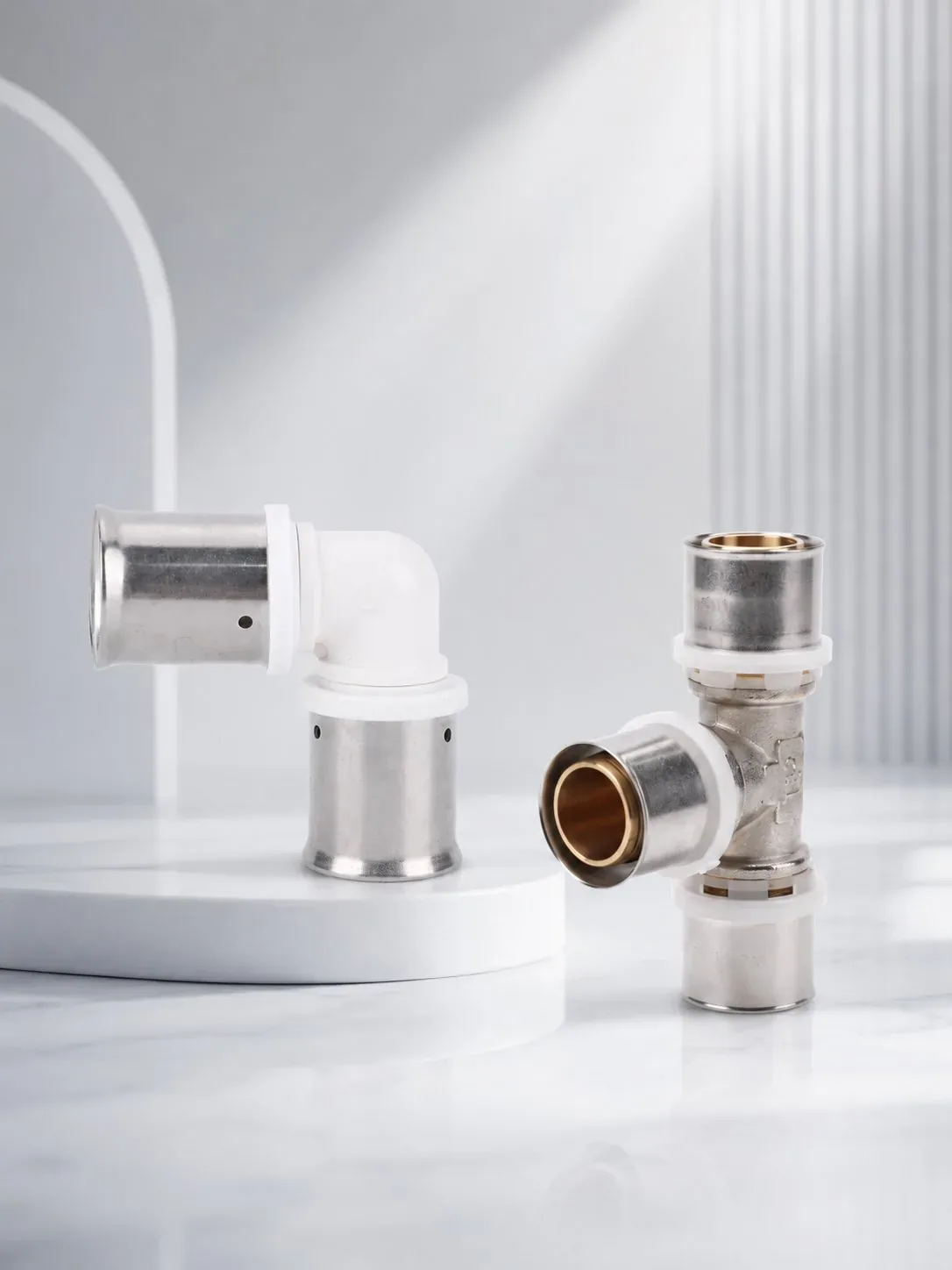
Photograph the fitting markings and the connected tube. Record the manufacturer, family, size and material. Confirm the approved jaw or ring arrangement from that family’s instructions. If the markings are hidden, the purchase record and installation documentation may help identify it. A similar-looking catalogue photograph is insufficient to authorize an adjustment.
Keep two observations separate. A fitting rotating relative to the tube is different from an entire pipe run twisting in its supports. The latter can also move neighbouring joints and connected equipment. Before deciding what the target joint permits, establish which parts would move and whether an adjustment would load another connection.
The insertion-depth check answers another question: whether the tube was seated as required. Rotation afterwards does not reconstruct missing assembly evidence. Equally, a visible depth mark cannot establish that a proposed post-press adjustment is allowed. Treat the installation record and the adjustment rule as separate evidence.
Three fitting families, three different decisions
Viega’s published explanation of rotating pressed fittings provides a useful system-specific comparison. Its ProPress copper and stainless example requires re-pressing after rotation exceeding five degrees. The accompanying jaw-flat alignment instruction is stated for ½–2-inch sizes. Its MegaPress discussion describes a different internal arrangement and allows rotation without re-pressing. For PureFlow PEX, the manufacturer recommends avoiding rotation after connection because the internal barbs can cause wear.

| Identified family | Published distinction | Decision |
|---|---|---|
| ProPress copper or stainless | Rotation beyond five degrees requires re-pressing | Follow the exact family’s adjustment and tooling instructions |
| MegaPress | Different gripping arrangement; rotation without re-pressing described | Do not import the ProPress re-press rule |
| PureFlow PEX | Manufacturer recommends avoiding rotation after connection | Re-plan the adjustment using approved instructions |
| Unknown or another brand | No permission established by these examples | Identify it before moving the connection |
Source: Viega, “Can You Rotate a Pressed Fitting?” These examples establish no Hitze product compatibility or adjustment permission.
The practical result is a different job decision for the same apparent problem. A direction correction on a documented metal press system may have a permitted route. A PEX connection beside it may require a different repair plan. “The other elbow turned successfully” is therefore poor evidence for the next connection.
Use this comparison to reject a universal rule, not to select a substitute brand’s procedure. Even within a family, verify the size, tooling and application covered by the current instructions. This guide plans adjustments with the system isolated and depressurized; it does not authorize live adjustment.
What the re-press instruction actually changes
The ProPress installation manual, section 2.5.9, states that an already pressed ProPress fitting may be rotated, but not by hand, and explains its re-press requirement as restoring resistance to rotational movement. The companion Viega article specifies aligning jaw and fitting flats for ½–2-inch sizes. For larger sizes, obtain the exact ring and actuator procedure; the small-jaw instruction does not establish it. The cited blog also calls for the jaw pattern to match the fitting: flat to flat and high point to high point within that stated small-size instruction. That is a prescribed operation for the named system; it is not an instruction to keep squeezing any joint until it feels tight.
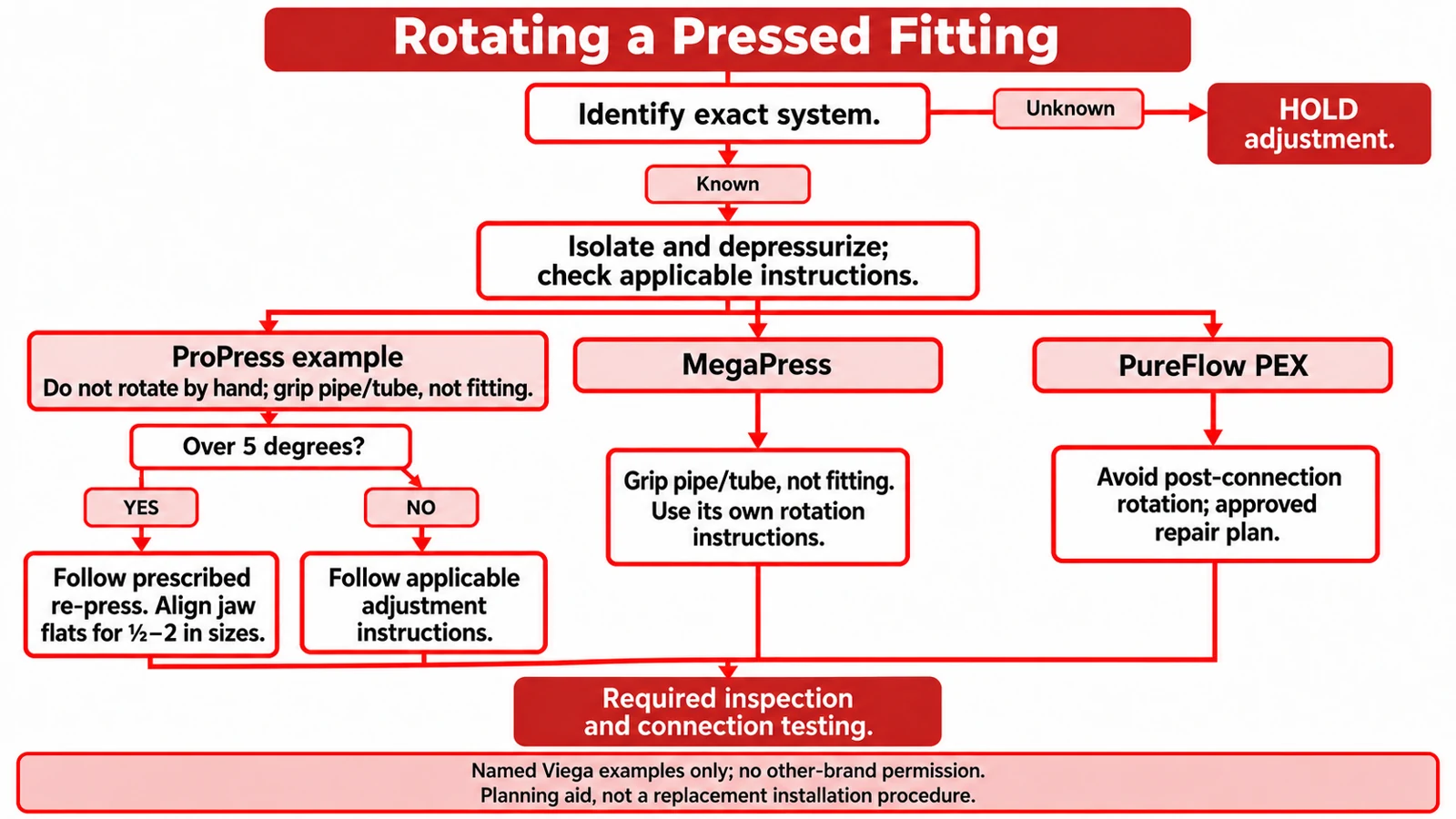

For the named Viega ProPress and MegaPress systems, Viega says never to put a pipe wrench or channel locks on the fitting. Stabilize and apply leverage to the pipe or tubing instead, with the system isolated and depressurized. This handling instruction does not establish permission for another brand or for PureFlow PEX.
Consider a transparent planning example: a confirmed 1-inch ProPress copper elbow needs a twenty-degree orientation correction. That exceeds the manual’s five-degree trigger. Plan the movement under the manual’s not-by-hand restriction. Separately, isolate and depressurize the system; keep a pipe wrench or channel locks off the fitting and use the pipe/tubing for stability and leverage. The twenty-degree correction also calls for the prescribed re-press, the applicable ½–2-inch jaw alignment and subsequent connection testing. None of these conditions substitutes for another. This is an example of reading a threshold, not a field trial or a compatibility statement for Hitze fittings.
At five degrees or less, the cited more-than-five-degree trigger is not reached. That does not waive the named system’s handling, inspection and testing instructions or resolve any separate damage or assembly concern.
Now change one input: the product family cannot be confirmed. The twenty-degree calculation has no authority over that joint. The correct result becomes “hold adjustment,” even if the available tool can physically fit around it. Resolving identity changes the decision more than measuring the angle precisely.
Do not use re-pressing as a diagnosis for a leak, split fitting, displaced tube or unresolved assembly error. Those observations require the applicable fault and repair instructions. A procedure intended to restore rotational resistance does not demonstrate that every other defect has been corrected.
Use a joint-specific adjustment record
Before the system is put back into service, the record should make the chosen branch visible to the next person. It need not be elaborate. The value comes from linking the exact connection, the reason for adjustment and the manufacturer instruction used, rather than leaving a note that merely says “re-pressed.”

| Record | Useful entry | What it settles |
|---|---|---|
| Joint identity | Manufacturer, family, size, tube material | Which instructions apply |
| Proposed movement | Orientation change and affected adjacent components | Whether this is a local adjustment |
| Instruction reference | Document, section and size-specific tooling | Whether movement and re-pressing are permitted |
| Handling / tool contact | ProPress: not by hand. Named Viega metal systems: pipe/tube tool contact only | No wrench/channel locks on fitting; isolate and depressurize; record required test |
| Return-to-service evidence | Required inspection and connection-test record | Whether the completed work has been checked |
Editorial planning aid derived from the cited manufacturer distinctions; not a replacement installation or testing procedure.
For procurement, distinguish finding a fitting category from approving a repair. Hitze’s press-fitting range is a starting point for a component enquiry. It does not establish interchangeability with the Viega examples. Submit the specification for an availability check with the project country, tube material and size, exact existing system, operating conditions and required approvals. Matching supply and the permitted repair method must both be confirmed.
Conclusion
Leave the job with a system-specific decision: identify the connection, establish whether adjustment is permitted, apply any prescribed re-press operation, then complete the required checks. If the identification or permission remains unresolved, the useful result is a documented hold and an approved alternative repair plan.
Frequently asked questions
Does a turning press fitting prove a leak?
No. Movement alone does not establish the condition of every press family. Identify the system and complete its required inspection and testing.
Can I use the five-degree rule on PEX press fittings?
No. It is a named ProPress example. Viega recommends avoiding post-connection rotation of its PureFlow PEX fittings.
Should I press again whenever I am uncertain?
Use the product’s instructions. Uncertainty about identity, assembly or damage needs investigation; it is not permission for another press.