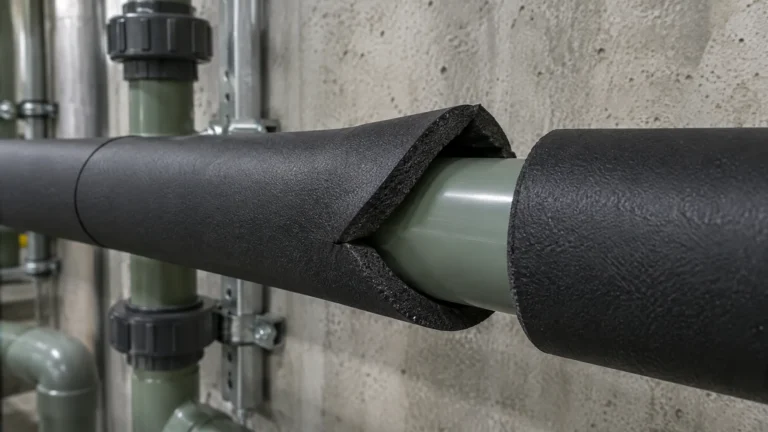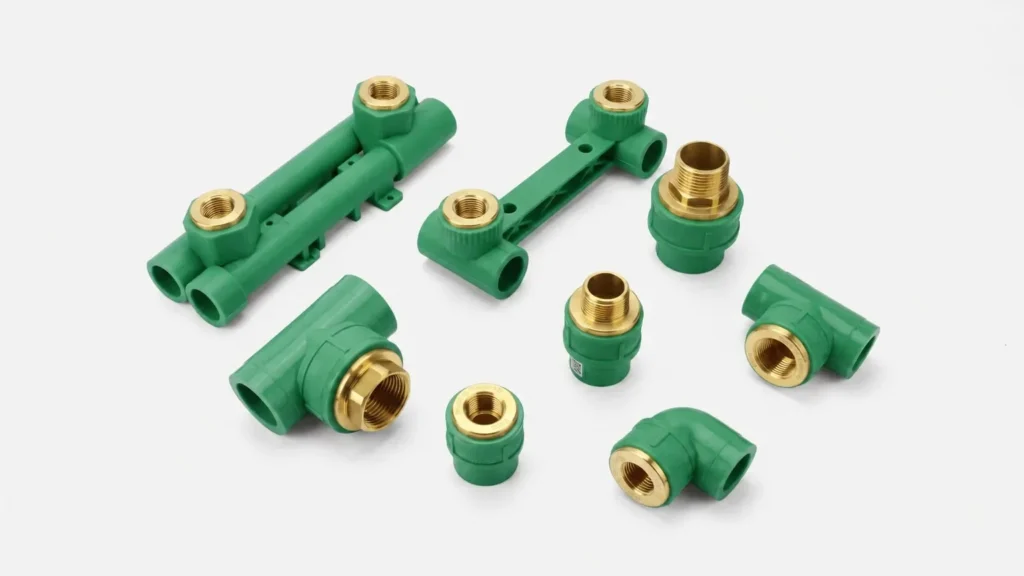
Every PP-R job on an existing building eventually reaches a galvanized riser, a brass stopcock or a steel boiler tapping, and the question of how to connect PPR pipe to GI pipe stops being theoretical. The PP-R side of that joint is straightforward — you fuse it, and the pipe and fitting become one continuous wall. The metal side is a threaded joint, and threaded joints are where callbacks come from. In a fully fused PP-R network the transition fittings are usually the only mechanical joints in the entire installation, which means a system with a hundred welds and six transitions has exactly six places it can leak.
That asymmetry is worth taking seriously at the specification stage rather than on site. PP-R moves 0.15 mm per metre for every degree of temperature change, roughly 37.5 mm on a 5 m run heated through 50 °C, while the steel it is bolted to barely moves at all. The transition fitting sits at the boundary between a material that grows and a material that does not, and it is loaded by that difference every heating cycle for the life of the building. Choosing the right transition type — and buying one whose brass insert is properly anchored — matters more than any technique you can apply on site.
Key Takeaways
- You never fuse PP-R to metal. You fuse PP-R to a brass-insert transition fitting, then thread that fitting into the GI pipe — two different joints made two different ways.
- Four SKU families cover almost every case: male-thread adapter, female-thread adapter, threaded union, and flanged adapter above roughly DN65. Pick by whether the joint must ever come apart again.
- Order the thread standard explicitly. ISO 7-1 (BSPT/BSPP) threads use a 55° flank and a 1/16 taper; NPT uses 60°. They will start together and never seal properly.
- Thread into the metal first, then fuse. Once PP-R is welded to the adapter you have lost the ability to rotate it, and people start overtightening to get alignment.
- ISO 15874-2:2013 explicitly covers PP-R joints “with components of PP, other plastics and non-plastics materials” — a compliant metal transition is inside the standard, not a workaround.
- UPC 605.16.2 requires “approved types of adapter or transition fittings designed for the specific transition intended”; IPC 605.23.2 is the equivalent clause. A shop-made joint is not that.
- Pressure-test every transition before it is concealed. PP-R design stress drops from 3.02 MPa at Class 1 to 2.12 MPa at Class 2 — hot lines have less margin for a marginal joint.
Why the Fused Side Never Leaks and the Thread Side Does
A socket-fusion joint has no seal in it. The heater plate takes the pipe outside surface and the fitting bore to 260 ±10 °C, the polymer chains on both faces become mobile, and when the two are pushed together they interdiffuse. What cools down is one piece of polypropylene with no interface left to fail. That is why a PP-R network with a hundred welds does not develop a hundred potential leak paths — it develops none, provided the welds were made to the DVS 2207 parameters.
A threaded joint is the opposite in every respect. It seals because two tapered helical surfaces are wedged against each other with a sealant filling the spiral leak path between them, and that wedge is held only by the torque you applied at assembly. Thermal cycling, vibration from a circulator pump, and the slow creep of the polypropylene surrounding the brass insert all work to relax it. This is the mechanism behind the failure buyers describe most often: a transition that passed its test at commissioning and started weeping eighteen months later behind a tiled wall.
The insert is the part you are actually buying
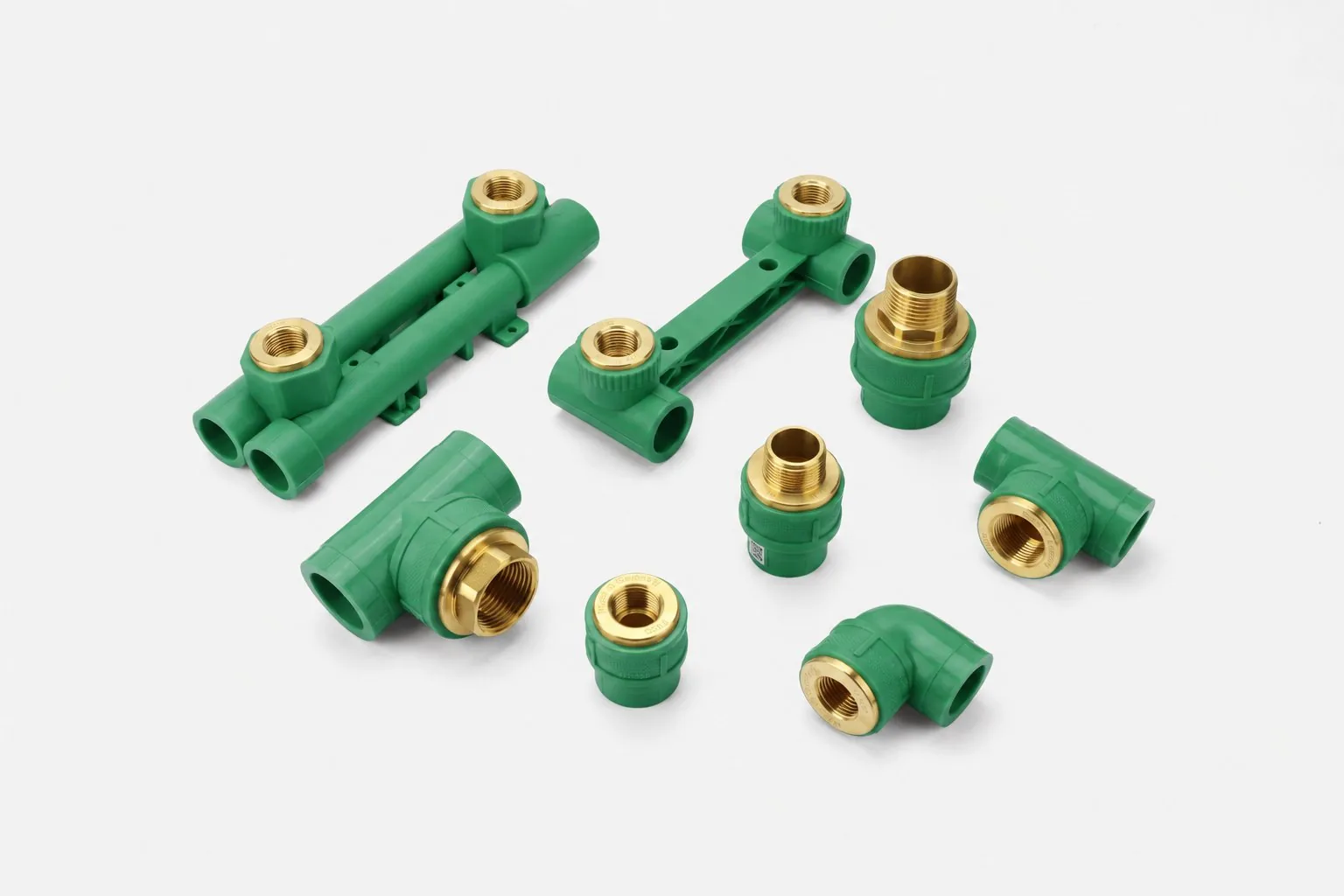
In a brass-insert transition fitting the brass is not glued or pressed in after the fact — it is placed in the mould and the PP-R body is injected around it.
The anchoring geometry on the outside of that insert, usually knurling plus a hexagonal or ribbed profile, is what stops the brass rotating inside the plastic when a wrench is put on it. A smooth-shanked insert will spin under torque, and once it spins the moulded interface is broken even though nothing is visible from outside. That is the single quality difference that separates a transition fitting that lasts from one that produces a warranty claim, and it is invisible on a photograph.
The same logic applies to the plastic. ISO 15874-2:2013 Table 11 requires PP-R to show longitudinal reversion of no more than 2 % when oven-tested by Method B of ISO 2505 at 135 °C. That test is a proxy for how much frozen-in stress the extrusion left behind. A PP-R body moulded around brass with excessive residual stress will relieve that stress over time in exactly the place you do not want it relieved — around the insert.
The Four Real Transition SKUs and What Each One Is For
Catalogues list dozens of transition part numbers, but almost all of them are size and configuration variants of four functional families. Getting the family right is a specification decision; getting the size right is a takeoff exercise. Buyers who confuse the two end up with a container of male adapters and a job that needed unions.
| Transition family | Metal side | Use it when | Avoid it when |
|---|---|---|---|
| Male-thread adapter (MTA) | R taper external | Screwing into a GI socket, a valve body or a female wall tapping | The mating female part is a thin-wall casting that may split |
| Female-thread adapter (FTA) | Rp parallel or Rc taper internal | Receiving an existing GI male spigot or a tap tail you cannot rotate | Exposed to hoop stress from an overtightened male taper |
| Threaded union (three-part) | Flat-face seat plus nut | At a boiler, pump, meter or any appliance that will be replaced | Fully concealed with no access panel |
| Flanged adapter (stub + backing ring) | Bolted flange face | Plant rooms and mains roughly DN65 and above | Small-bore branches where it is pure cost |
The union deserves more attention than it usually gets. Its seal is a flat gasketed face compressed by a nut, not a wedged taper, so it can be broken and remade repeatedly without degrading — which is exactly what you need where a water heater or circulator will be swapped in ten years. On a male-thread adapter, breaking and remaking the joint means cutting away sealant, re-taping and re-torquing a plastic-bodied fitting that has already been stressed once. Specifying unions at every serviceable appliance and male adapters everywhere else is the single decision that most reduces future callbacks.
Where the size range runs out
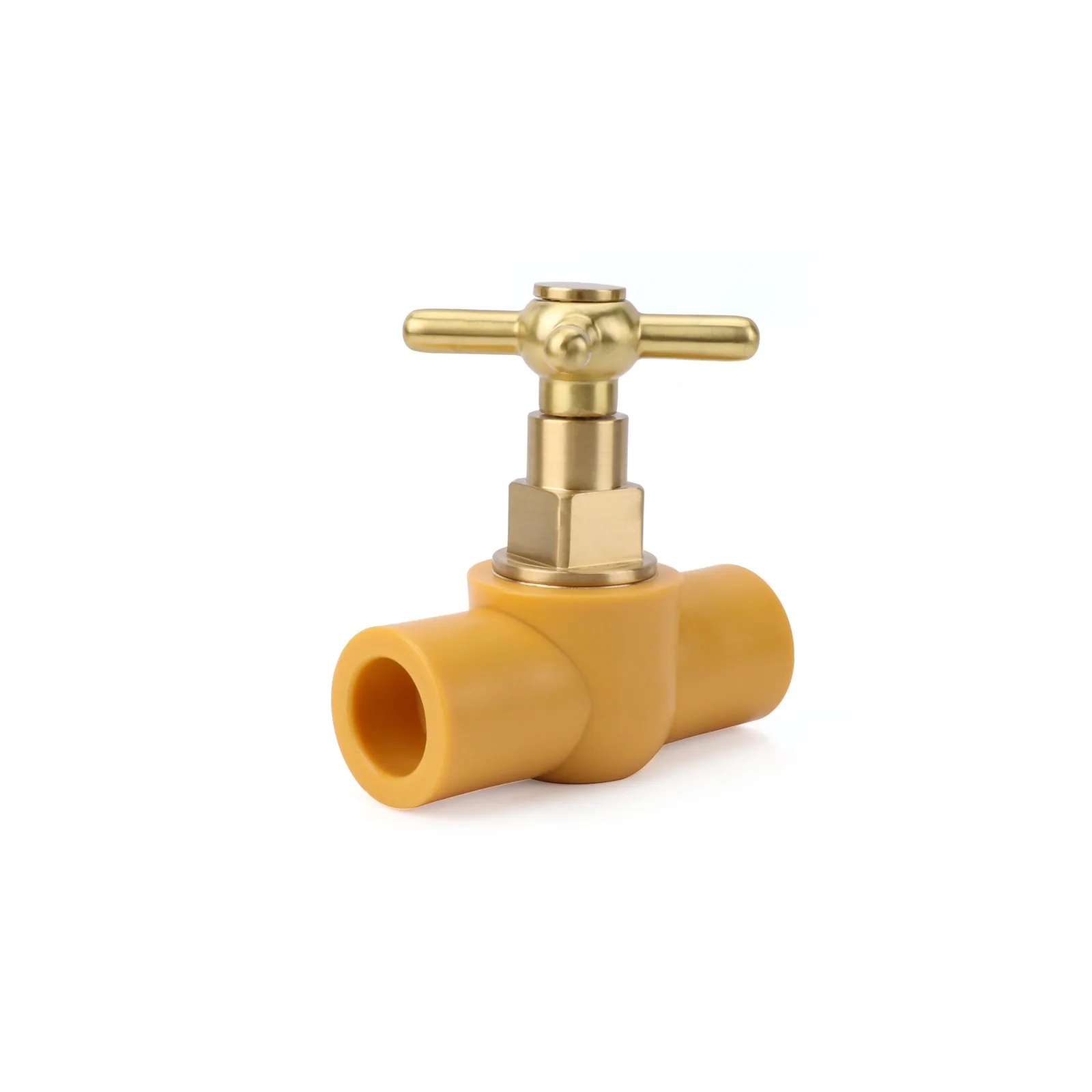
Threaded transitions are practical across the common branch sizes and become awkward above them. In the Hitze PP-R range, which runs OD 20–110 mm (DN15–90), the threaded families cover the small and mid sizes and the flanged adapter takes over at the top of the range. If your takeoff has 90 mm and 110 mm transitions in it, budget for flanges, backing rings, gaskets and bolt sets rather than assuming a threaded part exists — that assumption is a common cause of a short shipment discovered on site.
Thread Standards: BSP, NPT and the Mismatch That Passes a Test Then Weeps
This is the most expensive mistake available on a PP-R-to-metal job, and it is a purchasing mistake, not an installation one. ISO 7-1:1994 covers jointing pipe threads in sizes 1/16 to 6 inclusive and designates them R for a taper external thread, Rc for a taper internal thread, and Rp for a parallel internal thread — all cases where the pressure-tight joint is made on the threads themselves. The external thread carries a taper of 1/16, and the profile height between rounded crests and roots is defined as h = 0.640327 P.
NPT is a different system. The commonly published flank angle for ISO 7 threads is 55° against 60° for NPT, and the thread forms differ in crest and root treatment as well.
The practical consequence is what catches people out: an NPT male will thread into a BSP female for several turns and feel tight. The flanks are not in contact along their faces, so the joint is being sealed by PTFE tape squeezed into a gap rather than by metal wedged on metal. It holds a short commissioning test at ambient temperature and starts weeping once thermal cycling begins to extrude the tape out of the gap.
Two things make this worse in a PP-R context. Pitch is identical across some adjacent sizes — 1/2 and 3/4 both run 1.814 mm pitch, or 14 threads per 25.4 mm under ISO 7-1 — so a mismatch is caught by diameter rather than by the feel of the thread starting. And the female half is often the plastic-bodied fitting, so an installer forcing an incompatible male taper is putting hoop stress into the moulded PP-R around the brass rather than into steel.
State the thread standard on the purchase order, not just the size. “25 mm x 3/4 male adapter” is not a specification; “25 mm x R 3/4 to ISO 7-1” is.
Which Transition Type Should You Actually Specify?
Work through three questions in order, and the SKU falls out of the answers rather than out of what the wholesaler had on the shelf.
First, will this joint ever need to come apart? If a serviceable appliance sits on the other side of it — boiler, calorifier, pump, water meter, pressure-reducing valve — specify a union and give it an access panel. Everything else can be a threaded adapter.
Second, which side can rotate? If the metal side is fixed, as it is on a wall tapping or an existing riser stub, you need the PP-R side to be the male part that turns into it, and that means a male-thread adapter installed before the fusion weld. If neither side can rotate, you need a union regardless of serviceability, because there is no other way to make the joint up.
Third, what is the operating temperature? PP-R design stress under ISO 15874-2:2013 Table A.2 is 3.02 MPa at Application Class 1 but only 2.12 MPa at Class 2, and 6.93 MPa at 20 °C over a 50-year design life. A transition sitting in a 70 °C flow line has substantially less material margin than the same part on a cold feed, which is where the extra cost of a union or a heavier-walled fitting is genuinely justified.
Best for, and not for
| A brass-insert PP-R transition is right for | It is the wrong answer for |
|---|---|
| Retrofitting PP-R into a building with existing GI or steel risers | Joints you can eliminate entirely by running PP-R all the way to the fixture |
| Terminating at metal-bodied valves, taps, meters and appliances | Buried or fully concealed runs with no access and no test provision |
| Distributors stocking for mixed-material repair and maintenance work | Systems above roughly DN65, where flanged adapters are the correct family |
| Plant rooms where appliances will be swapped inside the pipework’s life | Aggressive or high-chloride water where brass alloy selection needs its own review |
A worked example makes the arithmetic concrete. Take a six-storey residential retrofit: a GI riser stays in place, PP-R branches serve each apartment, and each apartment has a wall-hung boiler. Per apartment that is one female-thread adapter onto the riser stub, one union either side of the boiler, and male adapters at each of four fixture tails.
Across 24 apartments the takeoff is 24 female adapters, 48 unions and 96 male adapters — and every one of the 48 unions is there so that a boiler replacement in 2038 does not require cutting into a wall. That is the specification decision the SKU list should reflect, and it is not visible from a fitting catalogue sorted by diameter.
For importers, distributors and MEP contractors specifying PP-R against existing metal: the catalogue lists male, female, union and flanged transitions across OD 20–110 mm with the thread designation on each part, so a wholesale order can be checked against ISO 7-1 before it ships.
Making the Joint: Thread First, Fuse Second
The order of operations is the part experienced installers get right and everyone else gets wrong. Make the threaded joint into the metal first, while the transition fitting is a loose part you can turn freely with a wrench on its brass hex. Only then fuse the PP-R pipe into its socket.
Do it the other way round and the fitting arrives at the metal already welded to a length of pipe, which means the only way to rotate it is to rotate the whole pipe run — and when that becomes impossible at three-quarters of a turn, the installer reaches for a longer wrench instead. That is the origin of most cracked transition bodies.

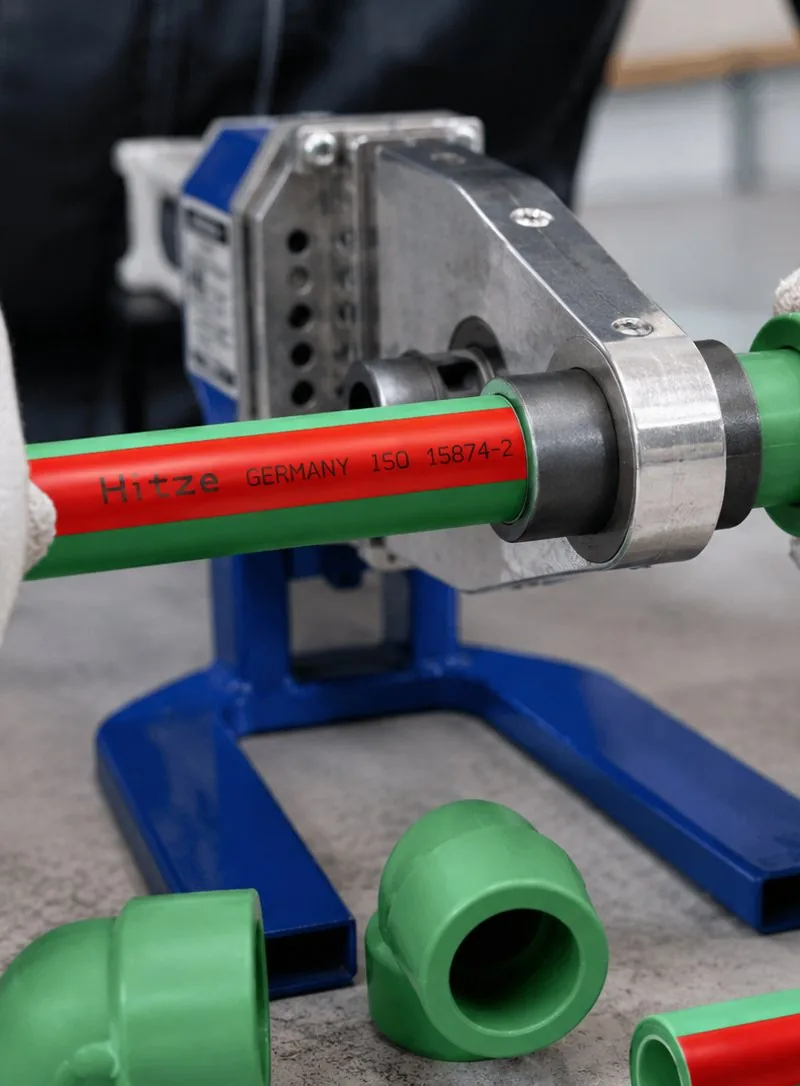
On the fusion side, run the standard DVS 2207 parameters — a heater plate at 260 ±10 °C, and heating, processing and cooling times by diameter. A machine whose plate temperature drifts will not tell you it is drifting, which is why the choice of welding machine matters more on a job with transitions than on a plain run.
Two details matter more on a transition fitting than on a plain socket. Keep the heater plate off the brass: heat conducted into the insert expands it inside the still-soft PP-R body and can pre-load the moulded interface. And observe the full cooling time before applying any load, because the joint has no mechanical strength while the polymer is still above its softening range.
| Outside diameter | Heating time | Processing time | Cooling before load |
|---|---|---|---|
| 20 mm | 5 s | 4 s | 2 min |
| 25 mm | 7 s | 4 s | 2 min |
| 32 mm | 8 s | 6 s | 4 min |
| 50 mm | 18 s | 6 s | 4 min |
| 63 mm | 24 s | 8 s | 6 min |
One more constraint that only appears on transitions: allow for expansion on the PP-R side of the joint. At 0.15 mm/m·K, a 5 m branch running through a 50 °C swing moves 37.5 mm. That movement has to be absorbed by an expansion loop, a change of direction or a properly designed sliding support — not by the transition fitting, which is anchored at one end to something that does not move.
Where the layout cannot give you that, glass-fibre-reinforced PPR-FB-PPR pipe cuts the coefficient to 0.035 mm/m·K, roughly a quarter of the movement over the same run. That is a design change, not a site fix, so it belongs in the specification.
Sealant, Tightening and the Overtightening Failure
ISO 7-1 threads are designed so that the pressure-tight joint is made on the threads, but the standard’s own designation covers parallel internal threads (Rp) as well as taper (Rc), and a taper male into a parallel female cannot seal on wedging alone.
In practice every one of these joints gets a sealant: PTFE tape wound in the direction of thread engagement so tightening does not unwind it, or an anaerobic thread sealant, or PTFE-loaded paste. Tape and paste together is common trade practice and is not a fault, but the quantity matters — a thick tape build-up on a taper thread acts as a wedge and generates hoop stress in the female part at a much lower applied torque than the installer expects.
There is no published torque figure for PP-R brass-insert threads in the way there is for a flanged bolt pattern, and any specific number you find online should be treated with suspicion unless it comes from the fitting manufacturer’s own technical data sheet. The practical rule is that these joints are typically taken hand-tight plus roughly one to two turns with a wrench on the brass hex, stopping as soon as the joint feels solid rather than pulling to a stop. This is deliberately a hedged statement, because the honest position is that the figure depends on thread size, sealant type and the specific fitting.
What is not hedged is where the load goes. The wrench must sit on the brass hex, never on the PP-R body, and never on the plastic collar of a female adapter. Torque applied to the polymer is transmitted straight into the moulded brass-to-plastic interface, which is precisely the interface with no visible failure indication. The classic sequence is: overtighten to stop a small weep, feel it stop, backfill and tile, and have the joint fail properly a year later when creep has relaxed what was an over-stressed joint from the start.
Galvanic Corrosion and What the Codes Actually Require
A brass-insert PP-R fitting threaded into galvanized steel puts two dissimilar metals in direct electrical and electrolytic contact, and that is a genuine galvanic couple regardless of the plastic body around one of them. The zinc coating on the GI is anodic to the brass and will sacrifice itself preferentially at the joint. What the plastic body does not do is act as a dielectric break — the current path runs through the metal-to-metal thread contact, not through the PP-R.
Model codes address this directly, though requirements vary by jurisdiction, product and the specific materials in contact, so the local authority’s adopted edition is what governs. Under the 2021 Uniform Plumbing Code, Section 605.15 requires that “dielectric unions, where installed at points of connection where there is a dissimilarity of metals, shall be in accordance with ASSE 1079”, and Section 605.16.1 permits a copper alloy adapter, a copper alloy nipple of minimum 6 inches, a dielectric fitting or a dielectric union to ASSE 1079 at copper-to-threaded-steel joints.
For plastic-to-metal specifically, UPC 605.16.2 requires that “approved types of adapter or transition fittings designed for the specific transition intended shall be used”; IPC 605.23.2 is the equivalent clause, and IPC 605.23.1 mandates a copper-alloy or dielectric fitting conforming to ASSE 1079 for copper-to-galvanized-steel.
The practical reading for a specifier is that a listed PP-R transition adapter satisfies the “approved transition fitting” requirement, but it does not by itself satisfy a dielectric-separation requirement where one applies, because the brass and the zinc are still touching. Where the water chemistry or the adopted code calls for separation, the answer is a dielectric union or an approved brass nipple upstream of the PP-R transition — two fittings, not one. Confirm the current requirement with the authority having jurisdiction rather than assuming a fitting listing covers it; this is a point where the code text and common site practice diverge widely between markets.
Quality Control: What We Check Before a Transition Fitting Ships
Because the anchoring of the brass insert is invisible in a photograph and only shows up years later, the checks that matter happen before the container is booked. The Hitze in-house sequence is documented as: resin verified before extrusion; outside diameter, wall thickness at multiple points and ovality checked against the S-series tables; and pipes, fittings and fused joint assemblies pressure-tested on in-house hydrostatic benches against DIN and EN ISO thresholds. Fused joint assemblies, not just loose fittings, is the part a buyer should look for — testing a fitting in isolation says nothing about the joint it will form.
Ask what the bench actually proves, in numbers. The ISO 15874-2:2013 thermal-stability test runs water-in-air at 110 °C against a hydrostatic hoop stress of 1.9 MPa for PP-R, on three test pieces, held for 1 h on walls up to 8 mm, 2 h from 8 mm to 16 mm, and 4 h above 16 mm. The longitudinal-reversion limit is ≤2 % by Method B of ISO 2505 at 135 °C for PP-R. Dimensional checks are against the S-series tables across the OD 20–110 mm range.
The design-stress values the assembly has to live with are 3.02 MPa at Application Class 1 and 2.12 MPa at Class 2. A supplier who can quote you those numbers for the specific transition SKU is testing it; one who describes the process without them is describing a room with machines in it.
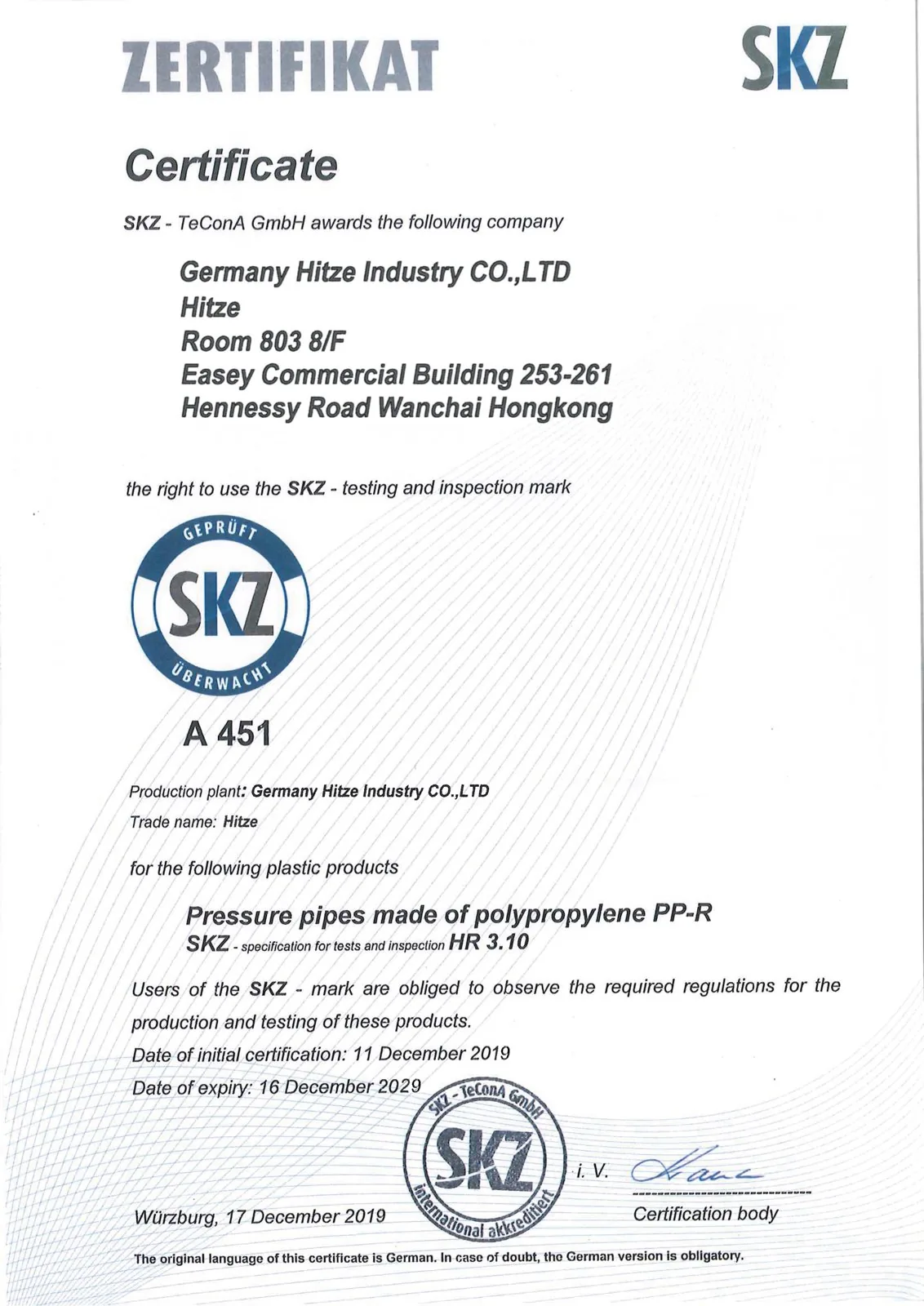
On credentials, ask which scope each one covers rather than accepting a logo wall — SKZ testing, a DVGW type examination, WRAS material approval and an NSF BS 6920 report each name a specific product scope, and Hitze’s are listed with theirs.
Each of those names a scope, and a credential covering pressure pipe is not automatically a credential covering a brass-insert transition fitting. Each of those is listed with its scope on the certifications and compliance page. Certificate numbers and the exact covered models are available on request; the useful question on a first email is which certificate covers the specific transition SKUs on your list.
On the commercial side: Hitze operates with no minimum order quantity, with private-label and ODM support and a 50-year product warranty on the product — terms confirmed by the company on 2026-07-21, with quote-specific inclusions, lead time and warranty conditions to be set in writing per project.
Pricing on transition fittings is not a single published figure, and any supplier quoting one without seeing your size mix is guessing: the price structure is driven mainly by brass content and thread machining rather than by the PP-R, which is why a male adapter costs more than a plain socket of the same diameter, why the per-unit number moves with copper and zinc rather than with polypropylene, and why a takeoff heavy in unions prices very differently from one heavy in plain adapters. Ask for the quote against your actual SKU list and diameter split rather than a single per-piece rate.
Whatever supplier you are evaluating, the insert-anchoring test costs almost nothing and settles the question the certificates cannot. Get one physical test piece of the exact transition SKU you intend to stock — alongside the mill test report or third-party test certificate for that model — clamp the PP-R body lightly, put a wrench on the brass hex and apply the torque a normal installer would.
If the brass turns inside the plastic, the moulded interface is inadequate and no amount of site technique will save it. Do that on one part before you commit a container, rather than discovering the answer through warranty claims two years into the stock. The PP-R fittings catalogue lists the transition families and their thread designations, and the PP-R specification and submittal checklist covers what to put on a submittal package.
Proving the Joint Before It Disappears Into a Wall
Every transition should be pressure-tested while it is still visible and still accessible, and the test should be held long enough to reveal a slow weep rather than just a burst. A threaded joint that is marginal will not fail instantly — it will pass a two-minute test and lose pressure over an hour. Test the whole section including the metal side, not just the PP-R, because a transition that is sound on the fused half and weeping on the threaded half is exactly the failure this article exists to prevent.
Test parameters and hold times come from the adopted local standard and the system designer, and they differ between EN, ASTM and national practice, so use the figure your specification names rather than a generic one.
What is universal is the sequencing: fuse, let the joints reach full cooling, make up the threads, fill, vent, pressurise, hold, inspect every transition individually, and only then allow the joint to be boxed in. Where a transition genuinely must be concealed, put an access panel over it — the cost of a panel is trivial against the cost of opening a tiled wall, and it is the difference between a ten-minute repair and a two-day one.
Conclusion
Connecting PP-R to GI, copper or threaded brass is not a difficult joint to make, but it is the only mechanical joint in an otherwise fully fused system, so it carries the whole system’s leak risk. The decisions that determine whether it lasts are made before anyone reaches the site: the right transition family for whether the joint must ever come apart, the thread standard written explicitly on the purchase order, and a fitting whose brass insert is anchored well enough to survive the torque it will see.
If you are building a takeoff or qualifying a supplier for this kind of work, it is worth comparing transition families and thread designations across the full size range before you commit to a mix. Reviewing the socket-fusion procedure and the EN ISO 15874 service classes alongside it will tell you whether the class you are designing to leaves enough margin at the transitions.
Frequently Asked Questions
Can you weld PPR directly to a GI pipe?
No. Heat fusion only bonds polypropylene to polypropylene. You fuse the PP-R to a brass-insert transition fitting, then thread that fitting into the GI pipe — two separate joints made by two different methods.
Should I use PTFE tape or thread paste on a PP-R transition?
Either works, and many installers use both. Wind tape in the direction of thread engagement so tightening does not unwind it, and keep the build-up thin — thick tape on a taper thread wedges the female part and stresses it well below the torque you expect.
Will a BSP fitting screw into an NPT thread?
It will start and feel tight, but it will not seal reliably. ISO 7 threads use a 55° flank against NPT’s 60°, so the joint is held by sealant in a gap rather than by mating flanks, and it commonly weeps once thermal cycling starts.
Do I need a dielectric union between PP-R and galvanized pipe?
Possibly, depending on the adopted code and water chemistry. The plastic body is not a dielectric break — the brass insert still touches the steel. UPC 605.15 points to ASSE 1079 dielectric unions at dissimilar-metal connections; confirm with your local authority.
Why does my PP-R transition fitting crack after a few months?
Almost always overtightening, or a wrench applied to the plastic body instead of the brass hex. Both put stress into the moulded brass-to-plastic interface, which then relaxes by creep and opens a leak path with no external warning.
What size PP-R transitions are available?
The Hitze PP-R range runs OD 20–110 mm (DN15–90). Threaded transition families cover the small and mid sizes; above roughly DN65 the correct family is a flanged adapter with a backing ring, gasket and bolt set.
Should transitions be used on hot lines?
Yes, but with less margin. PP-R design stress under ISO 15874-2:2013 falls from 3.02 MPa at Application Class 1 to 2.12 MPa at Class 2, so a hot-flow transition justifies a union, an access panel and a longer hold on the pressure test.