Key Takeaways
- Plain PEX and plain PP-R grow typically 0.15–0.20 mm per metre per Kelvin. Multilayer PEX-AL-PEX grows about 0.025 mm/(m·K) — six to eight times less — because the welded aluminium core, not the plastic, sets the length.
- On a 30 m hot riser at ΔT 40 K: PEX moves 180–240 mm, plain PP-R about 180 mm, fiber-composite PP-R roughly 42 mm, multilayer about 30 mm — against roughly 20 mm for copper.
- Expansion never disappears; it only relocates. Either you give it a bending leg or loop to bend into, or it finds a tee, a clamp or a press joint and loads that instead.
- The two formulas that decide your riser detail: ΔL = a × L × Δϑ for growth, and LBS = k√(OD × ΔL) for the bending-leg length. A low coefficient shrinks every compensation dimension downstream.
- Hitze builds 5-layer PEX-AL-PEX with a butt-welded aluminium core, matched fittings, a 50-year system warranty and a sample-first, no-MOQ program — so you can verify the low-expansion behaviour before committing a container.
The failure mode that thermal expansion produces is never dramatic on day one. A 30-metre plastic riser goes in cold in March, gets clamped tight at every floor because that is what the bracket schedule said, and passes its pressure test perfectly. Then the first heating season puts 60 °C water through it, the pipe tries to grow 180 millimetres, and every millimetre it cannot express as movement turns into force — shear on branch tees, bending moment on press sleeves, compression buckling between clamps. The leak arrives in year two or three, in the riser shaft, behind finished walls. By then the engineer who stamped the drawing owns it.
This article puts real numbers on pipe thermal expansion for the three plastic families that dominate hot-water and heating work — PEX, multilayer PEX-AL-PEX and PP-R (plain and fiber-reinforced) — then walks one 30 m riser through the maths for each, so you can see exactly what the coefficient does to your fixed-point and expansion-loop design. Every coefficient below comes from manufacturer technical datasheets, and the ranges are labelled as typical, because individual SKUs vary and the datasheet for the pipe you actually buy is the number that governs.
The coefficients that drive everything else
Linear thermal expansion is governed by one line of arithmetic: ΔL = a × L × Δϑ, where a is the material’s expansion coefficient in mm/(m·K), L is the straight run length in metres, and Δϑ is the temperature swing in Kelvin. That formula is common to every serious pipe planning guide, because nothing about it is negotiable. The only variable a designer truly controls is a — by choosing the pipe construction.
Here are the typical datasheet values. The load-bearing PEX number is grounded to a published manufacturer datasheet: Viega publishes 9.2 × 10⁻⁵/°F for its PureFlow PEX tubing at 68 °F, tested to ASTM D-696 — and that is the conversion worth doing carefully: 9.2 × 10⁻⁵/°F × 1.8 = 16.6 × 10⁻⁵/°C, which the same datasheet rounds to 15 × 10-5/°C, i.e. 0.15 mm/(m·K) at 20 °C. PEX coefficients drift upward with temperature, so hot-service figures nearer 0.20 mm/(m·K) appear in other PEX datasheets. Typical published multilayer PEX-AL-PEX datasheet values cluster at ~0.025–0.026 mm/(m·K) — Valsir’s Pexal multilayer TDS states 0.026 mm/(m·K) for its PE-Xb / butt-welded-aluminium composite — and the recurrence of that band across independent factories is itself the tell that the number belongs to the aluminium core, not any one brand. Worth noting for the spec desk: where a multilayer coefficient is quoted to ASTM D-696, that standard measures over a −30 to +30 °C reference band, not hot service — but unlike all-plastic PEX, the aluminium-dominated composite barely drifts with temperature, so the reference-condition figure is a fair guide to hot-riser behaviour. Plain PP-R sits around 0.15 mm/(m·K); glass-fiber composite PP-R around 0.035; aluminium-composite PP-R around 0.030.
| Pipe construction | Typical coefficient, mm/(m·K) | Growth: 30 m at ΔT 40 K | vs copper (~0.017) |
|---|---|---|---|
| PEX (PEX-a/b/c, all-plastic) | 0.15–0.20 | 180–240 mm | ~9–12× |
| PP-R homopolymer wall (plain) | ~0.15 | ~180 mm | ~9× |
| Fiber-composite PP-R (PPR-FB-PPR) | ~0.035 | ~42 mm | ~2× |
| PPR-AL-PPR (aluminium composite) | ~0.030 | ~36 mm | ~1.8× |
| Multilayer PEX-AL-PEX / PERT-AL-PERT | ~0.025 | ~30 mm | ~1.5× |
Two things in that table deserve a second look. First, the gap between all-plastic and metal-bound constructions is not incremental — it is a factor of six to eight. Bonding an aluminium layer into the wall cuts expansion by roughly 85% against plain PEX. Second, plain PP-R expands just as much as PEX, which surprises engineers who associate PP-R’s rigid straight lengths with dimensional stability. Rigidity and expansion are different properties; PP-R is stiff and it grows 0.15 mm/(m·K), which is exactly why fusion-welded PP-R risers need deliberate compensation — the joints are monolithic and will not slip to relieve anything.
One spec-desk warning: insist that the coefficient appears on the datasheet with its test standard — ASTM D-696 or DIN 53752 are the usual references — and at a stated temperature. A brochure that says “low expansion” without a number and a method is a marketing claim, not an engineering input. When we quote Hitze multilayer, the coefficient, the test method and the reference temperature travel together on the technical sheet, because a value without conditions cannot be checked.
Why the aluminium core changes the physics
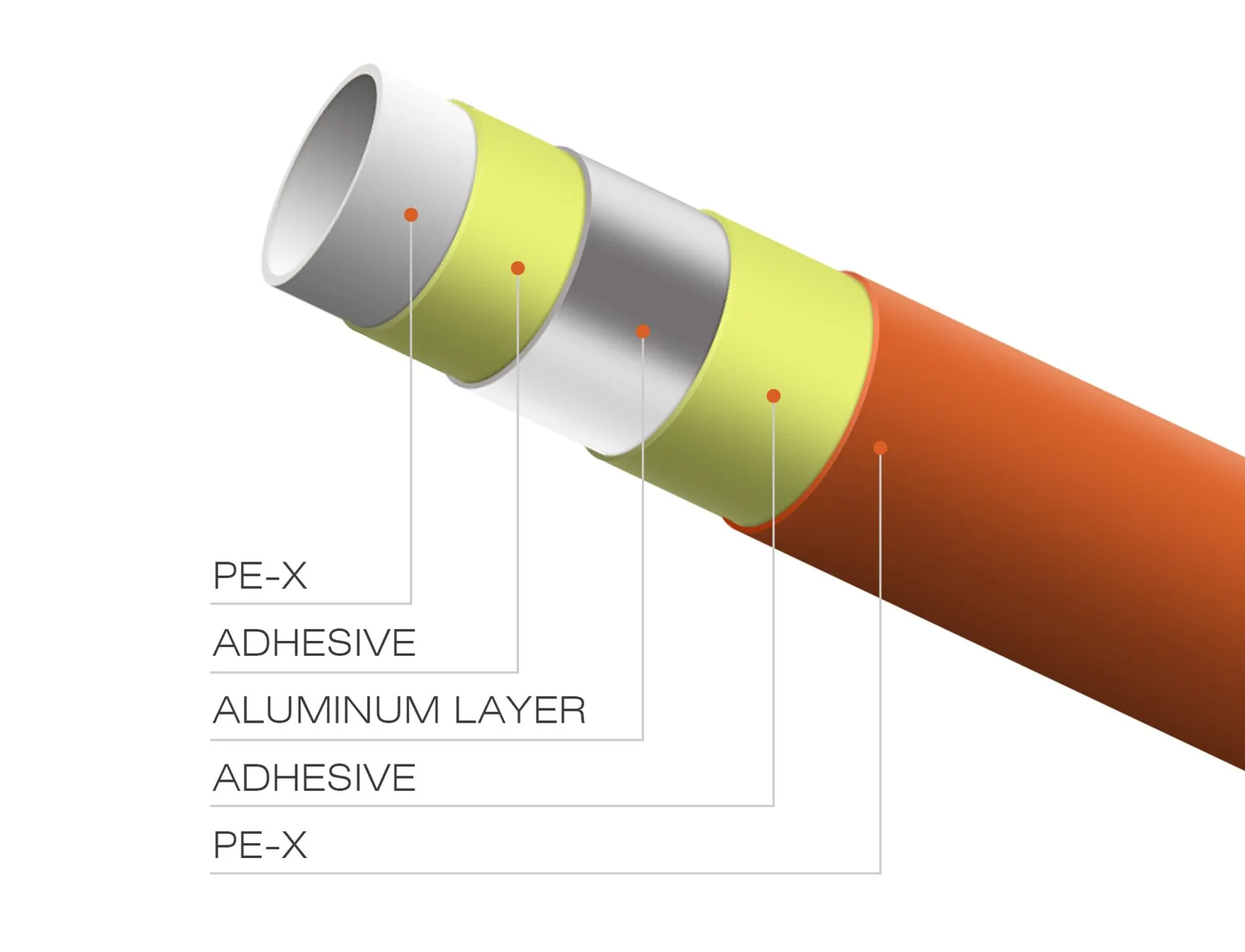
A multilayer pipe is five layers — inner PEX, adhesive, aluminium, adhesive, outer PEX — and the reason it expands like metal rather than plastic is mechanical, not chemical. Aluminium’s expansion coefficient is roughly an order of magnitude below the polymer’s. When the two are bonded across the full wall, the layer with the higher elastic modulus wins the argument: the aluminium tube physically restrains the polymer, and the composite settles at approximately 0.025 mm/(m·K) — the aluminium’s behaviour, not the plastic’s. That is why multilayer composite pipe is routinely described as expanding “like metal, not plastic,” and why the same 0.025 figure recurs across independent multilayer datasheets from different factories: the number belongs to the construction, not the brand.
The caveat that matters at the spec desk: this only works if the aluminium layer is continuous. The core in a properly made multilayer PEX-AL-PEX pipe is a butt-welded aluminium tube — edge fused to edge in a continuous longitudinal seam — so the restraining layer has no free edge to open under cyclic stress. Overlap-bonded cores rely on adhesive at the seam; under thousands of thermal cycles the overlap can creep, and with it goes part of the dimensional restraint and the oxygen-tightness. We have covered why the weld matters in detail in our teardown of butt-welded aluminium layers; the short version for expansion design is that the 0.025 coefficient you planned around assumes an intact, continuous metal tube for the pipe’s whole service life.
There is a second, less advertised benefit: multilayer holds its shape when bent. Because the aluminium yields plastically, a bend stays where you put it without fittings, and a formed expansion offset keeps its geometry instead of relaxing. On riser work this means your compensation details are dimensionally stable — a bending leg formed to length is still that length in year ten. All-plastic pipe has memory; multilayer has obedience. Engineers who have chased a wandering PEX offset through a shaft understand the difference in an afternoon.
PEX: big movement, small forces — design with it, not against it
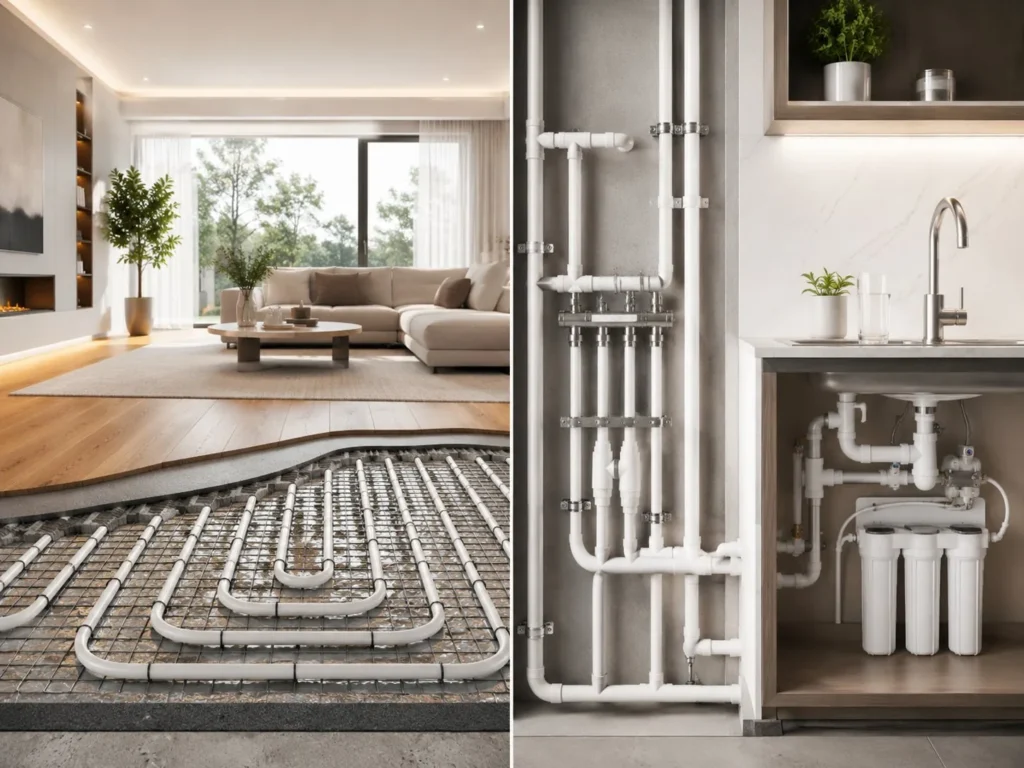
PEX’s 0.15–0.20 mm/(m·K) sounds disqualifying until you look at the other half of the mechanics. The Plastics Pipe Institute’s PEX design manual makes the point precisely: the expansion coefficient is high compared with steel, but the forces generated by thermal stresses are much lower, because PEX has a low modulus of elasticity and exhibits stress relaxation — restrained pipe partially sheds its own load over time. A restrained steel pipe pushes on its anchors with tonnes; restrained PEX pushes with a small fraction of that and then relaxes. This is why PEX embedded in screed or snaked through joists simply does not need expansion loops: the surrounding structure restrains it, the forces are absorbable, and the material forgives.
The trouble starts when PEX leaves the slab and runs exposed — risers, plant rooms, suspended ceilings. There, 180–240 mm of growth on a 30 m run has to go somewhere visible. Unrestrained PEX snakes between supports; it looks alarming, pulls sideways on clamps, and concentrates bending at branch takeoffs where a rigid tee meets a moving main. The standard playbook is close support spacing to control the snaking, guides that allow axial slide, and compensation geometry at direction changes — all sized from the manufacturer’s tables, which get long because ΔL is long. In practice, most engineers who run PEX against PEX-AL-PEX for a given job land on a split: PEX where the building restrains the pipe for free, multilayer where the pipe is on its own.
One insider check worth writing into your submittal review: ask at what temperature the quoted PEX coefficient was measured. The polymer’s coefficient rises with temperature — datasheets that quote 0.14–0.15 at 20 °C will show 0.20 or more at hot-service conditions, and a 60 °C DHW riser lives at the hot end of that curve. Sizing compensation from the 20 °C figure quietly under-designs the detail by a third.
PP-R and fiber-PPR: the 75% cut, and why fusion joints raise the stakes
Plain PP-R’s ~0.15 mm/(m·K) carries an extra sting that PEX avoids: every joint in a PP-R system is heat-fused. Socket fusion melts pipe and fitting into one continuous wall — excellent for leak-tightness, unforgiving for expansion, because there is no elastomer seal and no mechanical joint anywhere in the line to absorb even a millimetre of movement. A fused PP-R riser clamped rigid at every floor does not weep at the joints the way a badly restrained mechanical system telegraphs its distress; it bows between brackets, loads branch tees in shear, and when it finally fails it fails as cracked fittings. The compensation has to be designed in — loops, offsets and swing arms formed from fusion elbows — because nothing else in the system will improvise it for you.
This is exactly why fiber-composite PP-R took over commercial hot-water work. A middle layer of glass-fiber-reinforced PP-R restrains the wall the way aluminium restrains multilayer — less completely, but dramatically: aquatherm states its faser-composite construction cuts linear expansion by 75% versus standard polypropylene, bringing it to roughly copper’s rate, and typical fiber-PPR datasheet values of ~0.035 mm/(m·K) against ~0.15 plain bear that out. On our 30 m riser that is 42 mm of growth instead of 180 mm — the difference between a compact offset at one floor and a full loop assembly every few floors. Hitze produces all three PP-R constructions — ceramic-core, glass-fiber PPR-FB-PPR and PPR-AL-PPR — to DIN 8077/8078 and EN ISO 15874, and the fiber and aluminium versions exist principally because of this one property.
Choose plain PP-R only where runs are short, cold, or naturally broken by direction changes — apartment branch piping, cold-water mains, plant-room manifolding with elbows every few metres. For continuous hot risers and long ceiling mains, specify the fiber or aluminium construction and treat the plain-wall price saving as what it is: a transfer of cost from the pipe invoice to the compensation hardware and the installer’s time. The same construction logic drives the PP-R vs PPR-CU vs multilayer decision for hot and cold water more broadly — wall construction, not raw material, is what you are really specifying.
Worked example: one 30 m hot riser, ΔT 40 K, four materials
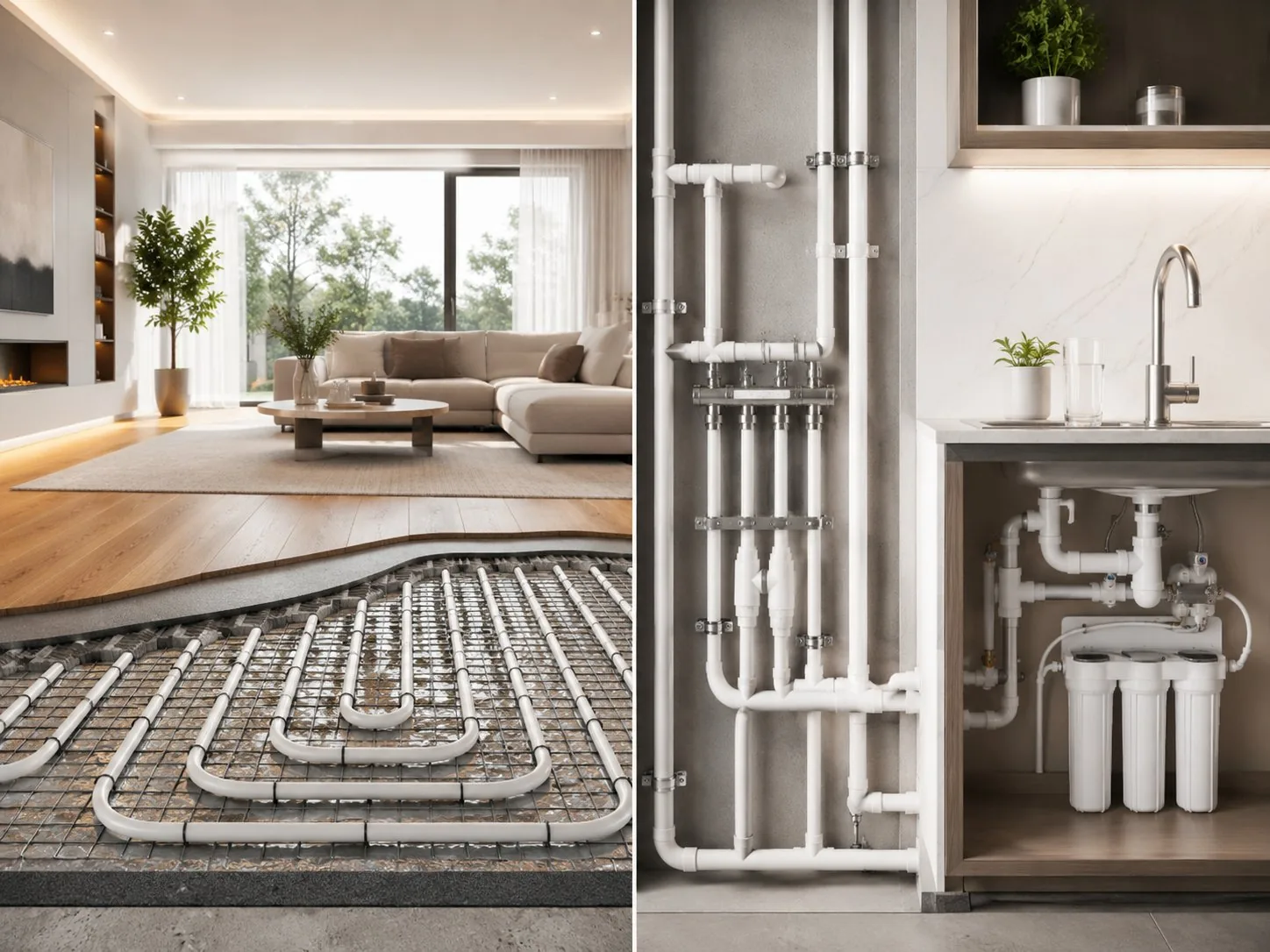
Take a realistic case: a 30 m DHW riser in a ten-storey building, 32 mm OD pipe, installed at 20 °C, operating at 60 °C — Δϑ = 40 K. Apply ΔL = a × L × Δϑ with the typical coefficients above and the growth over the full height is: PEX 180–240 mm; plain PP-R ~180 mm; fiber PP-R ~42 mm; multilayer ~30 mm. Copper, for reference, would move about 20 mm. Now push one step further, because ΔL is not the deliverable — the compensation detail is.
| 30 m riser, ΔT 40 K | Coefficient used | Total growth ΔL | Design consequence |
|---|---|---|---|
| PEX | 0.15–0.20 mm/(m·K) | 180–240 mm | Multiple loop/offset assemblies over the height; close guide spacing to control snaking on the exposed vertical |
| Plain PP-R | ~0.15 mm/(m·K) | ~180 mm | Fabricated fusion expansion loops roughly every second or third floor; rigid fused joints tolerate no improvised movement |
| Fiber PP-R (PPR-FB-PPR) | ~0.035 mm/(m·K) | ~42 mm | Compact offsets; near metal-pipe compensation practice |
| Multilayer PEX-AL-PEX | ~0.025 mm/(m·K) | ~30 mm | One or two short bending legs hidden inside the standard shaft offset; fixed point at mid-height halves ΔL per section |
| Copper (reference) | ~0.017 mm/(m·K) | ~20 mm | Conventional anchor-and-guide detailing |
Every composite-pipe planning manual sizes the flexible bending leg — the free length of pipe between the last guide and a direction change that bends to absorb ΔL — using the guided-cantilever method, in which the required leg length scales with √(OD × ΔL). The full expression, L = √(3 × E × OD × ΔL / Sa), folds in the pipe’s modulus of elasticity E and its allowable stress range Sa — which is exactly why manufacturers publish the result as a single construction-specific constant in their own planning tables rather than expecting you to carry the material properties yourself. The engineering point that survives the arithmetic is the scaling: because leg length grows with the square root of ΔL, the multilayer riser’s 30 mm of growth needs a dramatically shorter leg than an all-plastic riser’s 180 mm. Split the multilayer riser at mid-height with one fixed point and you halve ΔL per section to 15 mm, shrinking every leg again — a detail that hides inside a standard riser shaft offset without stealing plan area. Always size the real detail from your supplier’s own constant and tables, because E and Sa differ by construction.
Now do the same mental exercise with the all-plastic options. The bending-leg length scales with √ΔL, so six times the expansion means roughly two and a half times the leg (√6 ≈ 2.5) for plain PEX or PP-R at the same 30 m — or more loops, more often. (Read the actual leg length off your manufacturer’s own tables here; the constant varies by construction, which is precisely why a datasheet coefficient without planning tables is only half an answer.) In a real shaft that translates into loop assemblies at every second or third floor, each one a fabricated detail with four elbows, guides and clearance, versus one or two compact legs for the multilayer riser. This is the calculation in which multilayer usually pays for itself — not on the per-metre price, but on the shaft space, bracketry and labour that 30 mm of ΔL saves against 180.
And note what the numbers say about where each material belongs on this one project: PEX for the floor loops and in-slab branches, where the screed restrains it and its expansion is irrelevant; multilayer or fiber PP-R for the exposed vertical, where every millimetre of ΔL must be engineered. Materials are not better or worse at thermal expansion — they are better or worse somewhere.
Fixed points, sliding guides, bending legs: where the millimetres actually go
Compensation design is three decisions in a strict order. First, place the fixed points — anchors that divide the run into sections and decide the direction of growth. The governing rule in every composite-pipe planning manual is blunt: pipe must not be installed rigidly between two fixed points without compensation between them — a rule that applies with more force, not less, to higher-expansion pipe. Anchor at branch tees, so the takeoff moves with its main instead of being sheared by it; a tee floating mid-section is the classic hidden failure point, because Where the clips themselves go is the companion layout decision — our guide to support spacing and compensation on hot PP-R runs works through the spacing tables and bending-leg sizing.
Second, place sliding guides between the fixed points — clamps that hold the pipe on line but let it travel axially. The routine site error is over-tightened rubber-lined clamps that act as accidental anchors: each one turns a designed single-direction growth into an undesigned tug-of-war between clamps, and the pipe buckles between them. Third, size the bending leg or loop at each direction change from ΔL, using the manufacturer’s constant. If the leg is too short, the elbow becomes a stress riser; too long unguided, and the pipe whips. None of this is exotic engineering — it is one formula and a discipline about who is allowed to grip the pipe. But it must be on the drawing, because no installer will invent fixed-point logic from a bracket schedule that just says “clamp at 1.2 m centres.”
What Hitze checks: how a low-expansion pipe is actually built
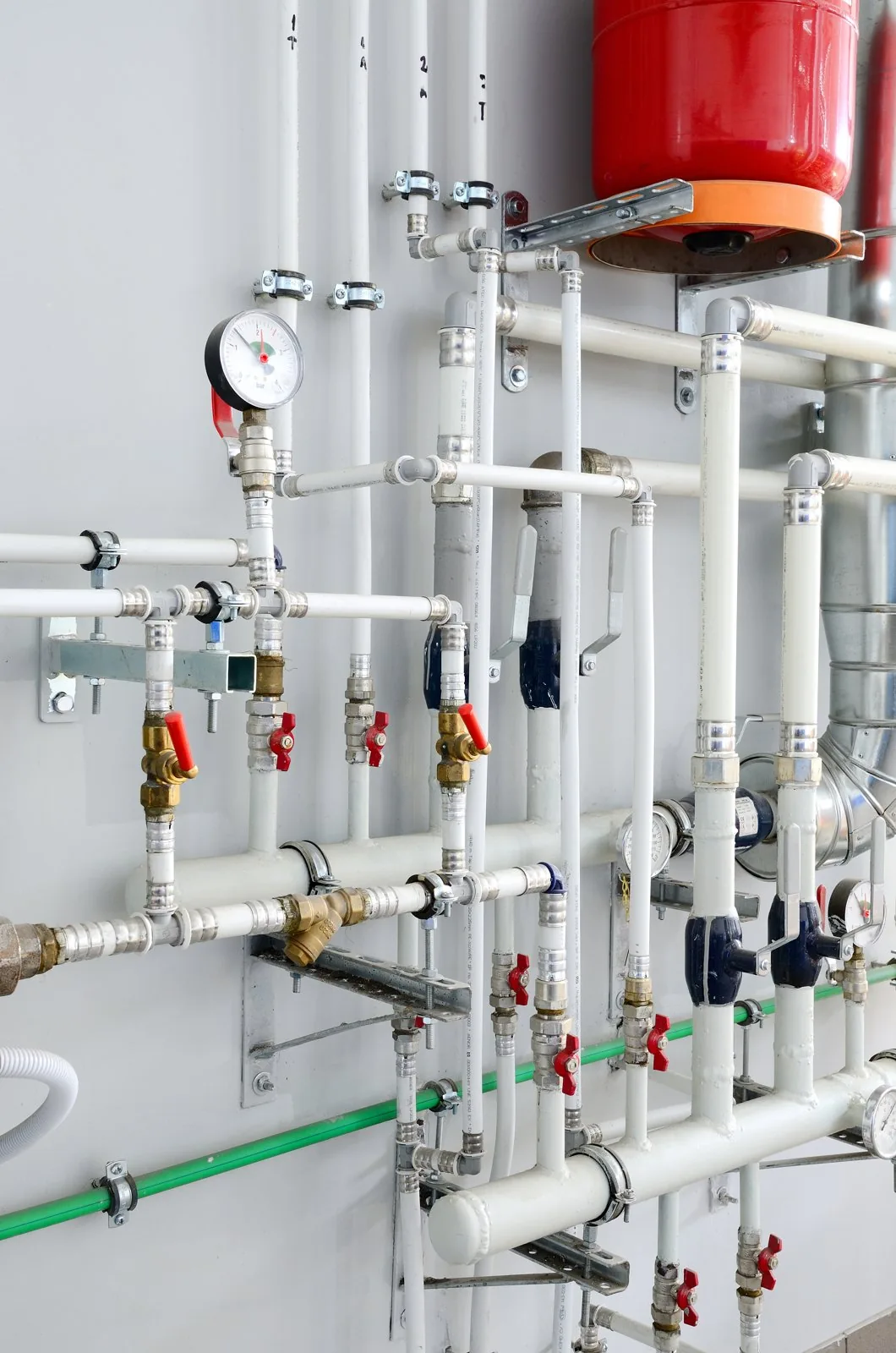
The 0.025 coefficient is a property of an intact composite, so on Hitze’s multilayer lines the quality gates target the composite, not just the pipe dimensions. The aluminium strip is formed around the inner PEX layer and butt-welded into a continuous longitudinal seam — welded edge to edge, not overlapped — then both adhesive interfaces are bonded in-line so the metal and polymer layers strain together as one wall. Production checks run destructive delamination and peel tests on cut samples from the running line, because a disbonded layer restores the polymer’s expansion behaviour exactly where you cannot see it; every batch also passes hydrostatic verification on dedicated pressure-test benches before release. The multilayer range carries the SAI Global StandardsMark to AS 4176.8 (the Australian consumer-gas multilayer standard), alongside the company’s SKZ test certification for its PE-Xb heating pipe and DVGW and WRAS approvals on the potable side — third-party evidence, not self-declared numbers.
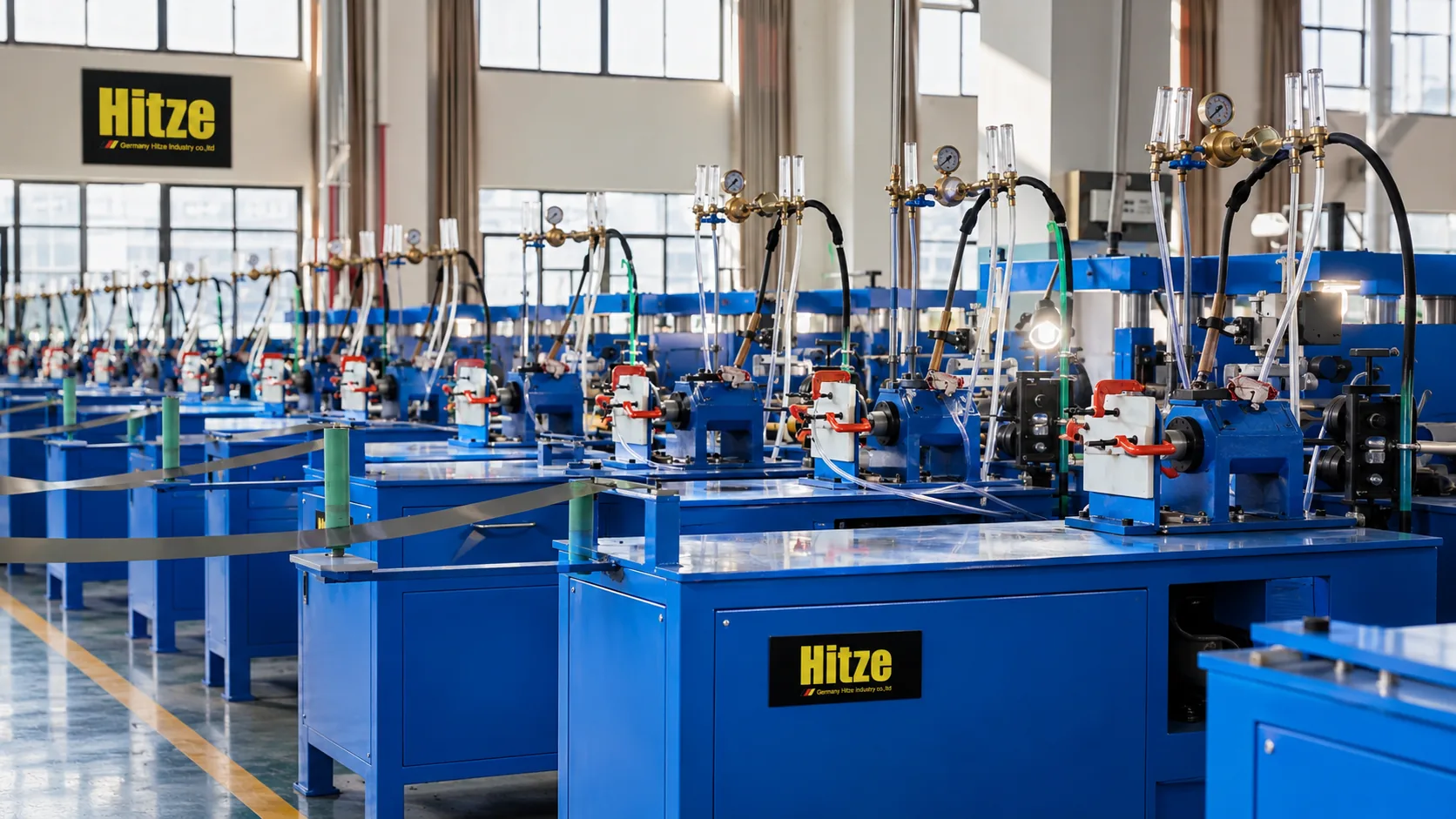
The scale behind that: a production base of 120,000 m², 1,000+ employees, a company founded in 1974, exporting to 118+ countries — and a German brand engineered to German DIN standards, with the multilayer, PEX and PP-R lines all made in-house so the pipe and its press fittings are qualified as one system. That last point is an expansion issue too, not just a warranty formality: the joint is where thermal cycling concentrates its damage, and a pipe-and-fitting pair tested together is the only configuration anyone can honestly warrant. Hitze backs the matched system with a 50-year warranty, and per-SKU expansion coefficients with test methods are stated on the technical datasheets — specific certificate numbers and project references are available on request.
Who this is for: if you are an importer, distributor or mechanical contractor specifying long hot-water or heating runs — risers, ceiling mains, district loops — and expansion detailing is eating your shaft space or your labour budget, low-expansion multilayer is usually the highest-leverage substitution you can make. Start with the Hitze multilayer PEX-AL-PEX range: request samples and the technical datasheets first — there is no MOQ, so you can cut cross-sections, check the welded aluminium seam and run your own numbers before any volume commitment. The matched pipe-and-fitting system ships with a 50-year warranty.
Contact: ifanholding@gmail.com · WhatsApp +86 186 6668 0913
FAQ: pipe thermal expansion in plastic systems
How do I calculate pipe thermal expansion?
Use ΔL = a × L × Δϑ: coefficient (mm/m·K) times run length (m) times temperature change (K). A 20 m PEX run at a = 0.18 with a 45 K swing grows 0.18 × 20 × 45 = 162 mm. Always take a from the datasheet of the actual pipe, at a temperature representative of service.
How much does PEX pipe expand compared with copper?
Typically 0.15–0.20 mm/(m·K) versus about 0.017 for copper — roughly nine to twelve times more movement. The compensating factor is that PEX’s low elastic modulus and stress relaxation mean restrained PEX exerts far smaller forces than restrained metal, which is why it can be embedded or snaked where copper would need loops.
Why does multilayer PEX-AL-PEX expand so little?
The butt-welded aluminium core is bonded to the PEX layers across the whole wall, so the metal — with roughly a tenth of the polymer’s expansion — dictates the composite’s length change. Typical datasheet values are about 0.025 mm/(m·K), around 1.5 times copper, provided the aluminium layer is continuous and the bond intact.
Does fiber-reinforced PP-R eliminate the need for expansion loops?
It shrinks them dramatically rather than eliminating them. A glass-fiber middle layer cuts expansion by roughly 75% versus plain PP-R — about 0.035 vs 0.15 mm/(m·K) — so long runs still need fixed points and compensation, but with legs and loops sized closer to metal-pipe practice than to plastic-pipe practice.
Is Hitze multilayer pipe made in Germany?
Hitze is a German brand — trademark registered at the DPMA in Munich — engineered in Germany and built to German DIN standards at the company’s own 120,000 m² production base, with SKZ testing and DVGW approval from German institutes. Production location and certificate documentation are stated openly in the certification pack, available on request.


