Key Takeaways
- PEX-AL-PEX pipe is a five-layer composite: PEX, adhesive, a welded aluminium tube, adhesive, PEX. The aluminium seam — butt-welded or overlap-welded — is the single biggest build-quality difference between brands.
- A butt-welded (edge-to-edge) aluminium core keeps the wall uniform and concentric; an overlap seam leaves a stepped double-thickness zone that shows up in press-fitting sealing and kink repair.
- The aluminium layer does three jobs at once: total oxygen barrier (DIN 4726 caps permeation at 0.32 mg O₂/m²·day at 40°C — a welded metal tube doesn’t even register), shape memory, and roughly 6–7× lower thermal expansion than plain PEX.
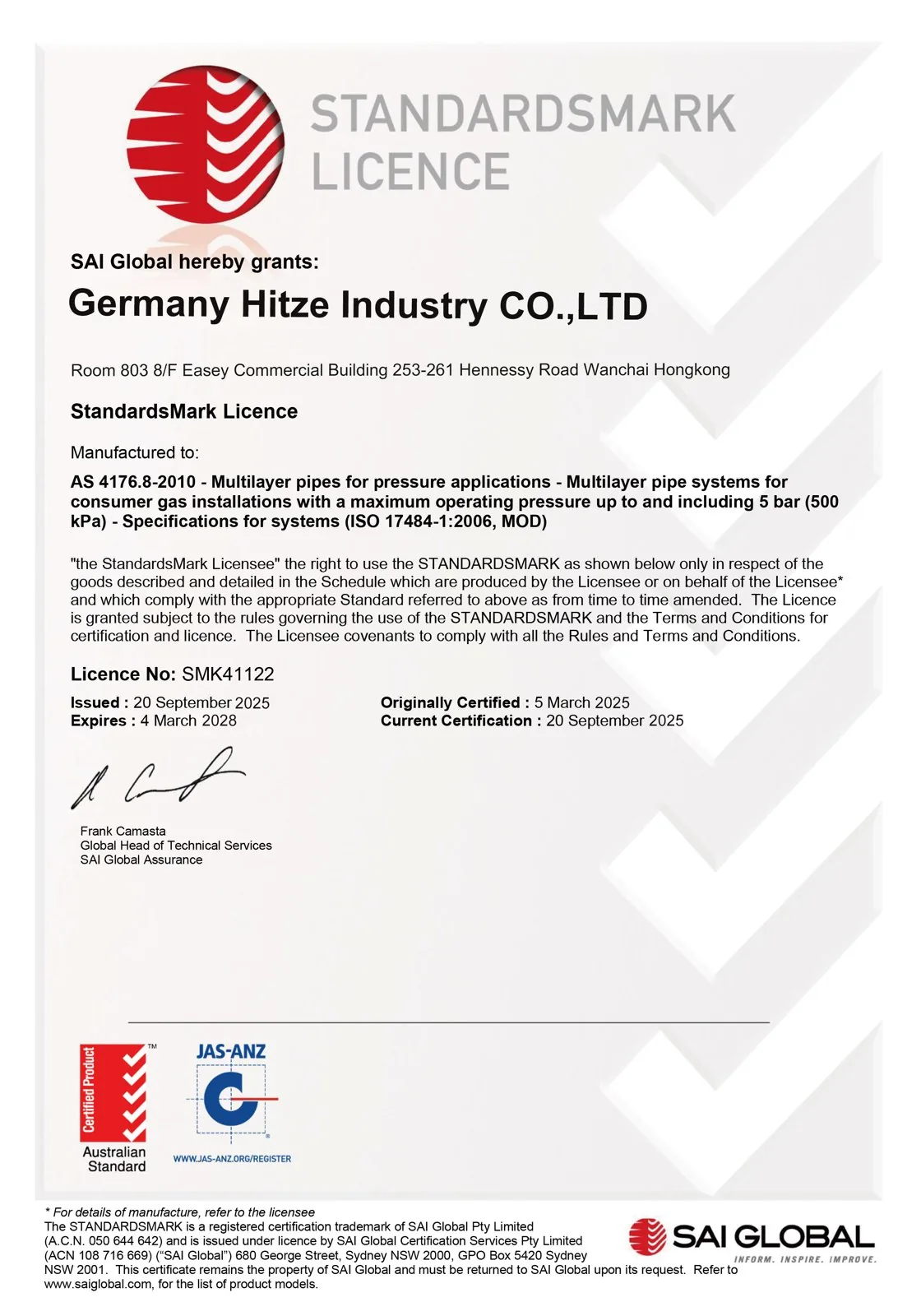
- ASTM F1281 covers welded-aluminium PEX-AL-PEX for water and heating; AS 4176.8 is a consumer-gas multilayer standard (≤5 bar) — holding it, as Hitze does via the SAI Global StandardsMark, is a weld-integrity credential, not a potable-water one.
- Hitze builds its multilayer line with a butt-welded core, tests to the F1281 trio of adhesion, burst and sustained pressure, and backs the matched pipe-and-fitting system with a 50-year warranty — samples first, no MOQ.
Put two coils of 16 mm PEX-AL-PEX pipe side by side and they look identical: same white jacket, same print line, same price bracket — until one of them is 15% cheaper and you can’t see why. The answer is almost always buried in the middle of the wall, in a seam of aluminium narrower than a fingernail. One factory welded that seam edge-to-edge with a TIG or laser head; the other lapped the strip over itself and tacked the overlap down (typically ultrasonically). Both coils will pass an incoming pressure check. Only one of them behaves the same way at every point around its circumference when you press a fitting onto it, re-round a kink on site, or ask it to hold a gas rating.
This is a first-party look inside the pipe: what each of the five layers actually does, why the welding method changes field behaviour, which standards genuinely test the weld — and what Hitze checks on its own multilayer line before a coil goes into a carton. If you’re still deciding between mono-layer PEX and multilayer in the first place, start with our comparison of PEX vs PEX-AL-PEX and which pipe suits which job, then come back here for the manufacturing depth.
The Five-Layer Stack: What Each Layer Is Actually Doing
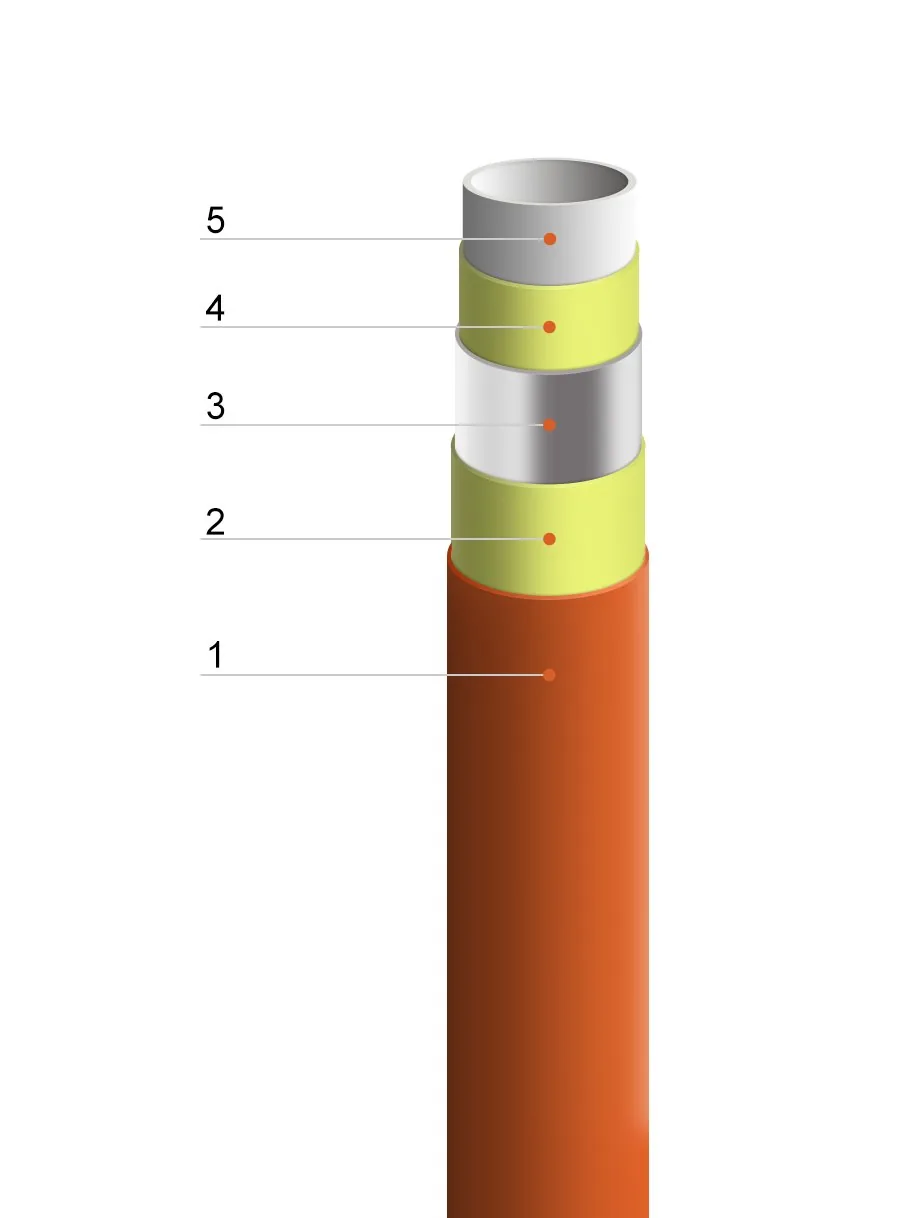
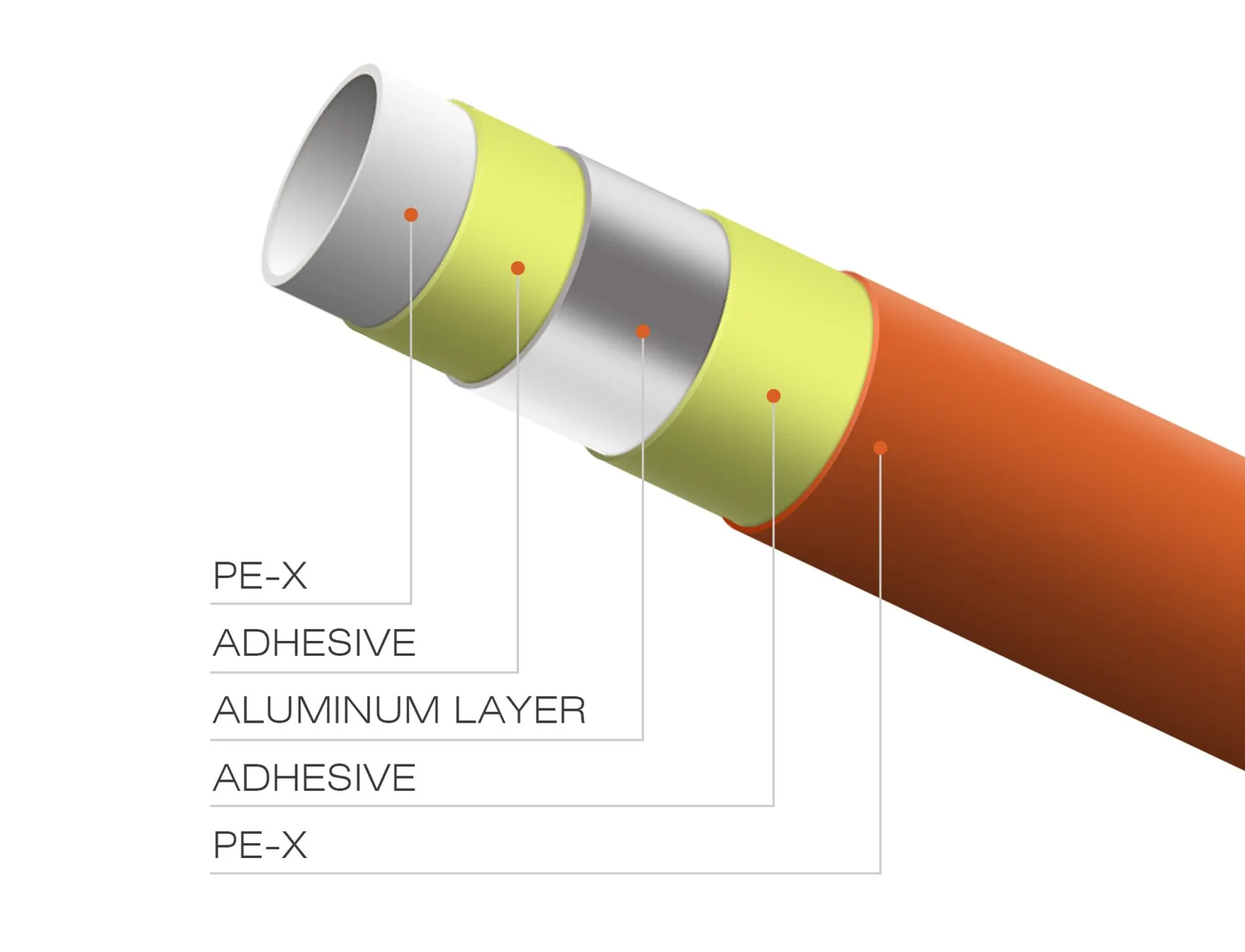
A PEX-AL-PEX pipe is not “PEX with foil in it.” It’s a co-engineered composite where every layer has a load-bearing job, and the failure of any bond between them degrades the whole pipe. From the water outwards:
| Layer | Material | Job |
|---|---|---|
| 1 — Inner wall | Crosslinked PE (PEX) | Water contact, hot-water temperature resistance, smooth low-friction bore |
| 2 — Inner adhesive | Melt adhesive | Bonds PEX to aluminium so the layers expand and carry load together |
| 3 — Core | Welded aluminium tube | Oxygen barrier, hoop strength, shape memory, expansion control |
| 4 — Outer adhesive | Melt adhesive | Same bond, outward — stops the jacket creeping over the core |
| 5 — Outer wall | PEX | Mechanical and UV-handling protection for the aluminium, print surface |
The wording in ASTM F1281 — the US specification for this construction — is precise about two things buyers gloss over: the aluminium must be a welded tube, not a wrapped foil, and it must be bonded to both PEX layers by melt adhesive. That’s why F1281 dedicates test methods to interlayer adhesion alongside burst and sustained-pressure performance. A pipe whose layers delaminate under thermal cycling still looks perfect from the outside; it has simply stopped being a composite. When you evaluate a supplier, ask for the adhesion (peel) test results, not just the burst number — burst is the easy one to pass.
Rated performance for the class is genuinely strong. F1281-compliant PEX-AL-PEX carries published ratings of 200 psi at 73°F (about 13.8 bar at 23°C), 125 psi at 180°F (8.6 bar at 82°C) and 100 psi at 200°F (6.9 bar at 93°C) — comfortably above what a residential heating loop at 1.5–3 bar or a supply riser at 4–6 bar will ever ask of it. The margin isn’t the point, though. The point is that those ratings assume the aluminium tube is continuous and concentric. Which brings us to the seam.
Butt Weld vs Overlap Weld: The Difference Hidden in the Wall
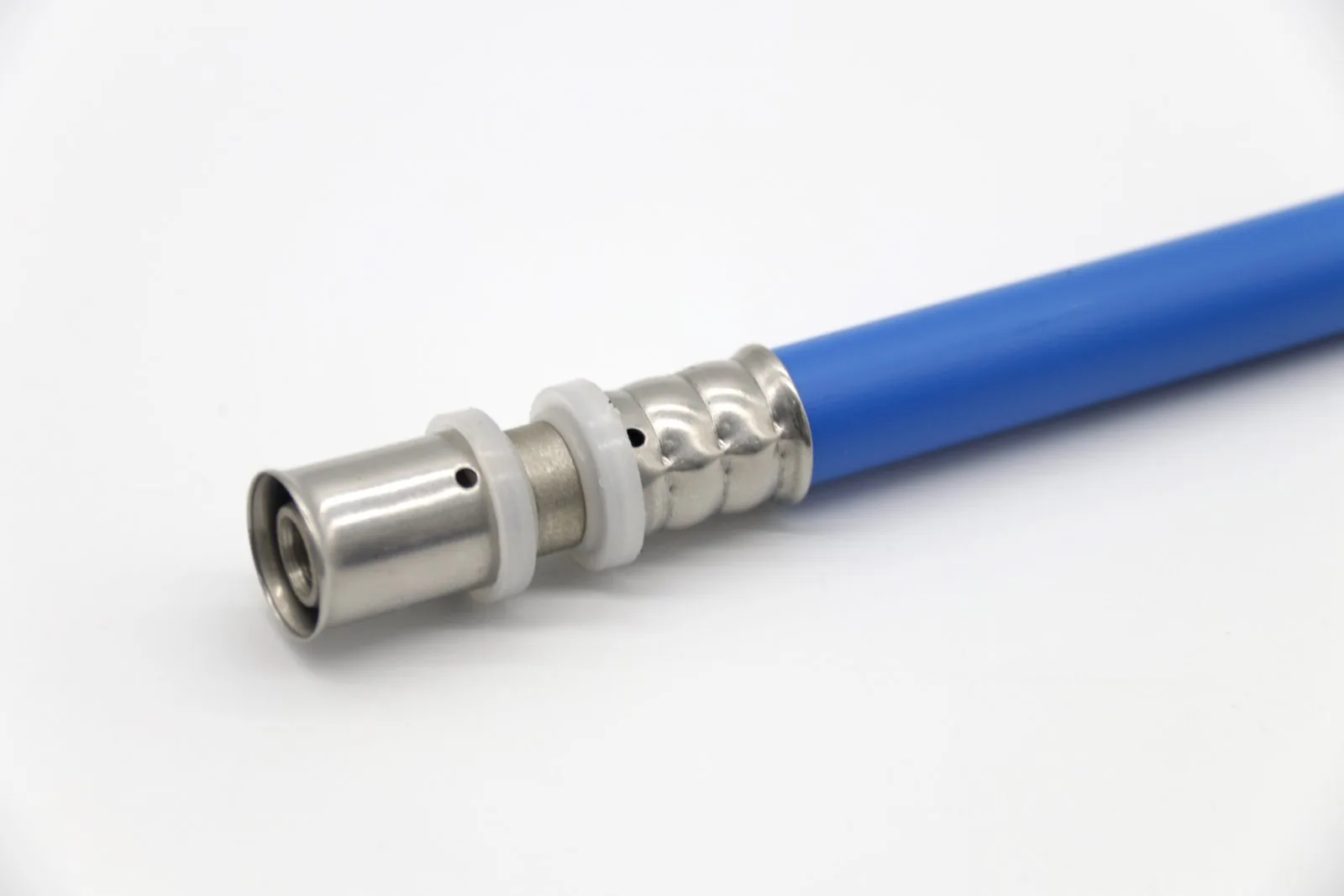
Every multilayer pipe starts as a flat aluminium strip that gets rolled into a tube around the freshly extruded inner PEX layer. The two strip edges then have to be joined into a cylinder, and there are only two commercial ways to do it. Butt welding brings the edges together end-to-end and fuses them with a TIG (argon-arc) or laser head, so the finished tube is a complete circle of constant thickness. Overlap welding lays one edge over the other and joins the lap along its length — usually with an ultrasonic head — which is faster, uses cheaper tooling, is more tolerant of thin foil, and leaves a stepped, double-thickness stripe running the full length of the pipe.
That stripe is not cosmetic. At the lap, the wall is locally thicker and the aluminium sits slightly off-centre, so the bore is no longer perfectly concentric with the outside diameter. Trade coverage of butt-welded tubing (Plumbing & Mechanical, on Henco’s Belgian-made line) singles out exactly this: the butt weld lets the tubing “stay uniform thickness both inside and out,” which is what supports the higher pressure and temperature ratings and makes tube layout predictable. On an overlap-welded pipe, an O-ring in a press fitting is sealing against a surface whose stiffness changes at one point on the circumference — usually fine, but “usually” is doing real work in that sentence when the joint is buried in a screed.
| Property | Butt-welded core (TIG/laser) | Overlap-welded core (ultrasonic) |
|---|---|---|
| Wall geometry | Uniform thickness, full circle, high roundness | Stepped double-thickness zone at the lap |
| Concentricity at fitting seats | Consistent around circumference | Local stiffness change at the seam |
| Aluminium strip | Thicker strip weldable — more hoop strength available | Suits thinner foil; strength capped by the lap joint |
| Kink re-rounding on site | Seam is as strong as parent metal — takes reworking better | Stress concentrates at the step; lap can open |
| Production cost & speed | Slower line, tighter parameter control, dearer machine | Faster, cheaper — the budget-coil default |
Here’s the trade-off stated honestly: overlap welding is not a defect, and hundreds of millions of metres of overlap-welded pipe are in service worldwide, mostly in light plumbing duty. The recommendation depends on what the pipe will live through. For radiant loops that get walked on, bent to tight radii and occasionally kinked and re-rounded; for exposed risers where expansion forces work the wall for decades; and for any gas application — specify butt-welded. For a cost-driven cold-water rough-in where the pipe goes in straight and stays untouched, overlap-welded product can be a defensible economy. What is not defensible is a supplier who can’t tell you which weld their line runs. Ask. If the answer is a pause, cut a sample lengthwise: an overlap seam is visible to the naked eye as a stepped stripe on the aluminium.
The insider warning: weld type is also a proxy for line discipline. Butt welding demands tight control of strip edge preparation, heat input and forming pressure — run it sloppy and the weld fails immediately and obviously at the mill, in burst or bend testing. Ultrasonic lap welding is far more forgiving of a poorly tuned line, which means marginal product is likelier to escape. When you audit a multilayer supplier, the welding station tells you more about the factory in five minutes than the showroom does in an hour.
What the Aluminium Layer Buys You: Oxygen, Shape, Expansion
Oxygen tightness. Plastic pipe walls are slightly permeable to oxygen, and in a closed hydronic loop that dissolved oxygen quietly corrodes every ferrous component — boiler heat exchangers, pump volutes, panel radiators. DIN 4726, the German benchmark for heating pipe, caps oxygen permeation at 0.32 mg O₂/m²·day measured at 40°C, and the test protocol is deliberately nasty: the accredited-lab procedure (Kiwa runs it to ISO 17455) preconditions the pipe by bending part of it around a diameter of just 8×dn, immersing it in water, then conditioning it for 28 days before the oxygen measurement — specifically to catch barrier layers that crack or degrade when handled like real pipe on a real site. EVOH-coated PEX passes this by staying under the threshold with a thin polymer coating that must survive intact. A welded aluminium tube passes it by being metal: it stops oxygen the way a metal pipe does, so published multilayer datasheets list gas permeability as flat zero rather than a small number, and trade literature flatly calls the welded sleeve a 100% oxygen barrier. There is no coating to scratch, no humidity sensitivity, no ageing curve. For the full corrosion mechanism and where EVOH-barrier PEX still makes sense, see our guide to choosing between PEX and multilayer.
Shape memory. Bend plain PEX and it springs back; every change of direction needs a clip, a bend former or a fitting. Bend PEX-AL-PEX and the aluminium core deforms plastically and holds the curve — the pipe stays where you put it, unsupported. On a radiant floor that means loops hold their 150–200 mm spacing while you staple; on a renovation it means you can hand-form an offset around a joist and it stays formed. One crew-level consequence contractors under-price: form-stable pipe needs meaningfully fewer clips and zero spring-back fighting, and on a whole-house rough-in the labour saving is real even though the coil costs more per metre than bare PEX.
Expansion control. The bonded aluminium tube also disciplines thermal movement. Datasheets for welded-core multilayer put linear expansion at 25×10⁻⁶ m/m·K — about 0.025 mm per metre per Kelvin, close to plain aluminium pipe — while mono-layer PEX runs around 9.2×10⁻⁵/°F per Viega’s technical data, which converts to roughly 0.17 mm/m·K (9.2×10⁻⁵/°F × 1.8 = 1.66×10⁻⁴/K). Work that on a 30 m hot-water riser heating from 20°C to 60°C: plain PEX grows 30 × 40 × 0.166 ≈ 199 mm; butt-welded multilayer grows 30 × 40 × 0.025 = 30 mm. That roughly six-to-sevenfold difference is the gap between engineering expansion loops on every floor and simply guiding the pipe. The mechanics — and how PP-R compares — get a full treatment in our article on thermal expansion in plastic pipe.
Note what all three benefits have in common: they only exist if the aluminium tube is continuous. A cracked seam is a hole in the oxygen barrier, a hinge in the shape memory and a discontinuity in the expansion restraint. The weld is not a manufacturing detail; it is the product.
The Standards That Actually Test the Weld
ASTM F1281 is the reference document for PEX-AL-PEX in North America. Its scope is explicit: coextruded crosslinked-polyethylene composite pressure pipe with welded aluminium tube reinforcement, melt-adhesive bonded, intended for potable water distribution, water service, irrigation, radiant panel and baseboard heating, snow- and ice-melt, and compatible gases. Its test regime — material requirements, layer dimensions, interlayer adhesion, burst, sustained pressure — is the minimum a serious multilayer producer should be running as routine, not as a one-off type test. In Europe the equivalent system standard is EN ISO 21003 for multilayer pipe in hot and cold water installations, which imports the same 0.32 mg O₂/m²·day oxygen ceiling for heating classes.
AS 4176.8 deserves an honest explanation, because it’s widely misquoted — including by suppliers who wave it around as a water credential. It is the Australian standard for multilayer pipes and joints in consumer gas installations up to and including 5 bar, operating from −20°C to +60°C, adopted from ISO 17484-1 with modifications. Gas is the least forgiving duty a composite pipe can hold: a seep that would be invisible on a water line is a hazard on a gas line, so the certification regime hammers precisely the things this article is about — seam continuity, layer adhesion, long-term pressure integrity. Australian gasfitting rules add their own tells about how seriously regulators take it: in NSW, multilayer consumer gas piping must transition to metallic pipe for at least one lineal metre before it exits a wall. Hitze’s multilayer pipe carries the SAI Global StandardsMark to AS 4176.8 — and we cite it for what it is: third-party proof, under the toughest composite-pipe scheme we submit to, that the butt-welded core holds a gas rating. For drinking water, the relevant credentials are separate and we list them separately.
The buying rule that falls out of this: match the certificate to the duty, then use the hardest certificate as a manufacturing signal. A factory whose multilayer line sustains a gas-grade StandardsMark audit cycle is running weld monitoring and batch pressure testing at a level a water-only producer never has to demonstrate. That’s the sense in which one Australian gas certificate tells you something about the heating coil you’re buying for a project in Manchester or Montreal.
How Hitze Builds and Checks Its Multilayer Pipe
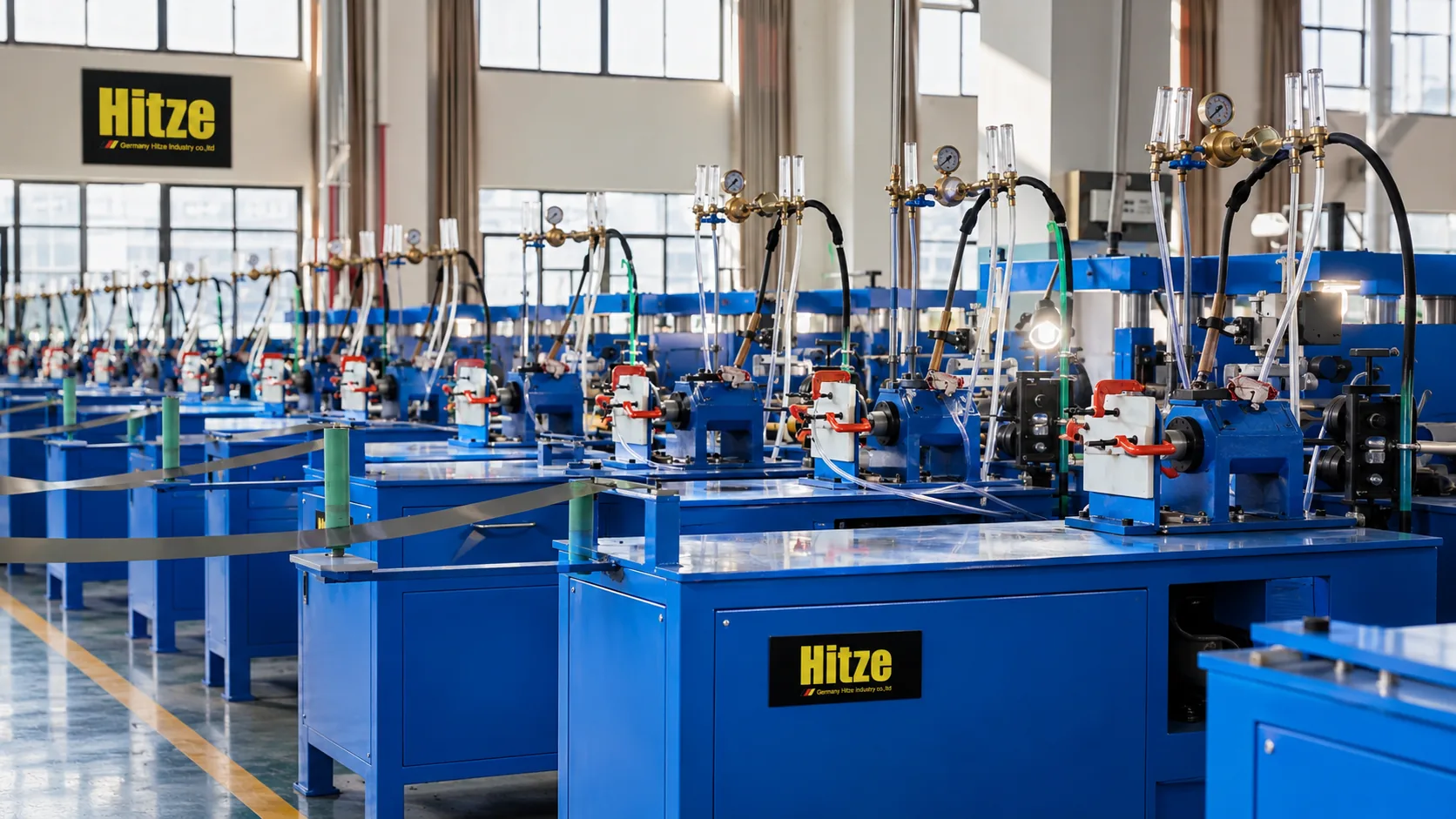
Hitze is a German brand of engineered piping systems, founded in 1974, producing across a 120,000 m² base with 1,000+ employees and exporting to 118+ countries. The multilayer range — PEX-AL-PEX and PERT-AL-PERT, 16 to 32 mm — is built as a five-layer construction around a butt-welded aluminium core, and the production sequence is organised around protecting that weld:
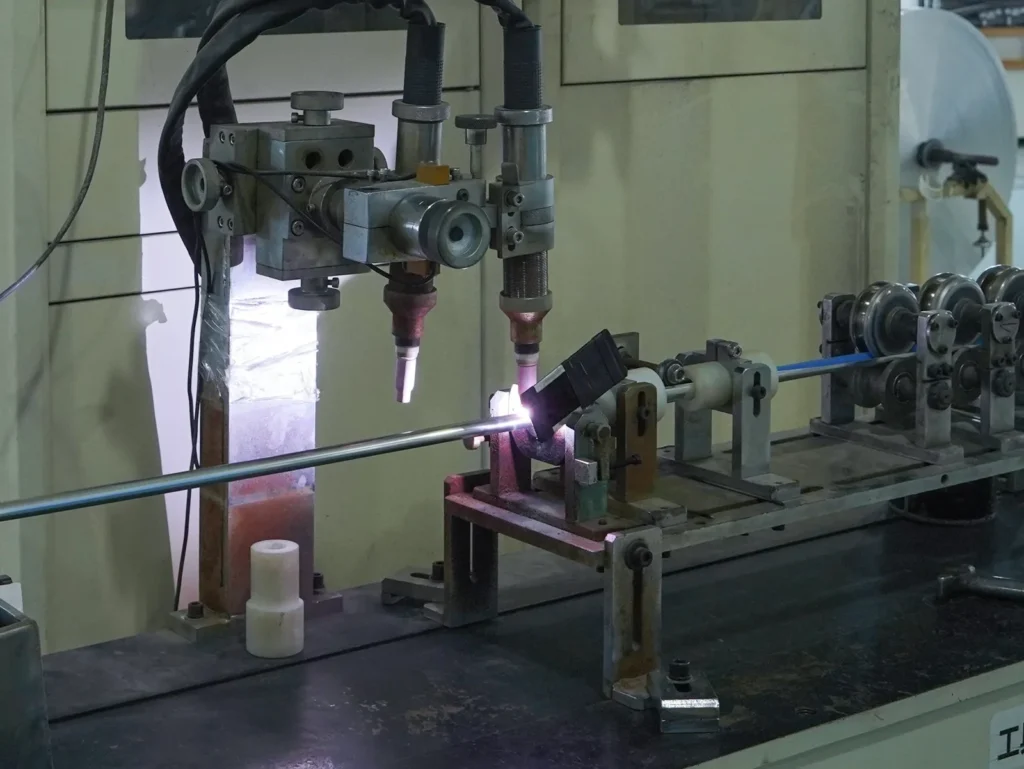
1. Strip forming and butt welding. The aluminium strip is formed around the inner PEX layer and welded edge-to-edge into a continuous full-length seam at a dedicated welding station — no lap, no step, a complete circle of constant wall. Weld continuity is monitored on-line; a discontinuous seam is scrap, not a second.
2. Bonding and gauging. Melt adhesive ties the welded tube to both PEX layers so the wall behaves as one material. Concentricity and wall uniformity are gauged through the haul-off — the property that makes a press fitting seat identically at any rotation angle is manufactured here, not inspected in later.
3. Verification against the standards that matter. Finished pipe is checked along the F1281 axes — interlayer adhesion, burst, sustained pressure — on in-house hydrostatic benches, with the oxygen-tightness delivered by the welded core construction itself per DIN 4726 practice. The multilayer product carries the SAI Global StandardsMark to AS 4176.8; the factory’s occupational health and safety management is certified to ISO 45001. Certificate copies and numbers are in the Cert Pack, available on request, and every one is verifiable with the issuing body — we’d rather you check than take our word.
Because pipe and fittings come off the same campus, the press-fitting dimensions are matched to the actual pipe wall — which is why the 50-year warranty applies to the matched Hitze pipe-and-fitting system rather than to components in isolation. You can see the full specification set on the Hitze multilayer PEX-AL-PEX pipe page, including size range, colours and fitting compatibility.
A Worked Example: One Duplex, Two Coils, One Decision
Take a job every contractor recognises: a two-storey duplex, radiant floors downstairs, radiators upstairs, hot and cold supply throughout. The radiant floor wants 16 mm multilayer in 60–80 m loops off a manifold; supply runs step between 16, 20 and 25 mm depending on fixture count (our 16–32 mm sizing guide walks the flow and pressure numbers). Two quotes land on your desk: a butt-welded coil and an overlap-welded coil roughly 15% cheaper. On a duplex using perhaps 900 m of pipe, the gap might be a few hundred dollars. Here’s where that money actually sits.
During the floor pour prep, an apprentice steps on a loop and kinks it at a tight return bend. With a butt-welded core you re-round the section with a repair tool and pressure-test the loop; the seam through the repaired zone is parent-strength metal, and the DIN 4726-style bending preconditioning is your evidence that a properly welded barrier survives exactly this kind of abuse. With an overlap seam, the step is where stress concentrates as the wall re-rounds — and if the lap opens, you now have a hidden oxygen leak and a weakened wall going under 60 mm of screed. The honest fix is cutting in a coupling or re-pulling the loop: an hour of labour, or the whole price gap on one incident.
Upstairs, the 25 mm hot riser runs 9 m floor-to-roof. At a 40 K temperature swing, multilayer at 0.025 mm/m·K moves about 9 mm — absorbed by two guide brackets and the natural flex of branch tees. The same riser in plain PEX would move about 60 mm, demanding deliberate expansion arrangement. And at every press joint, the fitting O-ring seats on a wall whose thickness is identical at every clock position — the quiet, unglamorous payoff of a butt weld that nobody photographs and everybody relies on.
Best for / not for, plainly: butt-welded PEX-AL-PEX is the right call for radiant heating loops, renovation work where pipe is hand-formed and exposed, long risers, and any market where a gas-grade multilayer credential matters to the spec. It is not the automatic answer everywhere: crews standardised on PEX-a cold-expansion fittings should stay in that ecosystem, and a straight-line, cost-critical cold-water rough-in doesn’t need an aluminium core at all — mono-layer PEX does that job well for less. Multilayer earns its premium where the pipe is bent, heated, exposed or certified; that’s the honest boundary.
Sampling Hitze Multilayer Pipe
If you’re a wholesaler, importer or contractor-distributor who specifies multilayer by construction rather than by price column — and especially if you’ve been burned by a coil that looked right and behaved wrong — the fastest due diligence is destructive: cut our pipe, look at the seam, peel the layers, then do the same to what you’re buying now. Hitze works sample-first with no minimum order quantity, so you can run that comparison plus a trial order before committing a container. The matched pipe-and-fitting system carries a 50-year warranty, and pricing for your sizes and market is quoted per enquiry — start from the multilayer PEX-AL-PEX product page and ask for the Cert Pack alongside the samples.
FAQ: PEX-AL-PEX Construction and Welding
How can I tell if a PEX-AL-PEX pipe is butt-welded or overlap-welded?
Cut a sample square and look at the exposed aluminium ring, ideally with a loupe. An overlap weld shows as a visible step where one strip edge rides over the other; a butt weld shows a near-invisible seam in a ring of constant thickness. Reputable manufacturers also state the weld type in the technical datasheet — if the TDS is silent, treat that as an answer.
Is PEX-AL-PEX the same as oxygen-barrier PEX?
No. Oxygen-barrier PEX is mono-layer PEX with a thin EVOH polymer coating that keeps permeation under the DIN 4726 ceiling of 0.32 mg O₂/m²·day at 40°C. PEX-AL-PEX blocks oxygen with a welded aluminium tube — a metal barrier rather than a coating — and adds shape memory and roughly six-to-sevenfold lower thermal expansion that EVOH pipe doesn’t offer.
Can PEX-AL-PEX pipe be used for gas?
Only where the specific pipe is certified for gas and local rules allow it. AS 4176.8 covers multilayer pipe for consumer gas installations up to 5 bar in Australia, and installation codes add conditions — NSW, for example, requires a metallic section of at least one lineal metre before the pipe exits a wall. Never run a water-certified coil on gas; the certificates are duty-specific.
Is Hitze PEX-AL-PEX pipe made in Germany?
Hitze is a German brand — trademark registered with the DPMA in Munich — engineered in Germany and built to German DIN standards, with production on a 120,000 m² base serving 118+ countries. We don’t label the pipe “Made in Germany”; we’d rather you judge the construction: butt-welded core, third-party marks, and certificates you can verify with the issuing bodies.
What is the minimum order for Hitze multilayer pipe?
There is no MOQ. Hitze works sample-first: request cut samples and coils for your own testing, trial a small order, then scale. Lead times and pricing vary by market and order and are quoted per enquiry.


