Key Takeaways
- The drinking water directive 2020/2184 replaces today’s patchwork of national approvals for materials in contact with drinking water with a single harmonised EU regime. Article 11 requires that every wetted substance in a pipe, lining, fitting or valve be drawn from a European Positive List.
- Six legal acts adopted 23 January 2024 build the machinery: three Commission Implementing Decisions (EU) 2024/365, 2024/367, 2024/368 and three Commission Delegated Regulations (EU) 2024/369, 2024/370, 2024/371. All entered into force 15 May 2024 and apply from 31 December 2026.
- EU national schemes are not dead on that date. A product with a valid EU national certificate (DVGW/KTW-BWGL, ACS, KIWA, etc.) as of 31 December 2026 may continue to be marketed under that scheme within its EU Member State until 31 December 2032. After that, only the EU regime applies. WRAS is a UK scheme outside EU law; its continued validity in Great Britain is independent of this transition clock.
- The catch for buyers: from 1 January 2027, no new material can be approved under a national scheme — new products must run on the EU Positive List. If your supplier is not already positioned, your 2027–2028 launches are exposed.
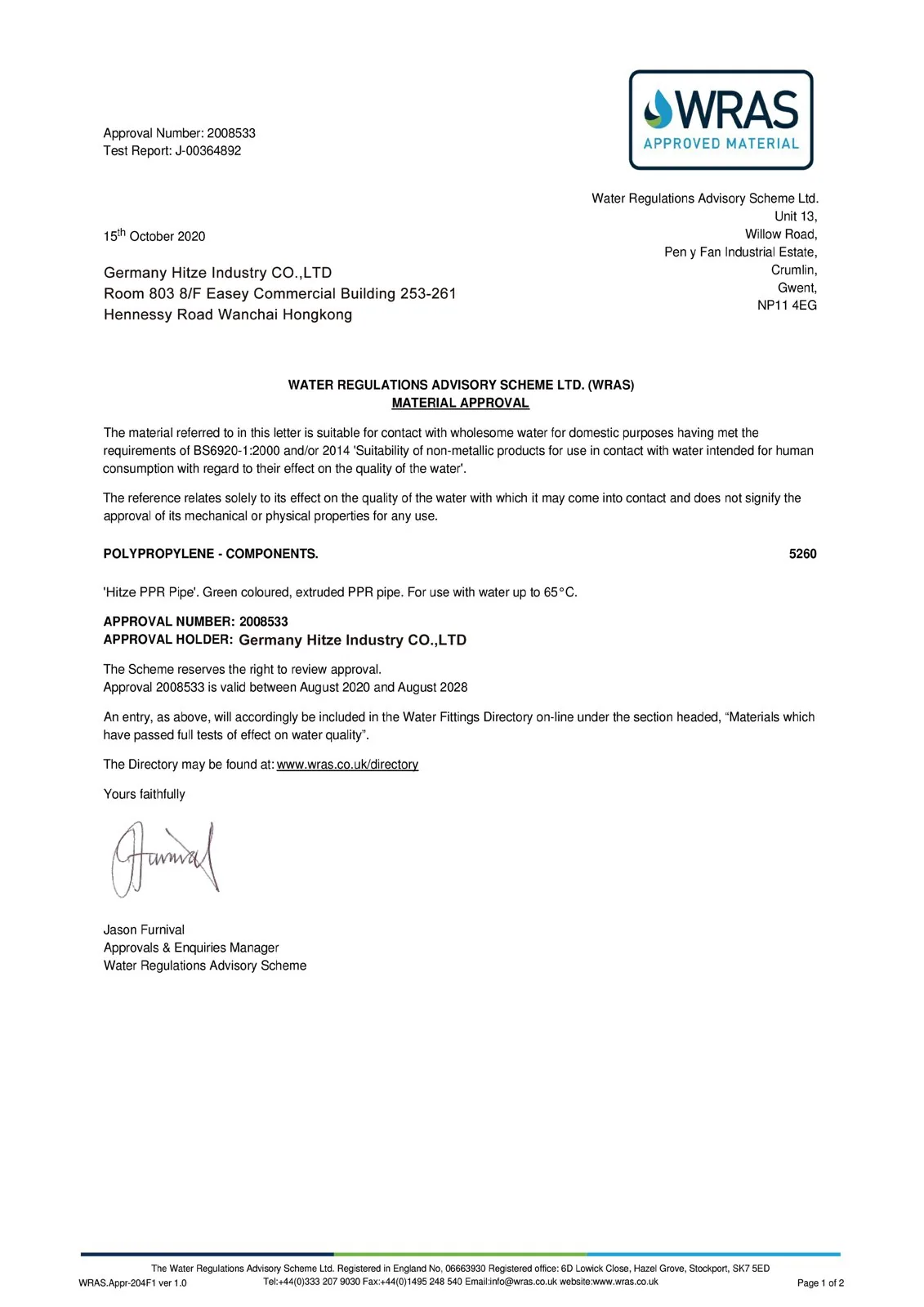
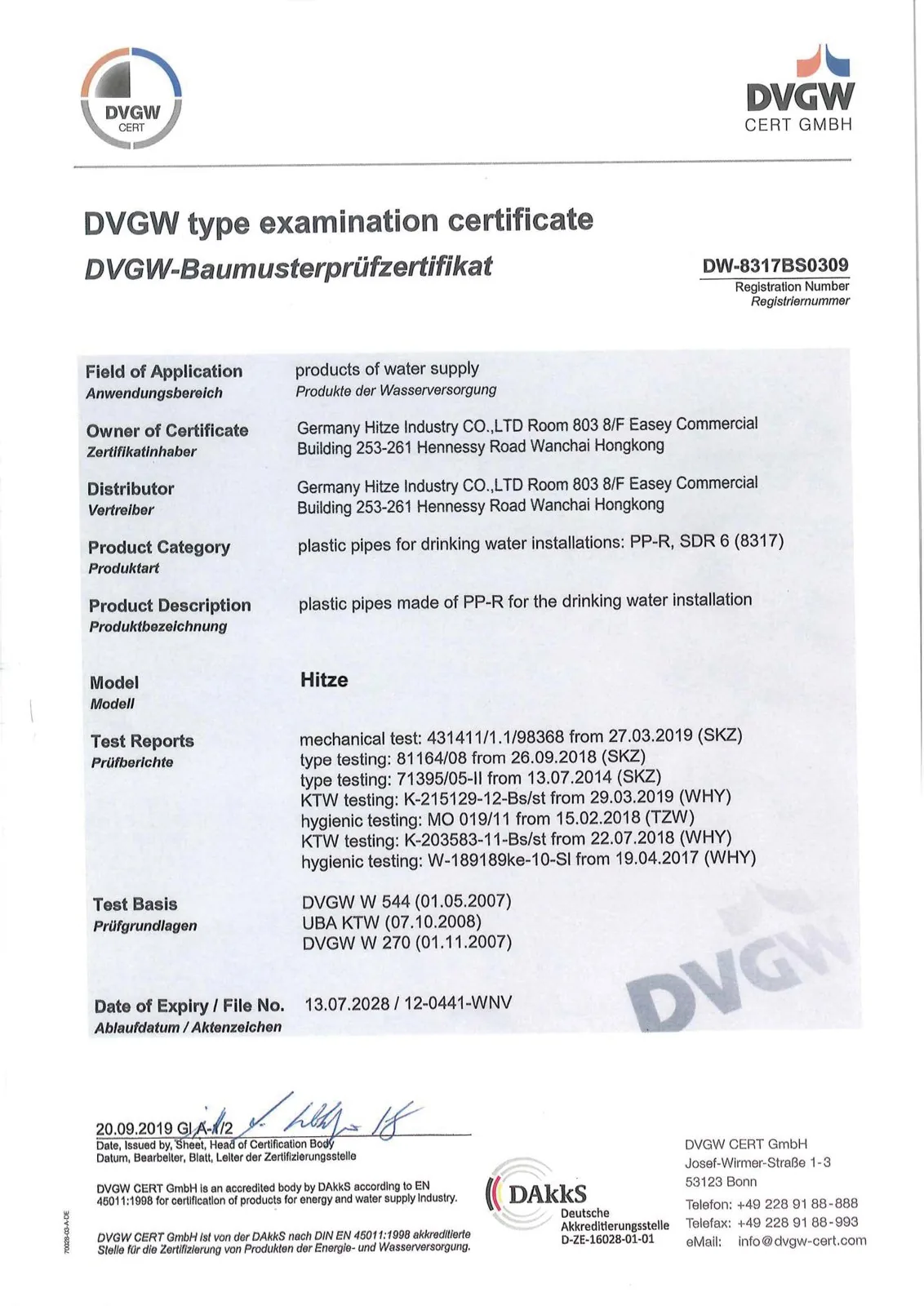
- Hitze holds live WRAS material approval, a DVGW type examination for PP-R drinking-water pipe, and an NSF Laboratories BS 6920 potable test report today, and is tracking the Positive-List transition on the affected lines. See our certifications and compliance overview.
If you specify potable pipe for the European market, the ground under your approvals is moving. For twenty-five years, “compliant for drinking water” meant a national hallmark — WRAS in the UK, DVGW and the KTW-BWGL in Germany, ACS in France, KIWA in the Netherlands, plus roughly a dozen more. Each ran its own substance list, its own migration limits and its own test house. The drinking water directive 2020/2184 ends that fragmentation by moving the whole question of “what may touch drinking water” up to the EU level, onto a single set of Positive Lists. This article covers the harmonisation shift itself — the exact acts, the dates that bind, and what a spec engineer should do in the 2026–2032 window. It deliberately does not re-cover how the national schemes work today; for that, see our guide to WRAS, DVGW and KTW certification for plumbing pipe.
What Article 11 of Directive (EU) 2020/2184 actually changes
Directive (EU) 2020/2184 — the recast Drinking Water Directive — entered into force on 12 January 2021 and had to be transposed into national law by 12 January 2023. Most of the headlines were about water-quality parameters: for example the lead parametric value stays at 10 µg/L until 12 January 2036 and then drops to 5 µg/L. But for anyone who makes or specifies pipe, the load-bearing article is Article 11: minimum hygiene requirements for materials in contact with water intended for human consumption. Article 11 is written broadly on purpose. It covers the entire chain from abstraction to the consumer’s tap, and it applies to new installations and to the repair or reconstruction of existing ones. If it is wetted — pipe, pipe lining, fitting, gasket, valve seat, storage tank coating — it is in scope, whether the material is organic, metallic, cementitious or ceramic.
The mechanism is the important part. Article 11 requires that materials be manufactured only from substances that have been assessed and placed on a European Positive List. That is a genuine break from the past. Under the national schemes, each country decided independently which base polymers, additives, stabilisers and alloys it would accept. Under 2020/2184, a starting substance either sits on the EU list or it cannot legally be used in a new material once the regime applies. The assessment is not limited to intentionally added substances: it reaches impurities and non-intentionally added substances (NIAS) — degradation and reaction products, including those formed at high temperature or by hydrolysis on contact with water. As a practical threshold, an impurity present above 0.1% in the substance and above 0.02% in the final formulation must be identified. That is the level of formulation transparency the new regime expects from your compound supplier.
Insider warning: the Positive List is a list of substances, not of finished products. A base resin being on the list does not make your pipe compliant. The finished material still has to pass migration and organoleptic testing, and the finished product still has to go through conformity assessment. Treat “our resin is on the Positive List” from a mill as necessary but nowhere near sufficient.
The six acts of 23 January 2024 — what each one does
Article 11 is a frame; the detail lives in the implementing legislation. On 23 January 2024 the Commission adopted six acts, published in the Official Journal on 23 April 2024, in force 15 May 2024, and — this is the date that binds procurement — applying from 31 December 2026. Three are Implementing Decisions and three are Delegated Regulations. Get the distinction right when you cite them to a compliance team: they are not interchangeable.
| Act | Type | What it establishes |
|---|---|---|
| (EU) 2024/365 | Implementing Decision | Methodologies for testing and accepting starting substances, compositions and constituents onto the Positive Lists. |
| (EU) 2024/367 | Implementing Decision | The first European Positive Lists themselves — starting substances (organic), compositions (metallic), constituents (cementitious) and inorganic materials. |
| (EU) 2024/368 | Implementing Decision | Procedures and methods for testing and accepting final materials used in water-contact products (migration, organoleptic, enhancement of microbial growth). |
| (EU) 2024/369 | Delegated Regulation | The procedure for including substances in, or removing them from, the Positive Lists. |
| (EU) 2024/370 | Delegated Regulation | Conformity assessment procedures for finished products, and rules for designating the conformity assessment bodies that run them. |
| (EU) 2024/371 | Delegated Regulation | Harmonised specifications for the marking of water-contact products. |
Read together, these six answer the four questions a certifier actually asks: Which substances may I use? (2024/367, built via 2024/365 and maintained via 2024/369). Does my finished material pass? (2024/368). Who signs off the finished product and how? (2024/370). How do I mark it? (2024/371). ECHA — the European Chemicals Agency — administers the Positive Lists and runs the substance-review process behind them: its Risk Assessment Committee (RAC) delivers scientific opinions on whether a substance should be included, amended or removed. The binding decision, though, rests with the European Commission, which acts on those RAC opinions — a distinction worth getting right when you brief a compliance team. The first lists in 2024/367 were assembled largely from the national positive lists that Member States notified to ECHA by 12 July 2021, which is why a well-established compound is more likely to be on them than an exotic new additive.
The transition timeline: the two dates that decide your risk
The most common mistake buyers make with 2020/2184 is treating 31 December 2026 as a cliff. It is not. There are two dates, and they do different jobs.
31 December 2026 — the EU regime starts, and national approval of new products stops. From 1 January 2027, the only route to approve a new material or product for drinking-water contact is the EU regime built on the Positive Lists. National schemes can no longer issue fresh approvals for products that were not already in the system. If you are planning to introduce a new potable pipe grade, a new fitting alloy or a new valve seal into the EU market in 2027, it has to be EU-compliant from day one.
31 December 2032 — the transition ends for legacy products. A product that holds a valid EU national certificate as of 31 December 2026 — a DVGW/KTW-BWGL certificate, an ACS attestation, a KIWA approval — may continue to be placed on the market under that national scheme, within its EU Member State, until 31 December 2032. Substances approved by a Member State between 13 July 2021 and 31 December 2026 under national provisions can likewise carry products through to that 2032 date. During this window the familiar EU hallmarks (DVGW, KIWA, ACS, IIP and others) remain valid recognitions. So EU national schemes are not switched off on 31 December 2026 — but they stop being a growth path, and they run out entirely at the end of 2032. One credential sits outside all of this: WRAS is a UK scheme under UK law, not an EU Member State provision, so the 2026→2032 runway does not apply to it — WRAS-approved products continue in Great Britain on the independent UK clock, as the scenario below makes concrete.
Do not overstate the change to your own management, either. The single most useful sentence you can put in a supplier questionnaire this year is: “For each SKU you supply to the EU, state (a) which national approvals are valid through 31 December 2026, and (b) your plan and timeline for EU Positive-List conformity before 31 December 2032.” A supplier who can answer both halves is positioned. A supplier who can only answer the first is selling you a product with a 2032 expiry you may not have priced in.
Worked scenario: a UK-plus-Germany rollout across the transition
Take a realistic case. A distributor is standardising a whole-house potable system — PP-R risers plus a PEX or multilayer distribution layer plus lead-free brass fittings — for supply into both Germany and, post-Brexit, Great Britain, with a first shipment in Q2 2027.
Great Britain first, because it clarifies scope. 2020/2184 is EU law; Great Britain sits under the UK regime, where WRAS approval and the Water Supply (Water Fittings) Regulations govern. The EU Positive List does not directly bind GB. So for the GB leg, a live WRAS material approval remains the operative credential and is unaffected by the EU 2026/2032 clock. The trap is assuming a single “European” approval now covers both markets — it does not, and post-Brexit divergence means you must hold the right credential for each jurisdiction. Our note on WRAS, DVGW and KTW for the UK and EU walks through which hallmark maps to which market.
Germany is where the transition bites. For the German leg, the products need a valid national credential — for PP-R drinking-water pipe, a DVGW type examination and the KTW-BWGL hygiene assessment — that is live as of 31 December 2026. That carries the range legally to 31 December 2032. But because the first shipment is Q2 2027, any component the distributor wants to add to the range after 1 January 2027 — say a new fitting series — cannot ride on a fresh national approval; it must come in on the EU Positive-List route. Practical recommendation: freeze the range on nationally-approved SKUs before the 2026 date so the whole system inherits the 2032 runway, and run the EU-conformity project in parallel for anything you expect to launch in 2028 or beyond. A metal-contact reminder that sits underneath all of this: lead migration is tightening on the water-quality side too, which is why lead-free brass discipline matters independently of the polymer question — see what NSF/ANSI 61 lead-free compliance requires.
Best for / not for: who needs to act now on 2020/2184
Act now if: you are an importer or private-label brand launching new potable SKUs into EU Member States in 2027–2028; you buy compound or brass stock from a single mill and have never seen its full formulation disclosure; or you are writing multi-year framework specifications that must stay valid past 2032. For you, the Positive-List transition is a live commercial risk, not a future compliance footnote.
Lower urgency if: your EU range is stable, already carries valid national approvals that will be live at end-2026, and you have no plans to introduce new wetted materials before 2032 — you have a genuine runway, though you should still get written EU-conformity roadmaps from suppliers now. Out of scope: Great Britain-only supply (UK/WRAS regime), and non-wetted or purely structural components. And a clean denial to a question we hear often — 2020/2184 does not require you to rip out and replace compliant existing installations; it governs what may be placed on the market and used in new work and repairs.
What Hitze checks, and how the potable lines are built
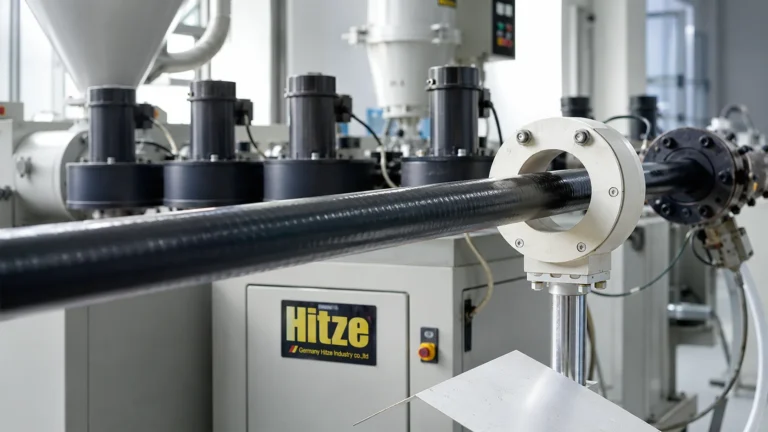
Hitze is a German brand of engineered piping systems, engineered in Germany and built to German DIN standards, founded in 1974 with a 120,000 m² production base, 1,000+ employees and exports to 118+ countries. On the potable-water lines, the compliance posture is deliberately conservative and scoped tightly to what is actually held:
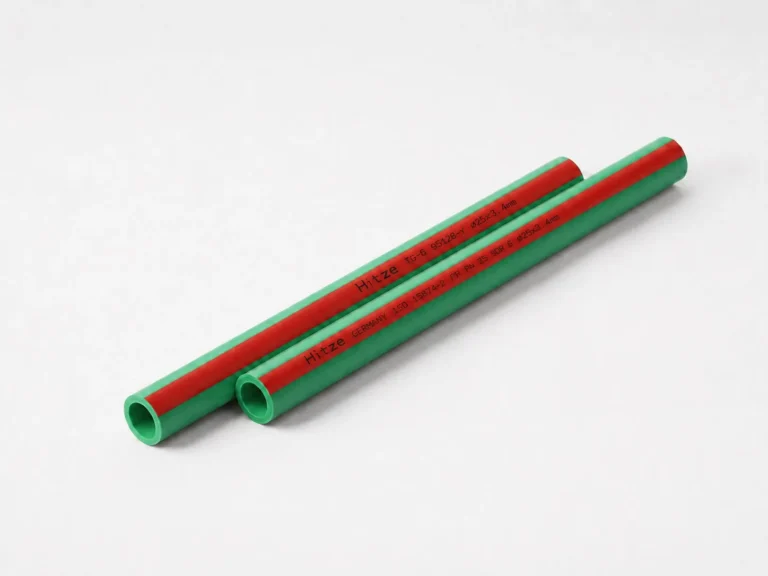
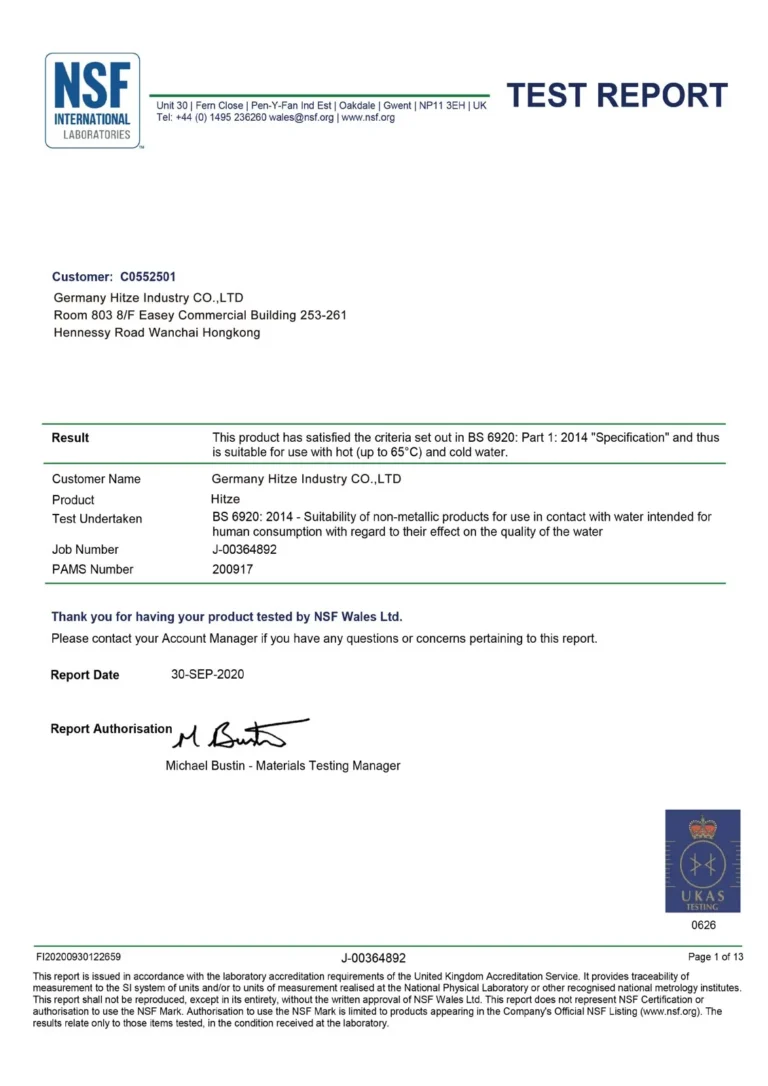
PP-R drinking-water pipe carries a DVGW type examination and is built to DIN 8077/8078 and EN ISO 15874; a numbered SKZ test certificate covers the PP-R pressure pipe and fittings and the PE-Xb heating pipe. Material-level potable approval is held via WRAS, and an independent NSF International Laboratories BS 6920 report confirms suitability for hot (≤65 °C) and cold drinking-water contact. Lead-free and DZR brass is specified in real grades — CW724R, CW511L, CW602N for DZR, CW617N as the standard alloy — so the metal-contact side is designed for lead-free potable duty from the material up, not retrofitted.
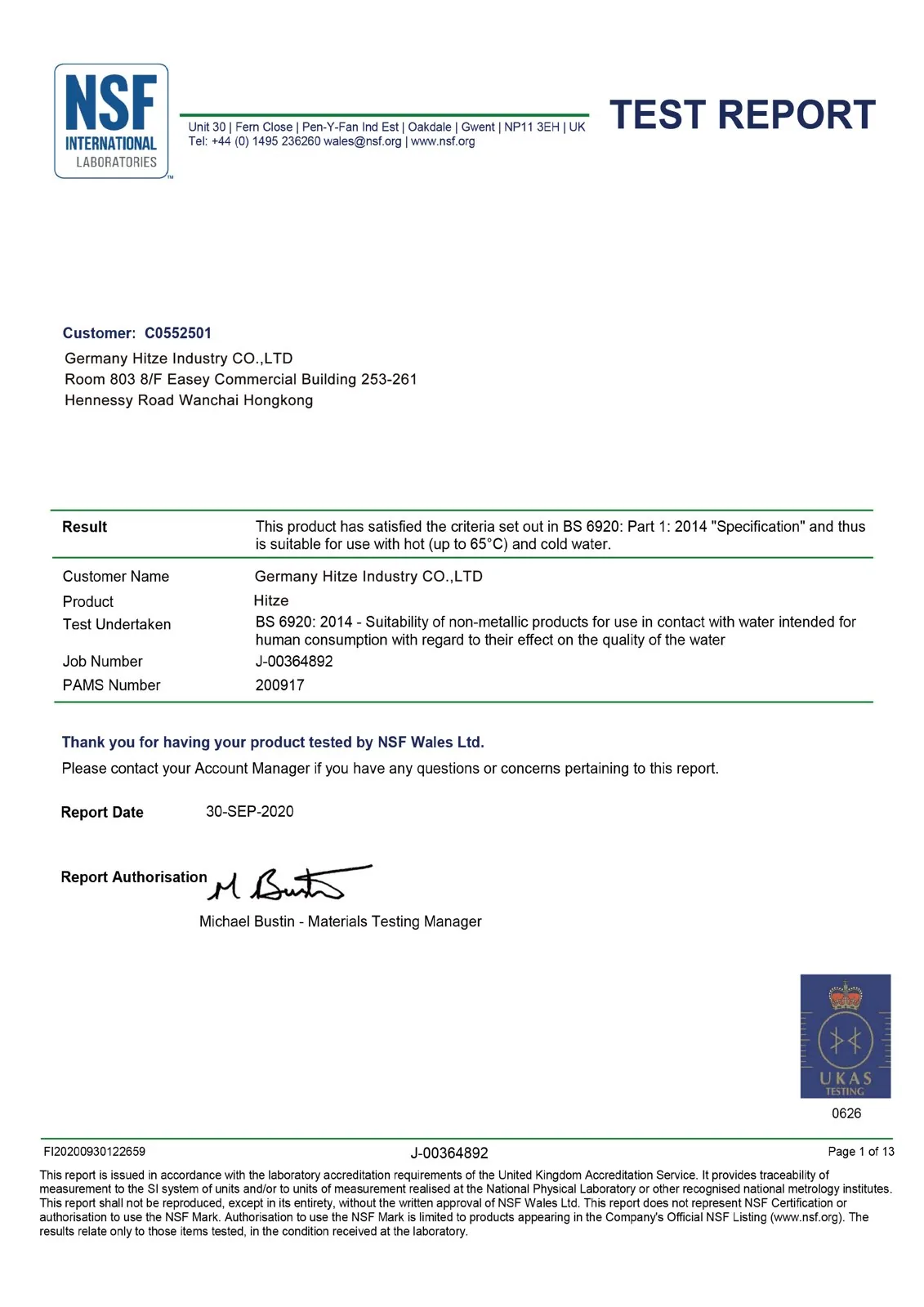
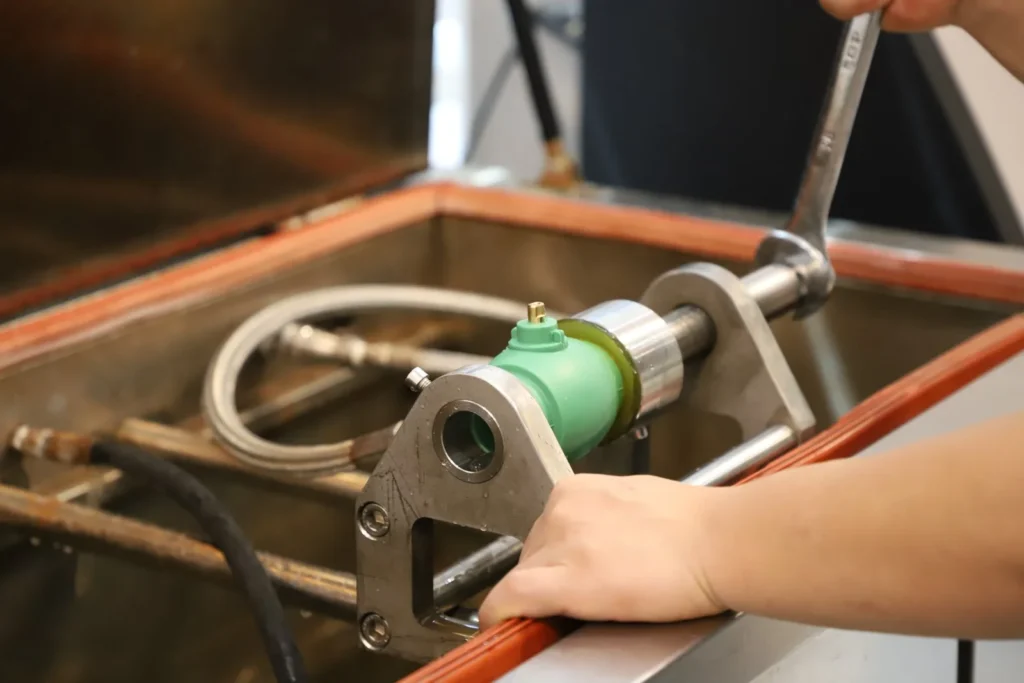
What Hitze checks before a potable batch ships: hydrostatic pressure verification against DIN and EN ISO on the test bench; full-length aluminium-core weld integrity on multilayer; and documented material traceability so that, as the EU Positive List transition proceeds, formulation data can be mapped to the relevant substance entries. Cert numbers exist on the physical certificates and are available on request; Hitze does not publish additional listing numbers or invent scope. Where a line is covered, it is stated; where it is not, it is not implied — for instance, the DVGW and SKZ scope covers PP-R and PE-Xb, not the PEX potable range, which is why the WRAS material approval and NSF BS 6920 report are the credentials cited for potable material suitability. You can review the full picture on the certifications and compliance page.
How the EU regime sits alongside CE marking and NSF/ANSI 61
Two clarifications save engineers a lot of wasted effort. First, the EU drinking-water marking under 2024/371 is a hygiene/health credential — it says the wetted material is safe for potable contact. It is not the same thing as CE marking and a Declaration of Performance, which address a product’s performance characteristics under the Construction Products Regulation. A potable pipe may need both, for different reasons; do not let a supplier present one as if it discharges the other. Our buyer’s guide to the DoP and CE marking for pipe keeps the two lanes straight.
Second, NSF/ANSI 61 is the North American potable-contact standard and is entirely separate from the EU Positive List. A product carrying NSF/ANSI 61 is not thereby EU-compliant, and vice versa — the substance lists, migration protocols and test waters differ. For a brand selling into North America and Europe, that means maintaining two parallel evidence packs. The common thread is lead-free metallurgy: both regimes are tightening on lead at the wetted surface, so specifying genuine lead-free/DZR brass grades is the one investment that pays off on both sides of the Atlantic.
A practical checklist for the 2026–2032 window
Turn the regulation into supplier actions. For every wetted SKU you buy for the EU: (1) confirm which national approvals are valid and live as of 31 December 2026, and get the certificate copies on file; (2) obtain a written EU Positive-List conformity roadmap with a target date comfortably inside the 2032 window; (3) require full formulation disclosure down to the 0.1% impurity / 0.02% formulation thresholds so NIAS assessment is possible; (4) separate your hygiene evidence (EU marking / national approval) from your performance evidence (DoP/CE) in your document control so an auditor can find each in one place; and (5) for any product you plan to launch after 1 January 2027, treat EU-route compliance as a gating requirement, not a post-launch tidy-up. A supplier who resists any of these five is telling you where your 2027–2032 risk lives.
Who this is for — and how to pressure-test Hitze on it
This transition matters most to importers, distributors and private-label brands who supply potable systems into the EU and cannot afford an approval gap in their 2027–2028 launches. If that is you, the useful next step is to put your actual SKU list against the two dates above and ask each supplier to answer for it in writing. Hitze holds live WRAS material approval, a DVGW type examination on PP-R drinking-water pipe, and an NSF Laboratories BS 6920 potable report today, and tracks the Positive-List transition on the affected lines. There is no minimum order quantity — you can start with samples or a small trial order to validate the documentation before you commit — and the matched Hitze pipe-and-fitting system carries a 50-year warranty when specified as a system. Start with the certifications and compliance page, then request the certificate copies and the EU-conformity roadmap for the exact grades you intend to buy; cert numbers and market-specific documentation are available on request.
Regulatory dates and act numbers above are drawn from Directive (EU) 2020/2184 and its 2024 implementing legislation as published on EUR-Lex and summarised by ECHA and accredited conformity assessment bodies. Confirm the current status against the Official Journal before making a binding specification decision, as the Positive Lists are subject to ongoing amendment.
Frequently asked questions
When does the EU drinking water directive 2020/2184 material regime actually apply?
The six implementing acts adopted on 23 January 2024 entered into force on 15 May 2024 and apply from 31 December 2026. From that date the EU Positive-List regime governs new approvals; from 1 January 2027 national schemes can no longer approve new products for drinking-water contact.
Do DVGW and KTW approvals become invalid on 31 December 2026?
No. A product holding a valid EU national certificate (DVGW/KTW-BWGL, ACS, KIWA, etc.) as of 31 December 2026 may continue to be placed on the market under that national scheme, within the relevant EU Member State, until 31 December 2032. After that the EU regime applies. These EU national hallmarks remain recognised during the transition — but cannot issue fresh approvals for new products after 2026. WRAS is a UK scheme outside EU law, so this EU transition clock does not govern it; WRAS-approved products continue in Great Britain under UK regulations independently.
What is a European Positive List and what is on it?
It is an EU-level list of the starting substances, compositions and constituents authorised for use in materials that contact drinking water, established by Commission Implementing Decision (EU) 2024/367 and administered by ECHA. The first lists were built largely from the national positive lists Member States notified to ECHA by 12 July 2021. A material may only be made from listed substances once the regime applies — though the finished material still has to pass migration and organoleptic testing separately.
Does 2020/2184 apply to Great Britain?
No. Directive (EU) 2020/2184 is EU law and does not directly bind Great Britain, which operates under the UK regime and WRAS/Water Fittings Regulations. Suppliers serving both markets must hold the correct credential for each jurisdiction rather than assume one European approval covers both.
Is Hitze pipe made in Germany?
Hitze is a German brand, engineered in Germany and built to German DIN standards, with certification held under German and international schemes including SKZ and DVGW. Hitze does not market its products as “made in Germany”; the accurate framing is a German brand engineered to German DIN standards and produced at its own 120,000 m² base.
Is a Hitze potable pipe already EU Positive-List compliant?
Hitze holds live WRAS material approval, a DVGW type examination for PP-R drinking-water pipe, and an NSF Laboratories BS 6920 potable report today, and is tracking the Positive-List transition on the affected lines. Specific Positive-List status and current certificate numbers for a given grade are available on request and vary by product line and market.