In a PPR vs PVC comparison, there is no honest universal winner. PVC-U is commonly the practical choice for cold-water pressure service and pressure drainage within its specified scope. CPVC is designed for hot and cold building-water systems and normally uses an approved solvent-cement joining process. PPR is also specified for hot and cold building-water and heating systems, but it normally uses heat-fused joints. The right choice depends on the duty schedule, local code, potable-water approvals, pressure-temperature design, installer capability, material availability and the engineer’s accepted system—not on a generic “best pipe” chart.
By the Hitze Technical Content Team · Technical review: 21 July 2026
Key takeaways
- PVC-U, CPVC and PP-R are different material systems with different standards and joining ecosystems.
- PVC-U’s ISO 1452 scope is principally cold water under pressure; CPVC’s ISO 15877 and PP-R’s ISO 15874 cover class-based hot/cold building-water applications.
- PPR heat fusion and PVC/CPVC solvent cement each reduce one risk while creating another; workmanship control still decides joint quality.
- Never compare PN or advertised pressure numbers without the design temperature, duration, material-specific tables and safety factors.
- Verify product-specific approvals. A material standard is not automatically a local drinking-water, fire or building-code approval.
PPR vs PVC vs CPVC: the quick verdict
Use this table as a screening tool, not a final specification. “PVC” below means unplasticized PVC pressure pipe, commonly written PVC-U. Flexible PVC hose and non-pressure drainage products are different categories.
| Decision factor | PPR / PP-R | PVC-U | CPVC / PVC-C |
|---|---|---|---|
| Core ISO building-service scope | Hot/cold water within buildings and heating, class-based | Principally cold water under pressure; also pressure drainage/sewerage in scope | Hot/cold water within buildings and heating, class-based |
| Typical socket-joint method | Controlled heat fusion | Approved solvent cement | Approved solvent cement |
| Site control focus | Tool calibration, heating/cooling time, alignment and insertion | Surface preparation, cement system, application and cure conditions | Surface preparation, compatible cement, application and cure conditions |
| Good screening fit | Hot/cold distribution where fusion-trained crews and approvals are available | Cold-water pressure and selected pressure-drainage duties within the declared scope | Hot/cold distribution where the CPVC code and solvent-cement ecosystem are established |
| Do not decide from | Color, “fusion is leak-free,” or one PN label | Low pipe price alone or confusion with drainage-only product | A generic high-temperature claim without system tables |
Bottom line: choose PVC-U when the verified duty is cold and its simple local ecosystem fits; choose CPVC when hot/cold service is required and the project is already designed and approved around CPVC; choose PPR when hot/cold or heating service, a fusion-based system and trained installation align. If two systems remain viable, compare the submitted assemblies—not isolated resin properties.
First, separate the three materials and their standards
PP-R is polypropylene random copolymer. PVC-U is unplasticized poly(vinyl chloride), the rigid PVC used for many pressure and drainage systems. PVC-C, commonly called CPVC, is chlorinated poly(vinyl chloride). The extra letter is not marketing trivia: it identifies a different material system with its own design and joining requirements.
These ISO references describe system families and design frameworks. They do not prove that a particular pipe is approved for a specific country, water authority, high-rise, hospital or fire-rated penetration. Product standards, test reports, listings and local code must converge on the same offered item.
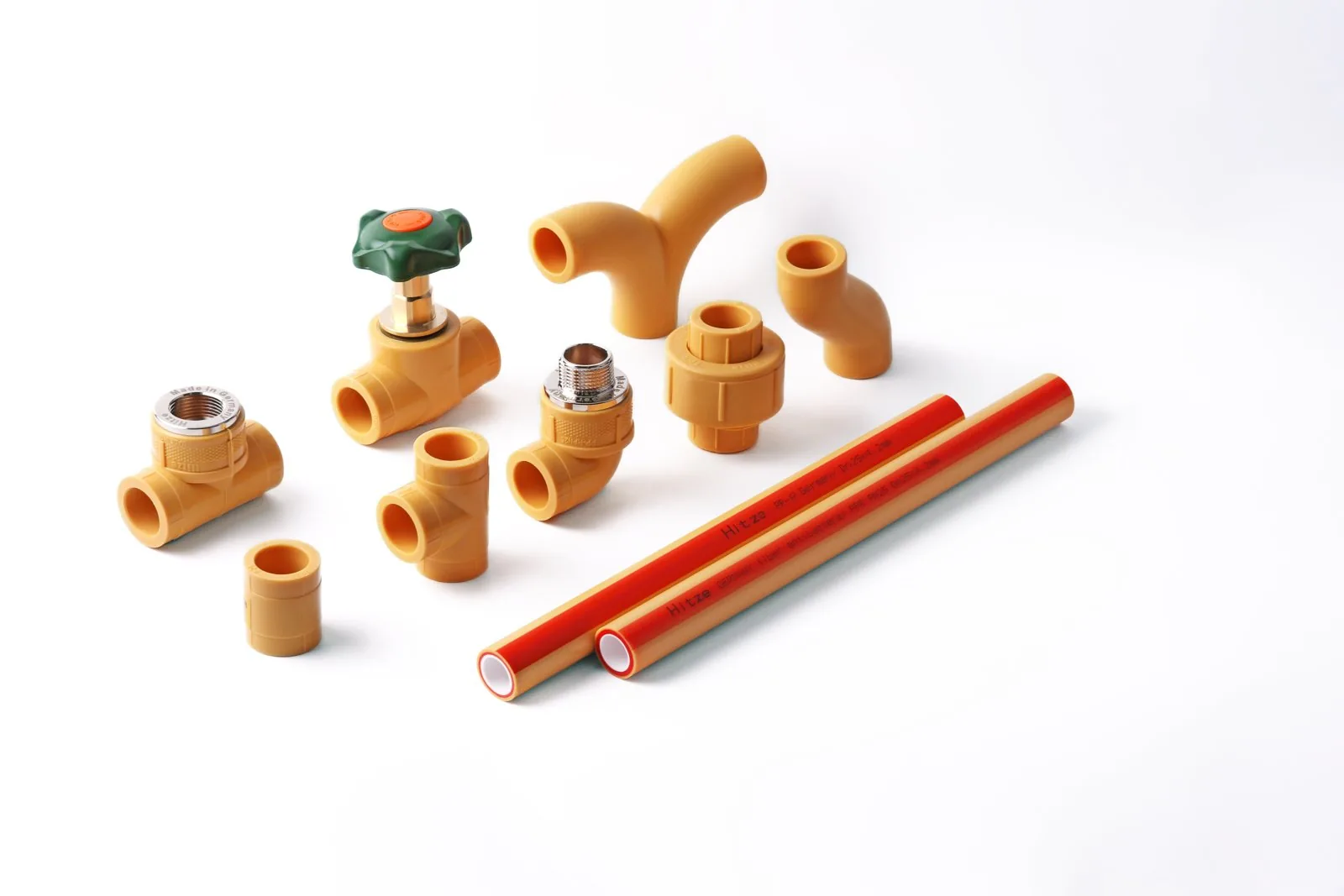
Hitze’s commercial system discussed here is PP-R pipe and fittings. This article compares that category with PVC-U and CPVC for selection purposes; it does not imply that Hitze manufactures the other two materials.
How do temperature and service scope differ?
The cleanest distinction is standards scope. ISO 1452 describes PVC-U for water supply and buried or above-ground pressure drainage and sewerage. Its water-under-pressure scope is up to and including 25°C, with certain conveyance applications addressed up to 45°C. ISO 15877 for CPVC and ISO 15874 for polypropylene address hot and cold water installations within buildings and heating systems through defined application classes, design pressures and temperature histories.
For cold potable-water distribution, all three materials can be candidates, but only when the offered system has the required health approvals and its declared pressure-temperature scope covers the duty. Material name alone is not an approval.
For domestic hot water and heating circuits, PP-R and CPVC can be evaluated through their ISO 15874 and ISO 15877 service-class frameworks. Ordinary cold-water PVC-U should not be carried into this duty by assumption; ISO 1452’s cold-water scope does not establish heating-water suitability.
For pressure drainage or sewerage, PVC-U has an explicit ISO 1452 route. A PP-R or CPVC proposal needs application-specific evidence rather than an inference from its building-water use.
Common mistake: turning a standard’s scope into a single “maximum temperature.” Real design uses a temperature profile over time, a design pressure, safety factors and the system manufacturer’s tables. A short excursion, continuous operating condition and test condition are not interchangeable.
A buyer should send the supplier a duty schedule: normal temperature, duration at each operating band, design pressure, exceptional condition, intended fluid and required service class. Without it, even a correct datasheet can be matched to the wrong project.
Heat fusion vs solvent cement: which joint is better?
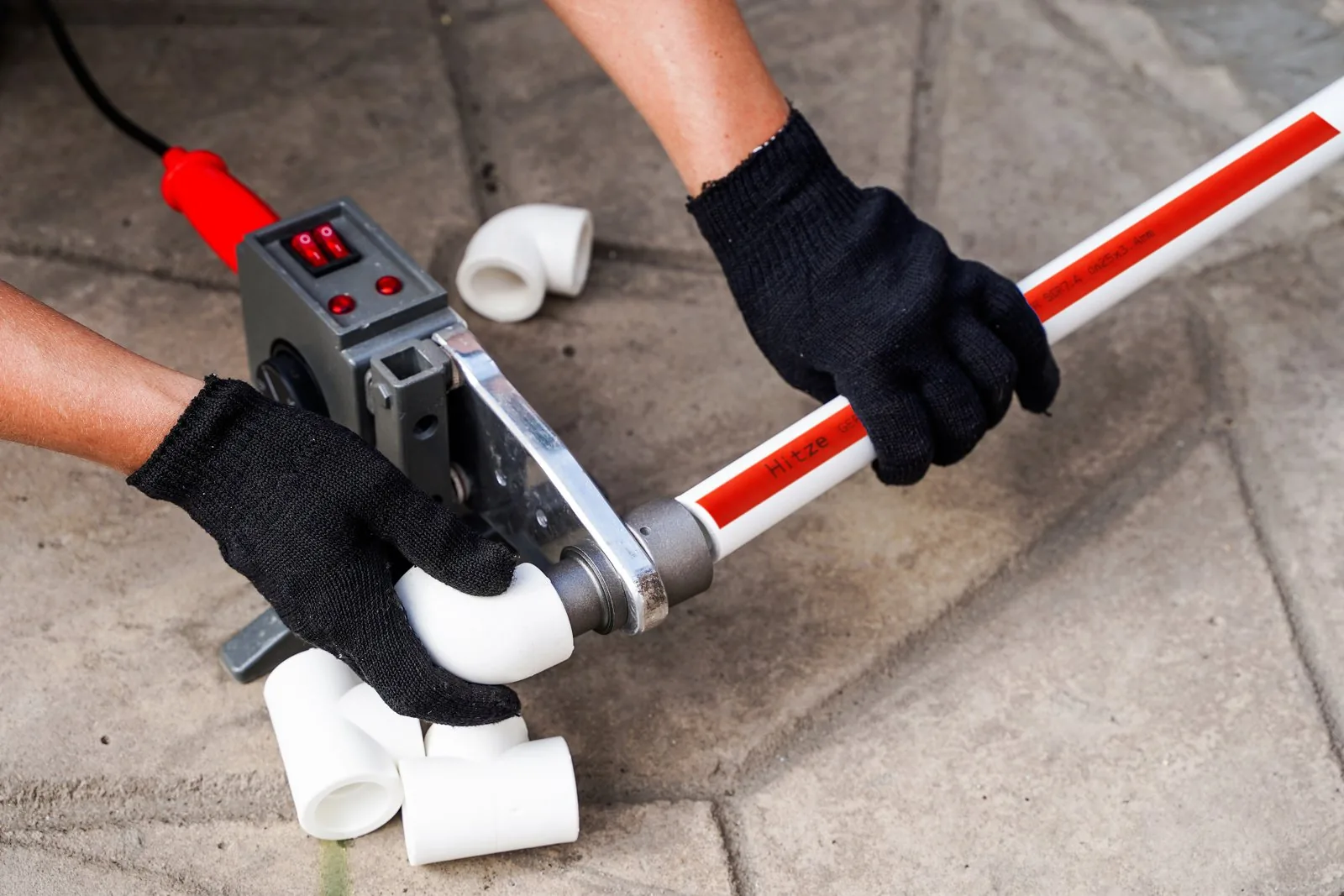
Neither method is automatically better; each needs a controlled procedure. PP-R components are commonly heat fused. A socket heater warms the mating surfaces, after which the installer joins and holds them through cooling. PVC-U and CPVC socket systems commonly use a compatible solvent cement, with preparation, application, assembly and curing controlled by the specified method and site conditions.
| Control point | PPR heat fusion | PVC-U / CPVC solvent cement |
|---|---|---|
| Compatibility | Approved pipe, fitting and fusion procedure | Approved pipe, fitting, primer/cleaner where required and cement |
| Critical process variables | Heater condition, temperature, heating time, insertion and cooling | Surface condition, cement condition, application, assembly time and cure |
| Typical visible evidence | Insertion marks, alignment and uniform bead appearance | Full application, insertion/alignment and documented cure conditions |
| Common failure path | Overheating, underheating, excess insertion, rotation or loading before cooling | Wrong cement, poor preparation, dry joint, misassembly or pressurizing before adequate cure |
ASTM F493-22(2026) covers CPVC solvent cements. ASTM F3328-18(2024) addresses one-step joining only where the manufacturers and local code permit it. The ASTM active plastic-pipe list also identifies D2564-20(2024) for PVC solvent cement, D2855-20(2024) for two-step PVC/CPVC joining and F3722-24 for polypropylene heat fusion. These references reinforce one rule: use the exact approved procedure, not a generic habit learned on another plastic.
Why pressure labels and pipe sizes are easy to miscompare
A PN label, schedule number, SDR/S series or nominal size does not translate directly across all three materials. Each system uses its own dimensional conventions and design tables. Pressure capacity is also temperature- and time-dependent. Comparing “PN20 PPR” with “Schedule 40 CPVC” as if the labels were the same language is an engineering error.
Five fields that make pressure comparable
- Design pressure at the point of use
- Operating-temperature profile and exceptional condition
- Material and exact pipe construction
- Outside diameter, wall thickness and dimensional series
- Applicable service-class/design table and safety basis
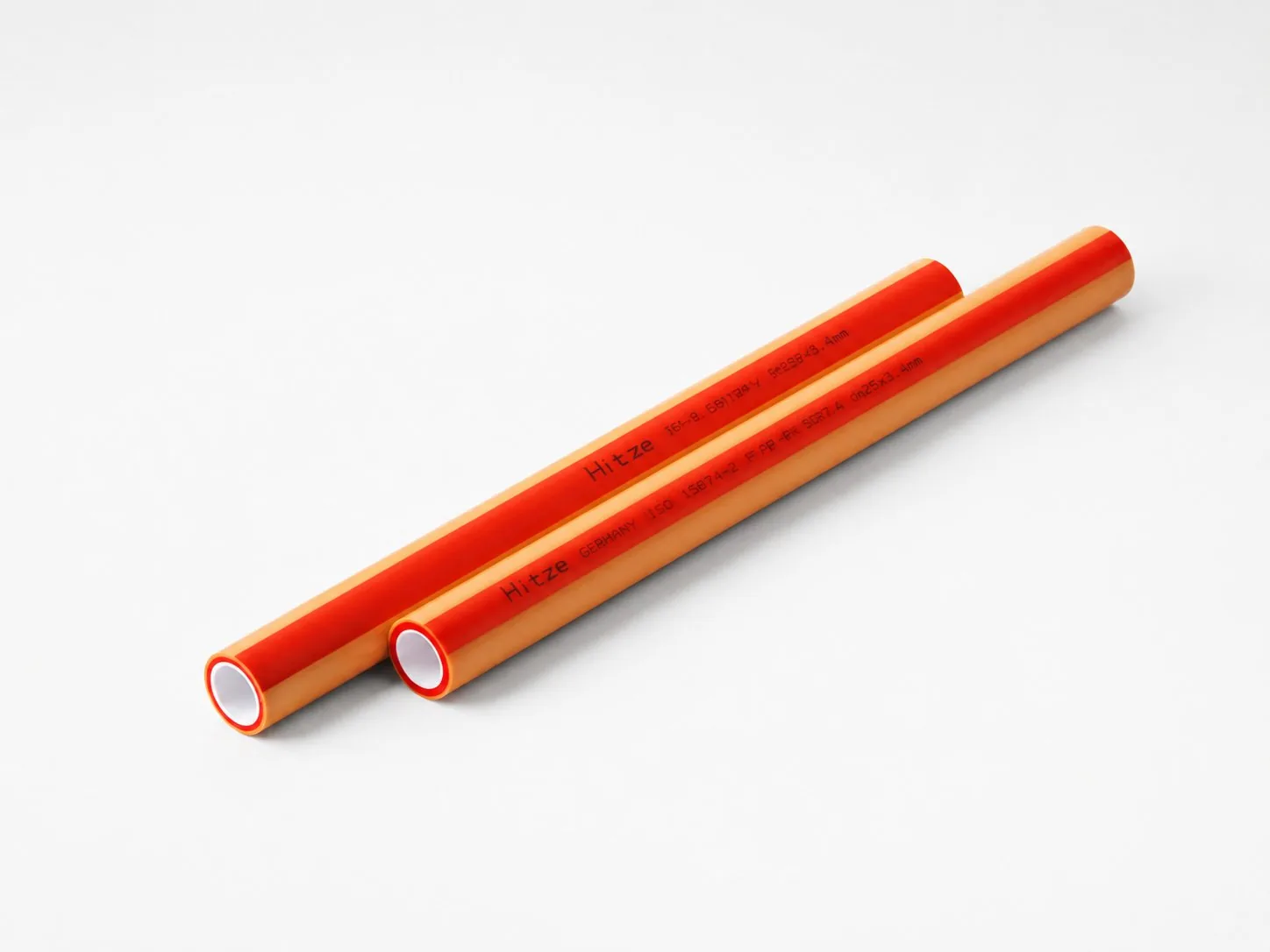
For context, Hitze’s PP-R catalog covers OD20–110 and listed DN15–90 across ceramic-core, fiberglass PPR-FB-PPR and PPR-AL-PPR constructions. Its catalog Class 1/Class 2 entries differ by construction. Those values describe one supplier range, not all PP-R pipe. PVC-U and CPVC offers must be read from their own current tables using the same project duty.
Procurement rule: normalize bids into one schedule before comparing price. Ask every bidder to fill the same columns for material, standard, service class, design pressure/temperature, OD and wall, fitting series, approvals and joining method.
Which system has lower installation risk?
The system that your project can control usually has the lower risk. A fusion system can perform poorly with damaged heater faces, wrong heating times or untrained crews. A solvent-cement system can perform poorly with incompatible cement, contaminated surfaces, poor ventilation, incorrect cure assumptions or rushed pressure testing. Material choice cannot compensate for an unmanaged method statement.
Site scenario: a high-rise project has ten installation teams and a compressed riser schedule. The specifier should ask which method can be trained, witnessed and recorded consistently across all teams. For PPR, that may mean controlled tool issue, daily heater checks, sample joints, insertion marks and fusion logs. For solvent cement, it may mean product shelf-life checks, ambient-condition records, joint timestamps, ventilation controls and a cure schedule tied to pipe size and conditions.
Routing matters too. All three systems need appropriate supports, allowance for thermal movement, protection against damage and compatible fire-stopping. Equipment connections and valves need load control. Review the supplier’s pipe-technology information, but make the project method statement more specific than the marketing page.
What about potable water, certificates and local code?
A material can fall within a hot/cold water standard and still lack the exact approval required by the project authority. Potable-water compliance may involve hygiene testing, extraction or taste/odor requirements, third-party certification and country-specific listings. Fire and building rules can add separate requirements for penetrations, shafts and exposed installations.
Certificate name, issuing body, product scope, model/size range, issue date and current status.
The certificate must cover the actual pipe construction and fittings being supplied.
A listing accepted in one country may not satisfy another authority or consultant.
Received pipe markings and lot records should reconcile with the approved submittal.
Do not accept a certificate logo as the entire proof. Ask for a current copy and verify that its scope includes the supplied product. Hitze lists EN ISO 15874, DIN 8077 and DIN 8078 among its PP-R references; the project team should confirm product-specific documents through the certifications and compliance process before approval.
Neutrality check: no material earns a blanket potable-water verdict here. Approval belongs to a defined product/system in a defined market.
Best for / not for: a conditional decision table
PPR is best considered when the hot/cold or heating duty fits the system data and the project can control fusion tooling, training, inspection and traceability. Do not select it when fusion quality cannot be controlled or the required local approval is absent. The deciding question is whether the project can qualify and audit a matched heat-fused system.
PVC-U is best considered when cold-water pressure or pressure-drainage duty falls inside the selected system’s declared scope. Do not substitute ordinary cold-water PVC-U into a hot-water duty. Confirm the complete operating temperature profile against the actual product data before approval.
CPVC is best considered when hot/cold building-water duty, local code and an established CPVC system align. Do not select it while cement compatibility, curing control, approvals or supply continuity remain unresolved. The deciding question is whether the project can control the complete solvent-cement system under real site conditions.
Installed cost must be calculated project by project. Pipe price is only one row. Include fittings, valves, transitions, supports, expansion control, tools, consumables, training, labor productivity, wastage, inspection, testing, program risk and locally stocked repair parts. Any universal statement that one material is “30% cheaper” without this bill of quantities is not transferable.
Which should you choose: PPR, PVC or CPVC?
Four-step decision path
- Define the duty. If it is cold-water pressure or pressure drainage, screen the specified PVC-U system alongside alternatives. If it includes hot water or heating, start from systems explicitly designed for that class, such as CPVC or PPR.
- Apply the jurisdiction filter. Remove any system without the required local, potable-water, building and project approvals.
- Apply the site-capability filter. Compare fusion competence, solvent-cement controls, tool availability, ventilation, curing schedule, inspection and repair logistics.
- Compare normalized submittals and total installed cost. Use the same duty, dimensions, approvals and bill-of-quantities boundaries for every bid.
Choose PPR when the project benefits from a matched heat-fused hot/cold or heating-water system and can control fusion workmanship. Choose CPVC when its hot/cold service data, approvals and solvent-cement ecosystem fit the project better. Choose PVC-U when the verified cold-water or pressure-drainage duty fits and paying for a hot-water-capable system adds no project value.
If PP-R remains on the shortlist, compare the complete pipe-and-fitting system, exact construction and service data. Hitze’s portfolio includes ceramic-core, fiberglass PPR-FB-PPR and PPR-AL-PPR options; a separate PP-R, PPR-CU and multilayer guide helps narrow that internal construction choice.
Does the decision point to PP-R?
For contractors, importers and distributors whose project points to a heat-fused PP-R system. Hitze confirms no minimum order quantity; project pricing and the 50-year product-warranty scope should be confirmed in the quotation and applicable terms. This commercial warranty is not the engineering design-life basis or a universal installed-lifespan claim.
Conclusion: compare systems against duty, not materials in isolation
PPR, PVC-U and CPVC each solve legitimate piping problems. PVC-U has a strong, clearly defined cold-water and pressure-drainage role. CPVC extends the PVC family into class-based hot/cold building-water service with a solvent-cement joining ecosystem. PPR covers class-based hot/cold water and heating service through a fusion-based polypropylene system.
Temperature, pressure, fluid and service history.
Product-specific evidence in the project jurisdiction.
A joining and inspection process the site can control.
Once those three gates are passed, total installed cost and supply continuity can make the final call. That sequence produces a defensible specification and prevents an attractive generic comparison chart from becoming an expensive site problem.
Frequently asked questions
Is PPR better than PVC?
Not universally. PPR is a candidate for specified hot/cold and heating-water systems, while PVC-U is often a practical choice for cold-water pressure or pressure-drainage duties within its declared scope. The project duty and approvals decide.
Is PPR better than CPVC for hot water?
Both material families have standards covering class-based hot/cold building-water service. PPR uses a fusion ecosystem; CPVC commonly uses solvent cement. Compare the exact pressure-temperature tables, approvals, installer capability and total installed system.
Can PVC pipe be used for hot water?
Do not assume ordinary PVC-U cold-water pipe is suitable for hot water. ISO 1452’s principal water-under-pressure scope is up to and including 25°C, with certain conveyance addressed up to 45°C. Use a system explicitly approved for the actual hot-water duty.
Which joint is stronger: PPR fusion or CPVC solvent cement?
A generic strength ranking is not useful. Both can produce compliant joints when compatible products and the approved procedure are used. Failures commonly trace to process control, preparation, timing, alignment, curing or loading.
Which system costs less?
It depends on local pipe and fitting prices, labor, tools, supports, transitions, program, wastage, inspection and repair logistics. Compare a normalized bill of quantities; pipe price alone is not installed cost.