PEX • Copper-ring verification
Replacing every fitting is a poor first response when the inspection rule itself has not been identified. The immediate decision is what to do with the suspect joint—and whether to make any more with the same setup.
If a PEX copper-ring gauge gives a different result after rotation, identify the exact tool, ring and gauge before deciding. A named WaterPEX GO snag at the jaw mark may be checked at another point; a NO-GO fit is a different failure and does not gain that exception. Apollo’s named angle-tool GO-range instructions do not approve an unidentified combo-tool joint. Record the readings, then follow the matched instructions for retesting, remaking or holding the joint.
Related educational video
General plumbing education, not authority for the named gauge branches. The exact manufacturer instructions in this article control the check. Watch on YouTube.
Identify the actual copper-ring gauge and system
A real installer question from August 2025 describes about ten trial crimps made with an Apollo combo tool and PRO rings. The NO-GO portion dropped in at one particular angle, while a video and written explanations seemed to disagree. The exact combo model and gauge part were not established in the question. It supplies a useful problem to investigate, but no basis for approving that person’s joints.
Start by separating the ring system from the name on the handle. This article concerns PEX copper crimp rings. A stainless cinch clamp, a press sleeve and an expansion ring have different checks; a gauge instruction from one does not become applicable because the nominal pipe size looks familiar. For the wider choice of connection method, use our expansion-versus-crimp comparison.

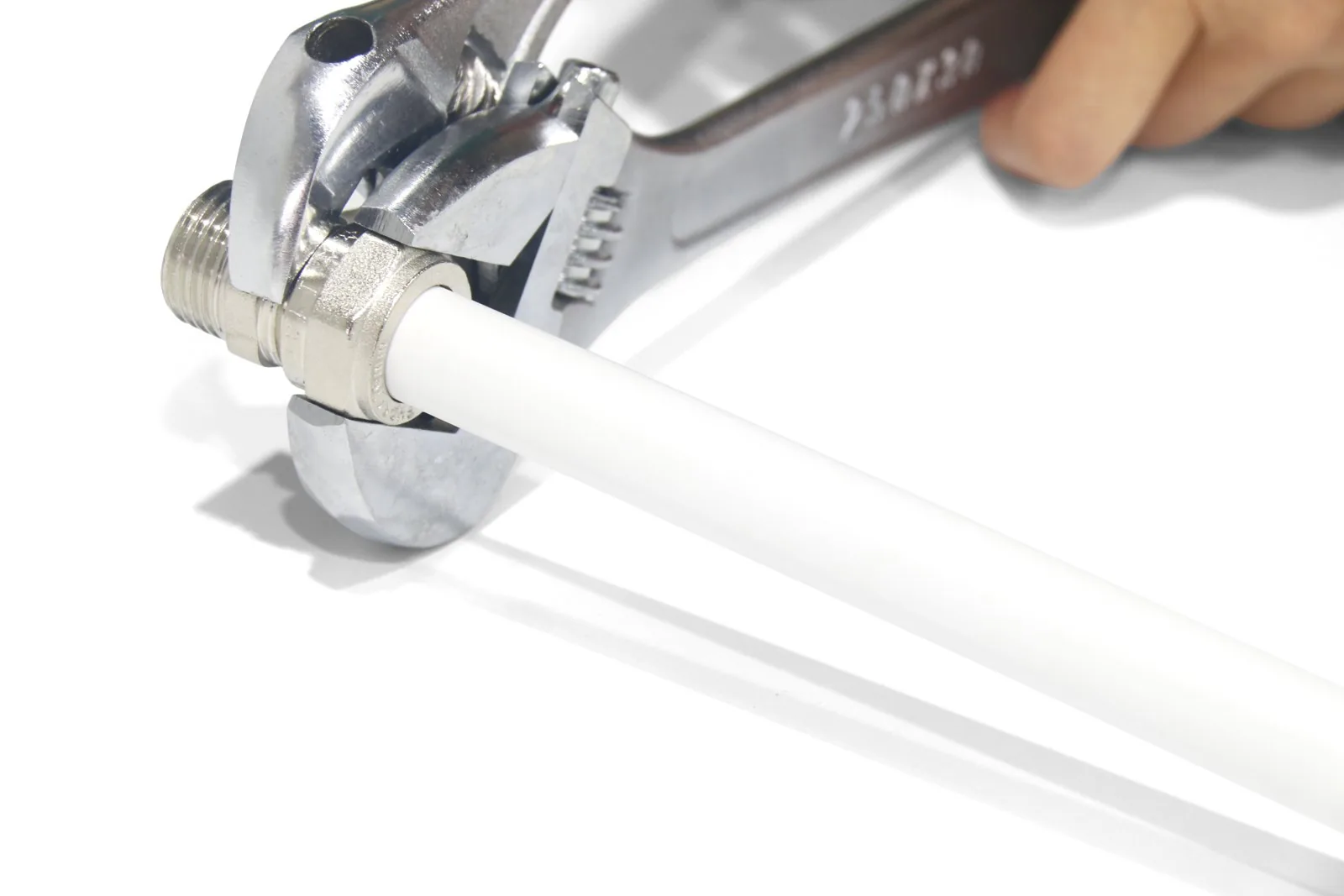
The photographs here provide pipe and connection context. They do not show a copper-ring GO/NO-GO measurement; no such demonstration photograph was identified in the reviewed library. The linked manufacturer diagrams, named instructions and readable decision steps carry that distinction.
| Named example | What its document shows | What you may carry forward |
|---|---|---|
| Watts WaterPEX copper CrimpRing | The IS-WaterPEX guide illustrates separate GO and NO-GO openings for each covered size. | Use its size, presentation and failure rules for that identified system. |
| Apollo 69PTKANG143 angle tool | The sheet dated January 20, 2021 describes the ring stopping in a GO range at least at one point; it says the ring will not fit that range all the way around. | A named GO-range example exists. This alone does not classify another Apollo gauge or clear a NO-GO observation. |
| Unidentified combo tool or loose gauge | Brand name or appearance alone does not establish the applicable instruction. | Keep the joint unclassified until the exact tool, gauge, ring and size are matched to their instructions. |
The distinction is visible in the WaterPEX guide, printed pages 2–3, and Apollo’s angle-tool sheet, page 2. Check the model and revision supplied for your actual equipment; neither document is a universal approval for another assembly. The Apollo sheet’s wording should not be used to invent an acceptance rule for an unidentified gauge.
Record the angle-dependent GO and NO-GO result without changing rules
Two movements are easily confused. Rotating the check around the ring changes the circumferential point being checked. Tilting the gauge changes how it meets the ring. A different reading after either movement is an observation to describe precisely, not a diagnosis of the tool or fitting lot.
For the named WaterPEX gauge, the guide requires the correct size opening, a check at a right angle to the ring, and pushing the gauge onto the ring rather than sliding it from the side. It also says not to change the opening and to replace a damaged gauge. Those details matter before treating a reading as a failed joint. Apollo’s named angle-tool illustration instead instructs the user to slide the correct slot around the crimped ring to read its GO range. Do not combine the movement from one document with the acceptance rule from another.
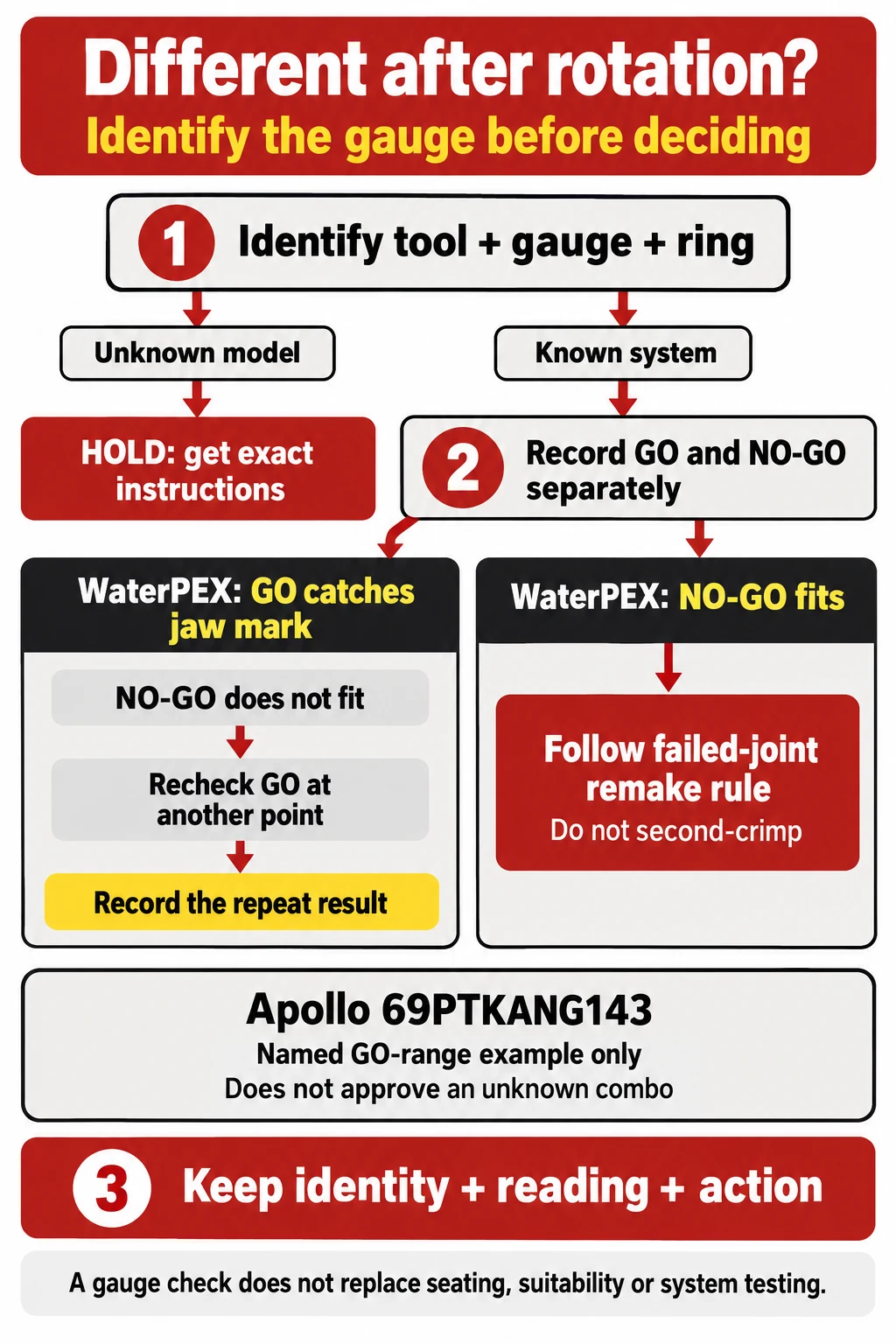
- Identify the check. Record the tool model, gauge markings, pipe size and ring identifier. If these cannot be matched, stop at “instruction not established.”
- Name the observation. Write GO will not fit, NO-GO fits, or ring stops inside/outside a marked GO range. These are different results.
- Repeat only the check the document permits. With WaterPEX, correct the presentation and note the jaw-closure mark. Its specific GO snag instruction permits a check at a different point.
- Preserve the other result. A retested GO observation does not erase a recorded NO-GO fit. Take both readings into the disposition.
The WaterPEX exception is narrow: if the gauge hangs up where the jaws closed and left a small mark, test at another point before failing the connection. It concerns a GO obstruction. A ring that enters NO-GO presents the opposite dimensional issue.
For this conventional gauge, the physical relationship explains the labels: a ring left too large will not enter GO because it was not compressed enough. A ring compressed too small can enter NO-GO. The WaterPEX guide calls that excessive compression. Reversing these descriptions sends a tool investigation in the wrong direction; the reading itself must be retained even if someone has called it “too loose” or “too tight” incorrectly.
Choose the next action for the named system
The following completed rows are teaching conditions derived from the named instructions, not tests carried out on Hitze products or a diagnosis of the anonymous installer’s work. They show how a similar-looking complaint can lead to a different next action.
| Known input and observation | Applicable distinction | Completed next action | Still unresolved |
|---|---|---|---|
| WaterPEX system and correct gauge identified. GO catches at the jaw-closure mark; NO-GO does not fit. | The guide permits another GO check where the jaw mark causes a snag. | Recheck GO at a different point as instructed and record that result. The initial snag alone does not settle rejection. | Until the repeat result exists, do not mark the gauge check complete. Even a satisfactory repeat leaves seating, suitability and system testing separate. |
| WaterPEX system and correct gauge identified. NO-GO fits during the prescribed check. | This indicates too much compression under its conventional gauge rule. The GO snag exception does not apply. | Follow the guide’s failed-joint instruction: cut out the bad joint and start over. Do not put that ring through the crimp tool a second time. | The observation alone does not establish why the failure occurred or condemn the complete fitting lot. |
| Apollo combo tool reported, but exact model and gauge not identified. NO-GO appears to fit at one angle. | The named 69PTKANG143 angle-tool GO-range example has not been matched to this assembly. | HOLD the joint’s acceptance. Identify the combo model and supplied gauge, then obtain the applicable manufacturer interpretation before selecting its recheck or remake branch. | The missing model/gauge rule changes the decision. The angle-tool example cannot supply it by analogy. |
For a known WaterPEX failure, cutting out and remaking is an actual disposition. For the unknown combo, a hold is also a useful result: it prevents an unsupported acceptance while avoiding a speculative tool adjustment or wholesale fitting return. Once the missing identity is established, apply that exact gauge’s rule to the recorded observations; do not simply choose whichever published instruction gives a pass.
The SharkBite multi-head kit 23100 guide, revision 1-21, separately says that over- and under-crimped rings must be removed and a new copper ring used. Its adjustment procedure belongs to that tool. Repeated trial failures call for pausing further assembly and following the identified tool’s checking or service instructions, rather than changing an unfamiliar adjustment until one reading looks favourable.
A dry joint at ordinary operation does not answer which gauge instruction applied. Nor does an online commenter’s account of a phone call establish a manufacturer-approved circumference percentage. Keep inspection, system testing and component suitability as separate questions. Our pipe-and-fitting brand compatibility guide addresses the wider system question; a diameter reading cannot establish listing or warranty coverage.
Carry a compact check record into handover
A bare entry reading “gauge passed” loses the distinction that solved the problem. Keep enough information for the supervisor, installer or supplier to reproduce the interpretation. A photo of the markings can support identification, but a photograph alone does not measure the finished ring or inspect hidden seating.
| Record field | What belongs in it |
|---|---|
| Assembly identity | Pipe marking and size; fitting and ring identifiers; available lot references; joint location or sample label. |
| Inspection identity | Tool model, jaw/die size, gauge part or markings, and the applicable instruction title, revision and page. |
| Observation | GO, NO-GO or marked GO-range result; presentation used; position relative to jaw mark; initial and permitted repeat readings kept separately. |
| Disposition | Retest awaiting result, failed joint remade, or HOLD pending the exact rule. Record who resolves the outstanding check. |
| Separate completion checks | Seating and visible condition, component suitability, and pressure testing under the applicable system instructions and project requirements. |
The record is useful before a fitting reorder. It distinguishes “we need replacement fittings for these remade joints” from “we have not yet identified how this gauge should be read.” It does not, by itself, prove a material defect or establish the number of replacement parts required.
For a possible Hitze PEX fitting order, first Check availability for the identified PEX fitting. Send the target market and service, exact pipe size and marking, fitting/ring identifiers, tool and gauge details, and required quantity; the PEX category alone does not confirm a matching CTS copper-ring SKU or a tool-calibration service.
Conclusion
The expensive mistake is carrying an unidentified inspection rule into concealed work: the next person cannot tell whether the joint needed a targeted retest, a remake or a hold. Preserve the named system, the separate GO and NO-GO observations, and the resulting action before accepting more joints or ordering replacement fittings.
FAQ
Does GO fitting at one point always mean the crimp is acceptable?
No. The Apollo angle-tool sheet describes its own GO range; that statement cannot replace a conventional gauge rule or clear an unidentified combo-tool joint.
Can a jaw mark explain a NO-GO fit?
The cited WaterPEX exception concerns GO catching at the jaw-closure mark. It does not waive a NO-GO fit.
Should I squeeze a failed copper ring again?
The cited WaterPEX guide says not to second-crimp a failed joint. Follow the matched system’s remake instruction rather than attempting a generic repair.
Does passing the gauge replace pressure testing?
No. Ring-diameter verification leaves seating, component suitability and the system’s required pressure test as separate checks.