A PEX line reaches a tight corner. Before adding an elbow, identify the tube and compare its permitted bend radius with the space available. Use the actual outside diameter and that product’s instructions. A free sweep, an approved bend support and an elbow can give different answers. The PEX-a, PEX-b or PEX-c label alone does not establish the permitted radius.
For example, an illustrative 4-inch available radius can accommodate the published 3¾-inch minimum for ½-inch Uponor PEX, yet fail the 5-inch free-bend minimum for ½-inch Viega PureFlow PEX. That is a product-specific comparison, not a ranking of the two materials. The support, connection and mounting details still have to fit.
Key Takeaways
- Read the instructions for the exact tubing system before choosing a bend.
- Use actual outside diameter: ½-inch CTS PEX has a 0.625-inch OD.
- A radius is not a bend diameter or the complete installation envelope.
- A supported bend can have a different permitted radius from a free bend.
- Check coil direction and fitting proximity separately from radius.
- If an approved bend cannot fit, use a compatible elbow or change the route.
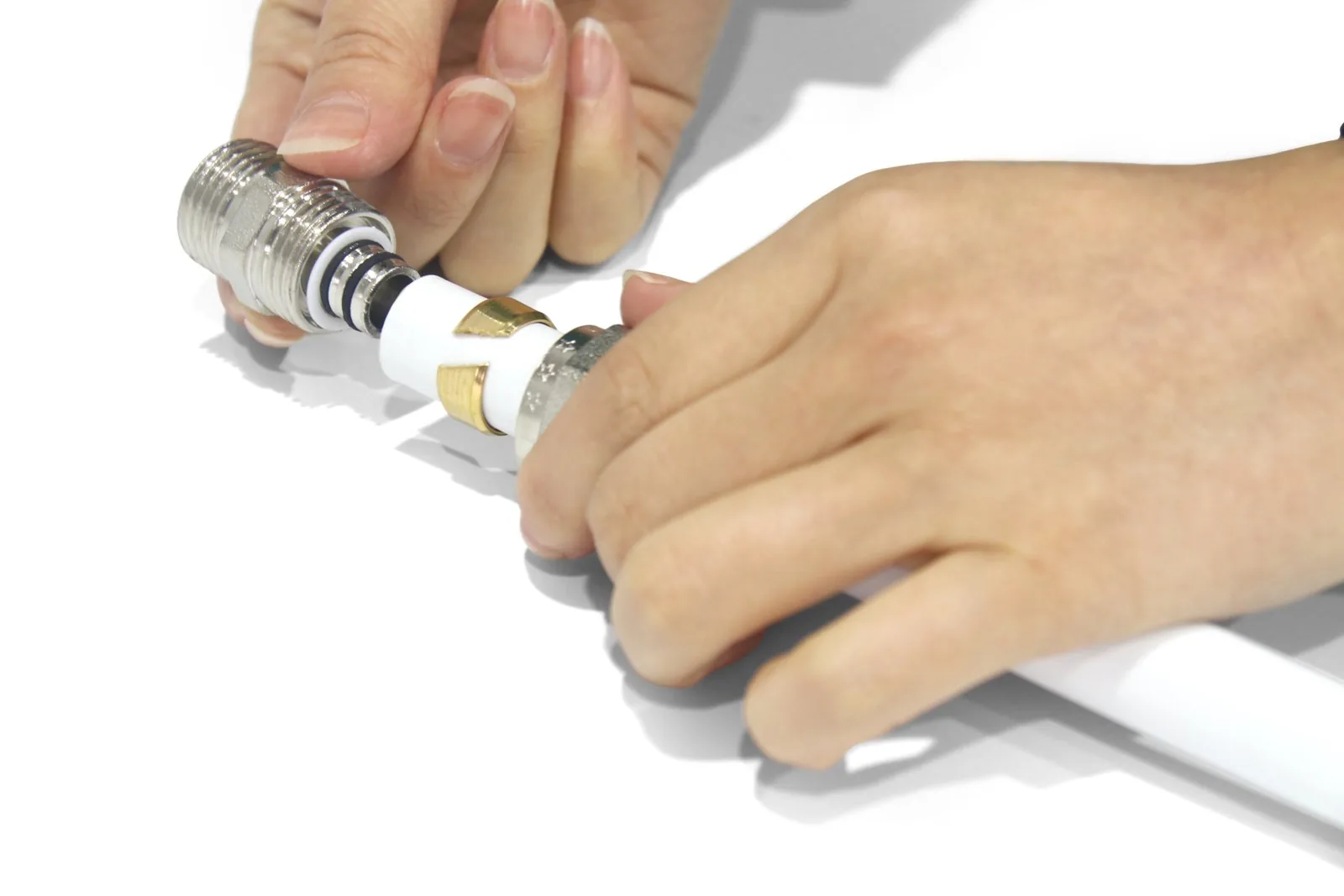
Research-lab demonstration of a supported PEX bend. The exact product instructions remain the radius authority.
Start with the tube and the radius reference
Find the manufacturer, product name and size on the print line, then obtain the matching installation instructions. A catalogue description such as “½-inch PEX-b” leaves out information that can change the answer: the exact tubing, its permitted support and the direction in which it will be bent.
The diameter in a bend multiplier is the actual tubing OD. The PPI/PPFA third-edition design guide, April 2026, lists CTS dimensions. Its ½-inch nominal tubing has a 0.625-inch OD, and ¾-inch nominal tubing has a 0.875-inch OD. Multiplying the nominal ½ inch by a bend factor produces an undersized radius.
Next establish where the radius is measured. The PPI guide describes its free-bend measurement at the midpoint of the bend. Read that with the manufacturer’s drawing; do not switch between the inside edge, tube centreline and outside edge while comparing a measured space with a table. Where a drawing establishes a centreline radius, the outer tube surface extends another half OD beyond that centreline.
A radius also describes curvature, not the entire space occupied by the installation. A U-turn has a different footprint from a quarter-circle turn of the same radius. A bend support adds its own thickness, fixing points and installation clearance. Measure the route, the fitting position and the complete proposed support; a radius that passes on paper can still leave no way to mount the assembly.
Why two valid PEX instructions give different radii
The PPI guide gives a general free-bend minimum of six times actual OD, unless the PEX manufacturer specifies otherwise. That exception is essential. A general six-times table cannot cancel an eight-times requirement printed in a particular tubing manual.
| Source and product | Free bend | Supported bend | Decision limit |
|---|---|---|---|
| PPI/PPFA guide, April 2026 | At least 6 × actual OD, unless otherwise specified | Consult the specific system | General guidance; not permission to override a manufacturer |
| Uponor PEX installation guide | Minimum 6 × OD | Supports facilitate the listed bends; use the system instructions | Do not assume a support permits a smaller radius |
| Viega PureFlow PEX pocket guide, 1125 | Minimum 8 × OD | 5 × OD with a Viega-approved support | Different supported and unsupported limits |
Sources: PPI/PPFA, printed page 24; Uponor installation guide, printed pages 25–26; Viega PureFlow pocket guide, printed page 34. These are named-system examples, not Hitze product specifications.
Notice what the table does not do: assign one universal factor to every PEX-a, PEX-b or PEX-c tube. The manufacturing-method comparison explains the material labels, but a field bend requires the actual product instruction. A calculator that starts from the crosslinking letter has not yet identified the applicable installation limit.
Likewise, do not reduce a published minimum just because the tubing feels softer on a warm day. Flexibility makes handling easier; it does not independently authorize a tighter permanent bend. Viega expressly prohibits hot bending its PureFlow PEX to achieve a tighter radius. Keep any kink-restoration procedure separate from the original bend-design decision.

A four-inch corner: sweep, support or elbow?
Illustrative geometry exercise: assume the layout provides a 4-inch available bend radius measured on the same reference as the applicable instruction. The tubing is ½-inch CTS, with an actual 0.625-inch OD. Assume adequate straight connection lengths and mounting space initially; those assumptions must be checked afterward. This is not a customer project or a claim that any Hitze product has these bend limits.
For the Uponor example, 6 × 0.625 = 3.75 inches. The proposed 4-inch radius exceeds that stated minimum, so radius alone does not require an elbow. For the Viega example, 8 × 0.625 = 5 inches. The same 4-inch radius fails its free-bend instruction. Changing only the product has changed the result.
Viega’s approved-support condition gives 5 × 0.625 = 3.125 inches; its published table rounds the ½-inch supported value to 3.1 inches. A matching approved support may therefore provide a route inside the assumed radius. That does not establish that an arbitrary support fits the pipe, is approved for the system, or can be mounted in this particular corner.
| Proposed arrangement | Radius requirement | Radius result | Next decision |
|---|---|---|---|
| Uponor example, free bend | 3.75 in | Passes this radius comparison | Check fitting distance and full envelope |
| Viega example, free bend | 5 in | Fails | Do not force the sweep |
| Viega example, approved support | 3.125 in calculated | Potential supported route | Verify exact support and mounting space |
| Compatible elbow | Use fitting dimensions | Not evaluated by tube-bend radius | Check system compatibility and connection space |
Derived from the named manufacturers’ instructions above; available space is an explicit teaching assumption. “Passes” concerns radius only, not complete installation approval.
A continuous sweep can remove a directional fitting where it is permitted and fits. The PPI guide identifies fewer joints and reduced fitting resistance as possible advantages. An elbow remains the appropriate option when the proper bend cannot be made. Do not exchange an unforced, compatible connection for a stressed sweep merely to reduce the fitting count.
| Condition | Radius (in) |
|---|---|
| Uponor free | 3.75 |
| Viega free | 5 |
| Viega supported | 3.125 |
| Available radius | 4 |
A fitting changes what a clear bend radius proves
Radius is one check. The straight section beside a connection is another. Uponor advises against changing direction immediately after a ProPEX connection and recommends at least two times OD before the turn, subject to installer judgment. For the example 0.625-inch OD tube, that recommendation is 1.25 inches. A curve can satisfy the minimum radius and still start too close to the connection.
Viega uses a different support instruction: bends close to its fittings require anchoring with a bend support or tubing fastener. Its table lists the fitting-to-bend distance threshold by tubing size; the ½-inch entry is 8 inches. This is an instruction about supporting a nearby bend, not a demand to leave an 8-inch straight section everywhere. Keep the drawing and wording together rather than turning one dimension into a universal rule.
Coil direction can change the radius as well. Viega specifies 24 × OD when bending against its coil direction. For the same illustrative 0.625-inch OD, that is 15 inches. A 4-inch free bend that was already unsuitable does not become acceptable by reversing the coil. Reorient the tube, change the route, or choose a permitted connection arrangement.
Finally, a bend support is not evidence that damaged tubing has been repaired. If the wall is kinked, cut, gouged or visibly distorted, stop and apply the exact manufacturer’s inspection and repair instructions. Do not heat an unidentified PEX tube or a multilayer pipe because another product permits a repair. Our pipe-in-pipe relining guide addresses a separate question: whether a liner can pass through an existing route. Passing a liner and approving its final bend are different checks.
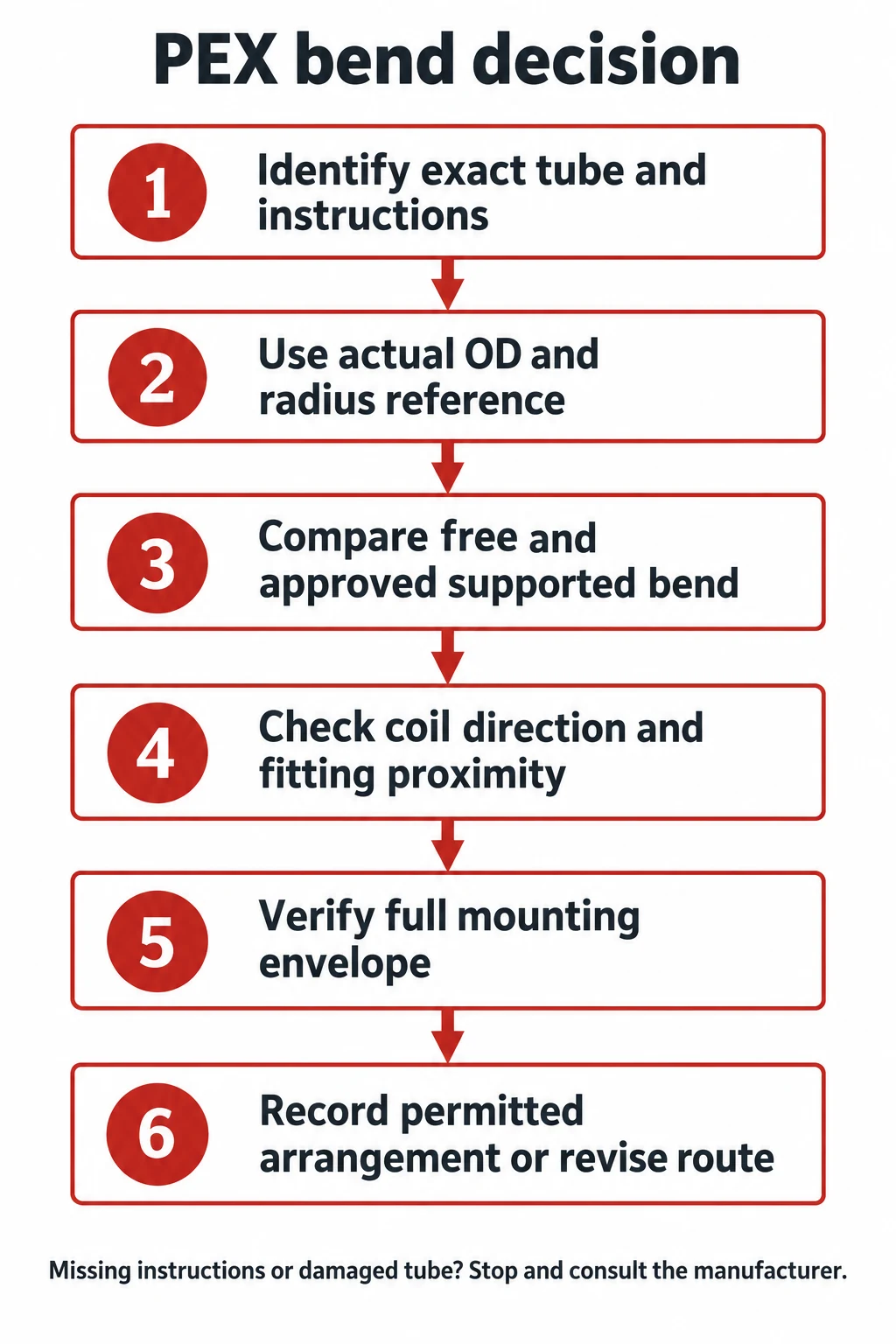
- Identify exact tube and instructions
- Use actual OD and radius reference
- Compare free and approved supported bend
- Check coil direction and fitting proximity
- Verify full mounting envelope
- Record permitted arrangement or revise route
Record a bend decision that another installer can check
A useful handover records the reason for the selected arrangement. Write down the tubing product, nominal size and actual OD; the manual and relevant page; whether the bend is free or supported; the radius reference and available space; coil direction; and the fitting and anchoring arrangement. Finish with one clear outcome: free sweep fits, named approved support fits, compatible elbow required, or route needs revision.
For unidentified tubing, the missing input is not simply “more information.” It is the product-specific permitted bend condition and its actual diameter. Obtain those before assigning a minimum. For an unidentified support, obtain the compatible tube sizes, permitted radius and mounting dimensions. Once those inputs are known, repeat the same radius and envelope comparison.
When reviewing a proposed PEX pipe system, keep these installation requirements with the tubing and fitting specification. The category page does not establish a particular Hitze tube’s bend approval or confirm the supply of a bend support. For an availability check, submit the product specification, actual OD, project country and intended connection or support.
Submit the PEX specification for an availability check. Confirm a matching offering before ordering; no stock, certification, minimum order or delivery term is established by this worked example.
Conclusion
Identify the tube, measure the right diameter and radius, then compare the free and supported arrangements that its own instructions permit. Check coil direction, fitting proximity and mounting space before accepting the result. If the permitted bend cannot fit, select a compatible elbow or revise the route. Keep the product reference with the decision so the installation can be checked.
Frequently Asked Questions
Is the PEX bend radius based on nominal size?
No. Apply the stated multiplier to actual outside diameter. For ½-inch CTS tubing, the OD is 0.625 inch.
Does a bend support always allow a tighter turn?
No. Use the exact system’s approved supported-bend instructions. Some supports hold a permitted curve without granting a smaller minimum radius.
Can warm tubing be bent tighter?
Do not reduce a published limit without product-specific authorization. Easier handling does not change the permitted installed radius.
When should I use an elbow instead?
Use a compatible elbow when an approved bend cannot meet the radius, mounting or connection-clearance requirements. Check the fitting’s own dimensions as well.