Key Takeaways
- The fastest factory vs trading company check is free: look up the supplier’s registered name on GSXT, China’s official business registry. A manufacturer’s business scope names production and manufacturing; a pure trader’s reads wholesale, retail, import and export.
- The registered company name on every certificate must match the name on your proforma invoice — and both must match the listee in the issuing body’s own register (IAF CertSearch for ISO, IAPMO’s PLD for cUPC). A certificate does not transfer to whoever emails you the PDF.
- The pipe itself testifies: ASTM F876 requires PEX to carry the manufacturer’s name or trademark printed at intervals of no more than 5 ft (1.5 m). One photo of the print line tells you who ran the extruder.
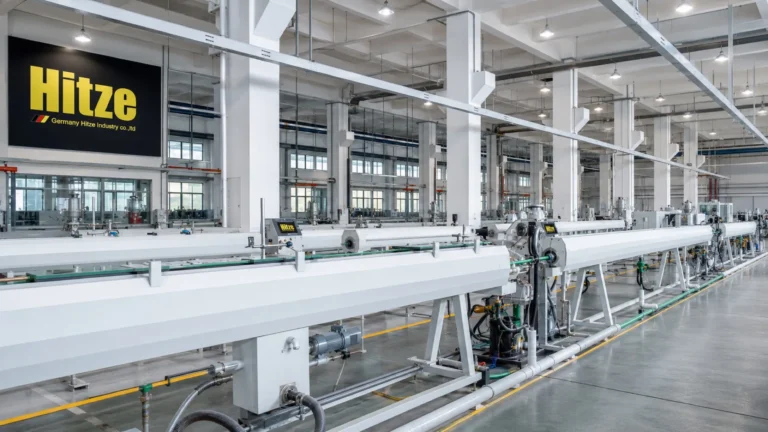
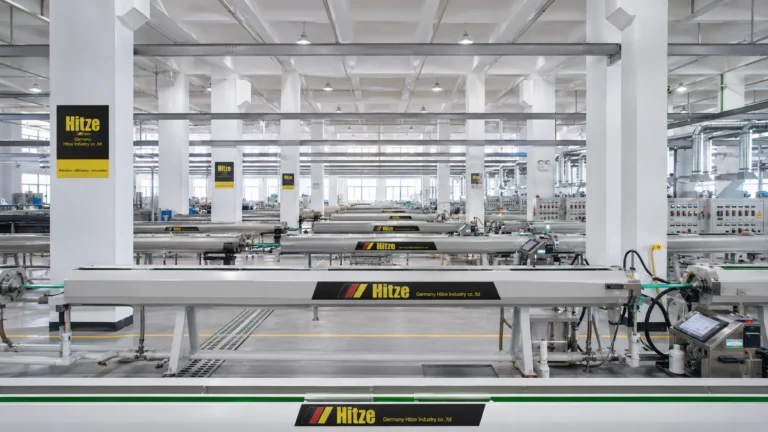
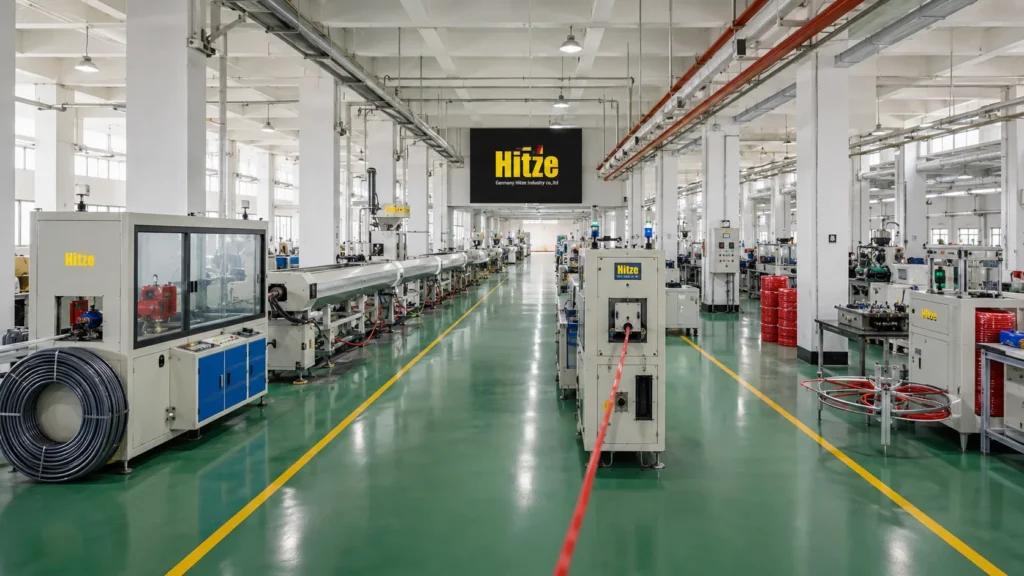
- A 20-minute live video walk to the extrusion hall — not a pre-recorded tour — settles most doubts. Crosshead dies, gravimetric dosing hoppers and a numbered mould store cannot be staged on short notice.
- Trading companies are legitimately useful for mixed containers and multi-category consolidation. On pressure-bearing pipe systems, though, the entity that signs the warranty matters more than the price line.
- With no-MOQ, sample-first manufacturers now common — Hitze included — “my order is too small for a factory” is no longer a reason to accept an extra margin layer you never see itemized.
The markup you never see on the invoice
The fear is specific, and it is rational: you negotiate hard, you get a “factory-direct” price, and eighteen months later you learn your supplier never owned an extruder. A trading desk sitting between you and the plant typically adds roughly 5–15 percent to the ex-works price — sometimes more on small orders — and that layer never appears as a line item. You cannot negotiate away a margin you cannot see. Meanwhile the registry entry that would have exposed the whole arrangement is free to read and takes about ten minutes to check.
The markup is actually the smaller problem. The larger one is the accountability gap. When a heating coil weeps at a press joint in year three, a reseller with no plant, no lab and thin registered capital has exactly one move: forward your complaint to a factory that has no contract with you. This article covers the six checks you can run from your desk — business-license scope, certificate holder names, catalog breadth, a live video tour, the vocabulary test and the warranty signature. If the desk checks pass and you are moving to container scale, the on-site work is a separate discipline; we covered it in our factory audit checklist with 8 red flags. And to be clear from the start: a trading company is not a scam by definition. The point is knowing which kind of counterparty you are paying, because they carry different risks at different prices.
Tell 1: The business-license scope never lies
Every legally registered company in mainland China has an 18-character Unified Social Credit Code (USCC) and a public record on GSXT, the National Enterprise Credit Information Publicity System run by the State Administration for Market Regulation. It is free, and it discloses the details your supplier’s English-language website will not: the legal representative, registered capital, establishment date, registered address and — the field you came for — the registered business scope. Ask the supplier for their business license and their registered Chinese company name up front; the English trading name in the email signature is a brand, not a legal identity, and it is not what the registry indexes.
Reading the scope takes one minute with machine translation. A manufacturer’s scope contains production language: manufacture of plastic products, pipe extrusion, production of pipes and fittings, mould making. A trading company’s scope is built from trade language: wholesale and retail, sales of building materials, import and export of goods and technology. Here is the nuance that separates a careful buyer from a paranoid one: nearly every genuine exporting factory also lists import-export in its scope, because that is what lets it ship to you directly. Trade terms in the scope are normal. The red flag is a scope that contains only trade terms and no production language at all.
Two second-order tells sit in the same record. First, the registered address: a plant occupies a plot in an industrial zone; a desk occupies a suite number in a commercial tower. Second, the establishment date read against the story you were told — a company registered two years ago cannot honestly claim two decades of extrusion experience under that entity. And ignore the English name entirely as evidence. Adding “Industry” or “Industrial” to a trading name costs nothing; the scope field is the part someone had to file with a regulator.
Tell 2: The name on the certificate vs the name on the contract
A certification is issued to a legal entity, and typically to named production locations — never to whoever happens to email you the PDF. So run a three-way name match: the seller entity on your proforma invoice, the registered holder printed on the certificate, and the listee in the issuing body’s own public register. All three should be the same company. When they are not, you have found the seam where most sourcing losses enter — a real certificate, genuinely valid, belonging to somebody who is not your counterparty.
The registers are public and fast. For ISO management-system certificates — ISO 9001, ISO 45001 — use IAF CertSearch, the official IAF database, which shows the certificate holder, its status, the certified scope and the certified locations. For cUPC and UPC plumbing listings in North America, the IAPMO R&T Product Listing Directory shows exactly which company holds the listing. WRAS, DVGW and NSF each publish their own directories on the same principle. If the “factory’s” name in the register differs from the name quoting you, ask why in writing and keep the answer. For the full register-by-register method on PEX specifically, see our guide on how to vet a PEX pipe manufacturer.
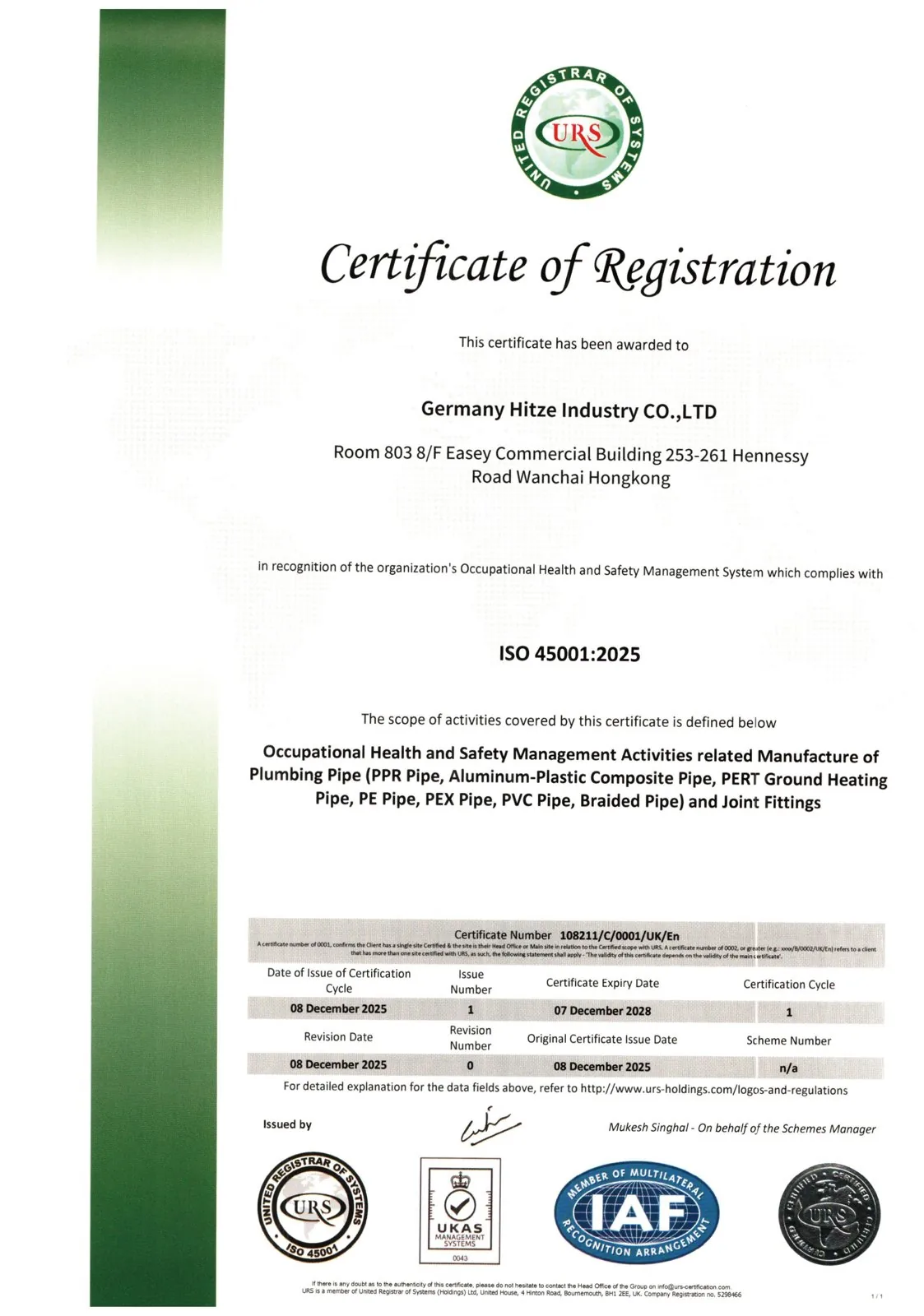
The phrase to listen for is “we are authorized to sell under the factory’s certificate.” Product listings and management-system certificates do not transfer by authorization letter; the holder is the holder. There is an honest version of this arrangement — a trader openly reselling a listed factory’s product, under that factory’s brand, with that factory’s name on the paperwork and on the pipe. That can be fine. The dishonest version hides the factory’s identity, because the moment you know who actually makes the pipe, the middle layer’s pricing power evaporates. Which version you are dealing with is revealed entirely by whether the names are volunteered or extracted.
This is also the standard we hold ourselves to. Hitze certificates are issued to Germany Hitze Industry — SKZ test certificates for PP-R pressure pipes, PP-R fittings and PE-Xb heating pipe; a DVGW type examination for PP-R drinking-water pipe; a WRAS material approval; an NSF International Laboratories BS 6920 potable-water test report covering hot (≤65°C) and cold; and ISO 45001 under URS with UKAS accreditation. The certificates are numbered, and copies with register pointers are available on request. Same name on the contract, the certificate and the register — that symmetry is exactly what you should demand from any supplier, including us.
Tell 3: Catalog breadth — the difference between wide and incoherent
Breadth alone proves nothing, and this tell is misused constantly. A real pipe plant is naturally broad within its process families: polymer extrusion covers PEX, PE-RT, PP-R, multilayer and HDPE on parallel lines; injection moulding produces the fitting bodies; brass machining turns the valves, inserts and manifolds. One site, shared raw-material intake, one QC lab. Hitze runs eight product lines this way and it is not a red flag — it is what 120,000 m² of production floor is for. The suspicious catalog is the one that crosses unrelated process families: pressure pipe next to LED panels, furniture and cosmetics. Nobody extrudes PP-R and injection-moulds phone cases under one roof out of engineering logic; that catalog is a sourcing list wearing a factory’s clothes.
The question that resolves it in one email: “Which of these items do you extrude or mould in-house, and which do you buy in?” A manufacturer answers precisely, because the honest answer is never 100 percent — rubber seals, O-rings and some accessories are bought in by nearly everyone, and a factory says so without flinching. A trading desk answers “all products are from our own factory,” which is the least credible sentence in international sourcing. Precision is the tell; totality is the bluff.
Why it matters beyond pride: a mixed-source “system” is where field failures breed. Pipe from plant A pressed onto fittings from plant B means two tolerance stacks that were never engineered together, and when a joint weeps behind a tiled wall, each plant points at the other. A matched system from one maker — pipe and fitting dimensioned against each other, warranted together — removes that finger-pointing structurally, which is why the warranty question at Tell 6 is really a manufacturing question in disguise.
Tell 4: The 20-minute live video tour and the vocabulary test
Ask for a live video call from the production floor — WhatsApp is fine — on a day’s notice, not a scheduled event three weeks out. Then direct the camera yourself. Skip the showroom and the reception wall of plaques; ask to start at the extrusion hall. What you want to see running is specific: resin feeding through gravimetric dosing hoppers into the extruder, pipe emerging from the crosshead die, the vacuum sizing tanks and haul-off pulling the line, coilers winding finished pipe at the discharge end. Ask them to walk to the mould store — racks of numbered injection moulds with an inventory board are a fixture a trading desk cannot rent by Thursday. Finish at the pressure-test benches. As a liveness check, have them zoom in on the printer marking today’s date code onto the pipe as it runs.
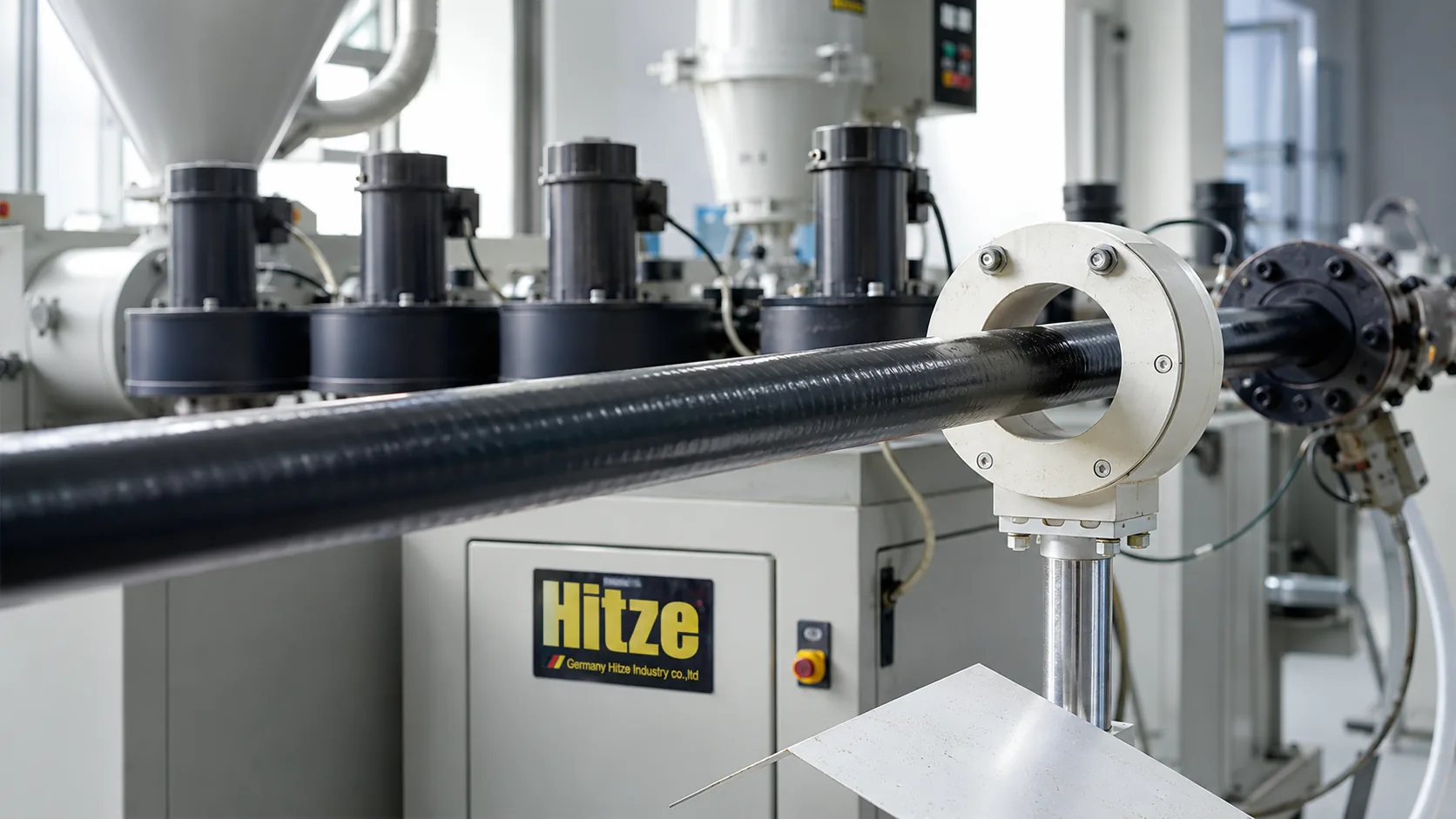
Layer the vocabulary test on top, because language is harder to fake than scenery. Ask which jaw profiles their press fittings are qualified for — TH, U, F or M — and watch whether the answer is instant or improvised. Ask whether the aluminium core in their multilayer pipe is butt-welded or overlap-welded, and why they chose it. Ask which resin grades they run for oxygen-barrier heating pipe versus potable PEX. Here is the fair-minded part: a factory’s export salesperson may not personally know every answer either — but on a live call at the plant, the line engineer is a two-minute walk away and gets pulled into frame. A trading desk can only promise to “check with the engineer and revert,” because the engineer works for a different company in a different city.
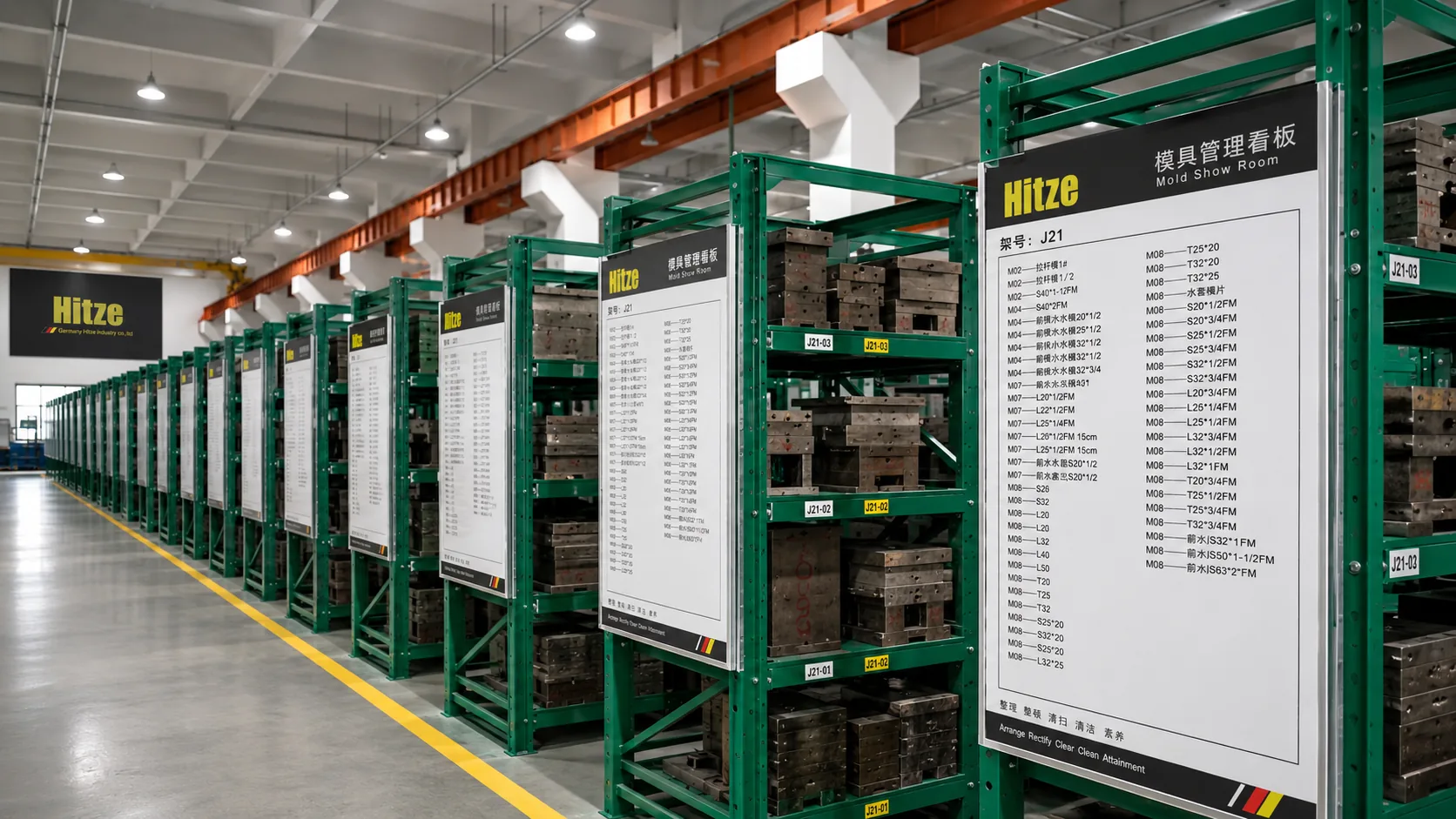
One caution: a polished pre-recorded “factory tour” video answers nothing, and borrowed factories do exist for scheduled visits. On the live call, ask the camera to pass the business license framed on the office wall and read the registered name against your GSXT lookup from Tell 1. The checks compound — each one is cheap, and a fabricated identity has to survive all of them at once.
Tell 5: Read the print line — the pipe names its maker
Product standards quietly do verification work for you, because they force the extruder to sign the product. ASTM F876, the base specification for PEX tubing, requires legible marking at intervals of no more than 5 ft (1.5 m), and the required content starts with the manufacturer’s name or trademark, alongside the standard designation, size and ratings (see the ASTM F876 specification). PP-R systems built to DIN 8077/8078 and EN ISO 15874 likewise carry printed identification of the maker together with OD, class and standard along the pipe. So before any money moves, ask for one thing that costs the supplier nothing: a sharp photo of the print line on the actual sample they will ship you.
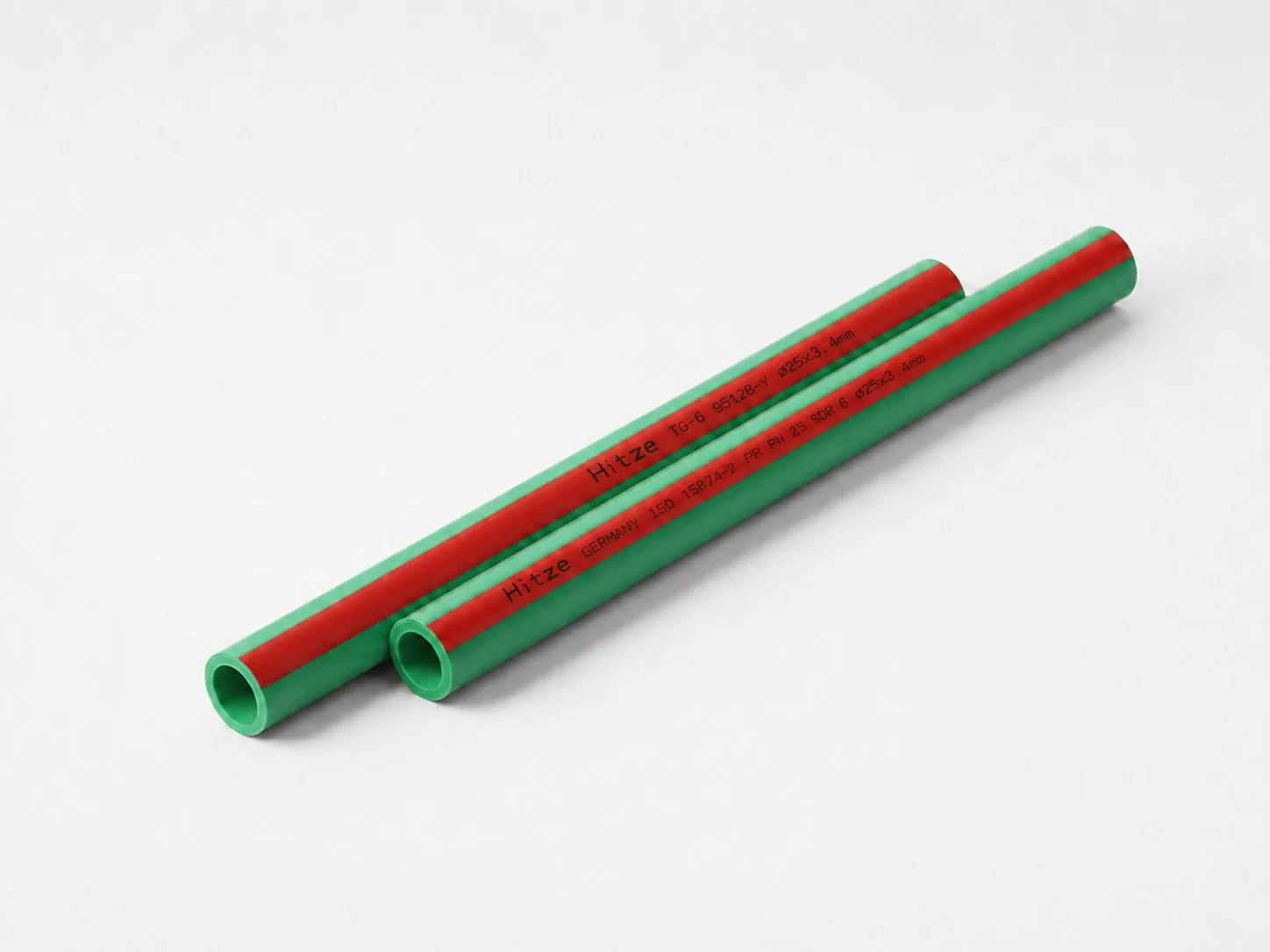
Now cross-check that print line against everything else: the name on the quote, the holder on the certificates, the listee in the registers. A trader reselling factory X’s stock will send you pipe carrying factory X’s mark or an unfamiliar brand code — and if the name on the pipe is a company you have never heard of, you have just met your actual manufacturer. Note the distinction that keeps this fair: private label is a legitimate, disclosed arrangement. Hitze runs an ODM program where the print line carries the buyer’s brand — but the buyer knows exactly whose plant stands behind it, whose certificates apply and who warrants the system. The difference between private label and deception is not the print; it is the disclosure.
Tell 6: Who signs the warranty — and will they exist in year 12?
The cleanest tell comes last because it forces every earlier question into one signature. Ask: who issues the warranty, in which legal entity’s name, and does it cover pipe and fittings together as one matched system? A trading company has two possible answers, both weak. Either it passes through “the factory’s warranty” — issued by an entity you have no contract with, reachable only through the same middleman you are trying to see past — or it issues its own paper, backed by a desk whose registered capital you already read on GSXT in Tell 1. Pipe disappears into walls and screeds and is expected to outlast the drywall around it. The question is not whether the warranty PDF looks solemn; it is whether the signer will still exist, still solvent, when a claim surfaces in year 12.
A manufacturer can answer structurally. Hitze issues a 50-year warranty on the matched Hitze pipe-and-fitting system in the brand’s own name — the same name on the certificates and in the registers — backed by the production base that extrudes the pipe and moulds the fittings it covers. The tolerances that make a press joint hold for decades are set by our German engineering team, which is precisely why the warranty covers the system rather than components: one entity engineered both sides of the joint, so one entity can stand behind the joint. Warranty documentation is available on request, and reading the issuing entity’s name on it is the whole point of asking.
The six remote tells at a glance
| Remote tell | A manufacturer shows | A trading desk shows | Desk check that settles it |
|---|---|---|---|
| Business scope on GSXT | Production/manufacturing terms (plus normal import-export rights); industrial-zone address | Wholesale, retail, import-export only; office-tower address; recent registration date | Free GSXT lookup by registered Chinese name or 18-character USCC; machine-translate the scope field |
| Certificate holder name | Same legal entity on the contract, the certificate and the register listing | “Authorized to use the factory’s certificate”; holder name differs from the quote | IAF CertSearch for ISO; IAPMO PLD for cUPC; issuer directories for WRAS, DVGW, NSF |
| Catalog breadth | Wide within process families (extrusion, moulding, brass machining); states what is bought in | Unrelated categories under one roof; claims “all from our own factory” | One email: “Which items do you extrude in-house, and which do you buy in?” |
| Live video tour | Running extrusion lines, mould store, pressure-test benches, today’s date code printing | Pre-recorded video; tours only by long-notice appointment | Short-notice WhatsApp walk; you direct the camera; read the framed license on the wall |
| Technical vocabulary | Jaw profiles, weld type, resin grades answered live; line engineer pulled into frame | “We will check with the engineer and revert” — the engineer is in another company | Ask TH/U/F/M jaw compatibility and butt-weld vs overlap-weld on the call, unprepared |
| Warranty signature | System warranty in its own legal name, pipe and fittings covered together | Pass-through factory warranty, or its own paper backed by thin registered capital | Request the warranty document; read the issuing entity’s name against Tells 1 and 2 |
When a trading company is actually the right call
Now the balance, because a buyer who treats every trader as a fraud will overpay in a different way. There are three situations where the middle layer genuinely earns its margin. First, the mixed container: if your 40HQ carries sanitary ware from one plant, accessories from a second, tile and lighting from a third and fourth, a competent trader consolidates six factories into one invoice, one quality coordinator and one bill of lading — work you would otherwise do yourself across time zones. Second, genuinely tiny orders in categories where large plants will not engage below a threshold. Third, fragmented categories where production lives in dozens of small workshops and a local desk with language and QC reach is the only practical aggregator.
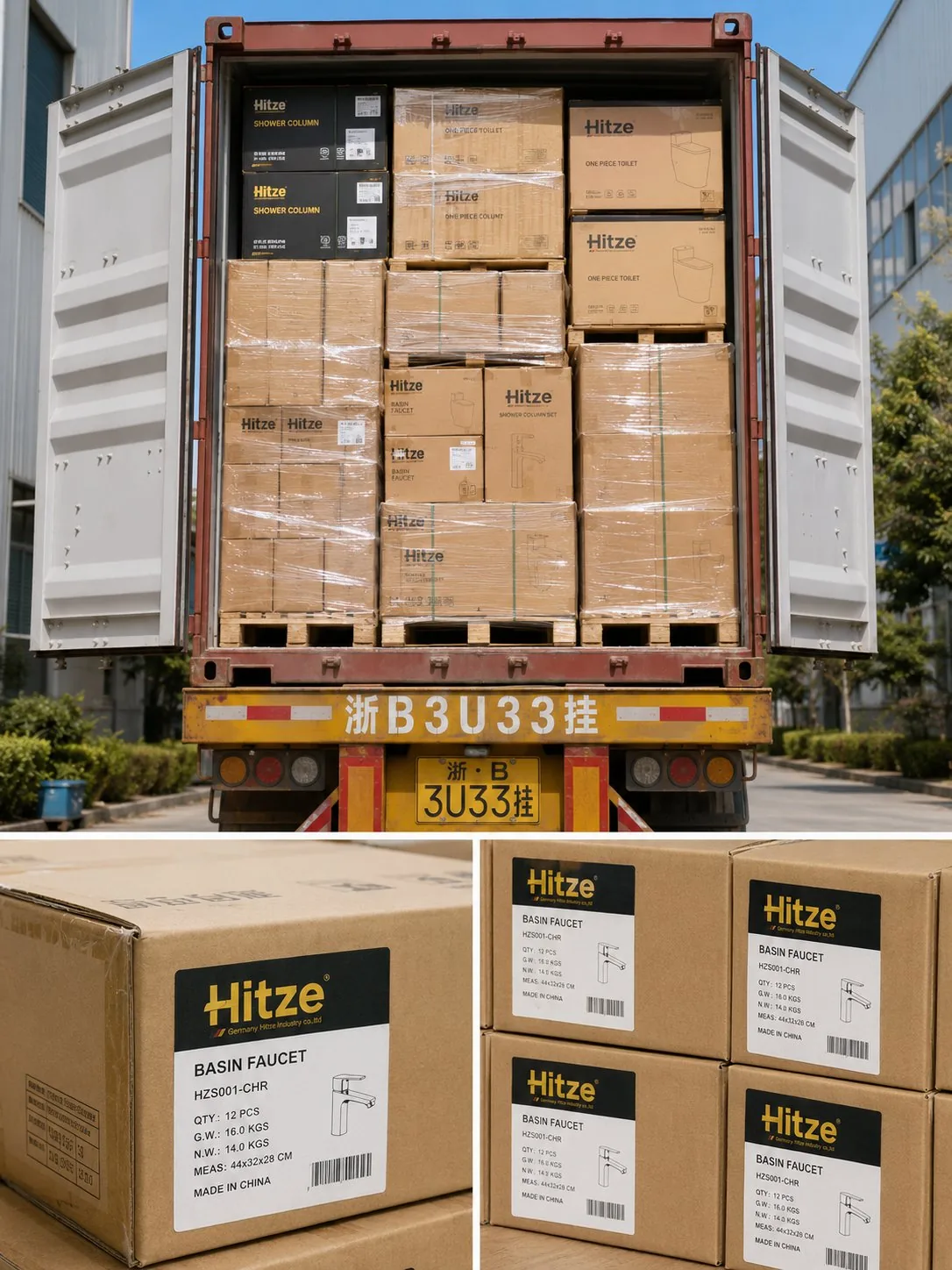
But weigh two counterpoints before extending that logic to pipe. Pressure-bearing systems are exactly the category where the certificate chain and the system warranty argue for buying direct — the failure mode is inside a wall, years out, and the recourse chain must be short. And the small-order argument has aged: some manufacturers now run no-MOQ, sample-first programs — Hitze among them — so a trial order no longer requires a middleman’s tolerance for small volume. The working rule we give distributors: let a trader consolidate your filler cargo and décor categories; buy the system that gets buried in concrete from the entity whose name is on the certificate and the print line.
How Hitze answers the six checks
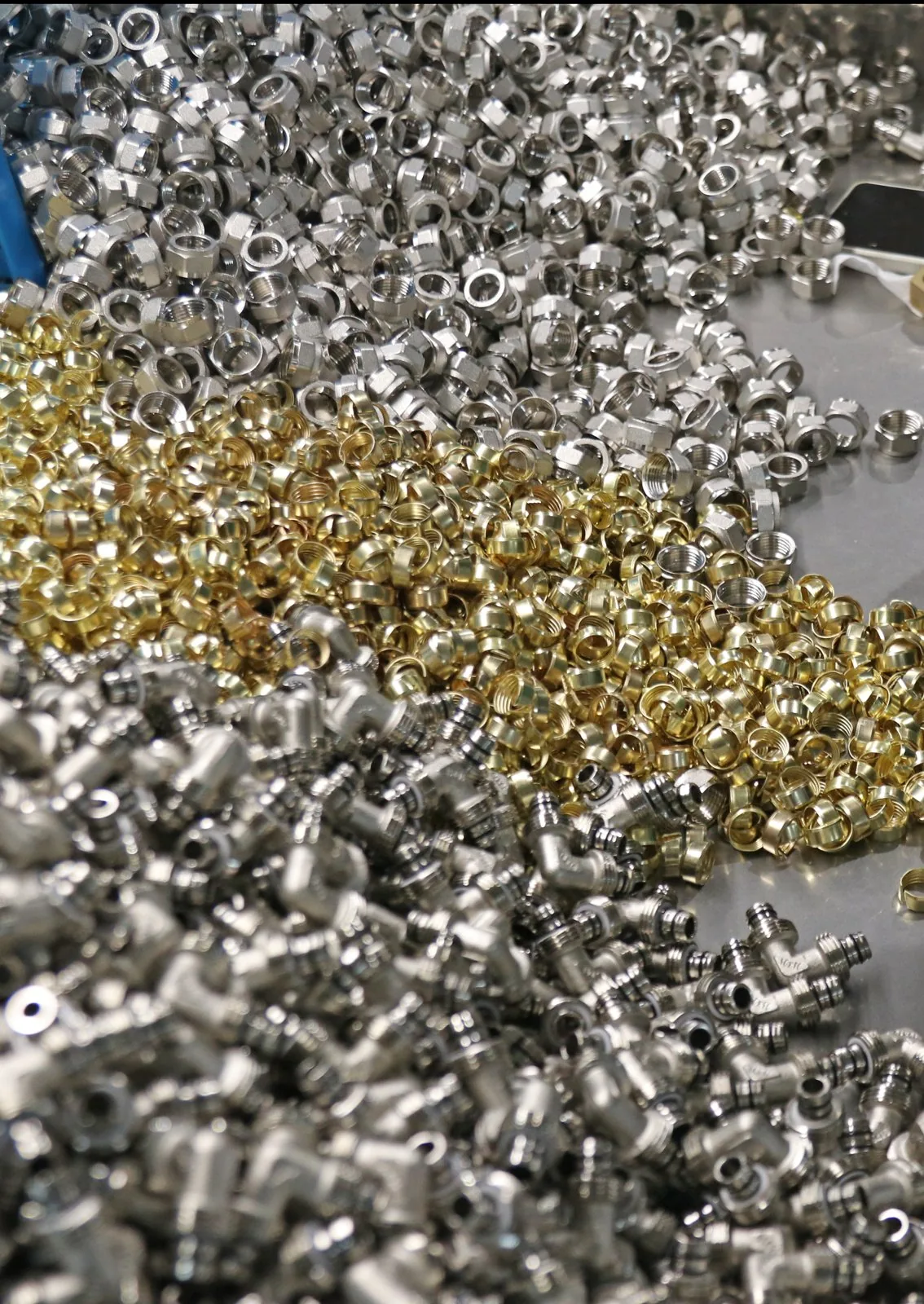
We publish this checklist knowing we have to pass it, so here is what a remote buyer sees when they run it against us. Hitze was founded in 1974, operates a 120,000 m² production base with 1,000+ employees, and ships to 118+ countries. Extrusion, injection moulding and brass machining run on one site: parallel pipe extrusion lines for PEX, PE-RT, PP-R, multilayer and HDPE; a managed mould store feeding the fitting-moulding hall; a brass workshop machining valve and manifold bodies from CW617N and DZR grades; and rows of pressure-test benches verifying pipe and fittings before packing. The Hitze trademark is registered at the German Patent and Trade Mark Office (DPMA) under Reg. No. 30 2020 005 484 — a register anyone can query, in the same spirit as this article.
On the checks themselves, the answers are the ones this article told you to demand. Certificates issued to Germany Hitze Industry: SKZ for PP-R pressure pipes, PP-R fittings and PE-Xb heating pipe; DVGW type examination for PP-R drinking-water pipe; WRAS material approval; an NSF International Laboratories BS 6920 potable-water test report (hot ≤65°C and cold); ISO 45001 under URS with UKAS accreditation; SAI Global StandardsMark to AS 4176.8 (Australian consumer-gas multilayer, ISO 17484-1); and products certified to cUPC/UPC, NSF-14, NSF/ANSI 61 and CE with a Declaration of Performance — certificate numbers available on request for your own register checks. Live video tours of the extrusion halls are routine, print lines carry the required markings, and the 50-year system warranty is signed by the brand behind the plant. If you want the deeper story of what a German brand’s engineering discipline means when production is global, read our piece on what “engineered in Germany” actually means — it addresses the origin question head-on rather than around it.
Worked example: 90 desk minutes on two multilayer quotes
A scenario, hypothetical but assembled from patterns we see constantly. An importer in Rotterdam needs 20,000 m of 16 mm PEX-AL-PEX plus matched press fittings for a heating distributor program. Two quotes arrive; Supplier A is about 9 percent cheaper than Supplier B. Ninety minutes of desk work follows. Minute 0–20, GSXT: Supplier A’s scope reads wholesale and import-export only, registered three years ago at a suite address; Supplier B’s scope includes manufacture of plastic pipes and fittings, registered at an industrial-zone plot. Minute 20–45, certificates: A sends an ISO 9001 PDF whose holder is a company name appearing nowhere on A’s quote; IAF CertSearch confirms the certificate is valid — for that other company. B’s cUPC listing in the IAPMO directory matches B’s contract name exactly. Minute 45–75, video: A offers a beautifully edited tour video “filmed last month”; B does a live WhatsApp walk, pans across the extrusion line, pulls the line engineer into frame to answer whether the aluminium core is butt-welded, and zooms on the printer laying down today’s date code. Minute 75–90, the sample photos: A’s sample print line carries a third brand name nobody has mentioned yet.
The decision now writes itself. Supplier A is a trading desk quoting one plant’s pipe with another company’s paperwork — the 9 percent saving buys an accountability gap on a product that will spend 30 years inside other people’s floors. The importer places the pipe-system order with Supplier B, and — this is the balanced ending — keeps Supplier A’s card, because next quarter’s mixed container of bathroom accessories from four small workshops is exactly the job a trader is for. Ninety minutes, zero air fare, and the margin layer either justified itself or disappeared.
Who this is for: importers and distributors in North America and Europe who buy pressure-bearing pipe systems at trial-to-container scale and want the certificate chain, the print line and the warranty to name the same company. If that is you, run every check in this article against Hitze — GSXT-style registry logic, register lookups, a live video tour of the extrusion halls, the works.
Start sample-first with no MOQ, verify the numbered certificates at your own pace, and see how a 50-year warranty on the matched pipe-and-fitting system changes the conversation with your own customers. Learn how the system is engineered on our German engineering page, or write to us for the certificate pack and a live tour slot.
Frequently asked questions
How can I tell if a supplier is a factory or a trading company without visiting China?
Run six desk checks: read the registered business scope on GSXT (production terms vs trade-only terms), match the certificate holder’s name against your contract entity in the issuing body’s register, test whether the catalog stays within coherent process families, request a live short-notice video tour of the extrusion hall, ask technical questions a sales-only desk cannot field live, and ask who signs the warranty. Each check is free; a false identity rarely survives all six.
Is buying from a trading company always more expensive?
Usually but not always. A trading layer typically adds roughly 5–15 percent that is never itemized, yet for mixed containers spanning several factories, a competent trader’s consolidation can cost less than managing six suppliers yourself. The rule of thumb: traders earn their margin on fragmented, multi-category cargo; on a single-system product like pipe and fittings, buying direct usually wins on both price and accountability.
What should I ask to see on a video call with a pipe factory?
Ask to start in the extrusion hall, live, not pre-recorded: running extruders with dosing hoppers, pipe leaving the crosshead die, haul-off and sizing tanks, coilers, the mould store with numbered moulds, and the pressure-test benches. Ask the printer to be shown laying today’s date code on the pipe, and have the camera pass the framed business license so you can read the registered name against your GSXT lookup.
Can a trading company legally use its factory’s certificates?
A certificate belongs to the legal entity named on it and, for product listings, to the listed production locations; it does not transfer by authorization letter. A trader can honestly resell a listed factory’s product under the factory’s name, with the factory identified on the paperwork and the pipe. What it cannot legitimately do is present the factory’s certificate as its own. Always verify the holder in IAF CertSearch, the IAPMO directory or the relevant issuer’s register.
Is Hitze a factory or a trading company — and is the pipe made in Germany?
Hitze is a German brand of engineered piping systems with its own production base — founded 1974, 120,000 m², 1,000+ employees, exporting to 118+ countries — not a trading desk. It is engineered in Germany and built to German DIN standards, with the trademark registered at the DPMA; we do not claim country-of-origin beyond that, and we encourage buyers to verify our certificates, issued to Germany Hitze Industry, in each issuer’s register. Samples ship with no MOQ, and the matched pipe-and-fitting system carries a 50-year warranty.