Every trade buyer sourcing plumbing pipe has met the same pitch: a supplier waves a photo of a certificate, drops the words “German quality,” and lets you assume the coil came off a line in Bavaria. Then the container lands, the paperwork says something different, and your inspector is asking why a “German” pipe carries a Chinese country-of-origin declaration. This explainer is about closing that gap before you wire a deposit — what a German brand legally is, what “engineered in Germany” can and cannot mean, and the exact documents that separate a real, standards-built product from a marketing skin.
Key Takeaways
- “German brand” and “Made in Germany” are two different legal statements. A brand is a registered trademark you can verify in Germany’s DPMA register; “Made in Germany” is a country-of-origin claim governed by German trademark law (MarkenG §§126ff) and EU customs rules — and it is far harder to earn.
- “Engineered in Germany” is a real, defensible claim when the brand owner, engineering standards, specifications and certifications are German — even if extrusion happens elsewhere. It is honest; “Made in Germany” on a Chinese-origin pipe is not.
- Certifications prove compliance, not geography. DVGW, SKZ, WRAS and NSF tell you a pipe passed a defined hygiene and pressure regime — not which country the coil was extruded in. Buyers routinely confuse the two.
- The origin that matters for your customs entry is set by “last substantial transformation” (EU Union Customs Code Art. 60), not by the brand name printed on the pipe.
- You can verify almost all of this yourself in an afternoon — trademark register, standards numbers, certificate scheme lookups, and the HS heading (3917) your goods clear under.
“German Brand” vs “Made in Germany”: Two Claims, Two Legal Tests
The single most expensive mistake in this category is treating “German” as one word with one meaning. It is at least three separate claims, each with its own proof, and a supplier who blurs them is either careless or counting on you being. A German brand is a trademark owned by a German legal entity and registered with the Deutsches Patent- und Markenamt (DPMA) in Munich. That is a fact you can check in minutes: the DPMAregister is free, updated daily, and searchable without an account. If a supplier claims a German brand, ask for the registration number and look it up. Hitze, for example, is a German brand — legal entity GERMANY Hitze Industry Co., Ltd., German Trademark Reg. No. 30 2020 005 484 — and that number exists in the register for anyone to confirm.
“Made in Germany,” on the other hand, is a country-of-origin claim, and Germany treats it seriously. Under Sections 126 and following of the German Trade Mark Act (Markengesetz), in force since 1995, an origin indication may only be used where it is accurate, and German case law has long held that the label is justified only when the qualities and components that give the product its value “are the result of German labour.” A pipe extruded outside Germany does not meet that test just because a German company sells it. This is precisely why a scrupulous German brand will write “engineered in Germany” or “built to German DIN standards” and will not stamp “Made in Germany” on a coil that wasn’t. The restraint is the tell of an honest supplier, not a weakness.
Then there is the claim your customs broker cares about: the non-preferential origin on your import entry. Under Article 60(2) of the EU Union Customs Code, goods manufactured across more than one country originate where they underwent their “last, substantial, economically justified processing… resulting in the manufacture of a new product.” That determination has nothing to do with the brand on the box. Confuse “German brand” with “German customs origin” and you can misdeclare an entry — a problem that surfaces at the worst possible moment, in front of an inspector.
| The claim | What it actually asserts | How you verify it |
|---|---|---|
| German brand | A trademark owned by a German legal entity | DPMAregister lookup by registration number |
| Engineered in Germany / to German DIN standards | German design ownership, specs and certification regime | Standard numbers on the pipe print + certificate schemes (DVGW, SKZ) |
| Made in Germany | Value-determining production performed in Germany | MarkenG §§126ff test; scrutinise heavily — rare in commodity pipe |
| Non-preferential origin (customs) | Where last substantial transformation occurred | EU UCC Art. 60; declared on the certificate of origin, not the label |
What “Engineered in Germany” Should Actually Buy You
If “engineered in Germany” isn’t a geography claim, is it just softer marketing? No — used honestly, it names a specific and valuable thing: the pipe is designed to German engineering standards and carries the certification a German-regulated market demands, regardless of where the extruder sits. The value shows up in three concrete places, and each one has a document behind it you can request today.
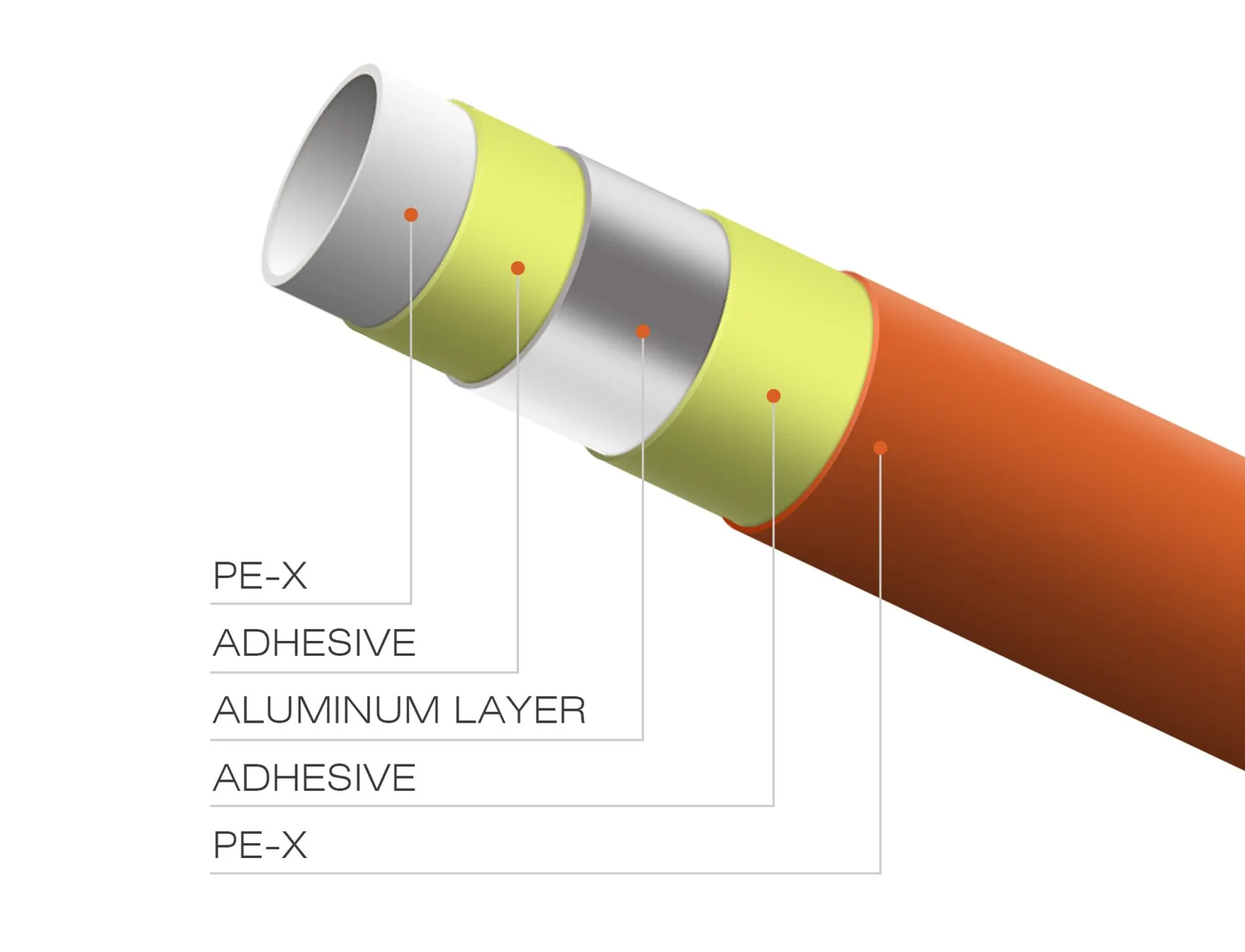
First, the standards the pipe is built and dimensioned to. For PP-R pressure pipe, that means DIN 8077 (dimensions) and DIN 8078 (quality requirements and testing), aligned with EN ISO 15874 for hot-and-cold-water polypropylene systems. For five-layer metal-plastic composite pipe, it means EN ISO 21003, the dedicated standard for multilayer piping inside buildings. For closed-loop underfloor heating, the oxygen-barrier requirement is set by DIN 4726 — the standard that stops dissolved oxygen from migrating through the wall and corroding your boiler and steel components. A German PEX pipe program should make its material grade explicit too: PEX-a, PEX-b and PEX-c behave differently on flexibility, fitting method and crosslinking, and an engineered heating coil states the grade and the crosslinking standard (for example ASTM F876, whose minimum degree of crosslinking is 70% for PEX-a and 65% for PEX-b and PEX-c) rather than hiding behind the bare word “PEX.” These numbers are printed directly on the pipe, at intervals, as a line marking. A pipe that can’t show them on its own body is telling you something.
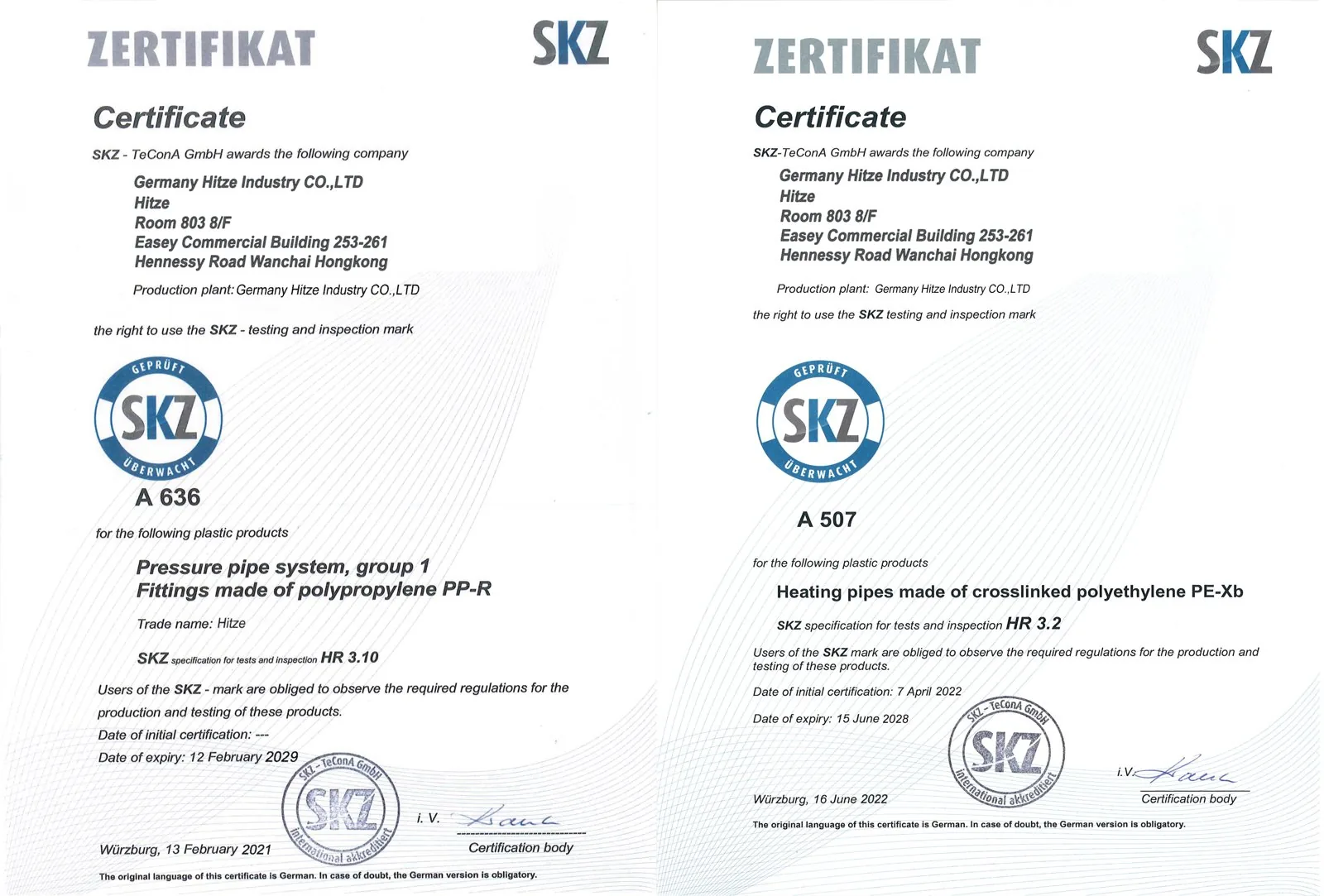
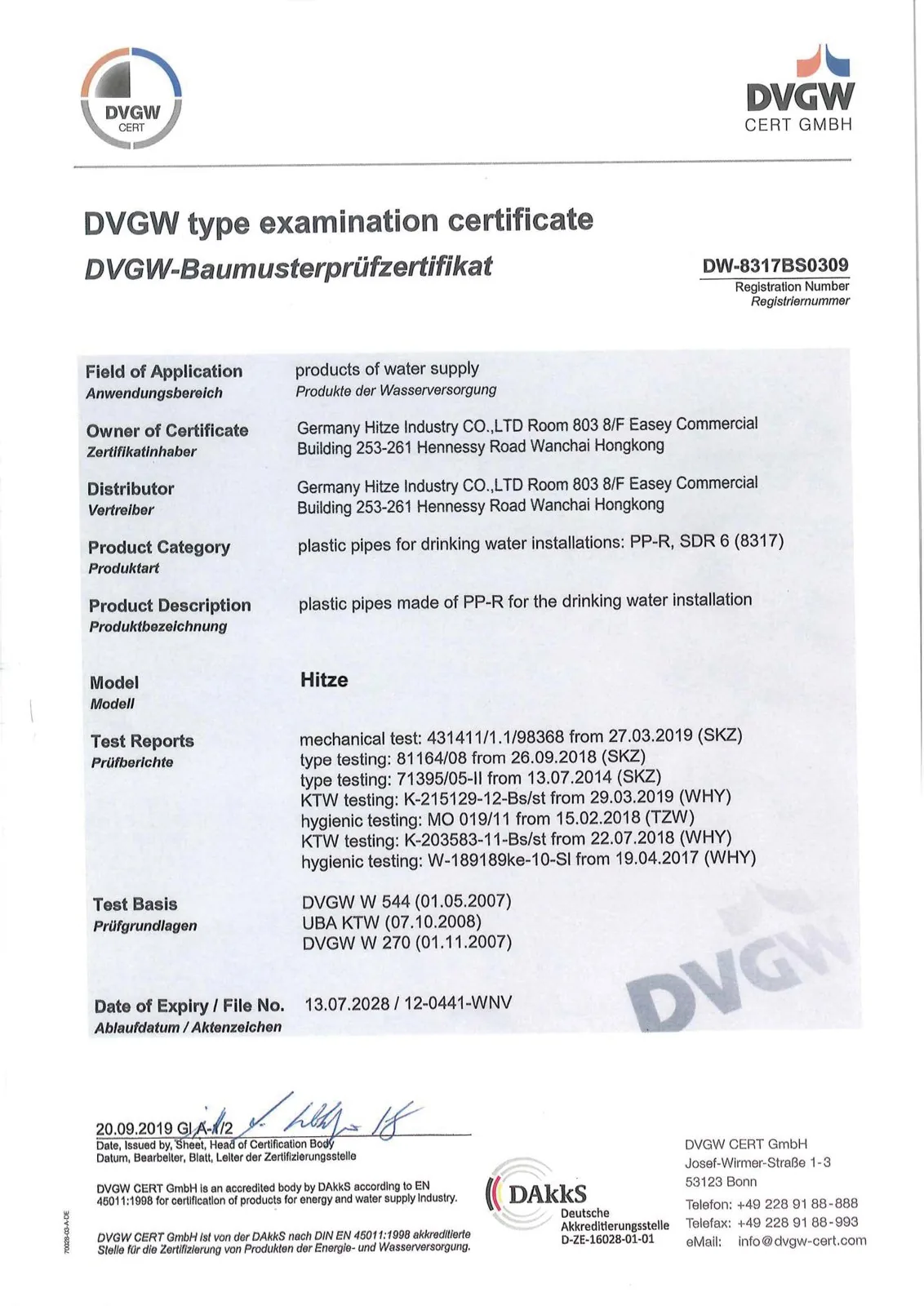
Second, the certification regime. German-market credibility runs through schemes like DVGW (the German Technical and Scientific Association for Gas and Water) and SKZ (the Süddeutsches Kunststoff-Zentrum). A DVGW type examination for a drinking-water PP-R pipe isn’t a rubber stamp — it verifies hygiene and material safety under DVGW W270 (migration of substances and resistance to microbial growth) and assesses the pipe and fittings against the plastic-pipe worksheets for drinking-water installation, DVGW W544 (pipes) and W534 (pipe connectors and joints), with factory inspection and ongoing surveillance. That is the substance behind “engineered to German standards.” You can see the same discipline on our certifications & compliance page, laid out scheme by scheme. Hitze holds DVGW type examination for PP-R drinking-water pipe and SKZ certificates for PP-R pressure pipes, PP-R fittings and PE-Xb heating pipe — the SKZ documents carry real registration numbers on the physical certificates, verifiable with the issuing body.
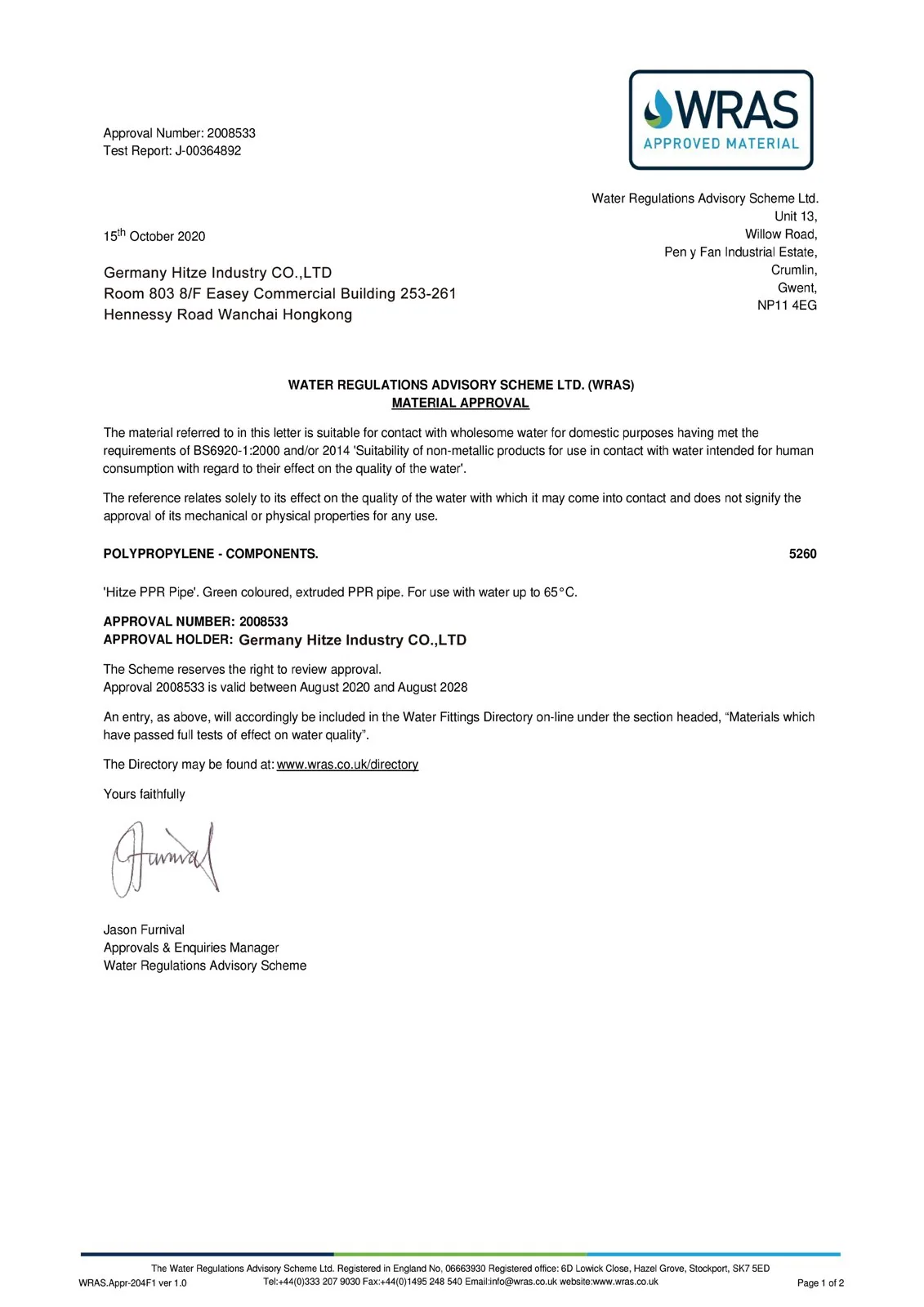
Third, the market-access certifications that let you actually sell. A German engineering pedigree is worthless in your market if it can’t clear your regulator. That is why a serious German brand carries the market-specific approvals as well — WRAS material approval for UK potable water, an NSF International BS 6920 potable-water test report, cUPC/UPC (IAPMO), NSF-14 and NSF/ANSI 61 for North America, and CE with a Declaration of Performance for the EU. “Engineered in Germany” should come bundled with the paperwork that makes the pipe legal where you resell it, not just where it was designed.
Why Certifications Prove Compliance, Not Country of Origin
Here is the trap that catches even experienced importers: a supplier shows a genuine DVGW or SKZ certificate and you read it as proof the pipe is made in Germany. It isn’t — and it was never meant to be. A certification scheme answers one question: does this product, from this production process, meet this standard? DVGW’s own testing is built around material hygiene and system performance, not the postal address of the factory. German notified bodies certify products manufactured all over the world; that is exactly why a Chinese-produced pipe can legitimately carry a real SKZ mark. The certificate is honest. Reading “Made in Germany” into it is your inference, and a costly one.
This distinction has a hard commercial edge. If your buyer contract or tender specifies “German-manufactured” pipe and you supply a certified-but-not-German-made product, you have a compliance problem no certificate cures — the origin claim and the certification claim are simply different obligations. Conversely, if your tender specifies “DVGW-certified” or “to EN ISO 15874,” then origin is irrelevant and a certified pipe from a German-brand supplier satisfies it cleanly. Read your own spec language precisely before you argue about factories. Most disputes here are the buyer and seller talking past each other about which of the two claims actually governs.
One more nuance worth money: certificate numbers should be issued to a named legal entity, and you can often confirm the certificate is live with the issuing body directly. A supplier who will give you the scheme, the standard and the holder’s name — and invites you to check — is behaving like a real manufacturer. A supplier who sends a blurry JPEG and gets defensive when you ask for the number is the one whose container you don’t want to be holding.
How Hitze Is Built and Checked — and What That Means for Your Order
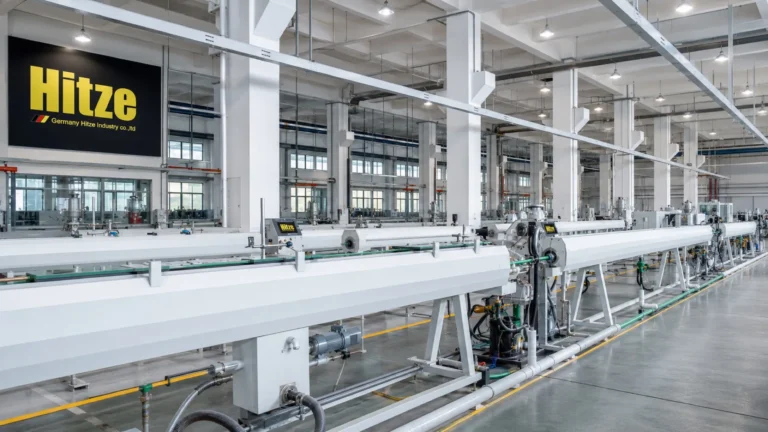
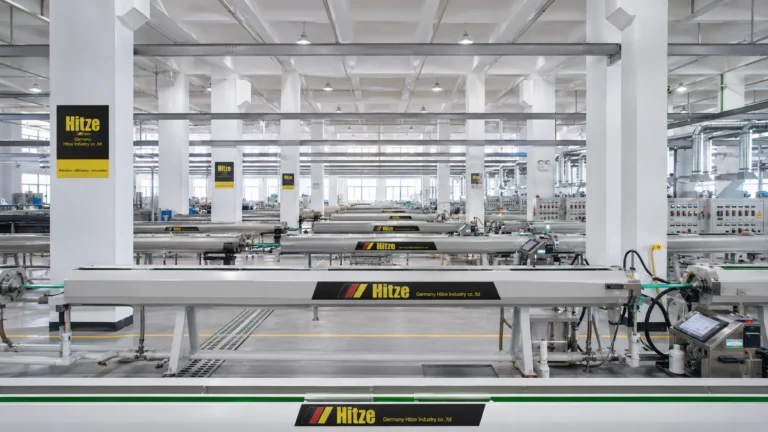
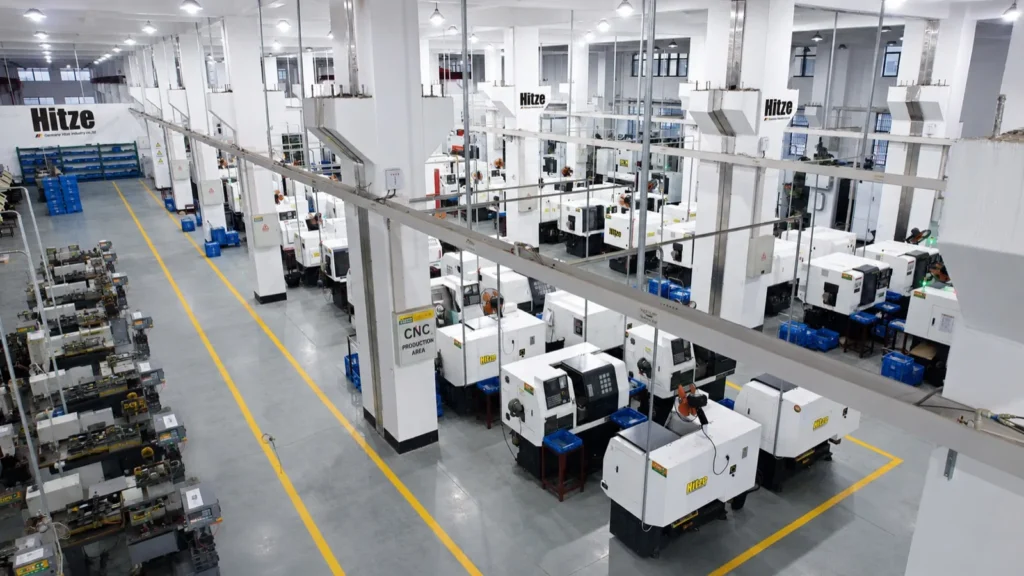
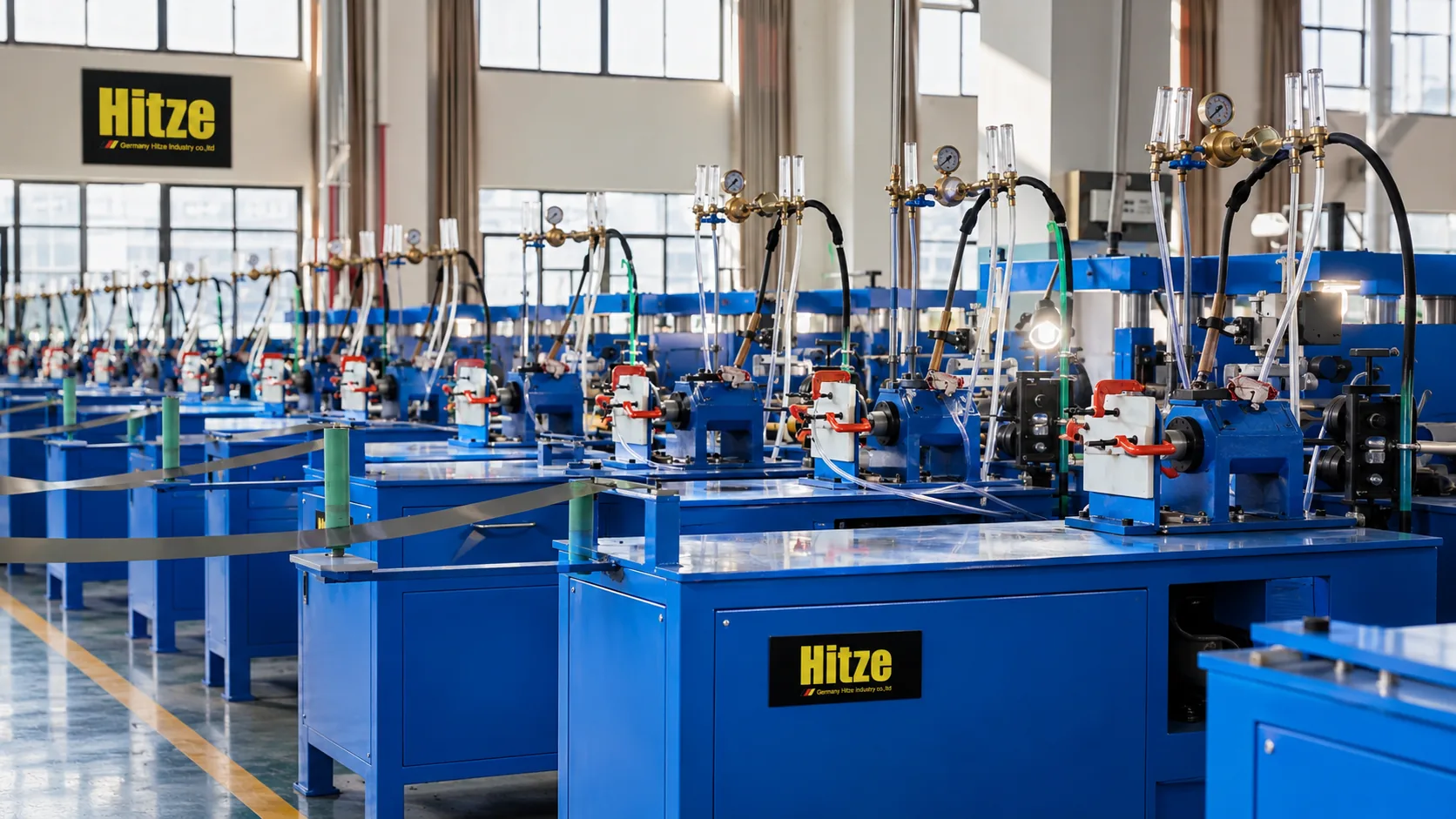
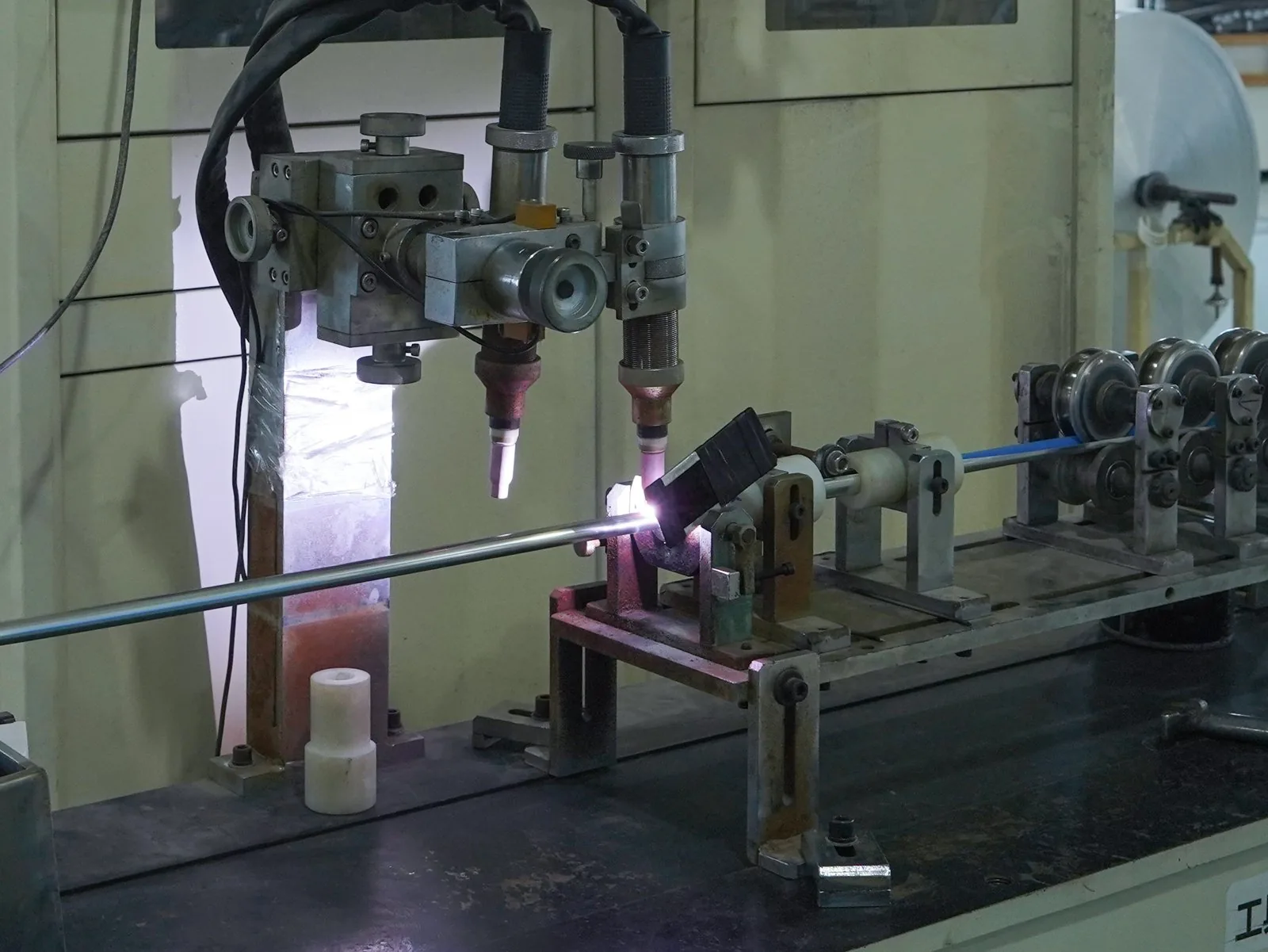
Because the honest version of “engineered in Germany” is a process claim, it’s worth showing what that process looks like end to end. Hitze is a German brand founded in 1974, operating a 120,000 m² production base with 1,000+ employees and exporting to 118+ countries. Pipe is engineered by the German engineering team to the DIN and EN ISO standards above; the multilayer line butt-welds a continuous aluminium core into a full-length seam so the pipe holds shape and blocks oxygen; and finished product runs across hydrostatic pressure-test benches that verify performance against DIN and EN ISO thresholds before it is allowed to ship. The certificates — SKZ, DVGW, WRAS, NSF, ISO 45001, SAI Global StandardsMark for AS 4176.8 (consumer-gas multilayer) — sit behind that, each tied to a defined test regime rather than a slogan.
For a trade buyer, the practical translation is a checklist you can run on any “German” supplier, us included. Ask for: (1) the DPMA trademark registration number; (2) the standard numbers that appear on the pipe print, matched to your application; (3) the certificate scheme, standard and holder name for each claimed approval, plus permission to verify with the issuer; (4) the certificate specific to your market (WRAS/DVGW for Europe, cUPC/NSF for North America); and (5) a clear, written statement of non-preferential origin for your customs entry. Every one of those is a document a real factory produces without friction. On order terms, Hitze has no MOQ — you can start with samples or a small trial order — while freight and lead times vary by market and order and are quoted on request, and you shouldn’t accept an invented figure in place of a real quote. On lead-free brass, ask for the grade by designation: Hitze uses CW724R, CW511L and CW602N (DZR) and CW617N, so “lead-free brass” should resolve to a specific alloy, not an adjective.
A Worked Example: The €40,000 Container That Almost Went Wrong
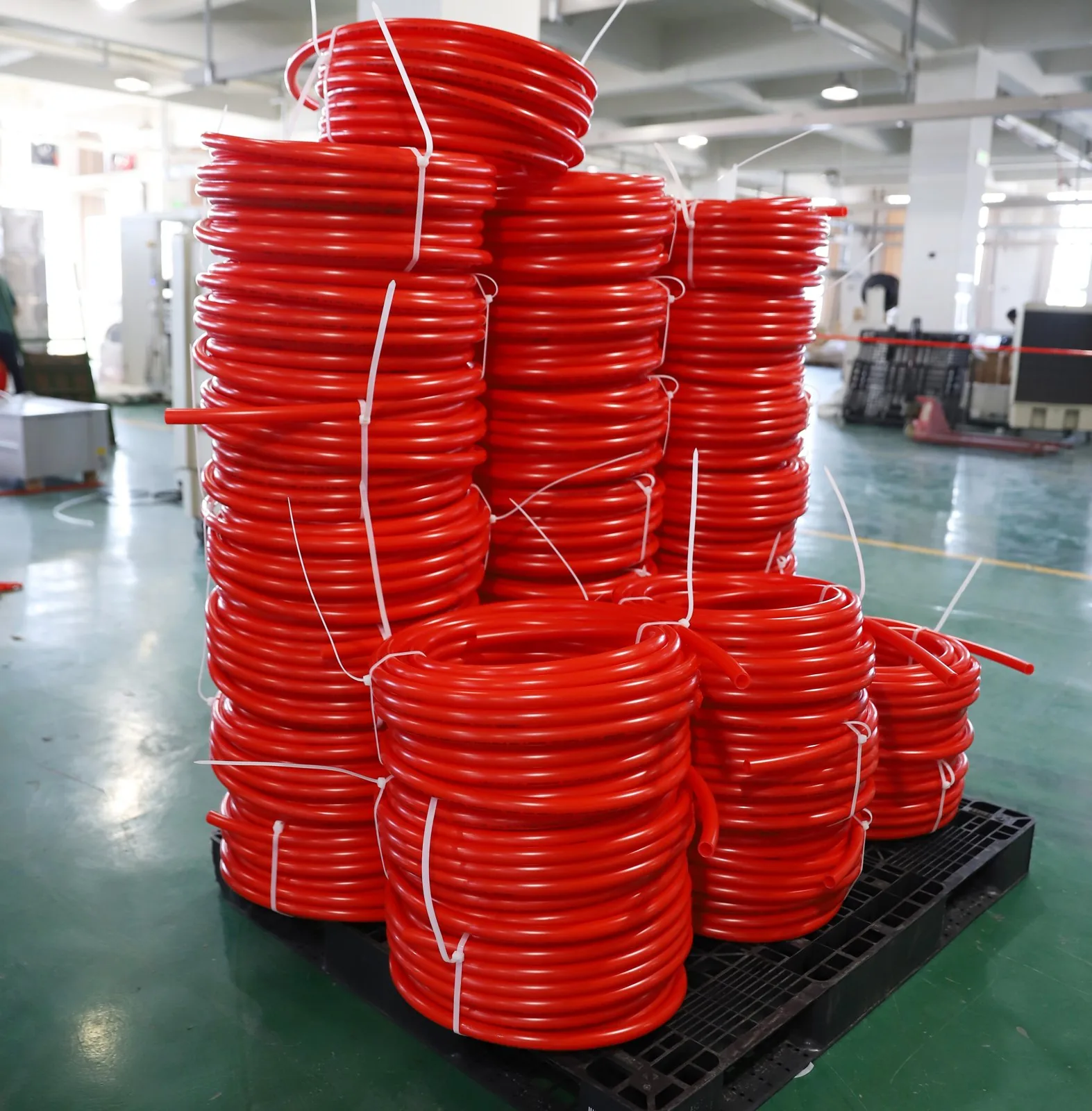
Take a UK-based importer sourcing a mixed container of PP-R hot-and-cold pipe and PEX-a underfloor-heating coils for a housing project. The tender document specifies “WRAS-approved potable pipe” and “oxygen-barrier heating pipe to DIN 4726.” Two suppliers quote. Supplier A leads with “Made in Germany” in bold and, when pressed, cannot produce a registration number, cannot say which legal entity holds the WRAS approval, and its pipe print shows no standard marking — only a logo. Supplier B calls itself a German brand, supplies a DPMA registration number, shows a WRAS material-approval certificate with a holder name, and its heating coil is printed with the DIN 4726 oxygen-barrier reference along the pipe.
On price, Supplier A is marginally cheaper. On risk, it is a trap: the “Made in Germany” claim is unverifiable and legally exposed, the WRAS holder is unnamed (so the approval may not even cover the product being shipped), and an unmarked pipe will fail on-site inspection against the DIN 4726 spec. Supplier B’s honest “German brand / engineered to German standards” framing, backed by a named WRAS certificate and a printed standard, is what actually satisfies the tender — and it holds up when the clerk of works checks the pipe against the spec. The importer chooses B, the container clears, the project passes inspection, and the reorder is clean. The lesson isn’t “buy German”; it’s “buy verifiable,” and the honest German brand is usually the one that hands you the proof unprompted.
Best For / Not For: When a German-Brand Pipe Is the Right Buy
A German-brand, standards-built pipe program is not the answer to every sourcing question, and pretending otherwise erodes trust. It is the right call when you are selling into a regulated market where the certificate is the sale — UK, EU and North American residential and light-commercial work where WRAS, DVGW, cUPC or NSF gate the tender. It fits importers and wholesalers who resell on documentation and consistency rather than on being the absolute cheapest coil in the market, and private-label brands that need certification and a credible engineering story under their own name.
It is not the right buy if your only decision variable is unit price for an unregulated application where no certificate is required and no inspector will ever look — a bottom-of-market commodity spot buy will always undercut an engineered, fully certified program, and that is a legitimate choice for that use case. It is also the wrong buy if you specifically need a pipe physically manufactured in Germany for a contract that mandates German origin; that is a narrow, premium niche, and an honest supplier will tell you plainly rather than blur “engineered in Germany” into “made in Germany” to win the order. Knowing which of these you are is worth more than any brochure.
Who this is for
If you are an importer, distributor or private-label brand who resells into a certification-gated market and needs to prove — not just claim — a German-brand, standards-built pipe, this is the ground you should stand on. Hitze is a German brand engineering piping systems to German DIN and EN ISO standards, with the SKZ, DVGW, WRAS and NSF documentation to back it. See how the engineering claim is substantiated on our German engineering page, review the scheme-by-scheme detail on certifications & compliance, and look at the range on our PEX pipe and multilayer PEX-AL-PEX lines. Certificate numbers, samples and origin documentation are available on request — bring your tender language and we’ll map the exact documents you need. Hitze is a trade and wholesale supplier and does not sell direct to homeowners.
Frequently Asked Questions
Is Hitze pipe made in Germany?
Hitze is a German brand — legal entity GERMANY Hitze Industry Co., Ltd., registered with the German Patent and Trade Mark Office (DPMA) — and its piping systems are engineered by its German engineering team to German DIN and EN ISO standards and certified through German schemes such as DVGW and SKZ. We describe the product as a German brand engineered to German standards rather than as “Made in Germany,” because that origin phrase carries a specific legal meaning under German trademark law. For your customs entry, we provide a clear written statement of non-preferential origin on request.
What is the difference between a “German brand” and “Made in Germany”?
A German brand is a trademark owned by a German legal entity, which you can verify in the free DPMAregister. “Made in Germany” is a country-of-origin claim that, under Sections 126ff of the German Trade Mark Act, may only be used when the value-determining production is genuinely German. A product can legitimately be a German brand, engineered to German standards, without qualifying for a “Made in Germany” origin stamp — and an honest supplier keeps those claims separate.
Does a DVGW or SKZ certificate mean the pipe was manufactured in Germany?
No. DVGW and SKZ certify that a product and its production process meet a defined German standard — DVGW testing focuses on drinking-water hygiene (W270) and on the plastic-pipe worksheets W544 (pipes) and W534 (connectors and joints), not on the country of manufacture. German notified bodies certify products made worldwide, so a genuine certificate proves compliance, not origin. Treat the two as separate claims and verify each on its own.
How do I verify a supplier’s German-brand and certification claims myself?
Ask for the DPMA trademark registration number and look it up in DPMAregister; check that the standard numbers (for example DIN 8077/8078, EN ISO 15874, EN ISO 21003, DIN 4726) are printed on the pipe and match your application; ask for the certificate scheme, standard and holder name for every claimed approval and confirm it with the issuing body; and require the market-specific certificate you actually need (WRAS/DVGW for Europe, cUPC/NSF for North America). Real factories provide all of this without friction.
Which HS code do plastic plumbing pipes and fittings clear under?
Plastic tubes, pipes and hoses and their fittings are classified under HS heading 3917 — for example ethylene-polymer rigid tube commonly under 3917.21 and plastic fittings under 3917.40. Your exact subheading depends on material, rigidity and whether fittings are attached, so confirm classification with your customs broker before entry. The brand name on the pipe does not change the tariff heading, and it does not set your declared country of origin either — that is decided by last substantial transformation under EU UCC Article 60.
Is “engineered in Germany” just a marketing phrase?
It is only meaningful if it is backed by documents. Used honestly, it means the brand, the engineering standards, the specifications and the certification regime are German — and that should be provable through a DPMA registration, standard markings on the pipe, and certificates tied to named schemes and holders. If a supplier uses the phrase but can’t produce those, it is marketing; if they can, it is a substantive claim about how the pipe was designed and tested.
For the deeper compliance mechanics behind these claims, see the authoritative sources: the DPMA trademark register, the EU non-preferential rules of origin (UCC Art. 60), and the DVGW-CERT certification body.