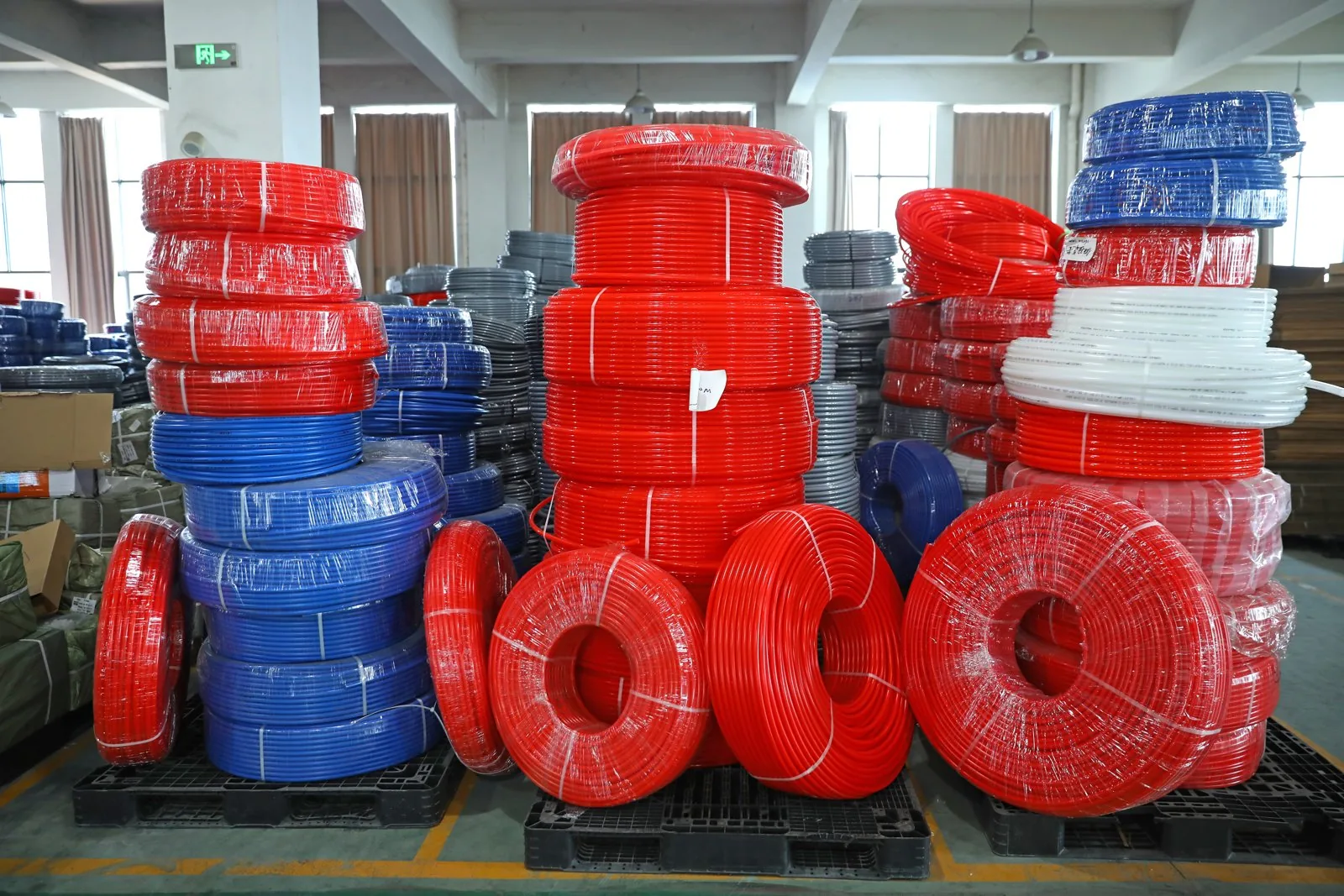
Key Takeaways
- A certificate without its test report is a picture, not proof. Always demand the underlying test report behind every certificate — the identifiers must match your exact model. Many fraudulent suppliers quit at this request.
- Separate the pack into four tiers: supplier identity, product-compliance certificates, batch/quality records, and trade/customs documents. A gap in any one tier can strand a container.
- Every real certificate is verifiable in a public register — UPC/cUPC at pld.iapmo.org, NSF at listings.nsf.org, UK potable at the WRAS directory. If you can’t find the listing, treat the PDF as unproven.
- For the US market, “lead free” is federal law with teeth. Since 1 September 2023, importers — not just factories — can be held liable for un-certified potable products under the Safe Drinking Water Act.
- Get the whole pack verified before you wire the deposit. Fixing a certification gap at the port costs weeks of demurrage; fixing it before production costs one email.
The most expensive mistake in a first pipe import isn’t the price you negotiate — it’s the document you forget to ask for. A supplier sends a tidy quote, a few glossy certificate PDFs, and a sample that looks perfect. You wire a deposit. Ten weeks later the container lands, a plan reviewer or a merchant buyer asks for a listing you don’t have, and a $40,000 pallet becomes dead stock you can’t legally sell. The paperwork is not bureaucratic friction bolted onto the deal — for regulated plumbing pipe, the paperwork is the product. This checklist walks the exact certification pack a decision-ready importer should demand, in the order you should demand it, and — just as important — how to verify each piece yourself so you are never trusting a PDF you can’t independently confirm.
We’ve written it from the supply side, because we sit on the other end of these requests every week. The buyers who protect themselves ask for specific documents with specific identifiers; the ones who get burned ask for “your certificates” and accept whatever arrives. The difference is entirely in the specificity.
Tier 1 — Prove the company is real before you discuss the product
Before a single test report matters, confirm you are dealing with an actual manufacturer and a real legal entity, not a trading desk reselling someone else’s containers under a borrowed brand. This tier is cheap to verify and it filters out most of the fakes. Ask for three things: the business licence / certificate of incorporation naming the legal entity, a trademark registration for the brand you’re buying, and — if the brand claims a national origin — the register entry that backs it.
Origin claims are where “German,” “European” and “premium” get abused most. A trademark is publicly checkable in the issuing office’s register, so a genuine brand can hand you a registration number you can look up in minutes. Hitze, for example, is a German brand operating as GERMANY Hitze Industry Co., Ltd, with German Trademark Reg. No. 30 2020 005 484 on file at the Deutsches Patent- und Markenamt (DPMA) in Munich — a number you can search in the DPMA register yourself rather than take on faith. That is the standard to hold every supplier to: a claim you can verify in a public database, not an adjective on a brochure. If a “German” or “Italian” pipe brand can’t produce a registration number in that country’s own office, you’ve learned something important for the price of one email.
Insider warning: match the name on the business licence to the name that will appear on your commercial invoice and, later, on the bill of lading. When those three names don’t line up, you may be paying a middleman while believing you’re paying the factory — and if a quality dispute arises, the entity you actually contracted with may be a shell you can’t pursue. Names must reconcile across every document in the deal.
Tier 2 — Product-compliance certificates: the marks that unlock a market
This is the tier that decides whether your product is legal to sell where you sell it — and it is the one importers most often accept at face value. A product-compliance certificate proves that a specific product complies with a specific standard, issued by a named certification body. The mark you need depends entirely on your destination market, and demanding the wrong certificate is as costly as demanding none. For the United States and Canada, plastic plumbing pipe needs an IAPMO UPC or cUPC listing (code compliance) plus NSF/ANSI 14 for the plastic material and NSF/ANSI/CAN 61 for drinking-water contact. For the United Kingdom, potable products need WRAS material approval; for Germany and much of the EU, DVGW certification (with DVGW W270 for drinking-water hygiene) and a CE marking with a Declaration of Performance under the Construction Products Regulation — which importers are formally required to obtain and keep a copy of.
Here is the rule that separates a real certificate from a decorative one: every legitimate certificate must state the applicant, the manufacturer, the exact product model or family covered, and the standard number the tests were run to — and it must be findable in the issuing body’s own public register. That last point is your single strongest defence against a forged PDF. IAPMO listings live in the IAPMO R&T Product Listing Directory; NSF-certified products in the NSF certified-products search; WRAS approvals in the WRAS Approvals Directory. Take the certificate number and the listee name off the PDF and search the register. If the listing isn’t there, or the product scope on the register doesn’t cover the pipe you’re actually buying, the certificate proves nothing — regardless of how official the logo looks.
The scope trap. The most common failure we see isn’t a fake certificate — it’s a real certificate that doesn’t cover the item shipped. A supplier’s pressure pipe may be genuinely NSF/ANSI 14 listed while the brass compression fittings that join it were never listed to NSF/ANSI 61. The pipe passes, the fittings get flagged, and the whole system fails inspection. Demand a certificate for each product line in your order, and read the scope line, not just the header. A certificate for “PP-R pressure pipe” says nothing about the manifolds, valves or fittings you’re loading in the same container.
Tier 3 — Test reports and batch records: the evidence under the certificate
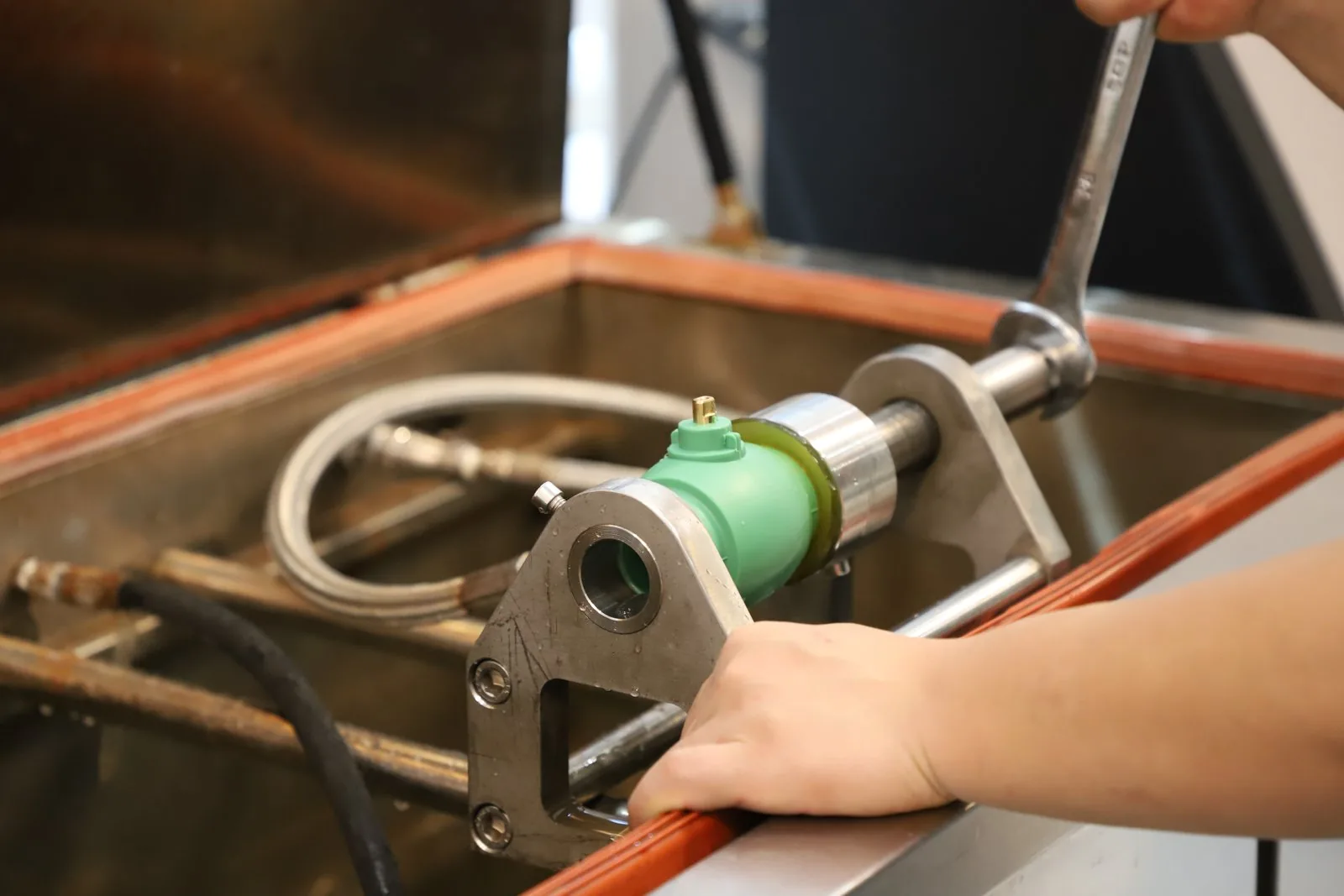
A certificate is a summary. The test report is the evidence, and demanding it is the fastest honesty test in sourcing. Trade-compliance specialists are blunt about this: when you ask for a certificate of conformity, always require the underlying test reports it was issued from — and a striking share of fraudulent suppliers simply stop responding at that request. The report runs dozens of pages, names the exact model, records the test date and each pass/fail result, and it is very hard to fabricate convincingly. If a supplier can produce a certificate but not the report behind it, you have your answer.
Understand what each document actually contains, because importers routinely conflate them. A Certificate of Conformity (CoC) is the supplier’s signed declaration that the product meets stated specs — it usually carries no test data. A Certificate of Analysis / test report is the batch-specific record of measured results. For metal parts, the equivalent is a Mill Test Certificate (MTC) giving the heat number, chemical composition and mechanical properties of the brass or steel. Regulated plumbing imports frequently need the declaration and the data. For potable brass in particular, the composition on the MTC is what proves the lead-free claim — you cannot verify a 0.25% wetted-surface lead average without knowing the actual alloy.
Ask, as standard, for: third-party hydrostatic pressure test results against the governing standard (DIN 8077/8078 or EN ISO 15874 for PP-R; ASTM F876/F877 for PEX), an oxygen-diffusion / barrier report to DIN 4726 if you’re buying heating pipe, and the material composition for any wetted brass. For a private-label program, also request that these reports carry your brand and model designation, not just the factory’s — a topic we cover in the certification-under-your-brand context below.
Tier 4 — Trade and customs documents: what actually clears the port
The best-certified pipe in the world still gets detained if the shipping paperwork is wrong or inconsistent. This tier is about moving the goods and paying the right duty. Demand, and cross-check against each other: the commercial invoice (price, quantity, precise description), the packing list (weights, dimensions, carton counts), the certificate of origin, the bill of lading, and — for anything but a trusted repeat supplier — an independent pre-shipment inspection (PSI) report from SGS, Intertek, Bureau Veritas or TÜV. When the invoice and packing list disagree on quantity or description, customs treats the discrepancy as a red flag and holds the shipment; matching detail across documents is not pedantry, it’s clearance insurance.
Get the HS tariff classification agreed in writing before shipment, because it drives your duty and your admissibility. Plastic pipe and its fittings sit under HS heading 3917: rigid pipe of ethylene polymers (PE / PEX base) classifies around 3917.21, rigid propylene-polymer pipe (PP-R) around 3917.22, other non-reinforced tube without fittings around 3917.32, and plastic fittings under 3917.40. The first six digits are standardized worldwide under the WCO Harmonized System; your destination country adds further digits, and current duty rates vary by market and by trade-remedy actions in force — always confirm the full local code and current rate with your customs broker rather than assume. A misdeclared HS code is one of the quiet ways an otherwise clean shipment gets stuck.
The pack, at a glance: what to demand and how to verify it
Read this as a checklist you tick before releasing a deposit, not a menu. The verify column is the part most importers skip — and it’s the part that actually protects you.
| Document | What it proves | How to verify it independently |
|---|---|---|
| Business licence + trademark reg. | The entity and brand are real; origin claim is backed | Search the national trademark office register (e.g. DPMA for a German brand) |
| UPC / cUPC listing (IAPMO) | Code compliance for US / Canada install | Search the listee & file number at pld.iapmo.org |
| NSF/ANSI 14 & 61 listing | Plastic-pipe performance & drinking-water safety | Search the company & product at listings.nsf.org |
| WRAS approval / DVGW cert + DoP | UK / EU potable + CE conformity | WRAS Approvals Directory; DVGW register; confirm DoP names the harmonised standard |
| Test reports / CoA / MTC | The measured evidence behind every certificate | Check identifiers match your exact model; batch/heat numbers present |
| Invoice, packing list, CoO, B/L, PSI | Clears customs; assigns duty; confirms quantity | Cross-check every figure between documents; agree HS code in writing |
The US lead-free floor: why this one law can void a whole container
If any of your product touches drinking water in the United States, one federal requirement sits underneath every certificate and it does not bend. Under Section 1417 of the Safe Drinking Water Act — amended by the 2011 Reduction of Lead in Drinking Water Act — any pipe, fitting or fixture in contact with potable water must be “lead free,” defined as a weighted average of not more than 0.25% lead across the wetted surfaces (and 0.2% for solder and flux). That replaced the old 8% ceiling. The weighted-average calculation method lives in NSF/ANSI/CAN 372, which is why you’ll see brass parts marked to 372 alongside 61. The rule is set out plainly by the US EPA.
Two facts make this a document you actively verify rather than assume. First, the certification requirement has been federally enforceable since 1 September 2023 — this is current law, not a coming change. Second, the US EPA has explicitly advised that importers, not only manufacturers, may be held liable for introducing non-certified plumbing products into commerce. You cannot outsource that exposure to the factory. For every wetted brass part, demand the alloy grade on the mill certificate and the NSF 61/372 listing that covers it. A supplier who can’t tell you whether a valve’s wetted surface is CW617N or a dezincification-resistant low-lead grade like CW724R, CW511L or CW602N cannot credibly certify it lead-free — and you’ll be the one holding the liability if it isn’t.
What Hitze puts in a certification pack — and how the documents are built
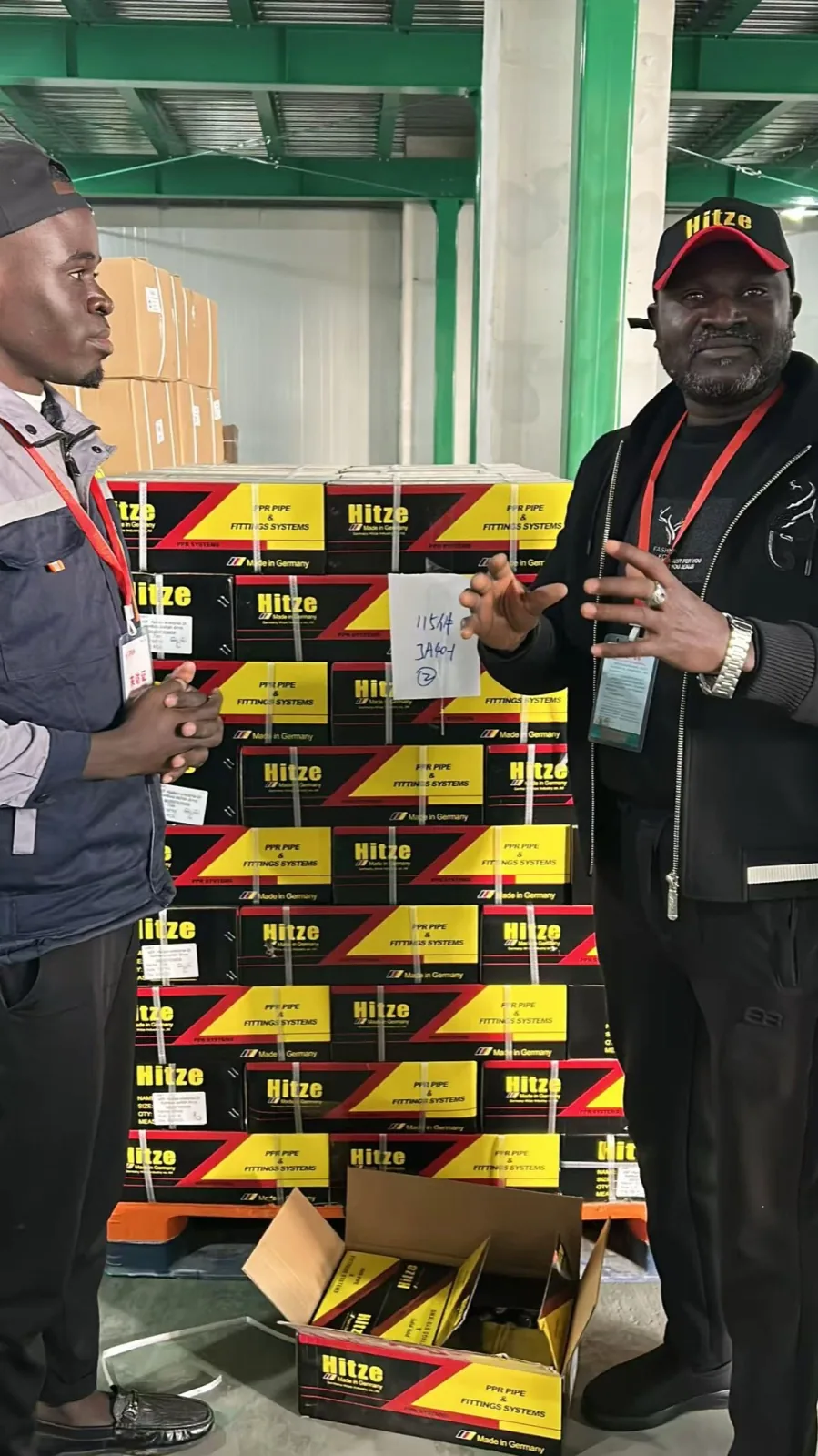
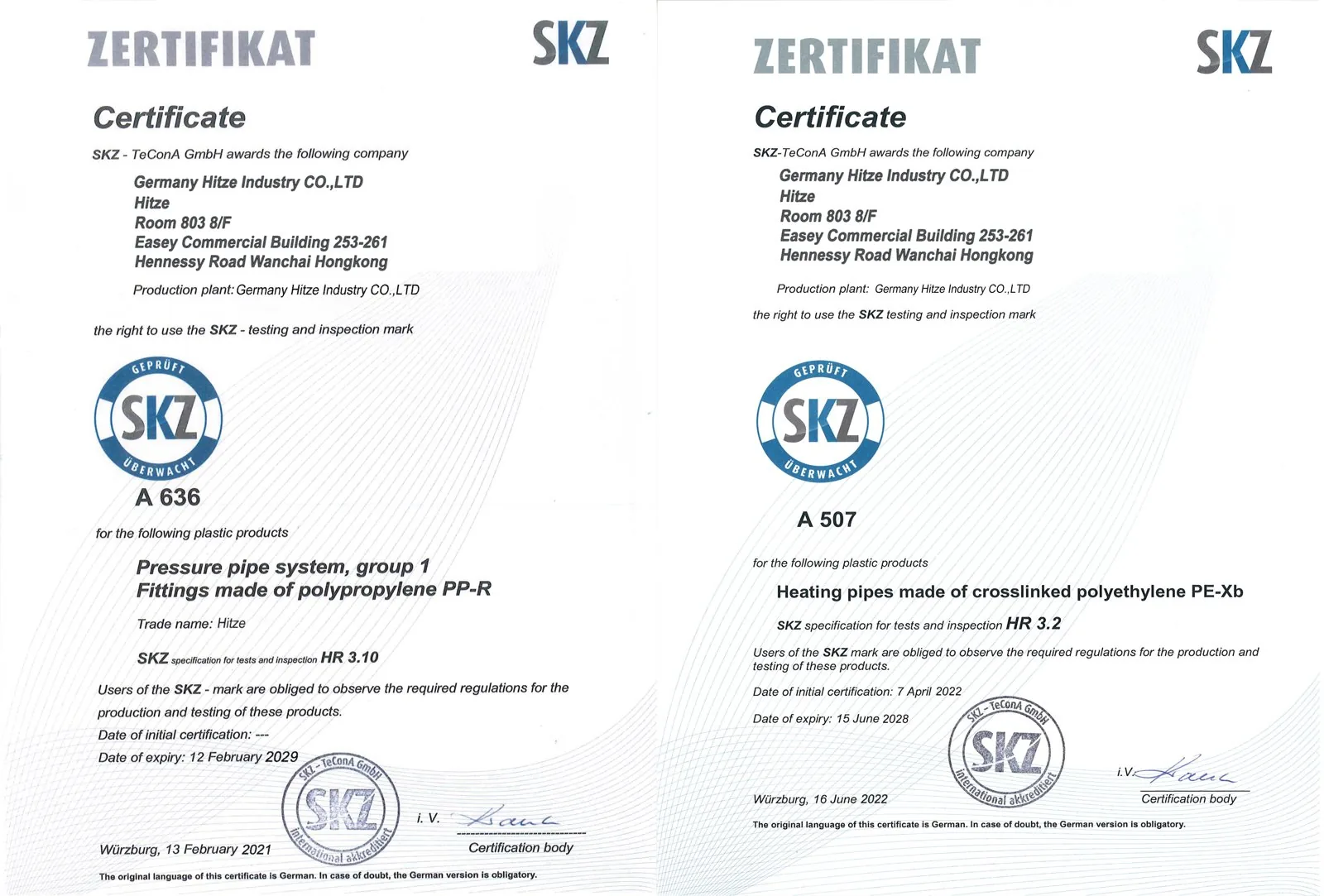
Here’s how the pack comes together on our side, because it tells you what to ask any supplier to reproduce. Hitze is a German brand engineered to German DIN and EN standards, founded in 1974, running a 120,000 m² production base with 1,000+ employees and exporting to 118+ countries — figures we’re happy to have checked against the public record rather than asserted. The compliance evidence behind our pipe is real, third-party, and numbered on the physical certificates:
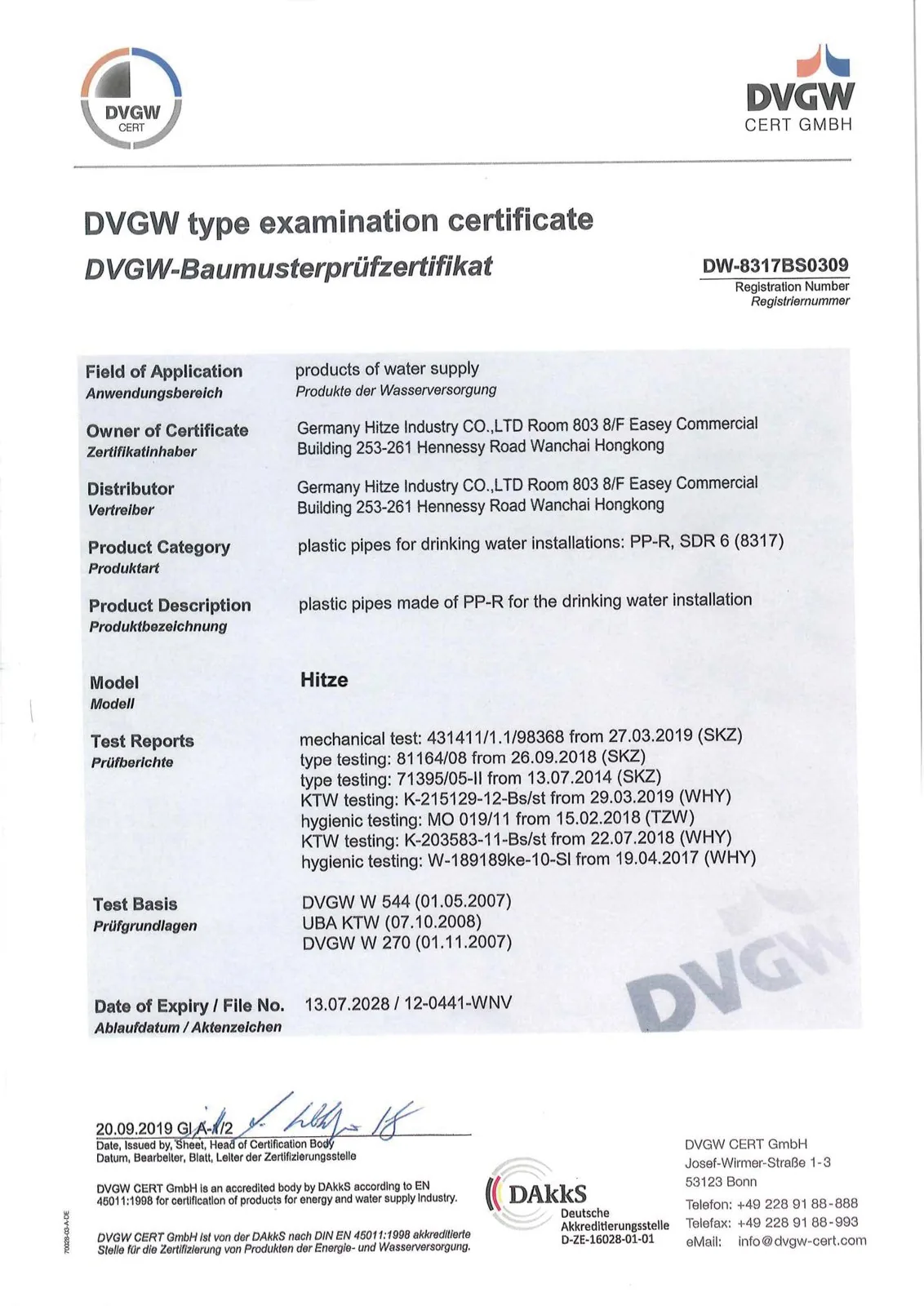
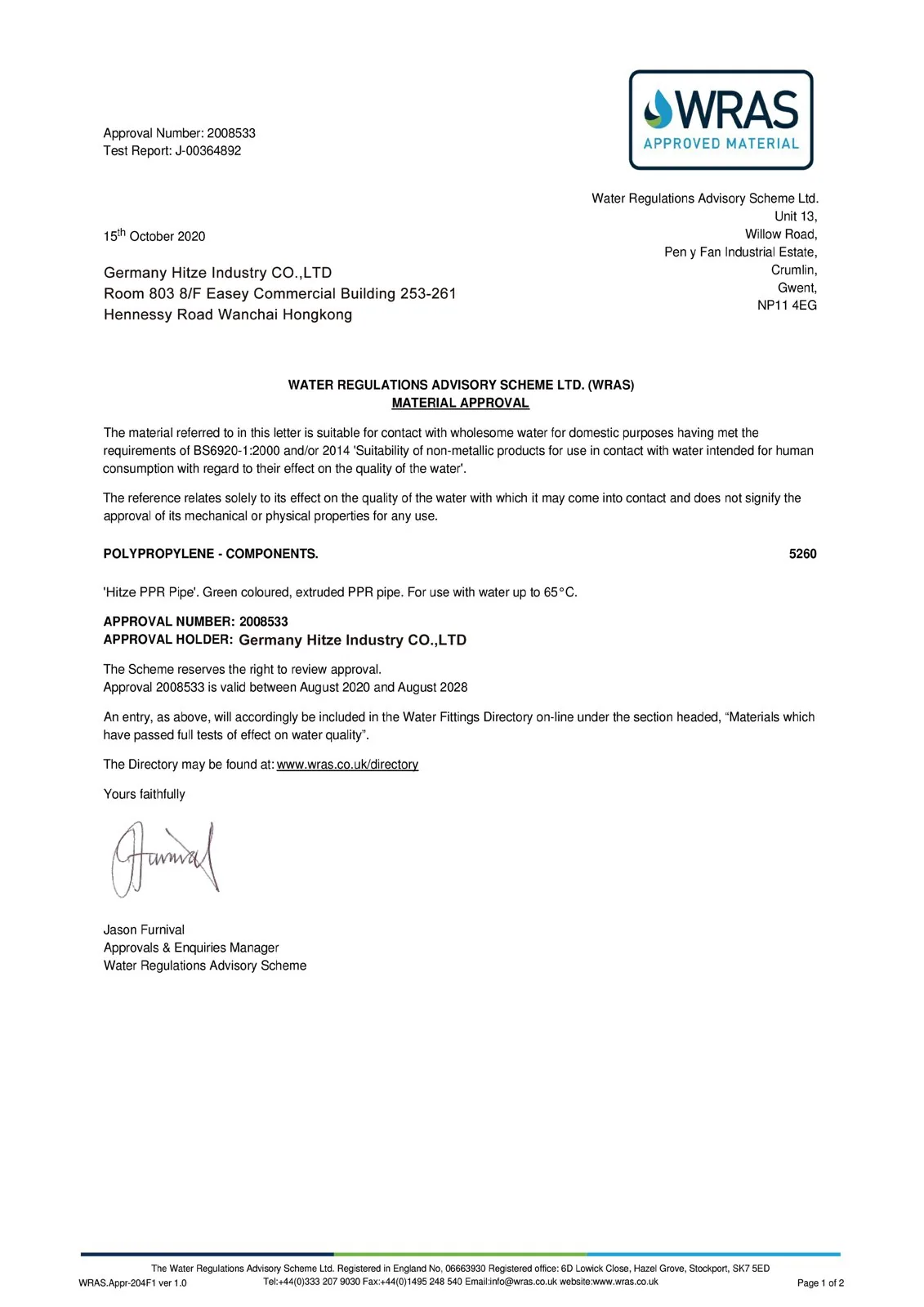
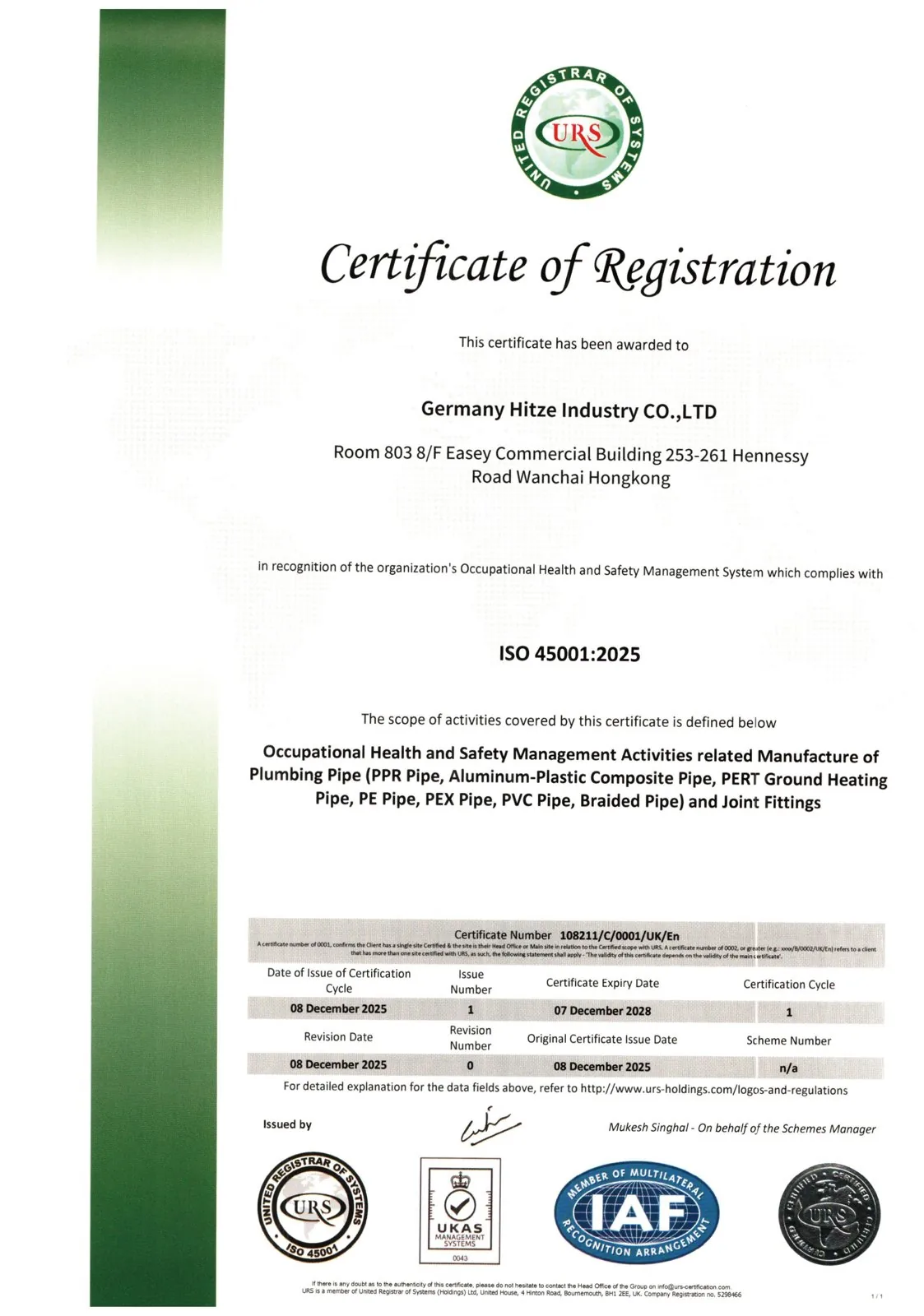
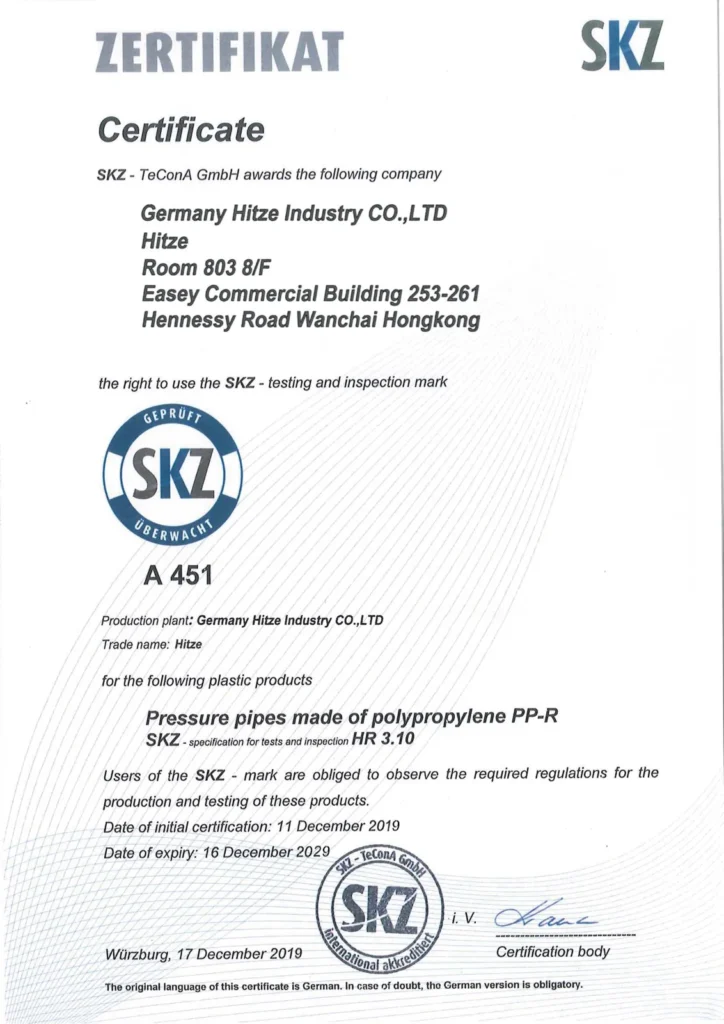
On the schemes: our PP-R pressure pipe, PP-R fittings and PE-Xb heating pipe are SKZ-tested in Germany; our PP-R drinking-water pipe carries a DVGW type examination; we hold WRAS material approval in the UK and an NSF International Laboratories BS 6920 potable-water test report; our management system is certified to ISO 45001 (URS, UKAS-accredited); and our multilayer pipe carries the SAI Global StandardsMark to AS 4176.8 (the Australian consumer-gas multilayer standard). We are certified to cUPC/UPC (IAPMO), NSF-14, NSF/ANSI 61 and carry CE marking with a Declaration of Performance. The individual certificate numbers are real and printed on each document; we release them on request against a specific product line and destination, so you receive the certificate that actually covers what you’re buying rather than a generic wall of logos.
The evidence layer underneath is built in-house: pipe is hydrostatic-tested against DIN 8077/8078 and EN ISO 15874, heating pipe is verified for the DIN 4726 oxygen barrier, and potable brass is specified in documented DZR low-lead grades (CW724R, CW511L, CW602N) so the wetted-surface lead average can actually be substantiated rather than merely claimed. That is the difference between a certificate you can defend at inspection and one you’re hoping nobody reads closely.
A worked example: the container that almost didn’t clear
Picture a US distributor placing a first mixed order — PEX-a heating coils, PP-R hot-and-cold pipe, and lead-free brass compression fittings — from a supplier who sent three certificate PDFs up front. On paper it looked complete. The importer, following this checklist, did one thing differently: he searched every listing before paying. The PEX listing checked out on the NSF register. The PP-R checked out. But the brass fittings’ “NSF 61” certificate returned no matching record — the file number on the PDF didn’t exist in the database. Pressed for the mill certificate, the supplier could only produce a composition sheet for standard CW617N with no NSF 61/372 listing tied to it.
Had that container shipped, the pipe would have cleared and the fittings would have been the problem — either rejected at inspection or, worse, sold onward into a market where the importer carried the lead-free liability. Because the gap surfaced before the deposit, the fix cost nothing but a week: the fittings were re-sourced in a documented DZR grade with a verifiable NSF 61 listing, and the corrected certificate was confirmed on the register before production started. That is the entire argument for verifying the pack up front. The same discovery at the port is demurrage, a rejected entry, and a quarter’s margin gone.
Best for / not for: how hard to push on documentation
This full four-tier pack is essential for you if you’re importing potable-water or heating pipe into a regulated market (US, Canada, UK, EU/Germany, Australia), running a private-label program where the certificate must name your brand, or supplying projects where an MEP engineer will demand submittals. In those cases every document here is load-bearing and skipping one is a genuine risk to the whole shipment.
It’s lighter — but never zero — if you’re buying non-potable HDPE for irrigation or drainage, or industrial pipe outside drinking-water and building-code scope. You can drop the NSF 61/WRAS/DVGW potable layer, but you still want the pressure-test report to the governing standard (EN 12201 / ISO 4427 for PE100 water pipe), the material certificate, and clean trade documents. “Non-potable” is not a licence to skip evidence — it’s a narrower evidence set.
Before you wire the deposit
If you’re an importer or distributor about to commit to a first container — and especially if drinking water or a building code is involved — treat the certification pack as a gate, not a formality. Ask for every document in the four tiers, insist on the test report behind each certificate, and verify the listings yourself in the public registers before any money moves. A supplier who welcomes that scrutiny and hands you verifiable numbers is telling you something the price never will.
If you’d like to pressure-test a real pack against this checklist, Hitze can supply the scheme certificates, third-party test reports and Declarations of Performance for the specific product lines and destination market you’re targeting — the numbered documents that actually stand up in a register, released against your order rather than as a generic bundle. You can review the schemes we hold on our certifications & compliance page, and see how we structure documentation and supply for trade buyers on our importer & distributor and project piping supply pages. It’s a fit if you’re a serious trade buyer who wants to verify before you commit — not the right route if you’re a homeowner buying a single fitting.
Frequently asked questions
What documents should I demand from a pipe supplier before I pay?
At minimum: the business licence and brand trademark registration; the product-compliance certificates for your market (UPC/cUPC, NSF/ANSI 14 & 61 for the US, WRAS for the UK, DVGW plus a CE Declaration of Performance for the EU); the third-party test reports behind each certificate; the mill/material certificate for any brass; and the trade documents (commercial invoice, packing list, certificate of origin, and a pre-shipment inspection report). Verify every certificate in the issuing body’s public register before releasing a deposit.
How do I know if a pipe certificate is genuine and not photoshopped?
Take the listee name and file/certificate number off the PDF and search the issuing body’s own register — pld.iapmo.org for UPC/cUPC, listings.nsf.org for NSF, and the WRAS Approvals Directory for UK potable approvals. If the record isn’t there, or the product scope on the register doesn’t match the pipe you’re buying, treat the certificate as unproven no matter how official it looks. Also demand the underlying test report; genuine suppliers can produce it, and many fakes cannot.
What’s the difference between a certificate of conformity, a test report and a mill certificate?
A certificate of conformity (CoC) is the supplier’s signed declaration that a product meets stated specifications — usually with no test data. A test report or certificate of analysis is the batch-specific record of actual measured results. A mill test certificate (MTC) is the metal equivalent, giving the heat number, chemical composition and mechanical properties of the brass or steel. Regulated plumbing imports typically need the declaration and the supporting data together.
Is the pipe “made in Germany” if the brand is German?
Hitze is a German brand — GERMANY Hitze Industry Co., Ltd, with a verifiable DPMA trademark registration — engineered in Germany and built to German DIN and EN standards, and third-party certified through German schemes such as SKZ and DVGW. We deliberately describe it that way rather than as a blanket “made in Germany” slogan, and the certifications are what let you verify the quality claim in a public register rather than take it on trust.
Do I really need NSF/ANSI 61 for brass fittings if the pipe is already certified?
Yes. A certificate for the pipe does not cover the fittings. For US drinking-water use, wetted components including brass fittings must meet the Safe Drinking Water Act “lead free” limit — a 0.25% weighted average on wetted surfaces, calculated to NSF/ANSI 372 — and this has been enforceable since 1 September 2023, with importers potentially liable. Demand a separate NSF 61/372 listing and the alloy grade on the mill certificate for each wetted brass part.
What HS code should plastic plumbing pipe ship under?
Plastic pipe and fittings fall under HS heading 3917 — rigid ethylene-polymer pipe (PE/PEX base) around 3917.21, rigid propylene-polymer pipe (PP-R) around 3917.22, other non-reinforced tube around 3917.32, and fittings under 3917.40. The first six digits are standardized worldwide; your country adds further digits and sets the duty rate, which can change with trade actions in force. Agree the full local code in writing with your customs broker before shipment.