Size a sleeve for plastic pipe in three additions: the pipe’s outside diameter, twice the insulation that runs through the penetration, and twice a radial clearance that covers what the pipe does at that wall. Codes and guide specs supply only the floor of the last term. IPC 2024 305.3 asks for a sleeve two pipe sizes greater at a foundation wall. The NY State OGS MasterSpec 2024 guide specification (Section 220517) asks for a 1/4-inch annular clear space at partitions and a bracketed, editable 1 inch for sleeve-seal systems.
None of them sizes for movement, and plastic pipe moves. A 10 m run of standard PP-R heated by 40 K grows 60 mm; glass-fibre PP-R grows 14 mm. If that growth reaches the wall as a sideways swing, a 1/4-inch annulus fails. Anchor the pipe at the wall, or size the sleeve for the swing.
Key takeaways
- Bore = OD + 2 x insulation + 2 x clearance. Measure the clearance to the insulation, as the MasterSpec and NJ texts do.
- Codes give floors, not movement. Two pipe sizes at foundation walls (IPC 2024 305.3), 1/2 inch in NJ 2.12, 1/4 inch in the MasterSpec 220517 guide spec.
- Plastic moves. 10 m of standard PP-R at 40 K grows 60 mm; glass-fibre PP-R grows 14 mm.
- A sealant will not absorb a swing. ASTM C920 Class 25 in a 1/4-inch joint takes about 1.6 mm.
- Out of scope: fire-rated penetrations follow IBC Section 714 and a tested firestop system.
On this page
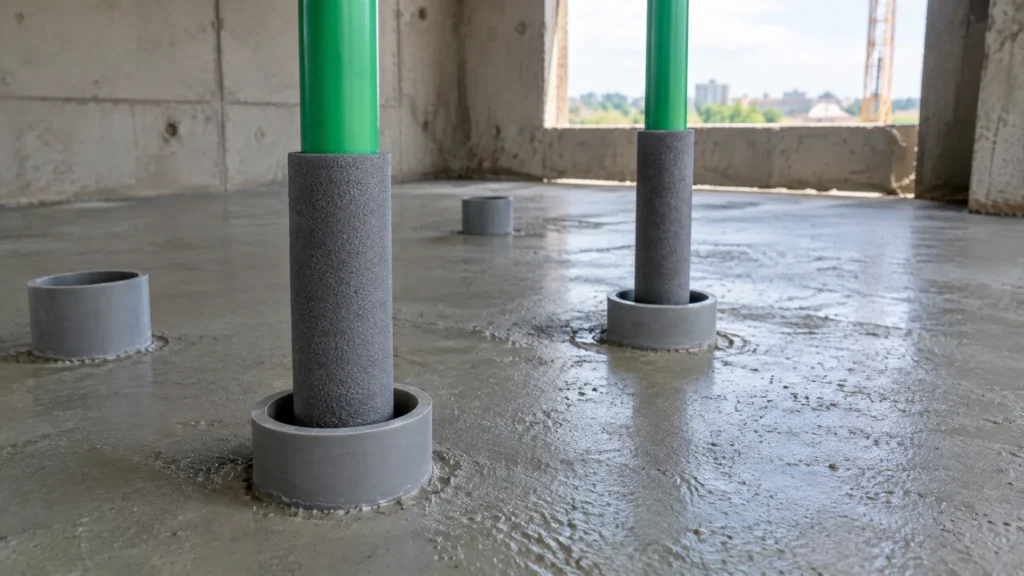
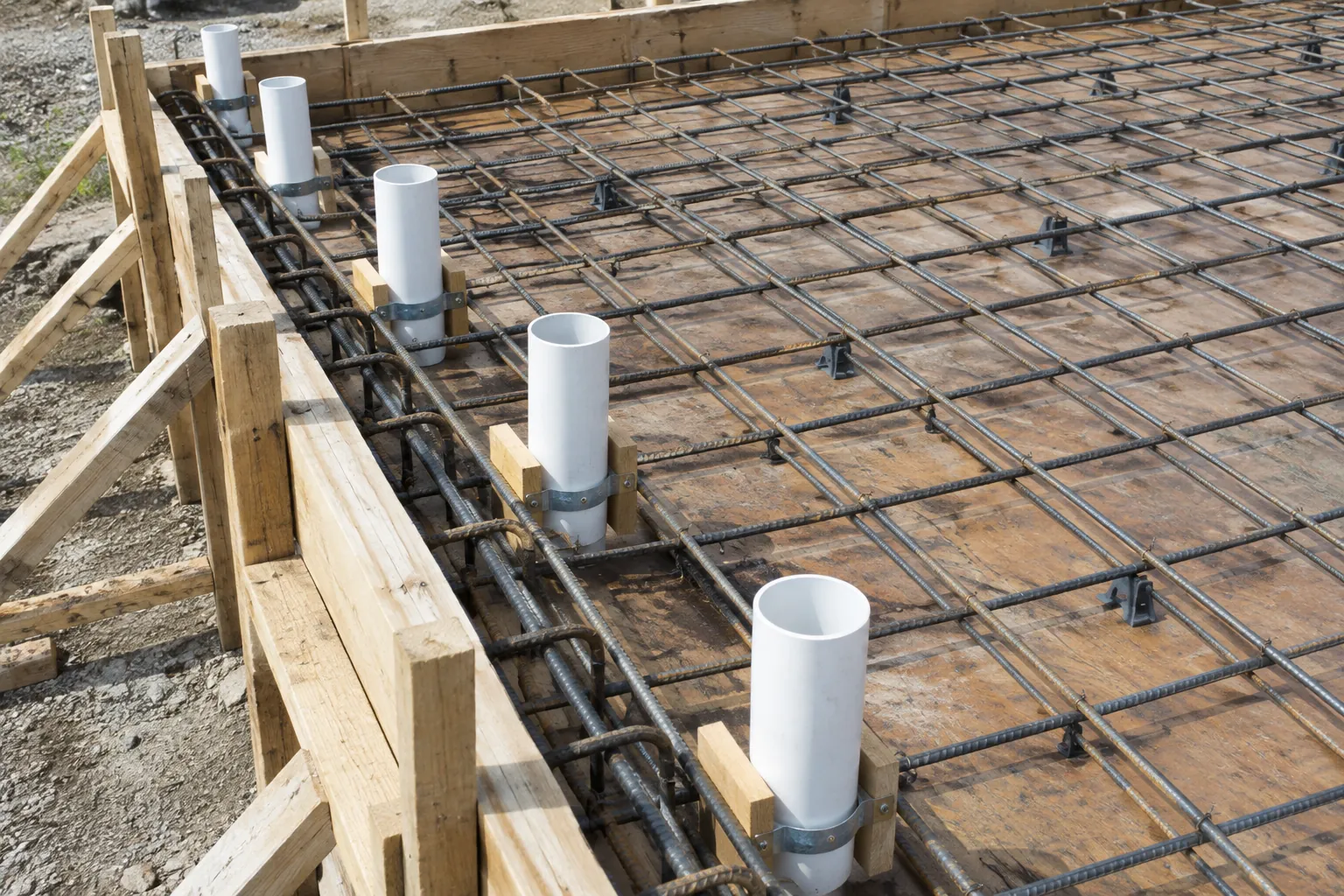
This short video shows a pipe sleeve set through a footing form before the pour.

What each code and spec actually sets at a penetration
Model codes treat the sleeve as protection. The exception is IPC 2024 305.3 and IRC 2024 P2603.4: at a foundation wall the sleeve is two pipe sizes greater than the pipe. That counts nominal sizes, so convert a metric PP-R OD with a mm-to-inch size chart before applying it.
UPC 2021 312.10 (Hawaii 2021 adoption) requires sleeves through concrete and masonry walls and concrete floors, exempts drilled or bored openings, and states no clearance; New Jersey’s 2.12 sets 1/2 inch (12.7 mm). Section 312.2 adds that no plumbing piping shall be directly embedded in concrete or masonry.
| Document | Where it applies | Size or clearance rule | Seal rule | Verdict |
|---|---|---|---|---|
| IPC 2024 305.3; IRC 2024 P2603.4 | Foundation walls | Sleeve two pipe sizes greater, or a relieving arch | IPC 315.1 / IRC P2606.1: compatible caulk, foam or gasket | Floor for foundation walls only |
| UPC 2021 312.10 (Hawaii 2021 adoption) | Concrete and masonry walls, concrete floors | Sleeve required; no dimension; drilled or bored openings exempt | Exterior walls sealed watertight (312.10.2) | Protection rule, no size |
| NJ Plumbing Subcode 2021, 2.12 | Concrete walls, floors, slabs, masonry | Minimum 1/2 inch around pipe and insulation | Resiliently sealed watertight where groundwater applies | The one code text here with a clearance |
| NY OGS MasterSpec 2024 (guide spec), 220517 | Interior partitions | 1/4-inch annular clear space to pipe or insulation | Joint sealant suited to joint size and depth | Minimum for a pipe that does not swing |
| NY OGS MasterSpec 2024 (guide spec), 220517 | Slabs and walls with a sleeve-seal system | [1-inch] annular clear space (editable default) | Modular sealing elements compressed by bolts | A seal clearance, not a movement allowance |
Source: IPC 2024 Chapter 3 and IRC 2024 Chapter 26 (GSA adoptions, UpCodes viewer); Hawaii Plumbing Code 2021, section 312; New Jersey UCC Plumbing Subcode 2021, 2.12; NY State OGS MasterSpec 2024, Section 220517.
IPC 2024 305.2 requires provisions against damage from expansion and contraction where necessary, and UPC 2021 312.1 requires approved provisions for expansion of hot water piping. Neither sets a dimension at the wall; the next three steps produce one.
Step 1: Decide what the pipe does at the wall
Every penetration is an anchor, a slide or a swing, and that choice changes the bore more than any code does. PPI TR-21 warns that pipe movement should not be constrained by external obstructions, “such as by placing an elbow or other bend too closely to a wall”, and that away from purposely anchored points the pipe must be able to move in guides and hangers.
| Penetration case | What the pipe does there | Sleeve rule | Verdict |
|---|---|---|---|
| Pipe anchored at or beside the wall | Nothing | Minimum clearance to the insulation | Smallest sleeve; absorb growth elsewhere |
| Straight run, guides on both sides | Slides along its axis | Minimum clearance; seal kept off the pipe | Bore can stay small |
| Branch close to a moving riser or bend | Swings sideways | Clearance at least the swing plus the minimum | Move the anchor before enlarging the sleeve |
| Service entry with a sleeve-seal system | Held by the compressed seal | Bore from the seal maker’s chart | Treat the wall as restrained |
Source: movement rules from PPI TR-21/2001 (anchors, guides and clearance from walls); sleeve-seal behaviour from NY State OGS MasterSpec 2024, Section 220517. Verdicts are Hitze engineering guidance.
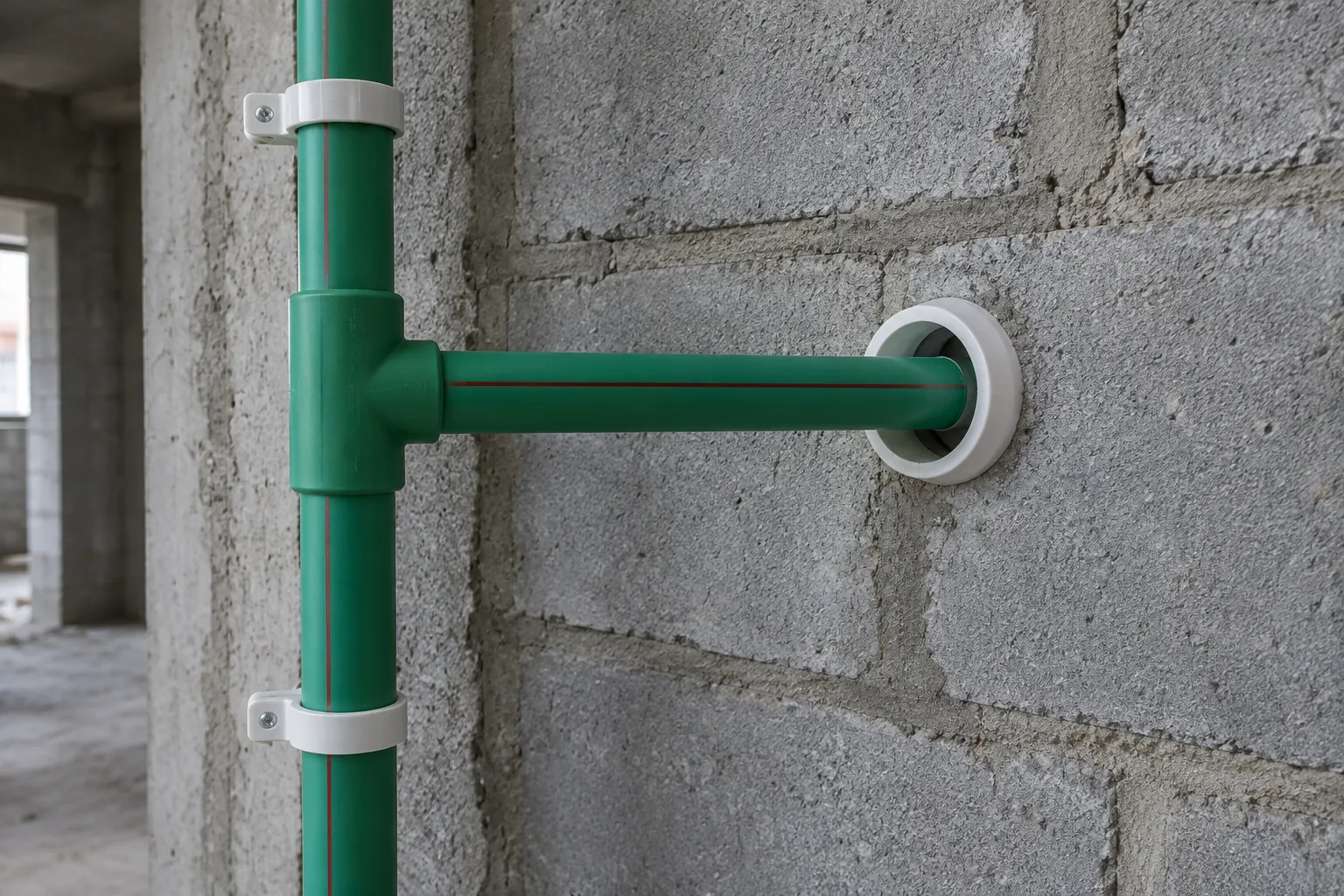
The usual failure: a rigid mortar pack or a bead bonded to a sliding pipe turns the wall into an anchor nobody designed. The growth, 60 mm on a 10 m hot PP-R run, still has to go somewhere, and TR-21 notes that most fittings have lower bending strength than the pipe they join, so the nearest fitting is the weak point. Fixed points and bending legs are laid out in our PP-R support spacing and expansion guide.
Step 2: Work out the movement at that penetration
Use ΔL = α × L × ΔT. L is the free length from the nearest fixed point; ΔT runs from the installation temperature to the hottest or coldest service. Hitze’s thermal expansion comparison puts plain PP-R at about 0.15 mm/(m·K), glass-fibre composite PP-R at about 0.035 and aluminium-composite PP-R at about 0.030. A third-party PP-R data sheet gives the same 1.5 × 10⁻⁴ per K, averaged from 0 to 110 °C to DIN 53712.
Take a hot riser with 10 m between its fixed point and a branch floor, installed at 20 °C and run at 60 °C. At that floor it has grown 60 mm in standard PP-R, 14 mm in glass-fibre PP-R and 12 mm in aluminium composite. A branch crossing a wall just past the tee rides with it, sideways through its sleeve.
| Pipe construction | Growth (mm) |
|---|---|
| Standard PP-R | 60 |
| Glass-fibre PP-R | 14 |
| Aluminium-composite PP-R | 12 |
For other plastics, PPI TR-21 lists PVC at 3.0 to 5.0 × 10⁻⁵ in/in·°F, PE at 9.0 × 10⁻⁵ and PEX at 9.5 × 10⁻⁵, against copper at 9.3 × 10⁻⁶. Those are roughly −30 to +30 °C values that tend to rise with temperature, so hot service needs the maker’s figure. On a cold line the pipe pulls back toward its anchor instead. Specify glass-fibre PP-R where riser branches cross walls close to the tee.
Step 3: Add the insulation, then the clearance
Both the MasterSpec and the NJ subcode measure clearance to the insulation, not the pipe. In Germany, Anlage 8 of the building energy law (the GEG, renamed GModG with effect from 29 July 2026) halves hot-water insulation in wall and ceiling penetrations. A 32 mm SDR 6 PP-R pipe has a 5.4 mm wall and a 21.2 mm bore, which puts it in the up-to-22 mm band at 20 mm, so 10 mm runs through the wall. Our PP-R insulation guide covers the bands.
| Case | Radial allowance per side (mm) | Minimum bore (mm) | Verdict |
|---|---|---|---|
| Anchored or sliding, 1/4-inch clearance (MasterSpec) | 6.35 | 64.7 | Fits an anchored pipe |
| Anchored or sliding, 1/2-inch clearance (NJ 2.12) | 12.7 | 77.4 | Use where that rule applies |
| Glass-fibre PP-R swinging 14 mm | 14 + 6.35 | 92.7 | Workable sleeve |
| Standard PP-R swinging 60 mm | 60 + 6.35 | 184.7 | Move the anchor instead |
Source: bore = OD + 2 x insulation + 2 x allowance; 32 mm SDR 6 wall 5.4 mm per the DIN 8077 PN 20 table. Insulation halved in the penetration per Anlage 8 of the GModG (formerly GEG); swing from a 10 m run at 40 K. The glass-fibre row reuses the SDR 6 wall; a thinner fibre wall (SDR 7.4, bore 23.2 mm) falls in the 30 mm band, 15 mm in the penetration: bore 102.7 mm. Hitze calculation.
The last row is the surprise. A 184.7 mm bore for a 32 mm pipe is a structural question, and it still leaves about 66 mm of annulus on each side to seal. Where the swing goes one way only, as on a hot riser anchored below, setting the pipe off-centre at installation cuts the bore to 124.7 mm. Better, fix the riser at the branch floor, or switch it to glass-fibre PP-R and size from the fibre row: 92.7 mm, or 102.7 mm on an SDR 7.4 wall.
Step 4: Choose the sleeve and the seal
Cast sleeves in as slabs and walls are built, as the MasterSpec requires. It lists PVC pipe sleeves to ASTM D1785 Schedule 40, noting that fire authorities having jurisdiction may prohibit PVC. A core-drilled hole in a UPC jurisdiction needs no sleeve, but it is sized by the same formula.
The MasterSpec’s silicone sealants to ASTM C920 Class 25 carry plus or minus 25 percent movement capability. In a 1/4-inch (6.35 mm) joint that is about 1.6 mm; in a 1-inch joint about 6.4 mm. Against 60 mm, or even 14 mm, of swing, a bead is only a seal. Bond it to the sleeve and the insulation jacket, keep it off a sliding pipe, and let the annulus take the travel.
A sleeve-seal system works the other way. Its bolts compress the sealing elements until they grip pipe and sleeve watertight, so it grips the pipe. At a service entry, treat that wall as the anchor and put the expansion leg inside. In wet areas the MasterSpec extends floor sleeves 2 inches above finished floor by default.
Where we stop, and what to put on the order
Fire-rated penetrations are a separate design. IPC 2024 315.1 sends their annular spaces to Section 714 of the International Building Code: a tested firestop system for the pipe material and size.
We do not list sleeves. We supply the PP-R pipe and fittings through them: standard, PPR-FB-PPR and PPR-AL-PPR, OD 20 to 110 mm. No lead time is printed because none is confirmed per order: construction, size and stock status set the date, so ask for a delivery date per SKU in writing, plus the TDS expansion coefficient per construction for Step 2. There is no MOQ, and our project piping supply programme stages deliveries to your programme.
Conclusion
For each penetration on a hot run:
- Name the case: anchor, slide or swing.
- Calculate ΔL = α × L × ΔT: 60 mm per 10 m at 40 K on standard PP-R.
- Add insulation and clearance: OD + 2 × insulation + 2 × clearance.
- Oversized bore? Move the anchor or change the construction.
- Seal to the sleeve, never a moving pipe; fire-rated walls get a firestop design.
Frequently asked questions
Are pipe sleeves required by code?
In UPC jurisdictions, yes through concrete and masonry walls and concrete floors: UPC 2021 312.10 requires them, except where openings are drilled or bored. IPC 2024 305.3 requires a sleeve two pipe sizes greater, or a relieving arch, where a pipe passes through a foundation wall.
How much bigger than the pipe should a sleeve be?
At a foundation wall, two pipe sizes greater (IPC 2024 305.3). Elsewhere, add the pipe OD, twice the insulation in the penetration and twice the radial clearance: 1/4 inch in the NY MasterSpec, 1/2 inch in the New Jersey subcode, plus any sideways movement the pipe makes at that wall.
Can I use PVC pipe as a sleeve?
Yes where the authorities allow it. The NY State MasterSpec 2024 lists PVC pipe sleeves to ASTM D1785 Schedule 40, and notes that PVC sleeves may be prohibited by fire authorities having jurisdiction.
Does the gap between the pipe and the sleeve have to be sealed?
Yes. IPC 2024 315.1 requires the annular space to be sealed with caulking, foam sealant or a gasketing system compatible with the pipe and sleeve, and fire-rated assemblies follow Section 714 of the International Building Code.