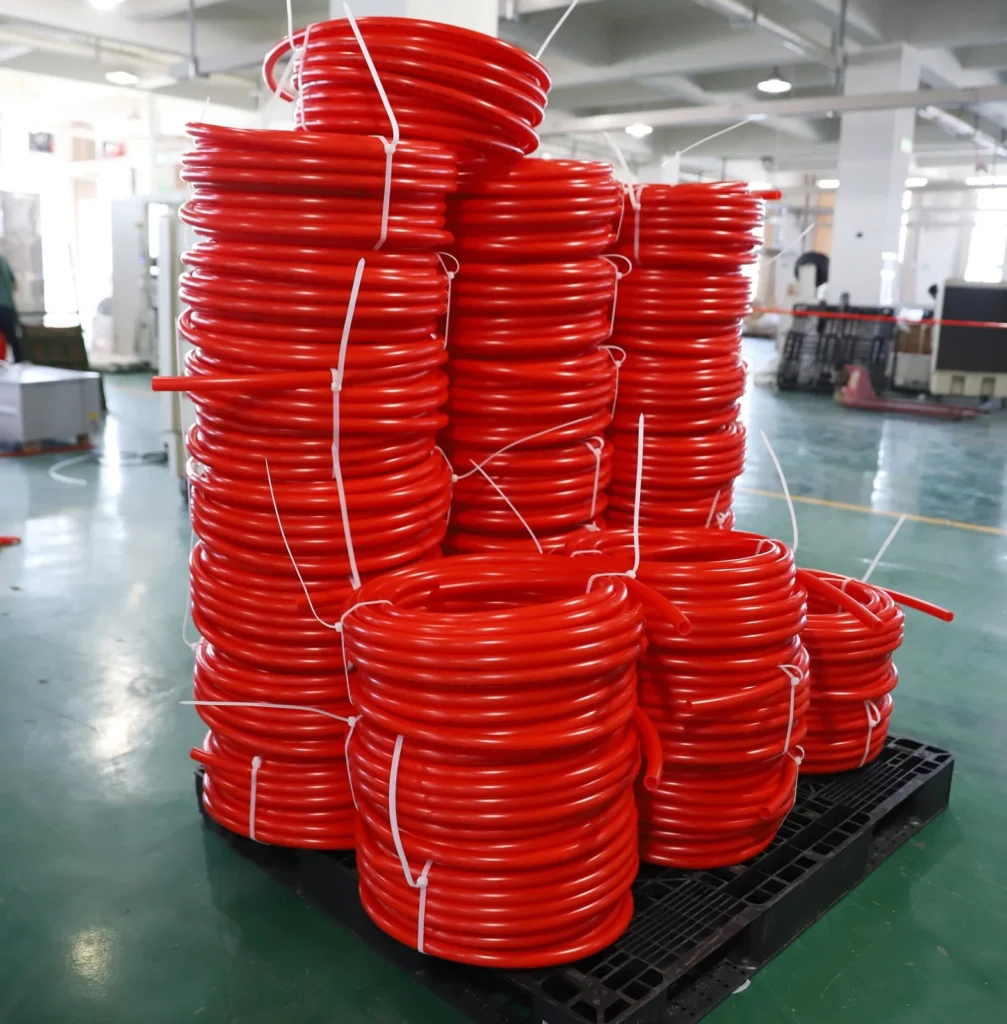
Key Takeaways
- ASTM F1960 cold expansion and ASTM F1807 copper-ring crimp both carry the same pressure rating — 100 psi at 180°F (82°C) — and both sit in the model codes. The real differences are flow path, process control, and cold-weather behavior.
- Get the scopes right before you spec: F1807 (metal insert crimp) runs 3/8 in. to 2 in.; F2159 (plastic insert crimp) stops at 1 in.; current editions of F1960 cover 3/8 in. through 3 in. and include PE-RT tubing, not just PEX.
- Every crimp insert must fit inside the pipe bore — 0.475 in. on 1/2-in. PEX — so the fitting waterway steps down at every joint. An expansion fitting goes into a pipe end that has been expanded first, so the step-down is far smaller.
- Cold weather flips the speed argument: below 40°F (4.4°C) expansion joints contract onto the fitting more slowly, while a crimp seals the instant the ring is compressed and gauged.
- Codes require PEX to be factory-marked with the fitting standards it accepts and require joints installed per the manufacturer’s instructions — which is why a matched pipe-and-fitting system, like Hitze’s with its 50-year system warranty, is the low-risk way to buy either method.
Ask three plumbing crews whether cold expansion or crimp makes the better PEX joint and you will get three confident answers, usually built on whichever tool is already in the van. Both methods have decades of field history and both are listed in every major North American model code. But they are not interchangeable on a bid sheet: the fitting geometry, the tooling economics, the January-morning behavior and the warranty exposure are measurably different. This comparison works through PEX expansion vs crimp the way an estimator should — standard by standard, number by number.
Two Ways to Hold Back 100 psi: How Each Joint Works
An F1960 cold-expansion joint exploits the shape memory of crosslinked polyethylene. The installer slides a PEX reinforcing ring over the pipe end, expands pipe and ring together with an expander tool, inserts the fitting, and lets the material contract. As the Plastics Pipe Institute (PPI) puts it in its residential PEX design guide, the expanded pipe end “is allowed to retract onto the fitting to form the seal — the memory of the pipe allows it to tighten over the fitting.” There is no separate sealing element to deform and no metal ring to gauge: the pipe itself is the gasket, squeezed onto the fitting by its own elastic recovery plus the reinforcing ring.
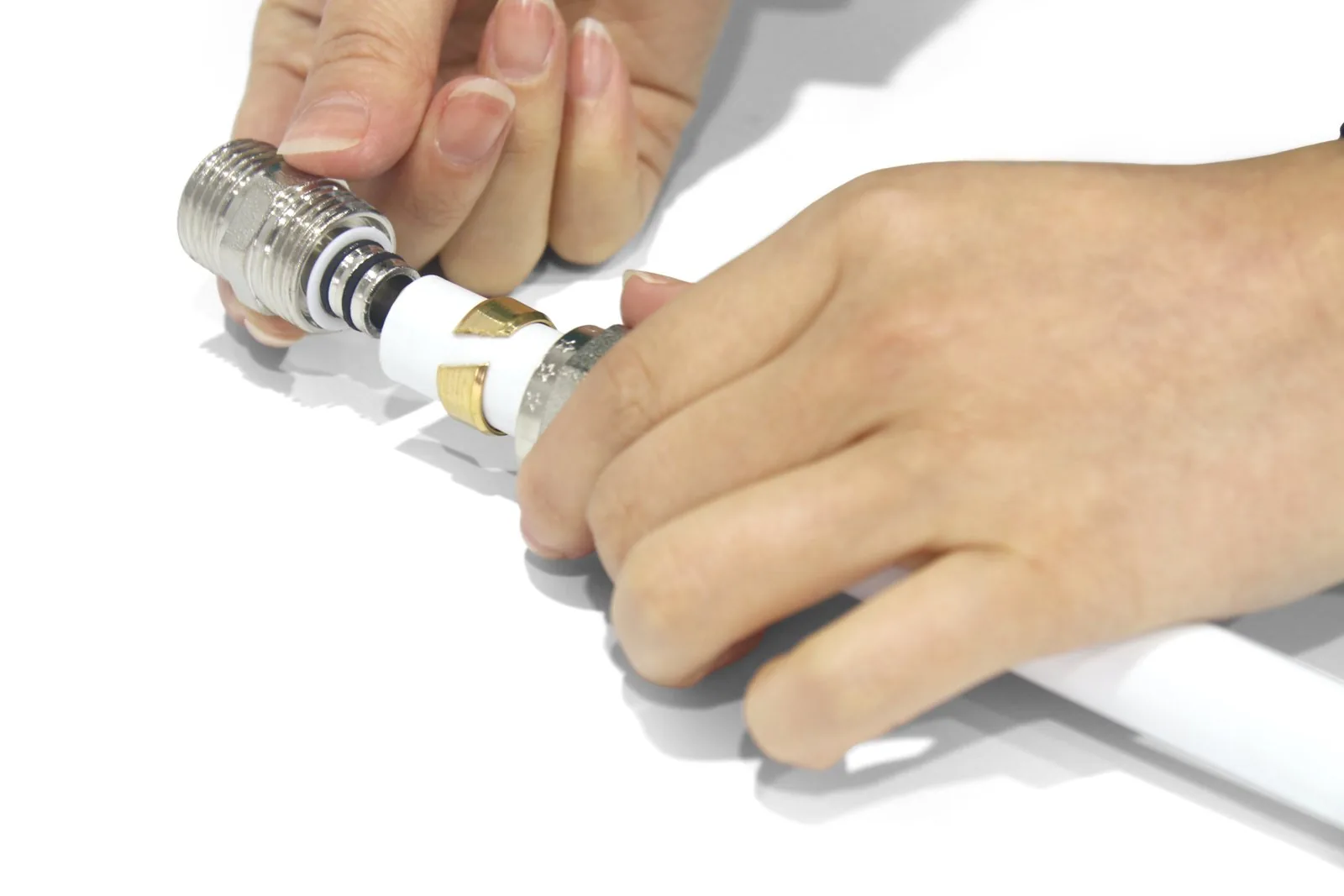
An F1807 crimp joint works the opposite way: force from outside. A ribbed brass insert slides into the pipe, a black copper ring slides over the outside, and a crimp tool compresses the ring full-circle, driving the pipe wall into the annular ribs of the insert. The seal is purely mechanical — pipe compressed between copper ring and brass barb — and it is complete the moment the tool closes. Its plastic-fitting sibling, ASTM F2159, uses the same copper ring over a sulfone-polymer insert. A third crimp-family option, ASTM F2098 stainless-steel clamps, secures the same F1807/F2159 inserts with a ratcheting tool that only releases once the clamp is fully closed.
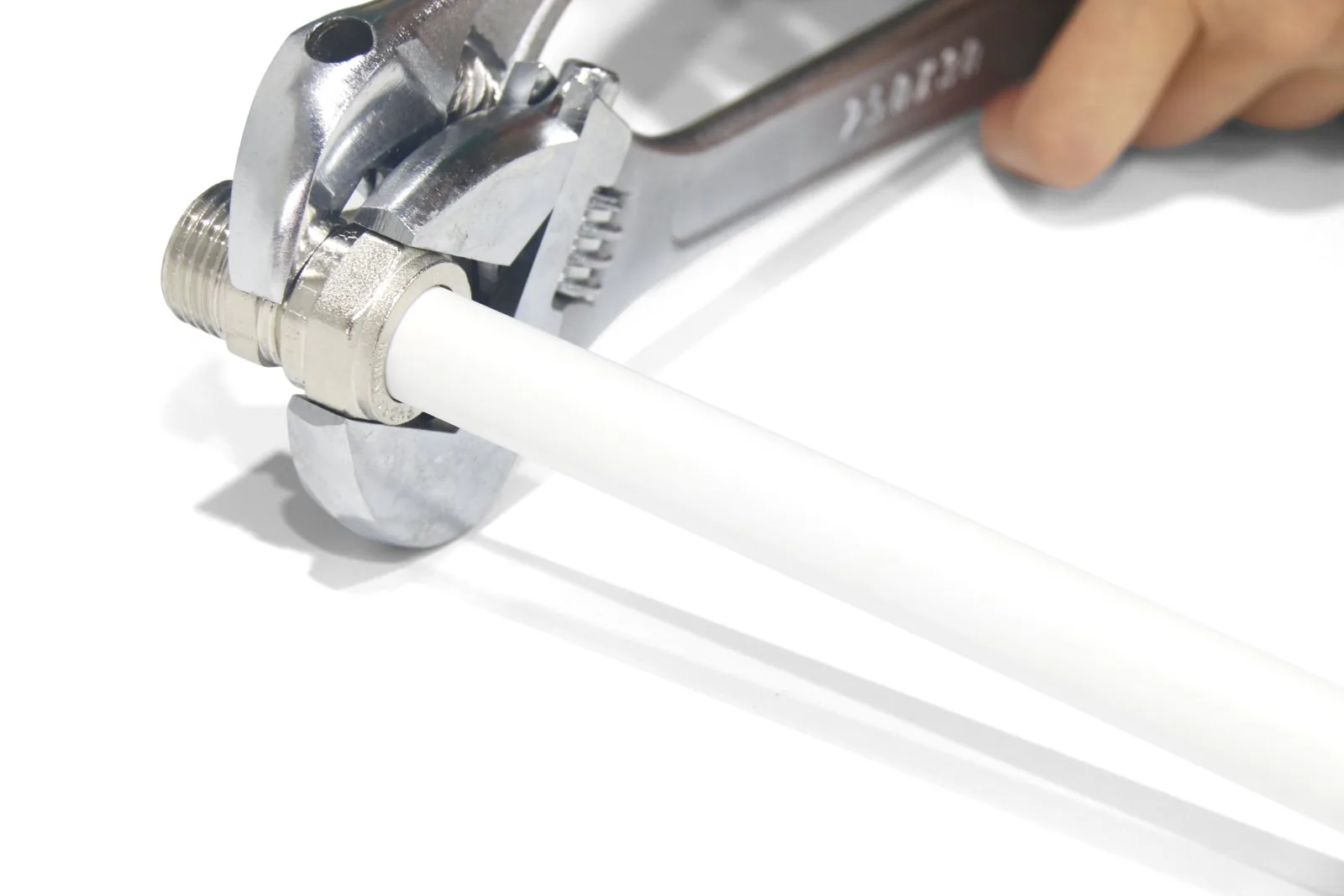
One more system belongs in this conversation because contractors constantly confuse it with F1960: ASTM F2080, cold expansion with a metal compression sleeve. The pipe is expanded, shrinks onto an oversized fitting, and then a metal sleeve is pulled axially over the joint with a dedicated tool. F2080 is common in European-style multilayer and radiant work; its acceptance criteria are tight — the sleeve must land within 0.040 in. of the fitting collar, and the fitting must be inserted within roughly 30 seconds of expansion before the pipe shrinks back. If your supplier quotes “expansion fittings,” make them say which standard: F1960 rings and F2080 sleeves do not mix.
Get the Standard Scopes Straight Before You Bid
A surprising number of published comparisons get the basic scopes wrong, and a wrong scope becomes a wrong submittal. Two errors circulate widely. First, F2159 plastic-insert crimp fittings are often described as running to 2 in. — they do not. The specification covers four nominal tubing sizes only: 3/8, 1/2, 3/4 and 1 in. If your riser design needs 1-1/4 in. or 1-1/2 in. crimp joints, you are in metal-insert ASTM F1807 territory, which genuinely runs 3/8 in. through 2 in. Second, installers still repeat that PE-RT pipe “can’t take expansion fittings.” Also false: the current title of ASTM F1960 explicitly covers both crosslinked polyethylene (PEX) and polyethylene of raised temperature (PE-RT) tubing, with PE-RT qualified through ASTM F2769, and recent editions extend the size range to 3 in. nominal — a full size beyond anything in the crimp family.
| Standard | Joint type | Securing element | Size range | Pipe covered |
|---|---|---|---|---|
| ASTM F1960 | Cold expansion | PEX reinforcing ring | 3/8–3 in. (current editions) | PEX (F876/F877), PE-RT (F2769) |
| ASTM F2080 | Cold expansion | Metal compression sleeve | 3/8–2 in. | PEX; SDR9 PE-RT (recent editions) |
| ASTM F1807 | Metal insert crimp | Copper crimp ring | 3/8–2 in. | SDR9 PEX; SDR9 PE-RT (F2623/F2769) |
| ASTM F2159 | Plastic insert crimp | Copper crimp ring | 3/8–1 in. only | SDR9 PEX; SDR9 PE-RT |
| ASTM F2098 | Insert + clamp | Stainless-steel clamp | Four insert sizes | Alternative ring for F1807/F2159 inserts |
All five specifications share the same duty rating — 100 psi (690 kPa) working pressure at temperatures up to and including 180°F (82°C) — inherited from the ASTM F877 system specification. That matters for how you argue with an inspector or a client: neither method is “rated higher” than the other. The engineering choice is never about pressure class; it is about the four factors that follow.
Flow Path: Where Crimp Gives Up Diameter
Here is the geometric fact no crimp fitting can escape: the insert must physically fit inside the un-expanded pipe bore. Per ASTM F876 dimensions published by PPI, 1/2-in. SDR9 PEX has a 0.625 in. OD, a 0.075 in. wall and an average inside diameter of 0.475 in. A brass F1807 insert slides into that 0.475 in. bore, and its own wall thickness then comes straight out of the waterway — the bore through a typical 1/2-in. crimp insert lands roughly in the 0.35–0.37 in. range, close to the 0.350 in. bore of 3/8-in. pipe. In diameter terms that is a step-down of roughly a quarter; in flow-area terms, roughly 40 percent, repeated at every coupling, elbow and tee.
An F1960 fitting plays by different geometry. Because the pipe end and reinforcing ring are expanded before insertion, the fitting body does not have to pass through the original bore — manufacturers can open the waterway to near the pipe’s own inside diameter. The restriction at each expansion joint is a fraction of the crimp equivalent, which is why expansion systems are routinely specified on fitting-dense trunk-and-branch layouts and on radiant manifolds where dozens of joints sit in series on one circulator.
How much does bore actually cost? PPI’s pressure-loss tables give a feel for the sensitivity: at 2.5 gpm, 1/2-in. PEX loses 8.70 psi per 100 ft of pipe, while 3/8-in. pipe at the same flow loses 38.45 psi — 4.4 times more from one nominal size step. A short fitting is not 100 ft of pipe, so a single crimp insert costs little; but a two-bath house rough-in can easily carry 60–80 fittings, and hydronic circuits are less forgiving still, because head added to a loop comes directly off circulator capacity. The practical rules: on crimp systems, resist the temptation to downsize; keep home runs at 1/2 in. minimum and trunks a size generous. On expansion systems you can size closer to the pipe tables. If a design is marginal on a 3/8-in. crimp home run, it usually is not marginal on 1/2-in. — that one-size insurance costs pennies per foot.
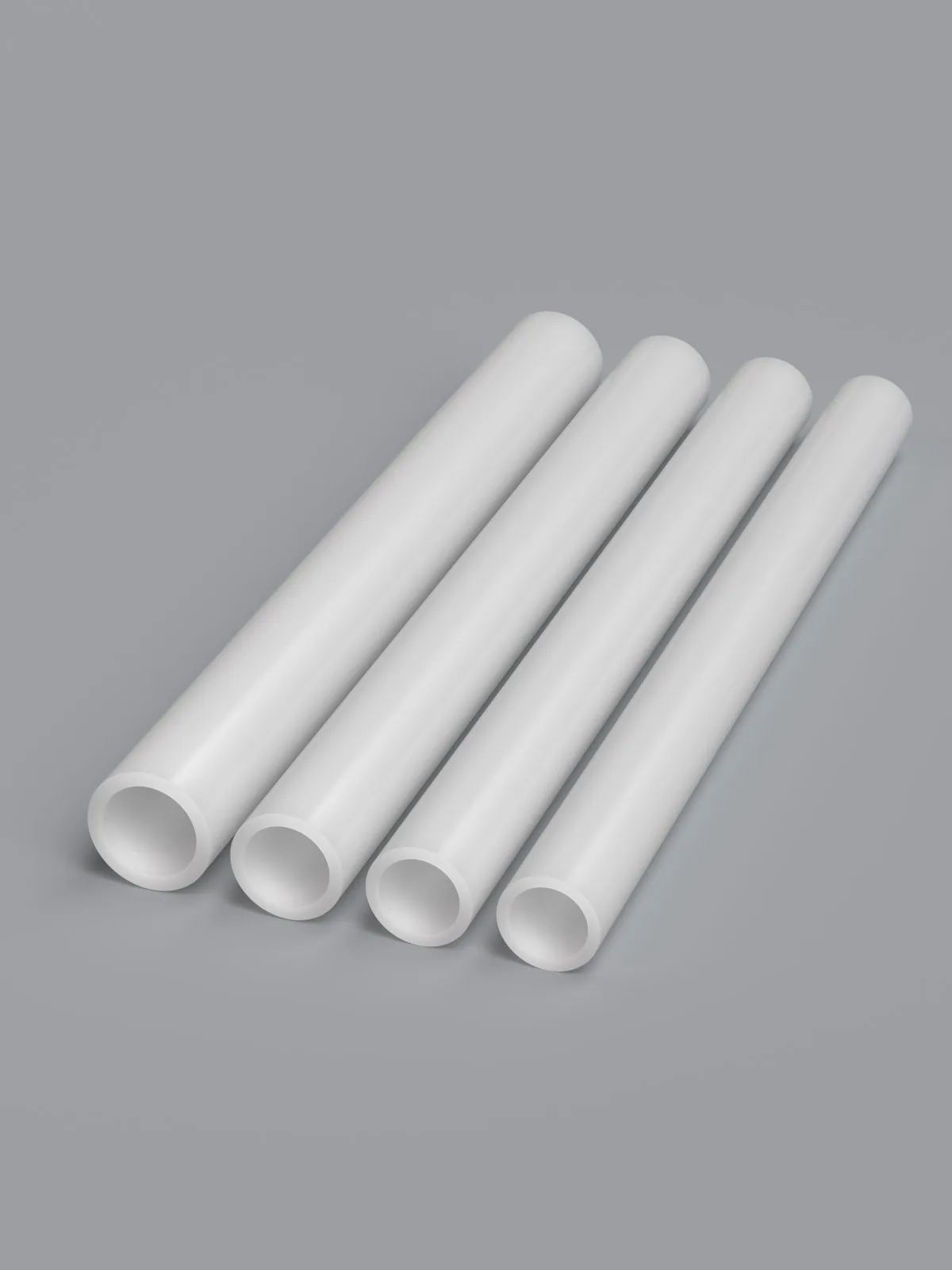
Tools, Speed and Crew Economics
Crimp wins the entry ticket. A manual full-circle crimp tool typically costs well under US$150 street price, and a bag of copper rings is the cheapest consumable in the trade. But cheap tooling buys an ongoing process burden that estimators routinely forget to price: the PPFA installation procedures reproduced in PPI’s design guide require that crimp tools be checked for adjustment at least daily and that every crimp be verified with a go/no-go gauge. The documented failure modes are all human: ring crimped over the end of the tube, tool held off 90 degrees, ring too far from the pipe end, tubing not cut square — each one reads “insufficient rib coverage” and each one is a callback wearing a disguise. A crimp system is only as good as the crew’s discipline with a gauge.
Expansion inverts the cost curve. A battery expansion tool with auto-rotating heads typically runs in the mid-hundreds of dollars, several times a manual crimper — but the process is largely self-verifying. The procedure is expand, rotate, repeat until pipe and ring sit snug against the tool shoulder, then seat the fitting; heads auto-rotate on battery tools for sizes up to 1-1/2 in., and manual tools must be rotated one-eighth of a turn between expansions to avoid grooving the pipe. The tell-tale for a bad joint is immediate and visible: if the fitting stays loose for more than a few seconds, the pipe was over-expanded — cut 2 in. back and redo it with a new ring. There is no gauge step, and there is no daily calibration ritual. Crews consistently find expansion faster per joint once the tool is in hand at room temperature; the honest caveat comes in the next section.
Two purchasing warnings from the wholesale side. First, rings are system components, not commodities: F1807 rings are dimension-controlled copper and F1960 rings are crosslinked PEX with a specific wall — substituting a look-alike ring voids both the listing logic and the warranty. Second, tool ecosystems lock you in more than the fitting price does, exactly as with press systems — if you have ever fought mismatched press jaw profiles, you already understand why an expansion head from one system should not touch another system’s rings. For a wider map of when each connection family earns its place, see our guide to press vs compression vs push-fit fittings.
Cold-Weather Behavior: The 40°F Line
This is the trade-off most comparisons skip, and it decides real winter schedules. An expansion joint depends on the pipe contracting onto the fitting, and contraction speed is temperature-driven. The leading F1960 system manufacturer’s installation guide is blunt about it: “the colder the temperature, the slower the contraction time,” crews should keep fittings and rings warm — in their pockets if necessary — and below 40°F (4.4°C) fewer expansions are required because the stiffened pipe holds its stretch longer. None of this makes cold-weather expansion unreliable; it makes it slower and more procedure-sensitive exactly when gloved hands want it least. A joint that seats in seconds at 70°F can leave you watching a loose fitting on a 25°F morning, and the correct response — wait, don’t re-expand on instinct — is the kind of thing that separates trained crews from callbacks.
Crimp is close to temperature-indifferent: copper deforms the same at -10°F as at 70°F, the joint is sealed the instant the tool closes, and the gauge verifies it on the spot. For unheated winter rough-ins, meter pits and freeze-risk retrofits, that instant verification is a genuine scheduling asset. The balanced recommendation: crews that run expansion year-round in cold climates should budget staging time for warming rings and fittings and slightly lower joints-per-hour in winter bids; crews that only occasionally work below 40°F may find a calibrated crimp kit the more predictable winter tool even if expansion is their summer standard. Either way, pressure-test before close-in — F1960 procedure requires testing at minimum to system working pressure, and cold-seated joints deserve that test more than most.
Code Acceptance and the Mixed-Brand Trap
Code acceptance is a tie — with a clause most buyers under-read. PEX water-supply piping has been in the model codes since 1993, and the IRC’s plastic-joint provisions (P2905.9.1.4.2 in the 2012 edition PPI summarizes) list F1807, F1960, F2080, F2098, F2434 and F2159 side by side, all “installed in accordance with manufacturer’s instructions.” The IPC’s mechanical-joint section carries the same list and the same clause, and UPC-family codes add the enforcement hook: PEX tubing must be factory-marked with the standard designations of the fittings the tubing manufacturer approves for it. Read those two requirements together and the legal shape of a PEX joint becomes clear: the code does not approve “crimp” or “expansion” in the abstract — it approves this pipe, with the fitting standards printed on it, assembled per that manufacturer’s instructions.
That is why the mixed-brand habit — brand A pipe, brand B fittings, brand C rings, whatever the counter had that morning — is riskier than it feels. Each combination may individually meet an ASTM number, yet the assembly can sit outside every party’s instructions and therefore outside every party’s warranty; when a joint weeps two winters later, three suppliers point at each other and the contractor holds the drywall bill. We dissected the mechanics of that finger-pointing in mixing pipe and fitting brands: the warranty and leak risk. The clean answer, for either connection method, is a matched system: pipe, fittings and rings qualified together, marked accordingly, and warranted by one name. Hitze supplies exactly that — PEX pipe produced to ASTM F876/F877 with matched fittings, covered by a 50-year warranty on the matched pipe-and-fitting system.
What Hitze Checks Before a Coil Ships
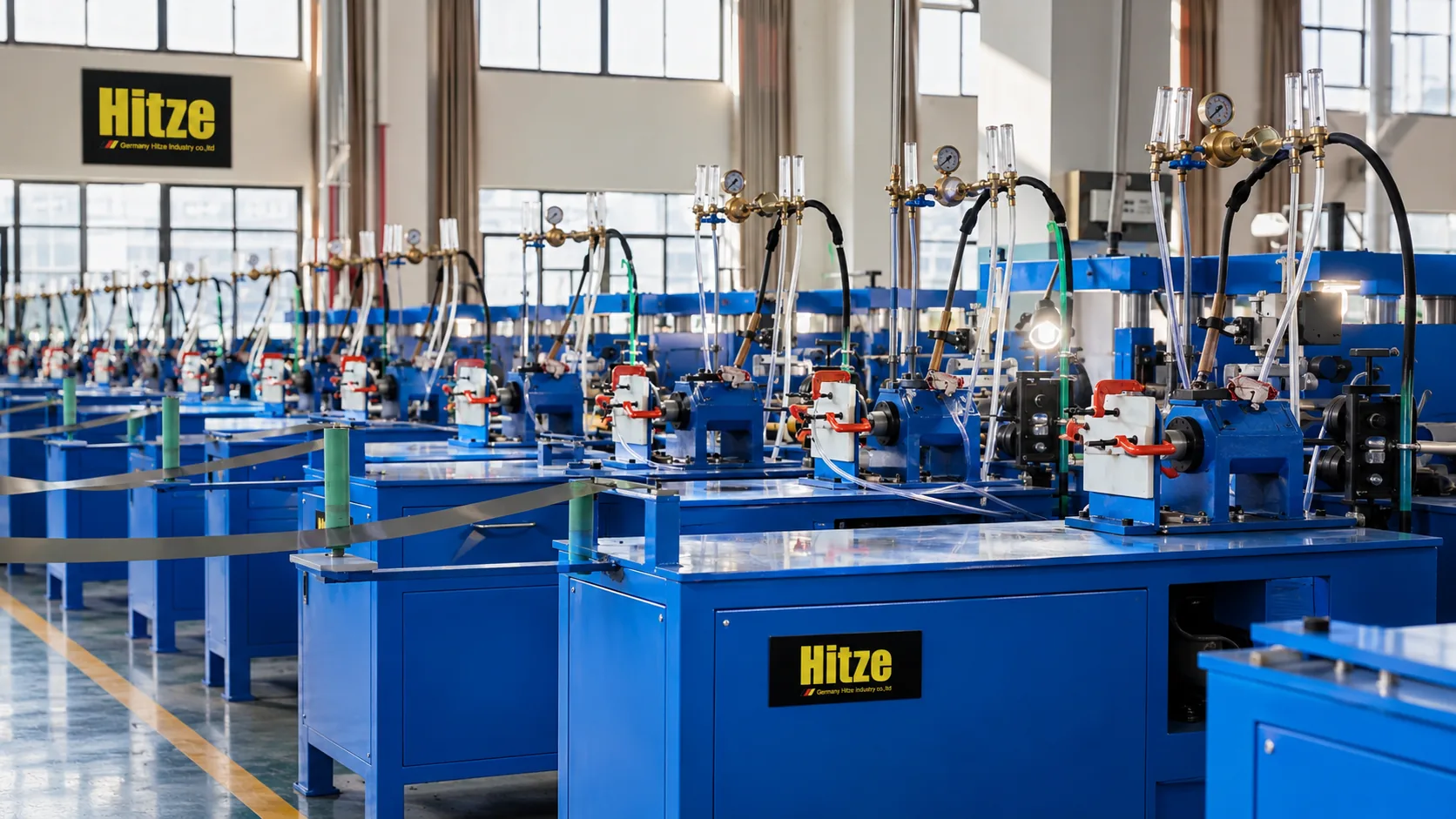
Hitze is a German brand of engineered piping systems, founded in 1974, producing across a 120,000 m² base with 1,000+ employees and exports to 118+ countries. For PEX programs the factory runs PEX-a, PEX-b and PEX-c in both potable and oxygen-barrier heating grades (DIN 4726 barrier for hydronic work), with PE-Xb heating pipe certified by SKZ in Germany and management systems certified to ISO 45001. Every production lot passes dimensional verification against the standard’s OD and wall tolerances — the same dimensions that decide whether a crimp ring or an expansion ring seats correctly — plus hydrostatic verification on dedicated pressure-test benches before packing. Fittings come out of in-house brass machining in lead-free and DZR grades (CW724R, CW511L, CW602N), so pipe and fitting tolerances are engineered against each other rather than merely both “in spec.”
Worked Example: 24-Unit Build, January Rough-In
Put numbers on a real decision. A mechanical contractor is roughing a 24-unit multifamily project: domestic water plus radiant floors, with the plumbing rough-in running through January in a building heated only by temporary units holding roughly 35–40°F. Assume 45 potable connections per unit — 1,080 joints — plus 96 radiant loop-to-manifold terminations.
On crimp: tooling for three two-man crews costs a few hundred dollars total, and joint speed is unaffected by the cold. The overhead is procedural — three tools checked for calibration every morning (a five-minute ritual that actually gets skipped by week three unless a foreman owns it) and 1,080 gauge checks. If even 1 percent of joints fail the gauge and need cutting back, that is 11 redone joints — cheap, if caught by the gauge; a ceiling stain, if not. Flow-wise, the estimator holds all home runs at 1/2 in. and the recirc trunk at 1 in. to absorb the insert step-downs.
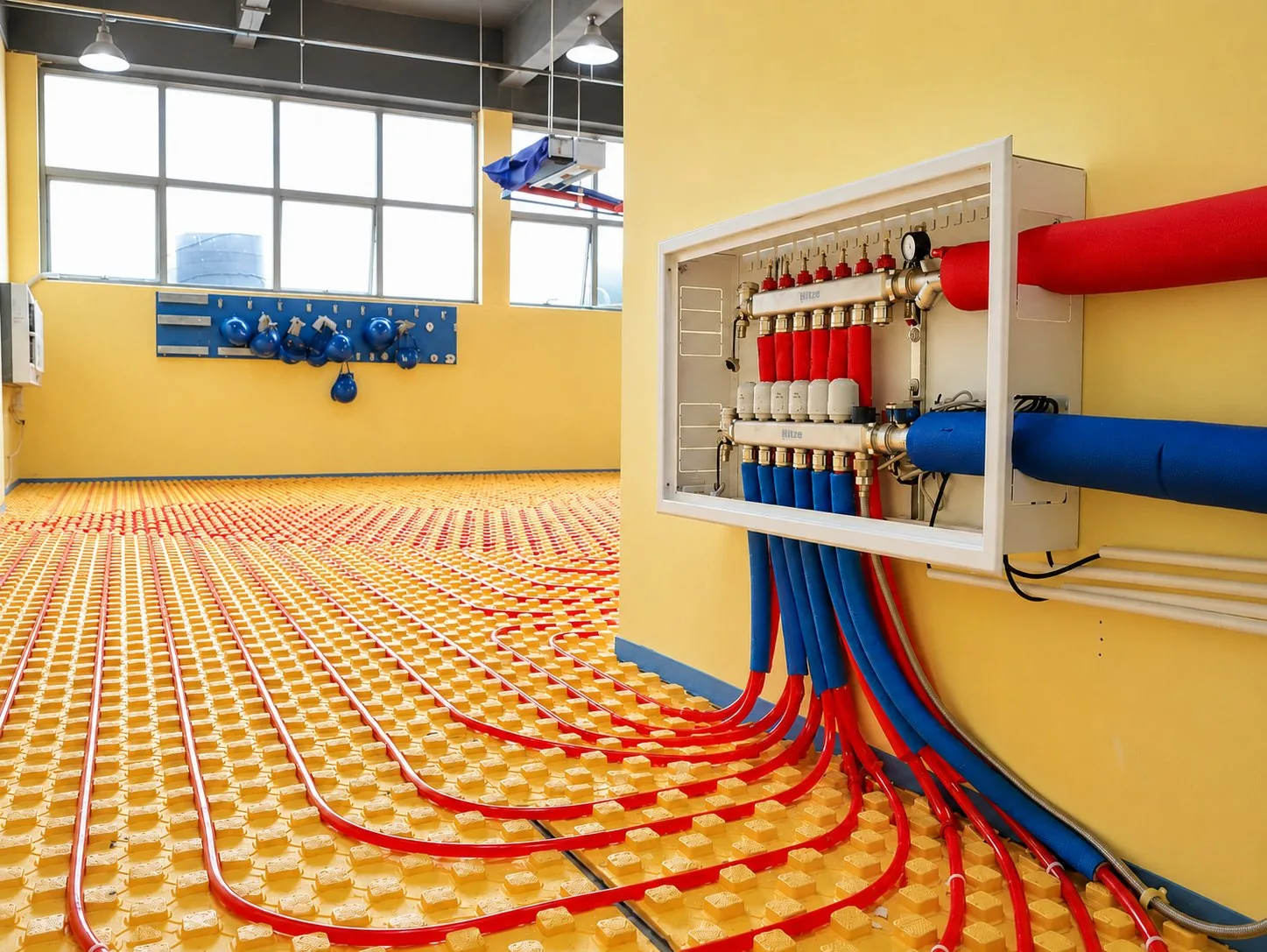
On expansion: three battery tools represent several times the tooling spend, but there is no gauge step on 1,080 joints and the full-bore fittings let two marginal trunk sections stay a size smaller. The January cost is seating time — at 35°F, contraction is visibly slower, so crews stage rings and fittings in warm boxes and sequence work so joints seat while they prep the next run. On this job the numbers favor expansion for the repetitive in-unit work and the radiant manifold walls, with a crimp kit kept for freeze-exposed service penetrations — a split that many production crews quietly run already. Sourcing both from one matched system keeps the warranty unified; contractors buying this way can pull pipe, fittings, rings and manifolds from our contractor radiant heating supply program as one coordinated package rather than four purchase orders.
Best For, Not For — and How to Buy Either Without Regret
| Factor | Cold expansion (F1960) | Crimp (F1807/F2159) |
|---|---|---|
| Flow path | Near pipe bore; best for fitting-dense runs | Insert steps bore down ~one pipe size |
| Tooling cost | Higher entry (battery tool) | Lowest in the trade |
| Joint verification | Self-evident seating; no gauge | Go/no-go gauge every joint; daily tool check |
| Below 40°F | Slower seating; warm rings, adjust pace | Essentially unaffected |
| Size ceiling | 3 in. (current editions) | 2 in. metal insert; 1 in. plastic insert |
Choose expansion when joints are many, flow margins are thin, PE-RT or larger diameters are in play, and crews work mostly above the 40°F line or can stage around it. Choose crimp when tooling budgets are tight, winter and freeze-exposed work dominates, and your foremen genuinely enforce the gauge. Choose neither on reputation alone — both fail in undisciplined hands and both run leak-free for decades in disciplined ones.
If you are a contractor, wholesaler or OEM buyer building a program around either connection method, Hitze supplies the matched system behind it: PEX-a/b/c and PE-RT pipe, brass and polymer fitting ranges, manifolds and the documentation pack — with no minimum order quantity, so you can validate with samples and a trial order before committing a season’s volume, all under the 50-year matched-system warranty. Start with the contractor radiant heating supply page or request samples against your own crimp gauges and expansion heads; certificates and test reports are available on request.
FAQ: PEX Expansion vs Crimp
Can F1960 expansion fittings be used on PE-RT pipe?
Yes. Current editions of ASTM F1960 cover both PEX and PE-RT tubing, with PE-RT qualified through ASTM F2769. The practical check is the print stream: codes require tubing to be factory-marked with the fitting standards it is approved for, so confirm F1960 appears on the PE-RT pipe you are buying.
Does F2159 plastic-insert crimp go up to 2 inches?
No — that is a common misquote. ASTM F2159 covers four nominal sizes only: 3/8, 1/2, 3/4 and 1 in. For crimp joints from 1-1/4 in. to 2 in. you need metal-insert fittings under ASTM F1807.
How cold is too cold for expansion connections?
There is no hard cutoff, but below 40°F (4.4°C) the manufacturer guidance changes: contraction onto the fitting slows, fewer expansions are needed, and rings and fittings should be kept warm before assembly. Budget more seating time in winter and always pressure-test to at least system working pressure before close-in.
Are expansion joints stronger than crimp joints?
Neither carries a higher rating: F1960, F1807, F2159 and F2080 systems are all specified for 100 psi at 180°F service. The reliability difference in the field comes from process control — crimp depends on tool calibration and a go/no-go gauge on every joint, while expansion depends on full expansions, correct ring position and adequate contraction time.
Are Hitze PEX pipes and fittings made in Germany?
Hitze is a German brand — trademark-registered at the DPMA in Munich — with products engineered in Germany and built to German DIN and ASTM standards at the group’s 120,000 m² production base, with German third-party validation such as SKZ testing on PE-Xb heating pipe. Pipe, fittings and rings ship as one matched system under a 50-year system warranty, with certificates available on request.


