Key Takeaways
- The code question is settled. Both the IPC and UPC accept PEX and copper for potable water — PEX has been in the ICC codes since 1997 and the UPC since 2000. The PEX vs copper decision is economics and application, not legality.
- Installed cost is decided by joints, not list price. A home-run PEX layout replaces dozens of soldered copper joints per dwelling with a coil and a manifold; copper material also rides a commodity that has swung roughly $4–7 per pound on COMEX through 2025–2026, with records above $6.60 in early 2026 on tariff anticipation.
- Water chemistry cuts both ways. Copper pits in aggressive high-pH, low-alkalinity chlorinated water; PEX oxidation is managed by ASTM F2023 chlorine testing — for recirculation contracts, stock pipe with the highest chlorine designation.
- Freeze and theft are the underpriced risks. PPI-documented testing showed PEX tolerating 400+ freeze-thaw cycles; frozen copper splits. And roughed-in copper has scrap value — the FBI has documented organized theft from construction sites and vacant homes. PEX has none.
- Copper still wins specific jobs: exposed runs, UV-lit spaces, and recirculation mains running above 140 °F (60 °C) in mechanical rooms. For residential contract work, a PEX-heavy stocking mix with a deliberate copper allocation is the rational shelf.
If you stock for plumbing contractors, the PEX vs copper question is not a philosophical debate — it is a working-capital decision you re-make every quarter. Buy too much copper and you have money sitting on a shelf that tracks a volatile commodity and attracts thieves. Buy only PEX and you lose the contractor who needs Type L sticks for a boiler-room job on Thursday. The homeowner blogs that dominate this search term compare “durability” in the abstract; almost none of them tell you what actually moves a trade buyer’s margin: joint counts, freeze claims, chlorine designations, scrap value, and what happens to a warranty when pipe and fittings come from different suppliers.
This comparison takes positions. Where PEX is simply the better commercial answer, we say so with numbers. Where copper still earns its place — and there are three specific applications where it does — we say that too, because a wholesaler who tells a contractor “PEX for everything” loses credibility the first time a recirculation main cooks a plastic line.
Code acceptance: both are legal, so stop selling legality
Start by clearing the objection you will still hear from older estimators: “PEX isn’t accepted everywhere.” That was true in the 1990s and it is not true now. PEX water-distribution pipe manufactured to ASTM F876 and F877 has been recognized in the ICC family of codes since 1997 and was added to the Uniform Plumbing Code in 2000, per the Plastics Pipe Institute’s code-acceptance chapter. Copper tube to ASTM B88 has been in every model code for as long as the codes have existed. Both materials pass. What differs is which type you must stock to be code-clean.
Copper is not one product; ASTM B88 defines three wall classes, and the class determines both the price per stick and where an inspector will accept it. Per the Copper Development Association’s Copper Tube Handbook, Type K (green stripe) carries the thickest wall and goes underground and into fire protection; Type L (blue) is the default for pressurized water distribution; Type M (red) is the thin-wall economy grade permitted for in-building water lines only where local code allows. On 1/2-inch tube the walls run 0.049 in for K, 0.040 in for L and 0.028 in for M — nearly a 43% metal difference between L and M, which is exactly why a contractor quoting against a tight bid will ask you for M and an engineer’s spec will demand L. Stocking copper means stocking that ambiguity. PEX to F876 is dimensionally one product per size (SDR9 wall), which is one quiet reason it simplifies a wholesaler’s shelf.
Total installed cost: the delta lives in labor and joint count
Material price per foot is the least interesting number in this comparison, because the contractor’s invoice is dominated by time. Copper arrives in rigid sticks — hard-drawn lengths, typically 20 ft — and every change of direction, every branch, every coupling is a cut, ream, flux, sweat joint that needs a torch, a flame permit on commercial sites, and a plumber who solders well. PEX arrives in coils of hundreds of feet. A home-run layout pulls one continuous line from a central manifold to each fixture with zero joints buried in the structure; the only mechanical connections sit at the manifold and at the fixture drop, both accessible. On a typical two-bathroom dwelling, that is the difference between roughly 60–100 soldered joints in a trunk-and-branch copper system and a few dozen crimp or expansion connections in PEX — each eliminated joint is eliminated labor and an eliminated future leak point.
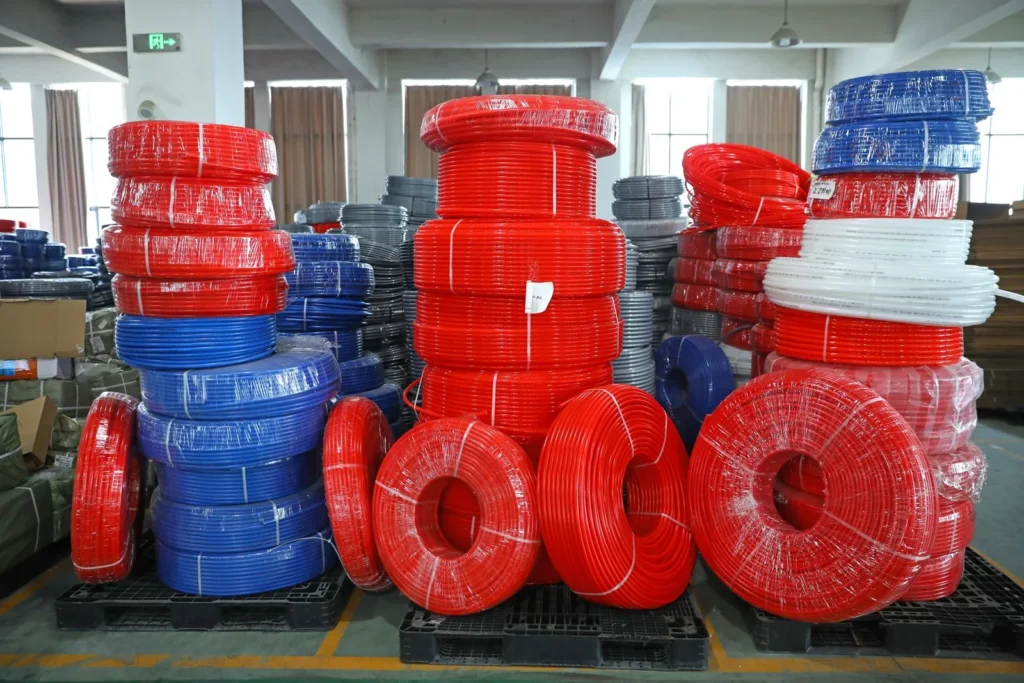
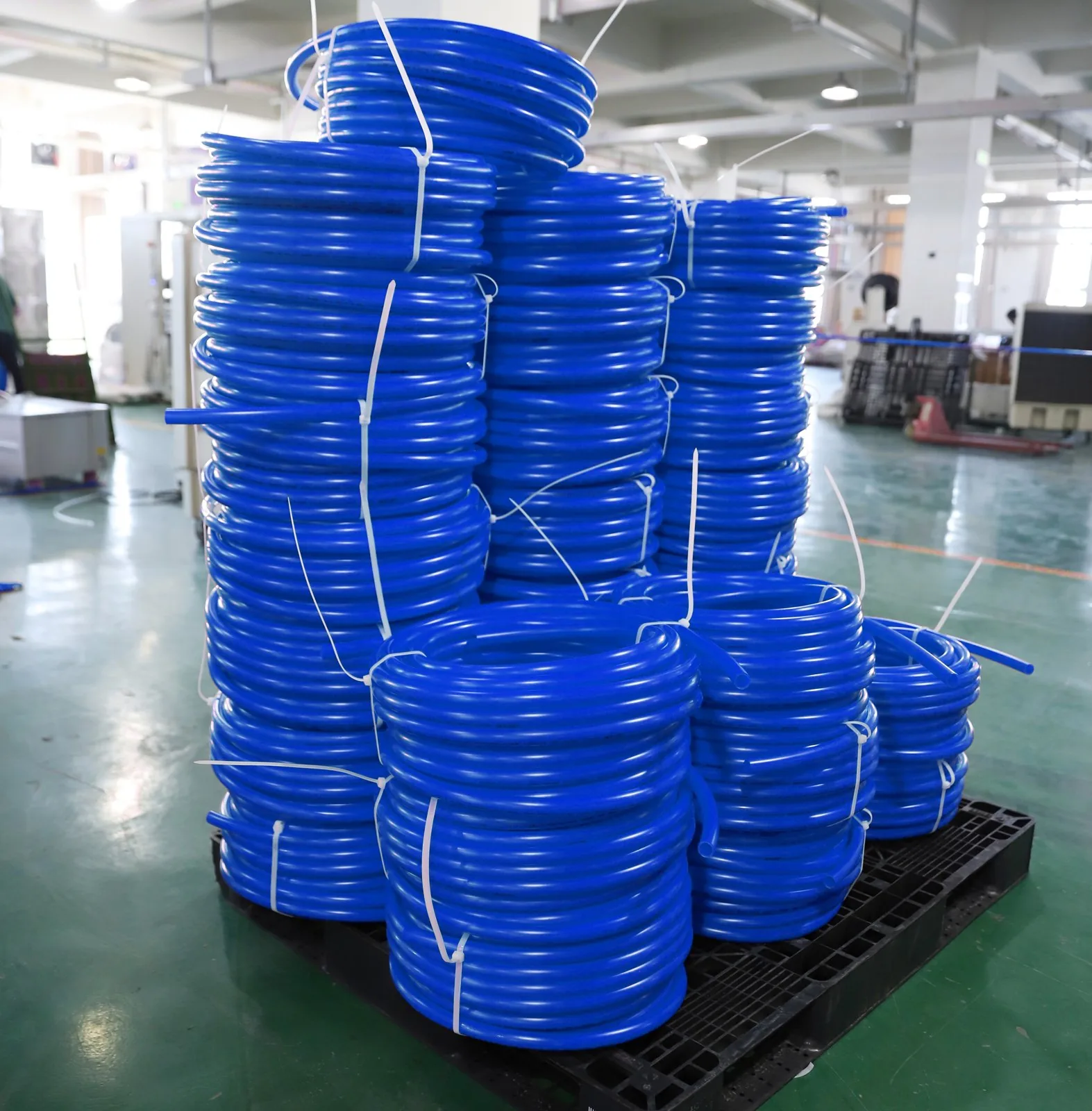
The second cost lever is the commodity itself. Copper traded in roughly the $4–7 per pound band on COMEX through 2025–2026 — plunging toward $4 when refined copper was excluded from US tariffs, then setting records above $6.60 in early 2026 on tariff anticipation and trading around $6.40 in mid-2026 — which means the copper on your racks is a metals position, not just inventory. Every wholesaler who lived through a copper spike knows the sequence: contractors lock quotes, the metal moves 20%, and somebody eats the difference. PEX pricing tracks polyethylene resin, which moves — but not like an exchange-traded metal with a futures curve. When you plan a stocking mix around multi-month plumbing contracts, that volatility difference is worth more than any per-foot price list. A dimensionally stable range of potable and barrier PEX pipe in 16, 20, 25 and 32 mm — the metric counterparts of the 1/2-in to 1-in sizes that carry most residential work — lets you quote a contract season without hedging a metal.
One honest caveat on the labor delta: it assumes crews trained on one connection system. A crew that solders daily and has never held an expansion tool will not hit PEX productivity numbers in week one. If your contractor customers are mid-transition, stock the tooling and jaws alongside the pipe — the wholesaler who supplies the crimp tool calibration service keeps the pipe account.
PEX vs copper head-to-head: the spec table
The table condenses the comparison; the sections after it carry the reasoning. Pressure figures for PEX are the ASTM F876 ratings — note how the rating steps down with temperature, because that gradient is exactly where copper keeps one of its remaining advantages.
| Criterion | PEX (ASTM F876/F877) | Copper (ASTM B88) |
|---|---|---|
| Code acceptance | IPC, UPC, IRC — ICC codes since 1997, UPC since 2000 | All model codes, all wall types (M where permitted) |
| Pressure-temperature rating | 160 psi @ 73.4 °F / 100 psi @ 180 °F / 80 psi @ 200 °F | Far above domestic pressures at all service temperatures; joint is the limit |
| Joining | Crimp, expansion, compression, push-fit — no flame | Soldered/brazed (hot works) or press (tool investment) |
| Supply form | Long coils; continuous fitting-free runs | Rigid sticks (typically 20 ft) + soft coils; joints at every direction change |
| Freeze event | Expands and typically recovers; 400+ cycle tolerance in PPI-documented testing | Rigid wall splits; burst repair after hard freeze |
| Chlorinated water | Oxidation managed by stabilizer package; verified per ASTM F2023 | Pitting risk in high-pH, low-alkalinity waters with chlorine residual |
| Theft / scrap value | Effectively zero scrap value | High — FBI-documented theft from sites and vacant buildings |
| UV / exposed runs | Must be protected from sunlight; limited exposure windows | Unaffected; neat exposed workmanship possible |
| High-temp recirculation | Hold at or below 140 °F (60 °C) continuous, velocity ≤2 fps per manufacturer guidance | Handles higher temps; watch velocity (2–3 fps) for erosion-corrosion |
| Typical warranty | 25 years as a matched system is the market norm; Hitze warrants its matched system for 50 years | Varies by mill; joints (workmanship) usually excluded |
Water chemistry: what chlorine actually does to each pipe
This is the section most comparisons get wrong in both directions, so let us ground it carefully. Copper’s failure mode in chlorinated potable water is pitting — localized attack that can perforate a tube wall while 99% of the pipe looks pristine. Peer-reviewed corrosion research associates aggressive pitting with a specific chemistry: high pH combined with low alkalinity and a free-chlorine residual. Industry symposium work published by the Copper Development Association adds that disinfectants — chlorine and the newer chloramines — directly influence how protective films form on the copper surface, and that improper chlorination combined with residual soldering flux can perforate tube rapidly. The practical read for a trade buyer: copper is not “immune because it’s metal.” In utility districts with that chemistry profile, copper repipe work exists precisely because copper pitted.
PEX’s exposure is different in kind: chlorine is an oxidant, and long-term oxidative attack on polyethylene is a real degradation pathway — which is why the industry does not leave it to marketing claims. ASTM F2023 is a dedicated accelerated test for the oxidative resistance of PEX tubing to hot chlorinated water, and the result is printed on the pipe as a chlorine designation code. The top designation certifies the pipe for the harshest end-use condition — continuous recirculation of chlorinated hot water at 140 °F (60 °C), i.e. hot water 100% of the time. Here is the insider detail that matters at the counter: chlorine resistance is a function of the stabilizer package in the resin, not of whether the pipe is PEX-a, -b or -c — a distinction we unpack in our guide to PEX-a vs PEX-b vs PEX-c manufacturing methods. Two coils that look identical can carry different designation codes, and only one of them belongs on a recirculation job. Read the print line before it leaves your dock.
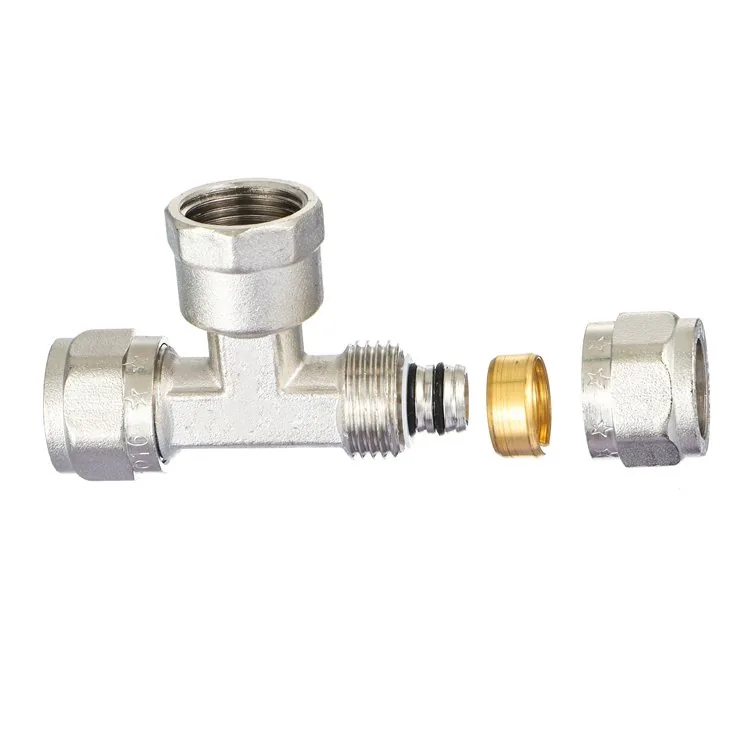
Recommendation: for municipalities known for chloraminated or high-residual water, quote PEX with a verified F2023 rating and lead-free brass fittings, and position copper only where the district’s water chemistry history is clean. If a contractor cannot tell you the local chlorine residual, the pipe with a printed, tested designation beats the pipe whose performance depends on water you cannot see.
Freeze behavior and theft: the two risks buyers underprice
Water expands roughly 9% when it freezes, and the two materials answer that expansion in opposite ways. Copper is rigid: the ice wins, the wall splits, and the claim arrives when the thaw comes. PEX is elastic: the tube swells with the ice plug and typically returns to its original diameter on thaw. This is not anecdote — the Plastics Pipe Institute published a dedicated technical report, TR-52, on the freeze-break resistance of PEX, and in the testing documented around it PEX remained freeze-tolerant through more than 400 freeze-thaw cycles. No manufacturer calls PEX freeze-proof, and neither should you: fittings, valves and manifolds still need protection. But for contracts in freeze-prone markets — vacation properties, unheated crawlspaces, slab-edge runs — the difference between “burst pipe insurance claim” and “system that survived the cold snap” is a stocking argument you can make with a straight face.
The theft argument is blunter. Copper is legal tender at a scrap yard; the FBI documented organized copper-theft rings stripping construction sites and vacant homes — including crews in Minneapolis hitting several houses a day for more than $20,000 a month in scrap profit, and stolen siren wiring that left a Mississippi community without tornado warnings. Two decades later, with copper still trading at multiples of its 2008 price, nothing about that incentive has improved. For a wholesaler this lands twice: copper inventory needs cage security in your own warehouse, and every roughed-in copper system your customer installs sits in an unsecured building as a scrap deposit until drywall closes it in. PEX in the same wall is worth nothing to a thief. On multi-unit projects with long rough-in-to-close timelines, that alone has decided the material.
Recirculation and high temperature: where copper still wins
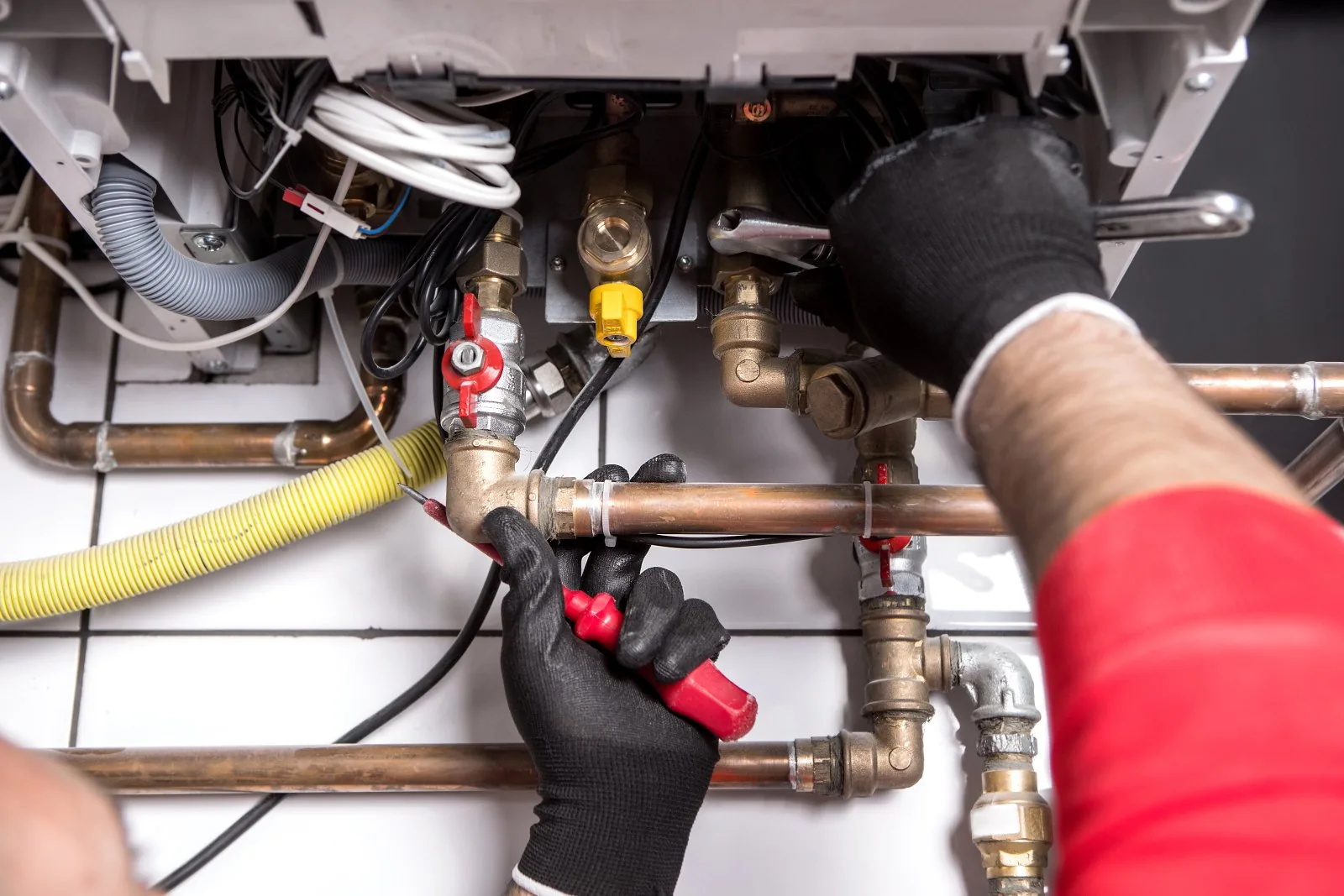
Now the honest part of the comparison — the applications where you should still sell copper, or at least not sell bare PEX. ASTM F876 rates PEX at 160 psi at 73.4 °F, 100 psi at 180 °F and 80 psi at 200 °F: the material keeps working hot, but its margin narrows as temperature climbs. Continuous hot-water recirculation is the harshest duty in a potable system — elevated temperature, chlorine residual, and flow that never stops. Manufacturer guidance across the PEX industry converges on the same envelope: keep continuous recirculation at or below 140 °F (60 °C), hold velocity to a stricter ceiling — leading PEX manufacturer guidance (MrPEX) caps recirculation flow at 2 fps, tighter than copper’s window — and use pipe carrying the top F2023 chlorine designation. A commercial mechanical room running 160–180 °F return loops sits outside that envelope, and that is copper’s job — with the caveat that copper has its own recirculation failure mode, erosion-corrosion, which plumbing-engineering guidance manages by holding hot recirculation velocity to roughly 2–3 fps. Neither pipe forgives a lazy recirc design; copper simply tolerates more heat while it waits for one.
Copper’s second surviving stronghold is the exposed run. PEX must be protected from UV — sunlight through a garage window is enough over time — and it will never look like a tradesman’s showpiece clipped to a wall. Copper is UV-indifferent, holds a dead-straight line, and signals craftsmanship in visible plant rooms. If the account insists on a plastic system for exposed work, the answer is not bare PEX but a form-stable composite — see our comparison of PEX vs PEX-AL-PEX multilayer for exposed and form-critical runs — which holds shape like metal while keeping mechanical joining. Position-taking summary: copper for mechanical rooms above 140 °F, exposed and UV-lit runs, and jurisdictions or specifiers that simply demand it; PEX for everything buried, concealed, or freeze-exposed.
Lifetime, warranty, and the mixed-system trap
Both materials, correctly applied, outlast the mortgage. The commercial difference is what is written down. Copper tube itself rarely fails; copper systems fail at joints, and workmanship is excluded from any mill warranty. PEX warranties are system warranties — and they hinge on matching. The market leader’s own terms make the point better than we could: Uponor covers its PEX-a pipe for 25 years when used with its own fittings and rings, but the cover drops to 10 years the moment non-matched fittings enter the system. Read that again as a wholesaler: the stocking decision you make — whether the fittings on your shelf match the pipe on your rack — silently sets the warranty your contractor passes to the building owner. Selling brand-A pipe with brand-B crimp rings is not a harmless substitution; it is a 60% warranty haircut the end customer never hears about.
Compliance is the other paper layer. In the US, everything wetted in a potable system — fittings included — must meet the Safe Drinking Water Act’s lead-free definition: a weighted average of not more than 0.25% lead across wetted surfaces (0.2% for solder and flux), tightened from 8% by the 2011 Reduction of Lead in Drinking Water Act, per the US EPA. That rule bites copper systems hardest at the fitting and valve level, and it is why the brass behind your PEX matters as much as the pipe — we cover the certification mechanics in NSF/ANSI 61 and lead-free brass: what potable water compliance requires. Hitze machines its potable-side fittings from lead-free and DZR brass grades (CW724R, CW511L, CW602N) and backs the matched pipe-and-fitting system with a 50-year warranty — double the market-norm 25 years, and only possible because pipe and fittings are engineered and tested as one system rather than assembled from strangers.
What Hitze checks: how the PEX system behind this comparison is built
Hitze is a German brand of engineered piping systems, founded in 1974, producing across a 120,000 m² base with 1,000+ employees and exporting to 118+ countries. The PEX range covers PEX-a, PEX-b and PEX-c in potable grades and DIN 4726 oxygen-barrier heating grades, built to ASTM F876/F877 where those standards are cited, in 16, 20, 25 and 32 mm. Third-party paper behind the potable claim: WRAS material approval for potable contact in the UK, and an NSF International Laboratories BS 6920 potable-water test report covering hot service to 65 °C as well as cold. Elsewhere in the range, SKZ (Süddeutsches Kunststoff-Zentrum) test certification covers the PE-Xb heating-grade pipe and DVGW type examination covers the PP-R drinking-water pipe — scopes worth stating precisely rather than blurring into the PEX potable line. For North American contracts, the range is certified to cUPC/UPC (IAPMO), NSF-14 and NSF/ANSI 61, with certificate numbers available on request.
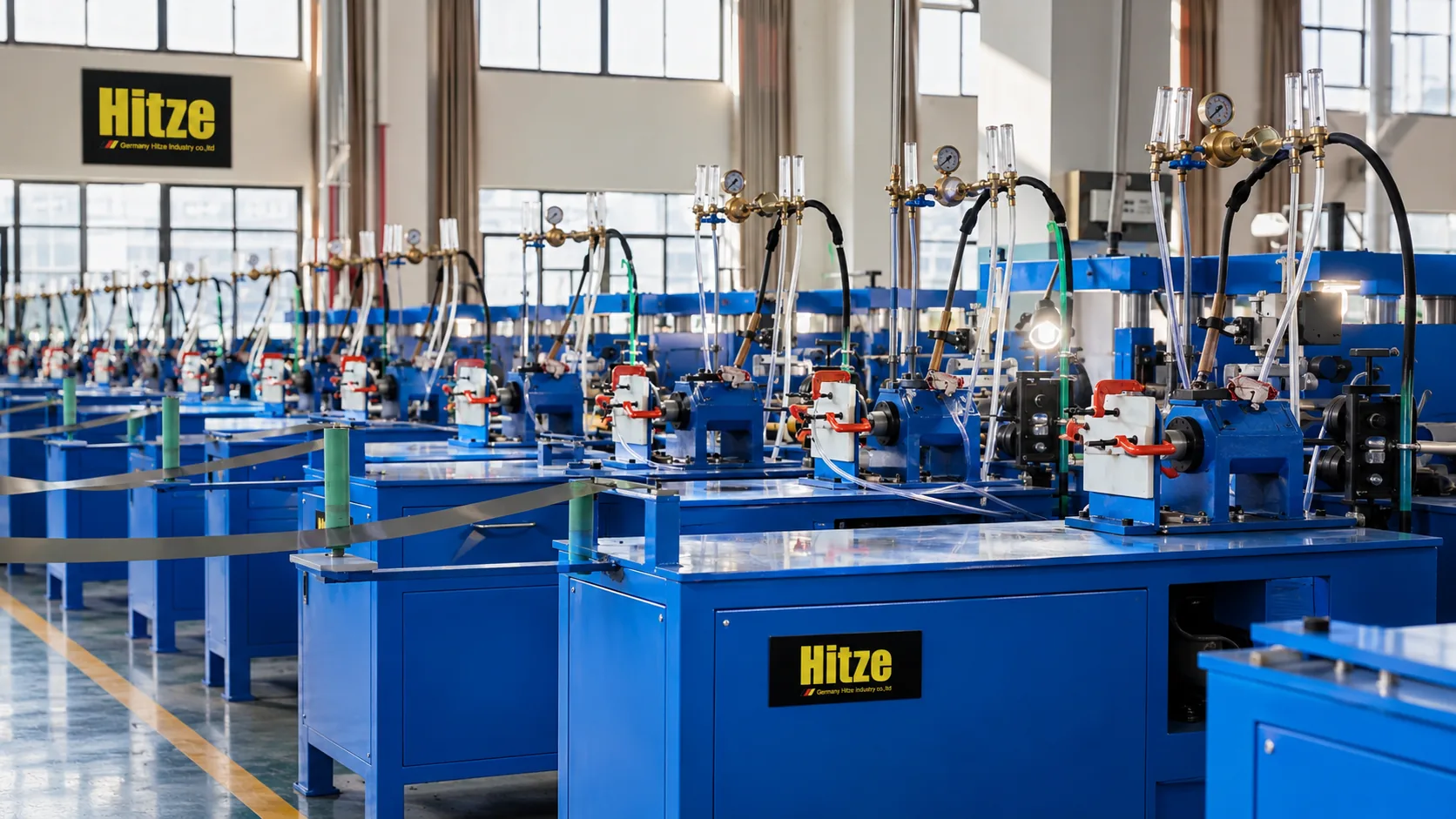
On the line, every production batch runs the checks this article has been describing from the buyer’s side: hydrostatic pressure verification on dedicated test benches against the DIN and EN ISO requirements, dimensional control on wall and OD so crimp and expansion fittings seat identically from coil to coil, and print-line traceability so the size, class and standard markings a counter clerk reads are backed by batch records. The press, compression and push-fit fittings that complete the system are machined in-house from the lead-free brass grades listed above and tested with the pipe they will be sold with — which is what makes a 50-year matched-system warranty an underwriting decision rather than a slogan.
Worked scenario: stocking for a 60-unit repipe contract
Put the whole comparison into one order. Your contractor customer wins a 60-unit garden-apartment repipe: two bathrooms and a kitchen per unit, existing failing copper (pitting — the district runs a chlorine residual in high-pH water), units vacant in rotating blocks of ten, and a shared boiler room with a 160 °F recirculation main. What do you put on the truck?
In-unit distribution goes PEX, and the numbers explain why without adjectives. Per unit, a trunk-and-branch copper replacement would mean roughly 70–90 sweat joints; across 60 units that is on the order of 5,000 torch events inside occupied-adjacent buildings — 5,000 chances for a flux drip, a scorched stud, or a slow weep behind new drywall. The PEX home-run alternative is one manifold and roughly 12–15 continuous fixture runs per unit, with mechanical connections only at accessible points. The vacancy rotation makes the theft math explicit: every block of ten units sits roughed-in and empty for weeks — copper in those walls is FBI-documented theft bait; PEX is not worth the trip. For the district’s water chemistry, you supply coils carrying the top ASTM F2023 chlorine designation, and the failing copper being removed is itself the argument printed in metal.
The boiler room stays copper — 160 °F continuous return duty is outside the 140 °F PEX recirculation envelope, so the order includes a modest allocation of Type L sticks and press fittings for the mechanical room, with the recirc pump spec’d to hold 2–3 fps. The resulting purchase order is roughly 85/15 PEX-to-copper by linear footage: PEX coils in 16 and 20 mm, one matched family of lead-free brass crimp and expansion fittings, manifolds, tool jaws — and a copper line item small enough that its commodity risk is noise. That is what a rational stocking mix looks like: not a religion, a ratio.
Who should source PEX from Hitze — and who shouldn’t
If you are a wholesaler or distributor building a PEX-forward stocking program for plumbing contracts — and you want the pipe, the lead-free brass fittings and the warranty to come from one engineering source instead of three suppliers pointing at each other — the Hitze PEX pipe range is built for exactly that account. If you only need occasional copper sticks for boiler rooms, we are not your vendor for that line item, and this article just told you why you should keep a small one anyway. There is no minimum order quantity: start with samples, run your own crimp-and-burst tests, check the print line against the certificates, and scale from a trial order. The matched pipe-and-fitting system carries Hitze’s 50-year warranty; pricing and lead times vary by market and order, and certificate copies are available on request.
FAQ: PEX vs copper for potable water
Is PEX or copper better for potable water?
Neither is universally better. Both are accepted by the IPC and UPC. PEX wins on installed cost (fewer joints, no torch), freeze tolerance, theft immunity and stable pricing; copper wins on exposed runs, UV exposure, and continuous recirculation above 140 °F (60 °C). Most residential contract work today is rationally PEX-heavy with a small copper allocation.
Does chlorinated water damage PEX?
Chlorine is an oxidant and matters for any polyethylene pipe, which is why PEX is tested under ASTM F2023 and printed with a chlorine designation code. Pipe carrying the top designation is rated for continuous recirculation of chlorinated hot water at 140 °F. Chlorine resistance comes from the stabilizer package, not from whether the pipe is PEX-a, -b or -c.
Does copper corrode in drinking water?
It can. Pitting corrosion is associated with aggressive water chemistry — high pH, low alkalinity and a chlorine residual — and disinfectants including chloramines influence the protective film on the tube wall. In districts with that profile, pitted copper is a documented repipe driver.
What temperature can PEX handle?
ASTM F876 rates PEX at 160 psi at 73.4 °F, 100 psi at 180 °F and 80 psi at 200 °F. For continuous hot-water recirculation, industry guidance is to stay at or below 140 °F (60 °C) with velocity capped at 2 fps for PEX (leading PEX manufacturer guidance, stricter than copper’s 2–3 fps window) and top-designation chlorine-rated pipe.
Is Hitze PEX made in Germany?
Hitze is a German brand — trademark-registered with the DPMA in Munich — engineered in Germany and built to German DIN and EN standards, with production at its 120,000 m² base. The potable PEX range carries WRAS approval and an NSF BS 6920 potable-water test report plus cUPC, NSF-14 and NSF/ANSI 61 certification; SKZ covers the PE-Xb heating grade and DVGW the PP-R drinking-water pipe. Certificate numbers are available on request.


