A supplier just emailed you a stack of PDFs — a cUPC certificate, an NSF report, a DVGW letter, a WRAS certificate — and every one of them looks official. Here is the uncomfortable truth for any importer: a certificate PDF proves almost nothing on its own. The scan can be real but expired, real but issued to a different company, or edited in ten minutes with a PDF tool. The only proof that survives a customs officer, an AHJ inspection, or a lawsuit is the entry in the certification body’s own public directory. The single skill that protects your order is knowing how to verify pipe certification against that live register — and this guide shows you exactly how to check each one, in the order that catches fakes fastest.
- A certificate PDF is a claim, not proof. Every real scheme — cUPC/UPC (IAPMO), NSF, DVGW, WRAS — publishes a free online directory. If the product is not in the directory under the supplier’s legal name, treat it as uncertified.
- IAPMO certificates say it in writing: “This certificate is not evidence of current listing.” Verify at pld.iapmo.org, not from the PDF.
- The four fastest fakes to catch: (1) certificate issued to a trading company, not the factory; (2) a material approval passed off as a product approval; (3) an expired listing; (4) a scope that covers a different pipe than the one you’re buying.
- Match five fields across the certificate and the directory: legal company name, file/approval number, product scope, standard, and validity date. One mismatch kills the claim.
- Best for importers and private-label buyers placing a first container; a factory that can walk you into its own directory entries in a live screen-share is the low-risk one.
Why a certificate PDF proves nothing on its own
Importers get burned in a predictable way. The quotation is competitive, the samples are acceptable, and the compliance folder looks complete — so the container ships. Then the goods reach a US wholesaler whose buyer runs the file number and finds nothing, or a UK merchant whose insurer asks for the live WRAS entry, and suddenly a five-figure shipment is unsellable. The failure almost never happens at the sample stage. It happens because nobody separated the document from the listing behind it.
There are four independent ways a genuine-looking certificate fails a real check, and you should assume any one of them until you’ve ruled it out. First, the certificate is authentic but expired — WRAS approvals, for example, are valid for five years, and the scheme removes them from the directory once they lapse, so a 2019 certificate can be perfectly real and completely worthless today. Second, it is issued to a different legal entity — a trading company or an agent, not the factory that will actually make your pipe, which means the listing does not cover your production. Third, it is a narrower scope than it appears: a WRAS material approval (the compound passed water-quality testing) is routinely presented as if it were a product approval (the finished fitting passed mechanical and water-quality testing). They are different things. Fourth, the document is simply edited — a real scan with a swapped logo, name, or date.
The defence against all four is the same and it costs nothing: go to the issuing body’s public register and confirm the listing is live, under the correct company, for the correct product, under the correct standard, within its validity window. IAPMO states the principle bluntly on the face of every certificate it issues — the paper “is not evidence of current listing.” Treat that sentence as the rule for all four schemes, not just IAPMO.
cUPC / UPC (IAPMO): verify at pld.iapmo.org
cUPC is the mark most US and Canadian plumbing imports live or die by, and it is issued by IAPMO R&T. The shield means the product complies with both its performance standard and the Uniform Plumbing Code. Every IAPMO certificate carries two fields that do your verification for you: a File No. and a “Void After” date. Ignore the pretty layout and go straight to those.
Open the IAPMO R&T Product Listing Directory and search by the company name on the certificate or by the file number. You are checking three things in one pass. Does the listing exist and is it active (not withdrawn or expired past the void date)? Is it held by the same legal entity that will invoice and ship you — not a sister trading company? And does the listed product scope actually include the pipe or fitting you’re buying, in the sizes and material you ordered? A factory can hold a genuine cUPC listing for a 1/2" PEX potable line and still have nothing covering the multilayer pipe on your PO. The listing is product-specific; the brochure is not.
One insider warning specific to IAPMO: a certificate can be technically valid on its void date and yet the listing may have been modified or suspended in the meantime. That is precisely why IAPMO tells you the certificate is not evidence of current listing — the directory is the live source, the PDF is a snapshot. If a supplier resists sending you the file number, or sends a certificate with the file number cropped or blurred, stop. A real listing holder has no reason to hide the one field that lets you confirm them.
NSF: the mark, the standard, and the listings database
NSF trips up buyers because “NSF certified” is not one thing. For plastic piping, the relevant standard is NSF/ANSI 14 (plastics piping system components), which the Uniform Plumbing Code and the other major model codes now require for plastic pipe. For anything in contact with drinking water — brass fittings, valves, manifold bodies — the health-effects standard is NSF/ANSI 61. A certificate that says “NSF” without naming the standard is telling you nothing useful; the first question is always certified to which NSF standard, and does that standard match this product?
Verify in NSF’s own Certified Products and Systems database (the plumbing-specific view is at info.nsf.org/Certified/plumbing/). Search by the manufacturer’s name and confirm the exact product, standard, and material appear in the listing. NSF is explicit about what counts as certified: only products bearing the NSF mark on the product, packaging, and/or shipped documentation are certified. That has a practical consequence for your order — if the pipe you receive is printed without the mark, an inspector can treat it as uncertified even if the factory holds a valid listing. Make the mark on the physical product part of your incoming-inspection checklist, not just the paperwork.
A worked example. You’re importing PEX for the US market. The supplier sends an NSF report. In the database you confirm the listing covers NSF/ANSI 14 and NSF/ANSI 61 (potable), the sizes match, and the mark will be printed on the pipe. Now you’re covered for both the plastics-piping code requirement and the drinking-water health-effects requirement in a single check. Skip the standard-matching step and you can land a container that is “NSF listed” for something — just not for the code line your customer will be inspected against.
DVGW and WRAS: the European checks buyers skip
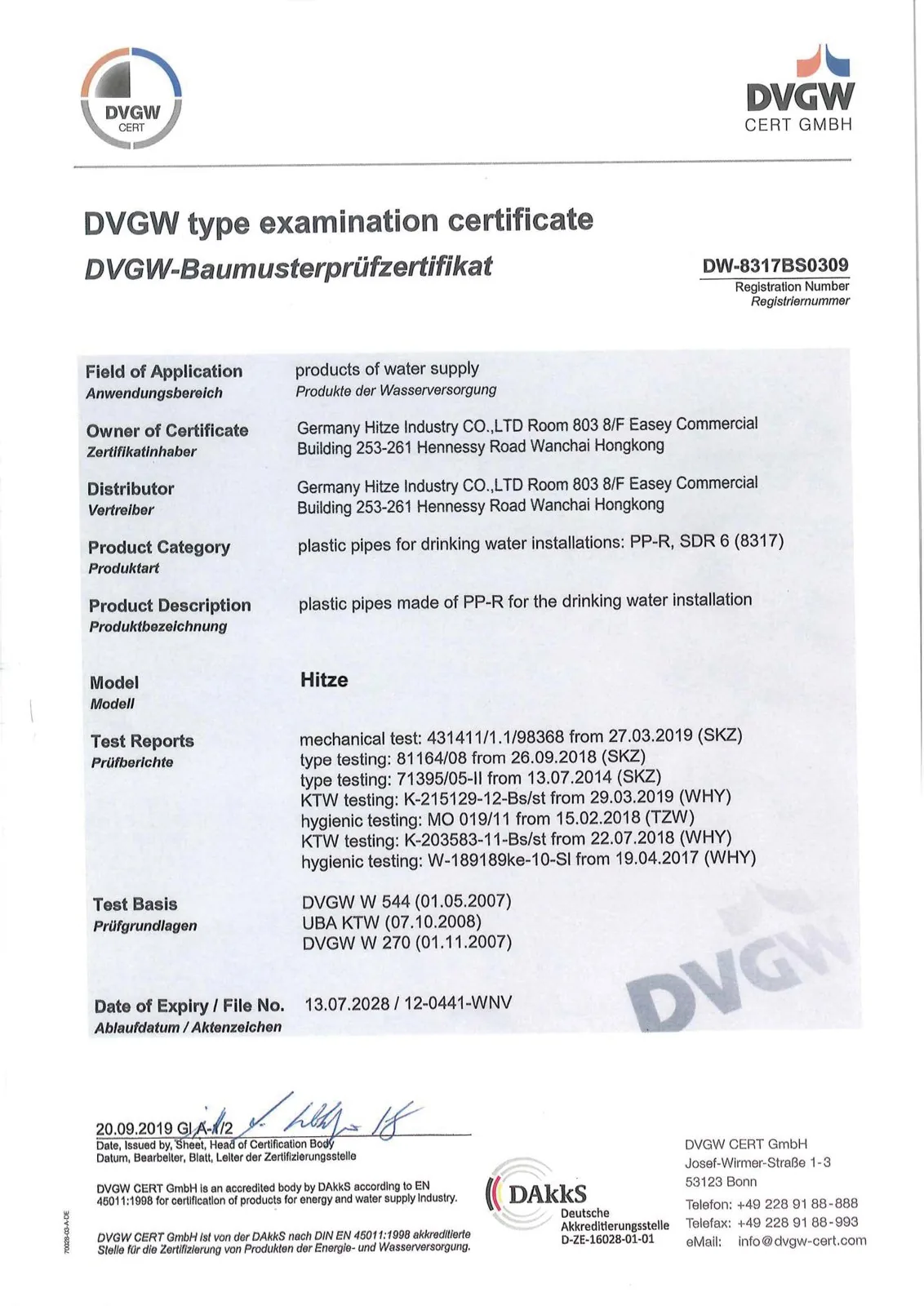
If you’re selling into Germany, DVGW is the register that matters, and importers routinely under-check it because the interface is German. It’s still free and public. Go to DVGW CERT GmbH’s directories (Verzeichnisse) and use the Water Products registry (there’s a separate one for gas). Confirm the registration number on the certificate resolves to a live entry under the manufacturer’s name, for the product type you’re buying. DVGW certification also implies ongoing factory surveillance, so a lapsed or withdrawn entry is a signal that monitoring stopped — not a paperwork technicality.
For the UK, WRAS is the one importers most often get wrong — and the mistake is almost always the product-vs-material trap. A check of the WRAS Approvals Directory is, in WRAS’s own words, the only reliable way to verify an approval, because approvals get modified and expire. Two rules will keep you out of trouble. First, WRAS approvals last five years; the scheme removes expired approvals from the directory, so an entry that isn’t there anymore has lapsed — check the “valid from” and expiry dates on the live listing, not the certificate. Second, distinguish a Product Approval (the finished valve, fitting, or assembly passed mechanical and water-quality testing) from a Material Approval (a non-metallic compound passed water-quality testing only). A material approval on a pipe compound does not mean the finished fitting is WRAS Approved. Suppliers blur this constantly; the directory entry states which one it is.
The 5-field cross-check: your one-page verification method
Once you know each directory, the method is identical across all four schemes. For every certificate in the folder, line up five fields between the paper and the live listing. If all five match, the claim holds. If one is off, the claim fails until the supplier explains it.
| Scheme | Where to verify (public directory) | Key ID on the certificate | The trap it catches |
|---|---|---|---|
| cUPC / UPC (IAPMO) | pld.iapmo.org | File No. + “Void After” date | Expired / withdrawn listing; wrong entity |
| NSF (14 / 61) | listings.nsf.org | Company + product + standard | “NSF” without the standard that fits your product |
| DVGW | dvgw-cert.com/verzeichnisse | Registration number (water registry) | Lapsed surveillance; wrong product type |
| WRAS | wrasapprovals.co.uk directory | Approval no. + valid-from / expiry | Material approval sold as product approval; expired |
The five fields to match in every case: legal company name · certificate/file/approval number · product scope · standard cited · validity date.
Run them in this order, because it fails suppliers fastest. Check the company name first — if the certificate is issued to a trading company and not your factory, nothing else matters. Then the date, because an expired listing is a two-second disqualification. Then the scope and standard together, which is where most honest-looking certificates quietly miss the product you’re actually buying. Do this once per certificate and you’ve done more diligence than most first-time importers do all year.
How Hitze makes its certificates verifiable
The reason we wrote this guide the way we did is that we field the “is this real?” question from importers constantly — usually after they’ve been burned by a “German” supplier that turned out to be a trading desk with a borrowed logo. Hitze is a German brand, engineered in Germany and built to German DIN and EN ISO standards, and our certificates are issued to the manufacturing legal entity, GERMANY Hitze INDUSTRY CO., LTD — the same entity that appears on the DPMA trademark register (Reg. No. 30 2020 005 484). That single point — certificate name equals factory name equals shipper name — is the first field on the checklist above, and the one fake “German” suppliers fail.
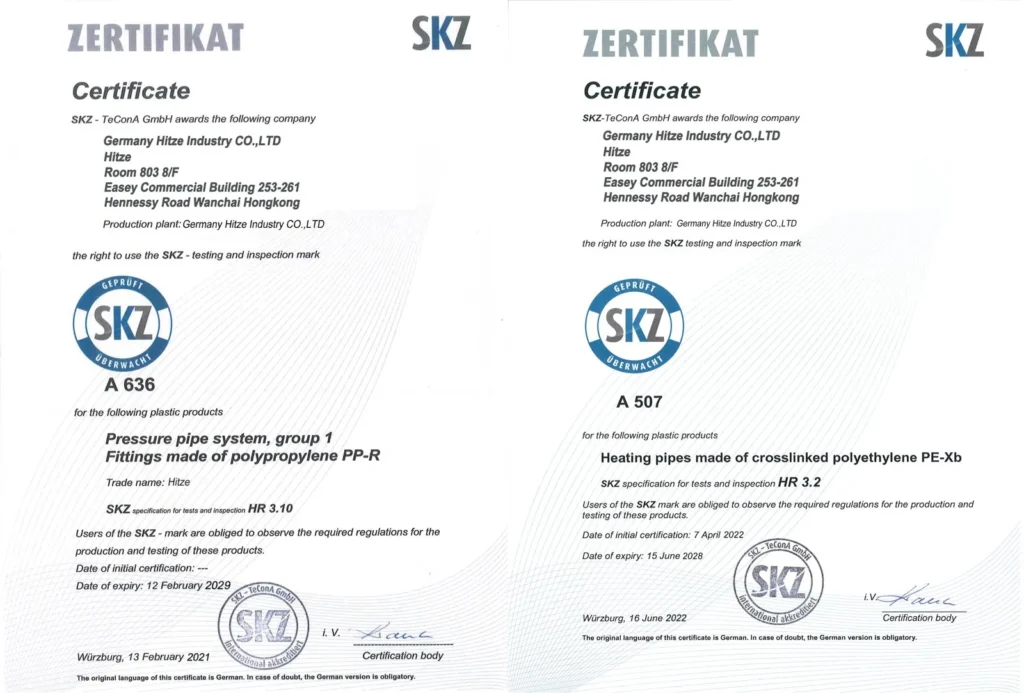
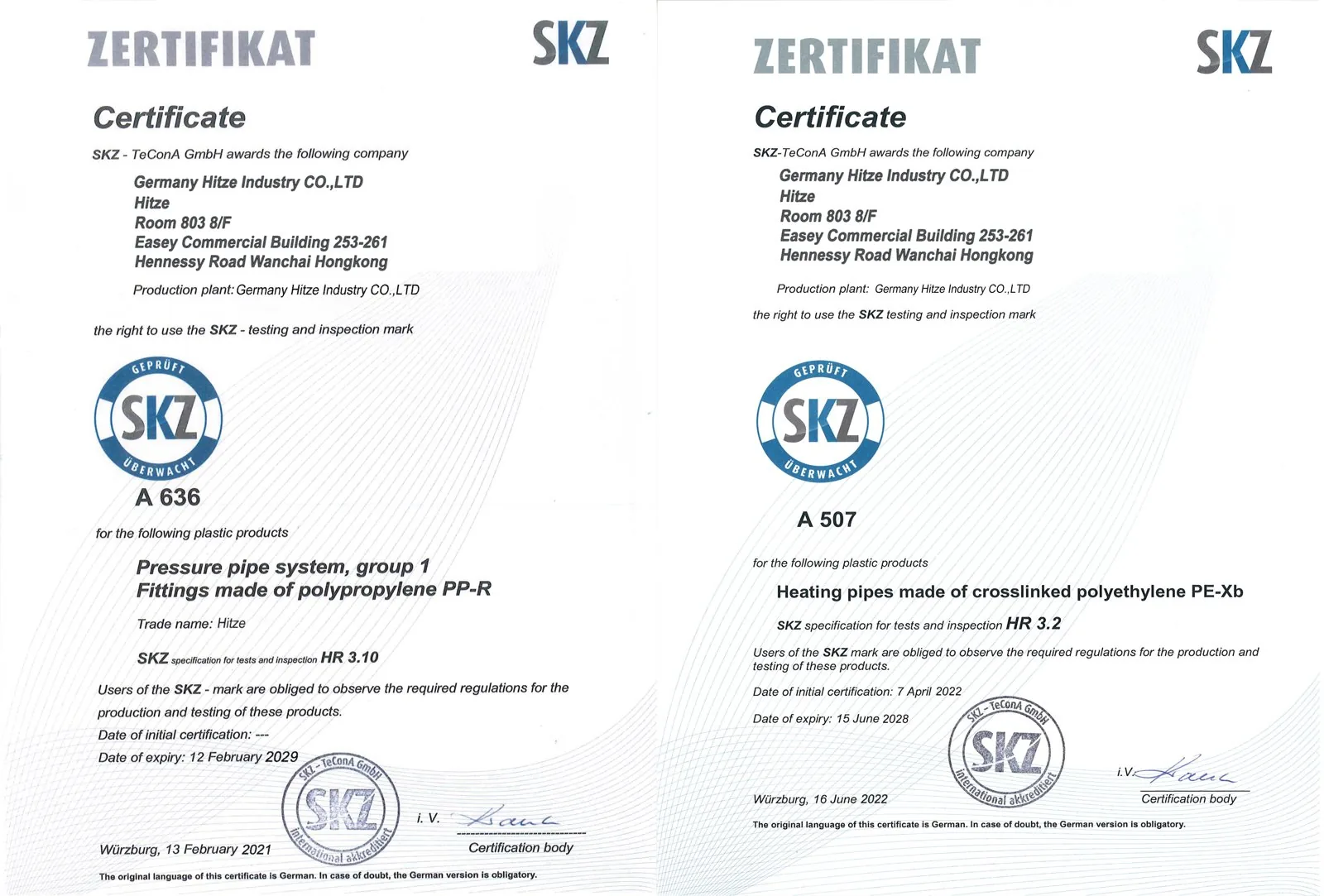
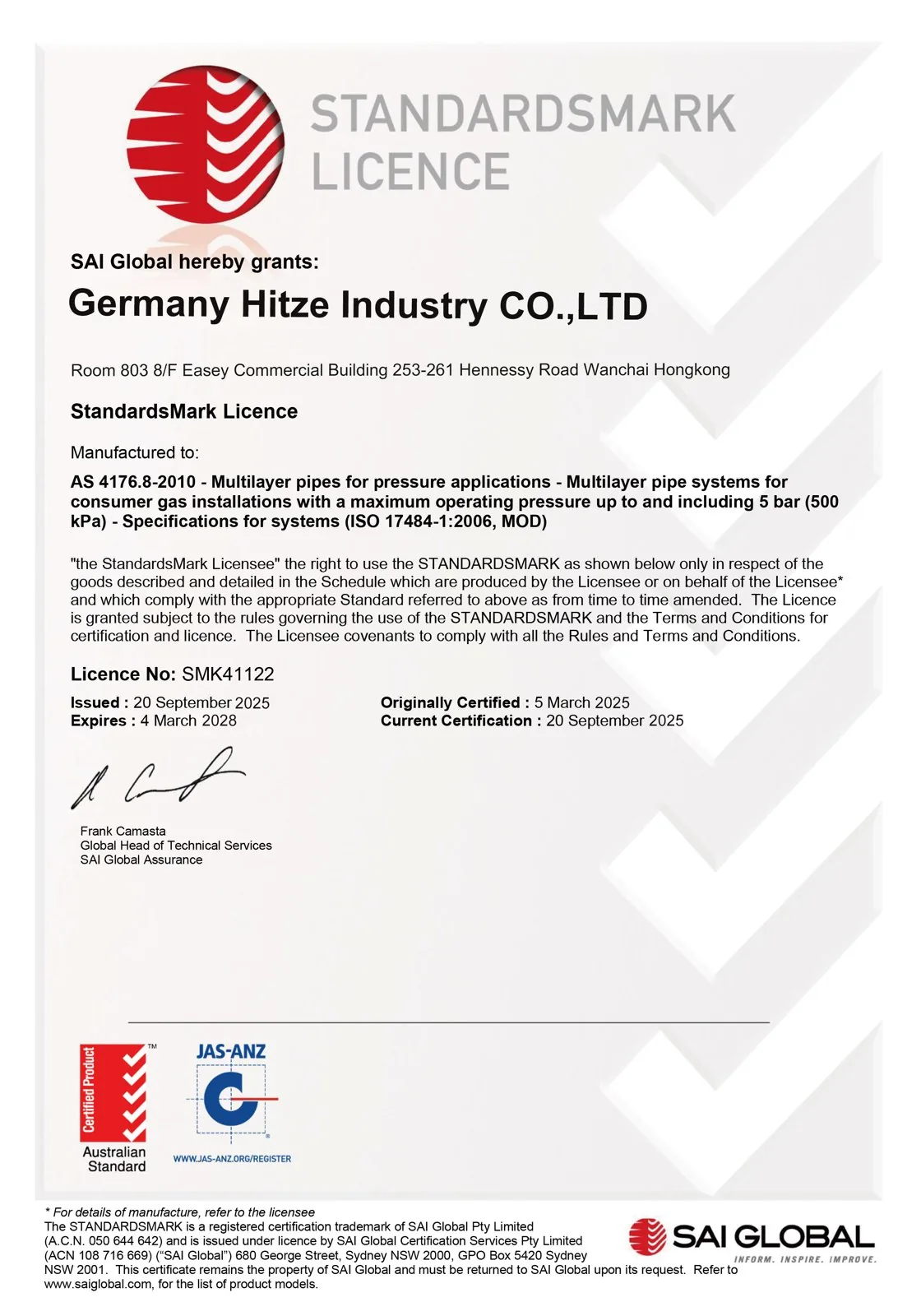
On the schemes themselves: Hitze holds SKZ test certificates (Germany) for our PP-R pipe and fittings and PE-Xb heating pipe, a DVGW type examination for PP-R drinking-water pipe, WRAS material approval, an NSF International BS 6920 potable-water test report, and ISO 45001 for occupational health and safety. Our PEX pipe and the rest of the range are also certified to cUPC/UPC (IAPMO), NSF-14 and NSF/ANSI 61, and carry CE with a Declaration of Performance. Every scheme, and the directory where each one is verified, is laid out on our certifications & compliance overview — and what we don’t do is print certificate numbers we can’t stand behind, so specific listing and file numbers are shared on request against a live directory check rather than left for you to trust in a PDF.
What we check when a buyer asks us to prove a claim is exactly the five-field pass above, done together on a screen-share: we open the relevant public directory, search our legal name, and match the file or approval number, the product scope, the standard, and the date against the certificate in your folder. If you’re comparing us to a quote from another “German-brand” factory, ask both of us to do that live. The supplier who can’t, or won’t, has told you what you need to know.
Who this level of checking is — and isn’t — for
Best for: importers and trading companies placing a first container, private-label buyers who need certificates issued or transferable under their own brand, and MEP specifiers whose project submittals will be inspected against a named standard. If your goods will face a US AHJ, a UK water regulation check, or a German building inspection, the directory pass is not optional — it’s the cheapest insurance you’ll buy on the whole order.
Not the priority for: a low-value sample run you’re buying purely to evaluate feel and dimensions, or a market where the product won’t be inspected against a plumbing code. Even then, do the company-name and date check — it takes two minutes and it’s the single best predictor of whether a supplier is a real factory or a middleman.
Vetting a pipe supplier for a first container?
If you’re an importer or private-label buyer who needs certificates that survive a live directory check — and want them tied to the manufacturing entity, not a trading desk — that’s the exact scenario our compliance documentation is built for. See the schemes we hold and how each one is verified on our certifications & compliance overview, or talk through your target market’s requirements via our importer & distributor program. If the plan is your own label, the private-label & ODM piping route covers certifying under your brand.
Specific file and approval numbers are shared on request against a live directory check — available terms vary by market and order.
Frequently asked questions
How do I know if a cUPC certificate is fake?
Don’t judge it by the PDF — judge it by the directory. Every IAPMO certificate carries a File No. and states in writing that it is “not evidence of current listing.” Take that file number to the IAPMO R&T Product Listing Directory at pld.iapmo.org and confirm the listing is active, held by the supplier’s legal manufacturing entity, and covers the exact product you’re buying. No live entry means no valid certification, regardless of how the paper looks.
Can I verify NSF and WRAS certificates online for free?
Yes. All four major schemes publish free public directories: NSF at listings.nsf.org, WRAS at the WRAS Approvals directory, IAPMO at pld.iapmo.org, and DVGW at dvgw-cert.com/verzeichnisse. Search by the manufacturer’s name or the certificate/approval number and confirm the product, standard, and validity date. For WRAS specifically, the scheme states that checking its directory is the only reliable way to verify an approval, because approvals can be modified and expire.
Is the pipe made in Germany if it has DVGW and WRAS certificates?
Not necessarily — and this is where buyers conflate two things. A certificate proves the product meets a standard and is registered with that body; it does not, by itself, prove country of manufacture. Hitze is a German brand, engineered in Germany and built to German DIN and EN ISO standards, with certificates (SKZ, DVGW, WRAS, NSF) issued to the German legal entity Germany Hitze Industry. Verify origin separately from certification: check the certificate holder’s legal name and address in the directory, and ask for the trademark registration (ours is DPMA Reg. No. 30 2020 005 484).
What’s the difference between a WRAS product approval and a material approval?
A Product Approval means the finished item — a valve, fitting, or assembly — passed both mechanical and water-quality testing. A Material Approval means only a non-metallic material or compound passed water-quality testing. Suppliers sometimes present a material approval as if the whole product were approved. They are not equivalent: a WRAS-approved compound in a fitting does not make the fitting a WRAS Approved Product. The directory entry states explicitly which type it is — read that field.
A supplier’s certificate is expired — is the product still compliant?
Treat an expired listing as uncertified until it’s renewed. WRAS approvals are valid for five years and are removed from the directory once they lapse; IAPMO certificates carry a “Void After” date; DVGW certification depends on ongoing factory surveillance. An expired entry may mean the factory stopped monitoring, changed its formulation, or simply let it drop — none of which you want on a container heading for inspection. Ask for the current, live directory entry, not last cycle’s PDF.
What if the certificate is issued to a different company than my supplier?
That is the most common and most serious red flag. A certificate held by a trading company, agent, or a “group” name that isn’t the factory does not cover the goods you’ll receive from that factory. The certificate holder in the directory must match the legal entity that will manufacture, invoice, and ship your order. If a supplier can’t reconcile those names, the certification does not apply to your purchase — walk away or get it in writing from the actual listing holder.