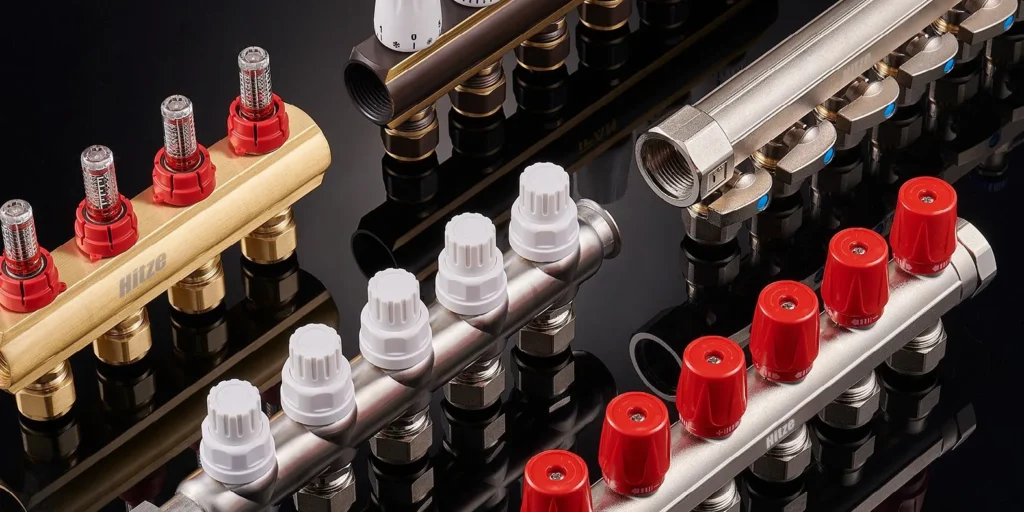
The single question that decides whether an underfloor-heating manifold is right or wrong for your job is not “brass or stainless” — it is how many loops you are running, and at what flow rate. Get the port count and the flow-meter range right and the material choice becomes a second-order decision. Get them wrong and you are back on site with a cold room, a screaming pump, or a manifold you have to cut out. This guide is written for the installer standing in the plant room, and it treats the manifold as what it actually is: the balancing hub that makes or breaks the whole radiant floor.
- Size by loops, not by room count. One port per loop, plus at least one spare port for a future zone. Five loops means a 6-port manifold, not a 5-port.
- Loop length caps flow. As a widely-used design convention, keep 16 mm loops around 100 m maximum; longer loops starve the far end and no flow meter can fix that.
- Flow meters are for commissioning, not decoration. A per-port sight gauge (Hitze uses a 0–2.5 L/min scale) is what lets you balance a system where one loop is 40 m and its neighbour is 95 m.
- Brass vs stainless is mostly about water chemistry and price, not “quality.” Both work; the wrong reason to choose is a spec sheet you didn’t read.
- Interfaces are standardised. 1″ mains, G¾″ Eurocone loop ports, M30 × 1.5 actuator thread — so a compliant manifold accepts common actuators and pipe unions.
Size the manifold by loop count first — everything else follows
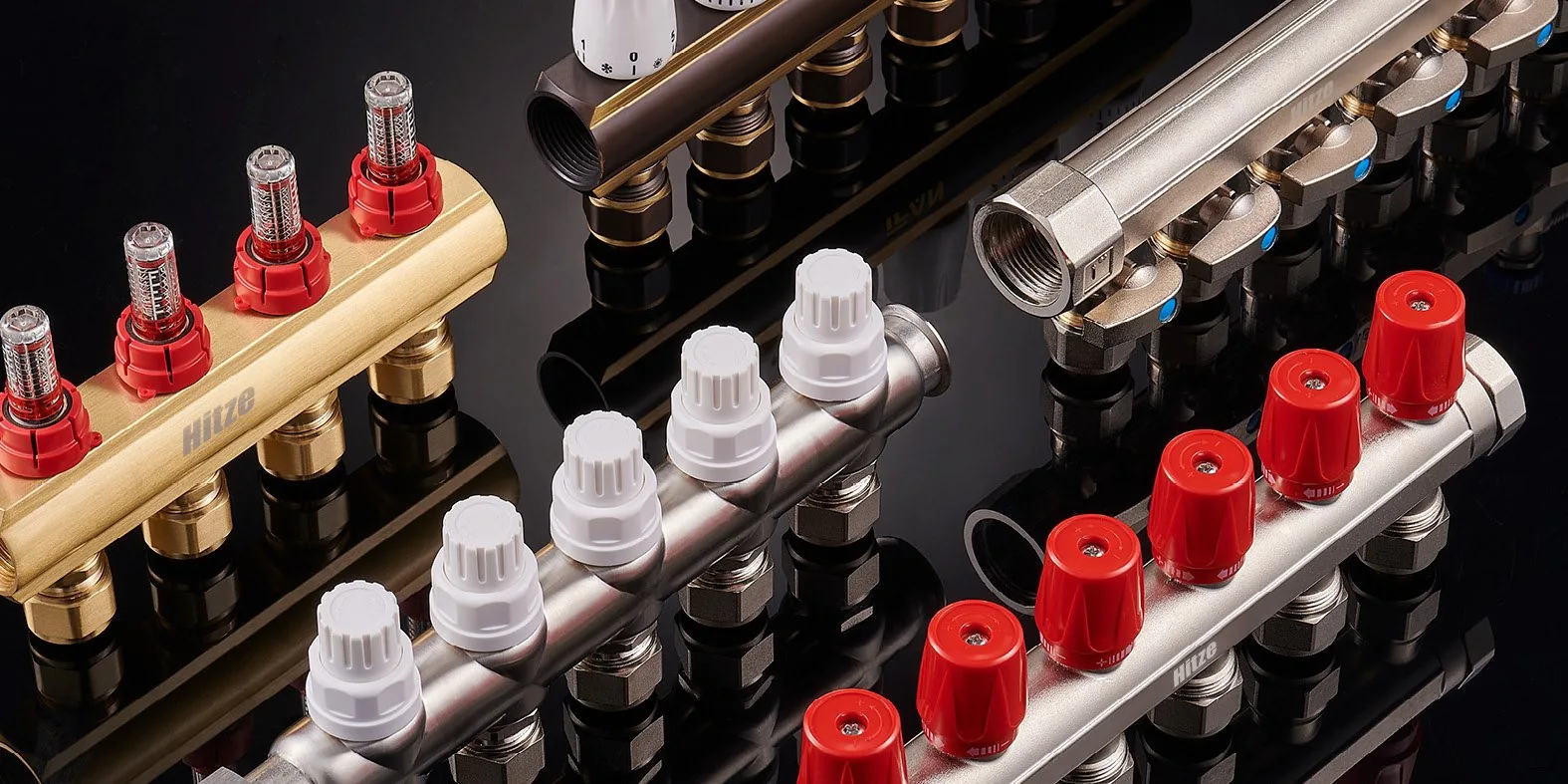
A manifold is a distribution bar with one outlet (“port” or “way”) per heating loop, and it is sold in modular sizes precisely because port count scales with the length of the body. A 2-port bar is roughly 200 mm wide; a 12-port bar is around 700 mm — you are literally buying more bar per loop. So the first thing to nail down before anything else is the number of loops your floor plan actually needs, and that number comes from area and loop length, not from the number of rooms.
Here is the mistake that generates callbacks: an installer counts rooms and orders a manifold with a port per room. But a 32 m² open-plan kitchen at 150 mm pipe spacing needs about 6.7 m of pipe per m² (that figure is just the geometry — 1 m ÷ 0.15 m spacing), which is roughly 215 m of pipe — far past the ~100 m per-loop ceiling that is the widely used industry design convention for 16 mm pipe. That single room needs two or three loops, so two or three ports, not one. Meanwhile a tight ensuite might share a port strategy with a landing. Count loops, then add a spare, then buy the manifold.
Why the 100 m ceiling matters at the manifold, not just at the pipe: every extra metre of loop adds pressure drop, and past roughly 100 m on 16 mm pipe the water reaches the return bar too cold and the pump has to work against a resistance the flow meter cannot balance out. The manifold gives you adjustment range, not miracles. If two loops on the same bar differ wildly in length — say 45 m and 95 m — the flow meters let you throttle the short one so the long one gets its share, but only if both are inside sane limits to begin with. This is the single most common source of “one room never gets warm” complaints, and it is designed out before the manifold is even ordered.
A quick sizing worked example
Take a 120 m² ground floor, mixed rooms, 16 mm PE-RT pipe at 150 mm centres. At ~6.7 m/m² that is roughly 800 m of pipe. Divide by a target loop length of about 80 m (staying comfortably under the 100 m ceiling and keeping loops even) and you land near 10 loops. Add one spare port for the conservatory the client hasn’t built yet, and you are specifying an 11- or 12-port manifold. Notice the material never entered that calculation — port count is a hydraulic and geometric decision, and it is where 90% of manifold sizing errors live.
Flow meters and flow rates: what actually gets balanced
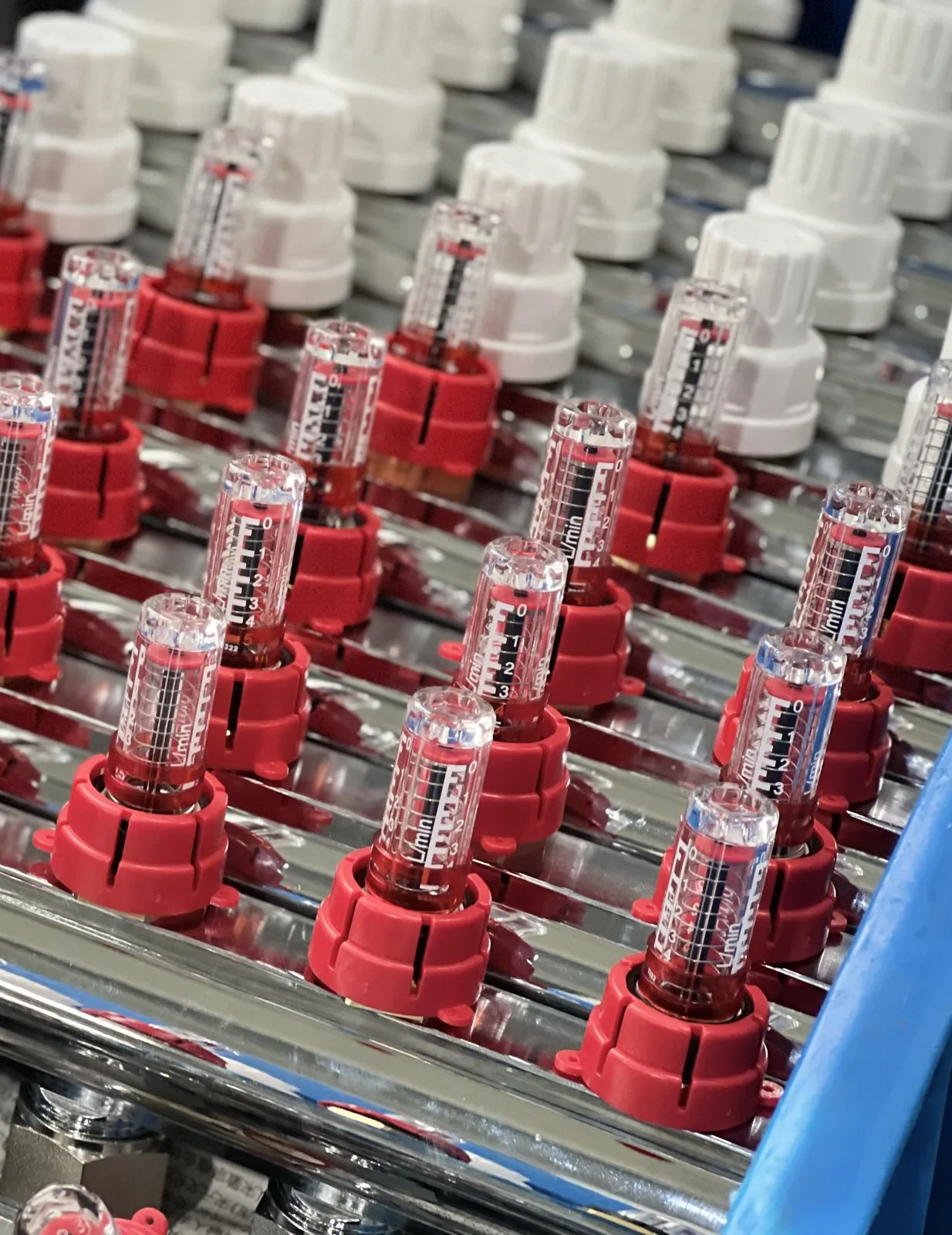
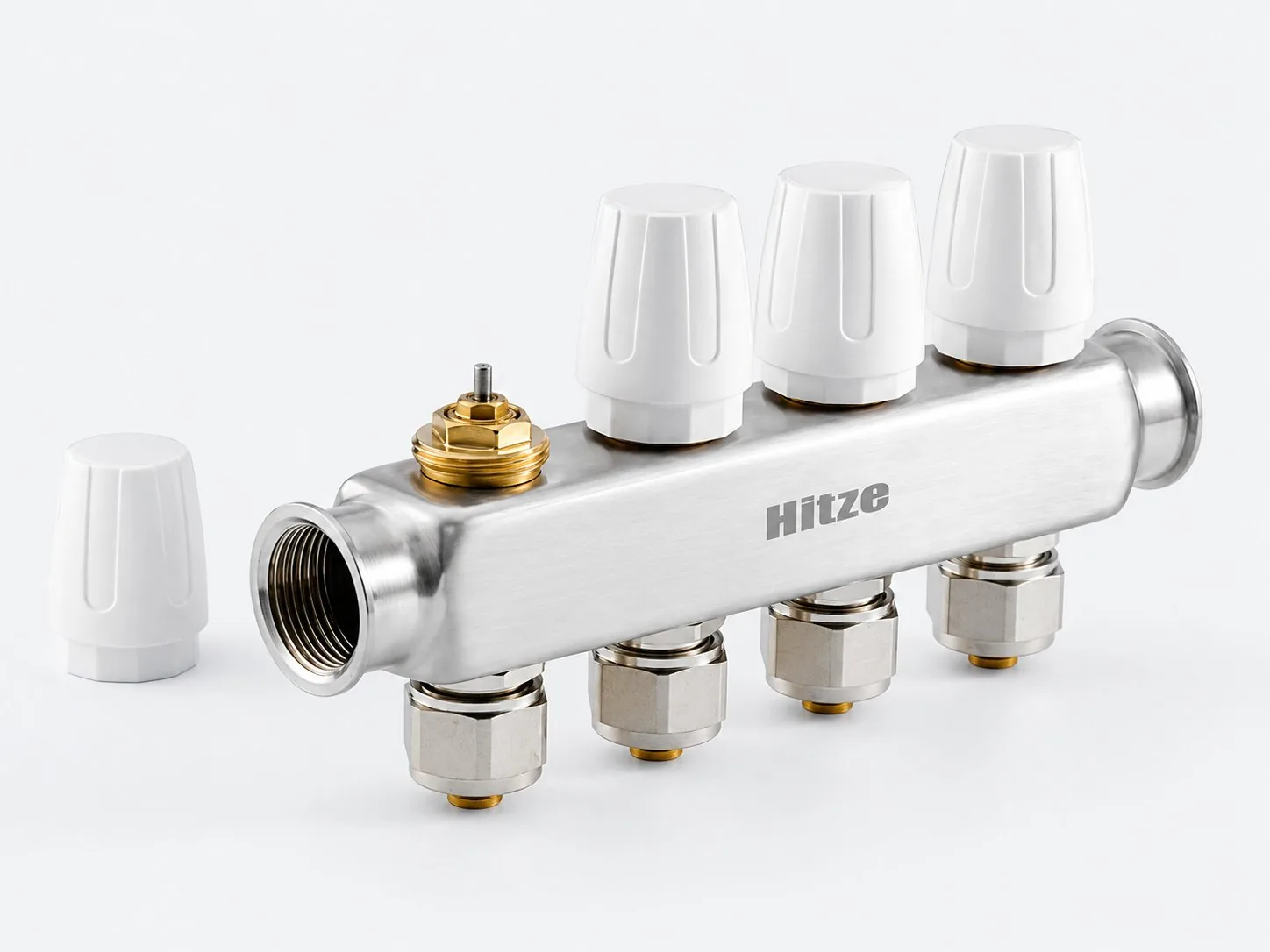
A flow meter is a clear sight gauge, one per loop, that reads the water actually passing through that circuit in litres per minute. Common bars carry meters scaled around 0–4 L/min or 1–5 L/min with an integrated shut-off; Hitze’s own manifold bars use a fine-resolution 0–2.5 L/min sight gauge, a range chosen deliberately because a typical residential loop lands near 2 L/min, so the reading you care about sits mid-scale where the graduations are easiest to set precisely rather than crammed against the bottom stop. The point of the meter is hydraulic balancing: with several loops of different lengths hanging off one bar, water takes the path of least resistance, and without adjustment the short loops hog the flow while the long ones run cold. You throttle the greedy loops down at the meter until each reads its design figure.
Where does the target figure come from? From the loop’s heat load and the design temperature drop across it, using the standard water relationship: flow (L/s) = heat output (kW) / (ΔT × 4.18). In residential radiant systems the design ΔT across a loop is usually 5–10 K and the flow temperature sits around 35–45 °C — low, because a warm floor is a large emitter and does not want scalding water. Run the numbers on a 1 kW loop at a 7 K drop and you get about 0.034 L/s, roughly 2 L/min — comfortably mid-scale on a 1–5 L/min meter, which is exactly why those meters are scaled the way they are. If your design flow lands at the very top or bottom of the meter’s range, that is a signal the loop is mis-sized, not that you need a different meter.
One velocity guardrail worth committing to memory, and a common one across radiant design guides: keep design velocity in the loop at or below roughly 1 m/s. Push past that and you get flow noise the homeowner will hear through the floor and a pressure drop that eats your pump head. On 16 mm pipe, the two typically-cited constraints — staying under ~1 m/s and under ~100 m per loop — together keep a radiant floor quiet, even, and balanceable.
Brass vs stainless: choose on chemistry and cost, not folklore
This is the comparison buyers agonise over, and honestly it is the least consequential of the three decisions on this page — provided both are made to a proper standard. Both brass and brushed stainless are proven, long-service manifold materials. The differences that actually matter to an installer are corrosion behaviour against local water chemistry, weight and finish, and price. Thermal conductivity gets quoted a lot — CW617N brass is rated at roughly 123 W/m·K on the material datasheet versus about 16 W/m·K for 316 stainless — but on a distribution manifold that conducts almost nothing to the room, that gap is close to irrelevant to comfort. Do not let a thermal-conductivity number decide a manifold; it is a real property being applied to the wrong problem.
| Factor | Brass manifold (CW617N) | Brushed stainless manifold |
|---|---|---|
| Corrosion behaviour | Excellent in normal closed heating water; use dezincification-resistant (DZR) grades where water is aggressive. | Very high resistance; a safe default where water chemistry is unknown or chloride-rich. |
| Weight & feel | Heavier, solid; forgiving to over-tighten a union onto. | Lighter, clean brushed finish that photographs well in exposed plant rooms. |
| Typical cost | Often the lower-cost option at the same port count. | Usually a premium; justified by finish and chloride resistance, not by heat transfer. |
| Interfaces | 1″ main, G¾″ Eurocone ports, M30 × 1.5 actuator thread. | Identical — dimensionally interchangeable at the connections. |
Best for brass: most standard residential and light-commercial closed systems, cost-sensitive projects, and installers who want a heavy, over-tighten-tolerant body. Best for stainless: jobs where the fill water is chloride-rich or unknown, exposed architectural plant rooms where the brushed finish is on show, and specifiers who want one material spec they can repeat everywhere without checking water reports. Not the right basis for either: a decision made purely on a conductivity figure, or on a vague sense that one metal is “better.”
The interfaces that decide whether it fits your job
A manifold that balances beautifully but won’t accept your actuators or pipe unions is scrap. The reason the industry has largely converged on a handful of interface standards is exactly to avoid that, and a manifold worth specifying holds to them: 1″ flat-sealing connections to the flow and return mains, G¾″ Eurocone outlets for the loop unions (which is why 16 and 20 mm pipe unions land straight on), and an M30 × 1.5 thread on the return-bar valves for the actuators.
That M30 × 1.5 detail is the one that saves you on control day. Common thermoelectric actuators — the little heads that open and close each loop on a signal from the room thermostat — are built for that thread, in either 230 V or 24 V, drawing only a couple of watts, and almost always normally-closed so that a lost signal fails a loop shut rather than cooking a floor. If the return bar isn’t M30 × 1.5, you are hunting for oddball actuators, and that is a friction you never want to introduce into a wiring-centre commissioning.
One more compatibility point that reaches back up the system: the manifold only stays clean if the pipe feeding it carries a proper oxygen barrier. DIN 4726 sets an oxygen-permeability limit for plastic heating pipe — an area-related limit of ≤ 0.32 mg/(m²·d) at 40 °C (and ≤ 3.6 mg/(m²·d) at 80 °C), the threshold the DIN-CERTCO certification scheme tests plastic floor-heating pipe against — precisely so oxygen does not diffuse through the pipe wall, dissolve in the loop water, and corrode the steel and iron parts of the system, including the pump and the manifold’s own valve internals. A barrier-grade PE-RT underfloor heating pipe is not a separate purchase decision from the manifold; it is what keeps the manifold serviceable for its full life. Contractors who want that pipe, manifold and unions matched and warranted as one kit usually spec them together through Hitze radiant-heating supply for contractors rather than mixing brands at the manifold.
What Hitze checks before a manifold ships
Hitze is a German brand of engineered piping systems, founded in 1974, building from a 120,000 m² production base with 1,000+ employees and exporting to 118+ countries. On the manifold line specifically, the checks are the ones that decide whether a bar balances on site or fights the installer:
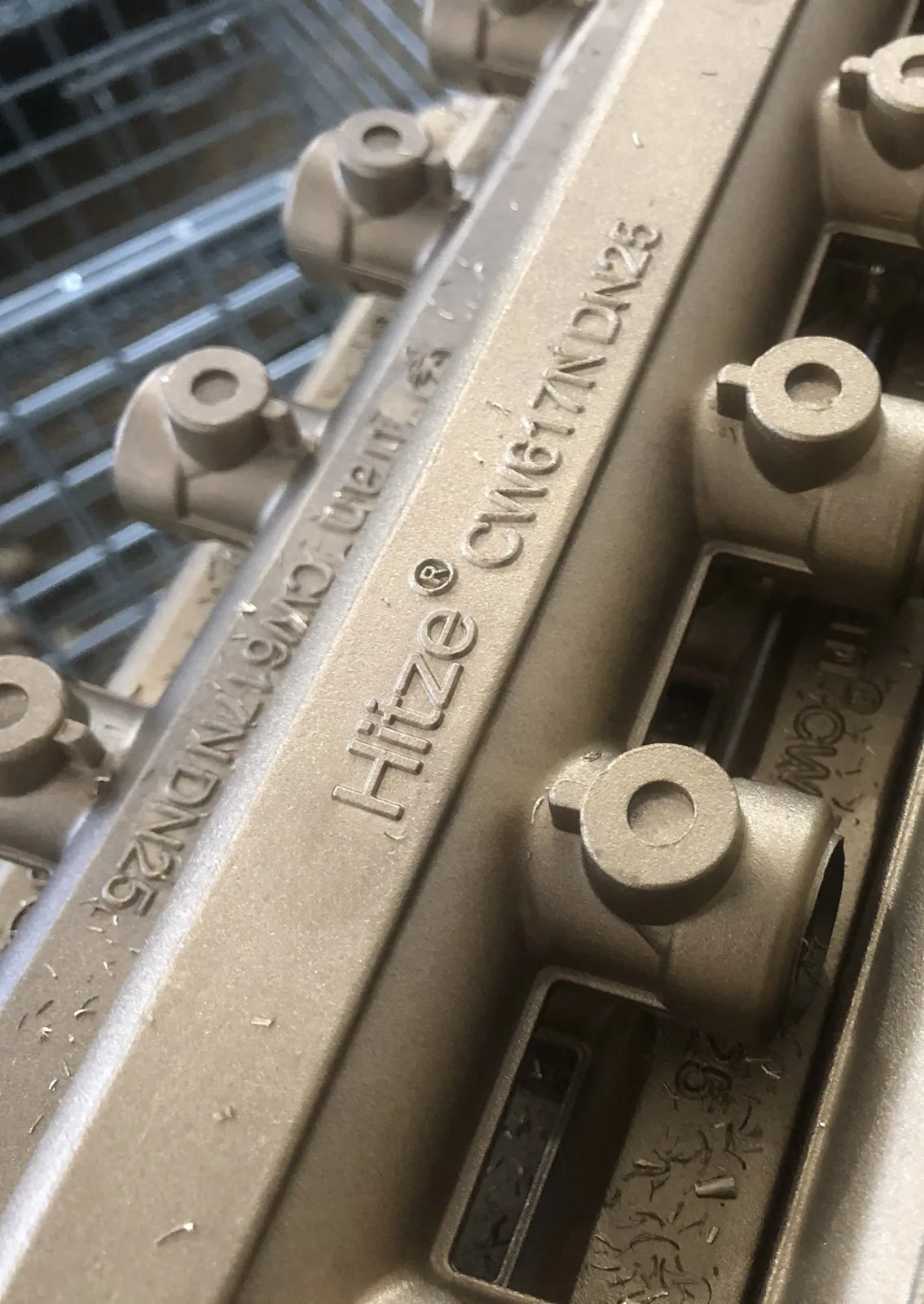
- Material and grade verified on the casting. Hitze offers the bar in two finishes — cast brass and brushed stainless — off the same interface set, so you spec the metal and keep the fit. Brass bodies are machined in CW617N, and the grade and the DN25 body size are cast into the metal itself (marked CW617N, DN25), so the spec is legible on site and not just claimed on a datasheet.
- Every bar pressure-tested. Assembled manifolds are hydrostatically tested before packing — the point is to catch a weeping union or a porous casting in the factory, not in a client’s ceiling void. Manifold-specific test-pressure and PN figures are available on request and confirmed per order.
- Flow meters checked for readability and free travel. Hitze’s flow bar carries a per-loop sight gauge graduated 0–2.5 L/min — a finer scale than the industry-typical 0–4 or 1–5 L/min, so a residential loop sitting near 2 L/min reads high on the scale where you can set it precisely. A gauge that sticks or fogs is useless for balancing, so each meter and its shut-off is function-checked as part of assembly.
- Interfaces gauged. The 1″ mains, G¾″ Eurocone ports and M30 × 1.5 actuator threads are the compatibility promise; they are gauged so common actuators and pipe unions fit without shimming or adapters. The return valves ship capped with Hitze’s white thermostatic caps, which are swapped for the wired actuators at commissioning.
- System-matched. Because Hitze also makes the barrier-grade PE-RT pipe, PEX and the brass and compression unions that land on the manifold, the whole loop can be specified from one brand — which is what makes a single-source system warranty possible in the first place. Contractors stocking the full radiant kit typically source manifold, pipe and fittings together through Hitze radiant-heating supply for contractors, so the compatibility is settled at the purchase order, not on site.
The group runs an ISO 45001-certified occupational health & safety management system, and across the wider potable and heating range it holds SKZ (Germany), DVGW and WRAS approvals. Because pipe, manifold and fittings are matched from one brand, Hitze backs the assembled system with a 50-year warranty. Manifold-specific listings and any project certificates are available on request and vary by market and order — the honest position is that certification scope should always be confirmed against your destination market before you import, not assumed. There is no MOQ, so a buyer can start with samples or a small trial order before committing to a full manifold program.
End to end: a whole-house radiant job, manifold-first
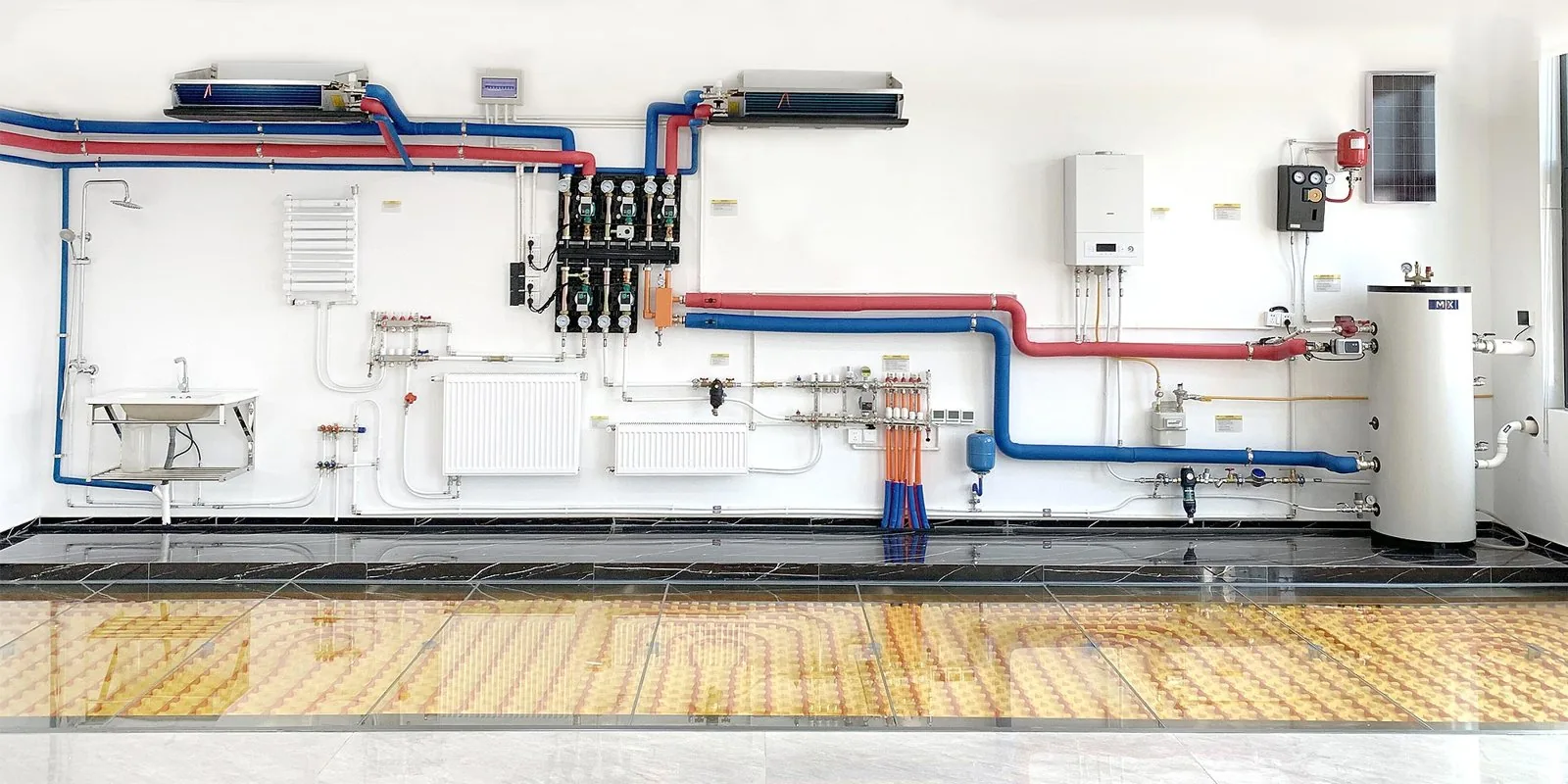
Walk a real sequence. You have a 120 m² ground floor, 16 mm PE-RT at 150 mm centres, feeding from a low-temperature heat source at ~40 °C. Step one is loop design: ~800 m of pipe divided into even loops around 80 m gives you 10 loops, and you add a spare port, so you order an 11- or 12-port manifold. Step two is material: the fill water is ordinary treated mains, budget matters, and the plant room is a cupboard nobody sees — so brass in CW617N is the sensible call, and stainless would be paying a premium for a finish and a chloride resistance you don’t need here.
Step three is flow: each loop’s heat load, at a 7 K design drop, lands each loop near 1.5–2 L/min — mid-scale on the flow meters. Step four is control: an M30 × 1.5 normally-closed actuator on each return valve, wired back to per-room thermostats through the wiring centre. Step five, on commissioning day, is balancing: you run the pump, then throttle each flow meter until every loop reads its design figure, spending the most time on the loop-length outliers. Because the pipe carries a DIN 4726 oxygen barrier, you are not seeding the system with the oxygen that would corrode the pump and the manifold’s own internals over the next decade. The floor comes up evenly, the pump runs quiet under 1 m/s, and there is no return visit. Every one of those steps except “brass or stainless” was locked before the material was even chosen — which is the whole point of this guide.
If you are a radiant-heating contractor or a distributor stocking for installers who need brass and brushed-stainless manifolds — with flow meters, actuators, and the barrier-grade pipe and unions that land on them from one brand — a single-source system removes the mixed-brand compatibility and warranty risk that causes callbacks. Manifold-specific certificates and pricing are available on request and vary by market and order.
Explore the Hitze underfloor-heating manifold range — brass and brushed stainless, with flow meters and actuators — or talk to the team about radiant-heating supply for contractors to spec pipe, manifold and fittings as one warrantable system. Best for trade and project buyers; Hitze supplies wholesale, not direct to homeowners.
Related: pair the manifold with PE-RT underfloor heating pipe for the loops and brass compression fittings for the loop unions.
Frequently asked questions
How many ports should my underfloor heating manifold have?
One port per heating loop, plus at least one spare for a future zone. Work out loops from floor area and loop length — with 16 mm pipe at 150 mm spacing you get roughly 6.7 m of pipe per m² and cap each loop near 100 m — then round up. Five loops means a 6-port manifold, not a 5-port.
Is a brass or stainless steel manifold better?
Both are proven when made to standard. Brass (in grades like CW617N, or DZR where water is aggressive) is usually the lower cost and is the default for standard closed residential systems. Brushed stainless is a safe choice where fill-water chemistry is unknown or chloride-rich, and where an exposed plant room benefits from the finish. Brass conducts heat far better on paper (CW617N is rated ~123 vs ~16 W/m·K for 316 stainless), but that barely affects a distribution manifold, so it should not drive the decision.
What flow rate should each underfloor heating loop run at?
It is calculated per loop from its heat load and design temperature drop: flow (L/s) = heat output (kW) / (ΔT × 4.18), with a residential ΔT usually 5–10 K and flow temperature around 35–45 °C. In practice most residential loops land somewhere around 1.5–2 L/min, which is why manifold flow meters are commonly scaled 0–4 or 1–5 L/min. Keep loop velocity at or below about 1 m/s.
What are the flow meters on a manifold for?
Hydraulic balancing. Each clear sight gauge reads the actual litres-per-minute in one loop, so on commissioning you can throttle the short, low-resistance loops down until every circuit reaches its design flow. Without them, water short-circuits through the easy loops and the long ones run cold — the classic “one room never warms up” fault.
Will standard actuators fit the manifold?
If the return bar is the industry-standard M30 × 1.5 thread, yes — common thermoelectric actuators (230 V or 24 V, usually normally-closed) are built for it. Confirm the thread before ordering; a non-standard return valve forces you into hard-to-source actuators.
Is Hitze made in Germany?
Hitze is a German brand, engineered in Germany and built to German DIN and EN standards, with an occupational health & safety management system certified to ISO 45001 and a wider range holding SKZ, DVGW and WRAS approvals. Manifold-specific certificates are available on request and vary by market and order, so confirm the scope for your destination market before importing.
Standards and design references consulted: EN 1264-3 (dimensioning of embedded water heating systems), the CW617N (CuZn40Pb2) brass material datasheet (thermal conductivity), a radiant floor heating design guide (H2X Engineering), and the HS 8481 tariff classification for valves and manifolds.


