Key Takeaways
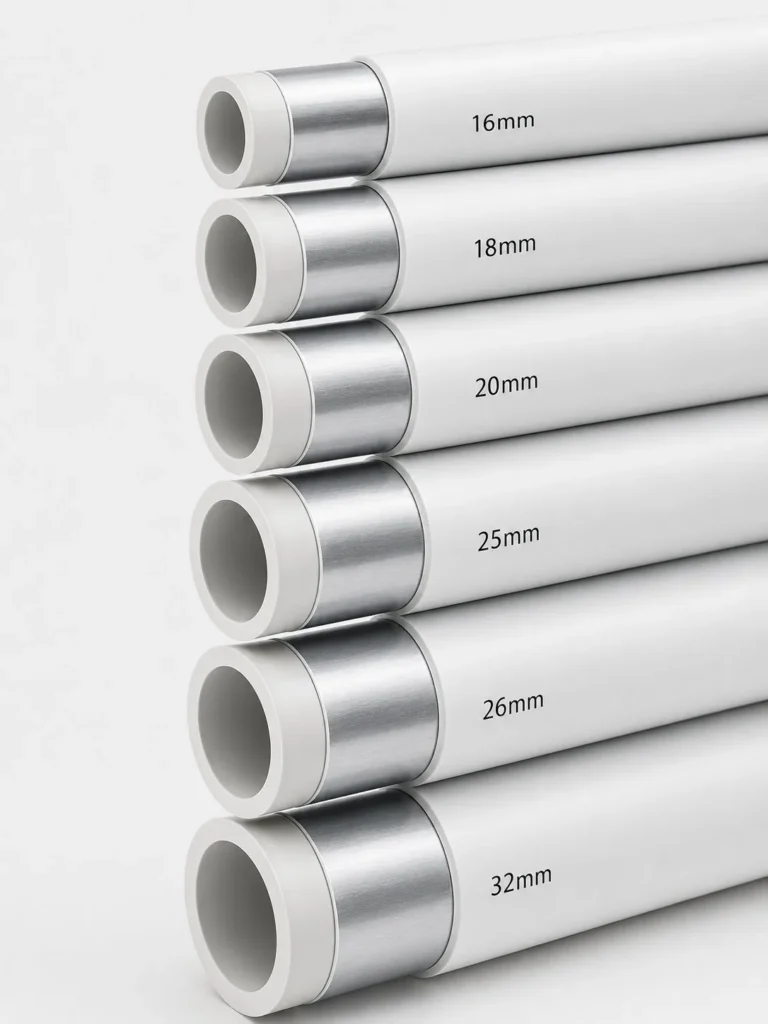
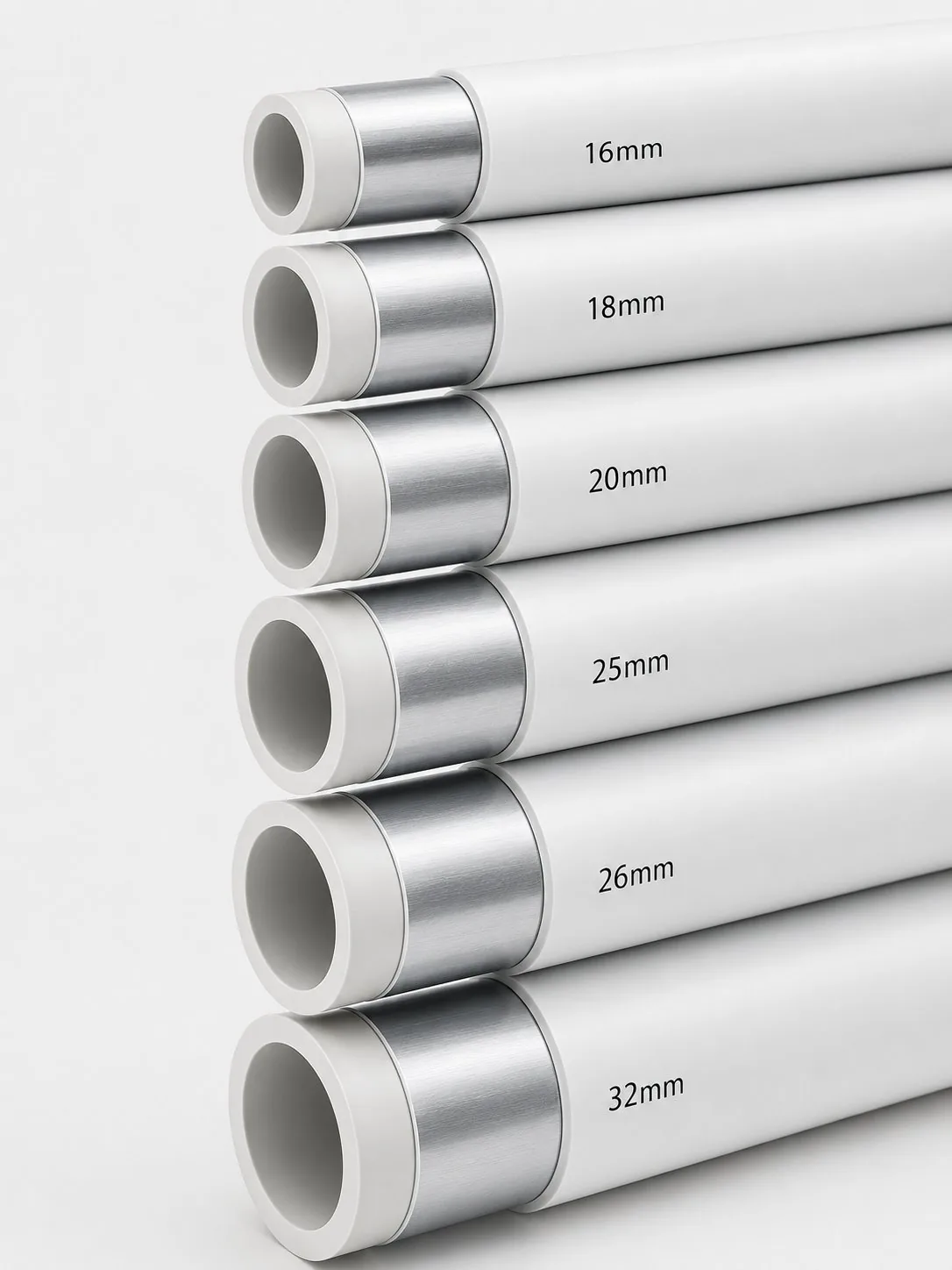
- The four sizes map to jobs, not guesses. 16 mm for radiant floor loops and single-fixture branches; 20 mm for a fixture or a short two-fixture run; 25 mm for hot/cold trunks in a normal home; 32 mm for the main feed, a big-house trunk, or a run past ~30 m.
- Flow, not diameter, is the real spec. On a conservative 2–4 ft/s design basis a 1/2″ (~16 mm-class) line carries roughly 1.2–2.3 GPM, 3/4″ ~2.3–4.6 GPM, and 1″ ~3.8–7.5 GPM; push to the 8 ft/s code cold-water ceiling and each size can carry more (a 1″/32 mm main, for example, tops out near 12 GPM). Size the pipe to the peak simultaneous demand, then check the run length.
- Velocity is the ceiling. Model plumbing codes cap supply velocity at 8 ft/s cold and 4–5 ft/s hot. Undersize the trunk and you buy noise, water hammer and premature erosion — the “shower drops when the toilet flushes” complaint is almost always an undersized trunk.
- Metric multilayer and CTS PEX are not the same numbers. Multilayer runs to a true OD (16×2.0, 20×2.0, 25×2.5, 32×3.0 mm per ASTM F1281 / EN ISO 21003); US PEX runs to copper-tube size (CTS, SDR-9). Don’t cross-reference by name alone.
- Buy the size range as one system. Hitze supplies PEX, PE-RT and PEX-AL-PEX in 16–32 mm plus the matching press, compression and brass fittings, engineered to German DIN and EN ISO standards — so the OD your tool expects is the OD in the coil.
Nearly every sizing mistake in a residential water or heating system traces back to one shortcut: picking a pipe by the diameter that “looks about right” instead of the flow it actually has to carry. The four sizes that do almost all the work — 16, 20, 25 and 32 mm — are close enough in appearance that the wrong one still fits the fitting and still holds pressure on test day. The penalty shows up later: a trunk that starves the far bathroom, a radiant loop that can’t move enough heat, or a main feed that whistles at peak draw. This guide is written for the contractor and installer who has to commit to a size before the screed goes down or the wall closes, and wants the reasoning, not just a chart.
We’ll work through it the way you actually spec a job: what each size is genuinely for, how to read flow instead of diameter, why velocity is the number the code cares about, where metric multilayer and inch-based PEX quietly diverge, and how to segment the four sizes across a real house. Every number below is either an industry-standard figure we’ve verified against an authoritative source or a Hitze product fact — nothing invented.
What Each Size Is Actually For: 16, 20, 25 and 32 mm
Start with the job, not the tube. The four sizes exist because residential systems have four broad jobs: move a little water to one fixture, move a bit more to a couple of fixtures, feed a floor of the house, and carry the whole building’s peak demand from the source. Match the size to the job first, then verify with flow and length — that order prevents 90% of resizing headaches.
16 mm is the workhorse of radiant heating and single-fixture supply. In underfloor heating it’s the default loop size because a 16 mm PE-RT or PEX-AL-PEX pipe bends tightly around a manifold and packs into 100–150 mm pipe spacing without kinking, while still moving enough water to deliver the design heat output of a loop under a couple hundred square feet of floor. On the plumbing side it’s the branch to a single lavatory or toilet — low demand, short run. Push 16 mm onto a trunk feeding several fixtures and you’ll hit the velocity ceiling long before you hit the pressure limit.
20 mm is the general-purpose branch. It comfortably feeds a tub, a shower, a washing machine, or a short run serving two low-demand fixtures that won’t both open at once. In a home-run manifold layout it’s a common dedicated line to a demanding fixture. It is the size people reach for by default — and often the size that’s slightly too small when it’s asked to act as a trunk. Treat 20 mm as a branch size and it rarely disappoints.
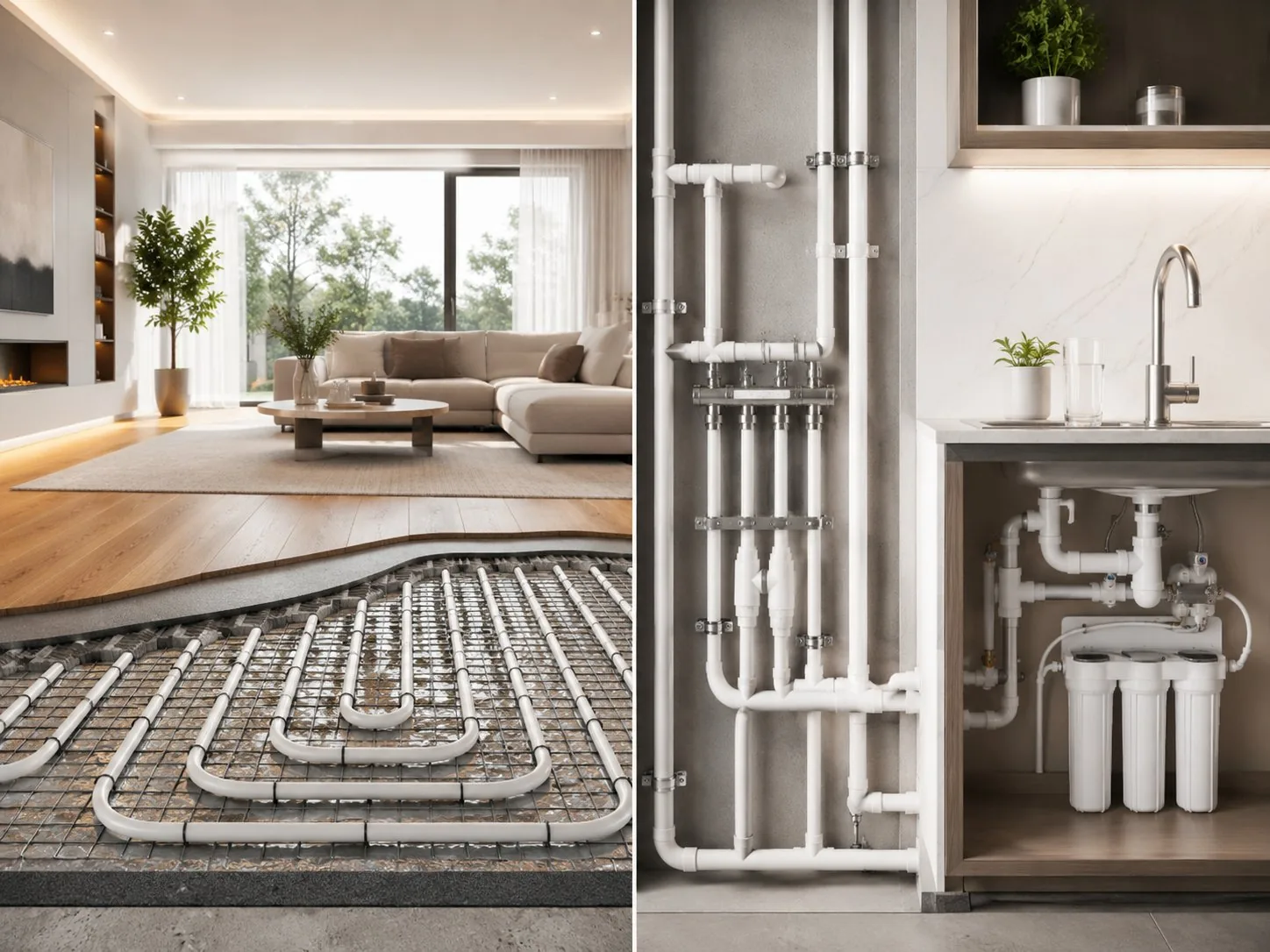
25 mm is where most people should be sizing their trunks and it’s the size most often skipped in favour of “one size smaller to save a bit.” In a normal two- or three-bathroom home, a 25 mm hot and cold trunk carries the combined peak of a floor’s fixtures with velocity and pressure loss both comfortably inside limits. It’s also the standard riser and header size on underfloor-heating manifolds feeding multiple loops. If you find yourself debating 20 vs 25 mm for a trunk, the run length or fixture count is usually already telling you 25.
32 mm is the main feed and the big-house trunk. It’s the size that brings water from the meter or the heat source into the manifold, the size for a home with three-plus bathrooms drawing simultaneously, and the size that rescues a long run where friction would otherwise eat your pressure. A 1″ (≈32 mm-class) main carries on the order of 10–12 GPM at the 8 ft/s cold-water velocity limit the code allows — roughly what a whole-house peak demands — whereas a 3/4″ (≈25 mm-class) trunk runs out of headroom near 8–9 GPM at the same ceiling. So once your peak pushes past what 25 mm can carry inside the velocity limit, or the run stretches past about 30 m (~100 ft), 32 mm is the honest answer even though it costs more per metre and holds a little more standing water.
Flow, Not Diameter: How to Read the Number That Matters
Diameter is what you buy; flow is what you’re actually specifying. A pipe’s job is to deliver a rate of water — gallons or litres per minute — without pushing velocity past the point where it gets loud and erosive. That’s why professional sizing works backward from demand: add up the fixtures that can realistically run at once, convert to a flow rate, and pick the smallest pipe that carries it inside the velocity limit. The chart below shows a conservative flow window for each common size, built on a 2 ft/s (low) to 4 ft/s (high) velocity basis — the design range the Plastic Pipe Institute uses for quiet, long-life residential systems, well below the 8 ft/s cold-water ceiling the code actually enforces. Note the ranges overlap, which is exactly why run length and simultaneity break the tie.
| Nominal / CTS size | Metric multilayer equivalent | Safe-velocity flow (GPM) | Typical job |
|---|---|---|---|
| 1/2″ | 16 mm (16×2.0) | ~1.2–2.3 | Radiant loop, single-fixture branch |
| 1/2″–3/4″ | 20 mm (20×2.0) | ~2.0–3.5 | Tub/shower branch, short 2-fixture run |
| 3/4″ | 25 mm (25×2.5) | ~2.3–4.6 | Hot/cold trunk, manifold header |
| 1″ | 32 mm (32×3.0) | ~3.8–7.5 | Main feed, large-house trunk, long run |
Flow figures are conservative design ranges for CTS/PEX tubing at roughly 2 ft/s (low) to 4 ft/s (high) velocity, consistent with the Plastic Pipe Institute PEX Plumbing Design & Installation Guide. They are intentionally below the 8 ft/s cold-water code ceiling — a pipe can carry more at that limit, but noise and erosion climb with it. The 20 mm row is an interpolated design estimate that sits between 1/2″ and 3/4″ CTS; treat it as a band, not a fixed value.
Two working rules come out of that table. First, always size the trunk larger than the branches it feeds. If your dedicated fixture lines are 16 mm, the header collecting them should be 25 mm, not 20 — otherwise the header becomes the choke point and remote fixtures starve when a nearer one opens. Second, simultaneity is the whole game. A single shower needs maybe 2–2.5 GPM; the same shower plus a toilet refill plus a kitchen tap can demand 6–7 GPM, and only the larger pipe holds pressure across all three. Size for the realistic peak, not the average.
Run length is the silent third variable. Friction loss climbs with distance, so a size that’s fine at 8 m can be undersized at 25 m even though the flow demand hasn’t changed. The practical field rule: if a run pushes past roughly 30 m (~100 ft), step up one size to keep pressure at the fixture usable. It costs a little more pipe and buys you no callbacks.
Velocity and Pressure: The Limits the Code Actually Enforces
Here’s the number most sizing shortcuts ignore: velocity. Water moving too fast through a pipe is noisy, hammers when a valve slams, and slowly erodes the inner wall — and the plumbing codes put a hard ceiling on it. Under the Uniform Plumbing Code, supply velocity is limited to 8 ft/s for cold water and 5 ft/s for hot; the International Plumbing Code keeps 8 ft/s cold but tightens hot to 4 ft/s. For metal systems carrying hot water above 140 °F, the recommended limit drops further, to 2–3 ft/s, because heat accelerates erosion-corrosion. Those thresholds are why a pipe that “passes pressure test” can still be the wrong size: it may be running well over velocity at peak flow.
Plastic and multilayer pipe tolerate velocity better than thin-wall copper — there’s no metal to erode in the same way — but the noise and water-hammer arguments still hold, and specifying to the code velocity keeps you defensible on inspection. The design move is simple: once you know the peak flow a pipe must carry, pick the diameter that keeps velocity under the applicable hot/cold limit, then confirm the pressure loss over the full run is acceptable. If you have to choose, honour the velocity ceiling first; pressure loss you can often live with, chronic over-velocity you can’t.
This is exactly where undersizing bites in the real world. The classic complaint — the shower going cold or weak the instant a toilet refills or a tap opens elsewhere — is almost always an undersized trunk hitting its velocity and pressure ceiling under simultaneous demand. The fix is never a bigger water heater or a pump; it’s the pipe. Get the trunk size right up front and the symptom never appears.
Metric Multilayer vs Inch-Based PEX: Don’t Cross-Reference by Name
This is the trap that produces the most expensive mistakes on mixed-standard jobs: assuming “16 mm” and “1/2 inch” are interchangeable because a chart lines them up in the same row. They are close, not equal, and they’re built to different dimensional standards. Metric multilayer PEX-AL-PEX runs to a true outside diameter with defined wall thicknesses — 16×2.0, 20×2.0, 25×2.5 and 32×3.0 mm (OD × wall) — the dimensional series specified under ASTM F1281 and EN ISO 21003 and published across multilayer-pipe manufacturers’ datasheets. US-market PEX, by contrast, is copper-tube-size (CTS) tubing made to ASTM F876/F877 at SDR-9, where a “1/2 inch” pipe has a 0.625″ outside diameter, not a 16 mm one.
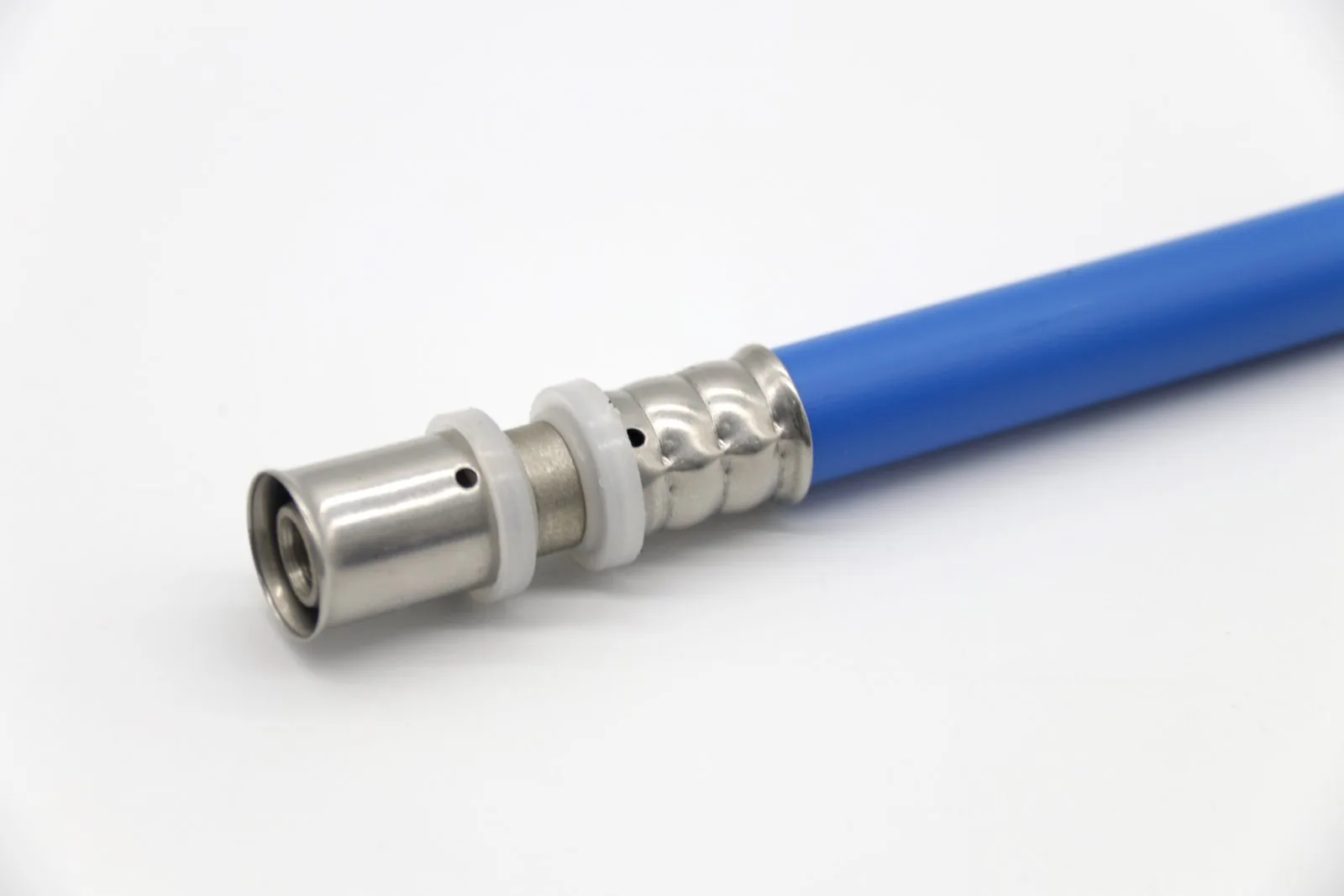
The consequence is at the fitting, not the flow chart. A press jaw, a compression olive, or a cold-expansion ring is machined for one OD system. Put a metric multilayer coil against a CTS press tool and the joint is out of tolerance — either it won’t seat or it seats without the grip the manufacturer tested. That’s why the safest sizing decision is to buy pipe and fittings as one dimensional system from one source. The size on the coil, the OD your tool expects, and the fitting bore then all agree by design, and your sizing math actually translates into a leak-free joint.
What Hitze checks so the size on the coil is the size in your tool
Sizing only works if the dimension is real and repeatable. Hitze — a German brand engineered in Germany and founded in 1974, with a 120,000 m² production base — builds the 16–32 mm range to fixed dimensional standards and verifies them before the pipe ships:
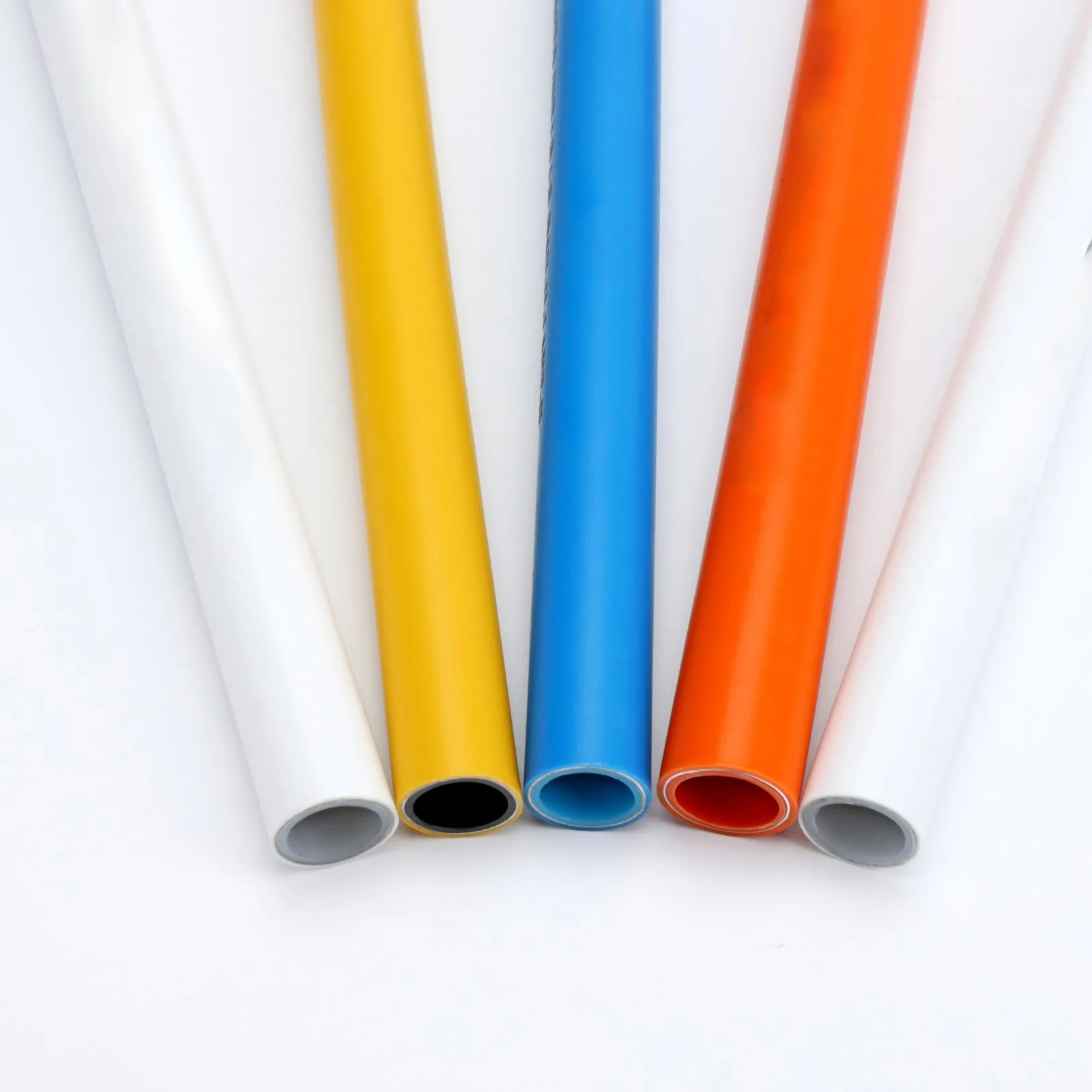
- Multilayer PEX-AL-PEX is butt-welded through a continuous aluminium core and laser-checked for wall build, so the OD holds across the coil — the reason a press fitting seats the same on the first metre and the last.
- PEX and PE-RT heating grades carry a DIN 4726 oxygen barrier so the water you sized for doesn’t corrode the steel components downstream of it.
- Dimensional and pressure conformance is built to EN ISO 15875, ASTM F876/F877 and, for multilayer water and heating pipe, ASTM F1281 / EN ISO 21003 — the same standards your calculator assumes.
- Matching press, compression and lead-free brass fittings are sized to the same OD range, so the pipe/fitting system is dimensionally one family, not a cross-brand gamble.
A Worked Example: Sizing a Three-Bathroom House End to End
Put it together on a realistic layout: a two-storey home with three bathrooms, a kitchen, a laundry, and a boiler room feeding radiant floors on the ground floor. Here’s how the four sizes fall out when you size by job, then check flow, velocity and length.
Main feed from the meter to the manifold: this carries the whole house’s peak simultaneous demand — realistically 6–8 GPM when a shower, a toilet and a tap coincide. A 25 mm line would run near its velocity ceiling; 32 mm keeps velocity comfortable and leaves headroom, so the main feed is 32 mm. Hot and cold trunks to each floor: each serves one floor’s fixtures, a peak of roughly 4–5 GPM, so 25 mm trunks are correct — and being one size above the branches, they don’t choke. Branches to fixtures: a tub or shower gets a 20 mm branch; a lavatory or toilet gets 16 mm. Radiant floor loops: 16 mm PE-RT or PEX-AL-PEX, loop lengths kept within the manifold’s design so each loop’s flow stays inside its meter’s range.
The one place to double-check is the longest branch. If the far bathroom’s 20 mm run stretches past ~30 m, step that single branch to 25 mm rather than accepting the pressure drop — a few extra metres of larger pipe is cheaper than a starved shower and a callback. Notice that the whole house needs exactly four sizes, all available as one coordinated range, which is what makes ordering and stocking clean.
Best For / Not For: Matching Size to the Job
A fast segmentation you can apply on site, before you open a calculator:
| Size | Best for | Not for |
|---|---|---|
| 16 mm | Radiant floor loops; single low-demand fixture branch; tight manifold connections | Any trunk; multi-fixture run; long high-demand run |
| 20 mm | Tub/shower branch; washing-machine line; short two-fixture run; home-run manifold drops | Whole-floor trunk; main feed; runs past ~30 m at demand |
| 25 mm | Hot/cold trunk in a normal home; manifold header; medium main feeds | Single fixtures (wasteful, dead-leg volume); tightest radiant bends |
| 32 mm | Main feed; 3+ bathroom trunk; long runs; high simultaneous demand | Branches and loops (oversized, slow hot-water arrival, more standing water) |
The two failure modes are symmetric. Undersize and you get velocity noise, pressure starvation and erosion; oversize and you get slow hot-water delivery, wasted material and a bigger dead-leg holding cooling water. Both are avoidable by sizing to job and flow rather than habit. When you’re genuinely on the fence between two sizes, let run length break the tie — longer run, size up.
Sourcing the Full 16–32 mm Range as One System
Once the sizing logic is clear, the supply decision follows from it: you don’t want four sizes from four sources with four slightly different OD tolerances and four fitting families to reconcile. You want the range as one coordinated system so the dimension you sized is the dimension you receive. This section is for contractors, radiant-heating installers and trade buyers stocking or specifying a residential water and heating range — not for one-off homeowner purchases, since Hitze supplies trade and wholesale only.
Hitze — a German brand engineered to German DIN and EN ISO standards, exporting to 118+ countries — supplies the whole sizing range in one place: multilayer PEX-AL-PEX pipe in 16–32 mm with the aluminium core that holds shape and OD, plus PEX pipe in potable and oxygen-barrier heating grades, PE-RT underfloor-heating pipe, and the manifolds and press, compression and brass fittings sized to the same OD family. Certificate scope and documentation are available on request, and the exact range, coil lengths and packaging vary by market and order. If you’d rather talk it through against a specific project, the contractor and radiant-heating supply route is the fastest way to get sized samples and a submittal pack.
Frequently Asked Questions
What size PEX should I use for a main water line?
For most homes the main feed is 3/4″ (≈25 mm) if the house is modest, or 1″ (≈32 mm) for three-plus bathrooms, high simultaneous demand, or a long run from the source. At the 8 ft/s cold-water velocity limit the code allows, a 3/4″ line tops out around 8–9 GPM while a 1″/32 mm main carries roughly 10–12 GPM — so once your peak pushes past what 3/4″ can hold, or the run runs past about 30 m (100 ft), size up to 1″/32 mm.
Is 16 mm multilayer pipe the same as 1/2 inch PEX?
They are close in size but not identical, and they’re built to different standards. Metric multilayer runs to a true outside diameter (16×2.0 mm per ASTM F1281 / EN ISO 21003); US “1/2 inch” PEX is copper-tube-size with a 0.625″ OD per ASTM F876. Because fittings are machined for one OD system, don’t mix them — match pipe and fittings by dimensional standard, ideally from one source.
What size pipe is best for underfloor heating loops?
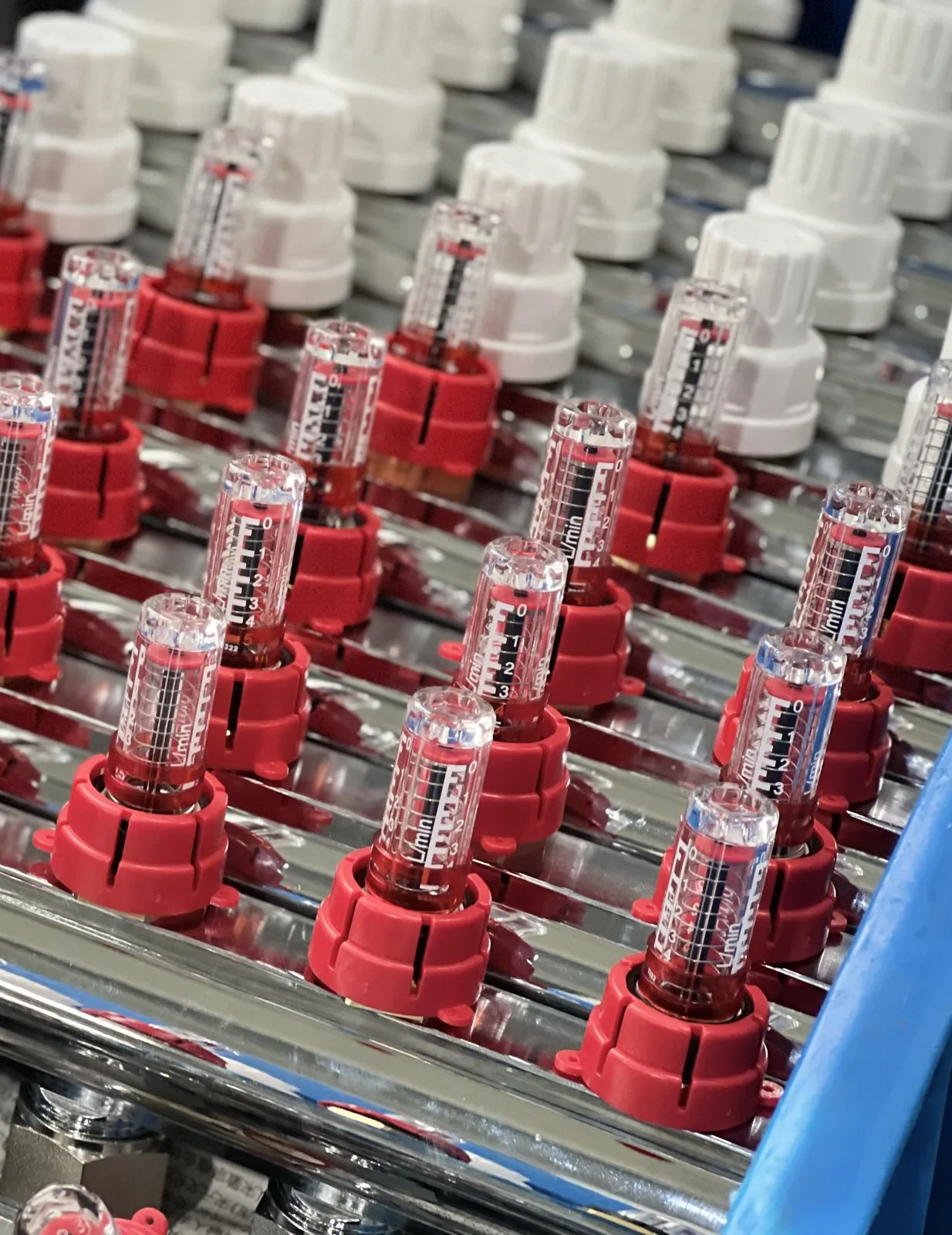
16 mm is the standard radiant-loop size for residential floors: it bends tightly into normal pipe spacing without kinking and moves enough water to hit a loop’s design heat output over a couple hundred square feet. Keep loop lengths within the manifold’s design range so each loop’s flow stays inside its flow-meter scale. Use PE-RT or PEX-AL-PEX with a DIN 4726 oxygen barrier to protect steel components in the system.
Why does my shower lose pressure when another tap or toilet runs?
That symptom is almost always an undersized trunk hitting its velocity and pressure ceiling under simultaneous demand — not a weak heater or a bad valve. The trunk feeding those fixtures can’t carry the combined peak flow. The fix is a larger trunk (often 20 mm → 25 mm, or 25 → 32), sized so the branches never share more flow than the trunk can deliver inside the 8 ft/s cold / 4–5 ft/s hot velocity limits.
How does run length change the size I need?
Friction loss grows with distance, so a size that’s adequate at 8 m can be undersized at 25 m even with the same flow demand. The practical rule is to step up one size once a run passes roughly 30 m (100 ft), or sooner if the run also serves high or simultaneous demand. Sizing up on a long run costs a little pipe and prevents a starved fixture at the far end.
Can I buy all four sizes and the matching fittings from one manufacturer?
Yes — and it’s the safest way to keep ODs and fittings consistent. Hitze, a German brand built to German DIN and EN ISO standards, supplies PEX, PE-RT and PEX-AL-PEX in 16, 20, 25 and 32 mm plus press, compression and lead-free brass fittings sized to the same OD family. Ordering the range as one system means the dimension you sized is the dimension in the coil. Trade and wholesale only; range, certification scope and packaging are provided on request and vary by market and order.


